
The most successful Web3 founders don't view the IRS as a defensive barrier; they treat tax architecture as a strategic competitive advantage. Effective tax planning for crypto startups requires shifting from a reactive posture to a proactive framework that transforms volatile on-chain data into disciplined, defensible records under IRS rules.
You likely recognize the friction of managing token distribution timing or the anxiety of holding highly appreciated treasury assets. It's natural to fear an audit when your financial history lives across fragmented smart contracts and decentralized protocols.
You can master these complexities to protect your capital and optimize your token distributions. This guide provides the roadmap you need to move from uncertainty to total command over your startup's financial future.
We'll detail the nuances of tax-efficient entity selection and strategies for compliant crypto payroll. You'll also learn how to build audit-ready records that satisfy the rigorous 2026 reporting standards.
Key Takeaways
- Understand how the IRS classifies digital assets as property and how the 2026 implementation of Form 1099-DA changes your reporting obligations.
- Evaluate the structural advantages of C-Corporations versus LLCs to ensure your tax planning for crypto startups supports a compliant token distribution.
- Learn how a Section 83(b) election—reporting token value at grant rather than vesting—can significantly reduce tax liabilities as your startup grows.
- Protect your runway using tax-loss harvesting to offset capital gains and discover deductible business expenses unique to the blockchain industry.
- Build a defensible financial foundation by shifting from manual tracking to professional accounting frameworks that are ready for federal scrutiny.
Navigating the 2026 IRS Landscape for Crypto Startups
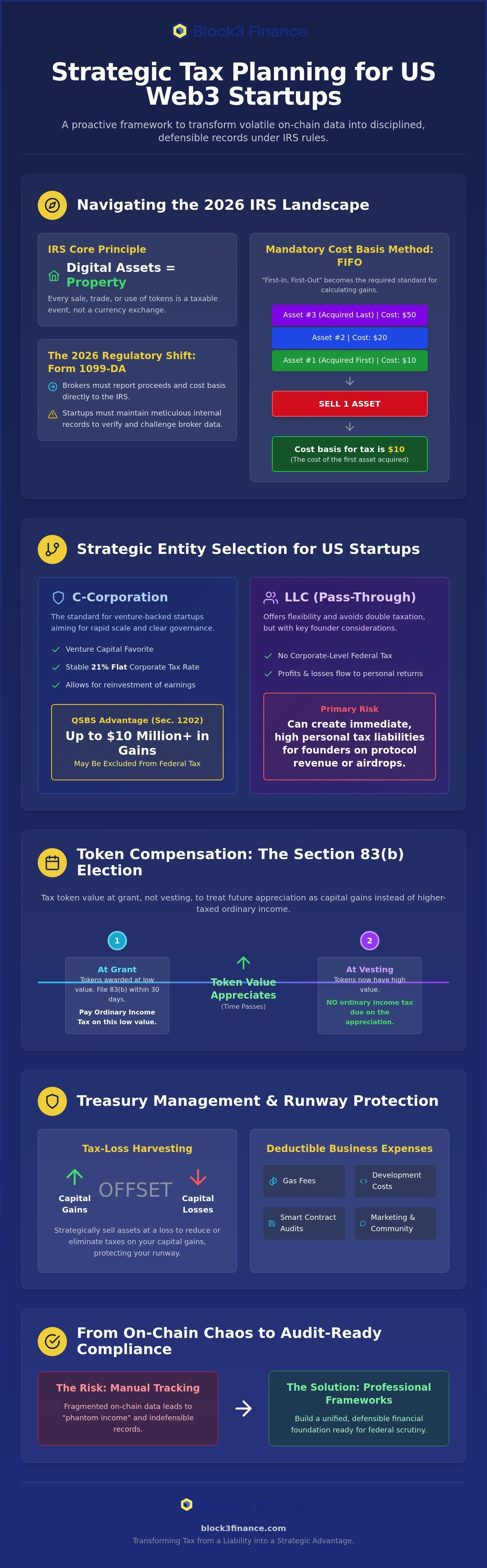
The IRS classifies digital assets as property rather than currency. This distinction is the bedrock of tax planning for crypto startups operating under U.S. law. Every sale, trade, or use of tokens to pay for services triggers a taxable event that requires precise documentation.
Startups must distinguish between ordinary income and capital gains. Tokens received as payment for services are taxed as ordinary income at their fair market value at the time of receipt. The subsequent appreciation of those tokens is treated as a capital gain or loss when they are sold or traded.
Foundational strategy begins before you mint a single token. Understanding U.S. virtual currency law ensures your initial architecture doesn't create accidental tax liabilities during the first distribution phase. Proactive planning transforms a potential regulatory burden into a manageable business process.
The 2026 Regulatory Shift: Form 1099-DA
The introduction of Form 1099-DA in 2026 marks a new era of transparency. Centralized brokers must now report gross proceeds and cost basis for transactions directly to the IRS. Cost basis is the original purchase price of an asset plus any associated fees; it is the starting point for calculating your tax liability.
Startups must maintain meticulous internal records for all assets acquired after January 1, 2026. You can't afford to rely solely on broker-reported data. Discrepancies between your verified on-chain records and 1099-DA filings can trigger immediate IRS inquiries and audits.
Under the new 2026 rules, the First-In, First-Out (FIFO) method becomes the mandatory standard for identifying cost basis. This removes the previous flexibility of specific identification. It forces a more rigid approach to managing treasury liquidations and impacts how you realize gains or losses.
Why Startups Face Unique Tax Risks
High-frequency on-chain movements create a dense web of taxable events. Every treasury rebalance or liquidity provision move must be tracked with precision. Failure to do so leads to "phantom income," where you owe taxes on peak values even if the market crashes before you pay.
Modern accounting standards like ASU 2023-08 now require "fair value measurement" for certain digital assets. This involves reporting assets at their current market price on your balance sheet rather than their historical cost. While this shift provides more transparency, it demands sophisticated monthly accounting to capture volatility accurately.
Strategic Entity Selection for US Crypto Startups
Choosing the right legal structure is a foundational pillar of tax planning for crypto startups. It determines how you interface with the IRS and how you attract capital from global venture firms. Your entity choice dictates whether your tax obligations are managed at the company level or passed through to your personal return.
Venture capitalists typically mandate a Delaware C-Corp structure to simplify their own tax reporting and ensure clear governance rules. This standardization is critical for startups aiming for rapid scale and institutional investment. While the administrative burden is higher, the strategic benefits often outweigh the complexity.
C-Corporations vs. LLCs: A Tax Perspective
Limited Liability Companies (LLCs) operate as pass-through entities. This means the business itself doesn't pay federal income tax; instead, profits and losses flow directly to the owners' personal tax returns. While this avoids double taxation, it can create immediate tax liabilities for founders when the startup receives significant on-chain revenue or airdrops.
C-Corporations face taxation at the corporate level and again when dividends are distributed to shareholders. Despite this, the 21% flat corporate tax rate provides a stable environment for treasury management. It allows you to retain earnings within the company for reinvestment without triggering high individual tax brackets for the founders.
Founders can also leverage Qualified Small Business Stock (QSBS) benefits under Section 1202 of the Internal Revenue Code. If you hold this stock for at least five years, you may exclude up to $10 million of gains from federal tax when you sell. This incentive makes the C-Corp structure exceptionally powerful for long-term Web3 builders.
Corporate Structuring for Token Launches
Launching a token requires a dual-entity approach to manage risk and tax exposure effectively. Many startups utilize a domestic software development company for operations and a separate entity for token issuance. This separation helps isolate the volatile tax events associated with token generation from the core business operations. You can find detailed frameworks for these setups on our corporate structuring page.
The IRS guidance on digital assets makes it clear that receiving tokens in exchange for services is a taxable event. Early investors often receive "token warrants," which are rights to acquire tokens at a future date. The tax treatment of these warrants depends on whether they are structured as property or options, impacting when the tax clock starts ticking.
Global Web3 strategies often involve offshore subsidiaries to serve non-U.S. users. However, U.S. founders must carefully navigate Controlled Foreign Corporation (CFC) rules to avoid accidental tax acceleration. If you're unsure how your current structure aligns with 2026 regulations, you can reach out to our strategists for a comprehensive review.
Token Compensation and Section 83(b) Strategies
Attracting top tier talent in the Web3 space often requires sophisticated token based incentive programs. These arrangements are a core component of tax planning for crypto startups. Without a compliant framework, both the company and its team face significant exposure to IRS penalties and unexpected tax liabilities.
The IRS treats tokens granted to employees or contractors as compensation. This means the value of the tokens is taxed as ordinary income at the time they are received. For founders and early employees, the timing of this tax event can determine the long term viability of their personal holdings.
Mastering the Section 83(b) Election
A Section 83(b) election is a powerful tool that allows you to report the fair market value of your tokens to the IRS at the time of the grant rather than waiting for them to vest. By paying tax on a low initial valuation, you protect yourself from high ordinary income taxes on future appreciation. This proactive strategy shifts the tax burden from the vesting date to the grant date.
You must file this election with the IRS within exactly 30 days of the grant date. There are no extensions for this deadline. If you miss this window, you lose the ability to lock in the lower valuation, which can lead to a massive tax bill if the token price surges before your vesting period ends.
A successful 83(b) filing also starts your holding period on the grant date. This allows you to qualify for long term capital gains rates much earlier. You can find more details on these specific thresholds in Fidelity's Guide to Crypto Taxes.
Crypto Payroll Compliance
Paying a global workforce in digital assets requires meticulous tracking of Fair Market Value (FMV). The IRS mandates that you record the USD value of every token at the exact moment of transfer. This value serves as the basis for all payroll tax withholding and reporting requirements.
Startups must distinguish between employees and contractors for reporting purposes. You must issue Form W-2 for employees and Form 1099-NEC for independent contractors. For employees, you are responsible for withholding federal income tax and FICA taxes, which include Social Security and Medicare, in USD.
Managing these cash obligations often requires liquidated treasury assets to cover the USD tax payments. Utilizing professional crypto accounting services ensures your payroll reconciliations are accurate and defensible. Proper documentation prevents the friction of IRS audits and ensures your team remains focused on building rather than tax disputes.
Treasury Management and Advanced Tax Deductions
Strategic treasury oversight is a vital component of tax planning for crypto startups. It allows you to protect your runway by minimizing the tax drag on your digital asset holdings. By treating your treasury as a dynamic financial engine, you can turn market volatility into a structural advantage.
The IRS treats every movement within your treasury as a potential taxable event. This requires a shift from simple holding to active management of your cost basis. Understanding how to leverage losses and identify unique deductions is essential for maintaining a healthy balance sheet.
Strategic Tax-Loss Harvesting for Startups
You can use realized losses on crypto assets to offset capital gains dollar for dollar. If your startup's treasury sells an asset for less than its cost basis, that loss can neutralize the tax impact of other profitable trades. This strategy is particularly effective for rebalancing a portfolio without triggering a massive tax bill.
As of 2026, the wash sale rule does not apply to cryptocurrency under IRS regulations. This allows you to sell a depreciated asset to lock in a tax loss and immediately repurchase it to maintain your market position. However, you must ensure these transactions have a clear economic substance to withstand federal scrutiny.
Precise tracking requires Specific Identification (SpecID). This method allows you to select which specific "lot" of tokens you are selling, which helps you maximize losses or minimize gains based on your current tax needs. This level of granularity is only possible with robust, audit ready financial records.
Managing Staking and DeFi Income
The IRS requires you to recognize staking rewards as gross income in the tax year you gain dominion and control over them. Dominion and control refers to the moment you have the legal ability to sell or transfer the assets. You owe tax on the fair market value of the tokens at the exact moment they become accessible.
Liquidity pool (LP) positions add another layer of complexity to corporate treasuries. Entering or exiting a pool is often viewed as a taxable exchange of assets, requiring careful valuation of both the tokens deposited and the LP tokens received. These movements must be reconciled monthly to avoid significant reporting errors.
Managing these decentralized flows requires a specialized approach to financial oversight. You can explore our DAO Accounting guide for deeper insights into decentralized treasury management. If your treasury data is currently unorganized, contact our CFO team to build a defensible tax strategy.
Gas fees are generally not separate deductions for the business. Instead, the IRS considers them transaction costs that either increase your cost basis when buying or decrease your proceeds when selling. Unique Web3 expenses like smart contract audits and protocol security fees are typically fully deductible as ordinary business expenses.
Implementing an Audit-Ready Strategy with Block3 Finance
Manual spreadsheets are a significant liability for a scaling Web3 firm. They fail to capture the complexity of high-frequency on-chain movements and create friction during federal inquiries. Transitioning to enterprise-grade crypto accounting replaces guesswork with the precision required for long-term growth.
This transition is a core requirement for effective tax planning for crypto startups. You need a system that automatically reconciles transactions across multiple protocols and chains. Professional oversight ensures your financial history is transparent and defensible under IRS rules.
The Value of Fractional Crypto CFO Services
A Crypto CFO acts as your visionary navigator in a volatile landscape. They bridge the gap between cutting-edge blockchain innovation and the disciplined rigor of legacy finance. This role is essential for managing your startup's runway, which is the amount of time your company can operate before needing more capital.
Your CFO implements robust internal controls to protect your treasury. Internal controls are the specific processes and records designed to ensure the integrity of your financial data. These guardrails prevent unauthorized transactions and ensure every movement of capital is documented for potential audits.
Navigating cross-border tax issues requires a deep understanding of Controlled Foreign Corporation (CFC) rules. A specialized strategist ensures your international operations don't trigger accidental tax acceleration in the US. This proactive stance turns regulatory compliance into a strategic advantage for your investors.
Building Defensible Financial Records
Defensible records require a total reconciliation of on-chain data with your fiat bank statements. This process eliminates the data silos that often lead to reporting errors or IRS flags. Every gas fee, swap, and airdrop must be linked to a verifiable business purpose to withstand federal scrutiny.
Block3 Finance utilizes 13 years of blockchain financial expertise to manage complex audit environments. We have helped over 980 clients globally turn fragmented on-chain data into clean, professional books. Our methodology ensures that your year-end filing is a routine check rather than a high-stakes crisis.
Founders who prioritize financial discipline today protect their ability to scale and exit tomorrow. Don't let messy records jeopardize your next funding round or trigger a costly federal investigation. You can contact Block3 Finance for a strategy session to secure your startup's financial future.
Mastering the New Era of Web3 Compliance
The 2026 IRS landscape demands a shift from reactive reporting to proactive financial architecture. By selecting the right corporate structure and filing timely Section 83(b) elections, you protect your treasury from unnecessary tax drag. Comprehensive tax planning for crypto startups ensures your on-chain data remains defensible against the new Form 1099-DA reporting requirements.
Block3 Finance is a top-ranked crypto accounting firm by Bitcoin.com with over 13 years of blockchain expertise. We have built clean, defensible audit trails for over 980 clients globally, navigating both IRS and international regulations. Our team bridges the gap between decentralized innovation and professional financial oversight.
Schedule a consultation with our US crypto tax specialists today.
You have the vision to build the future of finance. You don't have to face these complexities alone; let us provide the roadmap to ensure your startup remains compliant, resilient, and ready for institutional scale.
Frequently Asked Questions
Is crypto tax planning different for US startups compared to individuals?
Startups face significantly more complexity because they must manage corporate tax structures and payroll withholding under IRS rules. While individuals focus on personal capital gains, businesses must account for tokens as revenue, deductible expenses, and treasury assets. Effective tax planning for crypto startups requires a specialized approach to corporate governance that individual traders simply don't need to consider.
What is a Section 83(b) election and why is it vital for crypto founders?
A Section 83(b) election is a specific IRS filing that allows you to report the value of tokens on the day they are granted. This is vital because it locks in a lower tax liability if the token price increases before they vest. It also starts the holding period for long term capital gains immediately, which can significantly reduce your future tax burden.
How does the IRS view tokens held in a startup's treasury?
The IRS treats tokens in a corporate treasury as property rather than currency for federal tax purposes. Any appreciation in value is taxed as a capital gain only when the asset is sold or traded. However, tokens received through staking or airdrops must be recognized as gross income at their fair market value at the time the startup gains control over them.
Can a crypto startup deduct gas fees as a business expense?
Gas fees, which are the costs paid to process transactions on a blockchain, are typically not deductible as a separate business expense. Instead, the IRS requires you to add these costs to the cost basis of the asset you are purchasing. If you are selling an asset, the gas fees are subtracted from the total proceeds to determine your final capital gain or loss.
Do I need to pay taxes on tokens that haven't vested yet?
You generally don't owe taxes on unvested tokens unless you have filed a Section 83(b) election with the IRS. Without this election, the tax event occurs only when the tokens vest, based on their value at that time. If the token value has surged since the grant date, this can result in a much higher tax bill than if you had reported the value earlier.
What are the risks of paying international contractors in stablecoins?
Paying international contractors in stablecoins triggers a requirement to issue Form 1099-NEC if the contractor is a U.S. person. You must also track the fair market value of the stablecoin at the moment of transfer to ensure accurate reporting. Failure to comply can lead to significant IRS penalties and complications during a federal audit of your payroll records.
How will the 2026 1099-DA form affect my startup's tax filing?
The 2026 Form 1099-DA increases the transparency of your on-chain activities by requiring brokers to report transaction data directly to the IRS. Your startup must now perform rigorous monthly reconciliations to ensure internal records match what the brokers report. Any discrepancies between your filings and the broker data can lead to immediate inquiries or a more comprehensive federal tax audit.
When should a crypto startup hire a specialized tax accountant?
You should hire a specialized tax accountant before your first token mint, which is the initial creation of your digital assets. Early tax planning for crypto startups prevents the creation of expensive, unfixable structural errors in your legal entity setup. Professional guidance ensures your treasury management and payroll systems are compliant from day one, allowing you to focus on building your protocol.

Article by
Mahad Mohamed
Mahad Mohamed is an accountant and the CEO of Block3 Finance, with over 26+ years of Canadian and international tax and accounting experience. A crypto accounting specialist since the early days of Bitcoin, he has consulted for over 38 crypto companies and collaborated with legal professionals on regulatory matters. His expertise spans corporate reorganization, cross-border tax structuring (Canada & US), tax disputes, and CRA audits.
Previously, Mahad worked for the Canada Revenue Agency (CRA), Big4 accounting firms, and served as a Rulings Officer for the Federal Tax Authority of the UAE before acquiring Tax Partners in 2014.
Block3 Finance and Tax Partners has 44 full-time accountants and over 9,800+ clients.
Disclaimer
This article provides general information only and is current as of its publication date. It has not been updated and may be out of date. It does not constitute legal advice and should not be relied upon as such. Every tax situation is unique and may differ from the examples discussed in this article. If you have specific questions, you should seek the advice of our accountants for your unique circumstances.
Frequently Asked Questions
Is crypto tax planning different for US startups compared to individuals?
Startups face significantly more complexity because they must manage corporate tax structures and payroll withholding under IRS rules. While individuals focus on personal capital gains, businesses must account for tokens as revenue, deductible expenses, and treasury assets. Effective tax planning for crypto startups requires a specialized approach to corporate governance that individual traders simply don't need to consider.
What is a Section 83(b) election and why is it vital for crypto founders?
A Section 83(b) election is a specific IRS filing that allows you to report the value of tokens on the day they are granted. This is vital because it locks in a lower tax liability if the token price increases before they vest. It also starts the holding period for long term capital gains immediately, which can significantly reduce your future tax burden.
How does the IRS view tokens held in a startup's treasury?
The IRS treats tokens in a corporate treasury as property rather than currency for federal tax purposes. Any appreciation in value is taxed as a capital gain only when the asset is sold or traded. However, tokens received through staking or airdrops must be recognized as gross income at their fair market value at the time the startup gains control over them.
Can a crypto startup deduct gas fees as a business expense?
Gas fees, which are the costs paid to process transactions on a blockchain, are typically not deductible as a separate business expense. Instead, the IRS requires you to add these costs to the cost basis of the asset you are purchasing. If you are selling an asset, the gas fees are subtracted from the total proceeds to determine your final capital gain or loss.
Do I need to pay taxes on tokens that haven't vested yet?
You generally don't owe taxes on unvested tokens unless you have filed a Section 83(b) election with the IRS. Without this election, the tax event occurs only when the tokens vest, based on their value at that time. If the token value has surged since the grant date, this can result in a much higher tax bill than if you had reported the value earlier.
What are the risks of paying international contractors in stablecoins?
Paying international contractors in stablecoins triggers a requirement to issue Form 1099-NEC if the contractor is a U.S. person. You must also track the fair market value of the stablecoin at the moment of transfer to ensure accurate reporting. Failure to comply can lead to significant IRS penalties and complications during a federal audit of your payroll records.
How will the 2026 1099-DA form affect my startup's tax filing?
The 2026 Form 1099-DA increases the transparency of your on-chain activities by requiring brokers to report transaction data directly to the IRS. Your startup must now perform rigorous monthly reconciliations to ensure internal records match what the brokers report. Any discrepancies between your filings and the broker data can lead to immediate inquiries or a more comprehensive federal tax audit.
When should a crypto startup hire a specialized tax accountant?
You should hire a specialized tax accountant before your first token mint, which is the initial creation of your digital assets. Early tax planning for crypto startups prevents the creation of expensive, unfixable structural errors in your legal entity setup. Professional guidance ensures your treasury management and payroll systems are compliant from day one, allowing you to focus on building your protocol.