
ASU 2023-08 changes crypto accounting, but it doesn’t bring every digital asset into the new measurement model. For U.S. GAAP reporters, the asu 2023-08 crypto assets fair value measurement requirements apply only to holdings that meet specific scope criteria, so start by assessing each asset.
If you’re unsure which tokens qualify, how fair value changes could affect earnings, or how to turn on-chain activity into reliable financial records, those are important questions to resolve. The standard requires qualifying assets to be measured at fair value each reporting period, with changes recognized in net income. This makes reported results more responsive to market movements and increases the need for clear documentation of balances and valuations.
This guide explains the scope criteria, measurement and financial-statement presentation requirements, and records that can support implementation. It also explains why NFTs and certain pegged or wrapped assets may fall outside the scope, and how a repeatable close process connects wallet and transaction data to supportable U.S. GAAP reporting.
Key Takeaways
- Assess each holding against ASU 2023-08’s scope criteria. A crypto label alone doesn’t determine whether the standard applies.
- Understand how asu 2023-08 crypto assets fair value measurement changes recurring valuation and reported earnings.
- Connect asset inventories, scope decisions, valuation evidence, and financial statement disclosures in your reporting workflow.
- Assign clear responsibilities across treasury, accounting, and finance to support a consistent close.
- Use reconciliations and organized on-chain records to support U.S. GAAP reporting.
What ASU 2023-08 changes for U.S. crypto asset reporting
ASU 2023-08 amends U.S. GAAP accounting for qualifying crypto assets. Issued by the Financial Accounting Standards Board (FASB), it moves those assets from the previous cost-less-impairment model to recurring fair value measurement, with changes in value recognized in net income.
The update addresses an information gap in the former model. A decline in value could trigger an impairment loss, while a later recovery generally wasn’t reflected until the asset was sold. FASB’s new approach recognizes both increases and decreases in value for assets within the standard’s scope. This gives financial statement readers a more current view of reported holdings, while making earnings more responsive to market movements.
This is a financial-reporting rule, not a tax rule. U.S. GAAP determines how an entity presents assets and results in its financial statements; federal tax reporting follows separate requirements. A book value change under ASU 2023-08 doesn’t, by itself, establish the asset’s tax treatment.
In brief: ASU 2023-08 changes how qualifying crypto assets are measured and reported under U.S. GAAP. Entities holding digital assets should assess whether each asset falls within its scope.
What fair value means in this accounting context
Fair value is the amount an entity would receive to sell an asset in an orderly market transaction at the measurement date. It differs from original purchase cost, which records what the entity paid, and from a forced-sale price. For foundational context, see Fair Value Measurement.
Under the amended guidance, an entity remeasures each in-scope holding at fair value on applicable reporting dates, such as quarter-end or year-end. The change is recognized in net income for the period, rather than waiting for a sale to reflect a gain or recording only declines through impairment.
The treatment doesn’t automatically apply to every token or digital asset. Before applying fair value accounting, assess the asset’s features and the rights it gives the holder against the standard’s scope criteria.
When the new guidance applies
For U.S. GAAP reporters, ASU 2023-08 is effective for fiscal years beginning after December 15, 2024, including interim periods within those fiscal years. A calendar-year entity therefore applies the standard starting January 1, 2025, including its interim reporting periods during that year.
Early adoption is permitted for interim and annual financial statements that haven’t yet been issued or made available for issuance. If an entity adopts during an interim period, it applies the guidance from the beginning of the fiscal year that includes that interim period. Adoption uses a modified retrospective approach, meaning the entity records a cumulative adjustment to opening retained earnings at the start of its adoption year.
Which crypto assets qualify under ASU 2023-08?
ASU 2023-08 applies only to crypto assets that meet the scope criteria in U.S. GAAP’s ASC 350-60. Whether a holding qualifies depends on its characteristics and the rights it gives the holder, not simply on its blockchain technology or token label.
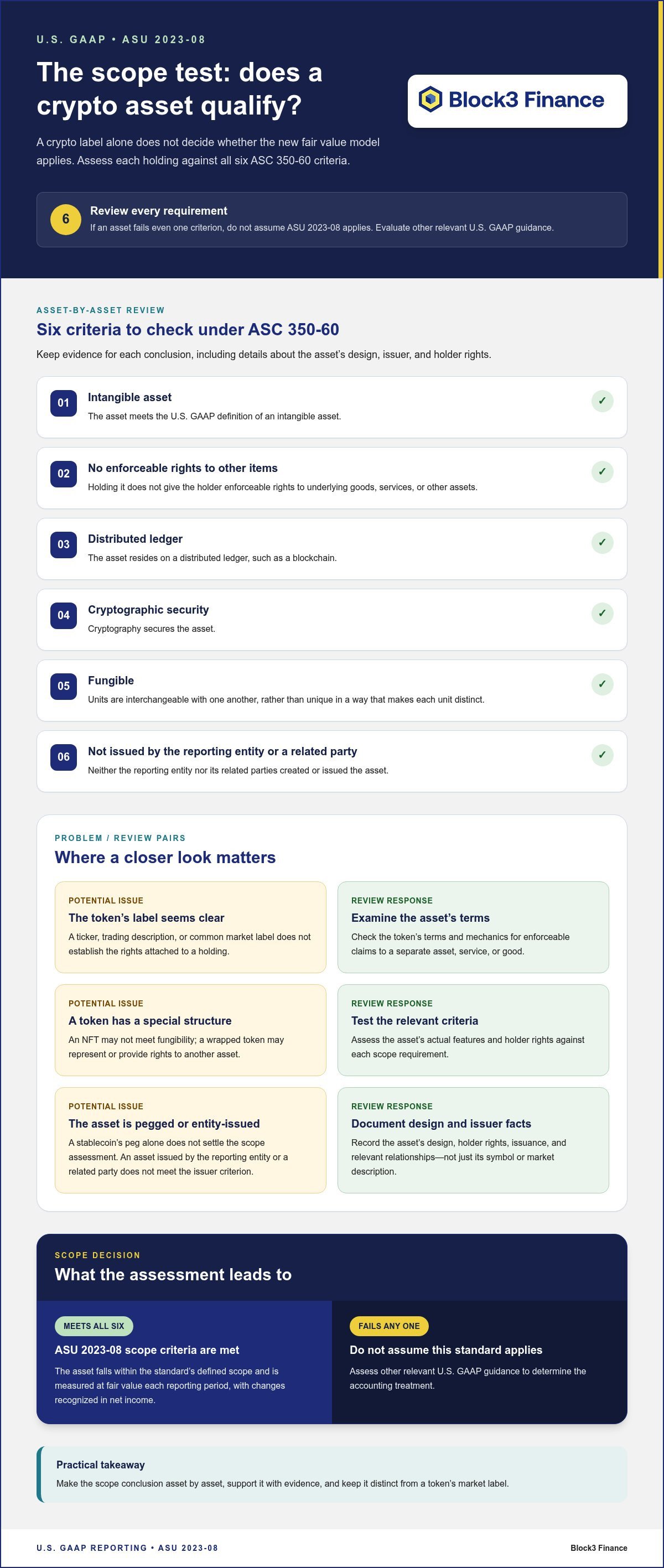
In-scope crypto assets are a defined subset of digital assets, not a synonym for digital assets generally. To determine whether the asu 2023-08 crypto assets fair value measurement requirements apply, assess each asset against every criterion below. If it fails even one, don’t assume this standard applies; evaluate other relevant U.S. GAAP guidance to determine the accounting treatment.
Apply the scope criteria asset by asset
Review each holding individually against the six ASC 350-60 requirements. Keep evidence for each conclusion, including information about the asset’s design, issuer, and holder rights.
- Intangible asset: The asset meets the U.S. GAAP definition of an intangible asset.
- No enforceable rights to other items: Holding the asset doesn’t give the holder enforceable rights to underlying goods, services, or other assets.
- Distributed ledger: The asset resides on a distributed ledger, such as a blockchain.
- Cryptographic security: Cryptography secures the asset.
- Fungible: Units are interchangeable with one another, rather than unique in a way that makes each unit distinct.
- Not issued by the reporting entity or a related party: The reporting entity and its related parties didn’t create or issue the asset.
Holder rights often require close examination. Review the token’s terms and mechanics to determine whether its holder can enforce a claim to a separate asset, service, or good. A ticker, trading description, or common market label doesn’t establish the rights attached to a holding.
Why some tokens may need separate analysis
Some token structures raise questions under individual scope criteria. An NFT may not meet the fungibility requirement, while a wrapped token may represent or provide rights to another asset. A stablecoin’s design and holder rights also matter; its peg alone doesn’t settle the ASC 350-60 assessment.
Issuer-related holdings need particular attention because an asset created or issued by the reporting entity or a related party doesn’t meet the issuer criterion. Document the relevant issuance and relationship facts instead of relying on a symbol or market description. This asset-level review determines whether the asu 2023-08 crypto assets fair value measurement model applies to a particular holding.
Keep the conclusion separate from tax classification. Whether an asset falls within this U.S. GAAP standard is a financial-reporting question; it doesn’t, by itself, determine the asset’s treatment for U.S. tax reporting.
A useful scope file records the asset, evidence reviewed, criterion-by-criterion conclusion, and reviewer approval. If token rights or on-chain records make the assessment difficult to document, Block3 Finance can support your crypto accounting process.
How fair value measurement affects financial statements
For qualifying assets, ASU 2023-08 changes both the value shown on the balance sheet and how value movements appear in earnings. The contrast with the prior model is important: fair value reflects reporting-date value, while the former impairment approach generally recorded declines without recognizing later recoveries above the asset’s carrying amount.
| Reporting area | Prior approach | ASU 2023-08 approach |
|---|---|---|
| Measurement | Cost, reduced for impairment losses | Fair value at each reporting date |
| Value increases | Generally not recognized before sale | Recognized in net income |
| Financial statement presentation | Included with other intangible assets, subject to applicable guidance | Crypto assets presented separately from other intangible assets; fair value changes shown separately from impairment and amortization of other intangible assets |
What changes at each reporting date
At each reporting date, the entity measures qualifying crypto assets it still holds at fair value and compares that amount with the previous carrying value. The difference is recognized as a gain or loss in net income for the period, in line with the standard’s requirements.
Consider an entity that holds the same number of qualifying tokens through a reporting period. If their fair value rises, the entity recognizes an increase in earnings even if it hasn’t sold any tokens or received cash. If fair value falls, the decrease affects earnings; neither movement, by itself, represents a sale or cash flow.
This distinction matters during the close. Finance teams should reconcile units held and recorded value, then explain how the period’s fair value movement flows into earnings. The asu 2023-08 crypto assets fair value measurement model captures changes in reported value, not just realized proceeds from disposals.
What investors and finance teams may see
Direct recognition of price changes can increase earnings volatility, meaning reported income may move as market values change between reporting dates. That’s a reporting effect, not a prediction of future performance, and it doesn’t mean an entity has realized cash gains or losses.
Separate presentation helps readers distinguish crypto asset balances from other intangible assets and identify related fair value changes in net income. Clear records and consistent explanations help finance teams trace those amounts through the close and support period-to-period review.
Keep asset measurement distinct from revenue recognition. ASU 2023-08 addresses how qualifying crypto assets held by an entity are measured and presented; revenue recognition addresses when revenue from a transaction is recorded. The appropriate analysis depends on the transaction and applicable U.S. GAAP guidance.
How to prepare a U.S. GAAP process for ASU 2023-08
A reliable close connects asset identification to the final financial statement entry. For entities applying asu 2023-08 crypto assets fair value measurement, assign clear responsibilities across treasury, accounting, and finance. Preserve evidence at each step so reviewers can follow how balances were established.
Use a repeatable sequence for each close:
- Inventory holdings. Gather balances across entity-controlled wallets, custodians, and exchanges.
- Assess scope. Document whether each material asset meets the ASC 350-60 criteria.
- Establish measurement. Apply the relevant fair value guidance to in-scope assets and retain supporting evidence.
- Record changes. Reconcile units and values, then record period changes in the appropriate accounts.
- Review reporting. Check financial statement presentation and required disclosures against the supporting records.
Build an asset inventory and scope record
Start with a structured inventory identifying each holding, its asset name or identifier, wallet or custodian location, and period-end units. Include records that support the entity’s ownership or control and the completeness of the inventory, such as wallet data, exchange statements, and transaction histories.
For each material asset, retain a scope assessment that addresses the relevant ASC 350-60 criteria and explains the conclusion. If rights, issuance, or token mechanics affect the analysis, preserve the documents or other evidence reviewed so the conclusion can be revisited if the facts change.
Strengthen close controls and review evidence
Reconcile activity from on-chain records, custodian or exchange statements, and the accounting ledger. Investigate differences such as transfers in transit, fees, timing mismatches, or unidentified transactions, and document how each item was resolved before closing the balance.
Keep valuation support linked to the period-end asset record. Consistently document the information source and date, preparer’s work, review responsibilities, and approval evidence. The file should show how reported amounts connect to holdings and recorded fair value changes.
Treasury may provide wallet and custody data, accounting may maintain scope files and entries, and finance may coordinate review and reporting. These are practical responsibilities, not a required organization chart. Smaller teams can assign multiple duties while documenting who prepared, reviewed, and approved key work.
A well-maintained accounting ledger and supporting records make the asu 2023-08 crypto assets fair value measurement process easier to repeat and review. Block3 Finance’s crypto accounting services support the bookkeeping discipline behind that process, particularly when transaction volume or wallet activity makes manual reconciliation difficult.
For help building or refining this workflow, Block3 Finance provides crypto accounting support for U.S. GAAP reporting processes.
Turn ASU 2023-08 reporting into a defensible close
A defensible close is more than a fair value number in the ledger. It’s a connected trail showing what the entity held, why the asset falls within or outside ASC 350-60, how the reported amount was supported, and how the information reached the financial statements.
For asu 2023-08 crypto assets fair value measurement, the trail should let a reviewer move from the reported balance back to underlying records without relying on undocumented assumptions. Each step should connect clearly to the next.
What a review-ready evidence package can contain
Organize the close file so reviewers can trace each material holding from its source records through its accounting conclusion. A practical package may include:
- Scope assessments: The asset’s relevant characteristics, holder rights, issuer information, and documented conclusion under ASC 350-60.
- Balance reconciliations: Period-end units tied to wallet, custodian, or exchange records and reconciled to the accounting ledger.
- Valuation support: The evidence and calculations supporting the recorded fair value, with the relevant reporting date identified.
- Entries and review approvals: Recorded fair value changes, supporting calculations, preparer and reviewer sign-offs, and explanations of resolved differences.
- Disclosure support: A clear connection between holdings and the information used to prepare required financial statement disclosures.
Preserve source files in a consistent location and use clear references between schedules, journal entries, and disclosures. If a reviewer asks how a balance was derived, the file should show the path from source data to reported amount and identify who reviewed the work.
When specialized accounting support can help
Complex wallet activity, multiple custody arrangements, high transaction volumes, or gaps between on-chain data and the general ledger can make recurring closes difficult to manage. Specialized accounting support can help organize transaction records, maintain reconciliations, and build a repeatable process for measurement and reporting.
Block3 Finance provides crypto audit and compliance support to help organize accounting evidence and reporting records. This supports a disciplined close without guaranteeing a particular audit outcome or establishing compliance by itself.
Keep the objective precise: support U.S. GAAP financial reporting with records that explain the entity’s accounting decisions and reported balances. This section concerns financial-statement accounting, not tax filing, investment decisions, or legal conclusions.
Block3 Finance’s crypto accounting support can help strengthen your reporting process.
Make your next reporting cycle more resilient
Make the accounting process durable, not just complete for one reporting date. As digital-asset activity evolves, clear ownership of records, decisions, and reviews can help your finance team respond consistently and connect reporting work across periods.
Applying asu 2023-08 crypto assets fair value measurement calls for accounting judgment and dependable records. Block3 Finance supports investors, businesses, DAOs, and Web3 projects with crypto accounting, bookkeeping, audits and compliance, and CFO support to strengthen the financial processes behind their reporting.
Choose a practical starting point by identifying where your current process creates the most friction, whether in organizing on-chain activity, maintaining books, or preparing support for review. Build from there with a focused process that fits your reporting needs and gives your team a clearer path forward.
Ready to strengthen your crypto accounting process? Discuss your crypto accounting needs with Block3 Finance.
Frequently Asked Questions
What is ASU 2023-08 for crypto assets?
ASU 2023-08 is a FASB update to U.S. GAAP that establishes specific accounting and disclosure requirements for crypto assets meeting defined criteria. It places those assets in ASC 350-60 and changes how entities report their value.
For example, a company holding a qualifying token must consider the standard’s measurement and presentation rules in its financial statements, rather than treating every digital asset under one blanket policy.
When does ASU 2023-08 take effect?
ASU 2023-08 applies to fiscal years beginning after December 15, 2024, including interim periods within those fiscal years. For a company using a calendar fiscal year, mandatory adoption began January 1, 2025.
Early adoption is permitted for financial statements not yet issued or available for issuance, subject to the standard’s transition conditions. Companies should align adoption planning with their fiscal year and reporting calendar.
Which crypto assets are covered by ASU 2023-08?
Only assets that meet all the scope conditions in ASC 350-60 are covered. A practical first pass is to compare each asset’s ledger, security, fungibility, issuer, and holder rights against the criteria, then record the basis for the conclusion.
For instance, a token that gives its holder an enforceable claim to a separate asset may require analysis beyond its blockchain features. An out-of-scope result does not establish the asset’s accounting treatment.
Does ASU 2023-08 require crypto assets to be measured at fair value?
Yes. For crypto assets within its scope, the standard requires fair value measurement at each reporting date. The rule doesn’t automatically extend to all digital assets, so establish scope before applying it.
A practical distinction is whether the asset is still held at the reporting date: qualifying holdings are remeasured, while tokens acquired or disposed of during the period require transaction records that accurately reflect those movements in the books.
How does ASU 2023-08 affect net income?
Fair value gains and losses on in-scope holdings are recognized in net income for the reporting period. As a result, earnings can change even when the entity hasn’t sold the asset or received cash.
Finance teams can help readers interpret those results by distinguishing valuation movements from disposal proceeds and connecting supporting calculations to the recorded entries.
Does ASU 2023-08 change U.S. crypto tax reporting?
No. ASU 2023-08 governs U.S. GAAP financial-statement accounting, not federal income tax reporting under IRS rules.
A fair value gain recorded in book income doesn’t, by itself, determine taxable income or the tax treatment of a token. Companies should maintain financial-reporting records separately from tax workpapers, then evaluate any differences under applicable tax rules rather than carrying book amounts over automatically.
How should a company prepare for ASU 2023-08 reporting?
Start by confirming the reporting period and adoption status, then identify the systems and teams that hold relevant asset data. Test whether wallet, custodian, and exchange records can be tied to the ledger, and decide how scope conclusions and valuation support will be retained for review.
Before the close, run a sample reconciliation to expose missing transaction details or inconsistent asset identifiers. This gives the team time to resolve record gaps before preparing final statements.

Article by
Mahad Mohamed
Mahad Mohamed is an accountant and the CEO of Block3 Finance, with over 26+ years of Canadian and international tax and accounting experience. A crypto accounting specialist since the early days of Bitcoin, he has consulted for over 38 crypto companies and collaborated with legal professionals on regulatory matters. His expertise spans corporate reorganization, cross-border tax structuring (Canada & US), tax disputes, and CRA audits.
Previously, Mahad worked for the Canada Revenue Agency (CRA), Big4 accounting firms, and served as a Rulings Officer for the Federal Tax Authority of the UAE before acquiring Tax Partners in 2014.
Block3 Finance and Tax Partners has 44 full-time accountants and over 9,800+ clients.
Disclaimer
This article provides general information only and is current as of its publication date. It has not been updated and may be out of date. It does not constitute legal advice and should not be relied upon as such. Every tax situation is unique and may differ from the examples discussed in this article. If you have specific questions, you should seek the advice of our accountants for your unique circumstances.
Frequently Asked Questions
What is ASU 2023-08 for crypto assets?
ASU 2023-08 is a FASB update to U.S. GAAP that establishes specific accounting and disclosure requirements for crypto assets meeting defined criteria. It places those assets in ASC 350-60 and changes how entities report their value. For example, a company holding a qualifying token must consider the standard’s measurement and presentation rules in its financial statements, rather than treating every digital asset under one blanket policy.
When does ASU 2023-08 take effect?
ASU 2023-08 applies to fiscal years beginning after December 15, 2024, including interim periods within those fiscal years. For a company using a calendar fiscal year, mandatory adoption began January 1, 2025. Early adoption is permitted for financial statements not yet issued or available for issuance, subject to the standard’s transition conditions. Companies should align adoption planning with their fiscal year and reporting calendar.
Which crypto assets are covered by ASU 2023-08?
Only assets that meet all the scope conditions in ASC 350-60 are covered. A practical first pass is to compare each asset’s ledger, security, fungibility, issuer, and holder rights against the criteria, then record the basis for the conclusion. For instance, a token that gives its holder an enforceable claim to a separate asset may require analysis beyond its blockchain features. An out-of-scope result does not establish the asset’s accounting treatment.
Does ASU 2023-08 require crypto assets to be measured at fair value?
Yes. For crypto assets within its scope, the standard requires fair value measurement at each reporting date. The rule doesn’t automatically extend to all digital assets, so establish scope before applying it. A practical distinction is whether the asset is still held at the reporting date: qualifying holdings are remeasured, while tokens acquired or disposed of during the period require transaction records that accurately reflect those movements in the books.
How does ASU 2023-08 affect net income?
Fair value gains and losses on in-scope holdings are recognized in net income for the reporting period. As a result, earnings can change even when the entity hasn’t sold the asset or received cash. Finance teams can help readers interpret those results by distinguishing valuation movements from disposal proceeds and connecting supporting calculations to the recorded entries.
Does ASU 2023-08 change U.S. crypto tax reporting?
No. ASU 2023-08 governs U.S. GAAP financial-statement accounting, not federal income tax reporting under IRS rules. A fair value gain recorded in book income doesn’t, by itself, determine taxable income or the tax treatment of a token. Companies should maintain financial-reporting records separately from tax workpapers, then evaluate any differences under applicable tax rules rather than carrying book amounts over automatically.
How should a company prepare for ASU 2023-08 reporting?
Start by confirming the reporting period and adoption status, then identify the systems and teams that hold relevant asset data. Test whether wallet, custodian, and exchange records can be tied to the ledger, and decide how scope conclusions and valuation support will be retained for review. Before the close, run a sample reconciliation to expose missing transaction details or inconsistent asset identifiers. This gives the team time to resolve record gaps before preparing final statements.