
Did a game reward create a tax question before you cashed out? For U.S. players, crypto gaming income tax questions can arise when they earn tokens or other digital assets. Selling or exchanging those assets later may raise a separate tax question, so it helps to keep each stage distinct.
Rewards, in-game assets, wallets, and exchange activity can make it difficult to see what happened and when. Under IRS rules, crypto rewards may count as taxable income based on their value when received. Selling or exchanging those assets later may raise a separate tax question.
This guide explains how different gaming activities may affect U.S. federal tax treatment and how to build a clear record from reward receipt through any later disposal. You’ll learn which transaction details to capture, how to reconcile activity across games and wallets, and when specialized tax preparation can help organize fragmented on-chain data into accurate, supportable reporting.
Key Takeaways
- Distinguish gambling payouts, gameplay rewards, and in-game token activity before assessing their U.S. federal tax treatment.
- For crypto gaming income tax records, capture the event, date, wallet, transaction ID, and evidence supporting the asset’s value.
- Trace each asset from the gaming event through any later sale or exchange to keep separate tax questions clear.
- Reconcile game statements with wallet and exchange histories to find missing or duplicate transaction records.
- When activity spans multiple games, wallets, or token types, specialized tax reporting can help organize a clear, supportable record.
What counts as crypto gaming income under U.S. tax rules?
Crypto gaming activity can include digital assets received, wagered, earned, or sold through games and gaming platforms. This section covers U.S. federal tax treatment under Internal Revenue Service (IRS) rules. It does not assume that every token connected to a game has the same tax character.
For U.S. federal tax purposes, the IRS generally treats digital assets, including cryptocurrency and non-fungible tokens (NFTs), as property rather than currency. The activity behind a receipt matters: a gambling payout, a reward for playing, and proceeds from selling an in-game token can raise different tax questions.
Crypto gambling, play-to-earn, and game tokens are not interchangeable
Wagering involves staking value on a gaming outcome. Play-to-earn activity generally involves receiving assets for participating, completing tasks, or reaching in-game milestones. A player might also sell a token earned in a game, receive an NFT drop, or get an asset through another platform feature.
Don’t group those events together just because they happen in the same game. Under current IRS guidance, crypto rewards may be ordinary income, meaning income treated under rules for regular earnings, based on fair market value when received. Gambling payouts and other receipts require review based on their specific facts and applicable IRS guidance.
A token’s label, such as “reward,” “prize,” or “game currency,” doesn’t by itself settle its tax treatment. For example, a player might earn a token for completing a quest, wager tokens in a tournament, and later sell an NFT. Each event has a different context and should be documented separately for review.
Why the U.S. jurisdiction matters
Tax treatment depends on the country’s rules, so this guide focuses only on U.S. federal tax and IRS guidance. It doesn’t cover state tax outcomes, which may require separate consideration, or rules from other countries.
For U.S. federal tax reporting, keep the activity’s underlying facts with the transaction record. Useful details include:
- Whether the asset was wagered, earned through gameplay, awarded, or sold.
- What the player did to receive it and whether a payment or wager was involved.
- When the asset was received, its type, and evidence of its value at that time.
- Whether the player later sold, exchanged, or used the asset.
These details help distinguish income at receipt from a later disposal, which may raise a separate gain-or-loss question. For crypto gaming income tax, verify current IRS rules for the relevant tax year and activity instead of relying on a platform’s terminology or a general example.
This is general educational information, not individualized tax advice. Game mechanics and transaction histories vary, so mixed or unclear activity may need careful review. Block3 Finance’s digital-asset tax filing and reporting helps organize records for clear, supportable reporting.
How can crypto gaming proceeds create more than one tax question?
A gaming transaction can unfold in stages: you use crypto to enter or participate, a game event occurs, you receive a token or other asset, and you may later sell, exchange, or use it. Under U.S. federal tax rules, each stage can raise a different question, so a single platform statement may not show the full picture.
Preserve the sequence of events. The IRS treats digital assets as property, and its IRS guidance on virtual currency transactions discusses how transactions involving that property may be treated. How a particular gaming receipt or transfer applies depends on its facts and current U.S. rules.
What to examine when crypto is received through gaming
Start with when the asset became accessible to you, not just the date a game recorded a win or reward. Record what you received, the units or asset identifier, the date and time, the activity that produced it, and any platform evidence showing when you could control or claim it.
Recognition, meaning whether and when an item is treated as income, and its classification depend on the facts and current IRS rules. Mark uncertain activity for review instead of assuming the game’s label settles the tax question.
What changes when received crypto is later used or sold
A later transaction is a separate point in the asset’s timeline. A sale, exchange for another digital asset, or use to pay for something may require analysis distinct from the original gaming event. An in-game transfer may also differ from an external blockchain transaction, depending on what occurred.
Track the units involved, transaction dates, values shown by the platform or exchange, wallet addresses, and supporting records. Basis is the amount used to measure gain or loss when property is disposed of. Preserve evidence of how the asset was received and its value then, and verify the applicable U.S. calculation and reporting treatment against current IRS guidance.
For example, imagine a player uses crypto to enter a game event, receives a token, keeps it in a game account, then transfers it to a wallet and exchanges it for another token. Don’t treat that chain as one undifferentiated “win.” Document the entry, receipt, transfer, and exchange separately so a tax preparer can assess what each step means without presuming a tax result.
- At entry: note the asset used and the game event.
- At receipt: save the reward details, timestamp, and valuation evidence.
- At later activity: record units, transaction IDs, destination, and any sale or exchange details.
When gaming proceeds move across accounts or wallets, a reconciled timeline makes the separate questions easier to review. Specialized crypto tax reporting support can help organize complex on-chain activity into clear, supportable records.
How do U.S. tax questions differ across crypto gaming activity?
Under U.S. federal tax rules, start by identifying what happened rather than relying on a platform’s label. A wagering payout, a reward earned by playing, and a later token sale have different records and may raise different tax questions.
This comparison is a framework, not a conclusion about every transaction. The tax character of a receipt, and whether a loss may be recognized or deducted, depends on the activity and current IRS rules. Verify the treatment for the relevant tax year before reporting.
| Activity | Event to document | Key evidence | Question for U.S. tax review |
|---|---|---|---|
| Gambling payout | Wager placed and outcome or payout received | Game statement, wager history, payout details, dates, and asset values | How should the payout be classified, and what rules apply to any losses? |
| Gameplay reward | Token or asset earned through participation, an achievement, or another game activity | Reward notice, game rules, account history, receipt date, and valuation evidence | Does the activity give rise to income, and how should the receipt be characterized? |
| Later token sale or exchange | Asset sold, exchanged, or otherwise disposed of after receipt | Wallet or exchange history, transaction ID, units, date, proceeds, and basis records | Does this later event create a reportable gain or loss under IRS rules? |
Gambling payouts versus rewards for playing
A wager depends on an outcome: the player commits value and may receive a payout. A play-to-earn reward may instead follow participation, completion of a task, or an achievement. The game’s activity log and reward terms can help explain why the asset was received.
Keep evidence of the wager or gameplay, the result, and the asset credited. For U.S. federal tax purposes, don’t assume that gambling and gameplay rewards share one classification, or that every loss is deductible. Review the treatment under current IRS guidance.
Game tokens versus later crypto transactions
An in-game credit, a token transferred to a personal wallet, and a token exchanged for another digital asset are distinct steps to document. A platform label such as “claim,” “transfer,” or “swap” is useful evidence, but it doesn’t by itself establish whether a taxable event occurred under U.S. rules.
For example, a player earns a game token, moves it from an in-game account to a wallet, then exchanges it through an external platform. Preserve each relevant account record and transaction ID, and match entries by date and units. This trail gives a tax preparer a basis to assess each step without presuming the result.
Even if a transaction stays inside a game, keep records of what changed hands and why. A clear activity trail supports accurate crypto gaming income tax review and helps separate the original game event from later transactions.
How to organize crypto gaming records for U.S. tax reporting
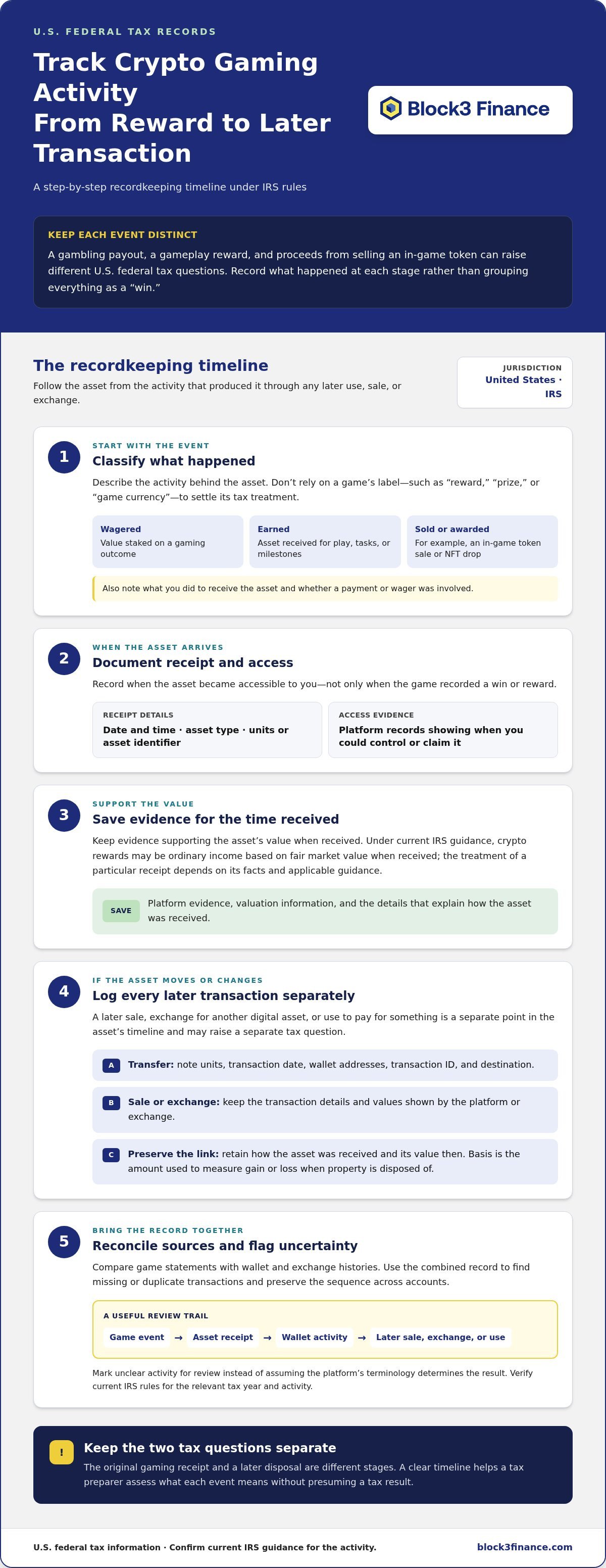
Accurate U.S. federal tax reporting starts with a transaction trail that connects game activity to wallet and exchange records. A structured process helps you identify what happened, preserve the evidence, and flag gaps for review instead of relying on a single year-end balance.
Build a transaction trail across games, wallets, and exchanges
Start with source records, then reconcile them against on-chain and exchange activity. For each event, retain the date and time, asset and units, transaction ID, wallet address, platform account, and available evidence of value in U.S. dollars. Save original exports or statements so you can trace each entry back to its source.
- Gather platform histories. Export game statements, reward logs, wager histories, marketplace activity, and records of in-game payments for the tax year.
- Map wallets and exchanges. List the addresses and accounts you used, including the destination or source for each transfer. Collect wallet histories and exchange statements for the same period.
- Build a dated transaction ledger. Record each receipt, transfer, sale, exchange, or game-related payment as a separate line. Include transaction IDs and note the source document that supports each entry.
- Capture valuation evidence. Preserve available records showing the asset’s value and the date and time used for review. Keep this evidence with the transaction rather than relying on memory or a later price lookup.
- Reconcile and flag exceptions. Compare platform exports with wallet and exchange records. Mark missing data, possible duplicate entries, transfers that appear on only one side, and balances you can’t explain. Investigate them before treating the ledger as complete.
A transfer between wallets you control may appear as an outgoing transaction in one record and an incoming transaction in another. Match both sides using the transaction ID, asset, units, and timing. Document any remaining difference rather than counting the entries as separate receipts or disposals without review.
Prepare records for accurate reporting
Once records are reconciled, summarize activity by event type, such as gameplay rewards, wagering activity, transfers, and later sales or exchanges. Keep the transaction-level detail behind each summary so the figures can be traced and reviewed.
For U.S. federal filing, check current IRS instructions for the relevant tax year to confirm applicable reporting requirements and forms. Don’t assume an exchange statement captures every game or wallet transaction, or that a platform’s category determines the tax treatment.
If an export is unavailable or an activity’s classification remains uncertain, record what you know, identify what is missing, and seek qualified tax review before filing. A clear crypto gaming income tax record keeps the underlying evidence connected to each reporting decision.
Block3 Finance’s tax filing and reporting services help organize complex digital-asset activity into clear, supportable records. To bring game histories and wallet data into a reconciled reporting file, discuss your crypto tax reporting needs.
When can specialized crypto tax support help with gaming activity?
Some gaming records are straightforward to review. The work becomes more demanding when activity spans several games, wallets, token types, or exchanges, especially when platform histories don’t align with on-chain records or important details are missing.
For U.S. federal tax reporting, specialized support can help organize the evidence and identify transactions that need closer review under current IRS guidance. The goal is a clear, traceable record, not a promised tax outcome.
Signs your gaming records need closer review
Consider a closer review if your records contain unresolved differences or unclear transaction sequences. These warning signs can point to missing source data, duplicate entries, or activity that needs its own tax analysis:
- Several game platforms or wallets show activity that doesn’t reconcile cleanly.
- The same tokens appear as rewards, transfers, and later sales or exchanges, but the records don’t connect those stages.
- Transaction histories are incomplete, inconsistent, or difficult to interpret.
- Balances remain unexplained after comparing game statements with wallet and exchange records.
For example, a game may show a reward credit while the connected wallet history contains several later transfers. Without matching dates, token amounts, and transaction identifiers, it can be difficult to tell whether the records describe separate events or different views of the same activity.
Turn complex on-chain activity into defensible tax records
Block3 Finance brings more than 13 years of blockchain financial expertise to complex digital-asset tax filing and reporting. The work can include organizing platform histories, wallet transactions, and supporting documents into a consistent record, while flagging gaps or uncertain classifications for review against current U.S. federal tax rules.
A structured reporting file should connect each entry to its source and preserve the details needed to follow the transaction trail. Depending on the activity, that may involve:
- Grouping records by event type while retaining transaction-level detail.
- Matching platform exports with wallet and exchange activity.
- Documenting missing information, duplicate entries, and unresolved balances.
- Separating confirmed facts from tax questions that require further review.
This preparation can make complex crypto gaming income tax records easier to review and support. Block3 Finance’s tax filing and reporting work organizes digital-asset activity into clear, supportable records.
If multiple platforms, wallets, or incomplete histories have made your reporting difficult to reconcile, discuss your crypto gaming tax reporting needs with Block3 Finance. A focused review can help clarify which records you have and where further tax analysis may be needed.
Take control of your next reporting cycle
Crypto gaming income tax questions don’t have to define your relationship with digital assets. A deliberate review can help you identify where uncertainty remains and make informed decisions about your next filing cycle.
Block3 Finance supports complex digital-asset tax filing and reporting, bringing blockchain financial expertise to activity that can be difficult to interpret across platforms. The focus is on clear, supportable reporting, not a promised tax outcome.
Discuss your crypto tax reporting needs and consider what kind of review would best support your situation.
Take the next step with a clear record of your gaming activity.
FAQs
Is crypto gaming income taxable in the United States?
It may be, even if you haven’t converted the asset to U.S. dollars. For a particular tax year, identify when the activity occurred and review the facts under current IRS guidance instead of relying on the date you withdrew funds from a game. Keeping separate records by tax year can help prevent activity from being assigned to the wrong return.
Do I have to report crypto gambling winnings to the IRS?
U.S. taxpayers may have reporting obligations for gambling winnings, but the applicable treatment depends on the activity and current IRS instructions. Don’t use the presence or absence of a tax statement from a platform as your only guide. Compare any statement with your account history, and note if it covers only part of your activity or uses a different reporting period.
Are play-to-earn rewards taxed the same as crypto gambling winnings?
Not necessarily. A single game can include both a prize tied to a contest and a reward tied to completing a task, so describe the activities separately instead of grouping every credit under one label. Preserve the game rules or event terms that explain how each item was awarded. Those details can help a tax preparer assess the proper U.S. treatment.
Is selling crypto earned in a game a separate taxable event?
It may be, and a conversion to another digital asset can matter even when no U.S. dollars reach your bank account. For example, retain the exchange confirmation and account export if you swap a game token for another token. Those records can help establish what was exchanged and when, while the applicable IRS rules determine how that transaction should be reported.
Can I deduct losses from crypto gaming or gambling?
Don’t assume that every loss is deductible on a U.S. return. A game balance falling in value while you still hold the asset is not, by itself, enough to establish a deductible loss. The event and applicable tax rules matter. Keep documents showing what happened, and have any proposed loss treatment reviewed against current IRS guidance before claiming it.
What records should I keep for crypto gaming taxes?
Keep original files in a secure location and preserve a separate working copy for organizing or annotating transactions. Record where each export came from and when you downloaded it, so you can explain gaps if a platform later changes or removes its history. For crypto gaming income tax records, preserving source data can make later review more reliable than relying on summaries alone.
How do I report crypto gaming activity on a U.S. tax return?
Use the current IRS instructions for the tax year you’re filing, since reporting details can change. Form 1040 includes a digital-asset question, but answering it doesn’t replace reporting income or dispositions elsewhere on the return when required. Review the exact wording on the current form and instructions, then keep your supporting schedules and transaction records with your tax files.

Article by
Mahad Mohamed
Mahad Mohamed is an accountant and the CEO of Block3 Finance, with over 26+ years of Canadian and international tax and accounting experience. A crypto accounting specialist since the early days of Bitcoin, he has consulted for over 38 crypto companies and collaborated with legal professionals on regulatory matters. His expertise spans corporate reorganization, cross-border tax structuring (Canada & US), tax disputes, and CRA audits.
Previously, Mahad worked for the Canada Revenue Agency (CRA), Big4 accounting firms, and served as a Rulings Officer for the Federal Tax Authority of the UAE before acquiring Tax Partners in 2014.
Block3 Finance and Tax Partners has 44 full-time accountants and over 9,800+ clients.
Disclaimer
This article provides general information only and is current as of its publication date. It has not been updated and may be out of date. It does not constitute legal advice and should not be relied upon as such. Every tax situation is unique and may differ from the examples discussed in this article. If you have specific questions, you should seek the advice of our accountants for your unique circumstances.
Frequently Asked Questions
Is crypto gaming income taxable in the United States?
It may be, even if you haven’t converted the asset to U.S. dollars. For a particular tax year, identify when the activity occurred and review the facts under current IRS guidance instead of relying on the date you withdrew funds from a game. Keeping separate records by tax year can help prevent activity from being assigned to the wrong return.
Do I have to report crypto gambling winnings to the IRS?
U.S. taxpayers may have reporting obligations for gambling winnings, but the applicable treatment depends on the activity and current IRS instructions. Don’t use the presence or absence of a tax statement from a platform as your only guide. Compare any statement with your account history, and note if it covers only part of your activity or uses a different reporting period.
Are play-to-earn rewards taxed the same as crypto gambling winnings?
Not necessarily. A single game can include both a prize tied to a contest and a reward tied to completing a task, so describe the activities separately instead of grouping every credit under one label. Preserve the game rules or event terms that explain how each item was awarded. Those details can help a tax preparer assess the proper U.S. treatment.
Is selling crypto earned in a game a separate taxable event?
It may be, and a conversion to another digital asset can matter even when no U.S. dollars reach your bank account. For example, retain the exchange confirmation and account export if you swap a game token for another token. Those records can help establish what was exchanged and when, while the applicable IRS rules determine how that transaction should be reported.
Can I deduct losses from crypto gaming or gambling?
Don’t assume that every loss is deductible on a U.S. return. A game balance falling in value while you still hold the asset is not, by itself, enough to establish a deductible loss. The event and applicable tax rules matter. Keep documents showing what happened, and have any proposed loss treatment reviewed against current IRS guidance before claiming it.
What records should I keep for crypto gaming taxes?
Keep original files in a secure location and preserve a separate working copy for organizing or annotating transactions. Record where each export came from and when you downloaded it, so you can explain gaps if a platform later changes or removes its history. For crypto gaming income tax records, preserving source data can make later review more reliable than relying on summaries alone.
How do I report crypto gaming activity on a U.S. tax return?
Use the current IRS instructions for the tax year you’re filing, since reporting details can change. Form 1040 includes a digital-asset question, but answering it doesn’t replace reporting income or dispositions elsewhere on the return when required. Review the exact wording on the current form and instructions, then keep your supporting schedules and transaction records with your tax files.