
What if the challenge in crypto accounting isn’t recording each transaction, but connecting activity across wallets, exchanges, and the blockchain to your business accounts? For Canadian businesses, crypto bookkeeping services turn those records into organized financial information that can support reporting and tax preparation.
If you’ve struggled to reconcile crypto activity consistently, you’re not alone. Transaction histories come in different formats, and each movement needs to be understood in the context of your business records. A repeatable monthly process helps bring the details together.
This guide explains what crypto bookkeeping covers, which records a monthly process uses, and how reconciliation supports clearer accounts for Canadian businesses. You’ll also learn how organized bookkeeping can support CRA-related tax preparation and audit readiness. Block3 Finance provides monthly accounting and bookkeeping for crypto businesses, connecting complex on-chain activity with defensible financial records.
Key Takeaways
- Crypto bookkeeping services bring activity from business wallets, exchanges, and the blockchain into organized records.
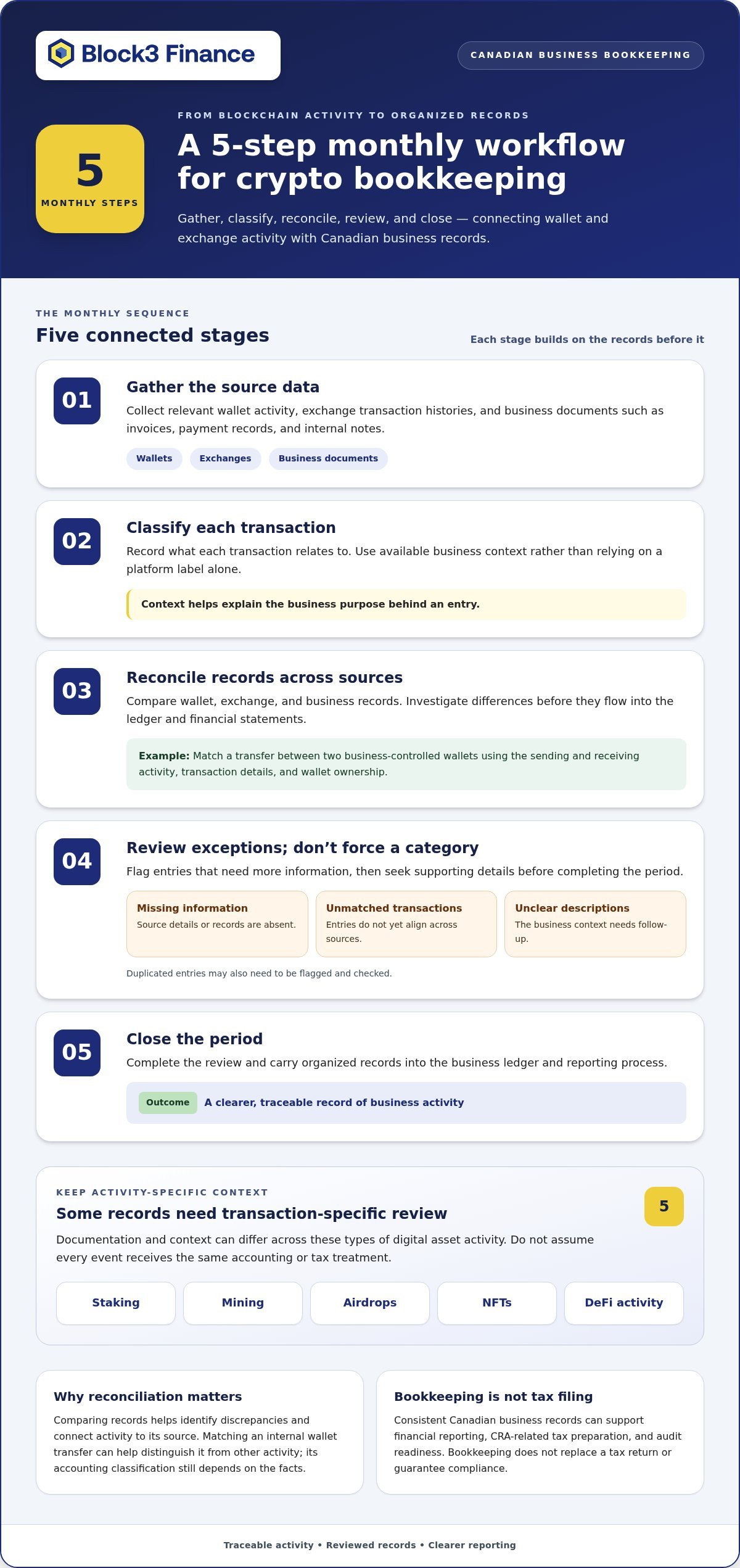
- A monthly workflow can move from gathering transaction data to classification, reconciliation, exception review, and period close.
- Software can organize transaction data, but imports may still need review to resolve accounting questions and discrepancies.
- Prepare for monthly bookkeeping by identifying business wallets, gathering exchange records, and keeping supporting documents together.
- Consistent records can support clearer financial reporting, CRA tax preparation, and audit readiness.
What crypto bookkeeping services do for Canadian businesses
Crypto bookkeeping services organize, categorize, reconcile, and maintain a Canadian business’s digital asset records so its financial activity can be reflected in reliable business accounts. The work connects transactions from wallets, exchanges, and blockchain networks to the business ledger, the record of its financial activity. Understanding what cryptocurrency is helps explain why records from different platforms and networks need careful interpretation.
Bookkeeping is an ongoing control process, not simply a collection of transaction exports. It helps a business trace activity to its source, understand how each transaction relates to operations, and maintain records for financial reporting and Canadian tax preparation. Accurate records are useful, but they don’t replace a tax return or guarantee compliance.
Which businesses use crypto bookkeeping in Canada?
Crypto startups, established businesses, DAOs, and Web3 projects may all need a consistent way to bring digital asset activity into their business records. The work can become more involved when a business uses several wallets and exchange accounts, since each source may present activity differently.
For example, a business might receive digital assets in one wallet, move them between its own wallets, and later use another platform to make an operating payment. Bookkeeping connects those records so internal movements aren’t confused with income or expenses, and so the activity can be understood alongside the business ledger. Monthly accounting provides a recurring structure for this work instead of leaving record cleanup until reporting time.
How bookkeeping differs from crypto tax filing
Bookkeeping maintains financial records throughout the year. Tax filing uses relevant information to prepare and report a return under Canadian tax rules. The two processes are connected but serve different purposes: organized books can support tax preparation, while filing remains a separate obligation.
For a deeper overview of filing, see Block3 Finance’s cryptocurrency tax filing guide. Reconciled financial records can also support broader financial oversight. Block3 Finance’s CFO services for business finance can complement its accounting work.
A sound bookkeeping process keeps evidence connected to the business accounts. That gives Canadian businesses a clearer foundation for reviewing financial activity, preparing reports, and assembling information for tax work, without treating bookkeeping as a substitute for professional tax filing.
How crypto bookkeeping turns blockchain activity into reliable records
Blockchain activity becomes useful to a Canadian business when each movement can be traced to a source, understood in context, and reflected consistently in its accounting records. Reconciliation compares wallet, exchange, and business records to help identify discrepancies before they flow into the ledger and financial statements.
A disciplined monthly workflow keeps this work traceable:
- Gather data: Collect relevant wallet activity, exchange transaction histories, and business documents.
- Classify activity: Record what each transaction relates to, using available context instead of relying on a platform label alone.
- Reconcile records: Compare information from different sources and investigate differences.
- Review exceptions: Flag missing information, unmatched transactions, or unclear descriptions for follow-up.
- Close the period: Complete the review and carry organized records into the business ledger and reporting process.
Gather records from wallets, exchanges, and on-chain activity
Start by identifying business-controlled wallets and exchange accounts. Gather their available transaction histories alongside relevant invoices, payment records, and internal notes. Complete source data helps trace activity across connected accounts and platforms, especially when a transaction begins in one place and appears in another.
Records may come in different formats, so a bookkeeping team can organize them into a consistent working set. Notes about business purpose, counterparties, or related documents can also help explain why a transaction occurred.
Reconcile transactions and review exceptions
Reconciliation means comparing records from different sources and resolving discrepancies where the available evidence allows. For example, a transfer between two business-controlled wallets can be matched by reviewing the sending and receiving activity, transaction details, and wallet ownership. Matching the movement helps distinguish an internal transfer from other activity, though its accounting classification still depends on the facts.
Treat unmatched entries as exceptions rather than forcing them into a category. A reviewer can flag missing records, duplicated entries, or descriptions that don’t explain the business context, then seek supporting information before completing the period.
Staking, mining, airdrops, NFTs, and decentralized finance (DeFi) activity may need transaction-specific review because the records and context can differ. Consistent documentation preserves that context for the business ledger, financial reporting, and Canadian tax preparation, without assuming every event receives the same treatment.
For a more structured monthly process, discuss your bookkeeping needs with Block3 Finance.
Crypto bookkeeping software or specialist services: what changes?
Software can help gather and organize digital asset data, but an import is a starting point, not a complete accounting review. Records may be incomplete, categories may need context, and unusual entries can require follow-up. Reliable books for a Canadian business depend on both usable data and a process for reviewing it.
| Task | What software may help with | What specialist bookkeeping adds |
|---|---|---|
| Transaction imports | Bring together available records from connected sources or uploaded files. | Review source coverage and identify gaps that may need more documentation. |
| Categorization | Apply labels or organize transactions using available data. | Consider the business context when a label doesn’t explain the transaction. |
| Reconciliation | Help compare or group imported activity. | Investigate discrepancies across records and track unresolved items. |
| Exception review | Surface entries that may need attention, depending on the tool. | Assess unclear or unmatched activity and document questions for follow-up. |
| Financial reporting | Prepare summaries from the data entered or connected. | Review whether the records are organized for the business’s reporting process. |
What crypto accounting software can help organize
Depending on the tool and information provided, software may aggregate transaction data, apply labels, and prepare summaries or reports. Its output depends on the completeness and quality of connected records. Missing wallet activity or unclear transaction details can affect what appears in a report.
Software can make data easier to manage, but it can’t establish business purpose from incomplete information or guarantee accurate books or CRA compliance. Someone still needs to assess whether the records make sense in context.
When recurring specialist bookkeeping adds value
For a business with ongoing digital asset activity, recurring bookkeeping creates a regular opportunity to reconcile records, review exceptions, and carry forward organized information. This can help surface incomplete documentation or transaction questions before they accumulate, while keeping bookkeeping connected to the wider business accounts.
Block3 Finance’s monthly accounting services bring specialist review to crypto business records. The right approach isn’t software or people in isolation. Crypto bookkeeping services can use tools to organize data while applying consistent review to questions that software imports don’t resolve.
For a more structured process for your Canadian business, discuss your bookkeeping needs with Block3 Finance.
How Canadian businesses can prepare for monthly crypto bookkeeping
A repeatable preparation routine makes monthly crypto bookkeeping more useful. It gives the reviewer a clearer trail from source records to business accounts and helps your team identify missing context before the period is closed.
Records to organize before a bookkeeping cycle
Begin with an inventory of wallets and exchange accounts used for business activity. Group available transaction histories by account and reporting period, then gather documents that explain the transactions.
- Wallets and exchanges: Identify business-controlled accounts and collect their available activity records.
- Transaction details: Keep dates, asset amounts, and transaction references where available.
- Supporting documents: Organize invoices, agreements, payment records, and internal notes alongside related activity.
- Open questions: Mark missing records or unclear descriptions for review rather than guessing at their purpose or treatment.
Consistent context matters. A brief note explaining why a transaction occurred can help distinguish a business payment from another type of movement, though the appropriate accounting or tax treatment depends on the facts.
Build a repeatable review and close routine
Set a recurring schedule for collecting source records, reconciling activity, and reviewing unresolved items. At each close, record what changed and why, so someone reviewing the books later can follow the reasoning instead of reconstructing it from scattered files.
For Canadian tax reporting, the treatment of crypto activity depends on the specific facts and current Canadian requirements. Use organized records as preparation, not as a substitute for assessing the applicable rules. See the Canadian crypto tax filing guidance for a separate overview, and verify current requirements with the CRA.
A clear bookkeeping trail can also support audit readiness by making source documents and explanations easier to locate. It doesn’t guarantee an audit outcome, but Block3 Finance’s audit and compliance services can support businesses preparing for financial review.
Crypto bookkeeping services can turn a recurring task into a reliable business routine: gather records, resolve questions, document decisions, and close the period with a traceable record. Discuss a monthly bookkeeping process for your business with Block3 Finance.
How Block3 Finance supports crypto bookkeeping in Canada
For a Canadian business, dependable crypto bookkeeping means more than collecting transaction exports. Block3 Finance’s monthly bookkeeping connects complex on-chain activity with organized business records, helping crypto startups, established businesses, DAOs, and Web3 projects maintain clear, defensible books.
A bookkeeping process built around digital asset activity
Different businesses have different transaction flows and record sources. Block3 Finance organizes bookkeeping around each business’s activity and available records, bringing wallet and exchange data together with supporting business information. The aim is to make activity easier to trace, review, and carry into the company’s financial records.
This recurring work can include maintaining records, reconciling activity, and identifying items that need more context. Rather than treating blockchain data as a standalone report, the bookkeeping process connects it to the business’s wider accounting picture.
Connect bookkeeping with the wider finance function
Organized books can give a business a stronger foundation for Canadian tax preparation and financial review. Bookkeeping and tax filing remain distinct: bookkeeping maintains the underlying records, while filing reports relevant information under applicable Canadian requirements. Well-kept records can also support audit preparation, but they don’t guarantee a particular audit outcome.
Block3 Finance’s crypto accounting services in Canada provide location-specific context for businesses seeking support with digital asset finances. For companies that need broader financial leadership alongside bookkeeping, CFO services may be a related part of the finance function. Their scope differs from maintaining monthly records.
Block3 Finance serves clients globally and focuses on translating complex blockchain activity into clean, defensible financial records. This specialist perspective keeps bookkeeping grounded in both on-chain evidence and the business context behind it.
With crypto bookkeeping services, a consistent monthly routine can help a business keep its records organized as digital asset activity continues. The result is a clearer financial picture for internal reporting, tax preparation, and audit readiness, without treating bookkeeping as a substitute for filing or assurance.
If your Canadian business needs a more structured approach to its digital asset records, discuss your bookkeeping needs with Block3 Finance.
Build a clearer financial picture, month by month
Reliable crypto bookkeeping services connect wallet, exchange, and on-chain activity to organized business records. A recurring process of gathering data, reconciling transactions, and reviewing exceptions can help Canadian businesses build clearer books for financial reporting and tax preparation.
Software can help organize transaction data, but it may not resolve every question about business context or incomplete records. Consistent documentation and review make the bookkeeping trail easier to follow and can support audit readiness without guaranteeing a particular outcome.
Block3 Finance provides monthly bookkeeping for crypto startups, established businesses, DAOs, and Web3 projects. The company reports serving more than 980 clients globally and having over 13 years of blockchain financial expertise.
Bring greater structure to your digital asset records. Discuss your crypto bookkeeping needs with Block3 Finance and take a confident next step toward clearer Canadian business records.
Frequently Asked Questions
What do crypto bookkeeping services include?
Crypto bookkeeping services organize and maintain a business’s digital asset records. The work can include gathering wallet and exchange activity, categorizing transactions, reconciling records across sources, reviewing unclear items, and recording results in the business ledger. For a Canadian business, this creates a structured record for financial reporting and tax preparation, but bookkeeping isn’t the same as filing a tax return.
Do Canadian businesses need a crypto bookkeeper?
Whether a Canadian business needs a crypto bookkeeper depends on its activity, recordkeeping capacity, and reporting needs. A business using several wallets or exchanges, or handling frequent on-chain transactions, may find it challenging to keep records complete and consistent internally. A bookkeeper can help organize and reconcile activity, while the business remains responsible for its records and should confirm applicable Canadian tax requirements with the CRA.
Can crypto bookkeeping software replace a bookkeeper?
Crypto bookkeeping software can help collect, label, and organize transaction data, but it may not resolve every accounting question. Imports can be incomplete, and a transaction’s label may not explain its business purpose or how it should be recorded. A bookkeeper can review exceptions, compare records, and investigate discrepancies using business context. Software doesn’t guarantee accurate books or CRA compliance.
How often should a business reconcile crypto transactions?
A business should set a recurring reconciliation schedule that fits its transaction activity and financial reporting process. Monthly reconciliation can help identify missing records and mismatches before they accumulate, especially when activity spans multiple wallets or exchanges. This is a practical bookkeeping routine, not a statement of a specific CRA deadline; record activity consistently and review exceptions as part of the regular close.
Does crypto bookkeeping include Canadian crypto tax filing?
Bookkeeping and Canadian crypto tax filing are related, but they’re distinct tasks. Bookkeeping maintains and reconciles records, while tax filing uses relevant information to prepare and report a return under applicable Canadian rules. Organized books can support tax preparation, but they don’t replace a return or determine treatment on their own. The tax result depends on the facts, so verify current requirements with the CRA or consult a qualified tax professional.
What records should I prepare for crypto bookkeeping?
Prepare available transaction histories for business wallets and exchange accounts, grouped by account and reporting period. Include supporting records such as invoices, agreements, payment documentation, and internal notes that explain business purpose. Keep transaction dates, asset amounts, and references where available; flag unclear entries or missing records for review rather than guessing at their purpose or treatment.
Can crypto bookkeeping help prepare a business for an audit?
Yes, organized crypto bookkeeping can support audit readiness by keeping transaction records, supporting documents, and explanations easier to trace. Reconciled books can help a business respond to questions about how activity was recorded, but bookkeeping can’t guarantee an audit outcome or replace separate audit or compliance work. For a Canadian business, maintaining a clear record trail also supports financial review and makes relevant information easier to assemble.

Article by
Mahad Mohamed
Mahad Mohamed is an accountant and the CEO of Block3 Finance, with over 26+ years of Canadian and international tax and accounting experience. A crypto accounting specialist since the early days of Bitcoin, he has consulted for over 38 crypto companies and collaborated with legal professionals on regulatory matters. His expertise spans corporate reorganization, cross-border tax structuring (Canada & US), tax disputes, and CRA audits.
Previously, Mahad worked for the Canada Revenue Agency (CRA), Big4 accounting firms, and served as a Rulings Officer for the Federal Tax Authority of the UAE before acquiring Tax Partners in 2014.
Block3 Finance and Tax Partners has 44 full-time accountants and over 9,800+ clients.
Disclaimer
This article provides general information only and is current as of its publication date. It has not been updated and may be out of date. It does not constitute legal advice and should not be relied upon as such. Every tax situation is unique and may differ from the examples discussed in this article. If you have specific questions, you should seek the advice of our accountants for your unique circumstances.
Frequently Asked Questions
Which businesses use crypto bookkeeping in Canada?
Crypto startups, established businesses, DAOs, and Web3 projects may all need a consistent way to bring digital asset activity into their business records. The work can become more involved when a business uses several wallets and exchange accounts, since each source may present activity differently. For example, a business might receive digital assets in one wallet, move them between its own wallets, and later use another platform to make an operating payment. Bookkeeping connects those records so internal movements aren’t confused with income or expenses, and so the activity can be understood alongside the business ledger. Monthly accounting provides a recurring structure for this work instead of leaving record cleanup until reporting time.
What do crypto bookkeeping services include?
Crypto bookkeeping services organize and maintain a business’s digital asset records. The work can include gathering wallet and exchange activity, categorizing transactions, reconciling records across sources, reviewing unclear items, and recording results in the business ledger. For a Canadian business, this creates a structured record for financial reporting and tax preparation, but bookkeeping isn’t the same as filing a tax return.
Do Canadian businesses need a crypto bookkeeper?
Whether a Canadian business needs a crypto bookkeeper depends on its activity, recordkeeping capacity, and reporting needs. A business using several wallets or exchanges, or handling frequent on-chain transactions, may find it challenging to keep records complete and consistent internally. A bookkeeper can help organize and reconcile activity, while the business remains responsible for its records and should confirm applicable Canadian tax requirements with the CRA.
Can crypto bookkeeping software replace a bookkeeper?
Crypto bookkeeping software can help collect, label, and organize transaction data, but it may not resolve every accounting question. Imports can be incomplete, and a transaction’s label may not explain its business purpose or how it should be recorded. A bookkeeper can review exceptions, compare records, and investigate discrepancies using business context. Software doesn’t guarantee accurate books or CRA compliance.
How often should a business reconcile crypto transactions?
A business should set a recurring reconciliation schedule that fits its transaction activity and financial reporting process. Monthly reconciliation can help identify missing records and mismatches before they accumulate, especially when activity spans multiple wallets or exchanges. This is a practical bookkeeping routine, not a statement of a specific CRA deadline; record activity consistently and review exceptions as part of the regular close.
Does crypto bookkeeping include Canadian crypto tax filing?
Bookkeeping and Canadian crypto tax filing are related, but they’re distinct tasks. Bookkeeping maintains and reconciles records, while tax filing uses relevant information to prepare and report a return under applicable Canadian rules. Organized books can support tax preparation, but they don’t replace a return or determine treatment on their own. The tax result depends on the facts, so verify current requirements with the CRA or consult a qualified tax professional.
What records should I prepare for crypto bookkeeping?
Prepare available transaction histories for business wallets and exchange accounts, grouped by account and reporting period. Include supporting records such as invoices, agreements, payment documentation, and internal notes that explain business purpose. Keep transaction dates, asset amounts, and references where available; flag unclear entries or missing records for review rather than guessing at their purpose or treatment.
Can crypto bookkeeping help prepare a business for an audit?
Yes, organized crypto bookkeeping can support audit readiness by keeping transaction records, supporting documents, and explanations easier to trace. Reconciled books can help a business respond to questions about how activity was recorded, but bookkeeping can’t guarantee an audit outcome or replace separate audit or compliance work. For a Canadian business, maintaining a clear record trail also supports financial review and makes relevant information easier to assemble.