
Does your year-end close still require crypto asset impairment testing, or has U.S. GAAP moved your holdings to a different measurement model? The answer depends on what each asset is and which accounting guidance applies, not simply on whether its market price has fallen.
That distinction matters. For fiscal years beginning after December 15, 2024, FASB’s ASU 2023-08 requires qualifying crypto assets, including Bitcoin and Ether, to be measured at fair value, with changes recognized in net income each reporting period. For these assets, impairment testing is no longer the standard process. Other digital assets may fall outside this guidance, so assess their characteristics before deciding how to account for them.
This guide explains how to identify the applicable U.S. GAAP model, what to do when impairment guidance is relevant, and how to build clear, supportable records. It also covers how reconciled asset-level data, consistent close procedures, and documented judgments can help your team distinguish book accounting from tax basis and prepare for audit scrutiny.
Key Takeaways
- Identify the asset and applicable U.S. GAAP guidance before deciding whether an impairment assessment is required.
- Use a clear decision path to determine whether crypto-specific guidance applies to each holding and reporting period.
- When crypto asset impairment testing applies, follow the relevant measurement guidance and retain records supporting the assessment and any entry.
- Reconcile wallet, exchange, and ledger balances before relying on asset-level data for review.
- Use a repeatable close checklist to document scope decisions, evidence, and review. Seek specialist accounting input if classification or valuation remains uncertain.
Crypto Asset Impairment Testing: Start by Identifying the U.S. GAAP Model
Impairment testing assesses whether the applicable accounting guidance requires an asset’s recorded amount to be reduced. It isn’t a tax calculation, and a token’s market-price decline alone doesn’t determine its financial statement treatment.
Start with classification, not a spreadsheet. Under U.S. GAAP, an asset’s characteristics and the reporting period help determine the applicable accounting model. Impairment analysis and fair-value measurement are different approaches: impairment may require a write-down under the relevant guidance, while fair-value accounting updates an asset’s recorded amount to fair value each reporting period, with changes recognized in net income.
What does crypto asset impairment testing determine?
The carrying amount is the value at which an asset is recorded in the financial statements. Crypto asset impairment testing assesses whether the applicable U.S. GAAP guidance requires that amount to be reduced.
A price drop may prompt a closer look, but it doesn’t settle the accounting question. First determine the asset’s classification and applicable guidance. Then assess the amount using the required method.
Why U.S. GAAP scope matters before calculating anything
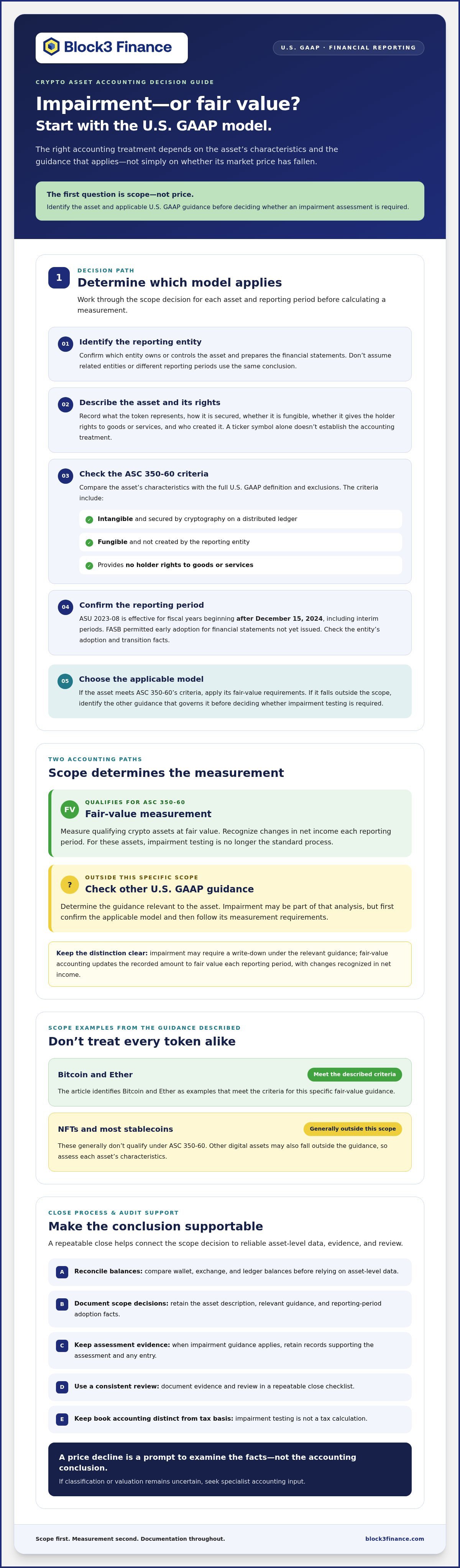
FASB’s ASC 350-60, introduced by ASU 2023-08, provides fair-value guidance for crypto assets that meet specific criteria. In general, an asset must be an intangible asset, provide no holder rights to goods or services, be secured by cryptography on a distributed ledger, be fungible, and not have been created by the reporting entity. The standard applies for fiscal years beginning after December 15, 2024.
Bitcoin and Ether meet the described criteria, while NFTs and most stablecoins don’t qualify under this specific guidance. Other assets may fall under different U.S. GAAP requirements, so don’t assume every token uses the same model. For background on the category, see this overview of intangible assets.
- In scope: qualifying assets are measured at fair value under ASC 350-60, rather than using the former cost-less-impairment model.
- Outside this scope: identify and apply the other guidance relevant to the asset. Impairment may be part of that analysis, but first confirm the applicable model.
For a deeper comparison of qualification criteria and fair-value accounting, see our planned guide to U.S. GAAP crypto fair-value rules. A scope-first approach helps prevent a price movement from being mistaken for an impairment conclusion and directs the close team to the right evidence and measurement process.
How to Decide Whether U.S. GAAP Impairment Testing Applies
Document the scope decision before scheduling a test. Under U.S. GAAP, the answer depends on the reporting entity, the specific asset and its rights, the guidance in effect for the reporting period, and any applicable transition provisions.
- Identify the reporting entity. Confirm which entity owns or controls the asset and prepares the financial statements. Don’t assume related entities or entities with different reporting periods use the same accounting conclusion.
- Describe the asset. Record what the token represents, how it is secured, whether it is fungible, whether it gives the holder rights to goods or services, and who created it. A ticker symbol alone doesn’t establish its accounting treatment.
- Check the scope criteria. Compare the asset’s characteristics with the full definition and exclusions in the Financial Accounting Standards Board (FASB) guidance. FASB’s Accounting Standards Update (ASU) 2023-08 added Subtopic 350-60 to the Accounting Standards Codification (ASC), the organized collection of authoritative U.S. GAAP requirements.
- Confirm the reporting period. ASU 2023-08 is effective for fiscal years beginning after December 15, 2024, including interim periods. FASB permitted early adoption for financial statements not yet issued. Check the entity’s adoption and transition facts instead of assuming every entity began applying it at the same time.
- Determine the applicable model. If the asset meets ASC 350-60’s criteria, apply its fair-value requirements. If it falls outside the scope, identify the other guidance that governs the asset before deciding whether impairment testing is required.
Which crypto assets fall within the relevant accounting scope?
ASC 350-60 applies to qualifying crypto assets that are intangible, secured by cryptography on a distributed ledger, fungible, not created by the reporting entity, and don’t provide the holder with rights to goods or services. An intangible asset is a nonphysical asset. Bitcoin and Ether are examples identified as qualifying, but that doesn’t mean every token with similar market features is eligible.
NFTs, wrapped tokens, stablecoins, and other edge cases need fact-specific analysis. Review the rights attached to the asset, not just its name. FASB’s April 2026 discussions about expanding scope to certain wrapped tokens were tentative. Confirm the status of any proposed change before treating it as effective guidance.
What changes when an asset is outside the crypto-specific guidance?
Being outside ASC 350-60 doesn’t automatically mean an asset is impaired or that the same test applies to every out-of-scope asset. Determine its classification and useful life: a finite-lived asset has a limited useful life, while an indefinite-lived asset has no predictable limit to its useful life. Then verify the applicable U.S. GAAP measurement, testing frequency, and recognition requirements.
Keep the conclusion and supporting evidence with the close records. If asset classification or source data is complex, specialist accounting input can help clarify what needs evaluation. A separate ASU 2023-08 explainer can provide a deeper comparison of fair-value measurement and impairment.
How to Perform and Document an Impairment Test When Required
Once the applicable U.S. GAAP guidance confirms that an impairment assessment is required, follow a controlled sequence: confirm scope, reconcile records, apply the required measurement, review the conclusion, and record any required entry. This isn’t a universal formula. Measurement and recognition rules depend on the asset’s classification and the specific guidance that applies.
Keep the distinction clear: qualifying crypto assets under ASC 350-60 are measured at fair value, not through the former cost-less-impairment model. For assets outside that scope, verify the governing guidance before selecting a test, valuation method, or journal entry. Use FASB’s ASU 2023-08 as a primary reference for its requirements, and confirm other relevant U.S. GAAP provisions in the current authoritative literature.
Build a complete asset and transaction record
Start with a period-end inventory that identifies each asset, wallet or custodian, quantity, acquisition history, and reporting date. Reconcile on-chain activity and exchange statements to wallet records and the general ledger before evaluating individual holdings. Investigate unexplained differences, such as a transfer recorded in one system but missing from another.
Retain evidence that lets a reviewer trace each reported balance to its source. This may include wallet exports, exchange statements, transaction records, ledger detail, and documentation showing how discrepancies were resolved.
- For valuation evidence: use information relevant to the measurement date and the method required by the applicable guidance. Retain the source, timestamp, and rationale for using it.
- For limited market data: document liquidity constraints, pricing limitations, assumptions, and how those limitations affect the conclusion. Don’t present an unsupported estimate as an observable market price.
Record, review, and retain the accounting conclusion
Prepare a concise memo that identifies the selected guidance, scope rationale, reporting period, source data, assumptions, and unresolved limitations. Name the preparer and reviewer, and retain evidence that the reviewer checked both the accounting conclusion and the underlying reconciliations.
If the applicable model requires an adjustment, explain the calculation and proposed journal entry. Then verify the account names and financial statement presentation against that guidance. Don’t carry forward a prior-period entry or apply a fair-value change as an impairment loss without confirming the model first.
A repeatable evidence trail helps reviewers follow the close team’s judgment. When records or accounting conclusions need additional scrutiny, Block3 Finance’s audit and compliance services may be relevant to digital-asset organizations preparing supportable financial records.
Compare Manual and Repeatable Testing: Controls, Evidence, and Common Errors
A spreadsheet can support a sound close, and accounting software can still produce a weak one. What matters is whether the process captures complete data, preserves a reviewable trail, and applies the right U.S. GAAP model. Older impairment instructions may describe the former cost-less-impairment approach, so confirm current guidance before using a template for crypto asset impairment testing.
| Control area | Spreadsheet-led process | System-supported process |
|---|---|---|
| Traceability | Can show source details if preparers retain exports and link calculations to them. Disconnected files can make a balance’s source difficult to trace. | May connect transaction data and reports, but confirm that source records and adjustments remain accessible. |
| Repeatability | Templates can standardize steps, but manual updates and formulas may vary between periods. | Can apply consistent workflows, provided mappings, settings, and data feeds are reviewed and controlled. |
| Review | Use version history, documented checks, and clear preparer and reviewer sign-offs. | Use role controls and review logs where available. System output still needs human review. |
| Data completeness | Reconcile wallet, exchange, and ledger records; document missing or delayed data. | Automated imports may improve coverage, but test for omissions, duplicates, and mapping errors. |
What makes a crypto impairment process audit-ready?
Build a traceable path from wallet or exchange source data to reconciled ledger balances, then to the accounting conclusion and any resulting entry. Use consistent reporting-date timestamps, retain pricing support when the applicable model requires valuation evidence, and preserve workpapers and approval records.
Keep book accounting separate from tax records. An impairment adjustment in U.S. GAAP financial statements isn’t automatically a tax deduction. Assess tax treatment separately under the applicable U.S. tax rules.
Which errors create avoidable review questions?
Applying one impairment model to every token is a common process risk. Unreconciled balances, undocumented pricing choices, and records without the asset-level or lot-level detail needed to support a conclusion can also prompt review questions.
Software can organize data and make a workflow more repeatable. It can’t determine accounting scope or replace documented professional judgment. Teams can review Block3 Finance’s accounting services for support with financial records, alongside its audit and compliance services.
If your team needs help strengthening crypto accounting controls or its evidence trail, contact Block3 Finance to discuss your accounting needs.
Make Crypto Asset Impairment Testing a Defensible Close Process
A reliable close starts with the right accounting model, not a prefilled impairment template. Under U.S. GAAP, qualifying assets within ASC 350-60 use fair-value measurement, while other assets may be subject to different guidance. Keep the scope conclusion, source records, and reviewer sign-off together so the team can explain both its decision and the evidence behind it.
Use this checklist to make crypto asset impairment testing part of a controlled close process:
- Confirm jurisdiction and framework: Verify that the financial statements follow U.S. GAAP and identify the reporting period and relevant guidance.
- Assess each asset’s scope: Document its characteristics and rights, then determine which accounting model applies before testing or measuring value.
- Reconcile records: Match wallet, exchange, and other source records to the ledger. Investigate and document differences.
- Support the conclusion: Retain the scope analysis, applicable valuation evidence, assumptions, and any limitations in the underlying data.
- Review and record: Have an appropriate reviewer assess the analysis, then record any required entry under the applicable guidance.
When should a finance team seek specialist support?
Consider specialist accounting review if holdings span multiple chains, transaction activity is difficult to reconcile, token rights or structures are unusual, or valuation evidence is limited. These conditions can make it harder to classify assets consistently and assemble a clear period-end record.
A specialist can help organize on-chain records and support a documented accounting process. That work can strengthen financial reporting and audit readiness, but it doesn’t guarantee an audit outcome or replace legal or investment advice.
What should teams prepare before an accounting review?
Bring together wallet and exchange listings, reporting-period balances, transaction exports, and current accounting policies. Include the proposed scope analysis, valuation support where relevant, and a list of unresolved reconciliation items so reviewers can see what is complete and where judgment remains.
Block3 Finance provides crypto accounting and audit-related services for digital-asset organizations. Teams reviewing their recordkeeping process can explore its crypto accounting services and discuss how accounting support may fit their needs.
For a review of your team’s crypto accounting needs, discuss your crypto accounting needs with Block3 Finance.
Build a Close Process Your Team Can Defend
Strong crypto asset impairment testing begins with the right question: which U.S. GAAP model applies to each holding? Qualifying assets under ASC 350-60 follow fair-value accounting, while assets outside its scope may require analysis under other guidance. A documented scope decision helps prevent teams from applying an outdated impairment process by default.
Next, reconcile wallet, exchange, and ledger records; retain evidence for the applicable measurement; and make sure a reviewer can trace the conclusion to any financial statement entry. Keep book accounting distinct from tax treatment, and seek specialist input if classification, valuation support, or asset records remain uncertain.
Block3 Finance brings more than 13 years of blockchain financial expertise and has served more than 980 clients globally. Its crypto accounting and audit-related services support digital-asset organizations working to organize complex activity into defensible financial records. Discuss your crypto accounting and reporting needs and take the next step toward a more consistent close process.
Frequently Asked Questions
What is crypto asset impairment testing under U.S. GAAP?
Under U.S. GAAP, crypto asset impairment testing assesses whether applicable guidance requires an asset’s recorded financial statement amount to be reduced. It isn’t a tax calculation, and a market-price decline alone doesn’t establish that an impairment loss is required. First identify the asset’s classification and governing guidance. Qualifying assets under ASC 350-60 follow fair-value accounting instead of the former cost-less-impairment model.
Do all crypto assets require impairment testing under U.S. GAAP?
No. The accounting treatment depends on the asset’s characteristics and the applicable U.S. GAAP guidance. Qualifying assets within ASC 350-60 are measured at fair value, while assets outside that scope may fall under other accounting requirements. Review the asset’s rights and features rather than relying only on its name or ticker. NFTs, wrapped tokens, stablecoins, and similar assets can require fact-specific analysis.
How do I test a crypto asset for impairment?
First confirm that the asset is subject to impairment guidance, rather than fair-value measurement or another model. Then follow the measurement and recognition requirements in the guidance that applies; there isn’t one universal calculation for every token. Reconcile wallet, exchange, and ledger records, retain relevant valuation evidence, document assumptions and limitations, and have a reviewer assess the conclusion before recording any required journal entry.
When should a company test crypto assets for impairment?
There isn’t one testing schedule that applies to every crypto asset under U.S. GAAP. Timing depends on the asset’s classification and the specific guidance governing it. For qualifying assets under ASC 350-60, fair value is measured each reporting period, rather than using the former impairment model. For assets outside that scope, confirm the applicable requirements for assessment frequency and triggering circumstances before setting the close calendar.
How does crypto impairment differ from fair-value accounting?
Impairment accounting assesses whether applicable guidance requires a reduction in an asset’s recorded amount. Fair-value accounting measures an asset at fair value at each reporting date, with changes recognized as required by the governing standard. Under U.S. GAAP, ASC 350-60 requires this fair-value model for qualifying crypto assets. The distinction matters: a decrease under fair-value accounting isn’t automatically an impairment loss.
Can an impairment loss on crypto be deducted on a U.S. tax return?
Not automatically. An impairment adjustment recorded in U.S. GAAP financial statements doesn’t, by itself, establish a deductible loss on a U.S. tax return. Book accounting and tax treatment follow different rules, so keep their records and conclusions separate. Before claiming a deduction, assess the specific transaction and applicable federal tax rules with a qualified tax professional, and confirm current guidance with the IRS where needed.
What records should a business keep for crypto impairment testing?
Keep records that let a reviewer trace each accounting conclusion to its supporting data. Useful documentation includes asset and wallet or custodian listings, period-end quantities, transaction and exchange exports, ledger reconciliations, the scope analysis, and valuation evidence where relevant. Retain assumptions, data limitations, preparer and reviewer sign-offs, and any resulting journal entry. Keep these book records distinct from tax workpapers so the purpose of each adjustment stays clear.

Article by
Mahad Mohamed
Mahad Mohamed is an accountant and the CEO of Block3 Finance, with over 26+ years of Canadian and international tax and accounting experience. A crypto accounting specialist since the early days of Bitcoin, he has consulted for over 38 crypto companies and collaborated with legal professionals on regulatory matters. His expertise spans corporate reorganization, cross-border tax structuring (Canada & US), tax disputes, and CRA audits.
Previously, Mahad worked for the Canada Revenue Agency (CRA), Big4 accounting firms, and served as a Rulings Officer for the Federal Tax Authority of the UAE before acquiring Tax Partners in 2014.
Block3 Finance and Tax Partners has 44 full-time accountants and over 9,800+ clients.
Disclaimer
This article provides general information only and is current as of its publication date. It has not been updated and may be out of date. It does not constitute legal advice and should not be relied upon as such. Every tax situation is unique and may differ from the examples discussed in this article. If you have specific questions, you should seek the advice of our accountants for your unique circumstances.
Frequently Asked Questions
What does crypto asset impairment testing determine?
The carrying amount is the value at which an asset is recorded in the financial statements. Crypto asset impairment testing assesses whether the applicable U.S. GAAP guidance requires that amount to be reduced. A price drop may prompt a closer look, but it doesn’t settle the accounting question. First determine the asset’s classification and applicable guidance. Then assess the amount using the required method.
Which crypto assets fall within the relevant accounting scope?
ASC 350-60 applies to qualifying crypto assets that are intangible, secured by cryptography on a distributed ledger, fungible, not created by the reporting entity, and don’t provide the holder with rights to goods or services. An intangible asset is a nonphysical asset. Bitcoin and Ether are examples identified as qualifying, but that doesn’t mean every token with similar market features is eligible. NFTs, wrapped tokens, stablecoins, and other edge cases need fact-specific analysis. Review the rights attached to the asset, not just its name. FASB’s April 2026 discussions about expanding scope to certain wrapped tokens were tentative. Confirm the status of any proposed change before treating it as effective guidance.
What changes when an asset is outside the crypto-specific guidance?
Being outside ASC 350-60 doesn’t automatically mean an asset is impaired or that the same test applies to every out-of-scope asset. Determine its classification and useful life: a finite-lived asset has a limited useful life, while an indefinite-lived asset has no predictable limit to its useful life. Then verify the applicable U.S. GAAP measurement, testing frequency, and recognition requirements. Keep the conclusion and supporting evidence with the close records. If asset classification or source data is complex, specialist accounting input can help clarify what needs evaluation. A separate ASU 2023-08 explainer can provide a deeper comparison of fair-value measurement and impairment. Once the applicable U.S. GAAP guidance confirms that an impairment assessment is required, follow a controlled sequence: confirm scope, reconcile records, apply the required measurement, review the conclusion, and record any required entry. This isn’t a universal formula. Measurement and recognition rules depend on the asset’s classification and the specific guidance that applies. Keep the distinction clear: qualifying crypto assets under ASC 350-60 are measured at fair value, not through the former cost-less-impairment model. For assets outside that scope, verify the governing guidance before selecting a test, valuation method, or journal entry. Use FASB’s ASU 2023-08 as a primary reference for its requirements, and confirm other relevant U.S. GAAP provisions in the current authoritative literature.
What makes a crypto impairment process audit-ready?
Build a traceable path from wallet or exchange source data to reconciled ledger balances, then to the accounting conclusion and any resulting entry. Use consistent reporting-date timestamps, retain pricing support when the applicable model requires valuation evidence, and preserve workpapers and approval records. Keep book accounting separate from tax records. An impairment adjustment in U.S. GAAP financial statements isn’t automatically a tax deduction. Assess tax treatment separately under the applicable U.S. tax rules.
Which errors create avoidable review questions?
Applying one impairment model to every token is a common process risk. Unreconciled balances, undocumented pricing choices, and records without the asset-level or lot-level detail needed to support a conclusion can also prompt review questions. Software can organize data and make a workflow more repeatable. It can’t determine accounting scope or replace documented professional judgment. Teams can review Block3 Finance’s accounting services for support with financial records, alongside its audit and compliance services. If your team needs help strengthening crypto accounting controls or its evidence trail, contact Block3 Finance to discuss your accounting needs. A reliable close starts with the right accounting model, not a prefilled impairment template. Under U.S. GAAP, qualifying assets within ASC 350-60 use fair-value measurement, while other assets may be subject to different guidance. Keep the scope conclusion, source records, and reviewer sign-off together so the team can explain both its decision and the evidence behind it. Use this checklist to make crypto asset impairment testing part of a controlled close process:
When should a finance team seek specialist support?
Consider specialist accounting review if holdings span multiple chains, transaction activity is difficult to reconcile, token rights or structures are unusual, or valuation evidence is limited. These conditions can make it harder to classify assets consistently and assemble a clear period-end record. A specialist can help organize on-chain records and support a documented accounting process. That work can strengthen financial reporting and audit readiness, but it doesn’t guarantee an audit outcome or replace legal or investment advice.
What should teams prepare before an accounting review?
Bring together wallet and exchange listings, reporting-period balances, transaction exports, and current accounting policies. Include the proposed scope analysis, valuation support where relevant, and a list of unresolved reconciliation items so reviewers can see what is complete and where judgment remains. Block3 Finance provides crypto accounting and audit-related services for digital-asset organizations. Teams reviewing their recordkeeping process can explore its crypto accounting services and discuss how accounting support may fit their needs. For a review of your team’s crypto accounting needs, discuss your crypto accounting needs with Block3 Finance. Strong crypto asset impairment testing begins with the right question: which U.S. GAAP model applies to each holding? Qualifying assets under ASC 350-60 follow fair-value accounting, while assets outside its scope may require analysis under other guidance. A documented scope decision helps prevent teams from applying an outdated impairment process by default. Next, reconcile wallet, exchange, and ledger records; retain evidence for the applicable measurement; and make sure a reviewer can trace the conclusion to any financial statement entry. Keep book accounting distinct from tax treatment, and seek specialist input if classification, valuation support, or asset records remain uncertain. Block3 Finance brings more than 13 years of blockchain financial expertise and has served more than 980 clients globally. Its crypto accounting and audit-related services support digital-asset organizations working to organize complex activity into defensible financial records. Discuss your crypto accounting and reporting needs and take the next step toward a more consistent close process.
What is crypto asset impairment testing under U.S. GAAP?
Under U.S. GAAP, crypto asset impairment testing assesses whether applicable guidance requires an asset’s recorded financial statement amount to be reduced. It isn’t a tax calculation, and a market-price decline alone doesn’t establish that an impairment loss is required. First identify the asset’s classification and governing guidance. Qualifying assets under ASC 350-60 follow fair-value accounting instead of the former cost-less-impairment model.
Do all crypto assets require impairment testing under U.S. GAAP?
No. The accounting treatment depends on the asset’s characteristics and the applicable U.S. GAAP guidance. Qualifying assets within ASC 350-60 are measured at fair value, while assets outside that scope may fall under other accounting requirements. Review the asset’s rights and features rather than relying only on its name or ticker. NFTs, wrapped tokens, stablecoins, and similar assets can require fact-specific analysis.
How do I test a crypto asset for impairment?
First confirm that the asset is subject to impairment guidance, rather than fair-value measurement or another model. Then follow the measurement and recognition requirements in the guidance that applies; there isn’t one universal calculation for every token. Reconcile wallet, exchange, and ledger records, retain relevant valuation evidence, document assumptions and limitations, and have a reviewer assess the conclusion before recording any required journal entry.
When should a company test crypto assets for impairment?
There isn’t one testing schedule that applies to every crypto asset under U.S. GAAP. Timing depends on the asset’s classification and the specific guidance governing it. For qualifying assets under ASC 350-60, fair value is measured each reporting period, rather than using the former impairment model. For assets outside that scope, confirm the applicable requirements for assessment frequency and triggering circumstances before setting the close calendar.
How does crypto impairment differ from fair-value accounting?
Impairment accounting assesses whether applicable guidance requires a reduction in an asset’s recorded amount. Fair-value accounting measures an asset at fair value at each reporting date, with changes recognized as required by the governing standard. Under U.S. GAAP, ASC 350-60 requires this fair-value model for qualifying crypto assets. The distinction matters: a decrease under fair-value accounting isn’t automatically an impairment loss.
Can an impairment loss on crypto be deducted on a U.S. tax return?
Not automatically. An impairment adjustment recorded in U.S. GAAP financial statements doesn’t, by itself, establish a deductible loss on a U.S. tax return. Book accounting and tax treatment follow different rules, so keep their records and conclusions separate. Before claiming a deduction, assess the specific transaction and applicable federal tax rules with a qualified tax professional, and confirm current guidance with the IRS where needed.
What records should a business keep for crypto impairment testing?
Keep records that let a reviewer trace each accounting conclusion to its supporting data. Useful documentation includes asset and wallet or custodian listings, period-end quantities, transaction and exchange exports, ledger reconciliations, the scope analysis, and valuation evidence where relevant. Retain assumptions, data limitations, preparer and reviewer sign-offs, and any resulting journal entry. Keep these book records distinct from tax workpapers so the purpose of each adjustment stays clear.