
What if the hardest part of a crypto audit isn’t finding the transactions, but showing how they connect to your financial records? For Canadian businesses and crypto users, activity across wallets, exchanges, and blockchain networks can be difficult to reconcile. Crypto audit services can help make that activity clearer, but the term doesn’t always describe the same kind of review or support.
You may need an audit, help preparing for a tax review, or support strengthening your accounting records. These services can have different scopes and deliverables. Before engaging a provider, confirm what they will examine, what they will produce, and how the work relates to your Canadian reporting needs.
This guide explains what crypto audit services may cover, how to assess a provider’s crypto-specific experience and process, and which records can support a clear review. You’ll also learn how to organize on-chain activity and keep Canadian tax questions distinct from other types of work. A defined scope and well-prepared records make it easier to discuss the review and identify what still needs attention.
Key Takeaways
- Crypto audit services can help connect wallet, exchange, and blockchain activity to financial records, but confirm the review’s scope and deliverables upfront.
- Reconciliation means comparing records from different sources and investigating differences, an important step in making digital-asset activity easier to review.
- A crypto accountant, tax preparer, and auditor aren’t automatically interchangeable. Compare their relevant experience, process, and stated responsibilities.
- Gather relevant wallet and exchange records, bookkeeping files, and explanations for transactions that may need context.
- Before choosing a provider, define the outcome you need, confirm how the work applies to Canada, and clarify what the provider will deliver.
What Do Crypto Audit Services in Canada Actually Cover?
Crypto audit services involve reviewing digital-asset activity and related financial records within an agreed scope. The phrase alone doesn’t tell you whether a provider will examine financial statements, help prepare tax records, or support internal accounting and compliance. Ask what records and procedures are included before assuming the work meets a particular need.
Relevant records may be spread across wallets, exchanges, bookkeeping systems, and public blockchains. Reconciliation involves comparing information from those sources and investigating differences, such as a transfer recorded in one wallet but not clearly reflected in the books. For work involving Canadian reporting, confirm that the proposed scope addresses your needs and clarify separately whether any work relates to the Canada Revenue Agency (CRA).
Audit, tax review, and accounting support are different
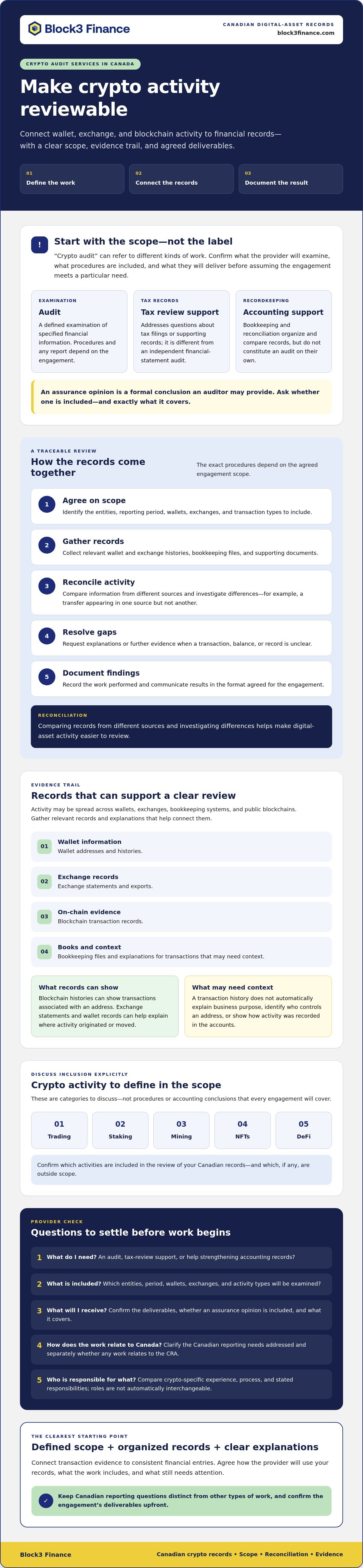
An audit is a defined examination of specified financial information. An independent financial-statement audit focuses on financial statements, but the procedures and any report depend on the engagement. An assurance opinion is a formal conclusion an auditor may provide about financial information. Ask whether an opinion is included and what it covers.
A tax-authority review is different. It concerns questions about tax filings or supporting records, rather than being an independent financial-statement audit. Bookkeeping and reconciliation help organize and compare records, but do not constitute an audit on their own or establish that an assurance opinion will be provided. Assess a provider’s audit services by the confirmed scope, not the label alone.
Why crypto activity needs a clear evidence trail
Blockchain histories can show transactions associated with an address. Exchange statements and wallet records can help explain where activity originated or moved. However, a transaction history doesn’t automatically explain its business purpose, identify who controls an address, or show how the activity was recorded in the accounts. Supporting records and clear explanations may be needed to connect those details.
Smart contracts can execute actions automatically when specified conditions are met. Understanding what smart contracts are may help explain why a blockchain record reflects an automated interaction. That doesn’t mean a financial-record review includes a technical security assessment of the contract.
Audit-ready crypto records connect transaction evidence to clear explanations and consistent financial entries. Discuss the records relevant to your situation with a prospective provider, including wallet addresses and histories, exchange statements, blockchain transaction records, and bookkeeping files. Agree how the provider will use those records before work begins.
How Crypto Audit Services Review Canadian Digital-Asset Records
A well-defined review brings separate records together into a traceable picture of digital-asset activity. The exact procedures depend on the engagement, so crypto audit services should start with an agreed scope rather than assumptions about what “crypto audit” includes.
A typical high-level sequence is:
- Agree on scope: Identify the entities, reporting period, wallets, exchanges, and transaction types to include.
- Gather records: Collect relevant wallet and exchange histories, bookkeeping files, and supporting documents.
- Reconcile activity: Compare records from different sources and investigate differences, such as a transfer that appears in one source but not another.
- Resolve gaps: Request explanations or further evidence where a transaction, balance, or record is unclear.
- Document findings: Record the work performed and communicate results in the format agreed for the engagement.
Potential scope items include trading, staking, mining, non-fungible tokens (NFTs), and decentralized finance (DeFi) activity. These are categories to discuss, not procedures or accounting conclusions that every engagement will cover. Confirm which activities are included in the review of your Canadian records and which, if any, are outside scope.
From blockchain activity to reviewable financial records
Wallet histories and exchange exports can be organized by account, date, and transaction, then compared with bookkeeping entries. For example, a transfer between two wallets controlled by the same entity may appear as separate blockchain activity. Supporting records can help explain how it was recorded. The appropriate treatment depends on the engagement and relevant Canadian requirements.
Keep transaction dates, asset quantities, source records, and explanations traceable to the entries they support. If a record is incomplete or a transaction’s purpose is unclear, flag it rather than filling the gap with an assumption. The reviewer can then ask focused questions and document how the difference was addressed.
Questions to settle before work begins
Before sharing records, confirm in writing which entities, wallets, periods, and transaction categories are covered. Ask what output you’ll receive, what reporting basis applies, what information you’re responsible for providing, and which activities or procedures are excluded.
These details help prevent bookkeeping from being mistaken for an independent audit, or a financial-record review from being mistaken for tax advice. Block3 Finance describes its audit services online, but confirm the proposed scope and deliverables directly for your needs. To discuss a potential engagement, you can contact the Block3 Finance team.
How to Compare Crypto Audit Providers Without Confusing Scope
Choose a provider based on the problem you need to solve, not the service label alone. A crypto accountant, tax preparer, and auditor aren’t automatically interchangeable. Their responsibilities and the work they perform can differ. Ask each provider to explain the Canadian scope, intended output, exclusions, and your responsibilities in writing.
What crypto-specific experience should a provider explain?
Look for clear answers about how the team works with wallet histories, exchange records, and blockchain activity, and how it identifies and documents incomplete or inconsistent data. The provider should explain technical terms in plain language and show how the proposed work relates to your Canadian situation. Avoid assuming that every engagement follows the same process.
Which service fits the problem you need to solve?
Use questions like these to compare providers and match the engagement to the outcome you need:
| Area | What to clarify |
|---|---|
| Scope | Which entities, periods, wallets, records, and activities are included? |
| Crypto experience | How does the team handle on-chain activity and reconcile it with financial records? |
| Record-handling process | How are missing or inconsistent source records identified, explained, and documented? |
| Deliverables | What will you receive, and what is it intended to help you do? |
| Communication | Who answers questions, explains findings, and identifies records you still need to provide? |
The service type matters, too. An audit engagement is a defined examination, with procedures that depend on its agreed scope. Bookkeeping organizes and maintains financial records. Tax filing prepares and reports tax information, while compliance support addresses specified internal or reporting processes. Don’t assume one service includes the others. A provider’s title alone doesn’t establish a particular assurance level or regulatory status.
If ongoing recordkeeping is what you need, explore crypto accounting services as a distinct service area. Before proceeding, request written confirmation of responsibilities, exclusions, reporting basis, and how the deliverable fits your intended use. That clarity lets you compare proposals based on the work itself, not terminology.
How to Prepare for a Crypto Audit Engagement in Canada
Preparation helps a provider understand which records you have and identify what may be missing. It doesn’t mean you’re performing an audit yourself, and gathering documents doesn’t determine what the engagement will conclude. Confirm the scope and required materials with the provider before spending time on extensive cleanup.
Records to organize before the initial discussion
Start with an inventory of records that may relate to the proposed Canadian engagement. Organize them by entity, account, platform, and period, then ask the provider which items are actually needed.
- Wallet histories and relevant blockchain transaction records.
- Exchange statements or transaction exports.
- Bookkeeping files and financial statements, if available.
- Supporting documents and brief explanations for transactions that may need context.
- A list of relevant entities, wallet ownership, and the systems or custodians used.
Don’t silently omit a wallet or unresolved transaction because its history is incomplete. Note what’s missing, what you know about the activity, and any steps already taken to locate supporting information. Ask the provider about preferred file formats and date ranges rather than assuming a particular export will be sufficient.
For a deeper readiness checklist, review crypto audit preparation guidance. Treat it as preparation support, not a substitute for agreeing on the engagement’s procedures and responsibilities.
Keep Canadian tax questions in the right scope
A financial-record review and a Canadian tax-return review may involve related documents, but they are not automatically the same service. If you need advice about a CRA filing or a question raised by the CRA, confirm that tax work is included and ask who is responsible for addressing it.
Direct questions about current Canadian tax requirements to the CRA or a qualified Canadian professional. Keep a separate list of tax questions for that discussion. Preparing records for an audit engagement doesn’t by itself resolve a tax position or filing issue.
Before sharing sensitive records, confirm in writing the engagement period, entities and activity included, intended deliverables, record-handling responsibilities, and known exclusions. This gives both sides a clear starting point for crypto audit services without treating readiness work as the audit itself. To discuss a potential engagement, contact Block3 Finance.
Choosing Crypto Audit Services: A Clear Next Step with Block3 Finance
Start by deciding what you need: an examination of financial information, help with Canadian tax filing, ongoing accounting, or compliance support. Then confirm the Canadian scope, assess the provider’s experience with digital-asset records, and agree on deliverables before work begins.
Block3 Finance is headquartered in Ontario and serves clients globally. The firm reports more than 13 years of blockchain financial expertise and over 980 clients globally, and lists audits and compliance among its services. These details provide context, not a promise of a particular audit opinion or deliverable. Confirm the exact work proposed for your organization directly with the firm.
What to bring to an initial service discussion
You don’t need to resolve every record before asking about an engagement. A concise overview can help determine whether the proposed work aligns with your needs. Be ready to describe:
- The Canadian entity or entities involved and the kinds of crypto activity they record.
- The wallets, exchanges, accounting systems, or other records available.
- Any unresolved reconciliation issues, missing records, or transactions that need explanation.
- The outcome you’re seeking, such as audit support, Canadian tax filing, or accounting assistance.
- Any questions about which Canadian requirements apply and which details you should confirm with the CRA.
Keep tax questions distinct from questions about financial records. If you need guidance on current CRA requirements or a tax-return position, identify that need explicitly and confirm who is responsible for addressing it.
Move from uncertainty to a defined engagement
Before proceeding, request written confirmation of the engagement’s scope, intended deliverables, responsibilities, and exclusions. Check that the document identifies the relevant entities, records, and period, and explains what the work is intended to support. This makes it easier to compare the proposed work with the outcome you need.
For crypto audit services, specialist knowledge matters because blockchain activity needs to be understood in context and connected carefully to financial records. Use your initial discussion to find out whether the provider can explain its process in plain language and identify what still needs clarification. A service label alone doesn’t guarantee a particular result.
If you’re ready to clarify the scope for your organization, discuss your crypto audit needs with Block3 Finance.
Turn Your Crypto Records Into a Clear Next Step
Choosing crypto audit services starts with defining the outcome you need. An audit, Canadian tax support, and ongoing accounting are different types of work. Confirm the provider’s Canadian scope, responsibilities, exclusions, and deliverables before engaging them.
Preparation matters, too. Organize the records you have, identify unresolved transactions, and ask what additional evidence is needed. A clear trail from digital-asset activity to financial records gives a review a practical starting point without assuming every engagement follows the same process.
Block3 Finance reports more than 13 years of blockchain financial expertise and serves over 980 clients globally. These details may inform your evaluation, but the next step is to discuss your organization’s specific needs and verify the proposed scope directly.
Discuss your Canadian crypto audit needs with Block3 Finance to clarify the scope for your organization.
Frequently Asked Questions
What do crypto audit services include?
Crypto audit services may examine selected financial records and digital-asset activity, but the exact work depends on the agreed scope. A provider might compare wallet histories, exchange statements, blockchain transactions, and bookkeeping entries, investigate differences, and document findings. Confirm which entities, periods, and activities are included, what procedures the provider will perform, and what deliverables you’ll receive. The service name alone doesn’t guarantee a particular audit opinion or assurance level.
Is a crypto audit the same as a CRA tax audit?
No. A financial-statement audit is a defined examination of financial information, while a CRA tax audit or review concerns information relevant to Canadian tax filings. They can involve some of the same records, but they have different purposes and aren’t interchangeable. If the CRA has contacted you, confirm what support the provider can offer and whether it covers your specific Canadian tax questions. Check current CRA requirements directly with the agency or a qualified Canadian professional.
Can a crypto accountant prepare my records for an audit?
Yes, a crypto accountant may help organize bookkeeping, reconcile activity, and assemble supporting records, depending on the services agreed. For example, they may help connect exchange statements and wallet histories to financial entries and flag transactions that need explanation. This readiness work doesn’t automatically mean the accountant is conducting an audit or providing an audit opinion. Confirm roles, responsibilities, and deliverables in writing so you know who prepares records and who examines them.
How do I choose a crypto audit provider in Canada?
Compare providers by the work they’ll perform, their experience with blockchain records, their process for handling incomplete data, and the clarity of their communication. Ask how the proposed engagement applies in Canada, what deliverables you’ll receive, and which records or procedures are excluded. A crypto accountant, tax preparer, and auditor aren’t automatically interchangeable. Request written confirmation of scope, responsibilities, and intended use, then assess whether the work matches the outcome you need.
What records should I gather before a crypto audit?
Start with records relevant to the proposed Canadian engagement: wallet histories, exchange statements or exports, bookkeeping files, and documents that explain transactions. Prepare a high-level list of relevant entities, wallets, platforms, and the period under review. Note missing records and unresolved transactions rather than silently leaving them out. Before collecting or reformatting everything, ask the provider which date ranges, file formats, and supporting documents are needed for the agreed scope.
Does every crypto business need an external audit?
Not necessarily. Whether an external audit is needed depends on the organization’s circumstances and applicable Canadian requirements or other commitments. The phrase “crypto business” alone doesn’t determine that. Review relevant agreements and obligations, and confirm any legal or reporting requirements with a qualified Canadian professional. If you’re considering an audit voluntarily, first define its purpose, such as supporting financial reporting or strengthening internal oversight, and clarify the intended deliverable.
Can an audit provider review DeFi, staking, NFT, or mining activity?
A provider may include decentralized finance (DeFi), staking, non-fungible token (NFT), or mining activity if it’s relevant and expressly included in the agreed scope. Ask how the team will use available wallet, exchange, and transaction records, and what explanations or supporting documents you should provide. Don’t assume every provider reviews every activity type or reaches the same accounting or tax conclusions. Confirm Canadian tax questions separately with the CRA or a qualified Canadian professional.

Article by
Mahad Mohamed
Mahad Mohamed is an accountant and the CEO of Block3 Finance, with over 26+ years of Canadian and international tax and accounting experience. A crypto accounting specialist since the early days of Bitcoin, he has consulted for over 38 crypto companies and collaborated with legal professionals on regulatory matters. His expertise spans corporate reorganization, cross-border tax structuring (Canada & US), tax disputes, and CRA audits.
Previously, Mahad worked for the Canada Revenue Agency (CRA), Big4 accounting firms, and served as a Rulings Officer for the Federal Tax Authority of the UAE before acquiring Tax Partners in 2014.
Block3 Finance and Tax Partners has 44 full-time accountants and over 9,800+ clients.
Disclaimer
This article provides general information only and is current as of its publication date. It has not been updated and may be out of date. It does not constitute legal advice and should not be relied upon as such. Every tax situation is unique and may differ from the examples discussed in this article. If you have specific questions, you should seek the advice of our accountants for your unique circumstances.
Frequently Asked Questions
What crypto-specific experience should a provider explain?
Look for clear answers about how the team works with wallet histories, exchange records, and blockchain activity, and how it identifies and documents incomplete or inconsistent data. The provider should explain technical terms in plain language and show how the proposed work relates to your Canadian situation. Avoid assuming that every engagement follows the same process.
Which service fits the problem you need to solve?
Use questions like these to compare providers and match the engagement to the outcome you need: The service type matters, too. An audit engagement is a defined examination, with procedures that depend on its agreed scope. Bookkeeping organizes and maintains financial records. Tax filing prepares and reports tax information, while compliance support addresses specified internal or reporting processes. Don’t assume one service includes the others. A provider’s title alone doesn’t establish a particular assurance level or regulatory status. If ongoing recordkeeping is what you need, explore crypto accounting services as a distinct service area. Before proceeding, request written confirmation of responsibilities, exclusions, reporting basis, and how the deliverable fits your intended use. That clarity lets you compare proposals based on the work itself, not terminology. Preparation helps a provider understand which records you have and identify what may be missing. It doesn’t mean you’re performing an audit yourself, and gathering documents doesn’t determine what the engagement will conclude. Confirm the scope and required materials with the provider before spending time on extensive cleanup.
What do crypto audit services include?
Crypto audit services may examine selected financial records and digital-asset activity, but the exact work depends on the agreed scope. A provider might compare wallet histories, exchange statements, blockchain transactions, and bookkeeping entries, investigate differences, and document findings. Confirm which entities, periods, and activities are included, what procedures the provider will perform, and what deliverables you’ll receive. The service name alone doesn’t guarantee a particular audit opinion or assurance level.
Is a crypto audit the same as a CRA tax audit?
No. A financial-statement audit is a defined examination of financial information, while a CRA tax audit or review concerns information relevant to Canadian tax filings. They can involve some of the same records, but they have different purposes and aren’t interchangeable. If the CRA has contacted you, confirm what support the provider can offer and whether it covers your specific Canadian tax questions. Check current CRA requirements directly with the agency or a qualified Canadian professional.
Can a crypto accountant prepare my records for an audit?
Yes, a crypto accountant may help organize bookkeeping, reconcile activity, and assemble supporting records, depending on the services agreed. For example, they may help connect exchange statements and wallet histories to financial entries and flag transactions that need explanation. This readiness work doesn’t automatically mean the accountant is conducting an audit or providing an audit opinion. Confirm roles, responsibilities, and deliverables in writing so you know who prepares records and who examines them.
How do I choose a crypto audit provider in Canada?
Compare providers by the work they’ll perform, their experience with blockchain records, their process for handling incomplete data, and the clarity of their communication. Ask how the proposed engagement applies in Canada, what deliverables you’ll receive, and which records or procedures are excluded. A crypto accountant, tax preparer, and auditor aren’t automatically interchangeable. Request written confirmation of scope, responsibilities, and intended use, then assess whether the work matches the outcome you need.
What records should I gather before a crypto audit?
Start with records relevant to the proposed Canadian engagement: wallet histories, exchange statements or exports, bookkeeping files, and documents that explain transactions. Prepare a high-level list of relevant entities, wallets, platforms, and the period under review. Note missing records and unresolved transactions rather than silently leaving them out. Before collecting or reformatting everything, ask the provider which date ranges, file formats, and supporting documents are needed for the agreed scope.
Does every crypto business need an external audit?
Not necessarily. Whether an external audit is needed depends on the organization’s circumstances and applicable Canadian requirements or other commitments. The phrase “crypto business” alone doesn’t determine that. Review relevant agreements and obligations, and confirm any legal or reporting requirements with a qualified Canadian professional. If you’re considering an audit voluntarily, first define its purpose, such as supporting financial reporting or strengthening internal oversight, and clarify the intended deliverable.
Can an audit provider review DeFi, staking, NFT, or mining activity?
A provider may include decentralized finance (DeFi), staking, non-fungible token (NFT), or mining activity if it’s relevant and expressly included in the agreed scope. Ask how the team will use available wallet, exchange, and transaction records, and what explanations or supporting documents you should provide. Don’t assume every provider reviews every activity type or reaches the same accounting or tax conclusions. Confirm Canadian tax questions separately with the CRA or a qualified Canadian professional.