
A high trade count doesn’t prove an accountant can handle your crypto records. For a crypto accountant for high volume traders, the real test is whether they can reconcile activity across exchanges, wallets, and chains, then explain how they resolved gaps and calculated cost basis under U.S. tax rules.
If your transaction history is scattered and manual tracking no longer feels reliable, that concern is justified. Incomplete records can make it difficult to review gains and losses or support the figures reported to the IRS.
This guide explains how to assess an accountant’s experience, data workflow, reconciliation methods, and review process. You’ll learn what to ask about privacy and record quality, how to distinguish a one-time tax filing from ongoing accounting support, and how to clarify each party’s responsibilities before you engage.
The goal isn’t to choose a firm based on transaction volume alone. It’s to find a specialist who can turn complex activity into organized, traceable records and explain what still needs attention.
Key Takeaways
- Assess a crypto accountant for high volume traders by asking how they reconcile exchange, wallet, and on-chain records, not by transaction count alone.
- Check whether their process tracks dates, transaction identifiers, asset quantities, and values consistently so records can be traced and reviewed.
- Compare accountants on data coverage, reconciliation, review, U.S. tax reporting, and communication before agreeing on an engagement.
- Prepare for a productive evaluation by listing accounts, exporting available records, identifying wallets, and flagging gaps while preserving original files.
- Clarify the scope and follow-up responsibilities, including whether tax filing, ongoing bookkeeping, or audit support fits your needs.
Why High-Volume Crypto Traders Need a Specialist Accountant in the U.S.
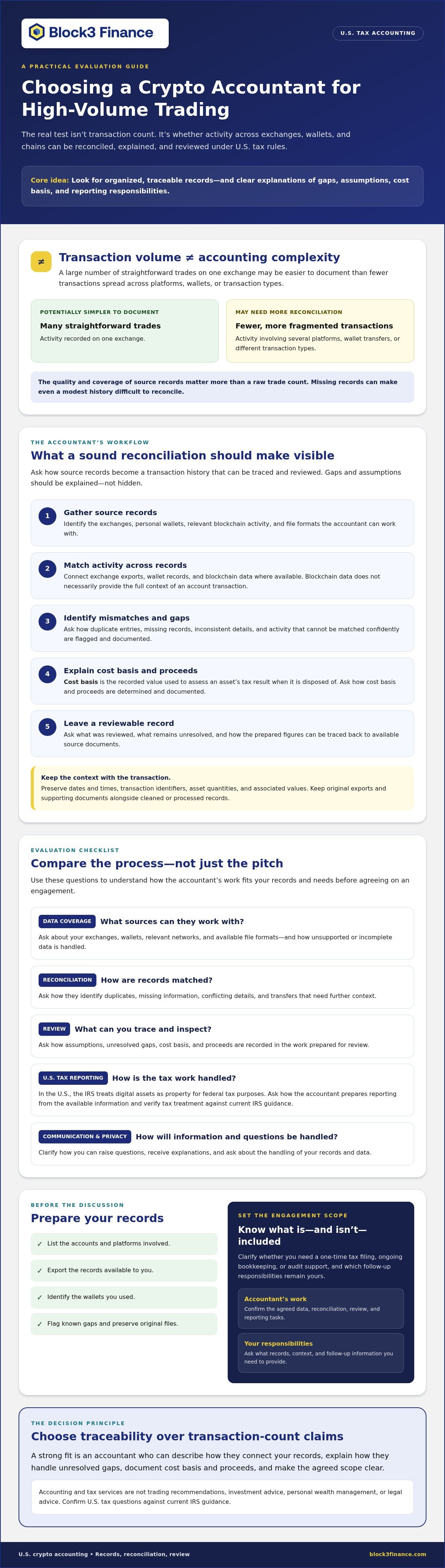
Trading across exchanges, personal wallets, and blockchain networks can fragment your records before tax preparation begins. A crypto accountant for high volume traders should be able to trace activity across those sources, identify where records don’t match, and explain how the resulting figures were prepared. The work is about organizing and documenting activity, not simply processing a large transaction count.
Volume alone doesn’t determine how difficult your accounting will be. A large number of straightforward trades on one exchange may be easier to document than fewer transactions involving several platforms, transfers between wallets, or different transaction types. In the U.S., the IRS treats digital assets as property for federal tax purposes. The U.S. Virtual Currency Law overview provides broader context, but check current tax treatment against IRS guidance.
Complete source data matters more than a raw transaction count. Without records showing where assets came from and where they went, even a modest trading history can be difficult to reconcile.
When trading activity becomes difficult to manage alone
Exchange exports may use different formats, repeat the same activity, omit timestamps, or leave gaps when an account closes. Transfers between wallets you control can add another layer: one record may show an outgoing asset, while the receiving wallet shows the corresponding deposit.
Reconciliation means matching activity across available records to identify gaps, duplicates, and inconsistencies. Don’t casually label a transfer between your own wallets as a taxable trade. Its treatment depends on what actually happened, so preserve transaction details and confirm U.S. tax treatment with a qualified professional or current IRS guidance.
What a specialist accountant can and cannot do
Within an agreed scope, an accountant can help organize transaction records and prepare tax reporting from the information available. Before engaging one, ask what data they need, how they handle missing or conflicting records, what work they’ll review, and which reporting responsibilities remain yours.
Accounting and tax services aren’t trading recommendations, investment advice, personal wealth management, or legal advice. For a broader introduction to U.S. filing considerations, see this cryptocurrency tax filing guide, then confirm tax questions against current IRS guidance.
What a High-Volume Crypto Accountant Should Reconcile
A sound reconciliation process connects records from centralized exchanges, personal wallets, and relevant blockchain activity into a transaction history that can be reviewed. Before engaging a crypto accountant for high volume traders, ask which exchanges, wallets, networks, and file formats they can work with. Also ask how they identify activity that can’t be matched confidently.
Reconciliation matches source records into a traceable transaction history. Gaps and assumptions should be made visible rather than hidden.
Exchange, wallet, and on-chain records
Exchange exports may show trades, deposits, withdrawals, fees, and timestamps. Wallet records and blockchain data can help clarify transfers and activity on supported networks. But blockchain data doesn’t necessarily establish the complete context of an account transaction, so it shouldn’t replace exchange statements or other source records.
Ask how the accountant will document and handle:
- Dates and times, including differences in how platforms record them.
- Transaction identifiers, asset quantities, and values associated with activity.
- Duplicate entries, missing records, and conflicting details across sources.
Keep original exports and supporting documents alongside any cleaned or processed records. If information is missing, a sound process should flag the issue, note what was reviewed, and explain any unresolved limitation. No accountant can promise that unavailable source data can always be recovered.
Cost basis, proceeds, and reviewable workpapers
Cost basis is the recorded value used to assess an asset’s tax result when it is disposed of. For U.S. reporting, ask how the accountant determines and documents cost basis and proceeds. Verify the relevant treatment against current IRS guidance, including the IRS Virtual Currency FAQs.
Useful workpapers, meaning records that show how reported figures were prepared, should let you trace a result back to its source. Ask how the accountant records assumptions, unresolved transactions, and data limitations, and what review you’ll receive before reporting is finalized.
If your trading activity calls for regular oversight rather than a one-time filing, compare the scope of ongoing bookkeeping with your needs. Block3 Finance provides monthly accounting services for digital asset activity. You can discuss your data sources and reporting needs before deciding whether the proposed scope fits.
How to Compare Crypto Accountants for High-Volume Trading
A specialist label alone doesn’t guarantee complete records or accurate reporting. A crypto accountant for high volume traders still depends on the source data you provide, the scope you agree to, and a clear process for reviewing uncertain transactions. Compare providers against the same practical criteria, then look for specific explanations of how they work rather than broad claims about handling large volumes.
| Area | What to evaluate | Question to ask |
|---|---|---|
| Data coverage | Supported exchanges, wallets, networks, file formats, and transaction types | Which of my accounts and activity types are within scope? |
| Reconciliation | How records are matched and missing, duplicate, or conflicting entries are flagged | How do you identify and document exceptions? |
| Review | Who checks unusual items and how unresolved issues are presented | Who reviews exceptions, and what will I see before work is finalized? |
| Reporting | What U.S. tax reporting deliverables are included and what assumptions they rely on | How are calculations tied back to source records? |
| Communication | Expected updates, client responsibilities, and how corrections are handled | How will we raise questions or provide missing information? |
A repeatable workflow should be easy to explain: the accountant can describe how records move from intake through reconciliation and review, and how you’ll hear about unresolved items. Ask for a clear description of the process rather than a promise based on transaction count. You can also discuss your trading records with Block3 Finance to clarify whether your data sources and reporting needs fit the proposed engagement scope.
Questions to ask before engaging an accountant
Ask which exchanges, wallets, networks, and transaction types the proposed scope covers, and what records you must supply. Clarify how missing information is flagged, who reviews exceptions, what deliverables you’ll receive, and how your responsibilities and review steps will be documented.
Specific answers help show whether the accountant has a defined workflow for your actual activity, not just general familiarity with digital assets. Make sure the engagement explains how you’ll review open questions and provide corrections or additional records.
Warning signs in a provider’s answers
Be cautious of guaranteed outcomes offered before anyone has reviewed your transaction history and source records. Vague answers about data security, missing transactions, exception review, or correction procedures also make it difficult to understand how the work will be controlled.
A general accountant may be a strong professional, but broad crypto claims aren’t proof of relevant experience. Ask for examples of the workflow they use for comparable record types, without requesting information that would expose another client’s confidential details.
Prepare Your Trading Records Before Hiring a U.S. Crypto Accountant
A structured intake makes it easier to see which records exist, where gaps remain, and what questions an accountant needs to resolve. It won’t replace professional analysis, but it can make your U.S. tax review more focused and help you agree on a clear engagement scope.
A practical intake checklist for active traders
Work through this sequence before sending records to a prospective crypto accountant for high volume traders:
- List your accounts. Record each exchange, wallet, blockchain network, and the period in which you used it. Include accounts you’ve closed or can no longer access.
- Export available records. Gather transaction histories, account statements, and records of transfers. Preserve the original files, even if you later organize copies into a different format.
- Identify your wallets. Note which wallets you control and, where known, which exchange or wallet received assets from each transfer.
- Flag gaps and questions. Mark incomplete periods, manual entries, unavailable account histories, and activity you can’t confidently classify. Don’t silently fill in missing details or discard conflicting records.
For supporting-documentation considerations, review Block3 Finance’s audit and compliance support information. Keep records that explain how you assembled your files, including notes about known account closures or missing exports.
Questions about scope, security, and ongoing support
Before sharing sensitive data, ask how records will be transferred, who can access them, how they’ll be stored, and what happens to them when the engagement ends. Get clear answers about handling access credentials. Don’t assume an accountant needs your passwords or private keys.
Then define the work in writing. Does the engagement cover a one-time U.S. tax filing, monthly bookkeeping, or both? Ask how later corrections or newly discovered records will be handled, who reviews changes, and whether follow-up work falls within the agreed scope.
Also confirm which U.S. deadlines, forms, and reporting rules apply to your filing situation, and check current requirements with the IRS. Tax rules and filing details can change, so don’t treat an old checklist or prior-year process as current guidance.
Once your records are organized, you can discuss your trading records and reporting needs with Block3 Finance and clarify the appropriate scope before deciding how to proceed.
Choose a U.S. Crypto Accountant Who Can Support Your Trading Activity
The right engagement starts with a clear view of your records, the accountant’s workflow, how exceptions are reviewed, and what the agreed scope includes. Communication matters too: you should understand what information you need to provide, what work you’ll receive, and how open questions will be handled.
Block3 Finance provides crypto tax filing and reporting, monthly accounting, and audit and compliance support. Which service fits depends on your activity and needs, so confirm the specific scope before making a decision. Block3 Finance serves more than 980 clients globally and brings over 13 years of blockchain financial expertise.
For broader provider-selection context, explore these crypto accountant resources.
When one-time tax filing may be enough
A limited filing engagement may suit a trader whose records are organized and whose reporting needs are clearly defined. A high transaction count alone doesn’t mean monthly bookkeeping is necessary. The accountant should first review the available records and confirm what the filing scope covers.
When ongoing accounting or audit support may help
If trading activity continues throughout the year or records need regular attention, discuss whether ongoing accounting is appropriate. Audit and compliance support may also help organize records and provide professional assistance within the agreed engagement, but confirm exactly what that support includes.
Before choosing a crypto accountant for high volume traders, compare the proposed deliverables, review process, responsibilities, and follow-up arrangements. A suitable engagement should make both the accountant’s work and your role clear.
Discuss your crypto accounting needs with Block3 Finance by sharing your data sources, reporting priorities, and the support you’re considering.
Build a Clearer Path for Your Crypto Tax Reporting
Choosing a crypto accountant for high volume traders means looking beyond a specialist label. Prioritize a clear reconciliation workflow, reviewable records, defined responsibilities, and communication that keeps unresolved questions visible. Then match the engagement to your needs, whether that’s a defined U.S. tax filing or ongoing accounting support.
Block3 Finance provides crypto tax filing and reporting, monthly accounting, and audit and compliance support. Ask which activities and records fit the proposed scope, and confirm how the work will support your U.S. reporting needs. Block3 Finance serves more than 980 clients globally and has over 13 years of blockchain financial expertise.
Discuss your high-volume crypto accounting needs with Block3 Finance by sharing your data sources, reporting priorities, and the support you’re considering. A thoughtful review can help turn fragmented activity into records you can understand and use with greater confidence.
Frequently Asked Questions
When should a high-volume crypto trader hire an accountant?
Consider hiring an accountant when you can’t confidently reconcile activity or prepare U.S. tax records from the information available. Signals include fragmented exchange histories, multiple wallets, unexplained transfers, or uncertainty about how transactions should be documented. High trade volume alone doesn’t mean you need ongoing accounting. The complexity of your data and activity, your reporting needs, and the time you can devote to recordkeeping matter too.
What does a crypto accountant need from a high-volume trader?
An accountant will generally need records for the activity included in the agreed scope. Prepare exchange transaction exports and statements, a list of wallets and networks used, relevant transaction periods, and supporting information about transfers. Preserve original files, and flag missing histories, manual entries, and activity you can’t confidently classify. The accountant should clarify which records are required and how gaps or conflicting information will be addressed.
Can a crypto accountant reconcile transactions across multiple exchanges and wallets?
They may be able to if the platforms, wallets, networks, and transaction types are within the agreed scope and usable records are available. Ask how the accountant matches exchange exports with wallet and blockchain activity, identifies duplicates, and documents unmatched items. Blockchain records can help trace activity, but they may not provide the full context held in account statements or other source records.
How do I know if a crypto accountant understands high-volume trading?
Look for a clear, repeatable explanation of how they handle your actual data sources, not just a claim that they work with high transaction counts. Ask how records move through reconciliation and review, who examines exceptions, and how unresolved items are reported to you. A qualified provider should also explain deliverables, client responsibilities, and the limits of what can be concluded from incomplete source data.
Is crypto accounting software enough for a high-volume trader?
It depends on the quality of your source records, the types of activity involved, and your ability to review the output. Software may help organize transaction data, but it can’t necessarily resolve missing records, conflicting entries, or uncertain transaction classifications without further review. Compare the software’s output against source documents and consider professional support if you can’t explain how reported figures were produced or what assumptions were used.
Does a U.S. crypto accountant also provide trading or investment advice?
Not necessarily, and accounting or tax reporting should not be confused with trading recommendations. Block3 Finance provides crypto tax filing and reporting, monthly accounting, and audit and compliance support, but does not offer investment or trading advice or personal wealth management. Ask the provider to define its scope in writing, and seek qualified advice separately if you need help making investment decisions.
What should I ask before hiring a crypto accountant for U.S. tax reporting?
Ask which exchanges, wallets, networks, and transaction types the engagement covers, what records you must provide, and how missing or conflicting data will be handled. Clarify who reviews exceptions, what deliverables you’ll receive, how corrections work, and whether the scope is a one-time tax filing or ongoing accounting. Confirm that U.S. tax reporting details will be checked against current IRS guidance, since requirements can change.
Discuss your crypto tax filing and accounting needs with Block3 Finance to clarify which service scope fits your records and reporting priorities.

Article by
Mahad Mohamed
Mahad Mohamed is an accountant and the CEO of Block3 Finance, with over 26+ years of Canadian and international tax and accounting experience. A crypto accounting specialist since the early days of Bitcoin, he has consulted for over 38 crypto companies and collaborated with legal professionals on regulatory matters. His expertise spans corporate reorganization, cross-border tax structuring (Canada & US), tax disputes, and CRA audits.
Previously, Mahad worked for the Canada Revenue Agency (CRA), Big4 accounting firms, and served as a Rulings Officer for the Federal Tax Authority of the UAE before acquiring Tax Partners in 2014.
Block3 Finance and Tax Partners has 44 full-time accountants and over 9,800+ clients.
Disclaimer
This article provides general information only and is current as of its publication date. It has not been updated and may be out of date. It does not constitute legal advice and should not be relied upon as such. Every tax situation is unique and may differ from the examples discussed in this article. If you have specific questions, you should seek the advice of our accountants for your unique circumstances.
Frequently Asked Questions
When should a high-volume crypto trader hire an accountant?
Consider hiring an accountant when you can’t confidently reconcile activity or prepare U.S. tax records from the information available. Signals include fragmented exchange histories, multiple wallets, unexplained transfers, or uncertainty about how transactions should be documented. High trade volume alone doesn’t mean you need ongoing accounting. The complexity of your data and activity, your reporting needs, and the time you can devote to recordkeeping matter too.
What does a crypto accountant need from a high-volume trader?
An accountant will generally need records for the activity included in the agreed scope. Prepare exchange transaction exports and statements, a list of wallets and networks used, relevant transaction periods, and supporting information about transfers. Preserve original files, and flag missing histories, manual entries, and activity you can’t confidently classify. The accountant should clarify which records are required and how gaps or conflicting information will be addressed.
Can a crypto accountant reconcile transactions across multiple exchanges and wallets?
They may be able to if the platforms, wallets, networks, and transaction types are within the agreed scope and usable records are available. Ask how the accountant matches exchange exports with wallet and blockchain activity, identifies duplicates, and documents unmatched items. Blockchain records can help trace activity, but they may not provide the full context held in account statements or other source records.
How do I know if a crypto accountant understands high-volume trading?
Look for a clear, repeatable explanation of how they handle your actual data sources, not just a claim that they work with high transaction counts. Ask how records move through reconciliation and review, who examines exceptions, and how unresolved items are reported to you. A qualified provider should also explain deliverables, client responsibilities, and the limits of what can be concluded from incomplete source data.
Is crypto accounting software enough for a high-volume trader?
It depends on the quality of your source records, the types of activity involved, and your ability to review the output. Software may help organize transaction data, but it can’t necessarily resolve missing records, conflicting entries, or uncertain transaction classifications without further review. Compare the software’s output against source documents and consider professional support if you can’t explain how reported figures were produced or what assumptions were used.
Does a U.S. crypto accountant also provide trading or investment advice?
Not necessarily, and accounting or tax reporting should not be confused with trading recommendations. Block3 Finance provides crypto tax filing and reporting, monthly accounting, and audit and compliance support, but does not offer investment or trading advice or personal wealth management. Ask the provider to define its scope in writing, and seek qualified advice separately if you need help making investment decisions.
What should I ask before hiring a crypto accountant for U.S. tax reporting?
Ask which exchanges, wallets, networks, and transaction types the engagement covers, what records you must provide, and how missing or conflicting data will be handled. Clarify who reviews exceptions, what deliverables you’ll receive, how corrections work, and whether the scope is a one-time tax filing or ongoing accounting. Confirm that U.S. tax reporting details will be checked against current IRS guidance, since requirements can change. Discuss your crypto tax filing and accounting needs with Block3 Finance to clarify which service scope fits your records and reporting priorities.