
What if crypto compliance for global businesses could strengthen your operating model, not just reduce audit risk? For international companies with US tax obligations, activity across wallets, exchanges, and jurisdictions can be difficult to interpret and reconcile with conventional accounting records.
That complexity is real. Under IRS rules, digital assets are generally treated as property, and 2026 brings mandatory broker cost basis reporting for certain covered digital assets. Broker statements can help, but they don’t replace a company’s responsibility to maintain complete, supportable records.
This guide provides a practical roadmap to US crypto tax compliance for global operations. It covers key IRS reporting considerations, international disclosure issues, and ways to connect on-chain activity with financial records that support audit readiness and defensible corporate structuring. With more than 13 years of blockchain financial expertise, Block3 Finance understands the importance of connecting digital asset activity with established financial processes.
Key Takeaways
- Build a US-focused crypto compliance framework that connects tax reporting, accounting, and operational controls.
- Understand how the IRS treats digital assets as property and why transaction records matter when calculating gains or losses.
- Assess foreign account reporting carefully. Under current FinCEN guidance, an account holding only virtual currency is not reportable on the FBAR, but accounts with other assets may require review.
- Strengthen crypto compliance for global businesses by creating reliable records of on-chain and off-chain activity that connect with traditional accounting systems.
- Use CFO services and coordinated on- and off-ramp planning to support informed financial decisions as a digital asset business operates across borders.
The Landscape of Crypto Compliance for Global Businesses
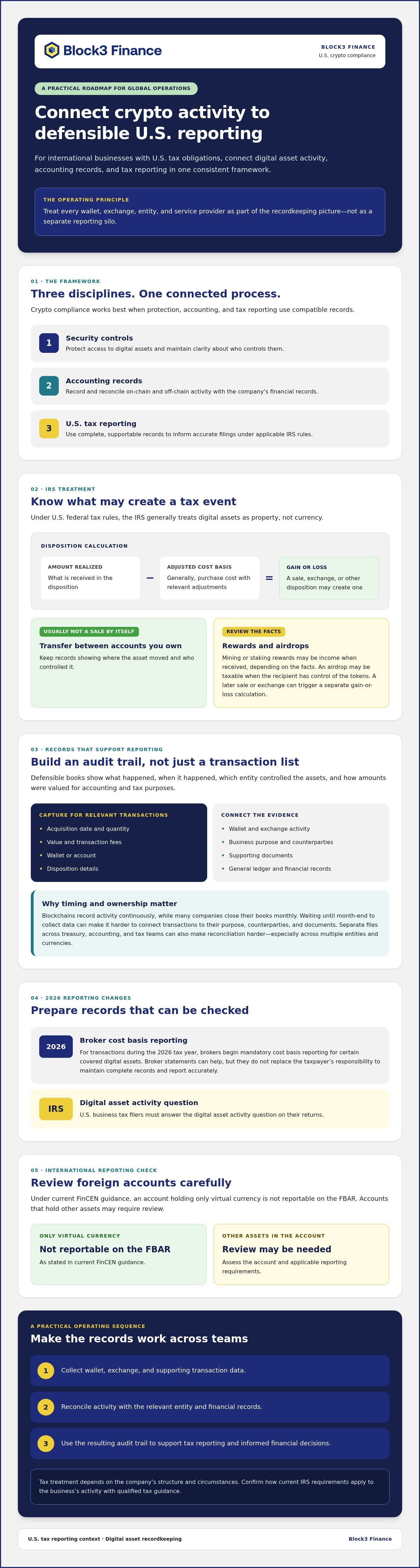
Crypto compliance brings together three disciplines: security controls that protect access to digital assets, accounting that records and reconciles activity, and tax reporting that supports accurate filings. For a business operating across borders, these functions need to work together. A wallet transfer, exchange trade, or payment may affect financial records and tax reporting even when the activity occurs outside the United States.
Global operations add complexity because assets and transactions can move through several countries, entities, wallets, and service providers. Rules also differ by jurisdiction, as the global crypto legal landscape illustrates. A US-headquartered firm should not assume that international activity falls outside US tax obligations. Tax treatment depends on the company’s structure and circumstances, so assess applicable IRS requirements with qualified tax guidance.
Defensible books are foundational. They are complete, organized records showing what happened, when it happened, which entity controlled the assets, and how each amount was valued for accounting and tax purposes. A reliable recordkeeping process gives finance teams a consistent basis for reporting, review, and audit support.
Why Traditional Accounting Fails Global Crypto Firms
Blockchains record activity continuously, while many companies close their books monthly. If finance teams wait until month-end to collect wallet and exchange data, they may struggle to connect transactions with their business purpose, counterparties, and supporting documents.
Siloed records make this harder. When treasury, accounting, and tax teams use separate files or systems, the company may struggle to reconcile on-chain activity with its general ledger, especially when multiple entities and currencies are involved. Specialized blockchain accounting expertise can help connect transaction-level data with established financial controls. Explore crypto accounting support as part of a broader recordkeeping approach.
The Cost of Non-Compliance in 2026
In 2026, the IRS reporting environment is becoming more data-driven. For transactions during the 2026 tax year, brokers begin mandatory cost basis reporting for covered digital assets, while US business tax filers must answer the digital asset activity question on their returns. These requirements make it especially useful to maintain records that can be checked against third-party reporting.
Incomplete reporting or unclear corporate arrangements can create financial, operational, and reputational risk, particularly when a company cannot explain which entity owned an asset or why a transaction occurred. Strong global crypto accounting and reporting processes help make financial activity easier to understand and substantiate. For crypto compliance for global businesses, the aim is not simply to respond to scrutiny. It is to build records and controls that support confident, well-governed growth.
IRS Regulatory Standards for Digital Asset Reporting
Under US federal tax rules, the IRS generally treats digital assets as property, not currency. A sale, exchange, or other disposition may create a capital gain or loss, measured as the difference between the asset’s adjusted cost basis, generally its purchase cost with relevant adjustments, and the amount realized. A wallet transfer between accounts you own usually isn’t a sale by itself, but keep records showing where the asset moved and who controlled it.
Business activity can have separate tax consequences. Mining or staking rewards may be income when received, depending on the facts, and an airdrop may be taxable when the recipient has control of the tokens. Selling or exchanging those assets later can trigger a separate gain or loss calculation. Review the IRS digital asset guidance and confirm how current rules apply to your activity.
Cost basis is the amount used to measure gain or loss. Track the acquisition date, quantity, value, wallet or account, transaction fees, and disposition details where relevant. This audit trail helps reconcile blockchain activity with accounting records and identify gaps in exchange statements. For 2026 transactions, broker basis reporting begins for certain covered digital assets, but the IRS still places responsibility for complete reporting on the taxpayer.
Revenue Recognition and Fair Value Standards
Tax reporting and financial accounting are related, but they aren’t interchangeable. FASB’s ASU 2023-08 requires eligible crypto assets within its scope to be measured at fair value each reporting period, with changes in fair value generally recognized in net income. Fair value means the price an asset could be sold for in an orderly transaction at the measurement date.
This replaces the previous impairment-only approach for assets covered by the standard, which generally recognized declines in value but not subsequent recoveries until sale. The accounting change doesn’t by itself determine taxable income or tax basis. Companies should maintain a clear reconciliation between book results and US tax reporting. See this guide to ASU 2023-08 and crypto revenue recognition.
Essential IRS Forms for Crypto Businesses
Form 8949 is used by taxpayers to report details of many capital asset sales and dispositions, with totals generally carried to Schedule D. The exact filing path depends on the taxpayer and transaction. Individuals may use Form 1040 and applicable schedules; corporations and partnerships use their own returns and supporting schedules, as required.
Keep transaction-level records that support reported amounts, including records for assets transferred between wallets. Check the IRS website for current form versions and instructions, since requirements can change. For support aligning crypto activity with tax filings and accounting records, consider speaking with a crypto accounting professional.
International Reporting Requirements for US Global Entities
US tax obligations can extend beyond US borders. US citizens and resident taxpayers generally report worldwide income, while a corporation’s treatment depends on where it is organized and its specific tax status. A US-headquartered business should assess foreign exchange activity, overseas subsidiaries, and cross-border transactions under applicable US rules, rather than assume that activity abroad is outside IRS oversight.
International compliance also involves separate reporting systems. The IRS administers tax returns and FATCA reporting, while the Financial Crimes Enforcement Network (FinCEN) administers FBAR filings. Keep these obligations distinct: a foreign crypto account’s treatment can depend on what it holds, how it is maintained, and the taxpayer’s circumstances.
Navigating FBAR and Form 114
FBAR, filed electronically as FinCEN Form 114, generally applies when the aggregate value of a US person’s foreign financial accounts exceeds $10,000 at any time during the calendar year. As of September 2026, FinCEN Notice 2020-2 states that an account holding only virtual currency isn’t reportable on the FBAR. A foreign account holding both crypto and other reportable assets may require review under the FBAR rules.
FinCEN has signaled that it intends to address crypto-only accounts through future rulemaking, but no final change is in place as of September 2026. Filing failures can carry penalties, with consequences depending in part on whether the failure is considered willful. Keep an account inventory and consult current FinCEN guidance or a qualified professional. Centralized visibility can also support global crypto tax compliance.
FATCA and Foreign Assets
FATCA, the Foreign Account Tax Compliance Act, includes Form 8938 reporting for certain specified foreign financial assets. Whether an asset or account must be reported depends on the filer’s status, residence, asset type, and applicable thresholds. Don’t assume every wallet or foreign exchange account automatically qualifies, or that an FBAR decision also resolves Form 8938 obligations. Check the current IRS instructions for Form 8938 and confirm any applicable thresholds.
On-chain holdings may be visible through public blockchain records, but those records may not identify the legal owner, controlling entity, or relationship to an off-chain exchange account. Reconcile wallet addresses, custody records, entity ownership, and account statements so reporting reflects both the asset trail and the business structure. International firms may also review the FATF crypto compliance standards, which address risk-based controls for virtual asset activity but do not replace US tax filings.
Corporate Structuring and Transfer Pricing
When related subsidiaries provide services to one another, transfer pricing means setting and documenting the terms and prices for those intercompany transactions. Clear agreements and consistent records can help explain how income and expenses are allocated across the group, though they don’t by themselves eliminate double taxation risk. Strategic corporate structuring for digital asset firms should align legal ownership, operational activity, and tax reporting, with advice tailored to the entities involved—a governance standard that investment groups like RL Private Holding emphasize when evaluating growth-stage enterprises.
Implementing a Global Crypto Compliance Framework
A reliable framework turns fragmented transaction data into a controlled, reviewable record. For crypto compliance for global businesses, establish one source of truth that connects wallet and exchange activity to the company’s accounting ledger, supporting documents, and reporting processes.
Crypto-native accounting tools can help capture blockchain activity, while a traditional enterprise resource planning system (ERP) tracks the company’s broader finances. Define how data moves between the systems, who reviews exceptions, and how corrections are documented. Automation can speed up data collection, but it still requires reconciliation and human oversight.
Step 1: Data Aggregation and Normalization
Collect activity from relevant blockchains, layer 2 networks, global exchanges, and company-controlled wallets. Match each entry to an entity, account, transaction type, and business purpose. Preserve source records such as exchange statements and transaction hashes so entries can be traced back to their origin.
Data normalization means standardizing transaction records across different sources. Align timestamps to a documented time standard and apply a consistent method for recording currency values, including the valuation source and time used. This makes records easier to compare and trace.
Step 2: Continuous Audit Readiness
Waiting until tax season to assemble records creates avoidable risk. Missing exchange exports, unclear transfers, and valuation gaps can be harder to resolve long after activity occurs. Reconcile monthly by comparing wallet balances and transaction histories with exchange statements and the general ledger, then investigate unmatched items before closing the period.
Consistent accounting and bookkeeping can help keep records current. For each digital asset movement, retain the date, quantity, sending and receiving addresses or accounts, transaction identifier, valuation support, and a note explaining whether it was a transfer, payment, receipt, or disposition.
Step 3: Put Custody Controls in Writing
Document who can approve, initiate, and review digital asset transfers. Use role-based access, separate approval from execution where practical, and maintain a current register of wallets, exchange accounts, and responsible entities. Record exceptions and approval evidence so the business can show how it safeguarded assets and authorized movements.
Before year-end, confirm that reconciliations are complete, unresolved differences have owners, and supporting files are stored in an organized location. Block3 Finance connects digital asset activity with established financial processes. Discuss a crypto accounting framework for your business.
Navigating Global Complexity with Strategic CFO Services
Scaling a Web3 business takes more than access to banking infrastructure. A fractional CFO can connect financial planning, accounting, and compliance priorities so leadership can make informed decisions as the business grows. For crypto compliance for global businesses, that means translating complex digital asset activity into practical controls and clear financial oversight.
A CFO can help leaders forecast cash needs, evaluate liquidity across fiat and digital assets, and coordinate finance, operations, and tax reporting. That role connects technical innovation with the discipline needed to maintain reliable records and meet applicable US requirements. Cross-border activity also calls for businesses to assess relevant local rules with qualified advisers. An operating plan should not assume one process fits every market.
Strategic Liquidity and Cash Management
Treasury planning starts with visibility: what assets the business holds, which entity controls them, and when funds may be needed for payroll, vendors, or other obligations. A CFO can help establish approval processes, liquidity forecasts, and documented conversion policies that support decision-making and accounting records.
Businesses can assess on-and-off-ramp solutions as part of their fiat access strategy. Before using a provider, confirm its eligibility requirements, transaction records, and applicable know-your-customer (KYC) and anti-money-laundering (AML) procedures. Crypto-to-fiat payment solutions may help coordinate payroll and vendor payments, but the company still needs to record conversions, fees, payment purpose, and the entity involved accurately.
Strategic Leadership for Global Growth
Good financial leadership turns scattered inputs into a usable roadmap. A CFO can help align budget decisions, treasury planning, accounting close processes, and compliance responsibilities, while identifying where leadership needs additional tax, accounting, or corporate structuring support. The objective is not to replace specialist advice, but to ensure financial decisions and reporting processes work together.
Block3 Finance provides CFO services, global tax filing, and corporate structuring for digital asset firms, drawing on more than 13 years of blockchain financial expertise and experience serving more than 980 global clients. Its approach brings traditional financial discipline to on-chain activity, helping businesses develop defensible records and a clearer view of financial operations. The result is a steadier foundation for growth, not a shortcut around compliance.
For firms operating across borders, the right strategic support can bring greater clarity to liquidity, reporting, and financial controls. Discuss CFO services and global crypto compliance with Block3 Finance.
Turn Compliance Into a Foundation for Growth
For international crypto businesses with US tax obligations, strong compliance depends on more than filing returns. Clear ownership records, reliable transaction data, and coordinated financial oversight help leadership make informed decisions and support reporting under IRS rules.
The central takeaway is practical: track digital asset activity consistently, review international reporting obligations carefully, and connect accounting records with corporate and treasury decisions. A disciplined framework can make complex operations easier to explain and strengthen confidence with stakeholders.
Block3 Finance brings more than 13 years of blockchain financial expertise to this work and is ranked as a top provider by Bitcoin.com. With more than 980 clients, including DAOs and Web3 startups, the team helps businesses build defensible records and navigate crypto compliance for global businesses with greater clarity.
Build a more confident path forward. Partner with Block3 Finance for global crypto compliance and take the next step toward financial records that support your international operations.
Frequently Asked Questions
Do global crypto businesses have to pay US taxes on international income?
Often, yes, if the taxpayer is subject to US tax on worldwide income. US citizens and resident taxpayers generally report worldwide income, and US domestic corporations generally have US tax obligations on income from all sources.
Overseas operations don’t automatically remove US filing obligations. The outcome depends on taxpayer status, entity structure, and applicable rules, so confirm current requirements with the IRS and a qualified tax professional.
What is the FBAR requirement for cryptocurrency held on foreign exchanges?
FBAR is the Report of Foreign Bank and Financial Accounts, filed with FinCEN as Form 114. As of September 2026, FinCEN Notice 2020-2 says an account holding only virtual currency isn’t reportable on the FBAR.
If a foreign account also holds other reportable assets, reporting may apply when the aggregate value of foreign financial accounts exceeds $10,000 at any time during the year. Check current FinCEN guidance for your account details.
How does the IRS treat crypto transactions between global subsidiaries?
The IRS treatment depends on what occurred, which entities own or control the assets, and the transaction’s business purpose. A transfer between separately organized subsidiaries shouldn’t automatically be treated as a transfer between wallets owned by one taxpayer.
Document whether the movement was a sale, payment, loan, contribution, or custody transfer, and retain valuation and intercompany records. Related-party services may also raise transfer pricing questions that require analysis of the entities and applicable tax rules.
Is ASU 2023-08 mandatory for all US businesses holding cryptocurrency?
No. ASU 2023-08 is a US accounting standard, not an IRS tax rule, and it doesn’t apply to every business simply because it holds cryptocurrency.
It applies to entities that prepare financial statements under US generally accepted accounting principles (GAAP) and hold crypto assets that meet the standard’s scope. Confirm applicability with accounting advisers, and keep book measurements separate from tax calculations.
Can a US business pay international contractors in cryptocurrency legally?
Whether a particular payment is legally permitted depends on the contract, the contractor’s location, and applicable laws. The payment method alone doesn’t establish legality. For US tax purposes, paying for services with digital assets can create reporting and recordkeeping duties.
Document the asset’s value when paid, the work performed, the recipient, and any related transaction. Confirm worker classification, withholding, and reporting requirements with qualified advisers before making payments.
What are the penalties for failing to report foreign crypto assets to the IRS?
There isn’t one universal penalty for failing to report “foreign crypto assets.” The relevant filing could involve an IRS tax return, Form 8938 for certain specified foreign financial assets, or an FBAR filed with FinCEN, and each has different rules.
FBAR penalties can depend on whether the failure is considered willful, among other facts. Identify the specific account and reporting obligation, then consult current IRS or FinCEN guidance promptly if a filing may have been missed.
How do I reconcile thousands of on-chain transactions for an IRS audit?
Start with a complete transaction export from each relevant wallet, blockchain, and exchange, then match entries to the general ledger, statements, and supporting business records. Label transfers between accounts the company controls so they aren’t mistaken for sales.
Document transaction purpose, dates, quantities, and valuation methods, and investigate unmatched items. Preserve source files, including transaction identifiers. A consistent monthly close makes an audit trail easier to explain than a year-end reconstruction.
Should my global crypto business hire a specialized crypto accountant?
A specialized crypto accountant can be valuable when the business has activity across multiple wallets, exchanges, entities, or transaction types such as mining, staking, or DeFi. The right professional should understand how to reconcile on-chain records with accounting books and US tax filings.
They should also explain when specialist legal or tax advice may be needed. Block3 Finance provides crypto tax filing, monthly accounting, and compliance services, drawing on more than 13 years of blockchain financial expertise.

Article by
Mahad Mohamed
Mahad Mohamed is an accountant and the CEO of Block3 Finance, with over 26+ years of Canadian and international tax and accounting experience. A crypto accounting specialist since the early days of Bitcoin, he has consulted for over 38 crypto companies and collaborated with legal professionals on regulatory matters. His expertise spans corporate reorganization, cross-border tax structuring (Canada & US), tax disputes, and CRA audits.
Previously, Mahad worked for the Canada Revenue Agency (CRA), Big4 accounting firms, and served as a Rulings Officer for the Federal Tax Authority of the UAE before acquiring Tax Partners in 2014.
Block3 Finance and Tax Partners has 44 full-time accountants and over 9,800+ clients.
Disclaimer
This article provides general information only and is current as of its publication date. It has not been updated and may be out of date. It does not constitute legal advice and should not be relied upon as such. Every tax situation is unique and may differ from the examples discussed in this article. If you have specific questions, you should seek the advice of our accountants for your unique circumstances.
Frequently Asked Questions
Do global crypto businesses have to pay US taxes on international income?
Often, yes, if the taxpayer is subject to US tax on worldwide income. US citizens and resident taxpayers generally report worldwide income, and US domestic corporations generally have US tax obligations on income from all sources. Overseas operations don’t automatically remove US filing obligations. The outcome depends on taxpayer status, entity structure, and applicable rules, so confirm current requirements with the IRS and a qualified tax professional.
What is the FBAR requirement for cryptocurrency held on foreign exchanges?
FBAR is the Report of Foreign Bank and Financial Accounts, filed with FinCEN as Form 114. As of September 2026, FinCEN Notice 2020-2 says an account holding only virtual currency isn’t reportable on the FBAR. If a foreign account also holds other reportable assets, reporting may apply when the aggregate value of foreign financial accounts exceeds $10,000 at any time during the year. Check current FinCEN guidance for your account details.
How does the IRS treat crypto transactions between global subsidiaries?
The IRS treatment depends on what occurred, which entities own or control the assets, and the transaction’s business purpose. A transfer between separately organized subsidiaries shouldn’t automatically be treated as a transfer between wallets owned by one taxpayer. Document whether the movement was a sale, payment, loan, contribution, or custody transfer, and retain valuation and intercompany records. Related-party services may also raise transfer pricing questions that require analysis of the entities and applicable tax rules.
Is ASU 2023-08 mandatory for all US businesses holding cryptocurrency?
No. ASU 2023-08 is a US accounting standard, not an IRS tax rule, and it doesn’t apply to every business simply because it holds cryptocurrency. It applies to entities that prepare financial statements under US generally accepted accounting principles (GAAP) and hold crypto assets that meet the standard’s scope. Confirm applicability with accounting advisers, and keep book measurements separate from tax calculations.
Can a US business pay international contractors in cryptocurrency legally?
Whether a particular payment is legally permitted depends on the contract, the contractor’s location, and applicable laws. The payment method alone doesn’t establish legality. For US tax purposes, paying for services with digital assets can create reporting and recordkeeping duties. Document the asset’s value when paid, the work performed, the recipient, and any related transaction. Confirm worker classification, withholding, and reporting requirements with qualified advisers before making payments.
What are the penalties for failing to report foreign crypto assets to the IRS?
There isn’t one universal penalty for failing to report “foreign crypto assets.” The relevant filing could involve an IRS tax return, Form 8938 for certain specified foreign financial assets, or an FBAR filed with FinCEN, and each has different rules. FBAR penalties can depend on whether the failure is considered willful, among other facts. Identify the specific account and reporting obligation, then consult current IRS or FinCEN guidance promptly if a filing may have been missed.
How do I reconcile thousands of on-chain transactions for an IRS audit?
Start with a complete transaction export from each relevant wallet, blockchain, and exchange, then match entries to the general ledger, statements, and supporting business records. Label transfers between accounts the company controls so they aren’t mistaken for sales. Document transaction purpose, dates, quantities, and valuation methods, and investigate unmatched items. Preserve source files, including transaction identifiers. A consistent monthly close makes an audit trail easier to explain than a year-end reconstruction.
Should my global crypto business hire a specialized crypto accountant?
A specialized crypto accountant can be valuable when the business has activity across multiple wallets, exchanges, entities, or transaction types such as mining, staking, or DeFi. The right professional should understand how to reconcile on-chain records with accounting books and US tax filings. They should also explain when specialist legal or tax advice may be needed. Block3 Finance provides crypto tax filing, monthly accounting, and compliance services, drawing on more than 13 years of blockchain financial expertise.