
Automated software can log millions of on-chain transactions, but it can't defend your balance sheet against an Internal Revenue Service (IRS) audit. As federal oversight tightens around digital assets, specialized enterprise crypto tax services have become vital for corporate treasuries managing multi-chain liquidity, staking yields, and complex protocol interactions. Unchecked data imports routinely generate erroneous calculations that leave your enterprise exposed to severe compliance penalties.
You already know the frustration of watching off-the-shelf platforms misclassify internal wallet transfers and staking rewards as taxable dispositions while traditional accounting firms struggle to understand basic smart contracts. That protocol illiteracy carries tangible financial danger, particularly with IRS interest rates on large corporate tax underpayments reaching up to 9% in 2026.
Discover how specialized enterprise crypto tax services establish defensible IRS compliance for corporate digital asset treasuries while safeguarding long-term capital. We'll explore current IRS reporting rules, break down institutional reconciliation frameworks, and show you how to build an audit-ready tax posture.
Key Takeaways
- Understand how heightened IRS corporate reporting standards impact digital asset treasuries and where conventional accounting frameworks fall short.
- Discover why relying exclusively on automated platforms introduces severe compliance exposure that specialized enterprise crypto tax services eliminate through expert oversight.
- Learn the mechanics of reconciling multi-chain smart contract interactions with standard general ledgers to build audit-defensible records.
- Identify the core technical credentials and Web3 fluency benchmarks you must evaluate before selecting an institutional tax partner.
- See how shifting from reactive year-end filing to ongoing monthly reconciliations protects corporate treasury value and simplifies federal compliance.
The Landscape of Enterprise Crypto Tax Compliance Under IRS Rules
Operating an institutional digital asset balance sheet requires more than standard corporate bookkeeping. Under established U.S. virtual currency law, the Internal Revenue Service (IRS) classifies digital assets as property rather than currency. For corporations, every on-chain transfer, liquidity provision, or vendor settlement represents a potential taxable event that demands rigorous tax characterization.
Federal enforcement standards now scrutinize high-volume corporate treasuries with forensic precision. Without specialized enterprise crypto tax services, corporate finance teams quickly find their general ledgers detached from on-chain reality. These discrepancies invite severe underpayment penalties, especially as the IRS enforces strict corporate reporting requirements across all business returns.
Corporate Digital Asset Classifications for Federal Filings
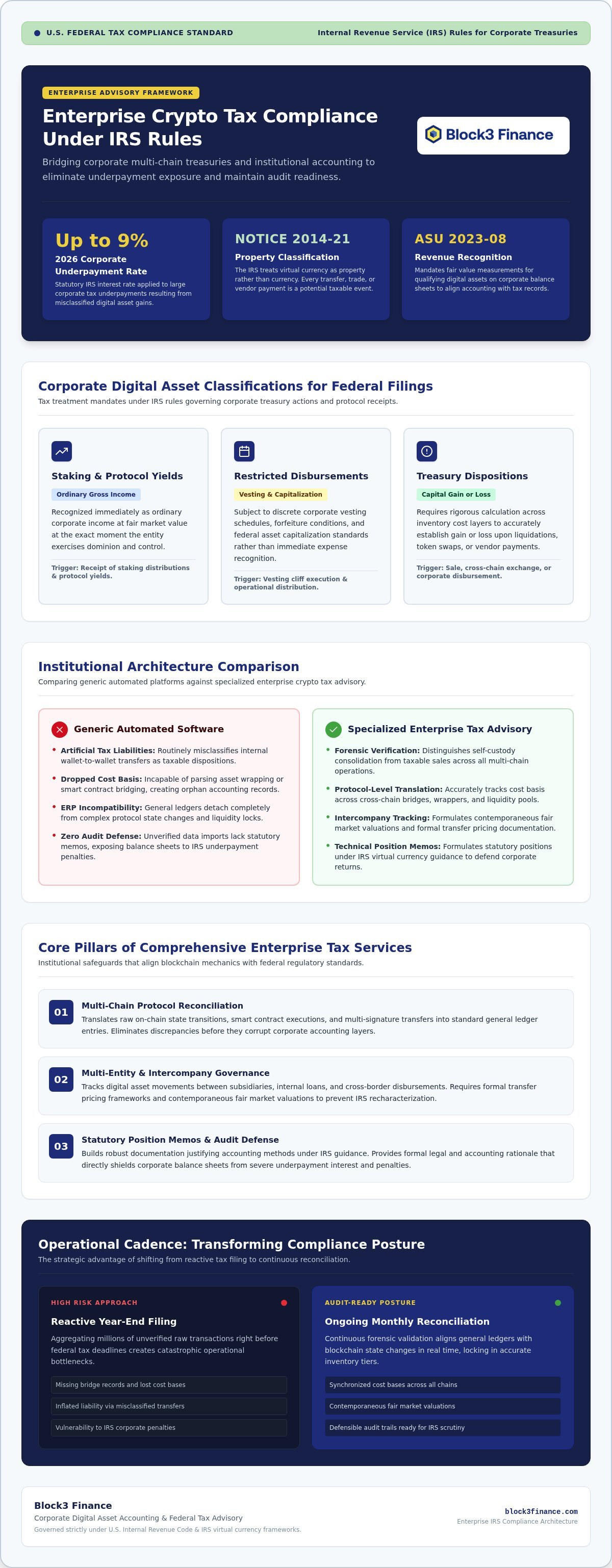
Corporate balance sheets require strict adherence to IRS Notice 2014-21 property rules. Staking yields generate ordinary corporate income at fair market value the moment an organization exercises dominion and control over those tokens. Liquid assets also require clear separation from restricted allocations on tax filings:
- Staking and Protocol Yields: Classified as immediate ordinary corporate gross income upon receipt.
- Restricted Token Disbursements: Subject to distinct vesting schedules and corporate capitalization rules.
- Treasury Dispositions: Require exact capital gain or loss calculations across all inventory layers.
Navigating these distinct categories demands professional tax filing and reporting strategies tailored to federal compliance mandates. Failing to differentiate capital transactions from operating income skews your total taxable basis and invites audit scrutiny.
Why Traditional Accounting Software Fails at Scale
Legacy enterprise resource planning (ERP) platforms cannot natively parse complex smart contract execution or raw blockchain state changes. When institutional treasuries route capital across bridging contracts or wrap native assets, conventional software frequently drops vital cost basis records. These systemic blind spots turn routine liquidity rebalancing into chaotic accounting anomalies.
Commercial crypto software also falls short when attempting to interpret sophisticated multi-chain treasury workflows without human review. Automated engines regularly misinterpret internal wallet-to-wallet transfers as taxable sales, manufacturing artificial tax liabilities. Specialized enterprise crypto tax services resolve these structural discrepancies by pairing protocol-level analysis with defensible federal tax frameworks.
Core Pillars of Comprehensive Enterprise Crypto Tax Services
True institutional compliance demands technical precision that connects on-chain smart contract data directly to your corporate balance sheet. Modern enterprise crypto tax services deliver multi-layered reconciliations that translate raw protocol events into audit-defensible tax entries. This methodology aligns federal tax filings with long-term entity governance, establishing clear transaction trails that withstand intense regulatory examination.
Specialized tax teams construct comprehensive technical position memos to defend corporate treatments before federal agents. These memos document statutory rationale under official IRS guidance on virtual currency, reducing exposure to underpayment penalties. They also integrate nuanced financial accounting standards, including the practical impact of ASU 2023-08 and crypto revenue recognition on institutional balance sheets.
Multi-Entity and Intercompany Digital Asset Tracking
Operating across multiple subsidiaries introduces complex tax exposure under federal oversight. Intercompany token movements, internal liquidity loans, and cross-border disbursements must reflect formal transfer pricing agreements. Every transaction between related business units requires contemporaneous fair market valuations to prevent IRS recharacterizations and unexpected corporate tax assessments.
DeFi, Staking, and Smart Contract Protocol Disclosures
Protocol engagement creates multifaceted corporate income events that require clear tax disclosure:
- Liquidity Pool Deployments: Depositing tokens into liquidity pools can be treated as taxable asset swaps depending on liquidity provider token mechanisms.
- Validator Rewards: Staking rewards constitute ordinary taxable income immediately upon claiming dominion and control over the funds.
- Governance Distributions: Airdrops and protocol disbursements require precise fair market valuations on the exact day and hour of delivery.
Documenting these automated events requires specialized protocol fluency rather than generalized accounting assumptions.
Treasury Management and Mark-to-Market Considerations
Converting treasury holdings into fiat or stablecoins produces realized capital gains or losses under Internal Revenue Code rules. The wash sale rule applies to digital assets in 2026, meaning your treasury team cannot claim tax losses if substantially identical assets are repurchased within 30 days. Integrating strategic oversight through executive CFO services protects capital reserves while ensuring corporate operations remain strictly tax-compliant.
To eliminate compliance blind spots across your company's digital asset operations, you can consult with our tax specialists for dedicated treasury advisory.
Software Platforms vs. Specialized Crypto Tax Advisory
Automated software platforms process data efficiently, but they cannot interpret tax law. Relying solely on algorithm-generated reports exposes institutional treasuries to massive compliance vulnerabilities. Professional enterprise crypto tax services bridge the divide between raw on-chain data and the nuanced statutory requirements of the Internal Revenue Code.
When an automated platform ingests data, it routinely treats complex liquidity movements as simple sales. If your firm moves assets between internal custody solutions or smart contracts, unassisted software often books an artificial disposal. Manual forensic accounting by specialized crypto professionals corrects these errors, properly restoring missing cost basis and ensuring your return aligns with official IRS digital asset reporting guidelines.
The Inherent Limitations of Automated Tax Tools
Application Programming Interface (API) sync failures frequently cause transaction history gaps across decentralized protocols. These dropped records create phantom capital gains or understate real corporate obligations:
- Bespoke Contract Execution: Automated scripts fail to categorize custom governance actions, multisig operations, or structured token distributions.
- API Desynchronization: Rate limits and node indexing drops erase transaction links across multi-chain environments.
- Strict Taxpayer Liability: The IRS holds your enterprise legally accountable for reporting errors, regardless of software bugs.
Software providers explicitly disclaim legal responsibility for inaccurate reports in their terms of service. Your executive team bears the ultimate tax exposure when algorithms miscalculate federal obligations.
Defensibility and Representation in Federal Tax Audits
Surviving a federal corporate examination requires formal documentation rather than raw spreadsheets. Institutional tax advisors draft comprehensive position papers that justify how your organization classified every ambiguous protocol event under U.S. tax statutes. These written positions give your enterprise an audit-defensible stance that software platforms cannot generate.
Experienced crypto advisors act as the primary interface when federal examiners review corporate filings. They speak the technical language of blockchain mechanisms while articulating compliance positions through established accounting standards. Investing in comprehensive audit readiness ensures your company resolves IRS inquiries swiftly without disrupting ongoing operations.
How to Evaluate and Select Enterprise Crypto Tax Services
Selecting an institutional tax partner requires rigorous technical due diligence. Traditional accounting credentials alone don't prove an advisory firm can untangle thousands of smart contract interactions. Chief Financial Officers must look beyond generic marketing and verify hands-on execution across non-custodial wallets, rollups, and secondary layer protocols.
A capable advisory partner treats on-chain forensics and federal tax law as inseparable disciplines. When vetting prospective enterprise crypto tax services, your executive leadership team should demand clear evidence of both technical protocol capability and strategic tax positioning under IRS guidelines. Use a structured rubric to ensure your chosen firm withstands institutional scrutiny.
Evaluating On-Chain Data and Protocol Fluency
Your review process should probe the firm's capacity to audit complex decentralized transactions without third-party reliance. Enterprise leaders must ask targeted questions before sharing internal records:
- Protocol Support: Can the firm natively parse transactions across Layer-2 rollups, modular networks, and zero-knowledge environments?
- Forensic Reconciliation: What methodology does the team use when cross-chain bridge events break cost basis chains?
- Custody Security Standards: Does the firm enforce strict, read-only data access policies that never compromise corporate cold storage infrastructure?
Proven advisors present established workflows for resolving missing transactional metadata. They reconstruct fractured records directly from on-chain event logs rather than forcing manual balance adjustments onto your books.
Assessing Cross-Functional Advisory and Corporate Structuring
A true strategic partner connects annual federal filings with broader business goals. Evaluating a firm's proficiency in corporate structuring ensures your operational entities, holding companies, and foundation grants run on tax-efficient foundations. This comprehensive approach aligns entity jurisdiction, IP rights, and intercompany agreements under prevailing federal standards.
Confirm that your enterprise receives direct, ongoing access to senior crypto CPAs rather than junior staff lacking blockchain experience. Established firms like Block3 Finance back their advisory with over 13 years of native blockchain expertise and a track record of serving over 980 global clients, earning recognition as a top provider by Bitcoin.com. If you want to elevate your compliance posture, schedule a strategic tax assessment with our senior partners today.
Institutional Excellence: Future-Proofing Corporate Crypto Compliance
Forward-thinking organizations do not wait until year-end to organize their digital asset accounting records. Scrambling to interpret twelve months of smart contract interactions in the spring leads to rushed assumptions, missed deductions, and reporting discrepancies. Corporate leaders operate on a continuous cadence, transforming compliance from a stressful annual exercise into an operational advantage.
Maintaining institutional excellence requires disciplined ledger hygiene across every operational wallet and custody account. Specialized enterprise crypto tax services embed structured workflows directly into your financial routine, eliminating the risk of unverified transactions. By pairing ongoing ledger management with formal tax filing and reporting, your enterprise builds lasting credibility with institutional investors, banking partners, and federal examiners.
Establishing Continuous Month-End Ledger Reconciliations
Month-end closes must account for all on-chain activity alongside traditional fiat operations. Bridging digital sub-ledgers with corporate general ledgers on a monthly basis protects basis calculations across your entire portfolio:
- Real-Time Gain and Loss Tracking: Monitor realized capital gains continuously to adjust quarterly estimated corporate tax payments accurately.
- Sub-Ledger Synchronization: Verify that internal transfers balance across operational accounts before transaction histories become stale.
- Contemporaneous Valuation: Record precise fair market values at the exact execution timestamp for every protocol reward and yield distribution.
This ongoing discipline keeps your corporate balance sheet permanently audit-ready under IRS mandates. It also prevents the compounding basis errors that often trigger extensive federal inquiries.
Partnering with Proven Blockchain Financial Leadership
Institutional digital asset compliance requires battle-tested expertise that can withstand rigorous IRS scrutiny. Block3 Finance delivers that assurance through more than 13 years of native blockchain financial expertise, having successfully guided over 980 global clients and Web3 foundations. Recognized as a top provider by Bitcoin.com, the firm provides the technical rigor and strategic perspective required for modern treasury management.
Securing elite guidance transforms your compliance approach from reactive filing into long-term balance sheet resilience. When managing high-volume protocol interactions or complex treasury movements, partnering with dedicated enterprise crypto tax services ensures your business stays fully compliant. Take control of your company's federal tax posture by establishing institutional accounting standards that scale with your growth.
Take Command of Your Corporate Digital Asset Compliance
Managing an institutional digital asset treasury requires a decisive shift from reactive data cleanup to proactive financial leadership. Specialized enterprise crypto tax services transform complex protocol interactions into audit-defensible filings, actively protecting corporate reserves against aggressive IRS enforcement. Establishing continuous month-end reconciliations ensures your executive finance team maintains total clarity over cost basis tracking, staking yields, and capital gains.
Block3 Finance brings 13+ years of native blockchain finance expertise to high-stakes corporate environments, earning recognition as a top provider by Bitcoin.com. Having successfully guided over 980 global clients and Web3 foundations, our CPAs deliver full-spectrum corporate solutions ranging from monthly bookkeeping to complete IRS audit defense.
Don't let algorithmic software errors or unverified on-chain feeds compromise your organization's financial future. Secure defensible corporate compliance with Block3 Finance to protect your balance sheet and navigate federal mandates with total confidence.
Frequently Asked Questions
What do enterprise crypto tax services cover under IRS regulations?
Enterprise crypto tax services cover multi-entity tax filing, protocol-level smart contract reconciliations, and audit-ready corporate reporting under Internal Revenue Service rules. They translate high-volume on-chain activity into defensible corporate tax returns such as Form 1120. These services also provide formal tax position memos and strategic entity structuring to minimize corporate exposure to federal underpayment penalties.
How do specialized crypto tax professionals handle high-volume decentralized finance transactions?
Specialized professionals extract raw event logs directly from blockchain nodes and smart contracts rather than relying on standard exchange exports. They programmatically trace multi-step liquidity pool entries, token wraps, and lending deposits across multiple chains to accurately determine fair market value cost basis. This forensic analysis restores fragmented transaction sequences that automated platforms regularly misclassify as taxable sales.
Can our company rely entirely on crypto tax software for corporate IRS filings?
No, relying entirely on automated software creates significant financial and legal risk for corporate tax filers. Algorithms routinely drop cost basis links during cross-chain bridging events and misinterpret internal custody transfers as taxable dispositions. The IRS holds your corporate officers strictly accountable for reporting errors, making human review by seasoned CPAs essential for audit defense.
How are corporate staking rewards and node operations taxed by the IRS?
The IRS taxes staking rewards and node validation disbursements as ordinary corporate income at fair market value upon receipt. Income recognition occurs the moment your organization gains dominion and control over the reward tokens. That initial valuation establishes the asset's cost basis, which determines capital gains or losses when your treasury eventually transfers or liquidates the tokens.
What records must an enterprise maintain to survive an IRS digital asset audit?
Enterprises must maintain complete contemporaneous records of every on-chain event, associated corporate wallet addresses, transaction hashes, and verifiable fiat valuation feeds. Corporate filers also need cryptographic proofs of wallet ownership, timestamped receipts, and written position memos explaining ambiguous protocol events. Maintaining these audit-defensible trails ensures your company can substantiate basis and proceeds during federal examinations.
Why is traditional corporate accounting insufficient for digital asset transactions?
Traditional accounting firms lack the protocol fluency and specialized sub-ledger systems required to interpret native blockchain data structures. Legacy enterprise software cannot parse smart contract calls or track gas fees across Layer-2 networks. Partnering with specialized enterprise crypto tax services ensures your balance sheet reflects both complex Web3 realities and rigid federal tax code requirements.
How does month-end digital asset bookkeeping improve enterprise annual tax reporting?
Continuous month-end bookkeeping prevents basis errors from compounding over the fiscal year by reconciling transactions as they happen. Closing digital ledgers monthly allows finance teams to track capital gains in real time, calculate quarterly estimated federal taxes, and resolve broken transaction chains immediately. This ongoing hygiene turns annual IRS filing into a routine sign-off rather than an emergency forensic cleanup.

Article by
Mahad Mohamed
Mahad Mohamed is an accountant and the CEO of Block3 Finance, with over 26+ years of Canadian and international tax and accounting experience. A crypto accounting specialist since the early days of Bitcoin, he has consulted for over 38 crypto companies and collaborated with legal professionals on regulatory matters. His expertise spans corporate reorganization, cross-border tax structuring (Canada & US), tax disputes, and CRA audits.
Previously, Mahad worked for the Canada Revenue Agency (CRA), Big4 accounting firms, and served as a Rulings Officer for the Federal Tax Authority of the UAE before acquiring Tax Partners in 2014.
Block3 Finance and Tax Partners has 44 full-time accountants and over 9,800+ clients.
Disclaimer
This article provides general information only and is current as of its publication date. It has not been updated and may be out of date. It does not constitute legal advice and should not be relied upon as such. Every tax situation is unique and may differ from the examples discussed in this article. If you have specific questions, you should seek the advice of our accountants for your unique circumstances.
Frequently Asked Questions
What do enterprise crypto tax services cover under IRS regulations?
Enterprise crypto tax services cover multi-entity tax filing, protocol-level smart contract reconciliations, and audit-ready corporate reporting under Internal Revenue Service rules. They translate high-volume on-chain activity into defensible corporate tax returns such as Form 1120. These services also provide formal tax position memos and strategic entity structuring to minimize corporate exposure to federal underpayment penalties.
How do specialized crypto tax professionals handle high-volume decentralized finance transactions?
Specialized professionals extract raw event logs directly from blockchain nodes and smart contracts rather than relying on standard exchange exports. They programmatically trace multi-step liquidity pool entries, token wraps, and lending deposits across multiple chains to accurately determine fair market value cost basis. This forensic analysis restores fragmented transaction sequences that automated platforms regularly misclassify as taxable sales.
Can our company rely entirely on crypto tax software for corporate IRS filings?
No, relying entirely on automated software creates significant financial and legal risk for corporate tax filers. Algorithms routinely drop cost basis links during cross-chain bridging events and misinterpret internal custody transfers as taxable dispositions. The IRS holds your corporate officers strictly accountable for reporting errors, making human review by seasoned CPAs essential for audit defense.
How are corporate staking rewards and node operations taxed by the IRS?
The IRS taxes staking rewards and node validation disbursements as ordinary corporate income at fair market value upon receipt. Income recognition occurs the moment your organization gains dominion and control over the reward tokens. That initial valuation establishes the asset's cost basis, which determines capital gains or losses when your treasury eventually transfers or liquidates the tokens.
What records must an enterprise maintain to survive an IRS digital asset audit?
Enterprises must maintain complete contemporaneous records of every on-chain event, associated corporate wallet addresses, transaction hashes, and verifiable fiat valuation feeds. Corporate filers also need cryptographic proofs of wallet ownership, timestamped receipts, and written position memos explaining ambiguous protocol events. Maintaining these audit-defensible trails ensures your company can substantiate basis and proceeds during federal examinations.
Why is traditional corporate accounting insufficient for digital asset transactions?
Traditional accounting firms lack the protocol fluency and specialized sub-ledger systems required to interpret native blockchain data structures. Legacy enterprise software cannot parse smart contract calls or track gas fees across Layer-2 networks. Partnering with specialized enterprise crypto tax services ensures your balance sheet reflects both complex Web3 realities and rigid federal tax code requirements.
How does month-end digital asset bookkeeping improve enterprise annual tax reporting?
Continuous month-end bookkeeping prevents basis errors from compounding over the fiscal year by reconciling transactions as they happen. Closing digital ledgers monthly allows finance teams to track capital gains in real time, calculate quarterly estimated federal taxes, and resolve broken transaction chains immediately. This ongoing hygiene turns annual IRS filing into a routine sign-off rather than an emergency forensic cleanup.