
What if your simple cross-chain transfer was actually a taxable event hidden in plain sight? Understanding the bridging crypto tax implications is essential for any Canadian investor moving assets between networks like Ethereum or Solana in 2026.
It's frustrating to feel that moving your own property should be a neutral event, yet the CRA often views the exchange of one token for a wrapped version as a disposition. A disposition occurs whenever you sell, trade, or give up ownership of an asset, potentially triggering a capital gain based on your Adjusted Cost Base (ACB). The ACB is the weighted average cost of your digital property calculated in Canadian dollars.
You deserve total command over your financial landscape without the fear of an unexpected audit. This article provides a roadmap to help you track cross-chain costs accurately and implement a professional documentation strategy that keeps your records defensible and compliant.
Key Takeaways
- Recognize how the CRA defines a "disposition" during cross-chain movements to identify exactly when a taxable event occurs.
- Differentiate between simple transfers and taxable wrapped token exchanges to ensure your 2026 tax filing remains accurate.
- Apply the pooled average cost method to calculate your Adjusted Cost Base (ACB) and properly manage the bridging crypto tax implications of your portfolio.
- Establish a robust, audit-proof record-keeping system that tracks fair market values and transaction hashes across multiple blockchains.
- Leverage specialized crypto accounting expertise to reconcile complex on-chain data into clean, defensible financial records.
What is Crypto Bridging and Why Does the CRA Care?
Bridging is the technical process of moving the economic value of a digital asset from one blockchain to another. While users often view this as a simple transfer, the Canada Revenue Agency (CRA) applies a rigorous legal framework. Understanding the bridging crypto tax implications starts with recognizing that on-chain movement often involves a change in property.
For a crypto tax accountant in Canada, the primary concern is whether a bridge event constitutes a disposition. A disposition is any transaction where you give up the rights to an asset, such as a sale, a gift, or an exchange. For CRA filers, swapping one token for another is a taxable event.
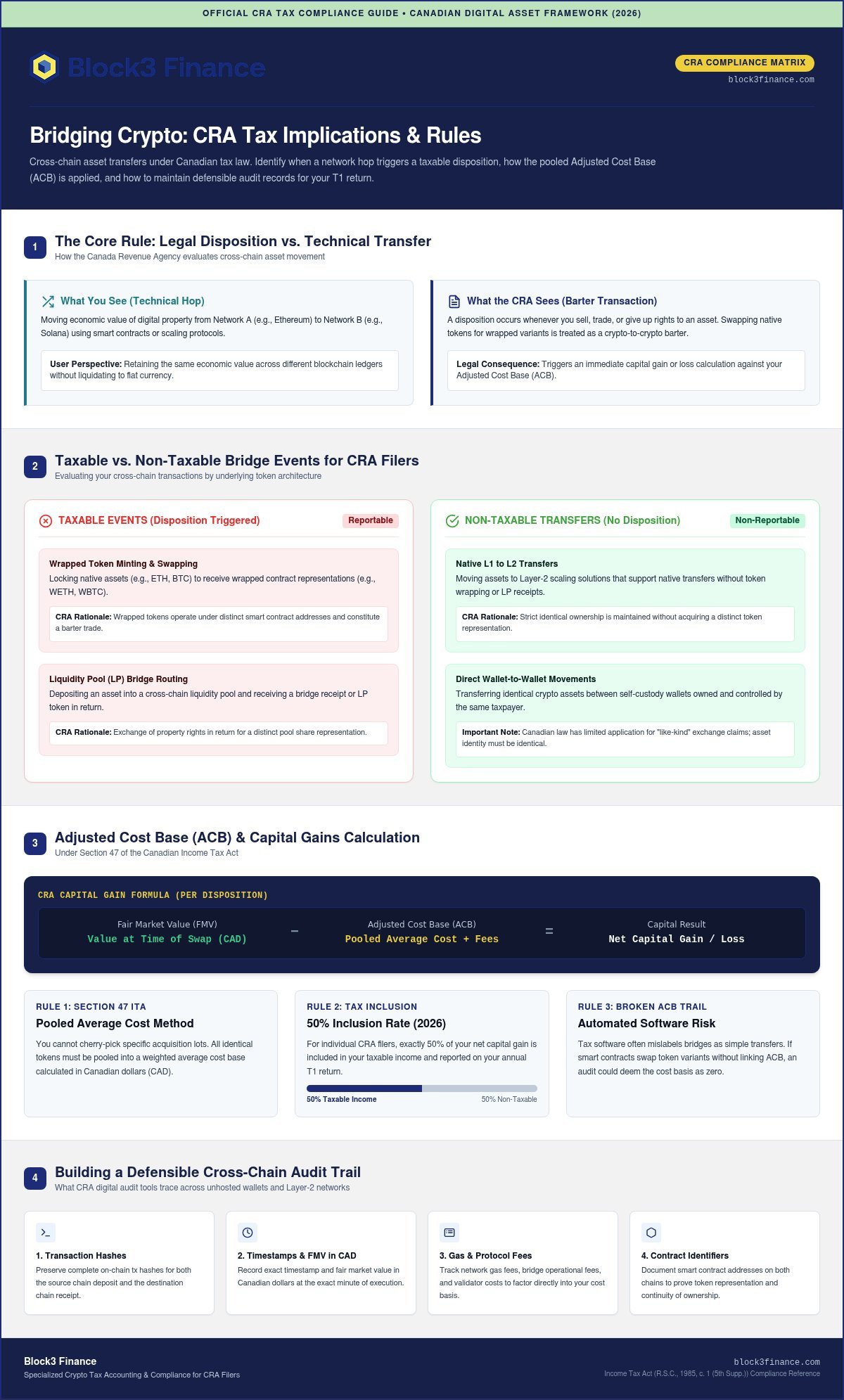
If you lock ETH on a bridge and receive a "wrapped" version on a different chain, the CRA may view this as a barter transaction. You've effectively disposed of one asset to acquire another. This action triggers a capital gain or loss based on the difference between the fair market value of the asset at the time of the swap and its Adjusted Cost Base (ACB).
The ACB is the total cost of your asset, including the purchase price and any acquisition fees, calculated in Canadian dollars. Under Section 47 of the Income Tax Act, you must use the pooled average cost method to track these values across all your holdings.
Maintaining clean financial records becomes difficult because on-chain data often masks the relationship between the original and bridged assets. Many automated tax software tools label these moves as "transfers," which suggests a non-taxable event. However, a technical transfer is not always a legal transfer under Canadian law.
If the smart contract replaces your native asset with a distinct token contract, your ACB trail could break. Missing data on one side of a bridge makes it impossible to prove your cost basis during an audit. This friction requires a proactive approach to documentation to ensure your bridging crypto tax implications are handled correctly.
Block3 Finance specializes in reconciling these complex on-chain activities into clean, defensible records for our clients. The CRA has expanded its digital audit tools to trace unhosted wallet movements between Layer-1 blockchains and Layer-2 scaling networks. Auditors no longer accept unexplained "missing links" where tokens disappear on one chain and reappear on another.
You must maintain a continuous ledger that accounts for every hop, gas fee, and token variant. This level of discipline transforms your tax posture from a defensive struggle into a position of mastery and growth.
Taxable vs. Non-Taxable Bridge Events for CRA Filers
Distinguishing between a neutral movement of funds and a taxable event is the core challenge of bridging crypto tax implications. The CRA has not established a "safe harbor" or specific exemption for cross-chain activity, meaning every hop must be evaluated based on the underlying change in property. You must determine if the bridge merely moves your asset or if it replaces it with a new, distinct token.
In many cases, the technical architecture of the bridge protocol dictates your tax treatment. If the process involves locking one asset to receive a different token representation, you've likely triggered a disposition.
Wrapped Tokens and Potential Swap Treatment
Wrapped tokens like WBTC or WETH are often treated as distinct assets because they exist under different smart contract addresses than their native counterparts. When you "mint" a wrapped token, you're effectively bartering your native asset for a new property. The CRA views this as a crypto-to-crypto trade, which is a reportable event in Canada.
This swap treatment means you must recognize a capital gain or loss at the moment of the exchange. For individuals, the capital gains inclusion rate remains at 50% in 2026, meaning half of your net gain is added to your taxable income. If the fair market value of the token has increased since your initial purchase, that gain is reportable on your T1 return.
Liquidity pool-based bridges present an even clearer taxable event for Canadian filers. These protocols often provide you with a receipt or LP token in exchange for your deposited asset. This receipt signals a complete change in the nature of your property, effectively trading your asset for a share in a pool.
Non-Taxable Transfers: When is Bridging Safe?
Bridging remains non-taxable only when you maintain strictly identical ownership of the same asset across chains without acquiring a distinct token representation. Some Layer-2 scaling solutions allow for native transfers that don't involve wrapping or receipt tokens. These may qualify as a simple wallet-to-wallet movement, which does not trigger a disposition.
The "like-kind" exchange argument has very limited application under Canadian law. If you're unsure whether your specific cross-chain activity qualifies as a transfer, you can use Block3 Finance's Canadian tax services for a detailed asset review.
Proactive classification of these events is the only way to ensure your ledger remains audit-ready. If your activity involves high-volume bridging across multiple decentralized protocols, you should consult with our team to build a defensible reporting strategy. We help you navigate the friction of on-chain data to maintain total command over your tax obligations.
Calculating Capital Gains and Adjusted Cost Base (ACB)
Mastering the mathematical side of your ledger is the only way to gain total command over your tax liability. For CRA filers, the calculation of a capital gain is the Fair Market Value (FMV) of the asset at the time of disposition minus its Adjusted Cost Base (ACB). The ACB represents the total cumulative cost of your digital property, including the initial purchase price and all associated acquisition costs.
Because the CRA requires the pooled average cost method under Section 47 of the Income Tax Act, you must track this value in Canadian dollars across all wallets and chains. This prevents you from cherry-picking specific high-cost lots to artificially lower your gains. Accurate tracking ensures that your bridging crypto tax implications are managed with professional discipline rather than guesswork.
Handling Bridge Fees and Gas Costs
Bridge protocol fees and network gas costs are not personal expenses; they are legitimate transaction costs. You should add these outlays to the ACB of the acquired asset or deduct them from the proceeds of disposition. This adjustment effectively reduces your total taxable gain, ensuring you only pay tax on your actual economic profit.
- Protocol Fees: The fee charged by the bridge itself (e.g., 0.1% of the transfer) is added to the cost basis of the new token.
- Gas Fees: Network fees paid to execute the smart contract are treated as outlays and expenses.
- Taxable Gas: Spending native tokens (like ETH) to pay for gas is a disposition of that ETH, triggering its own capital gain or loss.
If you bridge 1 ETH and pay a small fraction in protocol fees, your new bridged asset’s ACB includes that fee. This meticulous accounting turns a potential audit friction into a streamlined, defensible record of your activity.
Tracking FMV Across Different Blockchains
Moving assets between chains introduces the challenge of fragmented pricing and "thin" liquidity. You must use consistent, reputable pricing sources to determine the FMV in Canadian dollars at the exact minute of your transaction. The CRA expects you to maintain a continuous trail that links the value on the source chain to the value on the destination chain.
Newer blockchains or obscure bridged assets often lack deep markets, making FMV harder to pin down with certainty. In these high-stakes environments, maintaining clean financial records is the only way to ensure your reporting remains defensible. Block3 Finance acts as your visionary navigator, providing the technical rigor needed to reconcile these disparate data points into a single, cohesive ledger.
Record Keeping: Building a Defensible Cross-Chain Audit Trail
In the eyes of the Canada Revenue Agency (CRA), the burden of proof for all tax reporting lies solely with the taxpayer. When you engage in cross-chain activity, you aren't just moving assets; you're creating a series of ledger entries that must remain transparent and verifiable. Defending your bridging crypto tax implications requires a commitment to meticulous record-keeping that goes beyond simple software logs.
Under Section 230(4) of the Income Tax Act, Canadian filers must retain comprehensive books and records for at least six years from the end of the last tax year to which they relate. This includes every smart contract interaction and bridge receipt. If an auditor cannot trace an asset from its original purchase to its final disposition, they may deny your cost basis or reclassify your activity as business income.
Essential Data Points for Bridging Logs
A defensible audit trail links your activity across disparate blockchains through verifiable evidence. You need to capture specific data points for every bridge transaction to ensure your Adjusted Cost Base (ACB) remains intact. Relying on automated tools that might miss "mint" or "burn" events is a significant risk to your compliance status.
- Transaction Hashes: You must record the unique hashes for both the source chain (the lock/burn) and the destination chain (the unlock/mint).
- Timestamps and FMV: Document the exact time of the move and the Fair Market Value (FMV) in Canadian dollars at that moment.
- Wallet Addresses: Maintain a log of all public addresses involved in the bridge process to prove identical ownership.
Common Pitfalls in Cross-Chain Documentation
Losing the "missing link" between chains is the most common reason for audit failure among Canadian crypto users. When you perform multiple hops across Layer-2 networks, your original cost basis can easily become obscured. Failing to account for slippage or bridge-related price impacts can also lead to inaccuracies in your capital gains reporting.
Off-chain records, such as screenshots of bridge interfaces or exported CSV logs, provide an extra layer of defense that on-chain data alone may lack. You should review the CRA Crypto Audit checklist to identify any gaps in your current preparation. Taking an offensive posture today prevents a defensive crisis during a future review.
Building a robust documentation strategy is the only way to gain total command over your volatile financial landscape. If you're managing high-volume cross-chain transfers, you should contact our team to establish a professional audit trail. We help you turn complex blockchain activity into clean, defensible records.
Strategic Compliance: How Block3 Finance Navigates Bridging
Block3 Finance serves as a visionary navigator for entities facing the most complex bridging crypto tax implications in the 2026 fiscal year. We move beyond simple data entry to provide a sophisticated framework for financial oversight and strategic planning. Our methodology focuses on the resolution of friction between decentralized activity and legacy tax requirements.
We empower our clients to shift from a defensive posture of merely managing regulations to an offensive strategy focused on mastery and growth. By adopting a proactive stance, you gain total command over a volatile landscape. This disciplined approach ensures that your cross-chain movements are not just compliant but strategically optimized.
Beyond Software: The Need for Specialized Crypto Accountants
Automated tools often miscategorize bridge events as "missing" funds or "income" because they lack the technical context to link disparate chains. These errors can break your Adjusted Cost Base (ACB) trail and lead to overpayment of taxes. Block3 Finance provides the essential human oversight necessary to resolve these discrepancies and ensure every disposition is recorded accurately.
We leverage our 13+ years of blockchain financial expertise to build clean, defensible records that stand up to CRA scrutiny. This intellectual leadership ensures your reporting uses a polished, white-glove corporate vocabulary that resonates with professional auditors. We translate high-stakes on-chain activity into the structured language of traditional finance.
Corporate Structuring for Active Bridging Strategies
High-volume bridging strategies often require a more robust framework than a personal tax return can provide. For Canadian businesses, corporate structuring can optimize tax efficiency and provide a roadmap for scaling in the Web3 space. This is particularly vital for entities engaged in frequent arbitrage or decentralized liquidity provision across multiple networks.
Our CFO services offer the strategic depth needed to manage digital asset portfolios with the rigor of a traditional institution. We help you navigate the unique risks faced by Canadian corporations, such as the potential reclassification of capital gains into fully taxable business income. This level of elite strategist support is essential for maintaining stability in a chaotic industry.
Transitioning to a proactive compliance model allows you to focus on innovation rather than audit fear. We invite you to take command of your financial future by booking a consultation with our specialized team today. Our goal is to ensure your financial execution is as sophisticated as your blockchain vision.
Master Your Cross-Chain Financial Future
Managing the bridging crypto tax implications of a complex portfolio requires more than basic software. It demands a sophisticated understanding of how the CRA treats wrapped tokens and cross-chain dispositions. By maintaining a meticulous Adjusted Cost Base and robust documentation, you transform tax compliance from a burden into a strategic advantage.
Block3 Finance serves as your visionary navigator in this evolving landscape. Ranked as a top provider by Bitcoin.com and trusted by over 980 global clients, we specialize in turning fragmented on-chain data into clean, defensible financial records. Our expertise ensures you remain audit-ready while focusing on the growth of your digital assets.
Don't let regulatory friction slow your momentum. Secure your cross-chain compliance with Block3 Finance's specialized Canadian tax services. We are here to help you gain total command over your financial destiny.
Frequently Asked Questions
Is bridging crypto from one wallet to another taxable in Canada?
A simple transfer of the identical asset between two wallets you own is generally not a taxable event. However, if the bridge protocol requires you to lock your native asset and receive a different token contract in return, the CRA may view this as a disposition. A disposition occurs when you give up ownership rights to an asset, potentially triggering a capital gain or loss based on your Adjusted Cost Base.
How does the CRA treat wrapped tokens like WBTC or wETH?
The CRA typically treats wrapped tokens as distinct assets from their native counterparts because they exist under different smart contract addresses. When you exchange native BTC for WBTC, you are performing a crypto-to-crypto trade. This barter transaction is reportable at the fair market value in Canadian dollars. You must calculate any gain or loss at the moment of the minting or burning event to remain compliant.
Can I deduct bridge fees from my crypto taxes?
Bridge protocol fees and network gas costs are legitimate transaction expenses that you can use to reduce your tax liability. You should add these costs to the Adjusted Cost Base (ACB) of the acquired asset or deduct them from your proceeds of disposition. Note that spending a native token like ETH to pay for these gas fees is itself a taxable disposition of that ETH under Canadian law.
What happens if I cannot find the transaction hash for a bridge I used years ago?
Missing transaction hashes create a significant audit risk because the burden of proof for all tax reporting lies with the Canadian taxpayer. If you cannot provide a verifiable audit trail, the CRA may assign a zero-dollar cost basis to your assets, resulting in a much higher tax bill. Block3 Finance specializes in reconciling these missing links to build defensible financial records for our clients.
Does the CRA consider bridging to be a barter transaction?
Yes, the CRA views the exchange of one digital asset for another as a barter transaction rather than a simple movement of funds. Because crypto assets are classified as commodities, swapping a native token for a bridged representation triggers a reportable event. You must report the value of the transaction in Canadian dollars, even if you never converted the tokens into fiat currency at a centralized exchange.
How do I track the cost basis of an asset moved across three different chains?
You must maintain a continuous ledger that utilizes the pooled average cost method for all identical properties across every blockchain. This requires recording the fair market value and fees for every hop to ensure the bridging crypto tax implications are accurately captured. Section 47 of the Income Tax Act mandates this pooling, preventing you from using specific identification methods like FIFO to calculate your gains.
Are bridge protocol hacks tax-deductible as a loss in Canada?
If a bridge exploit results in the permanent loss of your assets, you may be able to realize a capital loss for tax purposes. You must provide clear documentation proving the loss is total and that there is no reasonable prospect of recovery. The CRA maintains high scrutiny on these claims, so having a professional documentation strategy is essential to ensure your loss is accepted during a future audit.
Do I need a specialized crypto accountant for my cross-chain DeFi activity?
Engaging a specialized professional is highly recommended for high-volume users because standard accounting software often miscategorizes complex bridge events. Block3 Finance provides the technical rigor and visionary navigation needed to resolve these errors. With over 13 years of blockchain financial expertise and 980 clients globally, we turn complex on-chain activity into clean, defensible records that ensure full compliance with current CRA rules.

Article by
Mahad Mohamed
Mahad Mohamed is an accountant and the CEO of Block3 Finance, with over 26+ years of Canadian and international tax and accounting experience. A crypto accounting specialist since the early days of Bitcoin, he has consulted for over 38 crypto companies and collaborated with legal professionals on regulatory matters. His expertise spans corporate reorganization, cross-border tax structuring (Canada & US), tax disputes, and CRA audits.
Previously, Mahad worked for the Canada Revenue Agency (CRA), Big4 accounting firms, and served as a Rulings Officer for the Federal Tax Authority of the UAE before acquiring Tax Partners in 2014.
Block3 Finance and Tax Partners has 44 full-time accountants and over 9,800+ clients.
Disclaimer
This article provides general information only and is current as of its publication date. It has not been updated and may be out of date. It does not constitute legal advice and should not be relied upon as such. Every tax situation is unique and may differ from the examples discussed in this article. If you have specific questions, you should seek the advice of our accountants for your unique circumstances.
Frequently Asked Questions
Non-Taxable Transfers: When is Bridging Safe?
Bridging remains non-taxable only when you maintain strictly identical ownership of the same asset across chains without acquiring a distinct token representation. Some Layer-2 scaling solutions allow for native transfers that don't involve wrapping or receipt tokens. These may qualify as a simple wallet-to-wallet movement, which does not trigger a disposition. The "like-kind" exchange argument has very limited application under Canadian law. If you're unsure whether your specific cross-chain activity qualifies as a transfer, you can use Block3 Finance's Canadian tax services for a detailed asset review. Proactive classification of these events is the only way to ensure your ledger remains audit-ready. If your activity involves high-volume bridging across multiple decentralized protocols, you should consult with our team to build a defensible reporting strategy. We help you navigate the friction of on-chain data to maintain total command over your tax obligations. Mastering the mathematical side of your ledger is the only way to gain total command over your tax liability. For CRA filers, the calculation of a capital gain is the Fair Market Value (FMV) of the asset at the time of disposition minus its Adjusted Cost Base (ACB). The ACB represents the total cumulative cost of your digital property, including the initial purchase price and all associated acquisition costs. Because the CRA requires the pooled average cost method under Section 47 of the Income Tax Act, you must track this value in Canadian dollars across all wallets and chains. This prevents you from cherry-picking specific high-cost lots to artificially lower your gains. Accurate tracking ensures that your bridging crypto tax implications are managed with professional discipline rather than guesswork.
Is bridging crypto from one wallet to another taxable in Canada?
A simple transfer of the identical asset between two wallets you own is generally not a taxable event. However, if the bridge protocol requires you to lock your native asset and receive a different token contract in return, the CRA may view this as a disposition. A disposition occurs when you give up ownership rights to an asset, potentially triggering a capital gain or loss based on your Adjusted Cost Base.
How does the CRA treat wrapped tokens like WBTC or wETH?
The CRA typically treats wrapped tokens as distinct assets from their native counterparts because they exist under different smart contract addresses. When you exchange native BTC for WBTC, you are performing a crypto-to-crypto trade. This barter transaction is reportable at the fair market value in Canadian dollars. You must calculate any gain or loss at the moment of the minting or burning event to remain compliant.
Can I deduct bridge fees from my crypto taxes?
Bridge protocol fees and network gas costs are legitimate transaction expenses that you can use to reduce your tax liability. You should add these costs to the Adjusted Cost Base (ACB) of the acquired asset or deduct them from your proceeds of disposition. Note that spending a native token like ETH to pay for these gas fees is itself a taxable disposition of that ETH under Canadian law.
What happens if I cannot find the transaction hash for a bridge I used years ago?
Missing transaction hashes create a significant audit risk because the burden of proof for all tax reporting lies with the Canadian taxpayer. If you cannot provide a verifiable audit trail, the CRA may assign a zero-dollar cost basis to your assets, resulting in a much higher tax bill. Block3 Finance specializes in reconciling these missing links to build defensible financial records for our clients.
Does the CRA consider bridging to be a barter transaction?
Yes, the CRA views the exchange of one digital asset for another as a barter transaction rather than a simple movement of funds. Because crypto assets are classified as commodities, swapping a native token for a bridged representation triggers a reportable event. You must report the value of the transaction in Canadian dollars, even if you never converted the tokens into fiat currency at a centralized exchange.
How do I track the cost basis of an asset moved across three different chains?
You must maintain a continuous ledger that utilizes the pooled average cost method for all identical properties across every blockchain. This requires recording the fair market value and fees for every hop to ensure the bridging crypto tax implications are accurately captured. Section 47 of the Income Tax Act mandates this pooling, preventing you from using specific identification methods like FIFO to calculate your gains.
Are bridge protocol hacks tax-deductible as a loss in Canada?
If a bridge exploit results in the permanent loss of your assets, you may be able to realize a capital loss for tax purposes. You must provide clear documentation proving the loss is total and that there is no reasonable prospect of recovery. The CRA maintains high scrutiny on these claims, so having a professional documentation strategy is essential to ensure your loss is accepted during a future audit.
Do I need a specialized crypto accountant for my cross-chain DeFi activity?
Engaging a specialized professional is highly recommended for high-volume users because standard accounting software often miscategorizes complex bridge events. Block3 Finance provides the technical rigor and visionary navigation needed to resolve these errors. With over 13 years of blockchain financial expertise and 980 clients globally, we turn complex on-chain activity into clean, defensible records that ensure full compliance with current CRA rules.