
What if your accounting department viewed a Canada Revenue Agency (CRA) audit as a routine verification rather than a catastrophic threat? Most Canadian firms find themselves buried under thousands of transactions, struggling with manual spreadsheet errors that put their compliance at risk. You deserve a financial architecture that provides clarity instead of chaos.
Implementing automated crypto bookkeeping allows you to move beyond the limitations of manual tracking. By leveraging specialized software, you can accurately calculate your cost-basis, which is the original value of an asset for tax purposes, across hundreds of sources. This proactive approach ensures your records remain CRA-compliant while reducing the time spent on your month-end close.
This article explores how to integrate automation into your financial workflows to achieve real-time visibility in 2026. We will detail the methodology for creating CRA-defensible books that protect your firm’s growth and reputation. You will discover a roadmap for navigating the complex digital asset landscape with the precision of a seasoned strategist.
Key Takeaways
- Learn why the Canada Revenue Agency (CRA) requires high-fidelity records that traditional spreadsheets cannot maintain.
- Discover how automated crypto bookkeeping uses API integrations to bridge the gap between raw blockchain data and your corporate general ledger.
- Identify the compliance gap between automated data aggregation and the professional oversight necessary to satisfy CRA auditors.
- Access a practical roadmap for implementing tools that specifically calculate the Adjusted Cost Base (ACB), which is the average cost of your holdings used for Canadian tax reporting.
- Explore how a dedicated partner can transform your month-end close from a source of friction into a streamlined, real-time financial asset.
The Evolution of Crypto Bookkeeping in Canada
The landscape for Canadian digital asset firms has shifted dramatically. Manual entry and static spreadsheets are no longer sufficient to manage the velocity of modern on-chain activity. This transition represents a move toward sophisticated subledgers that act as a bridge between the blockchain and corporate accounting software. While this is a global trend affecting all entities, including the sole trader models highlighted by Mazuma, it is particularly critical for firms navigating the Canadian regulatory environment.
Automated crypto bookkeeping is the programmatic syncing of wallet and exchange data directly into your financial system. It removes the human element from data collection, ensuring that every transaction is captured with precision. This mastery over data allows firms to shift from a defensive compliance stance to an offensive strategy focused on scalability.
Why Spreadsheets Fail in 2026
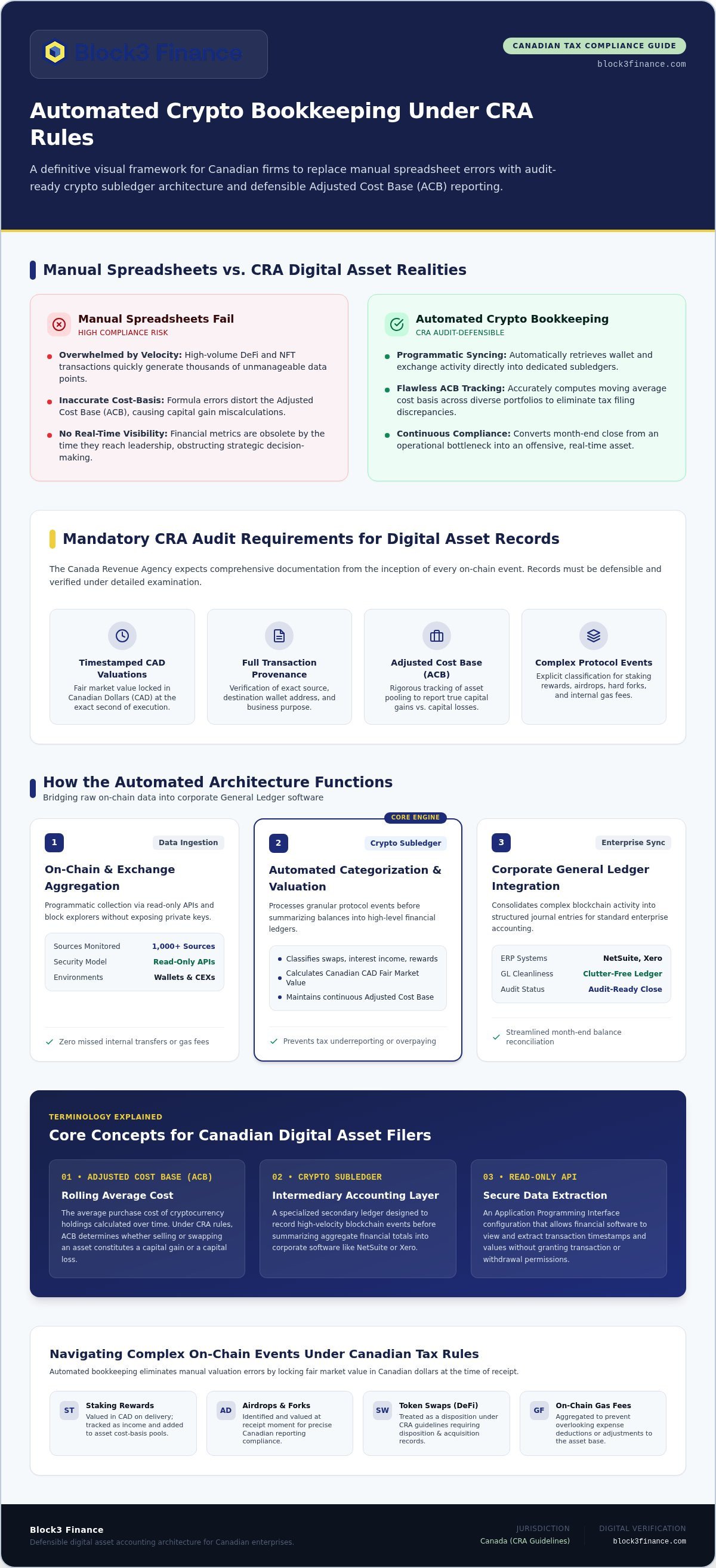
High-volume environments like DeFi (Decentralized Finance) or NFT marketplaces generate thousands of data points that overwhelm traditional tools. Manual tracking often leads to inaccurate calculations of the Adjusted Cost Base (ACB). ACB is the average cost of an asset over time, which determines your capital gains or losses under CRA rules.
Errors in these calculations can result in significant financial discrepancies during a tax filing. Beyond compliance, spreadsheets fail to provide the real-time visibility required for effective CFO leadership. You cannot steer a firm toward growth if your financial data is outdated by the time it reaches your desk.
CRA Expectations for Digital Asset Records
The CRA expects a comprehensive audit trail for every cryptocurrency transaction from its inception. This includes documenting the source, destination, and purpose of every transfer. Maintaining this level of detail manually is nearly impossible for active firms.
Every event must also include a timestamped valuation in Canadian dollars (CAD) to report income or capital gains accurately. These records must be defensible and verifiable during a detailed review. For a broader understanding of these requirements, you can review our guide on Crypto Tax in Canada.
Automation ensures that these valuations are captured at the exact moment of the trade. This precision protects the firm from the risk of underreporting or overpaying taxes due to price volatility. By leveraging automated crypto bookkeeping, you transform your financial records from a compliance burden into a strategic asset for growth.
How Automated Crypto Bookkeeping Functions
Effective financial management in the Web3 space requires a robust technical engine that translates raw blockchain data into a structured format. This process relies on API (Application Programming Interface) integrations and block explorer data aggregation to capture every movement of assets. By automating these connections, firms eliminate the friction of manual data exports and the risk of missing transaction history.
The core of this architecture is the crypto subledger. A subledger is a specialized ledger that records detailed crypto transactions before summarizing them in the main books. This system acts as a critical bridge between the decentralized world and your traditional General Ledger (GL) systems like NetSuite or Xero, ensuring your primary financial records remain clean and uncluttered.
Modern automated crypto bookkeeping also handles complex protocol events that are nearly impossible to track manually. Whether your firm is navigating staking rewards, airdrops, or hard forks, the software identifies these events in real-time. It assigns the correct fair market value in Canadian dollars at the precise moment of receipt, providing a foundation for accurate tax reporting.
On-Chain Data Aggregation
To achieve total financial visibility, software must connect to both non-custodial wallets and CEXs (Centralized Exchanges). We prioritize "read-only" API access to ensure that your financial data is accessible for reporting without compromising the security of your underlying assets. This allows for the simultaneous management of data from over 1,000 sources, creating a single source of truth for your entire portfolio.
Completeness is the cornerstone of any audit-ready system. By aggregating data across multiple chains and platforms, you ensure that no internal transfer or gas fee is overlooked. This comprehensive view is essential for firms operating in Ontario or British Columbia that must account for diverse digital asset holdings across the entire ecosystem.
Automated Categorisation for Canadian Tax
The software automatically identifies transaction types such as gas fees, swaps, or interest income. This automation is vital for adhering to CRA cryptocurrency tax guidance, which requires clear distinctions between business income and capital gains. Properly classifying these transactions ensures you don't overpay taxes or trigger unnecessary audits.
Handling "wrapped" tokens, which represent one asset on another blockchain, or liquidity provider (LP) tokens requires specialized logic. Automation tracks the underlying value of these assets through every swap and bridge. If you need assistance configuring these complex workflows for your firm, you can speak with our specialized team to establish a defensible framework.
Software vs. Professional Oversight: The Compliance Gap
Software is often marketed as a silver bullet for financial compliance. Many Canadian firms believe that purchasing a license for a subledger platform makes them "audit-ready" automatically. This is a dangerous misconception that conflates data aggregation with financial integrity. While software excels at the "data" layer, pulling in thousands of transactions with robotic speed, accountants provide the "defensibility" layer.
You need specialized Monthly Accounting to ensure that the automated output aligns with Canadian reporting standards. Automated crypto bookkeeping is a powerful tool, but it requires a human-in-the-loop to interpret the context of every trade. Without this oversight, your records are merely a collection of data points rather than a verified financial history.
The Limitations of "Set and Forget" Automation
Automation systems frequently encounter friction in the volatile digital asset market. Missing price feeds for niche tokens or incorrect transaction mapping can lead to significant discrepancies in your books. Relying on "bad data" results in incorrect filings that invite CRA scrutiny and potential financial penalties. It's a risk that no growing enterprise can afford to take.
Complex DeFi protocols often break standard automation rules. Liquidity pooling and sophisticated yield farming strategies require manual intervention to reflect the economic reality of the transaction. Without expert review, your automated crypto bookkeeping might misclassify a taxable event as a simple transfer, leading to an inaccurate tax liability.
Why Professional Reconciliation is Essential
Reconciliation is the rigorous process of ensuring your on-chain balances match your internal financial records exactly. It's the only way to prove to an auditor that your books are complete and accurate. A dedicated Crypto Tax Accountant applies the Canada Revenue Agency's guidance on digital currency taxation to interpret nuances that software simply ignores.
The CRA focuses on the intent and nature of your trades. Software cannot distinguish between personal use and business activity based on blockchain data alone. Establishing a professional audit trail is your best defense when facing a CRA Crypto Audit. Expert oversight transforms a raw list of transactions into a robust financial statement that protects your firm’s future.
Implementing an Audit-Ready Workflow in 5 Steps
Transitioning your firm to a digital asset-ready financial system requires a disciplined sequence of actions. This move shifts your accounting from a manual, error-prone environment to a streamlined, automated crypto bookkeeping framework. A standardized workflow ensures your data is not just collected, but also verified and integrated into your broader corporate reporting.
Step 1-3: Setup and Integration
Your first priority is to create a comprehensive inventory of all digital asset touchpoints. This includes every non-custodial wallet, centralized exchange account, and institutional custodian used by the business. Completeness at this stage is vital because any missing account will create unresolvable gaps in your transaction history and cost-basis records.
Once you've identified your sources, select and configure a crypto-native subledger with settings specifically tailored for the CRA. You must ensure the software calculates the Adjusted Cost Base (ACB) correctly, as this is the primary method for reporting capital gains in Canada. This technical configuration prevents the common error of using American-style FIFO (First-In, First-Out) methods, which are not compliant for Canadian entities.
Mapping your chart of accounts is the final integration step. This process ensures that every type of crypto activity, from staking rewards to gas fees, flows directly into the correct categories in your general ledger, such as NetSuite or QuickBooks. Proper mapping allows your traditional accounting software to recognize blockchain transactions as legitimate business entries rather than unexplained anomalies.
Step 4-5: Maintenance and Review
Establishing a monthly cadence for transaction review and reconciliation is essential for maintaining audit-readiness. You should resolve any pricing errors or unmapped transactions before they accumulate into a year-end crisis. This "Month-End Close" for digital assets mirrors traditional accounting cycles but requires specialized knowledge of on-chain events to ensure everything balances perfectly.
Engaging a professional firm for CFO Services provides the high-level strategy and compliance oversight necessary for Web3 enterprises. A fractional CFO ensures that your financial statements reflect both fiat and digital asset positions with total accuracy. This dual-layered reporting gives you the clarity needed to make informed capital allocation decisions while staying within regulatory boundaries.
By following this roadmap, you transform your automated crypto bookkeeping from a basic data feed into a sophisticated financial engine. If you're ready to modernize your firm's accounting infrastructure, contact our team to discuss a custom implementation plan.
Mastering Your Web3 Financials with Block3 Finance
Block3 Finance stands as the premier choice for Canadian digital asset enterprises seeking to institutionalize their financial workflows. We serve as a visionary navigator in a high-stakes environment where traditional accounting often falls short. Our firm bridges the gap between legacy corporate finance and the cutting-edge blockchain ecosystem.
With 13+ years of blockchain financial expertise, our team has supported over 980 clients globally. This deep experience earned us a top-ranking position from Bitcoin.com as a leading provider in the space. We combine high-level professional authority with a modern, forward-looking energy that empowers our clients to scale.
We offer specialized support tailored to the specific regulatory nuances of different provinces. Our experts provide localized guidance for firms in Ontario, British Columbia, and Alberta. This regional focus ensures your compliance strategy aligns with both federal CRA rules and provincial expectations.
The Block3 Advantage for Canadian Filers
Our methodology ensures your firm maintains defensible books that stand up to the most rigorous CRA scrutiny. We leverage automated crypto bookkeeping to handle the massive volume of on-chain data while providing the elite professional oversight required for tax defensibility. This dual-layered approach transforms your financial records from a defensive liability into an offensive asset for growth.
We excel at managing complex Corporate Structuring for crypto ventures. Our team understands how to align your digital asset holdings with your broader business goals to optimize your tax position. You gain the peace of mind that comes from knowing your financial records are audit-ready at all times.
Scaling with Professional Authority
Many firms remain stuck in a survival mode characterized by manual errors and the constant fear of a CRA inquiry. We help you transition into a state of strategic financial mastery where you have total command over your volatile landscape. Our proactive stance moves your narrative away from merely managing regulations toward active industry participation and expansion.
A well-connected professional network and deep technical rigor are the hallmarks of our service. We act as a calm force in a chaotic industry, providing the roadmap you need to thrive in a complex world. You deserve a partner that offers both the technical precision of an auditor and the mindset of a bold innovator.
Take the next step toward a friction-free financial operation by securing an elite accounting partner. Our specialists are ready to help you cultivate a robust financial architecture for 2026 and beyond. Contact our team of Canadian crypto specialists today.
Mastering Your Financial Narrative in 2026
The transition to automated crypto bookkeeping marks a definitive move toward financial maturity for Canadian enterprises. By replacing manual workflows with programmatic data syncing, you eliminate the risk of human error while gaining real-time visibility into your digital asset positions. True mastery requires combining this technical efficiency with the rigorous oversight of specialists who understand the CRA's evolving expectations.
Block3 Finance provides the intellectual leadership and technical precision needed to turn complex on-chain data into defensible financial records. With 13+ years of specialized blockchain financial expertise, we help you navigate high-stakes environments with total confidence. Our status as a top-ranked firm by Bitcoin.com reflects our commitment to providing comprehensive support for CRA tax compliance and audit-readiness.
You have the opportunity to transform your accounting department from a source of anxiety into a powerful engine for growth. Take the lead in the digital economy by establishing a friction-free financial operation today. Secure your Canadian crypto books with Block3 Finance and gain the agency you need to thrive in a volatile landscape.
Frequently Asked Questions
Is automated crypto bookkeeping enough for a CRA audit?
No, software alone is insufficient for a successful Canada Revenue Agency (CRA) review. While automation captures raw transaction data, it cannot interpret the intent behind complex trades or ensure compliance with specific Canadian tax laws. You need professional oversight to verify that the data is accurate, complete, and defensible before it reaches an auditor's desk.
How does automation handle Adjusted Cost Base (ACB) in Canada?
Automation software calculates the Adjusted Cost Base (ACB) by tracking the average cost of all identical assets held by a firm. This is the mandatory method for Canadian taxpayers to determine capital gains or losses. The software programmatically updates this figure as you acquire or dispose of assets, ensuring you don't accidentally use non-compliant methods like FIFO (First-In, First-Out).
Can I integrate crypto bookkeeping with QuickBooks or Xero?
Yes, most modern subledgers offer direct integrations with QuickBooks and Xero. These connections allow your crypto activity to flow into your general ledger as summarized journal entries. This ensures your traditional financial statements reflect your digital asset holdings without cluttering your main books with thousands of individual on-chain transactions.
What is the difference between a crypto subledger and a general ledger?
A crypto subledger is a specialized database that records every granular detail of your blockchain transactions. In contrast, a General Ledger (GL) is the primary accounting record for your entire business. The subledger handles the high volume of crypto data and then pushes summarized totals to the GL for final corporate reporting and tax filing.
How often should I reconcile my automated crypto books?
You should reconcile your books at the end of every month to maintain financial integrity. Monthly reconciliation ensures that your internal records match your actual on-chain balances. By maintaining this cadence, you can identify and resolve pricing errors or missing transactions immediately rather than waiting for a stressful year-end close or a surprise CRA inquiry.
Does automation work for complex DeFi and staking transactions?
Automation handles most standard DeFi and staking events, but it often requires manual intervention for niche protocols. The software can track rewards and fair market value at the time of receipt. However, liquidity pool (LP) positions and complex bridging often need an expert to verify that the automated crypto bookkeeping system has mapped the economic reality correctly.
What are the risks of relying solely on automated bookkeeping software?
The primary risk of relying solely on software is the "garbage in, garbage out" problem. If the software misses a price feed or miscategorizes a swap as a transfer, your tax liability will be incorrect. This can lead to significant penalties from the CRA for underreporting income or failing to maintain adequate records for your digital assets.
How much does it cost to implement automated crypto bookkeeping for a business?
Implementation costs vary based on your transaction volume and the complexity of your on-chain activity. Factors such as the number of wallets, exchanges, and specific DeFi protocols you use will influence the final investment. We recommend focusing on the long-term value of reduced audit risk and improved financial visibility rather than just the initial software licensing fees.

Article by
Mahad Mohamed
Mahad Mohamed is an accountant and the CEO of Block3 Finance, with over 26+ years of Canadian and international tax and accounting experience. A crypto accounting specialist since the early days of Bitcoin, he has consulted for over 38 crypto companies and collaborated with legal professionals on regulatory matters. His expertise spans corporate reorganization, cross-border tax structuring (Canada & US), tax disputes, and CRA audits.
Previously, Mahad worked for the Canada Revenue Agency (CRA), Big4 accounting firms, and served as a Rulings Officer for the Federal Tax Authority of the UAE before acquiring Tax Partners in 2014.
Block3 Finance and Tax Partners has 44 full-time accountants and over 9,800+ clients.
Disclaimer
This article provides general information only and is current as of its publication date. It has not been updated and may be out of date. It does not constitute legal advice and should not be relied upon as such. Every tax situation is unique and may differ from the examples discussed in this article. If you have specific questions, you should seek the advice of our accountants for your unique circumstances.
Frequently Asked Questions
Is automated crypto bookkeeping enough for a CRA audit?
No, software alone is insufficient for a successful Canada Revenue Agency (CRA) review. While automation captures raw transaction data, it cannot interpret the intent behind complex trades or ensure compliance with specific Canadian tax laws. You need professional oversight to verify that the data is accurate, complete, and defensible before it reaches an auditor's desk.
How does automation handle Adjusted Cost Base (ACB) in Canada?
Automation software calculates the Adjusted Cost Base (ACB) by tracking the average cost of all identical assets held by a firm. This is the mandatory method for Canadian taxpayers to determine capital gains or losses. The software programmatically updates this figure as you acquire or dispose of assets, ensuring you don't accidentally use non-compliant methods like FIFO (First-In, First-Out).
Can I integrate crypto bookkeeping with QuickBooks or Xero?
Yes, most modern subledgers offer direct integrations with QuickBooks and Xero. These connections allow your crypto activity to flow into your general ledger as summarized journal entries. This ensures your traditional financial statements reflect your digital asset holdings without cluttering your main books with thousands of individual on-chain transactions.
What is the difference between a crypto subledger and a general ledger?
A crypto subledger is a specialized database that records every granular detail of your blockchain transactions. In contrast, a General Ledger (GL) is the primary accounting record for your entire business. The subledger handles the high volume of crypto data and then pushes summarized totals to the GL for final corporate reporting and tax filing.
How often should I reconcile my automated crypto books?
You should reconcile your books at the end of every month to maintain financial integrity. Monthly reconciliation ensures that your internal records match your actual on-chain balances. By maintaining this cadence, you can identify and resolve pricing errors or missing transactions immediately rather than waiting for a stressful year-end close or a surprise CRA inquiry.
Does automation work for complex DeFi and staking transactions?
Automation handles most standard DeFi and staking events, but it often requires manual intervention for niche protocols. The software can track rewards and fair market value at the time of receipt. However, liquidity pool (LP) positions and complex bridging often need an expert to verify that the automated crypto bookkeeping system has mapped the economic reality correctly.
What are the risks of relying solely on automated bookkeeping software?
The primary risk of relying solely on software is the "garbage in, garbage out" problem. If the software misses a price feed or miscategorizes a swap as a transfer, your tax liability will be incorrect. This can lead to significant penalties from the CRA for underreporting income or failing to maintain adequate records for your digital assets.
How much does it cost to implement automated crypto bookkeeping for a business?
Implementation costs vary based on your transaction volume and the complexity of your on-chain activity. Factors such as the number of wallets, exchanges, and specific DeFi protocols you use will influence the final investment. We recommend focusing on the long-term value of reduced audit risk and improved financial visibility rather than just the initial software licensing fees.