
On-chain transparency is not a defensible audit trail; it is merely raw data that the CRA can easily weaponize against you if left unreconciled. You likely recognize that the 2026 tax season feels more precarious than years past. With 25% of Canadians now owning digital assets, the federal government has intensified its focus on "unexplained wealth" and complex DeFi earnings.
The anxiety of missing records from defunct exchanges or the headache of calculating staking rewards across multiple protocols is a burden no sophisticated taxpayer should carry alone. It's frustrating to face potential penalties because of technical friction or data gaps. You deserve total command over your financial narrative and the peace of mind that comes with professional precision.
This guide will empower you to build a robust audit trail for crypto transactions that withstands the most rigorous CRA scrutiny. We provide a clear framework for record-keeping to ensure your 2026 filings are bulletproof. We will explore specific retention rules, foreign property reporting thresholds, and the methodology needed to transform chaotic blockchain activity into defensible financial records.
Key Takeaways
- Master the CRA's "burden of proof" requirement by maintaining a chronological history that verifies the source and destination of all digital assets.
- Ensure your cost basis calculations reflect the fair market value in Canadian Dollars at the exact time of each transaction to avoid overpayment or scrutiny.
- Build a defensible audit trail for crypto transactions that reconciles complex inter-wallet transfers and accounts for missing data from defunct exchanges.
- Recognize the limitations of automated tax software and learn when professional forensic reconstruction is required to secure your financial standing.
- Follow a systematic five-step framework to inventory, consolidate, and verify your 2026 records before the filing deadline.
What is a Crypto Audit Trail and Why Does the CRA Demand One?
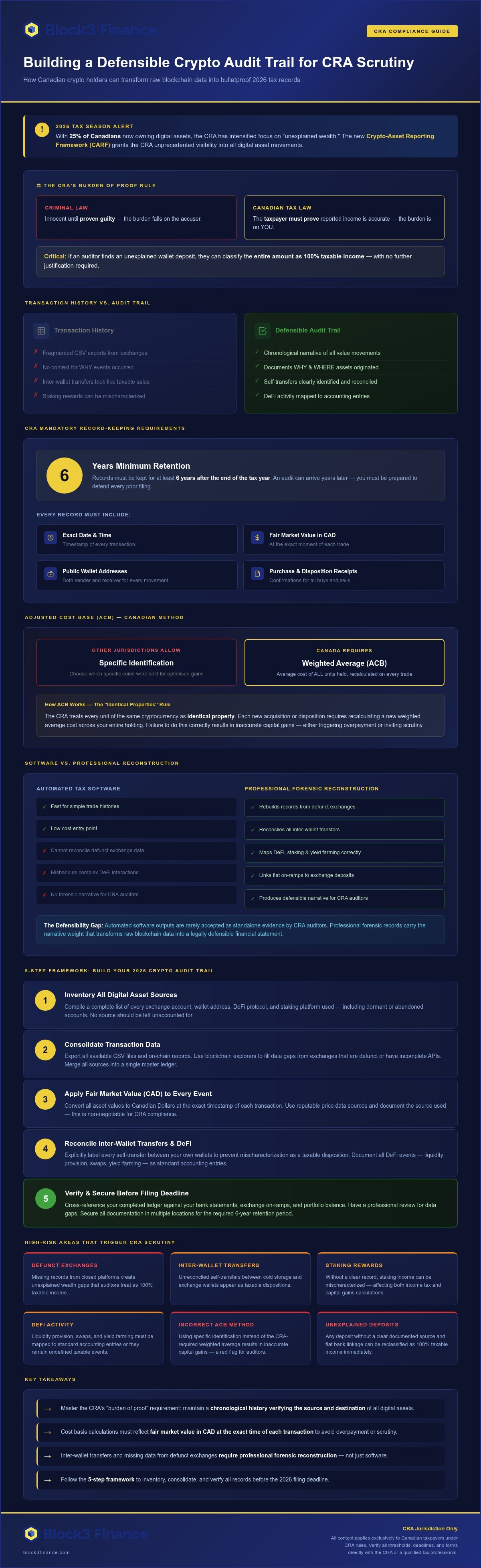
An audit trail serves as the definitive map of your financial journey through the blockchain. It's a chronological record that verifies the source, path, and ultimate destination of every unit of value you hold. In the eyes of the Canada Revenue Agency (CRA), a simple list of trades isn't enough. You must provide a transparent narrative that connects your initial CAD investment to your current portfolio balance. Building a comprehensive audit trail for crypto transactions is the only way to transform raw blockchain data into a defensible financial record.
The CRA operates under a strict "burden of proof" requirement. Unlike criminal law, where you're innocent until proven guilty, Canadian tax law places the responsibility on the taxpayer to prove their reported income is accurate. If an auditor identifies a deposit in your wallet that you can't explain, they have the authority to classify the entire amount as taxable income. This shift in 2026 is driven by the implementation of the Crypto-Asset Reporting Framework (CARF), which grants the CRA unprecedented visibility into digital asset movements. You're no longer operating in a vacuum; you're operating in a landscape of total transparency.
The Difference Between Transaction History and an Audit Trail
A transaction history is merely a list of what happened, often delivered in fragmented CSV exports from various exchanges. It's a collection of data points that lack context. An audit trail is the narrative of why those events occurred and where the underlying value originated. Without this narrative, inter-wallet transfers can look like taxable sales, and staking rewards can be mischaracterized. The CRA views any "unexplained" wealth as 100% taxable income. You must bridge the gap between raw data and financial intent to protect your assets.
CRA Record-Keeping Requirements for Digital Assets
Precision is mandatory for Canadian filers. The CRA requires you to maintain detailed records for a minimum of six years after the end of the tax year. This retention period ensures that if an audit occurs years later, you possess the documentation to defend your previous filings. Your records must include:
- The exact date and time of every transaction.
- The fair market value of the asset in Canadian Dollars (CAD) at the time of the trade.
- The public wallet addresses involved in each movement.
- Receipts or confirmations for all purchases and dispositions.
Establishing a professional audit trail for crypto transactions ensures you're prepared for any inquiry. If you're concerned about your historical data, you can explore how to get your CRA Crypto Audit ready with forensic-level precision. This proactive approach eliminates the friction of missing exchange data and secures your financial future.
The Anatomy of a Defensible Blockchain Financial Record
A defensible financial record serves as the bedrock of a successful tax filing. It requires a meticulous synthesis of on-chain activity and off-chain documentation to withstand scrutiny. You must go beyond the raw TXIDs mentioned earlier to create a cohesive audit trail for crypto transactions that identifies the fair market value of every asset in Canadian Dollars (CAD) at the exact moment of acquisition. This level of detail transforms a chaotic ledger into a professional financial statement.
Inter-wallet transfers often present a significant risk if they are left unreconciled. Auditors may mischaracterize these "self-transfers" as taxable dispositions if the trail between your cold storage and exchange accounts is broken. You must also map complex DeFi interactions, such as liquidity provision, swaps, and yield farming, into standard accounting entries that reflect the economic reality of the trade. Linking your fiat bank statements to exchange on-ramps provides the final layer of proof, ensuring the CRA can trace the legal origin of your initial capital.
Calculating Adjusted Cost Base (ACB) for CRA Compliance
The CRA applies the "identical properties" rule to determine the cost of digital assets held by a taxpayer. Unlike other jurisdictions where taxpayers might choose specific identification methods, Canadian filers must use a weighted average calculation. Adjusted Cost Base (ACB) represents the average cost of all units of a specific cryptocurrency held in your portfolio, adjusted for every new acquisition or disposition. This ensures your capital gains are calculated with the mathematical rigor the CRA expects. If you find these calculations overwhelming, you can consult with our specialized team to ensure your books are flawless.
Proving the Source of Funds in DeFi and Staking
Documenting the source of funds in decentralized environments requires a blend of technical and tax expertise. You must determine if your staking rewards qualify as business income or capital gains based on the frequency and nature of your activity. The CRA generally views crypto-to-crypto trades as taxable events. This includes "wrapping" tokens, such as converting BTC to wBTC, which the agency typically treats as a disposition of the original asset at its fair market value. Understanding Crypto Tax in Canada is essential for navigating these nuances and ensuring your audit trail for crypto transactions remains unbroken across protocols.
Software vs. Professional Reconstruction: The Defensibility Gap
Relying solely on automated tools creates a false sense of security for many Canadian filers. While software provides a convenient starting point, it often fails to distinguish between a taxable disposition and a simple inter-wallet transfer. A robust audit trail for crypto transactions requires human intelligence to reconcile these gaps and provide a narrative that satisfies the CRA's burden of proof. Without expert oversight, the "Garbage In, Garbage Out" problem leads to inflated tax liabilities or, worse, records that crumble under audit.
Professional reconstruction offers a level of defensibility that a software printout simply cannot match. When an exchange closes or API access is revoked, an automated tool loses the trail entirely. We utilize forensic methodologies to bridge these data gaps, ensuring your financial history remains unbroken and transparent. This proactive approach shifts your position from defensive to offensive, giving you total command over your books before the CRA even asks a question.
When Automated Crypto Tax Software Fails
High-volume trading bots often generate thousands of "dust" transactions that break standard software logic. These microscopic movements can cause calculation errors that propagate across your entire portfolio. Cross-chain bridges present an even greater challenge; software frequently loses the trail of an asset as it moves between Ethereum, Solana, or various Layer 2 networks. These technical blind spots result in incorrect adjusted cost base (ACB) figures and potential non-compliance with CRA rules.
Software also lacks the ability to provide a defensible narrative for complex business structures or corporate holdings. It cannot explain the "why" behind a specific smart contract interaction or liquidity provision. For high-net-worth individuals, this lack of context is a significant risk factor during a manual CRA review. You need a record that explains the economic reality of your trades, not just a list of hashes.
The Role of Forensic Crypto Accounting
Professional reconstruction utilizes block explorers as primary evidence rather than relying on potentially corrupted or incomplete API data. We verify the integrity of CSV exports from centralized exchanges (CEXs) to ensure every entry reflects the actual flow of funds. Our Crypto Accounting Services transform raw on-chain activity into clean, audit-ready financial statements. This forensic rigor ensures that your audit trail for crypto transactions is built on a foundation of verified data.
A professional report carries significant weight during a CRA inquiry. It signals to the auditor that your filings have been prepared with the same technical rigor applied to traditional corporate finance. The investment in professional reconstruction is a strategic choice; it protects you from the heavy penalties associated with "unexplained wealth" and provides the peace of mind that comes with total financial clarity.
5 Steps to Build Your 2026 Crypto Audit Trail
Building a resilient audit trail for crypto transactions requires a disciplined, systematic approach. You must move beyond fragmented data to create a unified financial narrative that aligns with CRA expectations. This five-step framework provides the roadmap for gaining total command over your 2026 tax obligations.
Success in a high-stakes audit depends on the integrity of your underlying data. You aren't just preparing a tax return; you're constructing a forensic record of your financial evolution. By following these steps, you transform a volatile ledger into a stable, defensible asset.
Step 1: The Wallet and Exchange Inventory
Begin by identifying every point of entry and exit within your digital asset ecosystem. Don't overlook cold storage hardware wallets or accounts on defunct exchanges where you previously held assets. These historical gaps are often the first places a CRA auditor will look for "unexplained" wealth.
Documenting public keys for every on-chain entity is essential for verifying the flow of funds without compromising your private security. Using a rigorous checklist ensures that no platform or protocol is overlooked during the data gathering phase. This inventory forms the foundation of your entire reporting structure.
Step 2: Transaction Data Consolidation and Classification
Once you've identified your sources, consolidate all transaction data into a single, unified ledger. You must then classify every movement as a trade, income, gift, transfer, or expense. This classification allows you to apply the correct tax treatment to each event according to Canadian law. Precise labeling is the difference between a clean audit and a manual CRA reassessment.
Pulling data from every exchange, wallet, and protocol into one centralized record eliminates blind spots that can trigger regulatory scrutiny. Standardizing date formats, asset tickers, and transaction types across all sources ensures consistency throughout your records. A well-organized ledger at this stage dramatically reduces the complexity of every subsequent step.
Step 3: On-Chain Verification and Reconciliation
Cross-referencing your consolidated ledger against publicly available blockchain data is a non-negotiable part of building a credible audit trail for crypto transactions. Every on-chain transaction has an immutable timestamp and hash that can be independently verified by the CRA. Confirming that your internal records match the blockchain's public record removes any grounds for disputing your reported figures.
Pay particular attention to DeFi interactions, NFT transactions, and cross-chain bridges, as these are frequently misreported or omitted entirely. Gaps between your ledger and on-chain data must be investigated and resolved before you file. Unresolved discrepancies are a primary trigger for CRA reassessments and penalties.
Step 4: Fiat-to-Crypto Reconciliation
Matching your CAD deposits to the initial purchase of digital assets is a critical step in proving the source of your wealth. You must reconcile your bank statements with exchange on-ramps to create a closed-loop history. This documentation proves a "disposition" occurred when you sold crypto back for CAD or used it for purchases.
Establishing this link eliminates the friction of proving where your investment capital originated. It provides the CRA with the transparency they demand while protecting you from the mischaracterization of your holdings. Ready to secure your books? Contact our expert team today.
Step 5: ACB Calculation Validation
The final step involves validating your Adjusted Cost Base (ACB) calculations using specific Canadian tax rules. You must ensure that every buy and sell event correctly updates the weighted average cost of your holdings. This mathematical verification ensures that your reported capital gains or losses are accurate. A verified audit trail for crypto transactions serves as your ultimate defense against regulatory scrutiny.
Review your ACB figures against your consolidated ledger and on-chain data one final time before submitting your return. Even a minor arithmetic error in your cost base can compound across hundreds of transactions, resulting in a materially misstated tax position. Completing this validation step gives you the confidence that your records are accurate, complete, and fully defensible before the CRA.
Secure Your Financial Future with Block3 Finance
Block3 Finance provides the technical rigor and intellectual leadership required to master the Canadian digital asset landscape. With 13+ years of blockchain expertise, we specialize in transforming the inherent complexity of the ledger into a source of strategic advantage. We don't just manage regulations; we empower you to gain total command over a volatile financial environment.
As a firm ranked as a top provider by Bitcoin.com, we have empowered over 980 global clients to navigate high-stakes environments with confidence. Our "white-glove" approach ensures that every client receives a bespoke strategy tailored to their specific risk profile. We act as a calm force in a chaotic industry, characterized by deep experience and a commitment to best practices.
Our firm serves as a strategic partner for high-growth investors, Web3 startups, and DAOs across Ontario and the broader Canadian market. We understand the jurisdictional nuances of the CRA's stance on digital assets better than any traditional accounting firm. This deep immersion allows us to resolve the friction that typically occurs during the reconciliation process.
Our proactive stance ensures that your financial records are not just compliant, but bulletproof. We believe that vision and execution are inseparable, providing you with the roadmap needed to thrive in a transparent world.
From Chaos to Compliance: Our Methodology
We apply forensic-level detail to every audit trail for crypto transactions we construct for our clients. Our methodology involves reconciling every swap, bridge, and liquidity provision with mathematical precision. We navigate the friction of DeFi and NFT portfolios by bridging the gap between cutting-edge technology and legacy corporate finance. This steady and logical process builds trust through the accumulation of professional weight.
We eliminate the risk of inaccurate data by verifying every entry against the source code of the blockchain itself. Our approach turns chaotic on-chain activity into clean, defensible financial books. Visit our Crypto Audit Preparation page to learn how we protect your wealth from regulatory uncertainty.
Take the Offensive Against CRA Scrutiny
The transition from defensive panic to a master-level financial posture begins with expert preparation. We act as your visionary navigator, providing the roadmap needed to thrive in a world of increasing transparency. By leveraging our global network and deep understanding of Canadian tax law, we ensure your international activity remains fully compliant.
You deserve the liberation that comes from knowing your books are ready for any level of scrutiny. We provide the mentorship and strategic planning required to evolve your portfolio while maintaining total oversight. Our Audit and Compliance service represents the gold standard for high-net-worth filers who require absolute certainty. Book your consultation with Block3 Finance to secure your financial future today.
Command Your Financial Narrative for the 2026 Tax Season
The landscape of digital asset taxation in Canada has fundamentally shifted toward total transparency. You've seen that relying on raw data or basic software is no longer a viable strategy for high-net-worth filers. Building a professional audit trail for crypto transactions is the only way to transform chaotic on-chain activity into a defensible shield against CRA scrutiny.
Block3 Finance brings 13+ years of blockchain financial expertise to ensure your records are bulletproof and your reporting is fully CRA-compliant. As the firm ranked #1 by Bitcoin.com, we provide the elite strategy needed to move from defensive panic to master-level control. We bridge the gap between cutting-edge technology and legacy corporate finance with forensic precision.
Don't leave your financial future to chance or automated algorithms. It's time to claim total agency over your books and navigate the complexity of the 2026 tax season with absolute confidence. Secure your defensible crypto audit trail; contact Block3 Finance today. We're ready to help you thrive in this new era of transparency.
Frequently Asked Questions
Is a block explorer link enough for a CRA audit trail?
A block explorer link is insufficient because it lacks the necessary financial context for a professional audit trail for crypto transactions. While a transaction hash proves a movement occurred, it doesn't calculate the fair market value in Canadian Dollars or track your adjusted cost base. The CRA requires a narrative that explains the purpose behind each movement. You must reconcile these on-chain events with your bank statements to prove the legal source of your funds.
How long should I keep my crypto transaction records in Canada?
You must retain all digital asset records for a minimum of six years after the end of the tax year to which they relate. This duration is the standard requirement for most Canadian tax records under CRA rules. Keeping detailed logs of your audit trail for crypto transactions ensures you can defend against retroactive audits. If you're involved in a dispute, you should keep these records until the matter is fully resolved.
What happens if I cannot find records from an exchange that shut down?
You are still responsible for proving your cost basis even if an exchange has ceased operations. We utilize forensic accounting techniques to reconstruct your history using block explorer data and historical price feeds. By matching your bank withdrawals to on-chain deposits, we can establish a defensible starting point for your portfolio. It's essential to document your efforts to retrieve data to show the CRA you've acted with due diligence.
Does the CRA track my crypto transactions automatically?
The CRA's visibility is increasing rapidly through information sharing agreements with centralized exchanges and the upcoming implementation of the Crypto-Asset Reporting Framework (CARF). By 2028, the CRA will receive automated reports on many crypto-asset transactions from service providers. It's safer to assume the agency has, or will have, access to your trading data. Proactive reconciliation is the only way to ensure your reported figures match the CRA's internal records.
Can I use US-based crypto tax software for my Canadian CRA filing?
You can use US-based software, but you must manually ensure it follows Canadian tax logic. The CRA requires the use of the weighted average cost method for calculating your adjusted cost base, whereas US software often defaults to First-In, First-Out (FIFO). Using the wrong method can lead to significant errors in your capital gains reporting. Most sophisticated filers prefer professional oversight to ensure their software settings align perfectly with Canadian jurisdictional requirements.
What is the penalty for failing to provide an audit trail for crypto?
Failing to provide a defensible record allows the CRA to treat your entire crypto deposit as 100% taxable income rather than a capital gain. This reassessment often leads to higher tax liabilities and substantial interest charges on the unpaid balance. The agency may also apply penalties for gross negligence if they believe you intentionally omitted information. Maintaining a robust audit trail for crypto transactions is your primary defense against these severe financial consequences.
Do I need an audit trail for small NFT trades or just large ones?
You must maintain a record for every digital asset transaction, regardless of its size or the nature of the asset. The CRA views the exchange of an NFT for cryptocurrency, or vice versa, as a taxable disposition at fair market value. Small trades can accumulate over time, significantly impacting your total adjusted cost base. Neglecting these minor events can create mathematical gaps that undermine the integrity of your entire financial history during an audit.
How does Block3 Finance help with a crypto audit trail?
Block3 Finance leverages 13+ years of blockchain expertise to turn complex on-chain activity into clean, defensible financial books. We specialize in forensic audit preparation for high-net-worth investors and Web3 startups across Canada. Our team reconciles fragmented data from multiple wallets and exchanges to build a master-level audit trail for crypto transactions. We provide the intellectual leadership required to navigate the CRA's rigorous compliance standards with absolute confidence and professional precision.

Article by
Mahad Mohamed
Mahad Mohamed is an accountant and the CEO of Block3 Finance, with over 26+ years of Canadian and international tax and accounting experience. A crypto accounting specialist since the early days of Bitcoin, he has consulted for over 38 crypto companies and collaborated with legal professionals on regulatory matters. His expertise spans corporate reorganization, cross-border tax structuring (Canada & US), tax disputes, and CRA audits.
Previously, Mahad worked for the Canada Revenue Agency (CRA), Big4 accounting firms, and served as a Rulings Officer for the Federal Tax Authority of the UAE before acquiring Tax Partners in 2014.
Block3 Finance and Tax Partners has 44 full-time accountants and over 9,800+ clients.
Disclaimer
This article provides general information only and is current as of its publication date. It has not been updated and may be out of date. It does not constitute legal advice and should not be relied upon as such. Every tax situation is unique and may differ from the examples discussed in this article. If you have specific questions, you should seek the advice of our accountants for your unique circumstances.
Frequently Asked Questions
Is a block explorer link enough for a CRA audit trail?
A block explorer link is insufficient because it lacks the necessary financial context for a professional audit trail for crypto transactions. While a transaction hash proves a movement occurred, it doesn't calculate the fair market value in Canadian Dollars or track your adjusted cost base. The CRA requires a narrative that explains the purpose behind each movement. You must reconcile these on-chain events with your bank statements to prove the legal source of your funds.
How long should I keep my crypto transaction records in Canada?
You must retain all digital asset records for a minimum of six years after the end of the tax year to which they relate. This duration is the standard requirement for most Canadian tax records under CRA rules. Keeping detailed logs of your audit trail for crypto transactions ensures you can defend against retroactive audits. If you're involved in a dispute, you should keep these records until the matter is fully resolved.
What happens if I cannot find records from an exchange that shut down?
You are still responsible for proving your cost basis even if an exchange has ceased operations. We utilize forensic accounting techniques to reconstruct your history using block explorer data and historical price feeds. By matching your bank withdrawals to on-chain deposits, we can establish a defensible starting point for your portfolio. It's essential to document your efforts to retrieve data to show the CRA you've acted with due diligence.
Does the CRA track my crypto transactions automatically?
The CRA's visibility is increasing rapidly through information sharing agreements with centralized exchanges and the upcoming implementation of the Crypto-Asset Reporting Framework (CARF). By 2028, the CRA will receive automated reports on many crypto-asset transactions from service providers. It's safer to assume the agency has, or will have, access to your trading data. Proactive reconciliation is the only way to ensure your reported figures match the CRA's internal records.
Can I use US-based crypto tax software for my Canadian CRA filing?
You can use US-based software, but you must manually ensure it follows Canadian tax logic. The CRA requires the use of the weighted average cost method for calculating your adjusted cost base, whereas US software often defaults to First-In, First-Out (FIFO). Using the wrong method can lead to significant errors in your capital gains reporting. Most sophisticated filers prefer professional oversight to ensure their software settings align perfectly with Canadian jurisdictional requirements.
What is the penalty for failing to provide an audit trail for crypto?
Failing to provide a defensible record allows the CRA to treat your entire crypto deposit as 100% taxable income rather than a capital gain. This reassessment often leads to higher tax liabilities and substantial interest charges on the unpaid balance. The agency may also apply penalties for gross negligence if they believe you intentionally omitted information. Maintaining a robust audit trail for crypto transactions is your primary defense against these severe financial consequences.
Do I need an audit trail for small NFT trades or just large ones?
You must maintain a record for every digital asset transaction, regardless of its size or the nature of the asset. The CRA views the exchange of an NFT for cryptocurrency, or vice versa, as a taxable disposition at fair market value. Small trades can accumulate over time, significantly impacting your total adjusted cost base. Neglecting these minor events can create mathematical gaps that undermine the integrity of your entire financial history during an audit.
How does Block3 Finance help with a crypto audit trail?
Block3 Finance leverages 13+ years of blockchain expertise to turn complex on-chain activity into clean, defensible financial books. We specialize in forensic audit preparation for high-net-worth investors and Web3 startups across Canada. Our team reconciles fragmented data from multiple wallets and exchanges to build a master-level audit trail for crypto transactions. We provide the intellectual leadership required to navigate the CRA's rigorous compliance standards with absolute confidence and professional precision.