
Does your balance sheet reflect the true economic substance of your blockchain activity, or is it a liability waiting for an auditor to dismantle? With crypto ownership in Canada reaching 25% in 2026, the pressure to maintain precise ifrs crypto asset accounting has never been higher. Most Web3 leaders feel the friction of reconciling high-volume on-chain data into a legacy framework that lacks specific standard-level guidance.
We recognize the burden of navigating the ambiguity between IAS 38 intangible assets and IAS 2 inventory. It's a high-stakes environment where the fear of audit failure is real; however, the opportunity for institutional-grade transparency is even greater. You deserve a reporting structure that acts as a foundation for growth rather than a defensive hurdle.
This guide empowers you to master these complexities and secure your organization's financial integrity. You will gain a clear understanding of fair value measurement under IFRS 13 and a strategic roadmap for turning volatile digital assets into clean, audit-ready financial statements. We'll explore classification strategies, disclosure requirements, and the latest CSA guidance to ensure your reporting is beyond reproach.
Key Takeaways
- Identify the correct classification for your holdings under IAS 38 or IAS 2 to ensure your balance sheet aligns with current IFRS interpretations.
- Master the technical requirements of ifrs crypto asset accounting to confidently select between cost and revaluation models for your digital assets.
- Streamline the reconciliation of high-volume DeFi and staking transactions into your general ledger for seamless, defensible financial reporting.
- Secure your organization's reputation by implementing robust disclosure practices that meet the heightened scrutiny of 2026 Canadian audits.
- Transform your accounting from a compliance burden into a strategic asset that attracts institutional capital and supports global expansion.
Classification of Digital Assets Under IFRS Frameworks
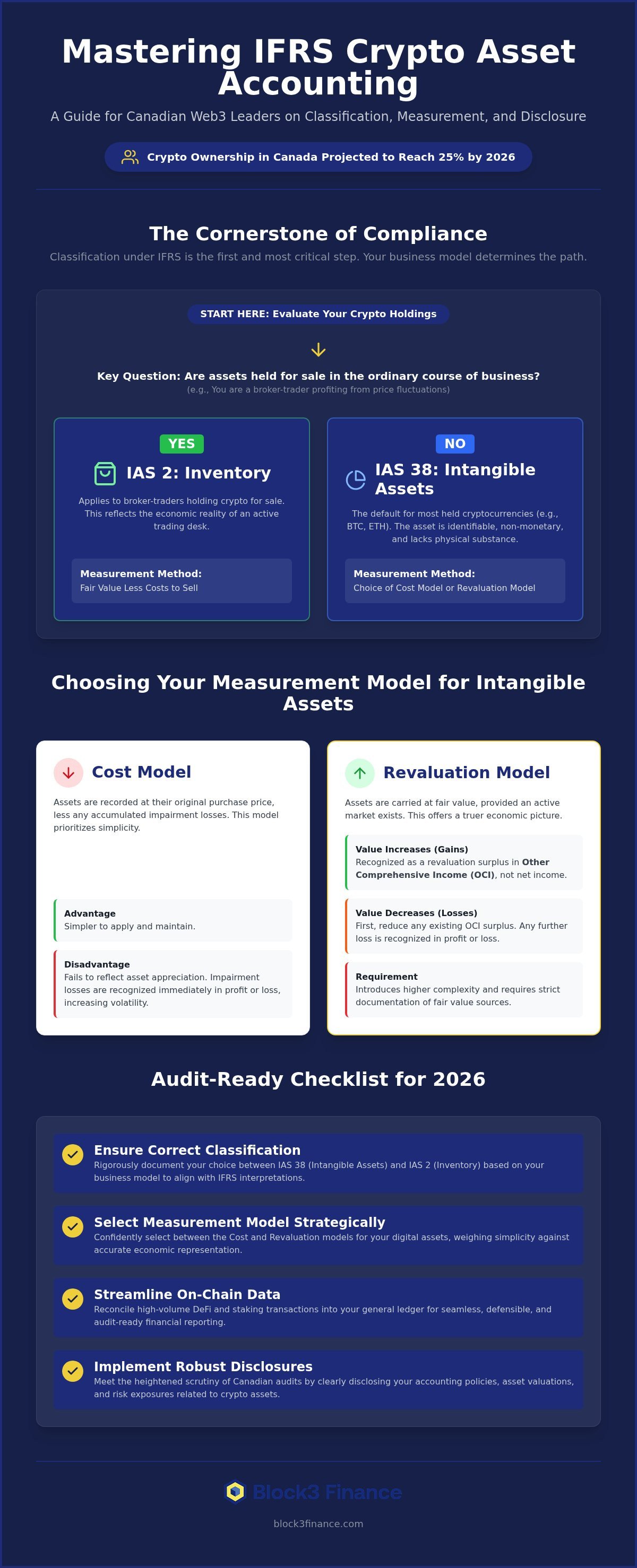
Classification is the cornerstone of your financial narrative. Within the current 2026 landscape, Canadian entities must apply a principles-based approach because a dedicated standard for digital assets does not exist. Your choice between intangible asset and inventory treatment dictates every subsequent measurement and disclosure.
The IFRS Interpretations Committee (IFRIC) provided the definitive roadmap in their June 2019 agenda decision. This guidance clarifies that cryptocurrencies are not cash or financial assets under IFRS. Instead, they typically reside within the scope of IAS 38 or IAS 2, depending on your organization's specific business model.
Ensuring your ifrs crypto asset accounting is defensible requires a deep understanding of these legal frameworks. This clarity allows you to move from a defensive posture to a position of strategic mastery. We help our clients navigate these high-stakes classifications to build a foundation for institutional growth.
IAS 38: The Default for Digital Assets
Most cryptocurrencies held by Canadian organizations are classified as intangible assets under IAS 38. To meet this definition, an asset must be identifiable, non-monetary, and lack physical substance. Bitcoin and Ethereum typically satisfy these criteria because they aren't legal tender and don't grant the holder a right to receive a fixed number of currency units.
This classification can feel counterintuitive for highly liquid tokens. However, the lack of a physical form and the non-monetary nature of the asset leave little room for alternative interpretations under current rules. Organizations must document their logic carefully to survive the rigors of an audit and compliance review.
Global transparency is also evolving through initiatives like the Crypto-Asset Reporting Framework (CARF). This framework emphasizes the need for standardized reporting across jurisdictions. Aligning your internal classification with these international expectations is essential for scaling your Web3 operations.
IAS 2: When Crypto is Treated as Inventory
The primary exception to the IAS 38 default occurs when an entity holds crypto assets for sale in the ordinary course of business. This scenario typically applies to broker-traders who act as intermediaries. If your business model focuses on generating profit from fluctuations in price or a dealer's margin, IAS 2 is your governing standard.
Commodity broker-traders measure their inventory at fair value less costs to sell. This approach provides a more accurate reflection of the economic reality for active trading desks. Identifying the exact moment your business model triggers IAS 2 requires precise technical oversight to avoid reporting friction.
We see many firms struggle to bridge the gap between their blockchain activity and these legacy definitions. Mastering ifrs crypto asset accounting means recognizing that your digital footprint must translate into a language traditional institutions trust. This alignment is what transforms a volatile ledger into a sophisticated financial statement.
Measurement Models: Cost vs. Fair Value Under IFRS
Choosing the right measurement model is a pivot point for your financial reporting. Under IAS 38, Canadian entities must select between the cost model and the revaluation model. This decision significantly impacts how volatility appears on your balance sheet and income statement.
The cost model records assets at their original purchase price minus any accumulated impairment. While this approach offers simplicity, it fails to reflect the appreciation of high-performing digital assets. If the market value drops below your carrying amount, you must recognize an impairment loss immediately in your profit or loss statement.
Mastering ifrs crypto asset accounting involves weighing these models against your organization's growth goals. Most Web3 firms prefer the revaluation model to capture the true economic value of their holdings. This method, however, introduces higher complexity and stricter documentation requirements.
Applying the Revaluation Model
The revaluation model allows you to carry assets at fair value, but only if an active market exists. When the asset's value increases, the gain is recognized as a revaluation surplus in Other Comprehensive Income (OCI). OCI is a section of the financial statements that records gains and losses not yet realized in the net income.
If the asset's value subsequently decreases, the loss first offsets any existing surplus in OCI. Any further decline beyond that surplus must be recognized as an expense in profit or loss. The KPMG IFRS Cryptoasset Guidance highlights that this model requires consistent application to ensure comparability across reporting periods.
Fair Value Hierarchy for Crypto Assets
IFRS 13 establishes a three-level hierarchy to categorize the inputs used for fair value measurement. Level 1 inputs are the most reliable, consisting of quoted prices in active markets for identical assets like Bitcoin or Ethereum. These prices must be readily and regularly available from an exchange or regulatory agency.
Level 2 inputs involve observable data other than quoted prices, such as prices for similar assets or market-corroborated data. Level 3 inputs are unobservable and apply to illiquid or restricted tokens where market activity is minimal. Determining the correct level requires professional judgment to ensure your valuations are defensible under audit.
Navigating these hierarchies is essential for maintaining a transparent relationship with stakeholders and regulators. If you are unsure which measurement model best serves your long-term growth objectives, consulting with an elite strategist can clarify your path. We help you move from managing regulation to mastering it.
Reconciling On-Chain Data for IFRS-Compliant Books
Bridging the gap between the decentralized ledger and your corporate books is the most significant operational hurdle in ifrs crypto asset accounting. While the blockchain provides an immutable record, the raw data is often a collection of cryptographic hashes that don't provide the context required for financial reporting. You must transform this digital noise into a structured, human-readable narrative that satisfies Canadian auditors.
High-frequency activity, such as DeFi lending or liquid staking, generates thousands of micro-transactions that traditional accounting software cannot ingest natively. Mapping these movements to your General Ledger (GL) accounts requires a robust middleware solution that can track cost basis across multiple chains. As noted in the Grant Thornton on IFRS for Crypto analysis, managing currency translation and cost-flow assumptions is critical for maintaining IFRS compliance in Canada.
Establishing a defensible audit trail for cross-chain movements is non-negotiable. When assets move through bridges or liquidity pools, the connection between the source and destination can become obscured. We resolve this friction by implementing automated reconciliation workflows that link every transaction hash to a specific business purpose.
DeFi and Staking Income Recognition
Revenue recognition for staking rewards or DeFi yield occurs at the point you gain control over the asset. This usually means the moment the rewards hit your wallet address, regardless of whether you've claimed them in a protocol's interface. You must value these non-fiat rewards in Canadian dollars (CAD) using the fair value hierarchy discussed in previous sections.
Gas fees present another layer of complexity for Canadian entities. You generally treat transaction costs as immediate expenses, though certain scenarios allow for basis adjustments if they're directly attributable to the acquisition of an asset. Maintaining a meticulous record of these fees ensures your net income reflects the true cost of your on-chain operations.
Building an Audit-Ready Blockchain Ledger
A defensible audit trail requires more than just a list of wallet balances. You need to provide third-party verification, such as node snapshots or signed messages, to prove ownership and control of your private keys. We help firms establish Blockchain Financial Records: Building an Audit Trail that stands up to the most rigorous regulatory scrutiny.
Turning raw hex data into a financial narrative is where elite strategy meets technical rigor. By institutionalizing these workflows, you shift from a defensive posture to a state of total command over your financial data. This clarity is what allows a Web3 organization to scale with confidence in a volatile landscape.
IFRS Disclosure Requirements and 2026 Audit Prep
Transparency is a strategic pillar for institutional credibility. For Canadian entities, 2026 audit preparation requires a shift toward exhaustive disclosure of both holdings and the underlying risks associated with ifrs crypto asset accounting. You must provide a clear narrative regarding your custodial arrangements and private key management to assure stakeholders of asset security.
Your financial statements should explicitly detail the methods used to determine fair value, especially for Level 2 and 3 assets. Level 2 inputs involve observable market data for similar tokens, while Level 3 inputs rely on unobservable data for illiquid or restricted assets. This level of detail moves your reporting from a defensive posture to one of absolute command; organizations often complement this with AI-driven investment insights from Rebellion Research to ensure their valuations are backed by sophisticated data analysis.
Auditors now scrutinize the specific logic used to classify assets within the digital ecosystem. You must document the rationale for choosing IAS 38 over IAS 2, particularly if your business model involves frequent trading or broker-dealer activity. This documentation includes identifying the 'principal market' used for valuation, which is the market with the greatest volume and level of activity for the specific asset.
Proactive documentation ensures your Audit-Ready Crypto Books can withstand deep technical inquiry from regulators. We help you articulate these judgments with the technical rigor expected by top-tier Canadian accounting firms. By institutionalizing these records, you transform a complex compliance hurdle into a foundation for long-term growth.
Risk Management Disclosures
Quantifying risk is essential for ifrs crypto asset accounting in the current volatile climate. You must disclose the impact of price volatility on your financial health and provide sensitivity analyses for significant token positions. To satisfy Canadian reporting standards, you should categorize and quantify the following exposures:
- Liquidity Risk: Explaining how easily you can exit large token positions without significantly moving the market price.
- Credit Risk: Addressing exposures in lending protocols, decentralized finance (DeFi) platforms, or centralized exchanges.
- Market Risk: Analyzing how fluctuations in the broader digital asset market affect your entity's equity and performance.
The Canadian Securities Administrators (CSA) emphasize robust disclosure regarding the safeguarding of crypto assets. Your reporting must include a meaningful discussion of how you manage non-monetary transactions and the risks involved in your specific blockchain activity. This transparency builds trust with banking partners who require a sophisticated understanding of your risk profile.
If you are preparing for a year-end review, contact our elite strategy team to ensure your disclosures are defensible and audit-ready. We provide the roadmap you need to navigate the complexities of digital asset reporting with confidence.
Strategic Growth Through Expert Crypto CFO Services
Clean financial records under ifrs crypto asset accounting are more than a regulatory requirement; they are a prerequisite for capital efficiency. Institutional investors and Canadian banking partners in 2026 demand data that is both defensible and transparent. By institutionalizing your reporting, you transform your balance sheet into a powerful tool for securing venture capital or traditional debt financing.
A fractional CFO acts as the bridge between your technical blockchain operations and the rigid expectations of the legacy financial world. This role is vital for resolving the friction of global tax treaties and complex cross-border accounting hurdles. Our Strategic Crypto CFO Services empower Web3 leaders to focus on core innovation while we maintain the technical rigor of financial oversight.
Positioning your firm for a successful exit or a 2026 IPO requires a multi-year history of clean, audit-ready books. Potential acquirers look for stability and a sophisticated understanding of your cost basis and risk management strategies. This proactive approach shifts your narrative from simple survival to long-term market leadership and institutional trust.
Scaling Web3 with Professional Oversight
Rapidly scaling a Web3 organization involves managing a decentralized workforce across multiple jurisdictions. You must ensure that global payroll and contractor payments made in digital assets are recorded accurately for both accounting and tax purposes. Understanding International Crypto Tax Compliance is essential to avoid regulatory friction with the CRA.
We help you integrate automated systems that map crypto disbursements to traditional payroll records. This ensures that your labor costs are fully deductible and that your organization remains compliant with Canadian employment and tax laws. Professional oversight allows you to expand your team without the fear of systemic reporting failures or audit surprises.
The Block3 Finance Advantage
Block3 Finance brings 13+ years of specialized expertise to the table, having served over 980 global clients. We don't just provide a service; we offer a roadmap for thriving in a complex world. Our elite strategists provide direct access to sophisticated corporate structuring and proactive audit-readiness tailored for the 2026 environment.
We act as a calm force in a chaotic industry, characterized by a commitment to best practices and intellectual leadership. Our team understands the deep nuances of ifrs crypto asset accounting and how they apply to the evolving Canadian landscape. Take the first step toward total command of your financial future and Consult with a Crypto Accounting Expert today.
Master Your Financial Narrative in a Digital World
Navigating the complexities of ifrs crypto asset accounting is no longer a defensive necessity; it's a strategic advantage for Canadian entities. By correctly classifying assets under IAS 38 and implementing robust fair value measurements, you build a foundation of institutional trust. This technical rigor ensures your organization remains audit-ready while positioning you for significant growth in the 2026 landscape.
You don't have to resolve the friction of blockchain data alone. Block3 Finance brings 13+ years of blockchain financial rigor and has been ranked as the top provider by Bitcoin.com. We have served over 980 global Web3 clients, helping them transform complex on-chain activity into defensible financial records that satisfy the most demanding regulators.
Take command of your reporting and unlock the full potential of your digital holdings. Secure your audit-ready financial future with Block3 Finance today. Our team is ready to help you navigate this volatile environment with the precision and confidence your organization deserves.
Frequently Asked Questions
Is cryptocurrency considered cash or a financial asset under IFRS?
No, cryptocurrencies are not generally considered cash or financial assets under the current IFRS framework. The IFRS Interpretations Committee concluded in June 2019 that digital assets lack the characteristics of cash because they aren't legal tender in most jurisdictions. They also fail to meet the definition of a financial asset because they don't represent a contractual right to receive cash or another financial instrument.
How do I account for stablecoins on my balance sheet?
Accounting for stablecoins depends on the specific legal rights granted to the holder. If the token provides a contractual right to redeem it for a fixed amount of fiat currency, it may qualify as a financial asset under IFRS 9. However, many stablecoins without such a direct claim are treated as intangible assets under IAS 38, consistent with general ifrs crypto asset accounting principles for Canadian entities.
What IFRS standard applies to NFT holdings for businesses?
Non-fungible tokens (NFTs) typically fall under IAS 38 Intangible Assets if you hold them for long-term appreciation or utility. If your Canadian business model involves frequently buying and selling NFTs as a primary revenue source, they are classified as inventory under IAS 2. You must evaluate the economic substance of the NFT to determine which framework provides the most transparent representation for your stakeholders.
Can I use the fair value through profit or loss (FVTPL) model for crypto?
You can only use a model similar to FVTPL if you qualify as a commodity broker-trader under IAS 2. For most Canadian entities holding crypto as an intangible asset under IAS 38, you must use either the cost model or the revaluation model. Under the revaluation model, increases in value are generally recorded in other comprehensive income (OCI) rather than directly in profit or loss.
How does IFRS crypto accounting differ from US GAAP?
The primary difference lies in the measurement of gains and losses. Under recent US GAAP updates, qualifying crypto assets are measured at fair value with changes recognized in net income. In contrast, ifrs crypto asset accounting typically requires Canadian entities to record revaluation gains in other comprehensive income. This creates a significant divergence in how market volatility affects your entity's reported bottom line.
What are the specific disclosure requirements for crypto assets in 2026?
For 2026 audits, Canadian entities must provide extensive disclosures regarding their valuation techniques and the inputs used in the fair value hierarchy. You are also required to disclose the nature and extent of risks associated with your holdings, including liquidity and credit risk. This transparency ensures that your financial statements remain defensible and provide a clear roadmap of your organization's digital asset exposure.
How should I account for gas fees and network costs under IFRS?
Gas fees and network costs are generally recognized as an expense in the period they are incurred. If these costs are directly attributable to the acquisition of a specific digital asset, you may have a basis for capitalizing them into the asset's initial cost. It's essential to maintain a consistent policy for these transactions to ensure your internal books align with IFRS principles and Canadian regulatory expectations.
Do I need to value my crypto assets daily or only at year-end?
While formal financial reporting occurs at the end of each period, maintaining daily or transaction-date valuations is a best practice for internal bookkeeping. This granular data allows you to track cost basis accurately and simplifies the reconciliation process during your year-end audit. Consistent monitoring helps you identify impairment triggers early and ensures your balance sheet reflects the current economic reality of your blockchain activity.

Article by
Mahad Mohamed
Mahad Mohamed is an accountant and the CEO of Block3 Finance, with over 26+ years of Canadian and international tax and accounting experience. A crypto accounting specialist since the early days of Bitcoin, he has consulted for over 38 crypto companies and collaborated with legal professionals on regulatory matters. His expertise spans corporate reorganization, cross-border tax structuring (Canada & US), tax disputes, and CRA audits.
Previously, Mahad worked for the Canada Revenue Agency (CRA), Big4 accounting firms, and served as a Rulings Officer for the Federal Tax Authority of the UAE before acquiring Tax Partners in 2014.
Block3 Finance and Tax Partners has 44 full-time accountants and over 9,800+ clients.
Disclaimer
This article provides general information only and is current as of its publication date. It has not been updated and may be out of date. It does not constitute legal advice and should not be relied upon as such. Every tax situation is unique and may differ from the examples discussed in this article. If you have specific questions, you should seek the advice of our accountants for your unique circumstances.
Frequently Asked Questions
Is cryptocurrency considered cash or a financial asset under IFRS?
No, cryptocurrencies are not generally considered cash or financial assets under the current IFRS framework. The IFRS Interpretations Committee concluded in June 2019 that digital assets lack the characteristics of cash because they aren't legal tender in most jurisdictions. They also fail to meet the definition of a financial asset because they don't represent a contractual right to receive cash or another financial instrument.
How do I account for stablecoins on my balance sheet?
Accounting for stablecoins depends on the specific legal rights granted to the holder. If the token provides a contractual right to redeem it for a fixed amount of fiat currency, it may qualify as a financial asset under IFRS 9. However, many stablecoins without such a direct claim are treated as intangible assets under IAS 38, consistent with general ifrs crypto asset accounting principles for Canadian entities.
What IFRS standard applies to NFT holdings for businesses?
Non-fungible tokens (NFTs) typically fall under IAS 38 Intangible Assets if you hold them for long-term appreciation or utility. If your Canadian business model involves frequently buying and selling NFTs as a primary revenue source, they are classified as inventory under IAS 2. You must evaluate the economic substance of the NFT to determine which framework provides the most transparent representation for your stakeholders.
Can I use the fair value through profit or loss (FVTPL) model for crypto?
You can only use a model similar to FVTPL if you qualify as a commodity broker-trader under IAS 2. For most Canadian entities holding crypto as an intangible asset under IAS 38, you must use either the cost model or the revaluation model. Under the revaluation model, increases in value are generally recorded in other comprehensive income (OCI) rather than directly in profit or loss.
How does IFRS crypto accounting differ from US GAAP?
The primary difference lies in the measurement of gains and losses. Under recent US GAAP updates, qualifying crypto assets are measured at fair value with changes recognized in net income. In contrast, ifrs crypto asset accounting typically requires Canadian entities to record revaluation gains in other comprehensive income. This creates a significant divergence in how market volatility affects your entity's reported bottom line.
What are the specific disclosure requirements for crypto assets in 2026?
For 2026 audits, Canadian entities must provide extensive disclosures regarding their valuation techniques and the inputs used in the fair value hierarchy. You are also required to disclose the nature and extent of risks associated with your holdings, including liquidity and credit risk. This transparency ensures that your financial statements remain defensible and provide a clear roadmap of your organization's digital asset exposure.
How should I account for gas fees and network costs under IFRS?
Gas fees and network costs are generally recognized as an expense in the period they are incurred. If these costs are directly attributable to the acquisition of a specific digital asset, you may have a basis for capitalizing them into the asset's initial cost. It's essential to maintain a consistent policy for these transactions to ensure your internal books align with IFRS principles and Canadian regulatory expectations.
Do I need to value my crypto assets daily or only at year-end?
While formal financial reporting occurs at the end of each period, maintaining daily or transaction-date valuations is a best practice for internal bookkeeping. This granular data allows you to track cost basis accurately and simplifies the reconciliation process during your year-end audit. Consistent monitoring helps you identify impairment triggers early and ensures your balance sheet reflects the current economic reality of your blockchain activity.