
What if your automated tax software isn't actually protecting you from a CRA audit, but is instead generating a trail of errors that could cost you thousands? Many Canadian investors struggle to decide when to hire a crypto accountant as their on-chain activity moves beyond simple trades into complex DeFi protocols. You likely feel the mounting pressure as tax deadlines approach and your transaction history becomes a tangled web of fragmented data.
We'll help you identify the specific complexity triggers that require a specialist's touch to ensure your records are truly audit-ready. Gaining total command over your digital landscape requires shifting from a defensive posture to one of proactive growth and financial advocacy. This guide provides the roadmap you need to navigate the evolving expectations of the Canada Revenue Agency with absolute confidence.
This guide details the transition from casual tracking to professional mastery. We'll explore how to manage your Adjusted Cost Base, which is the weighted average cost of your holdings used to determine capital gains, to ensure you never pay more than you legally owe. You'll gain peace of mind knowing your filings are backed by specialized expertise and a disciplined methodology.
Key Takeaways
- Recognize the "Complexity Threshold"—the point where manual reconciliation exceeds 20 hours—to determine exactly when to hire a crypto accountant to protect your assets.
- Navigate the tax treatment of DeFi activities and staking rewards under CRA rules to correctly distinguish between business income and capital gains.
- Evaluate the necessity of professional bookkeeping and corporate structuring when managing Web3 payroll or DAO operations to optimize tax efficiency.
- Secure your compliance by mastering the T1135 form requirements for foreign property exceeding $100,000 and understanding the CRA's latest data collection methods.
- Bridge the gap between volatile on-chain data and stable legacy financial records with professional oversight that ensures your filings are defensible and audit-ready.
The Complexity Threshold: When DIY Crypto Software Is No Longer Enough
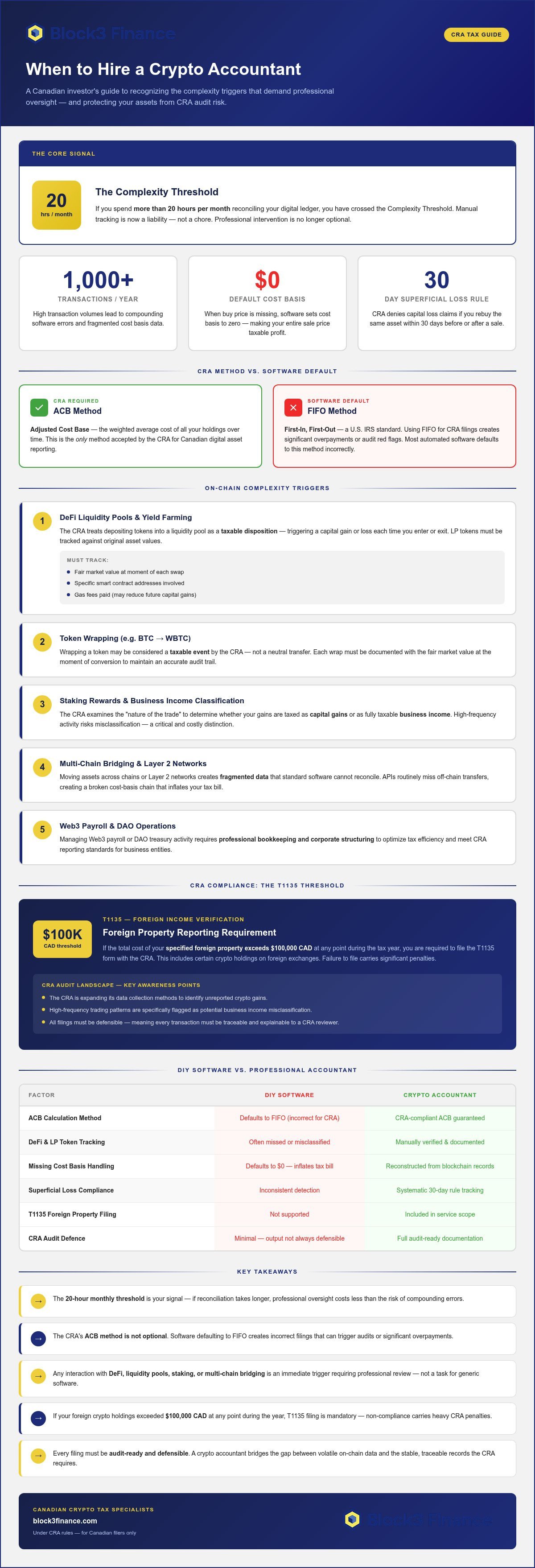
Managing a few trades on a single exchange is simple for most investors. However, a "Complexity Threshold" exists where manual reconciliation becomes a liability rather than a chore. We define this threshold as the point where you spend more than 20 hours per month attempting to balance your digital ledger.
Finding yourself trapped in spreadsheets is a clear signal of when to hire a crypto accountant to reclaim your time. High transaction volumes, typically exceeding 1,000 events per year, often lead to compounding software errors. This shifts your strategy from a defensive struggle to an offensive posture of financial mastery.
Understanding Adjusted Cost Base (ACB) for Canadians
For CRA filers, the primary metric for tracking value is the Adjusted Cost Base (ACB). This is the average cost of your holdings, calculated over time, used to determine capital gains or losses. While many software packages default to U.S.-style FIFO, the CRA strictly requires the ACB method for all digital asset reporting.
Using the wrong calculation method can result in significant tax overpayments or red flags during a review. You must also account for superficial loss rules in Canada. These prevent you from claiming a capital loss if you buy the same asset within 30 days before or after a sale.
A specialized crypto tax accountant in Canada ensures these calculations remain compliant with specific domestic regulations. This professional oversight protects your assets from avoidable penalties and ensures your records are defensible.
The Limits of Automated API Reporting
Automated API pulls often fail to capture the "story" behind the movement. APIs frequently miss off-chain transfers, wallet-to-wallet movements, or transactions from obscure decentralized exchanges. This creates a "broken chain" where the software cannot find the original purchase price of an asset.
When a buy price is missing, software often defaults the cost basis to zero. This leads to an artificially high tax bill because the CRA views the entire sale price as profit. A professional must manually verify the intent of every transfer to ensure accuracy and prevent overpayment.
Fragmented data across multiple chains requires a disciplined methodology to resolve friction. Partnering with experts who understand the blockchain ecosystem ensures your records are audit-ready and accurate. This provides the intellectual depth needed to navigate high-stakes financial environments with confidence.
Specific On-Chain Triggers Requiring Professional Oversight
While transaction volume signals a need for help, specific on-chain behaviors act as immediate triggers for professional intervention. If you are interacting with smart contracts or moving assets across Layer 2 networks, you've likely exceeded what standard software can handle. Identifying when to hire a crypto accountant becomes essential as your activity shifts from simple holding to active ecosystem participation.
The CRA increasingly focuses on the "nature of the trade" to determine tax liability. This means the way you interact with protocols determines whether your gains are taxed as capital gains or as fully taxable business income. Professional oversight ensures you don't accidentally misclassify high-frequency activity and face unexpected penalties during a review.
DeFi and Yield Farming Complications
In the Canadian tax context, providing liquidity to a pool is rarely a neutral event. The CRA generally views the exchange of your tokens for Liquidity Provider (LP) tokens as a disposition, which triggers a capital gain or loss. This creates a complex reporting requirement every time you enter or exit a pool, as the value of the LP token must be tracked against the original assets.
Similarly, "wrapping" a token, such as swapping BTC for WBTC, may be considered a taxable event rather than a mere transfer. This distinction is vital for maintaining an accurate audit trail. To reconcile these smart contract interactions, you must track the following:
- The fair market value of the assets at the moment of the swap.
- The specific smart contract addresses involved in the transaction.
- The gas fees paid, which can often be added to your cost basis to reduce future gains.
Bridging and Multi-Chain Reconciliation
Moving assets between chains, such as Ethereum to Solana or various Layer 2 solutions, creates a reporting nightmare. Most APIs fail to link the exit on one chain with the entry on another, leading to "orphaned" transactions. This fragmentation breaks your continuous history and often results in a missing cost basis for the receiving wallet.
A specialized accountant uses advanced forensic tools to reconstruct these events into a defensible record. They ensure that moving your own capital across bridges isn't incorrectly flagged as a series of taxable sales. If these technical hurdles are creating friction in your reporting, it's time to consult with a professional strategist to secure your records.
NFT activity adds another layer of complexity for CRA filers. Whether you are minting, flipping, or receiving royalty income, each event requires a precise valuation in Canadian dollars. A professional helps you navigate whether your NFT hobby has crossed the line into a business venture, which significantly changes your tax obligations and reporting requirements.
Business Triggers: When Web3 Startups and DAOs Must Hire
For Web3 startups, the transition from a founder-led project to a scaled operation introduces systemic financial risks that demand specialized oversight. This phase represents the critical moment of when to hire a crypto accountant to oversee treasury health and regulatory alignment. Maintaining audit-ready records is no longer optional when you are seeking venture capital funding or managing a complex cap table with global stakeholders.
Web3 firms seeking VC funding face rigorous due diligence processes that demand total command over their financial history. Investors look for more than just a balance sheet; they require a roadmap that demonstrates disciplined treasury management and a clear understanding of tax liabilities. A specialized accountant acts as a visionary navigator, transforming raw blockchain data into high-level professional records that build investor trust and secure your firm's future. For entrepreneurs seeking to align this professional success with their personal goals, The Bucket List Accountant provides strategic advisory that ensures your business wealth translates into a fulfilling lifestyle.
While many focus solely on the digital side, integrating your crypto activity with your overall business structure is a key step in professionalization. For those seeking comprehensive oversight across their commercial ventures, The Sphere Group offers specialized business accounting and tax advisory to ensure all components of your wealth are managed with precision.
Paying team members in digital assets creates immediate obligations under CRA rules. The agency treats these payments as employment income, requiring you to calculate and remit withholding taxes in Canadian dollars based on the fair market value at the time of payment. Withholding taxes are the portions of pay that an employer must deduct and send directly to the government to cover a worker's income tax and benefit contributions.
This valuation challenge becomes even more acute when using volatile native tokens for compensation. Professional crypto accounting services ensure your monthly bookkeeping captures every payroll event with precision. We help you navigate the friction between on-chain distributions and off-chain tax remittances. This proactive stance prevents the accumulation of penalties that can drain your startup's runway.
Treasury Management and DAO Governance
A Decentralized Autonomous Organization (DAO) is a blockchain-based entity where decisions are made through community governance rather than a centralized hierarchy. While DAOs operate on-chain, they often require jurisdictional legitimacy to interact with legacy financial institutions or legal frameworks. Defensible financial records are the bridge between decentralized innovation and established compliance, ensuring your organization is not viewed as a high-risk outlier by regulators.
Moving from "spreadsheet accounting" to professional sub-ledger management is essential for maintaining a transparent treasury. Strategic corporate structuring for crypto businesses allows you to optimize tax efficiency while protecting your core assets. Engaging a fractional crypto CFO provides the intellectual leadership needed to manage volatility and ensure long-term growth. This elite strategy shifts your DAO from a defensive posture to one of mastery and agency in a volatile landscape.
CRA Compliance: Navigating the Audit Landscape in 2026
The CRA has expanded its reach through Unnamed Persons Requirements, which allow the agency to gather detailed user data from centralized exchanges. This systemic shift means your on-chain history is likely already visible to regulators. Determining when to hire a crypto accountant is vital if your past filings don't match the digital footprint the CRA is currently tracking.
For investors with unfiled gains, the Voluntary Disclosures Program offers a path to rectify errors before an audit begins. This program can lead to the waiver of penalties and relief from prosecution if you come forward voluntarily. It's a strategic move to resolve friction and maintain jurisdictional legitimacy in an increasingly transparent environment.
The T1135 Requirement and Foreign Property
Many Canadians overlook the $100,000 CAD cost basis threshold that triggers mandatory reporting. The CRA classifies assets held on foreign exchanges or in private wallets as Specified Foreign Property, which you must report on form T1135. This is a transparency requirement rather than a direct tax, but the consequences for ignoring it are severe.
Non-compliance with this requirement leads to significant daily penalties, even if you don't owe additional taxes. A specialized accountant ensures these assets are valued correctly and disclosed according to current rules. This oversight is critical for high-net-worth individuals managing global custody while residing in Canada.
Building an Audit-Ready Trail
A crypto tax accountant in Canada constructs a narrative that stands up to forensic scrutiny. While software provides raw data, the agency expects a comprehensive record that includes transaction IDs (TXIDs), specific wallet addresses, and the intent behind smart contract interactions. Professional reconciliation ensures your financial history remains consistent across all platforms.
You must be able to prove that internal transfers between your own wallets are not taxable dispositions. This level of detail requires a disciplined methodology that goes beyond simple software exports. Relying on unverified data is a high-stakes gamble that often fails during a manual review by the agency.
You can evaluate your current readiness by reviewing our CRA crypto audit checklist. If you find gaps in your documentation, contact our strategist team to secure your records. Taking a proactive stance now prevents a defensive struggle later.
Choosing the Right Partner: Why Block3 Finance is the Strategic Choice
Selecting a partner to manage your digital assets requires more than a simple tax preparer. It demands a visionary navigator who possesses the technical rigor of a traditional auditor and the mindset of a bold innovator. Deciding when to hire a crypto accountant is a strategic pivot that shifts your narrative from defensive compliance to offensive growth and total command over your financial landscape.
Block3 Finance brings over 13 years of specialized blockchain financial expertise to every engagement. We've managed over 980 global clients, including high-growth startups and decentralized organizations, turning volatile on-chain data into defensible records. Our firm provides a sophisticated bridge between the cutting-edge digital asset space and the legacy requirements of Canadian corporate finance.
While our reach is global, we maintain a deep focus on Ontario and Canadian jurisdictions. This local authority ensures that every strategy we implement is perfectly aligned with the specific expectations of the CRA. We don't just observe the industry; we are active participants in its evolution, providing you with a roadmap for thriving in a complex world.
Expertise Beyond Simple Tax Preparation
Our capabilities extend far beyond calculating your annual capital gains. We specialize in high-stakes audits and compliance, providing the intellectual depth needed to resolve friction with regulators. The executive team at Block3 Finance possesses deep roots in the ecosystem, allowing us to anticipate shifts in the regulatory environment before they impact your portfolio.
We also facilitate operational excellence through specialized on and off-ramp solutions. These services ensure that your movements between digital assets and fiat currency are seamless and fully documented. By resolving the technical friction of liquidity, we empower you to focus on cultivation and strategic evolution rather than administrative bottlenecks.
The Block3 Onboarding Process
Our engagement begins with a methodical assessment of your transaction history and overall data health. We identify systemic challenges and data fragmentation that could trigger a CRA inquiry. This steady, logical approach builds trust through the accumulation of professional weight and immediate clarity regarding your compliance status.
Once we establish a clean baseline, we transition you to a model of monthly or annual oversight. This ensures your records remain audit-ready and your tax liabilities are legally minimized throughout the year. If you're ready to gain total command over your digital wealth, contact the team for a strategic consultation. We're a calm force in a chaotic industry, dedicated to your long-term financial agency.
Master Your Digital Legacy
The transition from a retail enthusiast to a sophisticated participant in the Web3 ecosystem requires a fundamental shift in your financial strategy. You've learned that the decision of when to hire a crypto accountant is often triggered by data fragmentation, complex DeFi interactions, or the crossing of mandatory CRA reporting thresholds like the T1135. Gaining total command over your assets means moving beyond unverified software exports to a disciplined, audit-ready methodology.
Block3 Finance acts as your visionary navigator, bringing over 13 years of blockchain financial expertise and the experience of serving more than 980 global clients. As the firm ranked #1 by Bitcoin.com, we specialize in resolving the technical friction between on-chain innovation and domestic compliance. We empower you to focus on the growth and cultivation of your portfolio while we secure the stability of your financial records.
Take the first step toward liberating your time and ensuring absolute peace of mind regarding your CRA obligations. Secure your digital future with a specialized crypto tax accountant at Block3 Finance. We look forward to helping you navigate the evolving landscape of 2026 with confidence and intellectual depth.
Frequently Asked Questions
Is crypto taxed as income or capital gains in Canada?
Cryptocurrency in Canada is treated as a commodity rather than currency. Your profits are taxed as either capital gains or business income based on your trading frequency and intent. Capital gains have a 50% inclusion rate, meaning only half of the profit is taxable.
If the CRA deems you are "carrying on a business," 100% of your profits are taxable. A specialized review ensures your activity is classified correctly under domestic law.
Can I use US-based crypto tax software for my Canadian taxes?
Using US-based software is often problematic because it defaults to the First-In-First-Out (FIFO) method. The CRA strictly mandates the use of the Adjusted Cost Base (ACB) method. This is the average cost of all identical assets in your portfolio.
Relying on the wrong calculation method can lead to significant errors in your tax return. You should ensure any tool or professional you use is specifically configured for Canadian jurisdictional requirements.
What happens if I didn't report my crypto in previous years?
If you have missed filings, the CRA's Voluntary Disclosures Program allows you to correct past errors. This program provides a path to resolve friction with the agency by coming forward before an audit begins. Successfully using this program can result in the waiver of penalties and relief from prosecution.
It is a strategic move that shifts your narrative from a defensive posture to one of proactive compliance and financial agency.
How much does it cost to hire a crypto accountant in 2026?
The cost depends on the complexity of your on-chain data and the total transaction volume. Factors include the number of exchanges used, DeFi interactions, and whether you require monthly bookkeeping or a one-time filing.
Block3 Finance provides customized engagements based on your specific data health. Contacting a specialist for an initial assessment is the best way to understand the professional investment required for your situation.
Does the CRA track decentralized wallet activity?
The CRA uses advanced blockchain forensics and "Unnamed Persons Requirements" to link decentralized activity to your identity. While a wallet address is pseudonymous, any interaction with a centralized exchange that requires KYC identity verification can link that wallet to you.
KYC stands for Know Your Customer, a process where exchanges verify your legal identity. The agency actively tracks these movements to ensure all dispositions are reported accurately.
Do I need a crypto accountant if I only buy and hold (HODL)?
Simple buy-and-hold strategies rarely require professional help unless your total cost basis exceeds $100,000 CAD. At this level, you must file form T1135 to disclose foreign property to the CRA. This is a common trigger for identifying when to hire a crypto accountant to ensure your disclosures are accurate.
Failing to file this form correctly results in significant daily penalties. These apply even if no tax is actually owed on the assets.
How do I report crypto earned from staking or airdrops to the CRA?
The CRA typically treats staking rewards and airdrops as income at the time they are received. You must determine the fair market value in Canadian dollars on the day of receipt and report it accordingly. This amount also becomes your cost basis for future capital gains when you eventually sell the tokens.
Managing these micro-transactions across a full year requires a disciplined accounting methodology. This ensures you maintain audit-ready records for the agency.
Can a crypto accountant help me with a CRA audit already in progress?
A specialized firm can step in to reconstruct your financial history and defend your position during an active inquiry. We use forensic tools to link fragmented on-chain data into a defensible narrative for the agency. This proactive advocacy shifts the power dynamic from a defensive posture to one of mastery and growth.
Having an expert navigator ensures that the CRA's final assessment is based on accurate, verified transaction data rather than estimates.

Article by
Mahad Mohamed
Mahad Mohamed is an accountant and the CEO of Block3 Finance, with over 26+ years of Canadian and international tax and accounting experience. A crypto accounting specialist since the early days of Bitcoin, he has consulted for over 38 crypto companies and collaborated with legal professionals on regulatory matters. His expertise spans corporate reorganization, cross-border tax structuring (Canada & US), tax disputes, and CRA audits.
Previously, Mahad worked for the Canada Revenue Agency (CRA), Big4 accounting firms, and served as a Rulings Officer for the Federal Tax Authority of the UAE before acquiring Tax Partners in 2014.
Block3 Finance and Tax Partners has 44 full-time accountants and over 9,800+ clients.
Disclaimer
This article provides general information only and is current as of its publication date. It has not been updated and may be out of date. It does not constitute legal advice and should not be relied upon as such. Every tax situation is unique and may differ from the examples discussed in this article. If you have specific questions, you should seek the advice of our accountants for your unique circumstances.
Frequently Asked Questions
Is crypto taxed as income or capital gains in Canada?
Cryptocurrency in Canada is treated as a commodity rather than currency. Your profits are taxed as either capital gains or business income based on your trading frequency and intent. Capital gains have a 50% inclusion rate, meaning only half of the profit is taxable. If the CRA deems you are "carrying on a business," 100% of your profits are taxable. A specialized review ensures your activity is classified correctly under domestic law.
Can I use US-based crypto tax software for my Canadian taxes?
Using US-based software is often problematic because it defaults to the First-In-First-Out (FIFO) method. The CRA strictly mandates the use of the Adjusted Cost Base (ACB) method. This is the average cost of all identical assets in your portfolio. Relying on the wrong calculation method can lead to significant errors in your tax return. You should ensure any tool or professional you use is specifically configured for Canadian jurisdictional requirements.
What happens if I didn't report my crypto in previous years?
If you have missed filings, the CRA's Voluntary Disclosures Program allows you to correct past errors. This program provides a path to resolve friction with the agency by coming forward before an audit begins. Successfully using this program can result in the waiver of penalties and relief from prosecution. It is a strategic move that shifts your narrative from a defensive posture to one of proactive compliance and financial agency.
How much does it cost to hire a crypto accountant in 2026?
The cost depends on the complexity of your on-chain data and the total transaction volume. Factors include the number of exchanges used, DeFi interactions, and whether you require monthly bookkeeping or a one-time filing. Block3 Finance provides customized engagements based on your specific data health. Contacting a specialist for an initial assessment is the best way to understand the professional investment required for your situation.
Does the CRA track decentralized wallet activity?
The CRA uses advanced blockchain forensics and "Unnamed Persons Requirements" to link decentralized activity to your identity. While a wallet address is pseudonymous, any interaction with a centralized exchange that requires KYC identity verification can link that wallet to you. KYC stands for Know Your Customer, a process where exchanges verify your legal identity. The agency actively tracks these movements to ensure all dispositions are reported accurately.
Do I need a crypto accountant if I only buy and hold (HODL)?
Simple buy-and-hold strategies rarely require professional help unless your total cost basis exceeds $100,000 CAD. At this level, you must file form T1135 to disclose foreign property to the CRA. This is a common trigger for identifying when to hire a crypto accountant to ensure your disclosures are accurate. Failing to file this form correctly results in significant daily penalties. These apply even if no tax is actually owed on the assets.
How do I report crypto earned from staking or airdrops to the CRA?
The CRA typically treats staking rewards and airdrops as income at the time they are received. You must determine the fair market value in Canadian dollars on the day of receipt and report it accordingly. This amount also becomes your cost basis for future capital gains when you eventually sell the tokens. Managing these micro-transactions across a full year requires a disciplined accounting methodology. This ensures you maintain audit-ready records for the agency.
Can a crypto accountant help me with a CRA audit already in progress?
A specialized firm can step in to reconstruct your financial history and defend your position during an active inquiry. We use forensic tools to link fragmented on-chain data into a defensible narrative for the agency. This proactive advocacy shifts the power dynamic from a defensive posture to one of mastery and growth. Having an expert navigator ensures that the CRA's final assessment is based on accurate, verified transaction data rather than estimates.