
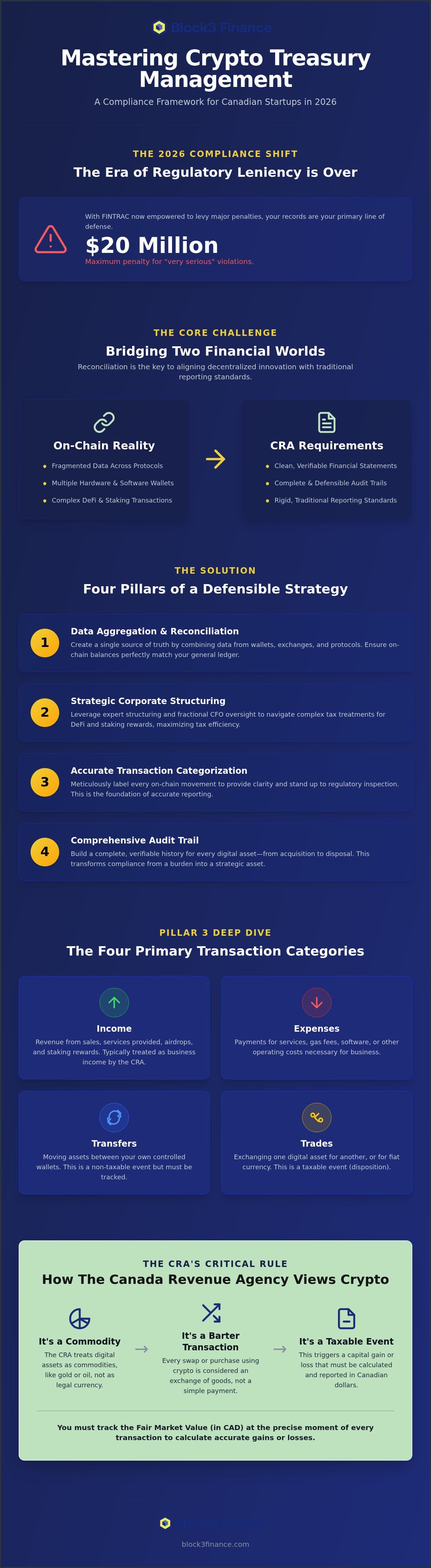
In 2026, the era of regulatory leniency for digital assets in Canada has officially ended. With FINTRAC now empowered to levy penalties as high as $20 million for very serious violations, your financial records are no longer just internal logs; they're your primary line of defense. Implementing sophisticated crypto treasury management for Canadian startups is now the difference between scaling with confidence and facing existential compliance risks.
You've likely felt the friction of reconciling fragmented data across multiple protocols while trying to stay ahead of evolving CRA expectations. It's exhausting to bridge the gap between decentralized innovation and rigid traditional reporting requirements. We understand that you want to focus on building the future, rather than getting lost in a sea of unaligned wallet addresses and staking rewards.
This article provides a comprehensive framework to help you master on-chain accounting and maintain total command over your digital assets. You'll learn how to establish a streamlined audit trail and use strategic corporate structuring to ensure tax efficiency under current rules. We're moving beyond simple tracking to help you build a defensible, high-growth financial foundation.
Key Takeaways
- Establish a robust foundation for growth by mastering crypto treasury management for Canadian startups, ensuring your on-chain activities align perfectly with CRA (Canada Revenue Agency) compliance standards.
- Gain total command over your financial data by aggregating fragmented records from hardware wallets and decentralized protocols into clean, verifiable financial statements.
- Leverage strategic corporate structuring and fractional CFO oversight to navigate complex tax treatments for DeFi (decentralized finance) and staking while maintaining maximum operational flexibility.
- Transform compliance into a strategic asset by building a comprehensive audit trail that documents the entire lifecycle of every digital asset you hold.
Defining Web3 Financial Management for Canadian Enterprises
Web3 financial management is the systematic oversight of a company's digital and fiat assets. It involves the meticulous reconciliation of on-chain transactions with traditional financial statements to ensure full CRA (Canada Revenue Agency) compliance. For firms operating in this space, achieving mastery over these records is no longer optional.
Effective crypto treasury management for Canadian startups requires a proactive approach to managing both capital gains and income generated from staking. Capital gains occur when you sell or trade a digital asset for more than its original purchase price. Staking involves committing your assets to support a blockchain network in exchange for rewards; the CRA typically treats these rewards as business income.
Strategic oversight reduces the looming risk of audits while ensuring long-term operational stability. By establishing a clear framework now, you transform your financial department from a reactive cost center into a strategic asset. You can explore our specialized crypto tax accountant Canada services to begin securing your firm's future.
The Shift from Traditional to On-Chain Finance
Traditional finance relies heavily on centralized bank statements and third-party verification to prove the existence of funds. In contrast, Web3 finance requires extracting data directly from blockchain ledgers and complex smart contracts. This shift demands a high level of technical rigor to ensure every movement of value is captured accurately.
Web3 financial management is the integration of decentralized data into standard accounting frameworks. This process often involves interacting with Decentralized Finance (DeFi) protocols, which allow for lending and trading without traditional intermediaries. Our team provides the monthly accounting support needed to bridge these two worlds seamlessly.
Why CRA Compliance is the Priority in 2026
The Canada Revenue Agency (CRA) views most cryptocurrency transactions as barter transactions. A barter transaction occurs when two parties exchange goods or services without using legal tender, such as the Canadian dollar. Because the CRA treats digital assets as commodities rather than currency, every swap or purchase triggers a taxable event.
Entities must track the fair market value of their assets at the precise moment of every transaction. This valuation is critical for calculating accurate gains or losses in a volatile market. Establishing these habits is essential for crypto treasury management for Canadian startups looking to avoid heavy penalties. Failure to maintain clean records can lead to significant scrutiny, especially as federal oversight of the digital asset sector intensifies throughout 2026.
The Core Pillars of Digital Asset Bookkeeping
Accurate bookkeeping is the foundation of every defensible financial record. You must aggregate data from hardware wallets, exchanges, and decentralized protocols to create a single source of truth for your organization. This holistic view is essential for robust crypto treasury management for Canadian startups.
Reconciliation ensures that your on-chain balances perfectly match the recorded entries in your general ledger. Without this precise alignment, your financial statements remain vulnerable to CRA scrutiny during an audit. Our monthly accounting services provide the technical rigor needed to maintain these records with total confidence.
Transaction Categorization and Labeling
Every movement of funds requires a specific label to ensure your records stand up to regulatory inspection. We categorize transactions into four primary buckets to maintain clarity:
- Income: Revenue from sales, services, or staking rewards.
- Expenses: Payments for services, software, or operating costs.
- Transfers: Moving assets between your own controlled wallets.
- Trades: Exchanging one digital asset for another or for fiat currency.
Staking rewards and airdrops (tokens distributed for free, often to promote a project) require specific treatment as either business income or capital gains. These distinctions are vital for accurate tax reporting for Canadian filers. Professional oversight is necessary to handle complex smart contract interactions that automated tools often misinterpret. If you're unsure how to categorize your recent activity, you can speak with our specialists to clarify your position.
Managing Gas Fees and Network Costs
Gas fees represent the transaction costs paid to miners or validators to process actions on a blockchain. Under CRA guidelines, these fees are typically treated as deductible business expenses or added to the cost basis of the acquired asset. Cost basis refers to the original value of an asset for tax purposes, used to calculate gains or losses later.
Tracking gas fees across thousands of individual transactions is critical for maximizing your tax efficiency and protecting your bottom line. Precise record-keeping allows you to offset income effectively while maintaining a transparent audit trail. This level of detail is a hallmark of elite crypto treasury management for Canadian startups looking to thrive in a regulated environment.
Strategic CFO Oversight and Corporate Structuring
Strategic leadership is the catalyst that transforms a collection of digital assets into a resilient enterprise. A fractional CFO provides this high-level guidance without the overhead of a full-time executive salary. Our CFO and corporate structuring solutions empower you to navigate the complexities of crypto treasury management for Canadian startups with surgical precision.
Corporate structuring determines how your digital assets are taxed and protected from liability. For Canadian entities, this often involves designing legal frameworks that can manage international crypto operations while remaining compliant with domestic laws. We help you move from a defensive posture to an offensive strategy focused on mastery and growth.
The Role of a Digital Asset CFO
CFOs manage liquidity to ensure enough fiat is available for payroll and operational costs. Liquidity refers to the ease with which you can convert digital assets into cash to meet immediate financial obligations. They implement sophisticated on-ramp and off-ramp solutions to move between the blockchain and the traditional banking system safely.
Strategic planning includes proactive treasury management and risk mitigation for volatile assets. By diversifying holdings and setting clear spending protocols, a CFO ensures the startup survives market fluctuations. This oversight is vital for maintaining a stable runway while pursuing decentralized innovation in an increasingly regulated environment.
Entity Selection for Canadian Web3 Projects
Choosing between a corporation, partnership, or trust significantly impacts your CRA reporting requirements. Each structure offers different advantages for asset protection and tax efficiency. Proper structuring helps manage cross-border tax implications for global teams, ensuring you don't face double taxation on your international revenue.
For instance, a Canadian corporation might be the ideal vehicle for holding intellectual property while a separate trust manages staking rewards. You can read about Crypto Tax in Canada for deeper context on how these choices influence your bottom line. We provide the roadmap needed to align your legal structure with your technical vision, ensuring you remain a calm force in a chaotic industry.
Building an Audit-Ready Trail for Digital Assets
Audit-readiness is the practice of maintaining clean, verifiable records long before the CRA (Canada Revenue Agency) initiates a formal review. It transforms compliance from a reactive burden into a strategic advantage for your firm. By prioritizing transparency, you demonstrate a level of professional maturity that builds trust with regulators and investors alike.
A complete audit trail tracks every asset from its initial acquisition to its final disposition. Effective crypto treasury management for Canadian startups requires you to document wallet addresses, transaction hashes, and counterparty details for every movement of value. A transaction hash is a unique alphanumeric string that identifies a specific record on the blockchain, serving as an immutable receipt.
You must demonstrate the flow of funds with absolute clarity to satisfy modern reporting standards. Use our audit preparation checklist to ensure your internal systems meet these high jurisdictional requirements. This proactive stance ensures you're always prepared for scrutiny.
Five Steps to Permanent Audit-Readiness
Achieving a state of constant readiness requires a disciplined approach to data management. This systematic process is a core component of elite crypto treasury management for Canadian startups. We recommend following these steps to secure your financial records:
- Centralize data: Consolidate all on-chain and off-chain financial data into a single source of truth for total visibility.
- Monthly reconciliations: Perform regular reviews to identify and resolve data gaps or inconsistencies immediately.
- Contemporaneous records: Maintain logs of the business purpose for every transaction at the time it occurs to preserve context.
- Secure archiving: Protect all transaction hashes and smart contract interaction logs in a tamper-proof digital environment.
Contemporaneous records are logs created at the same time the transaction occurs, which is essential for accurate CRA reporting. This practice eliminates the risk of memory gaps or lost context during a stressful year-end review. It ensures your financial narrative remains consistent and defensible.
Handling Lost or Stolen Assets
The CRA maintains a high evidentiary bar for claiming a tax loss on stolen assets or lost private keys. You cannot simply claim a loss without providing substantial proof that the assets are permanently inaccessible. This rigorous requirement prevents the misuse of loss claims in the volatile digital asset market.
Your documentation should include police reports or blockchain forensic evidence where available. This data provides the necessary verification to support your claim during your annual tax filing. Without this proof, the CRA may disallow the loss, leading to unexpected tax liabilities.
You should consult a specialist before writing off significant on-chain losses to ensure your evidence meets current regulatory standards. If you need assistance documenting a security incident or preparing for a review, contact our audit team for immediate guidance.
The Block3 Finance Approach to Web3 Mastery
Block3 Finance combines the technical rigor of traditional accounting with a deep, experiential immersion in the blockchain ecosystem. We act as a Visionary Navigator for firms scaling in the volatile Web3 landscape. Our team turns chaotic on-chain data into defensible Canadian tax filings that stand up to the highest levels of scrutiny.
We've managed over 980 global clients, ranging from individual traders to complex decentralized organizations. This extensive experience allows us to resolve friction where legacy finance meets decentralized innovation. We ensure your corporate records are clean, accurate, and ready for any regulatory review.
Mastering crypto treasury management for Canadian startups requires a partner who understands the nuances of the local landscape. We provide the intellectual leadership needed to navigate high-stakes environments with confidence. You gain total command over your financial records while we handle the complexities of the backend.
Why Specialized Expertise Matters
Generalist accountants often struggle with the technical nuances of Decentralized Finance (DeFi) and Non-Fungible Tokens (NFTs). DeFi refers to financial services built on blockchain technology that bypass traditional banks. NFTs are unique digital assets that represent ownership of specific items or content.
Block3 Finance brings over 13 years of specialized blockchain financial expertise to every engagement. We understand how the CRA views these assets and how to report them accurately to minimize your risk. Our team provides localized support across the country, including specialized services for clients in Ontario and British Columbia.
We bridge the gap between abstract innovation and the practical realities of compliance. Our methodology is cumulative and logical, ensuring that every transaction is accounted for within a defensible framework. This disciplined approach is essential for any firm looking to maintain a white-glove financial standard.
Get Started with Professional Web3 Oversight
Secure your financial future by implementing professional systems today. Transitioning from manual spreadsheets to a robust, automated framework is the first step toward long-term operational stability. It allows you to focus on growth while we ensure your compliance remains airtight.
Our fractional CFO services and monthly accounting packages provide the roadmap you need to thrive in 2026. Reach out to a crypto tax accountant today to begin your journey toward financial mastery. We're ready to help you navigate the complexities of crypto treasury management for Canadian startups with elite precision.
Mastering the Future of Canadian Digital Asset Finance
Commanding the intersection of decentralized innovation and CRA compliance requires more than just basic tracking; it demands a comprehensive strategic framework. By centralizing your on-chain data and implementing rigorous monthly reconciliations, you transform your financial department into a defensible asset. Proper corporate structuring ensures your entity remains tax-efficient while scaling across global borders with confidence.
Mastering crypto treasury management for Canadian startups is about shifting from a defensive posture to one of total command over your volatile landscape. Block3 Finance brings over 13 years of blockchain expertise and a track record of serving more than 980 global clients to your organization. As a top-ranked provider by Bitcoin.com, we provide the technical rigor and visionary navigation needed to thrive in high-stakes environments.
We invite you to secure your Web3 financial future with Block3 Finance and gain the clarity your enterprise deserves. Your journey toward financial mastery starts with a single step toward professional oversight. We're ready to help you build a resilient, growth-oriented foundation that withstands the tests of time and regulation.
Frequently Asked Questions
How does the CRA treat income from crypto staking?
The CRA generally treats staking rewards as business income when the activity is conducted in a commercial manner. Staking involves committing digital assets to support a blockchain network to earn rewards.
You must record the fair market value of the rewards in Canadian dollars at the time they are received. This ensures your income is accurately reflected on your annual tax return to avoid future reassessments and maintain compliance.
Do I need a separate bank account for my Web3 business in Canada?
You should maintain a separate fiat bank account to ensure a clear separation between personal and business finances. This separation is foundational for building a defensible audit trail and simplifying the reconciliation of crypto-to-fiat transactions.
It allows your accounting team to track capital injections and operational expenses with precision. Mixing funds creates significant friction during a CRA review and can jeopardize your corporate liability protection.
What is the best way to reconcile thousands of DeFi transactions?
The most effective method involves using specialized sub-ledger software to aggregate data followed by professional manual review. This dual approach is a core part of crypto treasury management for Canadian startups seeking absolute accuracy.
Automated tools often misidentify internal transfers as taxable trades; therefore, expert oversight is required to verify every transaction hash. Clean records prevent costly errors and provide a transparent roadmap for your firm's growth.
Can a DAO be registered as a legal entity in Canada?
A Decentralized Autonomous Organization (DAO) does not have a recognized legal personality in Canada on its own. To interact with the traditional financial system or hold assets legally, you must wrap the DAO in a corporate structure.
This provides a clear framework for CRA reporting and protects individual participants from personal liability. Selecting the right entity is a strategic decision that impacts your long-term tax efficiency and operational agency.
How do I report NFT sales on my Canadian tax return?
NFT sales are treated as barter transactions, where you exchange a unique digital asset for another asset or currency. You must report the difference between your cost basis and the fair market value at the time of sale.
Cost basis is the original purchase price plus any associated costs like gas fees. Proper documentation of every mint and sale is essential for maintaining audit-readiness and ensuring defensible financial records.
What are the penalties for not reporting crypto income to the CRA?
Failure to report crypto income can result in heavy financial penalties and interest charges from the CRA. Under the 2026 Anti-Money Laundering and Counter-Terrorist Financing (AML/CFT) legislation, very serious violations can lead to penalties as high as $20 million.
These fines are designed to enforce strict compliance and deter financial crimes. Maintaining transparent records is your best defense against these significant high-stakes risks to your startup's survival and growth.
Is crypto-to-crypto trading a taxable event in Canada?
Yes, exchanging one cryptocurrency for another is a taxable event in Canada. The CRA views this as a barter transaction, meaning you've disposed of one asset to acquire another.
You must calculate the gain or loss based on the fair market value of the assets in Canadian dollars at the moment of the trade. Failing to track these swaps is a common pitfall that leads to inaccurate tax filings.
How can a fractional CFO help my Web3 startup scale?
A fractional CFO provides the strategic leadership necessary to manage liquidity, which is the ease of converting assets into cash, without the expense of a full-time executive. They implement crypto treasury management for Canadian startups by optimizing on-ramp and off-ramp solutions.
By diversifying holdings and establishing clear financial protocols, they ensure your startup maintains a stable runway. This professional oversight allows you to focus on innovation while they navigate complex regulatory environments.

Article by
Mahad Mohamed
Mahad Mohamed is an accountant and the CEO of Block3 Finance, with over 26+ years of Canadian and international tax and accounting experience. A crypto accounting specialist since the early days of Bitcoin, he has consulted for over 38 crypto companies and collaborated with legal professionals on regulatory matters. His expertise spans corporate reorganization, cross-border tax structuring (Canada & US), tax disputes, and CRA audits.
Previously, Mahad worked for the Canada Revenue Agency (CRA), Big4 accounting firms, and served as a Rulings Officer for the Federal Tax Authority of the UAE before acquiring Tax Partners in 2014.
Block3 Finance and Tax Partners has 44 full-time accountants and over 9,800+ clients.
Disclaimer
This article provides general information only and is current as of its publication date. It has not been updated and may be out of date. It does not constitute legal advice and should not be relied upon as such. Every tax situation is unique and may differ from the examples discussed in this article. If you have specific questions, you should seek the advice of our accountants for your unique circumstances.
Frequently Asked Questions
How does the CRA treat income from crypto staking?
The CRA generally treats staking rewards as business income when the activity is conducted in a commercial manner. Staking involves committing digital assets to support a blockchain network to earn rewards. You must record the fair market value of the rewards in Canadian dollars at the time they are received. This ensures your income is accurately reflected on your annual tax return to avoid future reassessments and maintain compliance.
Do I need a separate bank account for my Web3 business in Canada?
You should maintain a separate fiat bank account to ensure a clear separation between personal and business finances. This separation is foundational for building a defensible audit trail and simplifying the reconciliation of crypto-to-fiat transactions. It allows your accounting team to track capital injections and operational expenses with precision. Mixing funds creates significant friction during a CRA review and can jeopardize your corporate liability protection.
What is the best way to reconcile thousands of DeFi transactions?
The most effective method involves using specialized sub-ledger software to aggregate data followed by professional manual review. This dual approach is a core part of crypto treasury management for Canadian startups seeking absolute accuracy. Automated tools often misidentify internal transfers as taxable trades; therefore, expert oversight is required to verify every transaction hash. Clean records prevent costly errors and provide a transparent roadmap for your firm's growth.
Can a DAO be registered as a legal entity in Canada?
A Decentralized Autonomous Organization (DAO) does not have a recognized legal personality in Canada on its own. To interact with the traditional financial system or hold assets legally, you must wrap the DAO in a corporate structure. This provides a clear framework for CRA reporting and protects individual participants from personal liability. Selecting the right entity is a strategic decision that impacts your long-term tax efficiency and operational agency.
How do I report NFT sales on my Canadian tax return?
NFT sales are treated as barter transactions, where you exchange a unique digital asset for another asset or currency. You must report the difference between your cost basis and the fair market value at the time of sale. Cost basis is the original purchase price plus any associated costs like gas fees. Proper documentation of every mint and sale is essential for maintaining audit-readiness and ensuring defensible financial records.
What are the penalties for not reporting crypto income to the CRA?
Failure to report crypto income can result in heavy financial penalties and interest charges from the CRA. Under the 2026 Anti-Money Laundering and Counter-Terrorist Financing (AML/CFT) legislation, very serious violations can lead to penalties as high as $20 million. These fines are designed to enforce strict compliance and deter financial crimes. Maintaining transparent records is your best defense against these significant high-stakes risks to your startup's survival and growth.
Is crypto-to-crypto trading a taxable event in Canada?
Yes, exchanging one cryptocurrency for another is a taxable event in Canada. The CRA views this as a barter transaction, meaning you've disposed of one asset to acquire another. You must calculate the gain or loss based on the fair market value of the assets in Canadian dollars at the moment of the trade. Failing to track these swaps is a common pitfall that leads to inaccurate tax filings.
How can a fractional CFO help my Web3 startup scale?
A fractional CFO provides the strategic leadership necessary to manage liquidity, which is the ease of converting assets into cash, without the expense of a full-time executive. They implement crypto treasury management for Canadian startups by optimizing on-ramp and off-ramp solutions. By diversifying holdings and establishing clear financial protocols, they ensure your startup maintains a stable runway. This professional oversight allows you to focus on innovation while they navigate complex regulatory environments.