
The IRS now tracks digital asset proceeds through Form 1099-DA, a reporting document for brokers that became mandatory for the 2025 tax year. This shift means that silence is no longer a viable strategy for those wondering how to file back taxes on crypto. You might feel paralyzed by lost exchange access or the sheer volume of messy historical data across multiple wallets.
It's common to feel overwhelmed when years of on-chain activity remain unreported to the IRS. We understand that reconciling cost basis, which is the original value of an asset for tax purposes, across defunct platforms feels like a monumental task. This guide provides a definitive roadmap to resolve your unfiled years while minimizing failure-to-file penalties and daily compounded interest.
You'll learn how to reconstruct your financial history and choose the right disclosure path to achieve total compliance. We'll walk through the technical requirements for amending returns and securing your financial records against future enforcement actions. By the end of this article, you'll have a clear strategy to move from a defensive posture to total command of your digital wealth.
Key Takeaways
- Understand the specific IRS penalties for unfiled crypto, including failure-to-file and failure-to-pay charges that compound over time.
- Master the systematic process of how to file back taxes on crypto by reconstructing historical data from both active and defunct exchanges.
- Learn to aggregate years of complex on-chain activity into a single master ledger to ensure your records are defensible in an audit.
- Identify the correct filing path, whether using Form 1040-X to amend unintentional errors or the Voluntary Disclosure Practice for more complex cases.
- Discover how professional tax filing and reporting can help you minimize interest and regain total command over your financial standing.
The Risks of Unfiled Crypto Taxes under IRS Rules
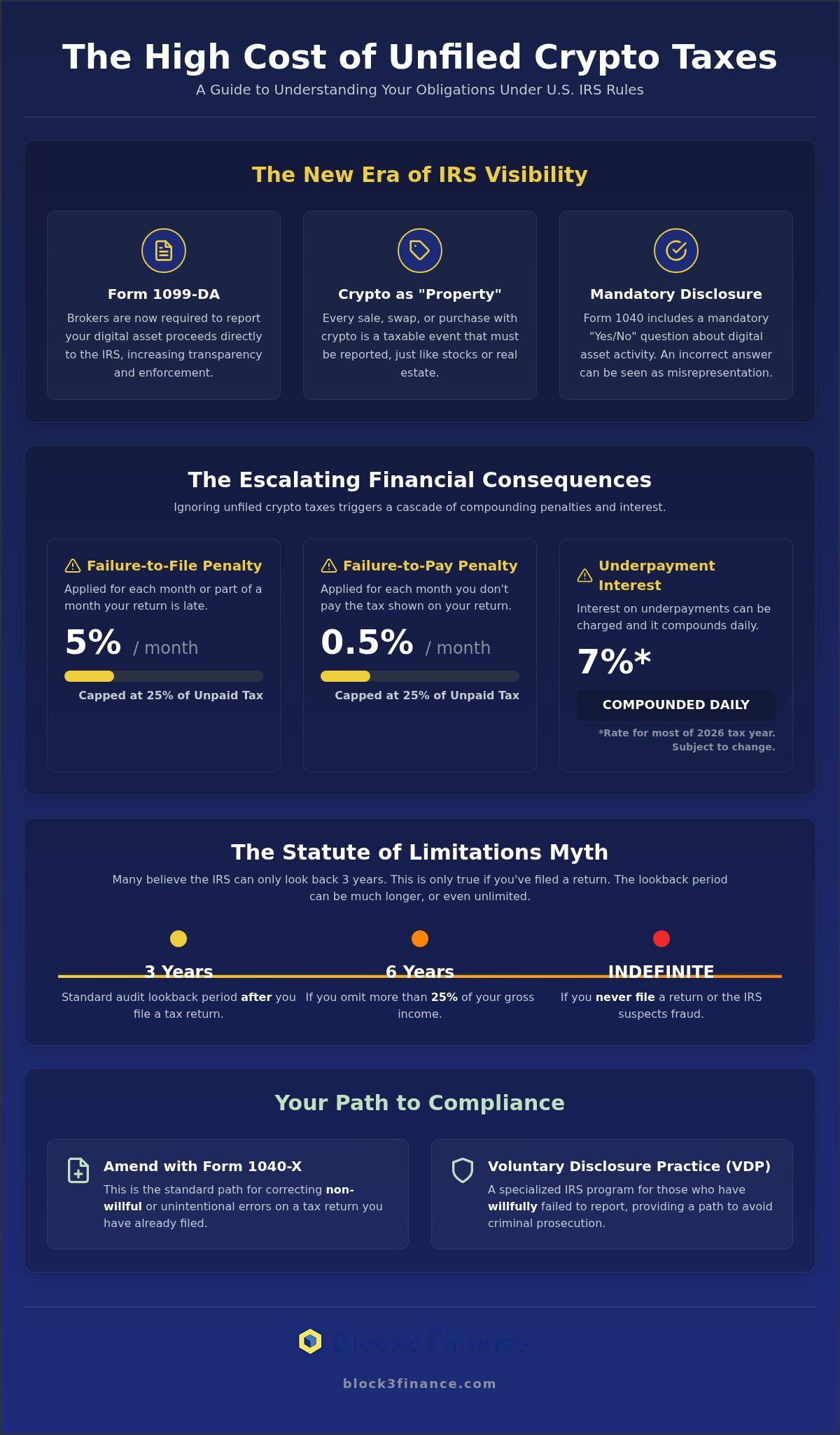
IRS enforcement has entered a new phase of transparency for digital asset holders. With the introduction of Form 1099-DA, the agency now receives direct reports on your transaction proceeds from brokers and exchanges. This increased visibility makes it impossible to ignore the question of how to file back taxes on crypto without inviting significant regulatory scrutiny.
The IRS classifies cryptocurrency as property rather than currency for tax purposes. This means every swap from one token to another or the use of digital assets for a purchase triggers a taxable event. Under U.S. Virtual Currency Law, these transactions must be reported on your annual return to maintain compliance.
Form 1040 now includes a mandatory digital asset question that requires a definitive "Yes" or "No" response. If you checked "No" while holding or trading assets, the IRS may view this as a deliberate misrepresentation. Such a choice complicates any future claims of "good faith" errors during a formal audit or investigation.
Understanding Capital Gains and Income in Crypto
You must calculate your capital gains, which is the profit realized when selling or swapping an asset for more than its cost basis. Cost basis represents the original value of the asset at the time of acquisition plus any associated fees. Accurate basis tracking is the only way to avoid overpaying on historical trades.
Assets held for less than one year are subject to short-term capital gains tax rates, which align with ordinary income brackets. If you hold an asset for more than one year, you qualify for lower long-term capital gains rates. Distinguishing between these two categories is vital for minimizing your total liability when filing for previous years.
The Statute of Limitations Myth
Many taxpayers believe they are safe from audit after three years have passed. However, the three-year statute of limitations for an IRS audit never begins until you actually file a return. For unfiled years, the agency's window to assess taxes, penalties, and interest remains open indefinitely.
If you did file but omitted more than 25% of your gross income, the lookback period extends to six years. The IRS classifies this as a "substantial omission," allowing them a much longer window for enforcement. In cases where the agency suspects fraud or willful non-compliance, which is the intentional disregard of tax laws, there is no time limit on their pursuit of back taxes.
Late filing also triggers a cascade of financial consequences:
- Failure-to-file penalty: 5% of unpaid taxes per month, capped at 25%.
- Failure-to-pay penalty: 0.5% of unpaid taxes per month, capped at 25%.
- Underpayment interest: Compounded daily, the rate stands at 7% for most of the 2026 tax year.
Willful non-compliance carries the risk of criminal charges and severe financial restitution. Understanding how to file back taxes on crypto before an audit starts is essential for preserving your wealth. Professional tax filing and reporting allows you to resolve these liabilities and move from a defensive posture to total command of your financial records.
IRS Voluntary Disclosure and Amending Prior Returns
The strategy for how to file back taxes on crypto hinges on whether your previous omissions were non-willful or intentional. Non-willful errors are honest mistakes or negligence without a specific intent to defraud the government. Initiating a disclosure voluntarily is a proactive move that preserves your agency and often leads to more favorable outcomes than waiting for an audit notice.
The IRS Voluntary Disclosure Practice (VDP) serves as a specialized track for taxpayers who have willfully failed to report assets and seek to avoid criminal prosecution. This program provides a structured environment to resolve high-stakes non-compliance through a standardized process. According to IRS Digital Assets Guidance, participants must provide a complete narrative of their financial activity, usually covering a six-year disclosure period.
Choosing to file before the IRS contacts you is almost always the superior financial decision. Once the agency issues a notice or begins an investigation, you lose the ability to participate in voluntary programs. Proactive filing signals a commitment to compliance and shifts the narrative from a defensive posture to one of mastery and growth.
When to Use Form 1040-X
Form 1040-X is the standard document for amending a previously filed U.S. tax return to include missing crypto activity. You must file a separate Form 1040-X for every specific tax year you intend to correct. This method is ideal for taxpayers who filed on time but were unaware of the specific reporting requirements for token swaps or DeFi earnings.
Every amendment must include a corrected Form 8949, which is the form used to report the Sales and Other Dispositions of Capital Assets. This granular reporting ensures that every on-chain event is accounted for in a way that the IRS can verify against its own data. Amending your returns allows you to synchronize your records with the new reporting standards and ensures your history is defensible.
The Benefits of Proactive Disclosure
Proactive disclosure often qualifies you for penalty abatement, which is the removal of penalties if you can demonstrate reasonable cause for the initial error. This process not only settles past debts but also establishes a clean "Basis Trail" for future tax years. By documenting your history now, you prevent the risk of double taxation on future sales and secure your long-term wealth.
Managing these filings requires a deep understanding of evolving regulatory frameworks and complex data reconstruction. You can learn how Block3 Finance handles complex tax filings to ensure your historical records meet the highest standards of professional rigor. If you are unsure which path fits your specific history, you should contact our team for a professional assessment of your situation.
Reconstructing Historical On-Chain Data for Back-Filing
Reconstructing a multi-year transaction history is a rigorous forensic exercise that requires identifying every exchange, wallet, and DeFi protocol you have touched. When learning how to file back taxes on crypto, you must prioritize the collection of API keys and CSV files from all historical platforms. Even if an exchange has closed its doors, you can often find transaction records in your email archives or through bank statements that detail your initial on-ramp activity.
A major pitfall in back-filing is the misclassification of internal transfers. You must reconcile transfers between your own wallets to ensure they are not miscounted as taxable sales. Utilizing blockchain explorers allows you to track on-chain movements and verify these transfers, which creates a defensible record for the IRS and prevents overpayment.
Accounting for "lost" data requires a proactive approach to historical reconciliation. By tracking on-chain movements across various networks, you can fill in the gaps left by defunct exchanges or forgotten private wallets. This methodical data aggregation is the only way to ensure your financial records are complete and accurate.
The Challenge of Missing Cost Basis
If you cannot prove the cost basis of an asset, the IRS may treat the entire sale price as a 100% taxable gain. This outcome significantly inflates your tax liability and ignores the capital you originally invested. For assets received through airdrops or mining, you must determine the Fair Market Value (FMV) at the time of receipt to establish an accurate basis for your records.
Specialized crypto accountants use forensic tools to fill data gaps when records are incomplete. These experts can reconstruct missing links in your transaction chain by cross-referencing on-chain data with known market prices. This level of detail is essential for anyone figuring out how to file back taxes on crypto without triggering unnecessary accuracy-related penalties.
Software vs. Professional Forensic Accounting
Generic tax software often struggles with "broken" cost basis chains from previous years. These tools are designed for simple, current-year filings and frequently fail when faced with complex DeFi interactions or missing historical data. When software encounters a gap, it often defaults to a zero-basis assumption, which unfairly penalizes the taxpayer.
Professional reconciliation ensures that internal transfers remain non-taxable and that every gain is calculated with precision. Our team acts as a Visionary Navigator, turning messy on-chain activity into clean financial records that stand up to IRS scrutiny. You should explore our crypto accounting and bookkeeping services to ensure your historical filings are audit-ready and accurate.
Step-by-Step: How to File Your Crypto Back Taxes
Executing a successful recovery of unfiled years requires a disciplined, sequential approach. You must move beyond the chaos of fragmented data to create a submission that the IRS will accept as accurate and complete. This process transforms your historical activity into a structured financial narrative that resolves your liabilities.
Follow these five essential steps to understand how to file back taxes on crypto and secure your standing with the IRS:
- Step 1: Aggregate historical data. Consolidate every transaction from active and defunct exchanges into a single master ledger to ensure no cost basis is missed.
- Step 2: Calculate annual gains and losses. Apply a consistent accounting method across all years to determine your net profit or loss for each specific tax period.
- Step 3: Complete Form 8949 and Schedule D. Fill out Form 8949 for every year and summarize the totals on Schedule D, which is the IRS form used to report overall capital gains and losses.
- Step 4: Prepare the necessary tax returns. Use Form 1040-X to amend previous filings or complete an original Form 1040 if you never filed for those specific years.
- Step 5: Submit and settle. File your completed documents and pay the balance due or establish a formal plan with the IRS to manage your debt.
Choosing an Accounting Method: FIFO vs. HIFO
The IRS requires you to use a consistent accounting method when calculating your gains for back-filing. FIFO, or First-In, First-Out, is the default method where the oldest assets you acquired are treated as the first ones sold. This method is straightforward but may result in higher taxable gains during periods of significant price appreciation.
HIFO, or Highest-In, First-Out, allows you to sell the assets with the highest cost basis first to minimize your current taxable profit. While HIFO can reduce your immediate liability, you must have the detailed records necessary to identify specific units of cryptocurrency. You cannot switch between these methods across different years without creating a conflict in your basis tracking.
Handling Payments and Interest
If the total balance of your back taxes is too large to pay immediately, you can apply for an Installment Agreement. This is a formal payment plan that allows you to settle your debt over an extended period. You should review what happens if I don’t file my crypto taxes to understand the compounding risks of delay.
Interest on unpaid taxes is compounded daily and begins accruing from the original due date of each return. For the first, third, and fourth quarters of 2026, the IRS interest rate for underpayment is set at 7%. Filing as soon as possible is the only way to stop the accumulation of these costs and regain command of your finances. If you are ready to resolve your historical liabilities, you should secure your financial future by speaking with our team today.
Professional Resolution: How Block3 Finance Secures Your Compliance
Block3 Finance provides a white-glove approach to historical tax reconciliation. We specialize in transforming years of fragmented on-chain activity into defensible financial records. Our team acts as a Visionary Navigator for those struggling with how to file back taxes on crypto through the complex IRS Voluntary Disclosure Practice.
We handle the heavy lifting of data reconstruction that generic software fails to resolve. Having served over 980 global clients, we have refined a methodology that identifies every cost basis gap. Our expertise ensures you understand exactly how to file back taxes on crypto while minimizing penalties and interest.
Ranked as a top provider by Bitcoin.com, we bring 13+ years of blockchain financial expertise to every case. We resolve the friction between legacy finance and digital assets. Our process moves you from a state of regulatory fear to one of total financial command.
Expert Audit Defense
Having a specialized firm manage your historical filings significantly reduces your audit risk. We provide a comprehensive audit trail, which is a step-by-step record of every transaction used to prove your reported figures. You should learn about our Audit and Compliance services to see how we protect your interests.
Our team represents you directly if the IRS questions your back-filings. We ensure that every piece of data is defensible and that your rights as a taxpayer are upheld. This proactive defense is essential for high-stakes cases involving significant capital gains or complex DeFi interactions.
Strategic CFO Leadership for High-Net-Worth Investors
Large-scale traders often require ongoing oversight to prevent future compliance gaps. We offer fractional CFO services, providing executive-level financial management on a part-time or project basis. Discover our Fractional CFO services to see how we manage complex portfolios.
We also implement customized on- and off-ramp solutions. These are systems designed to facilitate the seamless movement of funds between digital assets and traditional currency while ensuring every transaction is recorded correctly. This strategic leadership helps you master the volatile landscape of digital finance and maintain total command over your wealth.
Master Your Historical Compliance
Resolving years of unfiled transactions requires a strategic shift from a defensive posture to one of total command. You now understand the essential steps involved in how to file back taxes on crypto under IRS rules, from forensic data reconstruction to choosing the correct disclosure path. Proactive filing effectively stops the accumulation of daily compounded interest and protects your digital wealth from aggressive enforcement actions.
As a top-ranked provider by Bitcoin.com with over 13 years of blockchain expertise, Block3 Finance has served more than 980 global clients. We specialize in turning chaotic on-chain history into defensible financial records that withstand rigorous IRS scrutiny. Our team provides the specialized support you need to settle past liabilities and move forward with a clean financial slate.
Secure your financial future; contact Block3 Finance for a back-tax consultation today.. You possess the agency to resolve these complexities and regain mastery over your financial narrative. We're ready to help you turn this challenge into a foundation for future growth.
Frequently Asked Questions
Can I go to jail for not filing crypto taxes?
Civil penalties and interest are the most common consequences of non-compliance. However, the IRS can pursue criminal charges for willful tax evasion, which is the intentional disregard for tax laws to avoid payment. Proactively filing your historical returns is the most effective way to demonstrate good faith and mitigate the risk of prison for deliberate non-disclosure.
How many years back can the IRS look for crypto taxes?
The IRS lookback period depends on your filing history and the accuracy of your records. If you never filed a return, the statute of limitations never starts, allowing the agency to audit you indefinitely. For returns containing a substantial omission, which means omitting more than 25% of your gross income, the lookback period extends to six years.
What if I lost the records for my old crypto trades?
You can reconstruct your history even without direct access to old exchange accounts. We use blockchain explorers, which are digital ledgers that allow anyone to view every transaction on a specific network, to trace your on-chain movements. By cross-referencing your public wallet addresses with historical price data, we can build a defensible cost basis for your assets.
Is there a penalty for amending a tax return for crypto?
Filing an amended return does not trigger an automatic penalty, but you will be responsible for the original tax liability plus interest. The IRS may also apply an accuracy-related penalty, which is a 20% charge on any underpayment resulting from negligence or disregard of the rules. Resolving these errors voluntarily often allows for penalty abatement if you can prove reasonable cause.
How do I report crypto if the exchange I used is now defunct?
Reporting assets from a defunct exchange requires gathering secondary evidence to establish your cost basis. You should search your email for trade confirmations and download bank statements showing your initial fiat on-ramps. Understanding how to file back taxes on crypto involves using these records to approximate your acquisition prices when direct CSV exports are unavailable.
Can I use crypto tax software to file back taxes myself?
While retail software can handle simple trades, it often struggles with the broken cost basis chains found in historical records. Software typically defaults to a zero-basis assumption when it cannot find a matching purchase, which unfairly inflates your tax bill. Professionals provide a higher level of rigor by manually reconciling internal transfers and DeFi interactions to ensure records are defensible.
What is the IRS Voluntary Disclosure Practice for crypto?
The IRS Voluntary Disclosure Practice is a specialized program for taxpayers who have willfully failed to report their assets. When determining how to file back taxes on crypto through this path, you must provide a full narrative of your financial history to avoid criminal prosecution. It offers a structured environment for high-stakes cases to achieve total compliance and secure your financial future.
What happens if I can’t afford to pay the back taxes I owe?
If you cannot pay your full balance immediately, the IRS provides relief options like an Installment Agreement, which is a formal monthly payment plan. You may also qualify for an Offer in Compromise to settle for less than the total amount owed. Acting quickly is essential because interest and late-payment penalties continue to accrue daily until the balance is resolved.

Article by
Mahad Mohamed
Mahad Mohamed is an accountant and the CEO of Block3 Finance, with over 26+ years of Canadian and international tax and accounting experience. A crypto accounting specialist since the early days of Bitcoin, he has consulted for over 38 crypto companies and collaborated with legal professionals on regulatory matters. His expertise spans corporate reorganization, cross-border tax structuring (Canada & US), tax disputes, and CRA audits.
Previously, Mahad worked for the Canada Revenue Agency (CRA), Big4 accounting firms, and served as a Rulings Officer for the Federal Tax Authority of the UAE before acquiring Tax Partners in 2014.
Block3 Finance and Tax Partners has 44 full-time accountants and over 9,800+ clients.
Disclaimer
This article provides general information only and is current as of its publication date. It has not been updated and may be out of date. It does not constitute legal advice and should not be relied upon as such. Every tax situation is unique and may differ from the examples discussed in this article. If you have specific questions, you should seek the advice of our accountants for your unique circumstances.
Frequently Asked Questions
Can I go to jail for not filing crypto taxes?
Civil penalties and interest are the most common consequences of non-compliance. However, the IRS can pursue criminal charges for willful tax evasion, which is the intentional disregard for tax laws to avoid payment. Proactively filing your historical returns is the most effective way to demonstrate good faith and mitigate the risk of prison for deliberate non-disclosure.
How many years back can the IRS look for crypto taxes?
The IRS lookback period depends on your filing history and the accuracy of your records. If you never filed a return, the statute of limitations never starts, allowing the agency to audit you indefinitely. For returns containing a substantial omission, which means omitting more than 25% of your gross income, the lookback period extends to six years.
What if I lost the records for my old crypto trades?
You can reconstruct your history even without direct access to old exchange accounts. We use blockchain explorers, which are digital ledgers that allow anyone to view every transaction on a specific network, to trace your on-chain movements. By cross-referencing your public wallet addresses with historical price data, we can build a defensible cost basis for your assets.
Is there a penalty for amending a tax return for crypto?
Filing an amended return does not trigger an automatic penalty, but you will be responsible for the original tax liability plus interest. The IRS may also apply an accuracy-related penalty, which is a 20% charge on any underpayment resulting from negligence or disregard of the rules. Resolving these errors voluntarily often allows for penalty abatement if you can prove reasonable cause.
How do I report crypto if the exchange I used is now defunct?
Reporting assets from a defunct exchange requires gathering secondary evidence to establish your cost basis. You should search your email for trade confirmations and download bank statements showing your initial fiat on-ramps. Understanding how to file back taxes on crypto involves using these records to approximate your acquisition prices when direct CSV exports are unavailable.
Can I use crypto tax software to file back taxes myself?
While retail software can handle simple trades, it often struggles with the broken cost basis chains found in historical records. Software typically defaults to a zero-basis assumption when it cannot find a matching purchase, which unfairly inflates your tax bill. Professionals provide a higher level of rigor by manually reconciling internal transfers and DeFi interactions to ensure records are defensible.
What is the IRS Voluntary Disclosure Practice for crypto?
The IRS Voluntary Disclosure Practice is a specialized program for taxpayers who have willfully failed to report their assets. When determining how to file back taxes on crypto through this path, you must provide a full narrative of your financial history to avoid criminal prosecution. It offers a structured environment for high-stakes cases to achieve total compliance and secure your financial future.
What happens if I can’t afford to pay the back taxes I owe?
If you cannot pay your full balance immediately, the IRS provides relief options like an Installment Agreement, which is a formal monthly payment plan. You may also qualify for an Offer in Compromise to settle for less than the total amount owed. Acting quickly is essential because interest and late-payment penalties continue to accrue daily until the balance is resolved.