
What if a wallet address that doesn’t display your name could still be linked to you? The answer to “can the IRS track cryptocurrency” is yes, in some cases. But a public blockchain record alone doesn’t automatically identify the person behind an address.
It’s understandable to be unsure what an exchange reports, what a blockchain reveals, and whether a self-custody wallet offers privacy from tax authorities. These are related but distinct questions: transaction details may be public, while identity clues can come from other records. For 2025 tax-year activity, brokers report gross proceeds from digital asset sales and exchanges to the IRS on Form 1099-DA.
This 2026 guide explains how broker reporting, blockchain analysis, and the digital asset question on Form 1040 may help connect activity to a taxpayer, and where those methods have limits. You’ll learn why pseudonymous doesn’t necessarily mean anonymous, how to organize records when transactions span exchanges and wallets, and what to consider if past reporting may be incomplete. Clear records can help you understand your position and address discrepancies responsibly.
Key Takeaways
- Can the IRS track cryptocurrency? Some activity may be connected to taxpayers through exchange records and transaction data, but a wallet address alone doesn’t automatically reveal its owner’s legal identity.
- Distinguish public blockchain activity from identity information, and understand what each can and can’t show.
- Use exchange statements, wallet histories, transaction records, and prior returns to build a clearer picture of your crypto activity.
- Understand how crypto reporting fits into Form 1040 and why accurate, consistent records matter when addressing incomplete filings.
- Block3 Finance brings 13 + years of crypto financial expertise and experience serving 980 + clients worldwide to crypto tax filing and reporting.
Can the IRS Track Cryptocurrency? The Short Answer and What It Means
Yes, some cryptocurrency activity may be linked to taxpayers through records and transaction data. But “track” doesn’t mean every wallet address automatically reveals a person’s name. Under U.S. federal tax rules, it helps to distinguish the visibility of a transaction from evidence showing who controlled the account or address involved.
That distinction matters. A blockchain can preserve a public record of transfers, while identifying a person may depend on information beyond the ledger. This section focuses on U.S. federal tax reporting under IRS rules.
Public blockchain records show transaction activity; identity-linked information may help associate that activity with a person. Neither fact, by itself, means that every address is tied to a named taxpayer.
What does it mean for the IRS to track crypto?
“Tracking” can mean locating a transaction on a ledger, associating activity with an account, or connecting that account or address to a taxpayer. These steps aren’t interchangeable. Seeing a transfer does not, on its own, establish who initiated it, who controlled the address, or how the activity should be reported for tax purposes.
For example, a public record might show that one address sent Bitcoin to another. The ledger may not display either controller’s legal name. Information that connects an address or account to an identifiable person is a separate part of the picture.
So, can the IRS track cryptocurrency? Some activity may be traceable or identifiable through records and transaction data, but the strength of any connection depends on the information available. A visible transfer is evidence of on-chain activity, not automatic proof of a particular person’s identity or tax treatment.
Is cryptocurrency anonymous or pseudonymous?
Anonymous generally means an activity cannot be linked to a person’s identity. Pseudonymous means an activity uses an identifier, such as a wallet address, that doesn’t display a person’s name by default. The terms aren’t synonyms: an address can be visible even when its controller is not immediately known.
Bitcoin is a familiar example. Its blockchain records transactions associated with addresses, but an address is not a name printed on the ledger. The cryptocurrency category includes different networks and systems, so Bitcoin’s recordkeeping model shouldn’t be assumed to describe every digital asset or blockchain in exactly the same way.
Think of an address as a label in a transaction history, not a complete identity profile. If separate information later associates that label with a person, the public record may become more meaningful. Without that link, the ledger alone may not answer who controlled it.
Neither extreme is reliable: public visibility does not prove identity, and the absence of a name on-chain does not establish that activity is untraceable. Keeping transaction records organized helps taxpayers assess their own activity and support accurate U.S. federal reporting.
How the IRS May Connect Crypto Transactions to a Taxpayer
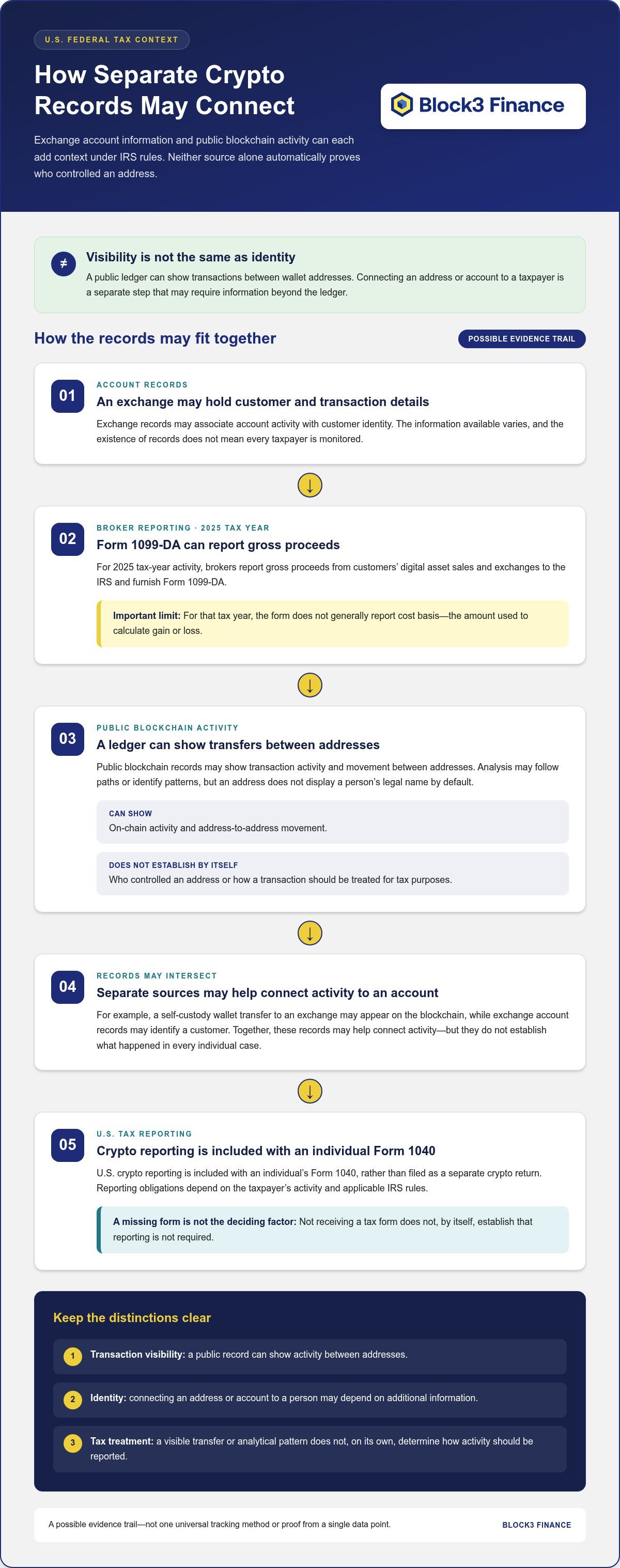
There isn’t one universal tracking method. Under U.S. federal tax rules, exchange records, tax forms, and public blockchain data can each provide a different part of the picture. Their existence doesn’t mean the IRS monitors every taxpayer or that any single data point proves who made a transaction.
The practical question is how separate records may fit together. An exchange account may contain customer details, while a blockchain can show transactions linked to addresses. Whether those sources establish a connection to a particular taxpayer depends on the information available.
Exchange records, tax forms, and account identity
Exchanges may hold customer identity and transaction records associated with accounts. For the 2025 tax year, brokers are required to report gross proceeds from customers’ digital asset sales and exchanges to the IRS and furnish a new Form 1099-DA. For that tax year, the form does not generally report cost basis, the amount used to calculate gain or loss.
A form provides information, not a complete tax calculation. The IRS’s IRS guidance on digital assets explains federal reporting considerations. Check current IRS instructions for the forms and requirements that apply to your circumstances.
Not receiving a tax form doesn’t, by itself, establish that reporting isn’t required. U.S. crypto reporting is included with an individual’s Form 1040, rather than filed as a separate crypto return. Reporting obligations depend on the taxpayer’s activity and the applicable IRS rules, not solely on whether an exchange sent a form.
Public blockchains and transaction analysis
On a public blockchain, transaction records can show activity and movement between addresses. Analysis may follow those paths or identify patterns, but linking an address to a specific taxpayer can require additional information. A pattern is an analytical clue, not automatic proof of identity or tax treatment.
For example, a person might transfer digital assets from a self-custody wallet to an exchange account. The blockchain may show a transfer to an address associated with the exchange, while the exchange’s account records may identify its customer. These are separate records that may help connect activity, but the example doesn’t establish what happened in any individual case.
Information requests and other evidence
The IRS may obtain information through applicable legal processes, but a legal request for records is not the same as routine visibility into every wallet. The process and scope depend on the circumstances, so don’t assume that any particular request applies to all taxpayers. Keep source records that help explain transactions and reconcile activity across accounts.
These information sources make consistent recordkeeping important, even when no single source tells the whole story. If you need support organizing crypto activity for U.S. tax reporting, discuss your crypto tax records with Block3 Finance.
Crypto Tracking Myths: What Visibility Does and Does Not Prove
Crypto visibility is often treated as all-or-nothing: either every transaction is tied to a named taxpayer, or nothing can be traced. Neither assumption is reliable. For U.S. federal tax reporting, separate what a record shows from what it can establish about identity, ownership, and tax treatment.
The question “can the IRS track cryptocurrency” doesn’t have a single answer for every wallet or transaction. The table below separates common assumptions from what the available information may actually support.
| Common belief | More accurate explanation | What remains uncertain |
|---|---|---|
| A public wallet address reveals its owner’s legal identity. | A public ledger may show transactions associated with an address, but the address doesn’t display a person’s name by default. | Who controlled the address, and whether other records connect it to a taxpayer. |
| A self-custody wallet makes activity invisible. | Self-custody means the user controls the wallet’s keys. It doesn’t mean activity recorded on a public blockchain disappears. | Whether a particular address can be linked to a person using available information. |
| No tax form means the IRS can’t discover the activity. | A tax form is one possible information source, not a complete record of every crypto transaction or reporting obligation. | Which IRS rules apply to the taxpayer’s specific activity and records. |
| A visible transfer proves a taxable event or filing error. | A transaction record shows movement between addresses; it doesn’t by itself determine the transfer’s tax treatment. | The purpose, ownership, and surrounding facts needed to assess the transaction. |
Does a non-custodial wallet make crypto untraceable?
No. A non-custodial, or self-custody, wallet gives the user control of its private keys rather than having a service hold them on the user’s behalf. That describes control, not whether transactions appear on a public blockchain. A ledger may show activity without identifying the person behind an address.
Separate records can matter. For instance, a person may move assets from a self-custody wallet to an account at an identifiable service. The transaction path and the service’s account information are distinct sources that may be relevant together, but they don’t guarantee identity attribution in every case.
Does no Form 1099 mean the IRS cannot see activity?
No. Forms can provide information about certain transactions, but their absence doesn’t establish that an activity is unrecorded or that no reporting is required. Under U.S. rules, taxpayers should assess their own activity using current IRS guidance rather than treating a missing form as a tax conclusion.
Just as importantly, a visible transfer is not automatically a taxable event, and it does not by itself demonstrate an error on a return. Tax treatment depends on the transaction and relevant facts, so preserve records that explain the activity and support how it was reported.
What to Do If Crypto Records or Tax Returns Are Incomplete
Incomplete records don’t tell you, by themselves, whether a return is inaccurate. Start by reconstructing what happened, then separate confirmed transaction facts from questions that need tax review. This records-first approach helps you make decisions based on evidence rather than assumptions about what the IRS can see.
How to organize crypto activity before reviewing a return
Begin with an inventory of every exchange, wallet, and blockchain you used during the tax year. Gather available exchange statements, wallet histories, transaction records, and copies of prior returns. A spreadsheet or ledger can help you compare dates, asset amounts, transaction types, and the accounts involved.
Then reconcile transfers between accounts you control. Don’t automatically treat a transfer from your own wallet to your own exchange account as a sale or other disposal. Document the sending and receiving addresses so the movement can be reviewed in context.
- Mark transactions with missing cost basis, the amount used to determine gain or loss.
- Flag gaps in platform exports, wallet histories, or records from a particular blockchain.
- Note entries that appear duplicated, inconsistent, or difficult to classify.
- Keep supporting files with the transaction they explain, including statements and available confirmations.
These steps organize the evidence; they don’t decide the tax treatment. For a general overview of U.S. reporting, consult this guide to cryptocurrency tax filing alongside current IRS guidance.
What if a previously filed return may be inaccurate?
Review the transactions and the return for the relevant year, and identify exactly what may be missing or misstated. Then assess the facts under applicable IRS guidance before deciding whether a correction is appropriate. The right next step depends on the discrepancy, so don’t assume that an incomplete record automatically establishes a filing error.
Correcting a previously filed return is separate from responding to an IRS notice. If you’ve received a notice, follow its instructions and deadlines. If you haven’t, focus first on establishing the facts and understanding your filing position. Keep a record of what you reviewed and why.
When does specialist tax support help?
Complex activity can make reconstruction more demanding. DeFi, staking, mining, airdrops, and transactions across multiple wallets may involve fragmented histories, missing cost basis, or records that need careful reconciliation. Defensible transaction records give a tax review a stronger foundation, while unresolved items can be identified for further analysis.
For specialized U.S. crypto filing and reporting, Block3 Finance’s crypto tax services can support the review of fragmented transaction histories. To organize your records with professional support, discuss your crypto tax filing needs.
Build Defensible Crypto Tax Records with Block3 Finance
Understanding how the IRS may connect crypto activity to taxpayers is only part of the picture. The practical next step is building a clear record of what happened, where it happened, and what information supports each transaction. For individuals and eligible business structures, organized records can make a complex reporting review more manageable.
Block3 Finance provides crypto tax filing and reporting, drawing on 13 + years of crypto financial expertise and experience serving 980 + clients worldwide. The firm is ranked #1 Crypto Tax Provider and has received a Best Choice award on Bitcoin.com.
How specialized crypto tax support addresses fragmented records
Crypto histories can span exchange accounts, self-custody wallets, and on-chain activity. Block3 Finance analyzes blockchain data to help reconcile fragmented transaction histories and bring records into a clearer structure for review. This can be useful when information is spread across platforms or contains gaps that need to be identified.
Specialized reporting support can address activity involving mining, staking, airdrops, NFTs, and DeFi. The goal is to organize and assess the underlying records, not to assume that every transaction has the same tax treatment.
- Bring together transaction histories from wallets and exchanges.
- Identify missing or inconsistent records that need further review.
- Organize complex on-chain activity for a more informed filing process.
Accurate documentation can support a careful tax review, but tax preparation cannot guarantee that the IRS won’t examine a return or impose consequences. The value lies in establishing a clearer, supportable account of the activity and how it was reported.
Take a clear next step toward accurate reporting
Before discussing your reporting needs, gather what you have: exchange statements, wallet histories, transaction exports, and prior returns. Note which platforms or wallets are missing records, and flag transactions you can’t confidently explain. These details give a review a practical starting point.
Block3 Finance serves individuals and eligible LLCs, S-Corps, and Partnerships. If you’re asking whether the IRS can track your cryptocurrency activity, a specialist review can help shift the focus from uncertainty to accurate, well-organized reporting.
The initial consultation is free. Discuss your crypto tax reporting needs.
Turn Uncertainty Into a Clear Reporting Plan
The question “can the IRS track cryptocurrency” is most useful when it leads to a practical next step: a clear view of your records and reporting position under U.S. federal tax rules. You don’t need to resolve every uncertainty at once. Start with what you can document, identify what needs review, and make decisions based on the facts rather than assumptions.
A consistent process can make future tax periods easier to manage. Preserve transaction records as activity occurs, keep account histories together, and note gaps while they’re still straightforward to investigate. If past filings may need attention, a careful review can help you understand the issue before deciding how to proceed.
Block3 Finance brings specialist crypto tax knowledge to reporting questions that can feel difficult to untangle. Discuss your crypto tax reporting needs and take a considered next step toward more organized, confident reporting.
Frequently Asked Questions
Can the IRS track cryptocurrency transactions?
Yes, the IRS may be able to connect some crypto activity with taxpayer records. The practical question is whether available information matches a transaction to a person and a tax year. To review your own reporting, compare exchange statements, wallet records, and transaction dates against the return for that year. “Can the IRS track cryptocurrency” doesn’t mean every transaction is identified or interpreted automatically.
Can the IRS identify who owns a crypto wallet?
It may be possible to associate a wallet with a person using information beyond the wallet itself. For your records, document who had authority to use each wallet, especially if it was shared or used for business activity. Keep access records and notes explaining the wallet’s purpose where available. This can help distinguish your transactions from activity conducted by another person or entity.
Can the IRS see crypto held in a non-custodial wallet?
The IRS doesn’t have a direct portfolio dashboard for every non-custodial wallet. Still, wallet activity and account records may provide information relevant to tax review. Create an inventory of wallets you used during the tax year and retain transaction histories for each. A balance snapshot alone may not explain when or how assets were acquired, moved, or disposed of.
Does the IRS know about crypto if I did not receive a tax form?
Possibly, and a missing form is not a useful way to measure what information may exist. Check the exchange account for downloadable statements or transaction exports, and save copies with your tax records. Compare those records with your wallet activity, since an exchange document may cover only transactions on that platform. Use current IRS guidance to assess how your activity should be reported.
Can the IRS track Bitcoin transactions?
Bitcoin activity may be examined using transaction records, but those records don’t explain the full tax history of an asset. For example, a transfer record won’t necessarily show what you originally paid or whether the transfer was a sale. Keep purchase confirmations and transaction histories together so you can substantiate acquisition details and reconcile amounts when preparing your U.S. federal tax reporting.
What should I do if I forgot to report cryptocurrency on my tax return?
Identify the tax year and determine what kind of item may have been missed, such as a sale, a receipt, or an exchange of assets. Compare your supporting records with the amounts on the filed return and note unresolved questions, including missing acquisition information. Review the facts under IRS guidance before deciding how to address the filing. Keep your calculations and supporting documents with the return.
Is cryptocurrency reporting filed on a separate tax return?
No. Individuals report crypto activity as part of their federal income tax filing on Form 1040; a separate crypto return isn’t required. The digital asset question on Form 1040 is distinct from calculating any reportable amounts. Depending on the activity, additional forms or schedules may be relevant. Review the instructions for the tax year you’re filing so your answers and supporting figures align.

Article by
Mahad Mohamed
Mahad Mohamed is an accountant and the CEO of Block3 Finance, with over 26+ years of Canadian and international tax and accounting experience. A crypto accounting specialist since the early days of Bitcoin, he has consulted for over 38 crypto companies and collaborated with legal professionals on regulatory matters. His expertise spans corporate reorganization, cross-border tax structuring (Canada & US), tax disputes, and CRA audits.
Previously, Mahad worked for the Canada Revenue Agency (CRA), Big4 accounting firms, and served as a Rulings Officer for the Federal Tax Authority of the UAE before acquiring Tax Partners in 2014.
Block3 Finance and Tax Partners has 44 full-time accountants and over 9,800+ clients.
Disclaimer
This article provides general information only and is current as of its publication date. It has not been updated and may be out of date. It does not constitute legal advice and should not be relied upon as such. Every tax situation is unique and may differ from the examples discussed in this article. If you have specific questions, you should seek the advice of our accountants for your unique circumstances.
Frequently Asked Questions
What does it mean for the IRS to track crypto?
“Tracking” can mean locating a transaction on a ledger, associating activity with an account, or connecting that account or address to a taxpayer. These steps aren’t interchangeable. Seeing a transfer does not, on its own, establish who initiated it, who controlled the address, or how the activity should be reported for tax purposes. For example, a public record might show that one address sent Bitcoin to another. The ledger may not display either controller’s legal name. Information that connects an address or account to an identifiable person is a separate part of the picture. So, can the IRS track cryptocurrency? Some activity may be traceable or identifiable through records and transaction data, but the strength of any connection depends on the information available. A visible transfer is evidence of on-chain activity, not automatic proof of a particular person’s identity or tax treatment.
Is cryptocurrency anonymous or pseudonymous?
Anonymous generally means an activity cannot be linked to a person’s identity. Pseudonymous means an activity uses an identifier, such as a wallet address, that doesn’t display a person’s name by default. The terms aren’t synonyms: an address can be visible even when its controller is not immediately known. Bitcoin is a familiar example. Its blockchain records transactions associated with addresses, but an address is not a name printed on the ledger. The cryptocurrency category includes different networks and systems, so Bitcoin’s recordkeeping model shouldn’t be assumed to describe every digital asset or blockchain in exactly the same way. Think of an address as a label in a transaction history, not a complete identity profile. If separate information later associates that label with a person, the public record may become more meaningful. Without that link, the ledger alone may not answer who controlled it. Neither extreme is reliable: public visibility does not prove identity, and the absence of a name on-chain does not establish that activity is untraceable. Keeping transaction records organized helps taxpayers assess their own activity and support accurate U.S. federal reporting. There isn’t one universal tracking method. Under U.S. federal tax rules, exchange records, tax forms, and public blockchain data can each provide a different part of the picture. Their existence doesn’t mean the IRS monitors every taxpayer or that any single data point proves who made a transaction. The practical question is how separate records may fit together. An exchange account may contain customer details, while a blockchain can show transactions linked to addresses. Whether those sources establish a connection to a particular taxpayer depends on the information available.
Does a non-custodial wallet make crypto untraceable?
No. A non-custodial, or self-custody, wallet gives the user control of its private keys rather than having a service hold them on the user’s behalf. That describes control, not whether transactions appear on a public blockchain. A ledger may show activity without identifying the person behind an address. Separate records can matter. For instance, a person may move assets from a self-custody wallet to an account at an identifiable service. The transaction path and the service’s account information are distinct sources that may be relevant together, but they don’t guarantee identity attribution in every case.
Does no Form 1099 mean the IRS cannot see activity?
No. Forms can provide information about certain transactions, but their absence doesn’t establish that an activity is unrecorded or that no reporting is required. Under U.S. rules, taxpayers should assess their own activity using current IRS guidance rather than treating a missing form as a tax conclusion. Just as importantly, a visible transfer is not automatically a taxable event, and it does not by itself demonstrate an error on a return. Tax treatment depends on the transaction and relevant facts, so preserve records that explain the activity and support how it was reported. Incomplete records don’t tell you, by themselves, whether a return is inaccurate. Start by reconstructing what happened, then separate confirmed transaction facts from questions that need tax review. This records-first approach helps you make decisions based on evidence rather than assumptions about what the IRS can see.
What if a previously filed return may be inaccurate?
Review the transactions and the return for the relevant year, and identify exactly what may be missing or misstated. Then assess the facts under applicable IRS guidance before deciding whether a correction is appropriate. The right next step depends on the discrepancy, so don’t assume that an incomplete record automatically establishes a filing error. Correcting a previously filed return is separate from responding to an IRS notice. If you’ve received a notice, follow its instructions and deadlines. If you haven’t, focus first on establishing the facts and understanding your filing position. Keep a record of what you reviewed and why.
When does specialist tax support help?
Complex activity can make reconstruction more demanding. DeFi, staking, mining, airdrops, and transactions across multiple wallets may involve fragmented histories, missing cost basis, or records that need careful reconciliation. Defensible transaction records give a tax review a stronger foundation, while unresolved items can be identified for further analysis. For specialized U.S. crypto filing and reporting, Block3 Finance’s crypto tax services can support the review of fragmented transaction histories. To organize your records with professional support, discuss your crypto tax filing needs. Understanding how the IRS may connect crypto activity to taxpayers is only part of the picture. The practical next step is building a clear record of what happened, where it happened, and what information supports each transaction. For individuals and eligible business structures, organized records can make a complex reporting review more manageable. Block3 Finance provides crypto tax filing and reporting, drawing on 13 + years of crypto financial expertise and experience serving 980 + clients worldwide. The firm is ranked #1 Crypto Tax Provider and has received a Best Choice award on Bitcoin.com.
Can the IRS track cryptocurrency transactions?
Yes, the IRS may be able to connect some crypto activity with taxpayer records. The practical question is whether available information matches a transaction to a person and a tax year. To review your own reporting, compare exchange statements, wallet records, and transaction dates against the return for that year. “Can the IRS track cryptocurrency” doesn’t mean every transaction is identified or interpreted automatically.
Can the IRS identify who owns a crypto wallet?
It may be possible to associate a wallet with a person using information beyond the wallet itself. For your records, document who had authority to use each wallet, especially if it was shared or used for business activity. Keep access records and notes explaining the wallet’s purpose where available. This can help distinguish your transactions from activity conducted by another person or entity.
Can the IRS see crypto held in a non-custodial wallet?
The IRS doesn’t have a direct portfolio dashboard for every non-custodial wallet. Still, wallet activity and account records may provide information relevant to tax review. Create an inventory of wallets you used during the tax year and retain transaction histories for each. A balance snapshot alone may not explain when or how assets were acquired, moved, or disposed of.
Does the IRS know about crypto if I did not receive a tax form?
Possibly, and a missing form is not a useful way to measure what information may exist. Check the exchange account for downloadable statements or transaction exports, and save copies with your tax records. Compare those records with your wallet activity, since an exchange document may cover only transactions on that platform. Use current IRS guidance to assess how your activity should be reported.
Can the IRS track Bitcoin transactions?
Bitcoin activity may be examined using transaction records, but those records don’t explain the full tax history of an asset. For example, a transfer record won’t necessarily show what you originally paid or whether the transfer was a sale. Keep purchase confirmations and transaction histories together so you can substantiate acquisition details and reconcile amounts when preparing your U.S. federal tax reporting.
What should I do if I forgot to report cryptocurrency on my tax return?
Identify the tax year and determine what kind of item may have been missed, such as a sale, a receipt, or an exchange of assets. Compare your supporting records with the amounts on the filed return and note unresolved questions, including missing acquisition information. Review the facts under IRS guidance before deciding how to address the filing. Keep your calculations and supporting documents with the return.
Is cryptocurrency reporting filed on a separate tax return?
No. Individuals report crypto activity as part of their federal income tax filing on Form 1040; a separate crypto return isn’t required. The digital asset question on Form 1040 is distinct from calculating any reportable amounts. Depending on the activity, additional forms or schedules may be relevant. Review the instructions for the tax year you’re filing so your answers and supporting figures align.