
Does borrowing crypto for a leveraged position create a tax event, or does the tax consequence arise when the position closes? Under U.S. federal tax rules, the leverage label alone doesn’t answer that question. The transaction mechanics matter. Because the IRS hasn’t issued guidance specifically for crypto margin trading, existing property tax principles must be applied to the facts, making the crypto margin trading tax rules more complex than a simple profit-and-loss figure suggests.
It’s understandable to be unsure whether borrowing, repaying a loan, paying interest, or having a position forcibly liquidated affects your tax reporting. Closing a position or experiencing a forced liquidation may result in a capital gain or loss, while fees, interest payments, and the way you used crypto can affect the records and analysis.
This guide explains which transaction details may matter under IRS rules, which exchange and wallet records to gather, and how to approach incomplete cost-basis information. You’ll also learn when specialist crypto tax preparation and reporting can help organize complex margin activity for a clearer, more supportable return.
Key Takeaways
- The crypto margin trading tax rules depend on how a position is structured and what happens during the transaction, not simply on the use of leverage.
- Review each stage of a trade, from opening and repayment to closing or liquidation, to identify facts that may affect U.S. federal tax analysis.
- Compare spot purchases, borrowed-funds trades, crypto-denominated loans, and derivatives before assuming they create the same tax records or outcomes.
- Gather exchange exports, wallet activity, loan terms, trade confirmations, and liquidation notices. Reconcile timestamps, quantities, and asset denominations.
- When activity spans multiple platforms or involves borrowing, derivatives, or liquidations, specialist crypto tax preparation can help organize records for filing.
What U.S. crypto margin trading means for your tax picture
Crypto margin trading uses borrowed funds or digital assets to open or expand a trading position. The details depend on how the platform structures the transaction. The financing is one part of the activity; the asset acquired, sold, exchanged, or used to repay the financing is another.
In brief: Margin financing describes how a trade is funded. It does not, by itself, determine whether a taxable transaction occurred under U.S. federal tax rules.
This section covers U.S. federal tax considerations only. It isn’t Canadian tax guidance, state-specific advice, or individualized tax advice. Because the IRS has not issued guidance specifically for crypto margin trading, the transaction facts and current IRS guidance matter more than a platform’s labels.
How a margin position differs from a spot purchase
A spot purchase is a direct purchase of a digital asset, generally using funds already available to the buyer. A margin position involves borrowed value or assets, which can add steps and records, such as a loan balance, interest entries, collateral movements, or repayment activity.
Leverage means using borrowed funds or assets to gain exposure to a larger position than the trader could open using only their own funds. It describes the scale or financing of a trade, not its tax treatment.
For example, an interface might label an activity “margin buy.” To assess what happened, a preparer would need to establish whether the trader borrowed cash to acquire crypto, borrowed crypto and sold it, or entered a contract tied to an asset’s price. These mechanics can differ even when an exchange uses similar labels.
Why U.S. tax analysis depends on the transaction facts
Realization is the point at which a transaction may produce a tax consequence, such as a gain or loss. For digital assets, the IRS generally treats crypto as property, so selling or exchanging an asset may require calculating the difference between its value when acquired and its value when disposed of. A change in the asset’s market price alone does not necessarily mean a gain or loss has been realized.
Borrowing, opening a position, changing collateral, paying interest, closing a position, and repaying a loan are distinct steps to document. Collateral is an asset pledged to secure a loan. The tax analysis may depend on what asset moved, who controlled it, whether it was disposed of, and how the transaction was settled.
For foundational context on capital gains, see Capital Gains Tax in the United States. Apply those concepts to crypto activity with care, since margin-specific treatment depends on the actual transactions and current IRS guidance.
Keep the underlying records, including trade confirmations, loan terms, and asset movement history. Reviewing these details alongside crypto tax filing and reporting can help organize complex activity for U.S. federal tax reporting. Confirm current requirements with the IRS, and seek individualized tax advice when your circumstances require it.
How opening, closing, and liquidating a crypto margin trade can matter
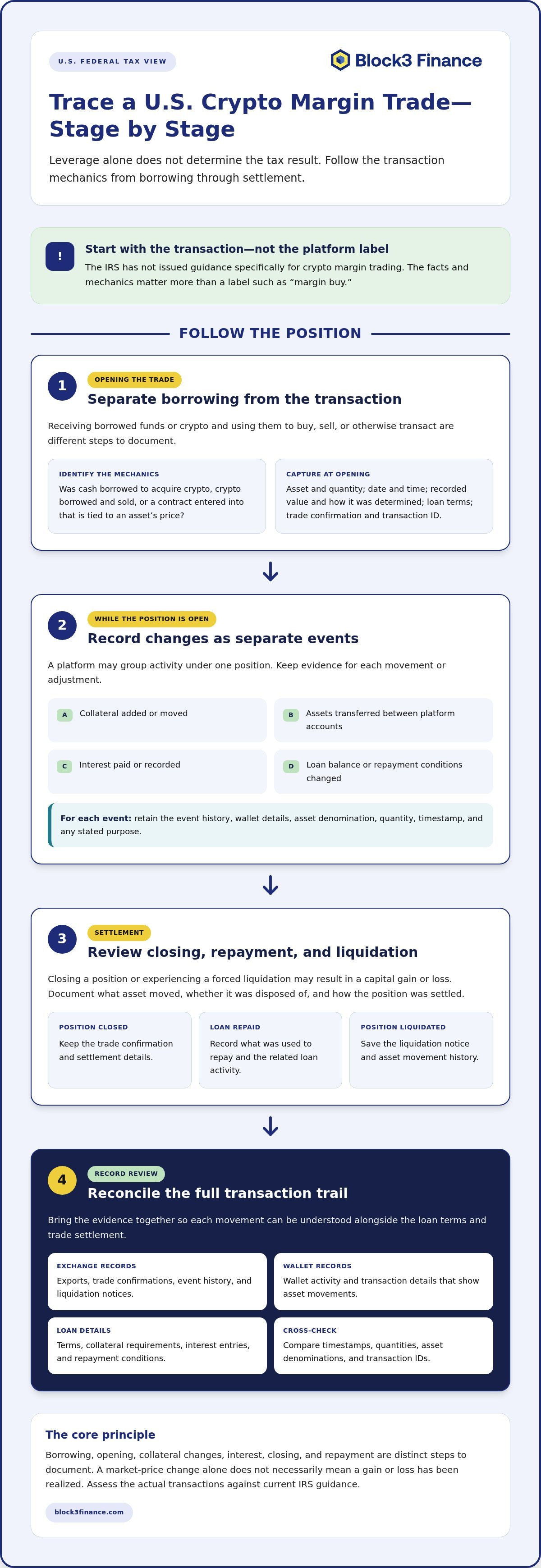
Under U.S. federal tax rules, review a margin trade as a sequence of events, not as a single entry on an exchange statement. Evaluate each stage separately, because borrowing, asset transfers, and position settlement may have different consequences.
The crypto margin trading tax rules aren’t set out in a single margin-specific IRS framework. Keep evidence for each event so a tax preparer can assess what occurred and compare it with current IRS guidance.
Opening a position and borrowing funds or crypto
Separate the loan from the later trade. Receiving borrowed funds or crypto and using them to buy, sell, or otherwise transact in an asset are different steps. The tax characterization of a particular borrowing arrangement depends on its terms and mechanics, so don’t assume the platform’s “loan” label settles the issue.
For the opening, retain records that show:
- The asset and quantity borrowed, acquired, or transferred
- The date and time, including the platform’s time zone if available
- The value recorded for the transaction and how it was determined
- The loan terms, collateral requirements, interest entries, and repayment conditions
- Trade confirmations and transaction IDs linking the borrowing to the position
These details help distinguish a cash-funded purchase from a crypto-denominated loan followed by a sale. A tax preparer should assess the specific loan structure against current IRS guidance and the relevant facts.
Changes during the trade
Track events between opening and settlement, even if the interface groups them under a single position. Adding collateral, moving assets between platform accounts, paying interest, or changing the loan balance may require separate review, particularly if crypto was transferred or used to make a payment.
For each change, preserve the platform’s event history, wallet transaction details, asset denomination, quantity, timestamp, and any stated purpose. For broader context on U.S. digital-asset taxation and reporting, Fidelity’s guide to cryptocurrency taxes explains general principles, but it doesn’t replace current IRS guidance or an analysis of an individual margin arrangement.
Closing, repayment, and forced liquidation
A voluntary close and an exchange-initiated liquidation can involve different steps. Keep the closing order or trade confirmation, liquidation notice, settlement details, and records showing which assets were sold, transferred, or applied to the debt.
Don’t treat repayment as automatically identical to selling an asset, or assume liquidation automatically creates a particular gain, loss, or deduction. A preparer may need to examine the disposition of any crypto used, the position settlement, the collateral returned or retained, and how the debt was resolved. Separate transaction records make those questions answerable.
If your trade history spans platforms or includes crypto borrowing and liquidation, discussing your transaction records with a tax specialist can help clarify what needs review before filing.
Compare margin trade structures before assuming they share one tax treatment
Two trades can create similar market exposure but use different legal and contractual arrangements. Under U.S. federal tax rules, that distinction matters: the crypto margin trading tax rules can’t be determined from the amount of leverage or a platform’s product name alone.
Use this comparison to identify what happened and which records to collect. It is a starting point for review, not a conclusion about the tax treatment of a specific transaction.
Margin trades versus spot trades and derivatives
A spot purchase generally involves acquiring an asset directly. A margin trade adds borrowing to the transaction, while a derivative is a contract whose value or settlement is tied to an asset or price. These descriptions explain mechanics, not legal tax classifications. Contract terms and actual settlement can change the questions to review.
| Structure | What it involves | Records to gather | Facts for U.S. tax review |
|---|---|---|---|
| Spot purchase | Directly buying or selling crypto, without margin financing in that transaction. | Trade confirmations, asset quantities, timestamps, transaction IDs, and payment details. | Which asset was acquired or disposed of, the transaction values, and how the activity was reported. |
| Borrowed-funds margin trade | Borrowing fiat currency, meaning government-issued money such as U.S. dollars, to open or increase a position in crypto. | Loan agreement, funding and repayment history, trade records, interest entries, and collateral activity. | How the borrowing was structured, what the borrowed funds purchased, and how the position and debt were settled. |
| Crypto-denominated borrowing | Borrowing a digital asset, which may then be held, sold, exchanged, or used in another transaction. | Loan terms, asset and quantity transferred, wallet records, sale or exchange confirmations, and repayment details. | Whether crypto moved as collateral, was disposed of, or was used to repay the loan, and the terms governing those movements. |
| Derivative | Entering a contract tied to an asset’s value, with settlement defined by the contract. | Contract specifications, trade confirmations, account statements, funding or settlement records, and fees. | Whether settlement was in cash or crypto, the contract’s terms, and the applicable U.S. tax treatment. Verify any derivative-specific rule against current authoritative sources. |
Which transaction details can change the analysis?
Start with the denomination of the borrowing: government-issued currency and crypto can produce different transaction trails. Then identify who provided the loan or contract, what collateral moved, how the position was settled, and whether a fee or repayment used digital assets.
For example, a trader might gain exposure to a coin through a direct purchase or through a contract settled in cash. The market result could look similar, but ownership, transfers, and contract obligations differ, so the U.S. tax review may differ too.
Keep the agreement and transaction records together rather than relying on an exchange label or summary total. For broader U.S. digital-asset reporting context, review this guide to cryptocurrency tax filing in the United States, then verify current requirements with the IRS. A comparison can surface the right questions, but an individual tax review must account for the actual terms and activity.
Build a U.S. crypto margin tax record set before filing
Reliable U.S. federal tax reporting starts with a clear record of what happened, not an estimate reconstructed from a single account balance. Complete margin records connect each position’s opening, changes, and final settlement, giving a preparer evidence to assess the activity against current IRS guidance.
Build one file for each position where possible, and preserve the original exports and statements separately. The crypto margin trading tax rules can’t be applied confidently if dates, assets, or settlement details are missing or inconsistent.
Records to preserve for each margin position
Collect source records from every exchange, wallet, and lending platform involved. Include documents showing both the trade and its financing, so the sequence can be traced without relying on memory or interface labels.
- Exchange exports and account statements, including trade history, deposits, withdrawals, and position summaries.
- Opening and closing confirmations with dates and times, asset names, quantities, transaction IDs, and settlement details.
- Borrowing agreements or platform terms showing the borrowed currency or crypto, repayment conditions, interest entries, and collateral requirements.
- Wallet activity and transaction hashes for transfers into or out of an exchange, including movements to collateral accounts.
- Liquidation notices, margin-call alerts, and correspondence explaining adjustments, disputed entries, or forced closures.
Keep the original timestamp and note the platform’s time zone if it provides one. If a record shows a token quantity while another shows a dollar value, preserve both and identify the source instead of replacing one with an unexplained estimate.
Reconcile records without guessing at tax treatment
Match exchange withdrawals to wallet receipts using transaction IDs, dates, assets, and quantities. A transfer between accounts you control may appear as separate entries in two systems, so mark linked records to avoid treating the same movement as two independent events.
Next, compare the opening, activity, and settlement records for each position. Note missing exports, mismatched timestamps, unexplained quantity differences, or gaps in the loan history. Separate verified facts from assumptions, and document unresolved items rather than inventing a cost basis, the amount used to determine gain or loss when an asset is disposed of, a transaction purpose, or a tax result.
Broker statements may not show every detail needed to establish your records. For the 2025 tax year, the IRS’s Form 1099-DA reporting framework includes gross proceeds, while basis information may require separate records. Check current IRS instructions for applicable forms and reporting requirements, since they can change.
When the records span multiple platforms or include wallet transfers and liquidations, crypto tax filing and reporting can help bring the transaction history into a structured view. If you need support organizing margin-trading records for a U.S. filing, discuss your tax reporting needs with Block3 Finance.
Move from margin-trade records to a defensible U.S. tax filing
Good records are the starting point, not the final tax analysis. Specialist review may be useful when your activity involves multiple exchanges, crypto-denominated borrowing, derivatives, incomplete exports, or liquidations whose settlement details are difficult to trace.
Under U.S. federal tax rules, those records help a preparer understand which transactions occurred and assess how they should be reported. No preparer can promise a particular tax result based only on the fact that a trade used margin.
When margin activity warrants specialist tax support
Consider a closer review if exchanges show conflicting quantities, loan activity is missing, or a liquidation notice doesn’t clearly explain which assets were sold or applied to debt. Multiple transaction structures can make it harder to connect wallet movements, trade confirmations, and settlement records.
Organized source documents give a preparer a clearer basis for identifying gaps and evaluating the activity against current IRS guidance. Tax preparation focuses on reporting and compliance, not on recommending investment or trading decisions.
Turn transaction history into organized tax reporting
Block3 Finance provides crypto tax filing and reporting for complex digital-asset activity, helping bring transaction data and supporting records into a structured filing process. A preparer can review documented facts, identify unresolved items, and apply relevant U.S. federal tax considerations without assuming that platform labels establish the treatment.
Before review, group records by platform and position, preserve original exports, and note missing documents or unexplained differences. This gives the tax preparer a practical starting point and helps distinguish evidence from assumptions.
Look for support that can work with the records your activity produces, including exchange histories, wallet transactions, financing terms, and settlement details. A useful discussion about working with a crypto tax accountant should focus on how complex digital-asset records are gathered, reconciled, and prepared for reporting, rather than on promises about deductions or audit outcomes.
Block3 Finance’s crypto tax filing and reporting can help organize margin activity alongside other digital-asset transactions. Confirm current filing instructions and reporting requirements with the IRS, since forms and guidance may change.
If your U.S. crypto records include borrowing, multiple platforms, derivatives, or forced liquidations, discuss your crypto tax filing needs with Block3 Finance. A clear review begins with the transaction history and the evidence behind it.
Bring your records into focus for the next filing
The next step is to turn a complicated trade history into a clear account of what occurred. Under U.S. federal tax rules, careful preparation begins with documented transactions and a review of how each part of the activity fits current IRS guidance. The crypto margin trading tax rules shouldn’t be treated as a shortcut to a predetermined tax outcome.
Block3 Finance provides crypto tax filing and reporting for complex digital-asset activity. The firm serves more than 980 clients globally and brings over 13 years of blockchain financial expertise to its work.
If you’re ready to move from scattered records to a more organized filing process, start a conversation about your U.S. crypto tax filing. Share your transaction history and supporting records to begin the review.
Frequently Asked Questions
Is crypto margin trading taxable in the United States?
Crypto margin trading may have U.S. federal tax consequences, but leverage alone doesn’t make every activity taxable or tax-free. The crypto margin trading tax rules depend on what assets moved, whether a transaction was completed, and the terms governing the position. This general information isn’t a determination for your return. Review current IRS materials and consult a qualified tax professional about your specific transactions.
Are crypto margin loan proceeds taxable income under U.S. rules?
Receiving a loan and receiving income are different concepts, but that distinction doesn’t resolve every crypto borrowing arrangement under U.S. federal tax rules. For example, borrowing a digital asset and later transferring or selling it involves different facts from borrowing fiat currency. Preserve the agreement, collateral records, and repayment history, then ask a tax professional to assess the arrangement using current IRS guidance.
Do I owe U.S. tax if I do not withdraw margin-trading profits to my bank?
Not withdrawing funds to a bank account doesn’t, by itself, determine whether U.S. tax consequences arise. A completed sale, exchange, contract settlement, or other disposition may be relevant even if value remains on an exchange. For example, converting one token into another can require review despite no cash withdrawal. Compare your position history with current IRS guidance instead of relying only on bank records.
What happens for tax purposes when an exchange liquidates a crypto margin position?
An exchange liquidation can involve multiple events, so it doesn’t have one automatic U.S. tax result. The exchange may close a position, apply collateral, or settle an obligation, and each action may need separate review under the contract terms. Keep the liquidation notice, trade confirmations, and account statements together. A tax professional can assess the documented events against current authoritative guidance without assuming a particular gain, loss, or deduction.
Can I deduct interest or fees from crypto margin trading on a U.S. return?
Possibly, but a cost isn’t automatically deductible just because it relates to a margin account. Under U.S. federal tax rules, the nature of the expense, how borrowed funds were used, your circumstances, and applicable limitations may affect its treatment. Keep itemized interest and fee statements, noting the related position and payment method. Before claiming a deduction or changing reported amounts, get current, transaction-specific tax guidance.
Can crypto margin losses offset other income under IRS rules?
An apparent loss in your account doesn’t alone establish that you can claim it or determine what it may offset on a U.S. return. The transaction’s tax characterization and your circumstances matter, and a displayed loss may differ from a calculated tax loss. Preserve the records supporting the calculation, then check current IRS instructions or seek individualized tax advice before applying any loss against other income.
Will an exchange tax form include every crypto margin transaction I need to report?
No single exchange document should be assumed to show every fact needed for U.S. tax reporting. A statement may omit activity on another platform, wallet transfers, loan terms, or details about how a contract settled. For example, an exchange’s trade summary may not explain an on-chain transfer to a separate wallet. Reconcile available documents with wallet histories and financing records, then consult current IRS reporting instructions.

Article by
Mahad Mohamed
Mahad Mohamed is an accountant and the CEO of Block3 Finance, with over 26+ years of Canadian and international tax and accounting experience. A crypto accounting specialist since the early days of Bitcoin, he has consulted for over 38 crypto companies and collaborated with legal professionals on regulatory matters. His expertise spans corporate reorganization, cross-border tax structuring (Canada & US), tax disputes, and CRA audits.
Previously, Mahad worked for the Canada Revenue Agency (CRA), Big4 accounting firms, and served as a Rulings Officer for the Federal Tax Authority of the UAE before acquiring Tax Partners in 2014.
Block3 Finance and Tax Partners has 44 full-time accountants and over 9,800+ clients.
Disclaimer
This article provides general information only and is current as of its publication date. It has not been updated and may be out of date. It does not constitute legal advice and should not be relied upon as such. Every tax situation is unique and may differ from the examples discussed in this article. If you have specific questions, you should seek the advice of our accountants for your unique circumstances.
Frequently Asked Questions
Which transaction details can change the analysis?
Start with the denomination of the borrowing: government-issued currency and crypto can produce different transaction trails. Then identify who provided the loan or contract, what collateral moved, how the position was settled, and whether a fee or repayment used digital assets. For example, a trader might gain exposure to a coin through a direct purchase or through a contract settled in cash. The market result could look similar, but ownership, transfers, and contract obligations differ, so the U.S. tax review may differ too. Keep the agreement and transaction records together rather than relying on an exchange label or summary total. For broader U.S. digital-asset reporting context, review this guide to cryptocurrency tax filing in the United States, then verify current requirements with the IRS. A comparison can surface the right questions, but an individual tax review must account for the actual terms and activity. Reliable U.S. federal tax reporting starts with a clear record of what happened, not an estimate reconstructed from a single account balance. Complete margin records connect each position’s opening, changes, and final settlement, giving a preparer evidence to assess the activity against current IRS guidance. Build one file for each position where possible, and preserve the original exports and statements separately. The crypto margin trading tax rules can’t be applied confidently if dates, assets, or settlement details are missing or inconsistent.
Is crypto margin trading taxable in the United States?
Crypto margin trading may have U.S. federal tax consequences, but leverage alone doesn’t make every activity taxable or tax-free. The crypto margin trading tax rules depend on what assets moved, whether a transaction was completed, and the terms governing the position. This general information isn’t a determination for your return. Review current IRS materials and consult a qualified tax professional about your specific transactions.
Are crypto margin loan proceeds taxable income under U.S. rules?
Receiving a loan and receiving income are different concepts, but that distinction doesn’t resolve every crypto borrowing arrangement under U.S. federal tax rules. For example, borrowing a digital asset and later transferring or selling it involves different facts from borrowing fiat currency. Preserve the agreement, collateral records, and repayment history, then ask a tax professional to assess the arrangement using current IRS guidance.
Do I owe U.S. tax if I do not withdraw margin-trading profits to my bank?
Not withdrawing funds to a bank account doesn’t, by itself, determine whether U.S. tax consequences arise. A completed sale, exchange, contract settlement, or other disposition may be relevant even if value remains on an exchange. For example, converting one token into another can require review despite no cash withdrawal. Compare your position history with current IRS guidance instead of relying only on bank records.
What happens for tax purposes when an exchange liquidates a crypto margin position?
An exchange liquidation can involve multiple events, so it doesn’t have one automatic U.S. tax result. The exchange may close a position, apply collateral, or settle an obligation, and each action may need separate review under the contract terms. Keep the liquidation notice, trade confirmations, and account statements together. A tax professional can assess the documented events against current authoritative guidance without assuming a particular gain, loss, or deduction.
Can I deduct interest or fees from crypto margin trading on a U.S. return?
Possibly, but a cost isn’t automatically deductible just because it relates to a margin account. Under U.S. federal tax rules, the nature of the expense, how borrowed funds were used, your circumstances, and applicable limitations may affect its treatment. Keep itemized interest and fee statements, noting the related position and payment method. Before claiming a deduction or changing reported amounts, get current, transaction-specific tax guidance.
Can crypto margin losses offset other income under IRS rules?
An apparent loss in your account doesn’t alone establish that you can claim it or determine what it may offset on a U.S. return. The transaction’s tax characterization and your circumstances matter, and a displayed loss may differ from a calculated tax loss. Preserve the records supporting the calculation, then check current IRS instructions or seek individualized tax advice before applying any loss against other income.
Will an exchange tax form include every crypto margin transaction I need to report?
No single exchange document should be assumed to show every fact needed for U.S. tax reporting. A statement may omit activity on another platform, wallet transfers, loan terms, or details about how a contract settled. For example, an exchange’s trade summary may not explain an on-chain transfer to a separate wallet. Reconcile available documents with wallet histories and financing records, then consult current IRS reporting instructions.