
Investor confidence is built on the records behind the presentation, not the polish of the slide deck. For U.S. crypto companies, crypto investor relations financial reporting must connect on-chain activity to financial records investors can follow and teams can support.
That connection isn’t always straightforward. Wallet activity, token movements, and changing asset values can be difficult to reconcile with conventional books. Inconsistent metrics or vague explanations can also leave investors unsure what performance figures mean. Investor updates serve a different purpose from formal financial statements and regulatory filings, so clear boundaries matter.
This guide explains how to build a repeatable reporting process with traceable supporting records and plain-language communication about crypto-specific financial information. You’ll learn how disciplined bookkeeping supports reliable reporting, where CFO oversight can strengthen the reporting cadence and analysis, and how accounting and audit-readiness work fit into the process. The goal is clear, useful information supported by records your team can trace.
Key Takeaways
- Separate management investor updates from financial statements and any U.S. filings that apply to the company.
- Map the reporting trail from wallets and exchanges to reconciliations, ledgers, review, and approved reports.
- Match each report to its audience and purpose, and make clear what its figures include.
- Use a consistent close-and-review sequence with named owners for preparation, accounting review, approval, and communication.
- Strong crypto investor relations financial reporting depends on traceable records, clear explanations, and financial oversight that can keep pace with transaction complexity.
Why Crypto Investor Relations Financial Reporting Starts With Reliable Records
Investor relations is the work of communicating a company’s performance, position, and relevant context to stakeholders. For U.S. crypto companies, that communication should start with records that support each reported figure, not with a polished dashboard or investor presentation.
Investor-facing financial reporting explains a company’s financial results and the context behind them. Formal financial statements follow applicable accounting requirements, while formal U.S. filings apply when required for the company or offering. These outputs may draw on some of the same underlying records, but they serve different purposes. An investor update can add management’s interpretation or operational context, but it doesn’t become a formal financial statement or replace any applicable U.S. filing.
Investor relations also involves building clear, ongoing communication between an organization and its stakeholders. The Investor Relations Overview offers a broad introduction to that function. For crypto businesses, financial discipline gives those communications a dependable foundation.
What investors need from crypto-company reporting
Investors need information they can interpret consistently from one reporting period to the next. A revenue figure, cash balance, or token-related measure is more useful when the company explains what it includes, how it was prepared, and whether its basis has changed since the previous update.
Keep three kinds of information distinct:
- Financial results: amounts drawn from the company’s accounting records, presented with the basis and reporting period clearly identified.
- Operational indicators: measures of activity, such as transaction volume or active users, with a definition that explains how the company counts them.
- Management commentary: the company’s explanation of developments, assumptions, and factors that may help readers interpret results.
Similar labels can describe different things. “Volume,” for example, might mean transactions processed, trading activity on a platform, or transfers between company-controlled wallets. Define the measure, its scope, and its time period so readers don’t mistake an operational indicator for revenue or treat a management estimate as an accounting result.
Why on-chain activity needs accounting context
A public blockchain can show that an address sent or received assets, but that visibility alone doesn’t establish who controlled the address, why the transaction occurred, or how the company should record it. A transaction may represent a customer movement, an internal transfer, a fee, or another activity, and each may need different context in the company’s books.
Reconciliation means comparing activity from wallets and platforms with accounting records, then investigating and documenting differences. For example, a wallet balance may not match the ledger because a platform statement is missing, a transaction hasn’t been categorized, or an internal transfer appears as separate activity at each address. The team needs supporting records and a clear explanation, rather than assuming every visible transaction represents new income or expense.
Disciplined crypto accounting records help create a traceable path from blockchain activity to reported results. That foundation makes crypto investor relations financial reporting easier to explain, review, and maintain consistently over time.
Build a U.S. Crypto Financial Reporting Foundation Investors Can Follow
A dependable reporting package has a traceable path from source activity to approved communication. Each handoff should preserve enough context for a reviewer to understand where a figure came from, how it was recorded, and what judgment shaped its presentation.
Traceable source data makes reporting more defensible because each reported amount can be followed back to evidence, accounting treatment, and documented review. Supporting evidence may include wallet exports, exchange statements, transaction records, valuation support, and explanations of management assumptions. Keep the reporting period and the person responsible for each record clear.
Connect blockchain data to the general ledger
Build a controlled reporting chain: collect wallet and exchange activity, identify the company’s accounts and activity, classify transactions, reconcile the records, post supported entries to the general ledger, then review and approve reporting outputs. Blockchain data shows activity, but it doesn’t explain the business purpose or accounting treatment on its own.
For example, distinguish a transfer between two company-controlled wallets from a customer payment or a payment to a vendor. Ongoing crypto accounting and bookkeeping can help maintain these records as activity is recorded, rather than reconstructing transaction history only when an investor report is due.
Explain crypto-specific figures without overstating them
A valuation assumption is a documented choice used to estimate an asset’s value, such as the pricing source and measurement time. State the reporting date, the method used, and any material limits in the available data so readers can understand what a balance represents.
Keep accounting amounts separate from operational measures and estimates. A token balance recorded in the books is not the same as a projected token value, transaction count, or management’s estimate of future activity. Label each clearly and explain the basis for the calculation.
For U.S. entities applying U.S. GAAP, FASB Accounting Standards Update 2023-08 established fair-value accounting for crypto assets that meet its scope. Fair value means a measurement based on the price an asset could be exchanged for in an orderly market transaction at the measurement date. The standard doesn’t apply to every digital asset or arrangement, so companies should assess whether specific assets qualify and confirm the accounting guidance that applies to their circumstances.
Maintain source support alongside reported figures. A practical record set can include:
- Wallet and exchange statements tied to the reporting period.
- Transaction classifications and explanations for unusual or material activity.
- Valuation sources, reporting dates, and documented assumptions.
- Reconciliation notes, review evidence, and approval records.
This foundation helps crypto investor relations financial reporting stay consistent as information moves from transaction data to investor-ready summaries. For companies building or refining that process, a discussion about reporting records and finance workflows can help clarify practical next steps.
Choose the Right Mix of Financial Statements, Investor Updates, and Dashboards
Different reporting formats answer different questions. A formal financial statement presents financial information under applicable accounting requirements. An investor update adds management’s context, while a dashboard gives a selected view of measures used to monitor activity and performance.
For U.S. crypto companies, the right mix depends on the entity, its stakeholders, and the purpose of each communication. There’s no universal reporting cadence or disclosure package for every company. Determine which U.S. requirements apply to the specific entity and offering, and keep management communications distinct from any required statements or filings.
Formal financial statements versus investor updates
Formal financial statements follow a defined structure and applicable accounting basis. Investor updates are management communications whose format and detail can vary with the company and audience. An update can explain trends or operating developments, but it doesn’t replace formal statements or applicable U.S. filing obligations.
As a practical control, identify the reporting period, the source of each financial amount, and whether information is actual, estimated, or forward-looking. Where an update relates to an offering or a company with formal reporting obligations, legal or regulatory review may be relevant. Requirements depend on the facts, so don’t assume one template applies to every company.
Use each format for a distinct purpose
| Format | Purpose and audience | Typical contents | Control expectations |
|---|---|---|---|
| Financial statements | Structured financial view for stakeholders who need formal results | Financial position, activity, and supporting notes as applicable | Apply the relevant accounting basis, review balances, retain supporting records |
| Investor update | Management communication for existing or prospective stakeholders | Performance context, key developments, selected measures, management commentary | Check figures against records, label estimates, review language and approvals |
| Dashboard | At-a-glance monitoring for management or a defined audience | Selected financial and operational indicators over a stated period | Document definitions, data sources, calculation methods, and update timing |
Make dashboards precise, not promotional
A dashboard can make trends easier to see, but only if the underlying measures remain stable and understandable. Define each metric, use consistent reporting periods and data sources, and note material changes in calculation. If a figure is an estimate or operational indicator, label it as such rather than presenting it like a financial result.
For example, on-chain transaction volume may describe activity passing through addresses or a platform, but it isn’t automatically company revenue. Revenue presentation requires accounting support and context about the company’s transactions. This distinction is central to credible crypto investor relations financial reporting: every format should help readers understand what a number represents and what it does not.
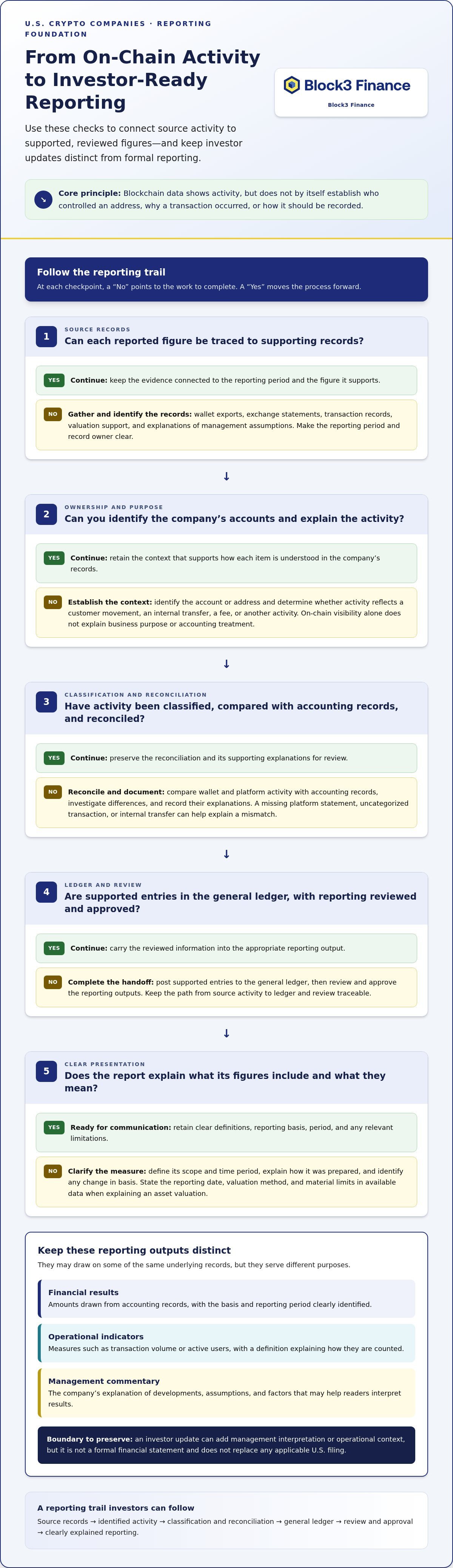
How to Create a Repeatable Crypto Investor Reporting Process
A reliable reporting process turns a recurring deadline into a controlled sequence. Set the scope, close the records, investigate differences, review the results, explain the figures, and preserve the evidence behind each release.
Set the reporting scope and close process
Start by defining who will read the report, which period it covers, and what business questions it should answer. Decide which financial results, operating indicators, and management commentary belong in the package, then identify the records needed to support them.
Set a close calendar around the company’s reporting needs. The schedule should give the team time to collect records, resolve open items, review calculations, and approve communications. For U.S. companies, assess any applicable filing obligations based on the specific entity and offering rather than treating an internal calendar as a substitute for formal deadlines.
Recurring monthly accounting support can help keep bookkeeping and source records current between investor reporting cycles. That continuity reduces the pressure to rebuild transaction histories or explain unexplained balances when a report is due.
Review, explain, and retain reporting support
Assign a clear owner to each stage. One person may prepare data, an accounting reviewer may check reconciliations and classifications, management may approve the final message, and a designated team member may distribute it to investors. In a smaller company, one person may hold several roles, but the responsibilities should still be explicit.
Use a documented sequence for each reporting cycle:
- Define the audience and period: Record who will receive the report, its purpose, and the dates covered.
- Close the records: Gather wallet, exchange, bank, and other relevant records for the period.
- Reconcile and investigate: Match material activity to accounting records, resolve differences, and document outstanding items.
- Review the figures: Check calculations, classifications, and valuation support before summarizing results.
- Explain and approve: Add context, label estimates and operational measures, and obtain management approval before distribution.
- Retain the support: Save source records, review notes, approvals, and the final version sent to stakeholders.
For each key measure, retain its definition, reporting period, data source, calculation method, and any relevant limitation. If the company changes how it calculates a metric, note the change and explain its effect on comparisons with earlier periods. Keep dated versions of draft and approved materials so the team can identify what changed and which version was communicated.
This discipline strengthens crypto investor relations financial reporting without imposing one cadence on every company. U.S. filing and disclosure requirements remain entity-specific, so identify which obligations apply before using investor updates as part of a formal reporting process.
To strengthen your reporting workflow, discuss your crypto accounting and reporting process with Block3 Finance.
Strengthen Crypto Investor Reporting With Finance and CFO Support
As digital asset operations expand, reporting can become harder to manage through ad hoc spreadsheets and periodic cleanups. More wallets, exchanges, counterparties, and transaction types mean more handoffs, increasing the effort required to keep records complete and explain how reported figures were prepared.
Finance support helps turn that complexity into a managed process. Consistent bookkeeping captures activity as it occurs; documented review checks how transactions flow into the company’s records; and financial oversight helps management interpret results before sharing them with stakeholders. These practices support investor-ready reporting, but they don’t guarantee compliance, a particular audit result, or investor confidence.
Match finance support to reporting complexity
Ongoing bookkeeping can support transaction capture, classification, and reconciliation, giving the finance team usable records for reporting cycles. When activity spans multiple wallets or platforms, consistent processes also help the company identify gaps and resolve them before figures reach management or investors.
CFO services bring a broader management perspective. A CFO can support financial planning, management reporting, cash-flow visibility, and executive-level review, helping leadership connect historical results with operating decisions. CFO financial oversight can complement the company’s accounting process as reporting needs evolve.
Recurring specialist support may be useful when internal staff spend increasing time reconciling digital asset activity, reporting definitions shift between periods, or management lacks a clear view of the assumptions behind key figures. The aim isn’t simply to produce a report faster. It’s to establish reliable routines that give finance leaders and decision-makers a consistent basis for review.
Move from fragmented data to a managed reporting process
Block3 Finance provides accounting and financial recordkeeping for digital asset businesses, drawing on more than 13 years of blockchain financial expertise. The firm serves more than 980 clients globally and provides services across accounting, audits and compliance, and CFO-level financial oversight.
In practice, this support can help connect transaction records to bookkeeping, strengthen the traceability of supporting documentation, and create a clearer review path before information is shared. Audit and compliance work can reinforce record organization and review discipline, without promising a particular audit outcome. Management remains responsible for understanding what its reporting communicates and approving the information it distributes.
The right support structure depends on the company’s activity, internal finance capacity, and reporting needs. A clear view of those factors can help leadership decide where additional accounting or CFO support would be most useful, while keeping crypto investor relations financial reporting grounded in traceable records and practical financial oversight.
Discuss your crypto financial reporting needs with Block3 Finance and identify practical next steps for strengthening your reporting process.
Make Your Next Reporting Cycle More Intentional
Your next step can be practical: choose one question stakeholders need answered and use it to guide how your company organizes its reporting. As products, transaction patterns, and management priorities evolve, revisit whether your metrics still communicate what you intend, and document meaningful changes so future decisions have clear context.
That discipline gives crypto investor relations financial reporting a stronger role in the company’s growth. It helps leaders move from assembling information at the last minute to building a financial process that can adapt as the business changes. Bitcoin.com ranked Block3 Finance as a top provider.
Set a clear direction for your next reporting cycle. Explore how Block3 Finance can support your crypto finance operations and take the next step toward reporting that grows with your business.
Frequently Asked Questions
What is crypto investor relations financial reporting?
Crypto investor relations financial reporting is how a company communicates financial information and relevant business context to stakeholders. It can help investors understand performance, financial position, and management’s interpretation of developments. For example, a company might explain how a change in its treasury holdings affected reported balances, while clearly distinguishing that explanation from a formal accounting statement or a forecast.
How should a crypto company report on-chain activity to investors?
Explain on-chain activity using the company’s records and the business purpose of the transactions, not transaction hashes alone. For example, if a wallet receives tokens as payment, identify the related business activity and connect the amount to its accounting treatment before describing it to investors. Use plain labels, clarify whether activity involves company-controlled wallets, and avoid implying that every transfer represents a sale.
Do crypto investor updates replace financial statements or SEC filings?
No. A management update is a communication, not a substitute for financial statements prepared under applicable accounting requirements or any U.S. SEC filings that apply to the company. The specific obligations depend on factors such as the entity and offering, so don’t assume private and public companies follow identical rules. Apply appropriate professional review before issuing materials tied to securities or formal reporting.
Which metrics should a crypto company include in investor reporting?
Choose measures that help the intended audience understand the company’s business model and financial condition. A company might include cash runway, customer growth, or platform activity if each measure is relevant and consistently calculated. Explain what each metric includes, its reporting period, and whether it is an accounting amount, an operating measure, or an estimate. Exclude figures that can’t be supported or explained clearly.
How often should a crypto company prepare investor financial reports?
There’s no single reporting schedule suitable for every U.S. crypto company. Management can set an internal cadence that fits its decision-making and stakeholder communication needs, while separately identifying any applicable U.S. filing or reporting deadlines for the entity. A company may also prepare additional updates after a material business development, but it should use defined approval steps and make clear whether the information is preliminary or final.
Can an accounting firm help prepare crypto investor reporting?
Yes. An accounting firm can help organize records, maintain bookkeeping, review reconciliations, and prepare financial information for management’s reporting process. For example, a finance team facing complex staking or treasury activity may need support to classify transactions consistently and explain their effect in internal reports. Block3 Finance provides monthly accounting, audits and compliance, and CFO services for digital asset businesses; management retains approval of investor communications.

Article by
Mahad Mohamed
Mahad Mohamed is an accountant and the CEO of Block3 Finance, with over 26+ years of Canadian and international tax and accounting experience. A crypto accounting specialist since the early days of Bitcoin, he has consulted for over 38 crypto companies and collaborated with legal professionals on regulatory matters. His expertise spans corporate reorganization, cross-border tax structuring (Canada & US), tax disputes, and CRA audits.
Previously, Mahad worked for the Canada Revenue Agency (CRA), Big4 accounting firms, and served as a Rulings Officer for the Federal Tax Authority of the UAE before acquiring Tax Partners in 2014.
Block3 Finance and Tax Partners has 44 full-time accountants and over 9,800+ clients.
Disclaimer
This article provides general information only and is current as of its publication date. It has not been updated and may be out of date. It does not constitute legal advice and should not be relied upon as such. Every tax situation is unique and may differ from the examples discussed in this article. If you have specific questions, you should seek the advice of our accountants for your unique circumstances.
Frequently Asked Questions
What is crypto investor relations financial reporting?
Crypto investor relations financial reporting is how a company communicates financial information and relevant business context to stakeholders. It can help investors understand performance, financial position, and management’s interpretation of developments. For example, a company might explain how a change in its treasury holdings affected reported balances, while clearly distinguishing that explanation from a formal accounting statement or a forecast.
How should a crypto company report on-chain activity to investors?
Explain on-chain activity using the company’s records and the business purpose of the transactions, not transaction hashes alone. For example, if a wallet receives tokens as payment, identify the related business activity and connect the amount to its accounting treatment before describing it to investors. Use plain labels, clarify whether activity involves company-controlled wallets, and avoid implying that every transfer represents a sale.
Do crypto investor updates replace financial statements or SEC filings?
No. A management update is a communication, not a substitute for financial statements prepared under applicable accounting requirements or any U.S. SEC filings that apply to the company. The specific obligations depend on factors such as the entity and offering, so don’t assume private and public companies follow identical rules. Apply appropriate professional review before issuing materials tied to securities or formal reporting.
Which metrics should a crypto company include in investor reporting?
Choose measures that help the intended audience understand the company’s business model and financial condition. A company might include cash runway, customer growth, or platform activity if each measure is relevant and consistently calculated. Explain what each metric includes, its reporting period, and whether it is an accounting amount, an operating measure, or an estimate. Exclude figures that can’t be supported or explained clearly.
How often should a crypto company prepare investor financial reports?
There’s no single reporting schedule suitable for every U.S. crypto company. Management can set an internal cadence that fits its decision-making and stakeholder communication needs, while separately identifying any applicable U.S. filing or reporting deadlines for the entity. A company may also prepare additional updates after a material business development, but it should use defined approval steps and make clear whether the information is preliminary or final.
Can an accounting firm help prepare crypto investor reporting?
Yes. An accounting firm can help organize records, maintain bookkeeping, review reconciliations, and prepare financial information for management’s reporting process. For example, a finance team facing complex staking or treasury activity may need support to classify transactions consistently and explain their effect in internal reports. Block3 Finance provides monthly accounting, audits and compliance, and CFO services for digital asset businesses; management retains approval of investor communications.