
Could a crypto gift be generous and still fail to support a tax deduction? A crypto donations tax deduction depends on more than sending assets to a charity: eligibility, holding period, valuation, and records all matter under U.S. federal tax rules.
A blockchain transaction can confirm that assets moved, but it may not establish that the recipient qualifies, how the donated crypto should be valued, or whether you have the records needed to support a claim.
This guide explains how the IRS framework may apply, including how long you held the crypto and why donating directly may differ from selling first. It also covers the records to gather, from transfer details and charity acknowledgments to valuation and appraisal documents where required.
You’ll find a practical preparation path for your U.S. federal return and guidance on when specialist digital-asset tax support may help organize a complex claim.
Key Takeaways
- A crypto donations tax deduction depends on more than completing a transfer. Understand what can affect whether a gift qualifies under U.S. federal rules.
- The asset, its acquisition history, the recipient, and your own tax circumstances may all affect the tax analysis.
- Direct donations and donor-advised funds involve different transfer steps and records.
- Use a repeatable workflow to connect transaction details, valuation evidence, and recipient acknowledgment.
- Complex wallet activity or incomplete records can make specialist digital-asset tax reporting support useful.
Crypto Donations and Tax Deductions: What U.S. Donors Need to Know
Transferring cryptocurrency to a charity doesn’t automatically establish a deductible contribution. Under U.S. federal tax rules, a charitable contribution is a gift to an organization that meets applicable requirements. Whether you can claim a deduction depends on current IRS rules and your circumstances.
This guide covers U.S. federal tax treatment only, not state or Canadian tax rules. Confirm current federal requirements with the IRS before claiming a deduction.
A potentially deductible crypto donation is a completed transfer of a digital asset to an organization that meets applicable federal charitable requirements. The gift’s eligibility and your ability to claim a deduction must still be assessed under current IRS guidance.
What counts as donating cryptocurrency?
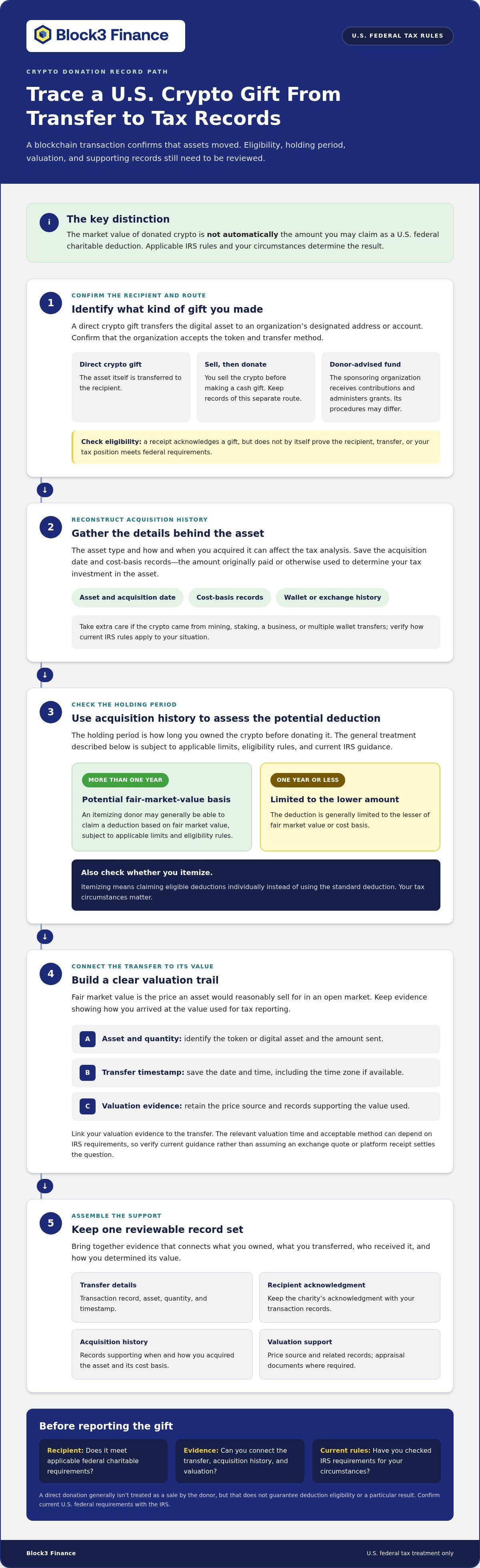
A direct crypto donation generally means transferring a digital asset, such as a token, from a wallet or exchange account you control to a charitable organization’s designated receiving address or account. The asset itself changes hands, so follow the organization’s transfer instructions and confirm that it accepts the token and transfer method you plan to use.
Selling crypto and donating the cash proceeds is a different route. In the first case, you transfer the asset to the recipient; in the second, you sell it before making a cash gift. Because the tax consequences may differ, keep records showing which route you took rather than treating both transactions as the same kind of donation.
A donor-advised fund is another charitable-giving route. A sponsoring organization receives contributions and administers grants to charities. Its role and procedures differ from those for a direct gift, so understand how the fund accepts and records digital assets before transferring them.
Does a donation receipt guarantee a tax deduction?
No. A receipt documents that an organization acknowledged a gift, but it doesn’t by itself prove that the recipient, transfer, or your tax position meets federal requirements. The recipient’s acknowledgment and your eligibility to claim a deduction are separate matters.
An acknowledgment might identify the date and describe the property received, while you may still need to establish what you transferred and determine how IRS rules apply to your return. Keep the receipt with your transaction records, and review the filing requirements that apply to your circumstances.
Check current IRS guidance on charitable contributions of digital assets and the documentation required for your situation. Block3 Finance’s digital-asset tax filing and reporting helps organize complex crypto records for tax preparation and compliance.
How U.S. Federal Tax Rules May Treat a Crypto Donation
For U.S. federal tax purposes, the IRS treats cryptocurrency as property. A donation’s tax treatment may depend on more than its market price: the asset type, how and when you acquired it, the recipient organization, and your tax circumstances can all matter.
The market value of donated crypto is not automatically the amount you may claim as a U.S. federal charitable deduction. The allowable deduction depends on applicable IRS rules, including your holding period and whether you itemize deductions. Itemizing means claiming eligible deductions individually instead of using the standard deduction.
How should donated crypto be valued?
Fair market value means the price an asset would reasonably sell for in an open market. For donated crypto, start with records that connect the asset and quantity transferred to the date and time the charity received it.
Keep evidence showing how you arrived at the reported value, including the transaction record and price data you relied on. The relevant valuation time and acceptable method can depend on IRS requirements, so verify the current guidance for your donation rather than assuming an exchange quote or platform receipt settles the question.
- Asset: Record the token or digital asset transferred.
- Quantity: Preserve the amount sent and the transaction details.
- Timestamp: Save the transfer date and time, including the time zone if available.
- Valuation evidence: Retain the source and records supporting the value used for tax reporting.
For example, a wallet record may show one transfer time while the valuation file uses a different timestamp. Linking the valuation evidence to the transfer helps explain the amount reported and makes it easier for you or your tax preparer to review the transaction.
Why can acquisition history affect the tax analysis?
Your holding period is the length of time you owned the crypto before donating it. Under current U.S. federal guidance, donating crypto held for more than one year may generally allow an itemizing donor to claim a deduction based on fair market value, subject to applicable limits and eligibility rules. For crypto held one year or less, the deduction is generally limited to the lesser of fair market value or cost basis, the amount originally paid or otherwise used to determine tax investment in the asset.
That distinction can affect the deduction calculation. A direct donation to a qualified charity generally isn’t treated as a sale by the donor, so the asset’s acquisition date and cost-basis records matter when determining the potential deduction. Verify current IRS rules for the asset, recipient, and your circumstances, especially if the crypto came from mining, staking, a business, or multiple wallet transfers.
Organizing acquisition records with transfer and valuation evidence makes a crypto donations tax deduction easier to review, but doesn’t guarantee eligibility or a particular result. If your transaction history is complex, specialist digital-asset tax support can help structure records for tax preparation and compliance.
Direct Crypto Gifts vs. Donor-Advised Funds: Compare the Routes
The route you choose affects who receives the crypto first, how the transfer is processed, and which records you’ll need. Neither route guarantees a U.S. federal deduction. Whether an organization can accept a token is an operational question; tax eligibility is a separate question governed by current IRS rules and your circumstances.
Consideration
Direct gift to charity
Contribution to a donor-advised fund
Process
You transfer crypto to a charity’s designated wallet or processor.
You contribute crypto to a sponsoring organization, then may recommend grants to eligible charities under the fund’s procedures.
Records
Keep transfer details and the charity’s acknowledgment.
Keep transfer records, the sponsor’s acknowledgment, and records of later grant recommendations.
Considerations
Acceptance, supported assets, and transfer instructions vary by recipient.
The sponsor’s crypto acceptance, valuation, and documentation processes may differ from those of a charity receiving a direct gift.
When might a direct charitable transfer fit?
A direct gift may suit a donor who has chosen a charitable recipient and wants to send assets straight to it. The transfer typically goes from the donor’s wallet or exchange account to an address designated by the charity. Keep the resulting on-chain record and pair it with the recipient’s acknowledgment.
Before sending, confirm the recipient’s instructions, supported asset, and network. A transfer to an incompatible address or network can create avoidable complications. Successful delivery shows that the asset reached the recipient, but it doesn’t by itself establish that the gift qualifies for a crypto donations tax deduction under U.S. federal rules.
What changes when a donor-advised fund is involved?
A donor-advised fund adds a sponsoring organization between the donor and the charities that may ultimately receive support. You contribute crypto to the sponsor, then may recommend grants from the fund, subject to its terms and procedures. These are distinct steps, so retain records for both the contribution and later grant recommendations.
Fund sponsors may set their own policies for accepted tokens, wallet transfers, valuation information, and acknowledgments. Review the fund’s procedures before transferring crypto, then verify the contribution’s federal tax treatment with current IRS guidance. A sponsor’s receipt or acceptance of the asset doesn’t resolve your individual filing obligations.
For either route, compare the recipient’s process with the records you can preserve and the giving arrangement you intend. This helps you plan the transfer without treating convenience, acceptance, or a receipt as a tax conclusion.
How to Prepare Records for a U.S. Crypto Donation Claim
A well-supported U.S. federal claim starts with a clear record trail, not a last-minute search through wallets and email. Build the file as you go so you can connect the recipient, transfer, asset details, and tax reporting decisions.
- Identify the recipient. Record the organization’s legal name and details that distinguish it from similarly named recipients.
- Confirm transfer instructions. Before sending, check the recipient’s accepted asset, network, and receiving address.
- Transfer the crypto. Save the exchange or wallet confirmation and the blockchain transaction identifier.
- Preserve supporting evidence. Keep the recipient acknowledgment, transaction data, and records supporting your valuation.
- Review filing treatment. Check current IRS instructions to determine how the gift and any required supporting documents apply to your return.
What evidence should donors organize?
Keep records that connect the on-chain transaction to you and the intended recipient. A transaction hash can show activity on a blockchain, but may not independently establish who controlled the sending wallet, who received the asset, or the purpose of the transfer.
- Wallet or exchange transaction data, including the transaction identifier.
- The asset type and quantity transferred.
- The transfer timestamp and the recipient’s identifying information.
- The charity’s acknowledgment and any correspondence confirming receipt.
- Contemporaneous valuation support, meaning records captured around the transfer that show how you determined the asset’s value.
Preserve original files where possible and store them together with a short note explaining how each record relates to the donation. If an exchange statement, wallet export, and receipt show different dates or quantities, resolve the discrepancy before filing rather than relying on one document in isolation.
How should donors prepare for tax return review?
Reconcile the donation file against exchange statements, wallet history, and other digital-asset records. This can reveal whether an asset passed through multiple wallets before reaching the recipient or whether a transfer record needs additional context.
Don’t assume a particular IRS form, appraisal requirement, threshold, or filing treatment without checking current official instructions for the tax year and your circumstances. For broader context on U.S. federal digital-asset reporting, consult this U.S. cryptocurrency tax filing guide, then verify donation-specific requirements directly with the IRS.
Accurate records can make a crypto donations tax deduction easier to assess, but they don’t guarantee that a claim qualifies. If your files span several wallets, exchanges, or incomplete transaction histories, digital-asset tax filing support can help organize the activity into reviewable reporting records.
For help preparing complex crypto records for tax review, discuss your digital-asset tax reporting needs.
When Crypto Donation Tax Reporting Needs Specialist Support
Some donation files are straightforward. Others involve multiple wallets, exchanges, asset movements, and incomplete records, making it difficult to explain how an asset was acquired or transferred. These are signals that specialist support may help organize the facts before you prepare a U.S. federal tax return.
- Multiple wallets or exchanges: The same asset may move through several accounts, making it harder to match its acquisition history to the eventual donation.
- Missing acquisition records: Incomplete statements or wallet history can leave gaps in the asset’s origin, timing, or cost basis.
- Substantial or complex transfers: Many transactions or several donation transfers can increase the work required to reconcile records.
- Business-related activity: Crypto connected to business operations may require a more involved review than a personal wallet transfer.
Complexity doesn’t determine whether a deduction is allowed, but it makes clear records and careful review more important. A specialist can’t guarantee a tax outcome, but an organized file makes the facts easier to evaluate against current IRS requirements.
What can a crypto tax specialist help organize?
A specialist can reconcile activity across wallets, exchange statements, and blockchain records, then identify where dates, quantities, or asset histories don’t align. The goal is to create a consistent, reviewable record set for tax preparation, return review, and compliance, rather than assume every transaction has the same tax treatment.
Block3 Finance brings more than 13 years of blockchain financial expertise and has served over 980 clients globally. The firm’s digital-asset tax filing and reporting work includes organizing intricate transaction histories into records that taxpayers and tax preparers can review.
What should donors bring into a tax review?
Gather source records before the review begins. A concise timeline can connect how you acquired the crypto, when you decided to donate it, and how the transfer reached the recipient during the relevant tax year.
- Wallet and exchange statements or transaction exports.
- Transfer confirmations, including transaction identifiers and timestamps.
- Recipient acknowledgments and related correspondence.
- Acquisition records explaining when and how you obtained the asset.
- Valuation evidence and notes describing how you determined the reported amount.
- Records of the recipient’s transfer instructions or the route used to send the asset.
Keep original records intact and flag missing information rather than trying to fill gaps from memory. A specialist can help distinguish documented facts from unresolved questions and identify the current IRS instructions relevant to your situation. This makes a potential crypto donations tax deduction easier to assess without promising eligibility or a specific result.
Block3 Finance provides structured support with complex digital-asset tax records, helping organize transaction history for reporting and review. To discuss your crypto tax reporting needs, connect with Block3 Finance.
Make Your Next Donation Easier to Review
Build a repeatable process before your next crypto gift. Decide where you’ll store transaction records, recipient acknowledgments, and valuation support, then keep them together from the initial decision through the completed transfer. A consistent routine can reduce uncertainty when you prepare your U.S. federal return.
Review your own facts: how the asset was acquired, how the transfer was completed, and which current IRS requirements apply. This can help you assess whether a crypto donations tax deduction may be available without treating a receipt or transaction record as proof of eligibility.
Block3 Finance provides specialized digital-asset tax filing and reporting to help bring complex activity into a clear, reviewable structure. Discuss your crypto tax reporting needs with Block3 Finance and take a more informed step toward your next filing.
With a disciplined process, you can approach digital-asset giving with greater clarity and confidence.
Frequently Asked Questions
Is cryptocurrency donated to charity tax deductible in the United States?
Potentially, yes. Under U.S. federal rules, a crypto gift may qualify if the recipient meets IRS requirements and you meet the rules for claiming a charitable deduction, including applicable limits and substantiation. Your tax situation also matters. Before claiming a crypto donations tax deduction, confirm the organization’s eligibility and review current IRS guidance for the tax year in which you made the gift.
Can I claim a crypto donation deduction if I do not itemize deductions?
Generally, charitable gifts are claimed as itemized deductions, so a donor who takes the standard deduction usually can’t claim the same gift separately. The standard deduction is a set amount taxpayers may subtract from income instead of listing eligible deductions individually. Federal rules for the tax year may affect how this works, so check current IRS instructions and compare the available approaches for your circumstances.
How do I determine the value of cryptocurrency donated to charity?
Start with the asset’s fair market value at the relevant donation time, then retain records showing the source and calculation. Save the token quantity, transfer timestamp, and supporting price information from the date of the gift. IRS rules govern acceptable valuation and timing, and requirements can vary with the circumstances. If prices differ across sources or the asset has limited trading activity, document the issue and check current IRS guidance.
Can donating cryptocurrency affect capital gains tax under U.S. federal rules?
A direct gift of crypto to a qualified charitable organization generally isn’t treated as a sale by the donor, so it ordinarily doesn’t trigger capital gains tax, a tax on profit from selling or otherwise disposing of an asset. Selling the crypto first is different: the sale may create a reportable gain or loss, even if you later donate the cash. Keep the transactions distinct and verify how each applies to your U.S. federal return.
Can I donate crypto to a donor-advised fund and claim a deduction?
Potentially, if the fund’s sponsoring organization and your contribution meet applicable U.S. federal requirements. The crypto contribution to the sponsor is separate from later grants recommended for charities, and the sponsor’s acceptance and documentation processes matter. A contribution receipt doesn’t establish your personal eligibility or allowable deduction. Review the fund’s procedures and current IRS guidance before transferring crypto, especially if you expect to recommend grants over time.
What records should I keep after donating cryptocurrency?
Keep a file that connects the gift to your tax records: the exchange or wallet statement, transaction identifier, asset and quantity, transfer date, recipient acknowledgment, and evidence supporting the reported value. Preserve emails or fund statements that clarify how the recipient processed the gift. If the crypto moved between wallets before donation, retain records explaining those transfers too. A clear audit trail can help answer questions that a blockchain entry alone may not resolve.
Do I need an appraisal or a specific IRS form for a crypto donation?
Possibly. Current IRS guidance generally requires Form 8283 when total noncash charitable deductions for the year exceed $500, and a qualified appraisal is generally required for a noncash gift valued above $5,000. Crypto doesn’t receive the publicly traded securities appraisal exception described in the IRS guidance. Requirements depend on your facts, so confirm current IRS instructions, including appraisal timing and form sections, before filing.

Article by
Mahad Mohamed
Mahad Mohamed is an accountant and the CEO of Block3 Finance, with over 26+ years of Canadian and international tax and accounting experience. A crypto accounting specialist since the early days of Bitcoin, he has consulted for over 38 crypto companies and collaborated with legal professionals on regulatory matters. His expertise spans corporate reorganization, cross-border tax structuring (Canada & US), tax disputes, and CRA audits.
Previously, Mahad worked for the Canada Revenue Agency (CRA), Big4 accounting firms, and served as a Rulings Officer for the Federal Tax Authority of the UAE before acquiring Tax Partners in 2014.
Block3 Finance and Tax Partners has 44 full-time accountants and over 9,800+ clients.
Disclaimer
This article provides general information only and is current as of its publication date. It has not been updated and may be out of date. It does not constitute legal advice and should not be relied upon as such. Every tax situation is unique and may differ from the examples discussed in this article. If you have specific questions, you should seek the advice of our accountants for your unique circumstances.
Frequently Asked Questions
What counts as donating cryptocurrency?
A direct crypto donation generally means transferring a digital asset, such as a token, from a wallet or exchange account you control to a charitable organization’s designated receiving address or account. The asset itself changes hands, so follow the organization’s transfer instructions and confirm that it accepts the token and transfer method you plan to use. Selling crypto and donating the cash proceeds is a different route. In the first case, you transfer the asset to the recipient; in the second, you sell it before making a cash gift. Because the tax consequences may differ, keep records showing which route you took rather than treating both transactions as the same kind of donation. A donor-advised fund is another charitable-giving route. A sponsoring organization receives contributions and administers grants to charities. Its role and procedures differ from those for a direct gift, so understand how the fund accepts and records digital assets before transferring them.
Does a donation receipt guarantee a tax deduction?
No. A receipt documents that an organization acknowledged a gift, but it doesn’t by itself prove that the recipient, transfer, or your tax position meets federal requirements. The recipient’s acknowledgment and your eligibility to claim a deduction are separate matters. An acknowledgment might identify the date and describe the property received, while you may still need to establish what you transferred and determine how IRS rules apply to your return. Keep the receipt with your transaction records, and review the filing requirements that apply to your circumstances. Check current IRS guidance on charitable contributions of digital assets and the documentation required for your situation. Block3 Finance’s digital-asset tax filing and reporting helps organize complex crypto records for tax preparation and compliance. For U.S. federal tax purposes, the IRS treats cryptocurrency as property. A donation’s tax treatment may depend on more than its market price: the asset type, how and when you acquired it, the recipient organization, and your tax circumstances can all matter. The market value of donated crypto is not automatically the amount you may claim as a U.S. federal charitable deduction. The allowable deduction depends on applicable IRS rules, including your holding period and whether you itemize deductions. Itemizing means claiming eligible deductions individually instead of using the standard deduction.
How should donated crypto be valued?
Fair market value means the price an asset would reasonably sell for in an open market. For donated crypto, start with records that connect the asset and quantity transferred to the date and time the charity received it. Keep evidence showing how you arrived at the reported value, including the transaction record and price data you relied on. The relevant valuation time and acceptable method can depend on IRS requirements, so verify the current guidance for your donation rather than assuming an exchange quote or platform receipt settles the question. For example, a wallet record may show one transfer time while the valuation file uses a different timestamp. Linking the valuation evidence to the transfer helps explain the amount reported and makes it easier for you or your tax preparer to review the transaction.
Why can acquisition history affect the tax analysis?
Your holding period is the length of time you owned the crypto before donating it. Under current U.S. federal guidance, donating crypto held for more than one year may generally allow an itemizing donor to claim a deduction based on fair market value, subject to applicable limits and eligibility rules. For crypto held one year or less, the deduction is generally limited to the lesser of fair market value or cost basis, the amount originally paid or otherwise used to determine tax investment in the asset. That distinction can affect the deduction calculation. A direct donation to a qualified charity generally isn’t treated as a sale by the donor, so the asset’s acquisition date and cost-basis records matter when determining the potential deduction. Verify current IRS rules for the asset, recipient, and your circumstances, especially if the crypto came from mining, staking, a business, or multiple wallet transfers. Organizing acquisition records with transfer and valuation evidence makes a crypto donations tax deduction easier to review, but doesn’t guarantee eligibility or a particular result. If your transaction history is complex, specialist digital-asset tax support can help structure records for tax preparation and compliance. The route you choose affects who receives the crypto first, how the transfer is processed, and which records you’ll need. Neither route guarantees a U.S. federal deduction. Whether an organization can accept a token is an operational question; tax eligibility is a separate question governed by current IRS rules and your circumstances. Consideration Direct gift to charity Contribution to a donor-advised fund Process You transfer crypto to a charity’s designated wallet or processor. You contribute crypto to a sponsoring organization, then may recommend grants to eligible charities under the fund’s procedures. Records Keep transfer details and the charity’s acknowledgment. Keep transfer records, the sponsor’s acknowledgment, and records of later grant recommendations. Considerations Acceptance, supported assets, and transfer instructions vary by recipient. The sponsor’s crypto acceptance, valuation, and documentation processes may differ from those of a charity receiving a direct gift.
When might a direct charitable transfer fit?
A direct gift may suit a donor who has chosen a charitable recipient and wants to send assets straight to it. The transfer typically goes from the donor’s wallet or exchange account to an address designated by the charity. Keep the resulting on-chain record and pair it with the recipient’s acknowledgment. Before sending, confirm the recipient’s instructions, supported asset, and network. A transfer to an incompatible address or network can create avoidable complications. Successful delivery shows that the asset reached the recipient, but it doesn’t by itself establish that the gift qualifies for a crypto donations tax deduction under U.S. federal rules.
What changes when a donor-advised fund is involved?
A donor-advised fund adds a sponsoring organization between the donor and the charities that may ultimately receive support. You contribute crypto to the sponsor, then may recommend grants from the fund, subject to its terms and procedures. These are distinct steps, so retain records for both the contribution and later grant recommendations. Fund sponsors may set their own policies for accepted tokens, wallet transfers, valuation information, and acknowledgments. Review the fund’s procedures before transferring crypto, then verify the contribution’s federal tax treatment with current IRS guidance. A sponsor’s receipt or acceptance of the asset doesn’t resolve your individual filing obligations. For either route, compare the recipient’s process with the records you can preserve and the giving arrangement you intend. This helps you plan the transfer without treating convenience, acceptance, or a receipt as a tax conclusion. A well-supported U.S. federal claim starts with a clear record trail, not a last-minute search through wallets and email. Build the file as you go so you can connect the recipient, transfer, asset details, and tax reporting decisions.
What evidence should donors organize?
Keep records that connect the on-chain transaction to you and the intended recipient. A transaction hash can show activity on a blockchain, but may not independently establish who controlled the sending wallet, who received the asset, or the purpose of the transfer. Preserve original files where possible and store them together with a short note explaining how each record relates to the donation. If an exchange statement, wallet export, and receipt show different dates or quantities, resolve the discrepancy before filing rather than relying on one document in isolation.
How should donors prepare for tax return review?
Reconcile the donation file against exchange statements, wallet history, and other digital-asset records. This can reveal whether an asset passed through multiple wallets before reaching the recipient or whether a transfer record needs additional context. Don’t assume a particular IRS form, appraisal requirement, threshold, or filing treatment without checking current official instructions for the tax year and your circumstances. For broader context on U.S. federal digital-asset reporting, consult this U.S. cryptocurrency tax filing guide, then verify donation-specific requirements directly with the IRS. Accurate records can make a crypto donations tax deduction easier to assess, but they don’t guarantee that a claim qualifies. If your files span several wallets, exchanges, or incomplete transaction histories, digital-asset tax filing support can help organize the activity into reviewable reporting records. For help preparing complex crypto records for tax review, discuss your digital-asset tax reporting needs. Some donation files are straightforward. Others involve multiple wallets, exchanges, asset movements, and incomplete records, making it difficult to explain how an asset was acquired or transferred. These are signals that specialist support may help organize the facts before you prepare a U.S. federal tax return. Complexity doesn’t determine whether a deduction is allowed, but it makes clear records and careful review more important. A specialist can’t guarantee a tax outcome, but an organized file makes the facts easier to evaluate against current IRS requirements.
What can a crypto tax specialist help organize?
A specialist can reconcile activity across wallets, exchange statements, and blockchain records, then identify where dates, quantities, or asset histories don’t align. The goal is to create a consistent, reviewable record set for tax preparation, return review, and compliance, rather than assume every transaction has the same tax treatment. Block3 Finance brings more than 13 years of blockchain financial expertise and has served over 980 clients globally. The firm’s digital-asset tax filing and reporting work includes organizing intricate transaction histories into records that taxpayers and tax preparers can review.
What should donors bring into a tax review?
Gather source records before the review begins. A concise timeline can connect how you acquired the crypto, when you decided to donate it, and how the transfer reached the recipient during the relevant tax year. Keep original records intact and flag missing information rather than trying to fill gaps from memory. A specialist can help distinguish documented facts from unresolved questions and identify the current IRS instructions relevant to your situation. This makes a potential crypto donations tax deduction easier to assess without promising eligibility or a specific result. Block3 Finance provides structured support with complex digital-asset tax records, helping organize transaction history for reporting and review. To discuss your crypto tax reporting needs, connect with Block3 Finance. Build a repeatable process before your next crypto gift. Decide where you’ll store transaction records, recipient acknowledgments, and valuation support, then keep them together from the initial decision through the completed transfer. A consistent routine can reduce uncertainty when you prepare your U.S. federal return. Review your own facts: how the asset was acquired, how the transfer was completed, and which current IRS requirements apply. This can help you assess whether a crypto donations tax deduction may be available without treating a receipt or transaction record as proof of eligibility. Block3 Finance provides specialized digital-asset tax filing and reporting to help bring complex activity into a clear, reviewable structure. Discuss your crypto tax reporting needs with Block3 Finance and take a more informed step toward your next filing. With a disciplined process, you can approach digital-asset giving with greater clarity and confidence.
Is cryptocurrency donated to charity tax deductible in the United States?
Potentially, yes. Under U.S. federal rules, a crypto gift may qualify if the recipient meets IRS requirements and you meet the rules for claiming a charitable deduction, including applicable limits and substantiation. Your tax situation also matters. Before claiming a crypto donations tax deduction, confirm the organization’s eligibility and review current IRS guidance for the tax year in which you made the gift.
Can I claim a crypto donation deduction if I do not itemize deductions?
Generally, charitable gifts are claimed as itemized deductions, so a donor who takes the standard deduction usually can’t claim the same gift separately. The standard deduction is a set amount taxpayers may subtract from income instead of listing eligible deductions individually. Federal rules for the tax year may affect how this works, so check current IRS instructions and compare the available approaches for your circumstances.
How do I determine the value of cryptocurrency donated to charity?
Start with the asset’s fair market value at the relevant donation time, then retain records showing the source and calculation. Save the token quantity, transfer timestamp, and supporting price information from the date of the gift. IRS rules govern acceptable valuation and timing, and requirements can vary with the circumstances. If prices differ across sources or the asset has limited trading activity, document the issue and check current IRS guidance.
Can donating cryptocurrency affect capital gains tax under U.S. federal rules?
A direct gift of crypto to a qualified charitable organization generally isn’t treated as a sale by the donor, so it ordinarily doesn’t trigger capital gains tax, a tax on profit from selling or otherwise disposing of an asset. Selling the crypto first is different: the sale may create a reportable gain or loss, even if you later donate the cash. Keep the transactions distinct and verify how each applies to your U.S. federal return.
Can I donate crypto to a donor-advised fund and claim a deduction?
Potentially, if the fund’s sponsoring organization and your contribution meet applicable U.S. federal requirements. The crypto contribution to the sponsor is separate from later grants recommended for charities, and the sponsor’s acceptance and documentation processes matter. A contribution receipt doesn’t establish your personal eligibility or allowable deduction. Review the fund’s procedures and current IRS guidance before transferring crypto, especially if you expect to recommend grants over time.
What records should I keep after donating cryptocurrency?
Keep a file that connects the gift to your tax records: the exchange or wallet statement, transaction identifier, asset and quantity, transfer date, recipient acknowledgment, and evidence supporting the reported value. Preserve emails or fund statements that clarify how the recipient processed the gift. If the crypto moved between wallets before donation, retain records explaining those transfers too. A clear audit trail can help answer questions that a blockchain entry alone may not resolve.
Do I need an appraisal or a specific IRS form for a crypto donation?
Possibly. Current IRS guidance generally requires Form 8283 when total noncash charitable deductions for the year exceed $500, and a qualified appraisal is generally required for a noncash gift valued above $5,000. Crypto doesn’t receive the publicly traded securities appraisal exception described in the IRS guidance. Requirements depend on your facts, so confirm current IRS instructions, including appraisal timing and form sections, before filing.