
Could a crypto transaction missing from your return lead to more than a correction? Potential unreported crypto taxes penalties in the United States depend on what was omitted, whether it changed the tax due, why it happened, and how you respond. Owning or moving digital assets alone doesn’t determine the outcome.
If you’re concerned that a gap in your records could lead to an IRS notice, start by separating a recordkeeping problem from an unpaid balance or intentional conduct. These situations aren’t the same, and their consequences can differ. This guide explains possible U.S. tax, interest, penalty, and enforcement outcomes, along with practical steps to organize your records.
You’ll learn what to gather from exchanges, wallets, and on-chain activity before responding to the IRS or considering a return correction. We’ll also explain how crypto-focused tax filing and accounting support can help reconstruct transactions and prepare consistent records. A clear picture of the facts is a better starting point than guesswork.
Key Takeaways
- An omitted crypto transaction doesn’t automatically mean you owe tax or face an IRS penalty.
- Additional tax, interest, and different types of penalties may apply under U.S. federal rules.
- Factors that can matter include reporting duties, tax impact, timing, intent, and available records.
- Preserve exchange exports, wallet histories, transaction IDs, and prior returns to build a reliable record.
- Crypto-focused tax filing and accounting support can help organize activity for accurate reporting and audit readiness.
What unreported crypto taxes mean under U.S. federal tax rules
Under U.S. federal tax rules, unreported crypto taxes may involve digital asset income, gains, or required disclosures omitted from a return filed with the Internal Revenue Service (IRS). A missing transaction or disclosure is a reason to review the return, but it doesn’t by itself establish that tax was due.
Simply owning cryptocurrency doesn’t automatically create taxable income or a tax liability. The result depends on what happened to the asset, the taxpayer’s circumstances, and the U.S. rules that apply to the activity. A missing record and unpaid tax are possibilities to investigate, not interchangeable conclusions.
Which crypto activity may need review on a U.S. return?
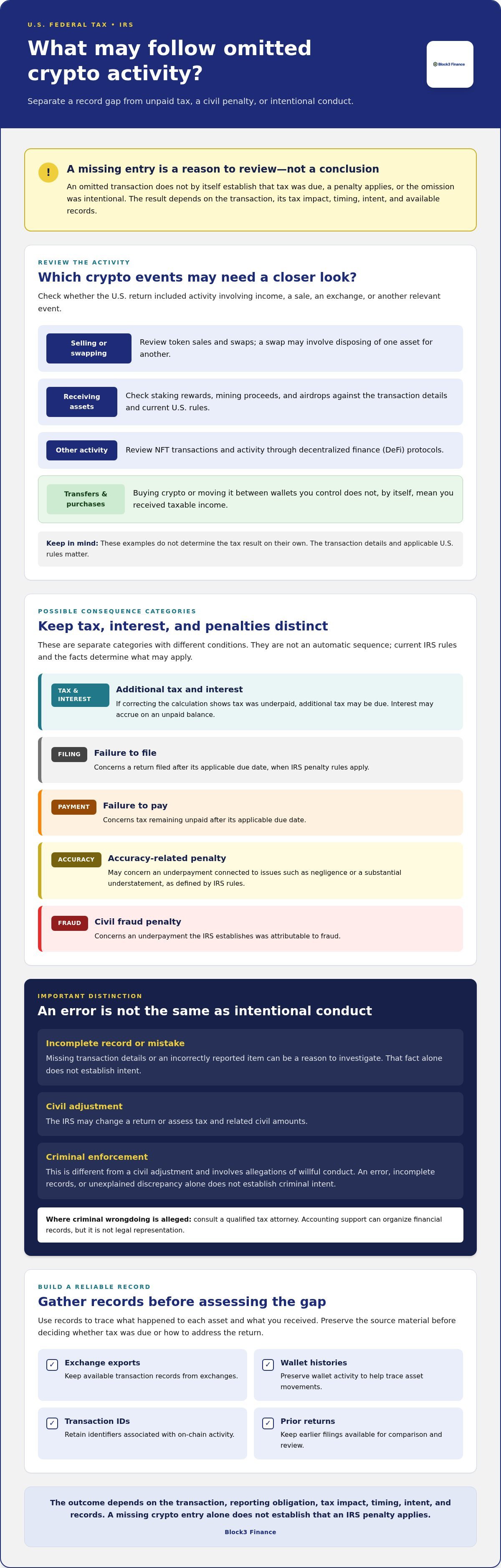
Review activity that may have involved income, a sale, an exchange, or another event relevant to your U.S. federal return. Examples include selling or swapping tokens, receiving staking rewards, mining, airdrops, NFT transactions, and activity through decentralized finance (DeFi) protocols.
These examples don’t determine the tax result on their own. A swap may involve disposing of one asset for another, while the treatment of rewards, mining proceeds, airdrops, NFTs, and DeFi activity depends on the transaction details and current U.S. rules. Buying crypto or transferring it between wallets you control doesn’t, by itself, mean you received taxable income.
If the underlying technology is unfamiliar, Wikipedia offers a basic overview of cryptocurrency. For a tax review, the key is tracing what you did with an asset and what you received, rather than relying on a general definition.
A missing disclosure is not automatically proof of tax evasion
An omission can result from an error, incomplete records, or a misunderstanding of how a transaction should be reported. Intentional conduct is different. The IRS may evaluate intent and surrounding facts rather than treating every missing item as evidence of evasion.
Useful distinctions include:
- An incomplete record: Activity took place, but the available exchange or wallet history doesn’t show the full transaction.
- An error: A transaction was recorded or reported incorrectly. That fact alone doesn’t establish intent.
- Intentional conduct: Evidence about a taxpayer’s actions and circumstances may affect how authorities evaluate the case.
This distinction matters when assessing unreported crypto taxes penalties. Finding a gap is a reason to examine the facts, not a prediction of an IRS outcome. Preserve transaction histories and related records before deciding whether tax was due or how to address the return.
Which IRS penalties and consequences may apply to unreported crypto?
An omitted crypto transaction doesn’t automatically mean you owe tax or a penalty. If the transaction changes the tax calculation, you may owe additional U.S. federal tax, and interest may accrue on an unpaid balance under IRS rules. Tax, interest, and penalties are separate amounts, and the outcome depends on the facts.
The IRS explains digital assets and related reporting considerations in its guidance on digital assets. The consequences below are distinct categories, not an automatic sequence. Current IRS rules and the details of the return determine which, if any, may apply.
Tax owed, interest, and civil penalties are different
A late return, an unpaid balance, and an inaccurate return raise different issues. If a correction shows that tax was underpaid, the IRS may assess additional tax, and interest may apply to the unpaid amount. Civil penalties are separate consequences that apply only when particular legal conditions are met.
| Category | What it generally concerns |
|---|---|
| Additional tax and interest | Tax due after correcting the calculation, plus interest that may accrue on unpaid tax. |
| Failure to file | A return filed after its applicable due date, when the IRS penalty rules apply. |
| Failure to pay | Tax remaining unpaid after its applicable due date. |
| Accuracy-related penalty | Underpayment connected to certain issues, such as negligence or a substantial understatement, as defined by IRS rules. |
| Civil fraud penalty | An underpayment the IRS establishes was attributable to fraud. |
These categories have different conditions and calculations. Whether a penalty applies, and how it is calculated, should be assessed using current IRS guidance. A missing crypto entry alone doesn’t establish that a penalty applies.
When inaccurate reporting can become a more serious matter
A civil tax adjustment generally means the IRS changes a return or assesses tax and related civil amounts. Criminal enforcement is different: it involves allegations of willful conduct, and authorities must establish the case based on evidence. An error, incomplete records, or unexplained discrepancy alone doesn’t establish criminal intent.
Intent, the amount involved, records, and conduct all matter. If the IRS alleges criminal wrongdoing, consult a qualified tax attorney. Accounting support can help organize financial records, but it isn’t legal representation.
For help organizing crypto activity and preparing tax records for review, connect with Block3 Finance’s team. Clear documentation can support accurate reporting, but it can’t guarantee a particular IRS decision or outcome.
Does an unreported crypto transaction always trigger an IRS penalty?
No. An omitted crypto item doesn’t automatically lead to an IRS penalty or audit. Whether a return needs correction or tax is due depends on the reporting obligation, the transaction’s effect on the tax calculation, timing, intent, and available records.
Exchange reports and public blockchain activity can provide information about transactions, but neither determines by itself how an item should be treated on a U.S. federal return. A transfer between wallets, for example, may appear in a ledger without necessarily representing a taxable sale. The underlying facts and applicable IRS rules matter.
That’s why unreported crypto taxes penalties can’t be assessed from a transaction label alone. Two similar-looking omissions may differ because one is a documented recordkeeping mistake with no tax due, while the other involves an underpayment, repeated inaccurate reporting, or evidence of deliberate concealment.
Why similar omissions can lead to different outcomes
The IRS analysis can turn on details that aren’t obvious from a transaction summary. Relevant facts may include the type of activity, the tax year, whether the transaction changed the amount of tax due, what documentation exists, and how the taxpayer handled the issue.
- Recordkeeping error: A missing exchange entry may be explained by incomplete data, with records elsewhere helping establish what happened.
- Possible underpayment: If an omitted item affected the tax calculation, a corrected return may show tax due and raise separate questions about interest or penalties.
- Possible intentional conduct: Evidence of deliberate concealment may be assessed differently from an accidental omission, but intent can’t be inferred from a missing entry alone.
These are general distinctions, not predictions about an individual case. IRS rules and procedures can change, so confirm current requirements through official IRS information and assess the return, records, and conduct before drawing conclusions.
What an IRS notice does, and doesn’t, tell you
An IRS notice identifies an issue, proposes an adjustment, or requests action. It isn’t automatically a finding of criminal conduct. Its meaning depends on the notice itself and the facts of the return.
Read the notice carefully. Verify that it’s genuine, identify the tax year and issue, and follow the response instructions and deadline stated in it. If anything is unclear, use official IRS channels to confirm the notice and the appropriate next step. Ignoring it doesn’t resolve the issue and may limit your ability to respond effectively.
How to respond when you discover unreported crypto activity
Finding a gap is the start of a review, not an automatic instruction to amend a return. First rebuild the activity, identify the tax year, and compare the records with what you filed. Then consider what action may be appropriate under current U.S. IRS guidance.
Reconstruct transactions before changing a return
Start with the source records. Preserve original files and note where information is missing so you can distinguish verified activity from estimates.
- Gather source records. Save exchange exports, wallet histories, block explorer records, transaction IDs, relevant service-provider statements, and copies of prior filed returns.
- Map the activity. Sort transactions by date, asset, amount, and wallet or platform. Track transfers between wallets you control so they can be distinguished from sales or other disposals. Don’t automatically treat every wallet movement as a sale.
- Reconcile gaps. Compare deposits and withdrawals across platforms, identify unmatched transactions, and document the assumptions used to connect records. Keep a clear trail from each summary back to its source.
For a broader process, review this crypto tax filing guidance. It can help frame your review, while transaction-level records establish what happened in your own accounts.
Review the return, notice, and appropriate next action
Once you have a transaction history, compare it with the U.S. federal return for the relevant tax year. Determine whether the issue is a missing disclosure, a changed tax calculation, an incomplete record, or a combination. Discovering an omission doesn’t by itself determine whether or how to correct a filing.
- Identify the filing at issue. Match the activity to the tax year and return, and keep the filed version alongside your reconstructed records.
- Check current IRS instructions. If a correction may be needed, verify the current IRS amendment procedure and any applicable time limits. Don’t rely on general guidance for a specific filing decision.
- If you received a notice, verify its details. Confirm the tax year, requested action, response method, and notice-specific deadline through official IRS information. Keep the notice and proof of any response with your records.
- Organize the supporting file. Retain source exports, transaction IDs, calculations, and explanations for unresolved items so the reasoning behind the reporting is clear.
Complex exchange, wallet, and on-chain histories can require careful reconciliation. Block3 Finance provides IRS crypto tax filing support to help organize digital asset activity for tax reporting. If you need help bringing records together, discuss your crypto tax records with our team.
How crypto tax support can help restore accurate U.S. reporting
Correcting a crypto reporting gap starts with reliable records. A crypto-focused accounting process can bring exchange exports, wallet histories, and on-chain activity into one organized view, making it easier to trace transactions and prepare a consistent U.S. federal return.
That clarity can show which information is available, where records conflict, and what may need further review. It can also make it easier to explain the basis for reported figures if questions arise, without guaranteeing that the IRS will waive penalties or take a particular action.
What specialized crypto tax filing can address
Digital asset histories often span multiple platforms and types of activity. Tax filing and reporting support can organize trading, staking, mining, airdrops, NFTs, and decentralized finance (DeFi) transactions, then reconcile records across exchanges, wallets, and public transaction data.
Reconciliation can surface missing entries, duplicate records, and transfers that need context before they are classified. The goal is a more complete, consistent record for return preparation, not an assumption that every transaction has the same tax treatment. Crypto audit-readiness support can also help structure records for examination.
Block3 Finance brings more than 13 years of blockchain financial expertise and serves more than 980 clients globally, including individuals and digital asset businesses. That experience supports work with complex on-chain records, while the facts of each taxpayer’s activity determine the reporting analysis.
Choose a measured next step, not a guaranteed outcome
Before discussing a filing issue, gather materials that show both what happened and what was reported. Useful records include:
- Prior U.S. federal returns for the tax years involved
- Any IRS notice and its response instructions
- Exchange transaction exports and statements
- Wallet histories, transaction IDs, and relevant on-chain records
- Notes identifying missing data or unresolved transfers
A tax professional can help organize records and support tax filing and accounting. That work is distinct from legal representation. If you face criminal allegations, consult a qualified attorney. Because unreported crypto taxes penalties depend on the facts and applicable IRS rules, a careful review is more useful than assuming a specific outcome.
If you’re ready to review your records and U.S. tax filing needs, start a discussion with Block3 Finance.
Take the Next Step Toward Clearer Crypto Tax Records
In the United States, an omitted crypto transaction doesn’t automatically mean tax is due or an IRS penalty applies. The outcome depends on the transaction, its effect on the return, the available records, and the surrounding facts. Understanding how unreported crypto taxes penalties may apply is a reason to review the details, not assume the worst.
Start by preserving exchange exports, wallet histories, transaction IDs, and returns for the tax years involved. Reconstructing activity before deciding whether to correct a filing can help reveal gaps and create a clearer record for accurate reporting.
Block3 Finance provides crypto tax filing and reporting for complex on-chain activity, drawing on more than 13 years of blockchain financial expertise. This support can help organize records and prepare for reporting, but no service can guarantee a particular IRS outcome.
If you’re ready to bring your records and questions into focus, discuss your crypto tax reporting needs. A careful, informed next step can help you move forward with greater clarity.
Frequently Asked Questions
Is there a penalty for not reporting crypto on U.S. taxes?
There isn’t one outcome for every omitted crypto transaction on a U.S. federal tax return. Depending on the facts, an IRS review may identify additional tax, interest on unpaid tax, or a civil penalty under applicable U.S. rules.
Potential unreported crypto taxes penalties depend on the transaction, the return and tax year involved, and the surrounding circumstances. Check current IRS guidance or consult a qualified tax professional about your situation.
Can the IRS find unreported cryptocurrency transactions?
Some cryptocurrency activity may leave records with exchanges, payment platforms, wallets, or public blockchains, but those records can vary in visibility and completeness. Don’t assume activity is invisible, or that a transaction record alone determines its U.S. tax treatment.
Reporting obligations depend on the facts and current IRS rules. Keep complete records, including transaction histories, and review any IRS notice carefully before responding.
What happens if I forgot to report crypto on a U.S. tax return?
Start by identifying the tax year, return, and transaction involved, then gather relevant exchange, wallet, and on-chain records. Compare that activity with the filed U.S. return to determine whether the omission may have affected income, gains, or another reporting requirement.
The appropriate correction depends on the facts and current IRS procedures. If you’ve received a notice, follow its instructions and verify its response deadline rather than relying on a general process.
Does the IRS treat an honest crypto tax mistake differently from intentional evasion?
Intent and surrounding facts can matter, but you shouldn’t assume how the IRS will characterize an omission. An incomplete record, a calculation error, and deliberate concealment describe different circumstances. A missing entry alone doesn’t establish intent.
Preserve supporting documents and avoid making claims about intent that you can’t support. If you suspect fraud or face criminal allegations related to U.S. taxes, seek advice from a qualified U.S. tax attorney.
Can I amend a U.S. tax return after leaving crypto off?
A correction may be possible, but the appropriate procedure depends on the return, tax year, and issue. First reconstruct the transactions, compare them with the filed U.S. return, and retain records supporting your calculations.
Don’t rely on a general deadline or form number without checking current IRS instructions for your situation. A crypto tax professional can help organize the activity and assess the reporting work involved.
What should I do if an IRS notice mentions cryptocurrency?
Verify that the notice is authentic, identify the tax year and issue, then follow its response instructions and stated deadline. Gather the relevant U.S. return, exchange records, wallet history, and transaction details before preparing a response.
Don’t ignore the notice, but don’t assume it alleges criminal conduct either. Use current IRS instructions and the specific facts in the notice to guide your next steps.
Can a crypto tax accountant remove IRS penalties?
A crypto tax accountant can help organize digital asset records and prepare or review U.S. tax reporting, but can’t guarantee that the IRS will remove a penalty or accept a particular position. Penalty relief depends on applicable U.S. rules and individual facts.
Block3 Finance provides crypto tax filing and reporting for complex on-chain activity, including staking, mining, NFTs, and DeFi. For legal representation or criminal allegations, consult a qualified tax attorney.

Article by
Mahad Mohamed
Mahad Mohamed is an accountant and the CEO of Block3 Finance, with over 26+ years of Canadian and international tax and accounting experience. A crypto accounting specialist since the early days of Bitcoin, he has consulted for over 38 crypto companies and collaborated with legal professionals on regulatory matters. His expertise spans corporate reorganization, cross-border tax structuring (Canada & US), tax disputes, and CRA audits.
Previously, Mahad worked for the Canada Revenue Agency (CRA), Big4 accounting firms, and served as a Rulings Officer for the Federal Tax Authority of the UAE before acquiring Tax Partners in 2014.
Block3 Finance and Tax Partners has 44 full-time accountants and over 9,800+ clients.
Disclaimer
This article provides general information only and is current as of its publication date. It has not been updated and may be out of date. It does not constitute legal advice and should not be relied upon as such. Every tax situation is unique and may differ from the examples discussed in this article. If you have specific questions, you should seek the advice of our accountants for your unique circumstances.
Frequently Asked Questions
Which crypto activity may need review on a U.S. return?
Review activity that may have involved income, a sale, an exchange, or another event relevant to your U.S. federal return. Examples include selling or swapping tokens, receiving staking rewards, mining, airdrops, NFT transactions, and activity through decentralized finance (DeFi) protocols. These examples don’t determine the tax result on their own. A swap may involve disposing of one asset for another, while the treatment of rewards, mining proceeds, airdrops, NFTs, and DeFi activity depends on the transaction details and current U.S. rules. Buying crypto or transferring it between wallets you control doesn’t, by itself, mean you received taxable income. If the underlying technology is unfamiliar, Wikipedia offers a basic overview of cryptocurrency. For a tax review, the key is tracing what you did with an asset and what you received, rather than relying on a general definition.
Is there a penalty for not reporting crypto on U.S. taxes?
There isn’t one outcome for every omitted crypto transaction on a U.S. federal tax return. Depending on the facts, an IRS review may identify additional tax, interest on unpaid tax, or a civil penalty under applicable U.S. rules. Potential unreported crypto taxes penalties depend on the transaction, the return and tax year involved, and the surrounding circumstances. Check current IRS guidance or consult a qualified tax professional about your situation.
Can the IRS find unreported cryptocurrency transactions?
Some cryptocurrency activity may leave records with exchanges, payment platforms, wallets, or public blockchains, but those records can vary in visibility and completeness. Don’t assume activity is invisible, or that a transaction record alone determines its U.S. tax treatment. Reporting obligations depend on the facts and current IRS rules. Keep complete records, including transaction histories, and review any IRS notice carefully before responding.
What happens if I forgot to report crypto on a U.S. tax return?
Start by identifying the tax year, return, and transaction involved, then gather relevant exchange, wallet, and on-chain records. Compare that activity with the filed U.S. return to determine whether the omission may have affected income, gains, or another reporting requirement. The appropriate correction depends on the facts and current IRS procedures. If you’ve received a notice, follow its instructions and verify its response deadline rather than relying on a general process.
Does the IRS treat an honest crypto tax mistake differently from intentional evasion?
Intent and surrounding facts can matter, but you shouldn’t assume how the IRS will characterize an omission. An incomplete record, a calculation error, and deliberate concealment describe different circumstances. A missing entry alone doesn’t establish intent. Preserve supporting documents and avoid making claims about intent that you can’t support. If you suspect fraud or face criminal allegations related to U.S. taxes, seek advice from a qualified U.S. tax attorney.
Can I amend a U.S. tax return after leaving crypto off?
A correction may be possible, but the appropriate procedure depends on the return, tax year, and issue. First reconstruct the transactions, compare them with the filed U.S. return, and retain records supporting your calculations. Don’t rely on a general deadline or form number without checking current IRS instructions for your situation. A crypto tax professional can help organize the activity and assess the reporting work involved.
What should I do if an IRS notice mentions cryptocurrency?
Verify that the notice is authentic, identify the tax year and issue, then follow its response instructions and stated deadline. Gather the relevant U.S. return, exchange records, wallet history, and transaction details before preparing a response. Don’t ignore the notice, but don’t assume it alleges criminal conduct either. Use current IRS instructions and the specific facts in the notice to guide your next steps.
Can a crypto tax accountant remove IRS penalties?
A crypto tax accountant can help organize digital asset records and prepare or review U.S. tax reporting, but can’t guarantee that the IRS will remove a penalty or accept a particular position. Penalty relief depends on applicable U.S. rules and individual facts. Block3 Finance provides crypto tax filing and reporting for complex on-chain activity, including staking, mining, NFTs, and DeFi. For legal representation or criminal allegations, consult a qualified tax attorney.