
What if converting crypto to dollars is the simplest part of your payment workflow? For U.S. businesses, crypto to fiat payment solutions also raise practical questions: who handles conversion, where funds settle, how fees are recorded, and who is responsible for each control.
A provider may facilitate conversion, a financial institution may receive settlement, and your team still needs records connecting each payment to its conversion, fees, and accounting entries. These roles aren’t interchangeable. A professional-services firm advising on a workflow is not itself an exchange or payment network.
This guide explains how U.S. businesses can compare custodial and non-custodial operating models, assess operational and counterparty risks, and build a documented payment and reconciliation process. It also outlines the financial, operational, and professional stakeholders to involve before implementation, helping you evaluate fit and keep conversion, controls, and records aligned.
Key Takeaways
- Assess crypto to fiat payment solutions beyond conversion, including custody, settlement, reporting, support, and integration needs.
- Map the roles of your business, wallet or custody provider, conversion provider, and receiving financial institution before choosing a workflow.
- Compare provider-led arrangements with setups using separate providers to see which better fits your controls and operating needs.
- Build a reviewable record trail connecting transaction evidence, conversion activity, settlement, and accounting entries.
- Consider how Block3 Finance’s payment and finance capabilities may support workflow assessment, and confirm the precise scope of any proposed service.
What crypto-to-fiat payment solutions do for U.S. businesses
Crypto-to-fiat payment solutions convert digital assets into government-issued currency for a business payment or treasury workflow. In this U.S.-focused guide, the example is converting a digital asset into U.S. dollars, which a business may use to settle operating expenses or manage incoming payments.
A workflow is the full sequence of responsibilities and records, not a single product. An exchange can facilitate trades between digital assets and traditional currencies. A cryptocurrency exchange is one possible participant, but it is not the same as a bank, payment workflow, or standalone software tool. Arrangements vary, so clarify who handles each step and what records each provider supplies.
How a crypto-to-fiat business payment flow works
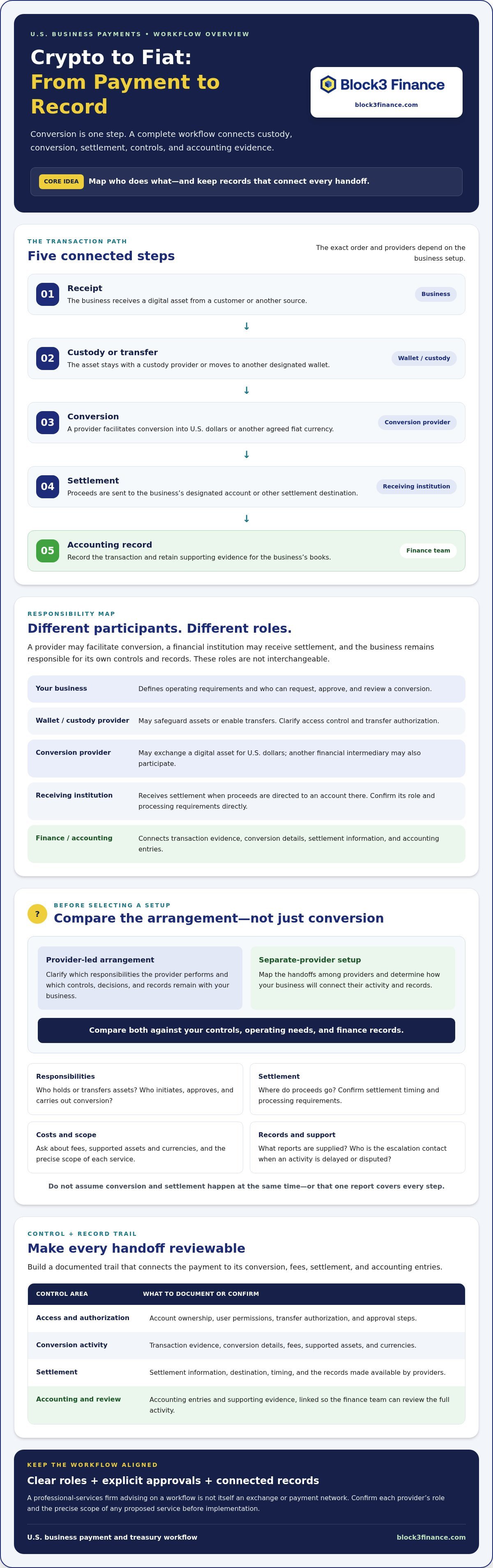
A U.S. business might receive a digital-asset payment, transfer it to a wallet or custody provider, convert it through a service provider, and receive U.S. dollars in a financial institution account. The order and the parties involved depend on the selected providers and business setup.
- Receipt: The business receives a digital asset from a customer or another source.
- Custody or transfer: The asset remains with a custody provider or moves to another designated wallet.
- Conversion: A provider facilitates conversion into U.S. dollars or another agreed fiat currency.
- Settlement: The proceeds are sent to the business’s designated account or other settlement destination.
- Accounting record: The business records the transaction and retains supporting evidence for its books.
Make each handoff explicit. The business sets its operational requirements, while wallet, conversion, and financial institution providers perform the roles agreed with them.
Which U.S. businesses might evaluate these solutions?
Startups, established firms, and Web3 organizations may assess a conversion workflow if they receive digital-asset payments or manage digital assets in their operations. Their needs differ: one business may prioritize predictable settlement into dollars, while another may need clearer responsibility for custody, approvals, and accounting records.
Start with the business purpose, the people responsible, and the records the finance team needs. Don’t assume every organization requires the same setup. These are business payment and treasury considerations, not personal investing or trading decisions. Block3 Finance offers on and off-ramp solutions; confirm the precise scope of any proposed service before implementation.
How crypto-to-fiat conversion connects providers, controls, and settlement
A conversion workflow connects several parties, but there is no single sequence for every U.S. business. The provider arrangement determines who holds or transfers the digital assets, who carries out conversion, how dollars are settled, and which records each party makes available.
- The business receives or holds digital assets and defines who can request, approve, and review a conversion.
- A wallet or custody provider may safeguard the assets or enable their transfer. Confirm who controls access and how transfers are authorized.
- A conversion provider may exchange the digital asset for U.S. dollars. Another financial intermediary may also participate.
- The receiving financial institution receives settlement if the arrangement sends proceeds to an account there. Confirm its role and processing requirements directly.
- The business records the activity by retaining transaction evidence, conversion details, settlement information, and accounting entries.
This map is a starting point, not a promise of a particular route. Before choosing among crypto to fiat payment solutions, ask each provider to confirm conversion and settlement timing, fees, supported assets and currencies, and the records it supplies. Don’t assume conversion and settlement happen at the same time or that one report covers every step.
Where custody and conversion responsibilities sit
Make responsibility explicit at each handoff. Document who controls the assets, who can initiate or approve a conversion, and whether a third-party provider or another intermediary carries it out. Record account ownership, user permissions, approval steps, and escalation contacts. That way, the finance team knows whom to contact if a transaction is delayed, disputed, or not reflected as expected.
What changes when a business receives stablecoins
Stablecoins are digital assets designed to maintain a reference value, often against a currency, but that design doesn’t guarantee price stability or access to redemption. Confirm which tokens a provider supports, how redemption works, what settlement options are available, and what records document each stage.
Include the issuer, custody arrangement, and operational dependencies in the review. These are points to investigate, not automatic signs of safety or risk. The Brookings Institution discusses wider considerations in its article on stablecoins and national security. Assess how your own providers and controls fit your business needs.
Clear roles make it easier to review a workflow before funds move. To assess how payment processes connect with finance oversight, you can discuss your requirements with Block3 Finance and confirm the proposed service scope.
Comparing crypto-to-fiat payment models for U.S. businesses
U.S. businesses can consider a provider-led arrangement, where one provider coordinates several parts of the workflow, or combine separate wallet, conversion, and settlement providers. A provider-led arrangement may centralize some handoffs, while a multi-provider setup may offer more choice over individual providers. Neither model is automatically better. Compare the responsibilities and records in the arrangement being proposed.
Choose a model by weighing control, settlement, recordkeeping, and operational needs.
| Comparison area | Provider-led arrangement | Workflow assembled from separate providers |
|---|---|---|
| Custody | Confirm whether the provider holds assets or coordinates with a custodian. | Identify each wallet or custody provider and map transfers between them. |
| Conversion control | Ask who initiates or approves conversion and what the business can direct. | Document how instructions pass between providers and who authorizes each step. |
| Settlement | Verify the destination, timing, and conditions for settlement. | Confirm which provider sends proceeds and how the receiving institution fits in. |
| Reporting and fees | Request transaction-level records and a clear breakdown of applicable fees. | Check whether records from each provider can be matched and compared. |
| Support and integration | Confirm support channels, service limits, and available bookkeeping connections. | Assess how the business will coordinate support and move records between systems. |
Questions to ask a prospective payment provider
Ask for written, provider-specific answers about what is supported for your U.S. business. Confirm details such as:
- Which digital assets, fiat currencies, jurisdictions, and business types are supported?
- Who holds assets, executes conversion, arranges settlement, and supplies transaction records?
- What fees may apply, how are they calculated, and where will they appear in the records?
- What support channels, account permissions, service limitations, and exception-resolution steps apply?
How finance teams can compare operational fit
Test the proposed workflow against the company’s bookkeeping and approval process. Ask for a sample transaction report or export, then check whether finance staff can trace a payment from its source record through conversion and settlement into the ledger.
Review access and dependencies before implementation. Determine who can initiate, approve, and review transactions, and whether responsibilities are appropriately separated for your business. List the banks, custodians, payment providers, and other third parties involved. Assign an owner to each handoff and identify whom the team should contact if records or funds don’t align.
Preparing crypto-to-fiat workflows for financial review
A reliable workflow leaves a clear trail from the original transaction to the accounting entry. For U.S. businesses, that means documenting how transaction evidence, conversion records, settlement records, and internal books connect, then assigning responsibility for maintaining and reviewing those records.
Reconciliation means comparing records from different sources to identify missing information or inconsistencies. For example, a finance team can compare a provider statement with available wallet or blockchain records and the company’s accounting entries, then investigate differences rather than assuming amounts and dates match.
Records to organize for reconciliation
Build a consistent record set for each payment or conversion. Available details may include:
- Transaction evidence: transaction identifiers, timestamps, asset amounts, and relevant wallet or blockchain records.
- Conversion records: provider statements showing conversion details and any fees or adjustments.
- Settlement evidence: records showing the amount received, destination, and settlement date.
- Accounting entries: the corresponding entries in the company’s ledger and any supporting documents.
Match records using shared identifiers where available, and document gaps rather than estimating or filling them in without support. Assign an owner and next step for each exception, such as requesting a missing provider statement or resolving a difference between the settled amount and the ledger entry.
Ongoing accounting services can support consistent recordkeeping and financial review. The process should fit the business’s providers and books, rather than relying on a report that may omit part of the transaction trail.
Controls and U.S. compliance questions to verify
Include tax, financial reporting, and provider onboarding in the review, but treat classification and tax treatment as questions for qualified U.S. accounting and tax professionals. Records can help those professionals assess the business’s facts; they don’t, by themselves, establish how a transaction must be reported.
Regulatory relevance also depends on the business’s activities and provider relationships. Ask qualified U.S. legal and compliance professionals whether IRS, FinCEN, or OFAC rules are relevant to your specific arrangement, and confirm current requirements with the appropriate authority. Don’t assume a provider’s onboarding process resolves every obligation the business may have.
Before implementation, document the workflow, approval roles, record sources, review cadence, and exception owners. If you want support assessing how payment activity connects with accounting and financial oversight, contact Block3 Finance to discuss your workflow and confirm the precise scope of any proposed service.
How Block3 Finance can help assess crypto-to-fiat payment solutions
Choosing a conversion workflow involves more than selecting a provider. A business also needs to understand how payment activity connects with bookkeeping, reporting, and financial oversight. Block3 Finance offers crypto-to-fiat payment solutions alongside CFO and corporate structuring services for digital asset operations.
Block3 Finance is not a cryptocurrency exchange, standalone payment software provider, or payment network. Its crypto-to-fiat solutions overview describes the service area. Prospective clients should confirm directly which responsibilities Block3 Finance would handle and which remain with the business or its other providers.
When specialist financial support may be useful
Financial support may be worth considering when a business works with multiple providers, transaction activity grows, or reconciliation becomes difficult to manage. These conditions can make it harder to trace payment activity from receipt through conversion and settlement into the company’s records.
Connecting payment design with bookkeeping and oversight helps decision-makers assess whether responsibilities, reports, and review steps fit the business’s operations. Not every business needs an advisor, and implementation requirements differ. The goal is to identify gaps and clarify roles, not assume one arrangement suits every organization.
A practical next step for business decision-makers
Prepare a concise picture of the current or proposed workflow before discussing options. Useful materials include:
- A flow diagram showing how assets move from receipt to conversion and settlement.
- A list of providers and the role each one performs.
- Representative transaction records, provider statements, and accounting entries.
- Questions about permissions, approvals, fees, records, and unresolved reconciliation issues.
These materials can keep the conversation focused on the business model, the quality of existing records, and the financial workflow the company needs. They also help distinguish what a proposed service covers from responsibilities held by an exchange, custodian, bank, or other provider.
Block3 Finance's finance and payment capabilities may be relevant for businesses assessing how conversion activity connects with corporate finance and financial records. Confirm the proposed service scope, provider roles, and implementation responsibilities directly before proceeding. Discuss your crypto-to-fiat payment needs.
Build a payment workflow your finance team can review
Reliable crypto to fiat payment solutions depend on more than conversion. U.S. businesses should understand who controls each handoff, compare provider models against their operating needs, and connect transaction evidence, conversion records, settlement details, and accounting entries.
A documented process gives finance teams a clearer basis for tracing activity and investigating gaps. It also helps decision-makers identify where they need provider-specific answers or guidance from qualified U.S. accounting, tax, legal, or compliance professionals.
Block3 Finance offers crypto-to-fiat payment solutions within its broader finance capabilities. The firm brings more than 13 years of blockchain financial expertise and serves more than 980 clients globally, including individual traders and investors, crypto startups, DAOs, and Web3 projects.
Bring your provider list, workflow diagram, and unresolved questions into your next planning conversation. Discuss your crypto-to-fiat payment needs and take a considered next step toward a workflow your business can understand, review, and manage.
Frequently Asked Questions
What is a crypto-to-fiat payment solution?
A crypto-to-fiat payment solution helps convert digital assets into government-issued currency, such as U.S. dollars, for a business payment or treasury workflow. Depending on the arrangement, separate providers may handle custody, conversion, and settlement, or one provider may coordinate multiple steps. The term describes a workflow, not necessarily a single product, exchange, bank account, or software platform.
How does a business convert cryptocurrency into U.S. dollars?
A U.S. business typically uses a conversion provider or another agreed financial intermediary to exchange digital assets for U.S. dollars, then arranges settlement to its designated destination. The exact steps depend on the provider and business setup. Before proceeding, confirm supported assets, conversion and settlement timing, applicable fees, approval controls, and the transaction records each party supplies.
Can a U.S. business accept crypto and pay expenses in fiat?
Yes, a business may be able to receive digital-asset payments, convert them into U.S. dollars through a provider, and use the settled funds for operating expenses. Confirm the arrangement with the conversion provider and receiving financial institution, including settlement details and available records. Ask qualified U.S. accounting and legal professionals how to record and assess the business’s specific transactions.
How do I choose a crypto-to-fiat payment provider?
Compare providers based on your business’s required assets and currencies, custody arrangements, conversion control, settlement process, reporting, fees, support, and bookkeeping fit. Ask who can initiate or approve transactions, what happens when a transfer or settlement needs review, and how exceptions are resolved. Request clear, provider-specific answers rather than assuming features, integrations, or service terms are standard across crypto to fiat payment solutions.
What records should a business keep for crypto-to-fiat conversions?
Keep available transaction identifiers, timestamps, asset amounts, conversion details, fee information, settlement evidence, provider statements, and corresponding accounting entries. Retain wallet or blockchain records where available, and match them with provider and internal records during reconciliation. Document missing evidence or differences, assign someone to resolve each exception, and ask a qualified U.S. tax professional which records the business should retain for its circumstances.
Does Block3 Finance provide a crypto exchange or payment software?
No. Block3 Finance is a specialist finance firm, not a crypto exchange or standalone payment software provider. It offers crypto-to-fiat payment solutions as part of its on-and-off-ramp and broader corporate finance capabilities, alongside services such as accounting and CFO services. Prospective clients should confirm directly which work Block3 would perform and which responsibilities remain with the business or other providers.
Are crypto-to-fiat payment solutions subject to U.S. compliance requirements?
Potential U.S. compliance considerations depend on the business’s activities, providers, and arrangement, so don’t assume one rule applies to every workflow. Review tax, financial reporting, provider onboarding, and other relevant questions with qualified U.S. accounting, legal, and compliance professionals. Ask them to assess whether IRS, FinCEN, or OFAC requirements apply to your specific circumstances, and verify current requirements with the appropriate authority.

Article by
Mahad Mohamed
Mahad Mohamed is an accountant and the CEO of Block3 Finance, with over 26+ years of Canadian and international tax and accounting experience. A crypto accounting specialist since the early days of Bitcoin, he has consulted for over 38 crypto companies and collaborated with legal professionals on regulatory matters. His expertise spans corporate reorganization, cross-border tax structuring (Canada & US), tax disputes, and CRA audits.
Previously, Mahad worked for the Canada Revenue Agency (CRA), Big4 accounting firms, and served as a Rulings Officer for the Federal Tax Authority of the UAE before acquiring Tax Partners in 2014.
Block3 Finance and Tax Partners has 44 full-time accountants and over 9,800+ clients.
Disclaimer
This article provides general information only and is current as of its publication date. It has not been updated and may be out of date. It does not constitute legal advice and should not be relied upon as such. Every tax situation is unique and may differ from the examples discussed in this article. If you have specific questions, you should seek the advice of our accountants for your unique circumstances.
Frequently Asked Questions
Which U.S. businesses might evaluate these solutions?
Startups, established firms, and Web3 organizations may assess a conversion workflow if they receive digital-asset payments or manage digital assets in their operations. Their needs differ: one business may prioritize predictable settlement into dollars, while another may need clearer responsibility for custody, approvals, and accounting records. Start with the business purpose, the people responsible, and the records the finance team needs. Don’t assume every organization requires the same setup. These are business payment and treasury considerations, not personal investing or trading decisions. Block3 Finance offers on and off-ramp solutions; confirm the precise scope of any proposed service before implementation. A conversion workflow connects several parties, but there is no single sequence for every U.S. business. The provider arrangement determines who holds or transfers the digital assets, who carries out conversion, how dollars are settled, and which records each party makes available. This map is a starting point, not a promise of a particular route. Before choosing among crypto to fiat payment solutions, ask each provider to confirm conversion and settlement timing, fees, supported assets and currencies, and the records it supplies. Don’t assume conversion and settlement happen at the same time or that one report covers every step.
What is a crypto-to-fiat payment solution?
A crypto-to-fiat payment solution helps convert digital assets into government-issued currency, such as U.S. dollars, for a business payment or treasury workflow. Depending on the arrangement, separate providers may handle custody, conversion, and settlement, or one provider may coordinate multiple steps. The term describes a workflow, not necessarily a single product, exchange, bank account, or software platform.
How does a business convert cryptocurrency into U.S. dollars?
A U.S. business typically uses a conversion provider or another agreed financial intermediary to exchange digital assets for U.S. dollars, then arranges settlement to its designated destination. The exact steps depend on the provider and business setup. Before proceeding, confirm supported assets, conversion and settlement timing, applicable fees, approval controls, and the transaction records each party supplies.
Can a U.S. business accept crypto and pay expenses in fiat?
Yes, a business may be able to receive digital-asset payments, convert them into U.S. dollars through a provider, and use the settled funds for operating expenses. Confirm the arrangement with the conversion provider and receiving financial institution, including settlement details and available records. Ask qualified U.S. accounting and legal professionals how to record and assess the business’s specific transactions.
How do I choose a crypto-to-fiat payment provider?
Compare providers based on your business’s required assets and currencies, custody arrangements, conversion control, settlement process, reporting, fees, support, and bookkeeping fit. Ask who can initiate or approve transactions, what happens when a transfer or settlement needs review, and how exceptions are resolved. Request clear, provider-specific answers rather than assuming features, integrations, or service terms are standard across crypto to fiat payment solutions.
What records should a business keep for crypto-to-fiat conversions?
Keep available transaction identifiers, timestamps, asset amounts, conversion details, fee information, settlement evidence, provider statements, and corresponding accounting entries. Retain wallet or blockchain records where available, and match them with provider and internal records during reconciliation. Document missing evidence or differences, assign someone to resolve each exception, and ask a qualified U.S. tax professional which records the business should retain for its circumstances.
Does Block3 Finance provide a crypto exchange or payment software?
No. Block3 Finance is a specialist finance firm, not a crypto exchange or standalone payment software provider. It offers crypto-to-fiat payment solutions as part of its on-and-off-ramp and broader corporate finance capabilities, alongside services such as accounting and CFO services. Prospective clients should confirm directly which work Block3 would perform and which responsibilities remain with the business or other providers.
Are crypto-to-fiat payment solutions subject to U.S. compliance requirements?
Potential U.S. compliance considerations depend on the business’s activities, providers, and arrangement, so don’t assume one rule applies to every workflow. Review tax, financial reporting, provider onboarding, and other relevant questions with qualified U.S. accounting, legal, and compliance professionals. Ask them to assess whether IRS, FinCEN, or OFAC requirements apply to your specific circumstances, and verify current requirements with the appropriate authority.