
You open a wallet report and find token swaps, bridge transfers, and liquidity pool activity, but no clear explanation of what each event means for your U.S. tax return. That’s the central challenge of DeFi tax reporting: blockchain records show what happened on-chain, but they don’t automatically establish the tax treatment.
A software report or token label may help organize activity, but it may not capture the context behind transactions that span wallets, chains, and protocols. Some DeFi mechanics also lack detailed IRS guidance. Strong reporting starts with traceable evidence, not assumptions based on a transaction’s name.
This guide explains how to organize U.S. DeFi activity for the 2026 tax year, preserve useful transaction evidence, and distinguish observable facts from tax conclusions. You’ll learn which records to gather, why transaction-level context matters, and when an uncertain event may need specialized review. The goal is a clearer reporting process informed by IRS guidance and expert judgment where on-chain data alone can’t answer the question.
Key Takeaways
- Inventory your wallets, exchanges, protocols, and tax years before reconciling DeFi activity.
- For stronger DeFi tax reporting, capture transaction-level facts such as dates, assets, quantities, wallet addresses, and transaction hashes.
- Compare swaps, liquidity pool activity, and yield based on the available evidence and the questions each event raises. Don’t assume they share one tax treatment.
- Separate what the blockchain shows from your tax interpretation, and flag unclear transactions for review under U.S. IRS rules.
- Prepare records in a clear sequence so you can identify gaps and reporting questions before filing.
What DeFi Tax Reporting Means Under U.S. IRS Rules
DeFi tax reporting means organizing activity from decentralized finance protocols and evaluating how each transaction should be reflected on a U.S. federal tax return under IRS rules. It involves connecting on-chain records to the facts of what happened, then checking the potential tax treatment against current IRS guidance.
This section covers U.S. federal tax reporting only. Protocol data can show which assets moved, when they moved, and which wallet addresses were involved. On its own, it doesn’t establish whether an event is taxable or how it should be classified.
What counts as DeFi activity in a tax record?
Decentralized finance (DeFi) broadly refers to financial activity conducted through blockchain-based protocols rather than traditional intermediaries. Token swaps, lending, liquidity pool contributions, and yield receipts are examples of activity a U.S. taxpayer may need to review. These describe actions, not automatic tax outcomes.
An on-chain transaction is an action recorded on a blockchain, such as transferring a token or interacting with a protocol. A wallet address is a public identifier associated with a blockchain wallet. It can help locate activity, but it usually doesn’t show who controlled the wallet, the purpose of a transfer, or what happened outside that transaction.
For a useful tax record, keep transaction details alongside verifiable context. This may include the protocol, the assets and quantities shown, and notes or supporting records that explain why you initiated the interaction.
Why does DeFi activity need careful review?
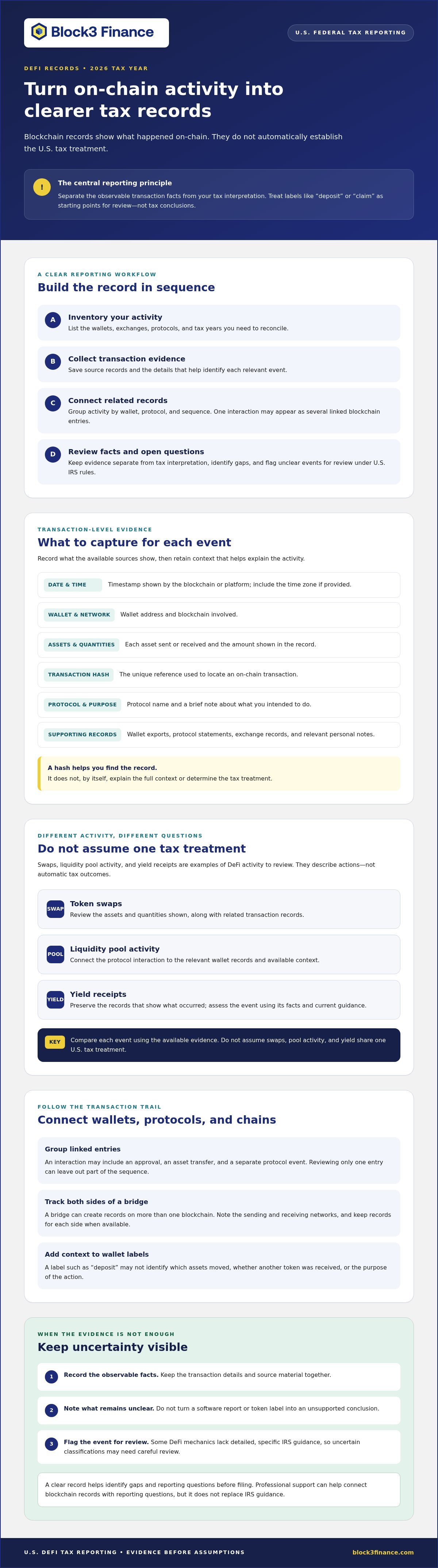
One protocol interaction can create several linked blockchain records. For example, a user action might involve a token approval, an asset transfer, and a separate protocol event. Reviewing only one entry can leave out part of the sequence.
Wallet labels don’t tell the whole story. A label such as “deposit” may not identify which assets moved, whether another token was received, or the purpose of the action. A transaction hash, the unique reference used to find a blockchain transaction, can help trace the record, but interpretation still requires context.
Under U.S. IRS rules, assess each event using its facts and current guidance. Don’t assume every wallet interaction is taxable or irrelevant. Some DeFi mechanics lack detailed, specific IRS guidance, so uncertain classifications may need careful review. Block3 Finance’s digital-asset tax filing and reporting information describes its work in this area. Professional support can help connect blockchain records with reporting questions, but it doesn’t replace IRS guidance.
How to Map DeFi Transactions to the Evidence You Need
Start with observable facts. In DeFi tax reporting, a transaction label such as “deposit” or “claim” is a starting point for review, not a conclusion about its U.S. tax treatment.
What should you record for a DeFi transaction?
Create a record for each relevant event and retain the source material that supports it. Capture these details where available:
- Date and time: Record the timestamp shown by the blockchain or platform, including the time zone if provided.
- Wallet and network: Identify the wallet address and blockchain involved.
- Assets and quantities: Note each asset sent or received and the amount shown in the record.
- Transaction hash: Save the unique identifier that lets you locate an on-chain transaction.
- Protocol and purpose: Name the protocol and briefly note what you intended to do.
- Supporting records: Keep wallet exports, protocol statements, exchange records, and relevant personal notes.
A transaction hash helps locate an on-chain record, but it doesn’t explain the full economic context or determine tax treatment. For U.S. reporting context, consult the IRS digital asset reporting rules alongside your transaction evidence.
How do you connect activity across protocols and chains?
Group related records by wallet, protocol, and sequence. One activity may appear as several entries, such as an approval followed by a deposit, a later withdrawal, or a token swap. A bridge can also create records on more than one blockchain. Note both the sending and receiving networks, and preserve records for each side when available.
Use a working log to connect those entries without assigning a tax result too early. For each group, record the apparent purpose, the evidence supporting that interpretation, and any unresolved questions.
- Wrapped assets: Record the assets and quantities involved, and flag uncertainty about how the movement should be classified.
- Missing records: Mark gaps clearly and look for corroborating wallet, protocol, or exchange records.
- Software imports: Compare imported data with source records. Software may not capture intent or all cross-chain context.
Keep facts separate from judgments. If activity remains difficult to reconcile, a specialist can review the source records and help identify reporting questions. Contact Block3 Finance about complex DeFi records if you’re considering professional support. For broader context, see this 2026 cryptocurrency tax filing guide.
Are DeFi Swaps, Liquidity Pools, and Yield Treated the Same?
No. A protocol action describes what happened on-chain, but its label alone doesn’t establish its U.S. federal tax treatment. For accurate DeFi tax reporting, document the assets and events involved, then verify any proposed tax characterization against current IRS guidance.
The IRS provides general digital asset information, but a specific DeFi mechanism may need closer analysis. Use IRS guidance on digital assets as an authoritative starting point, not a substitute for examining the transaction’s facts.
What is different about swaps and liquidity pool activity?
Start by identifying what went in and what came out. A swap record may show one token leaving a wallet and another arriving. A liquidity pool interaction may involve a deposit, a withdrawal, and separately recorded receipts. These differences matter for review, but they don’t automatically determine the tax result.
Use the comparison below to organize evidence and identify questions. It is not a tax classification chart.
| Action | Evidence to capture | Questions to verify under U.S. IRS rules |
|---|---|---|
| Token swap | Assets and quantities sent and received, timestamp, fees, wallet, transaction hash | How should the exchange be characterized, and what values or basis records are relevant? |
| Liquidity pool deposit | Each asset transferred, any receipt or pool token, protocol records | Did the interaction include a distinct receipt, and how should each step be analyzed? |
| Liquidity pool withdrawal | Assets returned, quantities, any separate rewards or fees | Does the withdrawal include more than a return of deposited assets? |
| Lending or borrowing | Assets transferred or received, timing, repayment terms shown, protocol | Which movement relates to a loan, and are there separate receipts to review? |
| Yield or other receipt | Asset, quantity, time received, protocol, transaction purpose | What is the receipt’s nature, and how does current IRS guidance apply? |
How should lending, borrowing, and yield be reviewed?
Keep loan-related movements distinct from other receipts. Record what you supplied, what you received, when each event occurred, which protocol handled it, and the purpose you understood at the time. A borrowed asset, a repayment, a fee, or a yield receipt may appear in related records, but each can raise a different reporting question.
Avoid blanket assumptions about rewards, fees, or borrowed assets. Preserve the records, note what remains unclear, and seek qualified tax review when the available facts don’t support a confident classification. Separating transaction evidence from tax conclusions helps keep your U.S. reporting analysis grounded and defensible.
How to Reconcile DeFi Records Before U.S. Tax Filing
Start with a complete inventory. Before importing data or preparing a U.S. tax report, list every wallet, exchange account, blockchain, and DeFi protocol you used, along with the tax years you need to review. This defines the scope and helps prevent activity from being overlooked because it sits on another chain or platform.
What is a practical DeFi reconciliation sequence?
Reconciliation means comparing records from different sources to identify gaps, duplicates, and inconsistencies. Work through these steps in order:
- Collect source records: Export wallet and exchange histories, download protocol statements where available, and gather relevant transaction notes.
- Import and organize: Bring records into your chosen tracking process, grouping activity by wallet, chain, protocol, and tax year.
- Match linked events: Compare imported entries with blockchain records and transaction hashes. A deposit, withdrawal, bridge transfer, and related receipt may appear as separate entries.
- Investigate exceptions: Flag missing records, duplicate entries, unexplained asset movements, and transactions that appear in one source but not another. Note what you checked and what remains unresolved.
- Review before preparing: Resolve straightforward discrepancies and separate uncertain tax questions for review before using the data to prepare a final U.S. tax report.
Don’t delete an entry just because it looks duplicated. First determine whether two records describe the same event from different sources or represent separate steps in a transaction sequence.
When should you seek specialist review?
Consider specialist review if records are incomplete, transaction sequences remain unclear, or your activity spans numerous wallets, chains, or protocols. A specialist can help connect technical records with tax reporting questions. Any tax position still needs to be assessed under current U.S. IRS guidance.
Keep a short exception list for the reviewer. Include the transaction hash or date, the wallets and protocols involved, the records you compared, and the specific question you couldn’t resolve. This focuses the review and gives you a clear record of open issues.
Once your data is organized, Block3 Finance’s tax filing services may be relevant if you need support preparing digital-asset reporting. Ongoing digital asset accounting can also help maintain clearer records over time, but neither service replaces IRS guidance.
If you’d like to discuss unresolved DeFi records and reporting questions, start a conversation about DeFi tax reporting.
How Specialized Support Can Clarify Complex DeFi Tax Reporting
Specialized support can help turn fragmented blockchain records into an organized set of reporting questions. For U.S. federal tax purposes, a reviewer may examine source documents, wallet activity, linked transaction sequences, and how proposed classifications align with current IRS guidance.
The aim isn’t to force every protocol interaction into a simple label. It’s to clarify what the evidence shows, identify what remains uncertain, and prepare records for a considered tax reporting process.
What should you prepare before discussing your DeFi activity?
A focused review starts with materials that show both the transaction history and your understanding of it. Gather what you have, even if some records are incomplete:
- Wallet addresses, transaction exports, and relevant exchange records.
- Protocol statements or other records that explain activity not obvious from a wallet history.
- Prior tax work, if available, so a reviewer can understand earlier reporting decisions.
- A list of unresolved transactions, including dates or transaction hashes and the questions you want answered.
- Brief notes in plain language about what you believe happened, such as why you moved assets or what you expected to receive.
Never share private keys or recovery phrases with a tax professional. Those credentials can grant control of your assets. Transaction records and public wallet addresses are different and should be handled through an appropriate, secure process.
What can a specialized crypto tax firm help clarify?
A specialist may compare wallet and protocol records, trace related transactions, investigate missing or inconsistent entries, and connect the findings to U.S. tax reporting questions. This can also help distinguish documented transaction facts from assumptions that need further support.
Block3 Finance provides digital-asset tax filing and reporting, including support for complex on-chain activity such as DeFi transactions. Its tax filing and reporting services may be relevant if you need help organizing activity for review and filing preparation.
Professional support doesn’t replace IRS guidance, and no reviewer can guarantee a particular tax outcome. For an uncertain event, ask what evidence supports the proposed treatment, which questions remain open, and whether current IRS guidance addresses the issue directly.
With your records and questions assembled, you can have a focused discussion about the support you need. Discuss your DeFi tax reporting needs with Block3 Finance.
Build a Clearer Path to DeFi Tax Reporting
Strong DeFi tax reporting starts with evidence, not assumptions. Keep transaction records organized across wallets, protocols, and chains, and distinguish what the blockchain shows from your tax interpretation.
Swaps, liquidity pool activity, lending, borrowing, and yield receipts can raise different questions under U.S. IRS rules. Review each event based on its facts, reconcile linked records, and check uncertain classifications against current IRS guidance before preparing your return.
If your records are incomplete or a transaction sequence is difficult to explain, specialized support can help connect on-chain activity with reporting questions. Block3 Finance provides digital-asset tax filing and reporting, including support for complex DeFi activity, but professional assistance doesn’t replace IRS guidance or guarantee a particular outcome.
Discuss your DeFi tax reporting with Block3 Finance to explore support for your situation. Organized evidence and an appropriate review can help you approach your U.S. filing with greater clarity.
Frequently Asked Questions
Is every DeFi transaction taxable?
No, not necessarily. A protocol interaction can involve several distinct steps, and its U.S. tax treatment depends on what happened, which assets moved, and the available evidence.
Don’t assume every wallet signature is taxable or that a transfer is automatically irrelevant. Keep records of the full transaction sequence, then check uncertain events against current IRS guidance and consult a qualified tax professional when needed.
How are DeFi liquidity pool deposits and withdrawals reported?
Don’t determine their U.S. tax treatment from a “liquidity pool” label alone. Preserve records of the assets and quantities deposited or withdrawn, the dates, the protocol, and any related receipts or transactions.
Review the complete sequence under current IRS guidance, since pool mechanics and transaction details can differ. Avoid applying one universal tax rule to every liquidity pool interaction.
Do I need to report DeFi yield on my U.S. tax return?
The word “yield” alone doesn’t establish how a receipt should be reported under U.S. IRS rules. Record what asset you received, when it appeared, which protocol was involved, and whether another transaction followed.
Keep supporting records that help explain the receipt. If its nature or tax treatment isn’t clear, ask a qualified tax professional to review the facts against current IRS guidance.
Can crypto tax software accurately track DeFi transactions?
Software can help collect and organize supported wallet or protocol data, but an imported label may not explain a transaction’s purpose or tax treatment. Compare reports with blockchain records and supporting documents, and investigate missing, duplicated, or unclear entries.
For complex activity, specialist reconciliation may help connect related transactions. Confirm final U.S. tax reporting decisions against current IRS guidance rather than relying on an automated classification alone.
What records should I keep for DeFi tax reporting?
Keep wallet addresses, transaction hashes, dates, asset names and quantities, protocol records, exchange histories, and notes that explain unusual activity. Preserve available records for both sides of related transactions, such as an asset sent and a receipt that followed.
A transaction hash helps locate an on-chain event, but it doesn’t show the full context or decide its U.S. tax treatment. Organize records by wallet, protocol, and tax year.
How do I report a DeFi transaction with missing records?
First, identify the wallet, blockchain, approximate period, and protocol. Then search available blockchain records and account exports for related activity. Note what you can verify and what remains unknown. Don’t fill gaps with assumptions.
If the records still don’t reconcile, share the uncertainty and available evidence with a qualified tax professional. Any proposed U.S. reporting treatment should be checked against current IRS guidance.
Should I hire a crypto tax accountant for DeFi activity?
Professional help may be useful if your activity spans multiple wallets or protocols, records are incomplete, or you can’t confidently reconcile transaction sequences. Ask how the accountant reviews on-chain data, documents unresolved questions, and supports U.S. tax return preparation.
Block3 Finance provides digital-asset tax filing and reporting, including support for DeFi activity. A specialist can help with analysis and filing, but doesn’t replace IRS guidance or guarantee a tax outcome.

Article by
Mahad Mohamed
Mahad Mohamed is an accountant and the CEO of Block3 Finance, with over 26+ years of Canadian and international tax and accounting experience. A crypto accounting specialist since the early days of Bitcoin, he has consulted for over 38 crypto companies and collaborated with legal professionals on regulatory matters. His expertise spans corporate reorganization, cross-border tax structuring (Canada & US), tax disputes, and CRA audits.
Previously, Mahad worked for the Canada Revenue Agency (CRA), Big4 accounting firms, and served as a Rulings Officer for the Federal Tax Authority of the UAE before acquiring Tax Partners in 2014.
Block3 Finance and Tax Partners has 44 full-time accountants and over 9,800+ clients.
Disclaimer
This article provides general information only and is current as of its publication date. It has not been updated and may be out of date. It does not constitute legal advice and should not be relied upon as such. Every tax situation is unique and may differ from the examples discussed in this article. If you have specific questions, you should seek the advice of our accountants for your unique circumstances.
Frequently Asked Questions
What counts as DeFi activity in a tax record?
Decentralized finance (DeFi) broadly refers to financial activity conducted through blockchain-based protocols rather than traditional intermediaries. Token swaps, lending, liquidity pool contributions, and yield receipts are examples of activity a U.S. taxpayer may need to review. These describe actions, not automatic tax outcomes. An on-chain transaction is an action recorded on a blockchain, such as transferring a token or interacting with a protocol. A wallet address is a public identifier associated with a blockchain wallet. It can help locate activity, but it usually doesn’t show who controlled the wallet, the purpose of a transfer, or what happened outside that transaction. For a useful tax record, keep transaction details alongside verifiable context. This may include the protocol, the assets and quantities shown, and notes or supporting records that explain why you initiated the interaction.
Why does DeFi activity need careful review?
One protocol interaction can create several linked blockchain records. For example, a user action might involve a token approval, an asset transfer, and a separate protocol event. Reviewing only one entry can leave out part of the sequence. Wallet labels don’t tell the whole story. A label such as “deposit” may not identify which assets moved, whether another token was received, or the purpose of the action. A transaction hash, the unique reference used to find a blockchain transaction, can help trace the record, but interpretation still requires context. Under U.S. IRS rules, assess each event using its facts and current guidance. Don’t assume every wallet interaction is taxable or irrelevant. Some DeFi mechanics lack detailed, specific IRS guidance, so uncertain classifications may need careful review. Block3 Finance’s digital-asset tax filing and reporting information describes its work in this area. Professional support can help connect blockchain records with reporting questions, but it doesn’t replace IRS guidance. Start with observable facts. In DeFi tax reporting, a transaction label such as “deposit” or “claim” is a starting point for review, not a conclusion about its U.S. tax treatment.
What should you record for a DeFi transaction?
Create a record for each relevant event and retain the source material that supports it. Capture these details where available: A transaction hash helps locate an on-chain record, but it doesn’t explain the full economic context or determine tax treatment. For U.S. reporting context, consult the IRS digital asset reporting rules alongside your transaction evidence.
How do you connect activity across protocols and chains?
Group related records by wallet, protocol, and sequence. One activity may appear as several entries, such as an approval followed by a deposit, a later withdrawal, or a token swap. A bridge can also create records on more than one blockchain. Note both the sending and receiving networks, and preserve records for each side when available. Use a working log to connect those entries without assigning a tax result too early. For each group, record the apparent purpose, the evidence supporting that interpretation, and any unresolved questions. Keep facts separate from judgments. If activity remains difficult to reconcile, a specialist can review the source records and help identify reporting questions. Contact Block3 Finance about complex DeFi records if you’re considering professional support. For broader context, see this 2026 cryptocurrency tax filing guide. No. A protocol action describes what happened on-chain, but its label alone doesn’t establish its U.S. federal tax treatment. For accurate DeFi tax reporting, document the assets and events involved, then verify any proposed tax characterization against current IRS guidance. The IRS provides general digital asset information, but a specific DeFi mechanism may need closer analysis. Use IRS guidance on digital assets as an authoritative starting point, not a substitute for examining the transaction’s facts.
What is different about swaps and liquidity pool activity?
Start by identifying what went in and what came out. A swap record may show one token leaving a wallet and another arriving. A liquidity pool interaction may involve a deposit, a withdrawal, and separately recorded receipts. These differences matter for review, but they don’t automatically determine the tax result. Use the comparison below to organize evidence and identify questions. It is not a tax classification chart.
How should lending, borrowing, and yield be reviewed?
Keep loan-related movements distinct from other receipts. Record what you supplied, what you received, when each event occurred, which protocol handled it, and the purpose you understood at the time. A borrowed asset, a repayment, a fee, or a yield receipt may appear in related records, but each can raise a different reporting question. Avoid blanket assumptions about rewards, fees, or borrowed assets. Preserve the records, note what remains unclear, and seek qualified tax review when the available facts don’t support a confident classification. Separating transaction evidence from tax conclusions helps keep your U.S. reporting analysis grounded and defensible. Start with a complete inventory. Before importing data or preparing a U.S. tax report, list every wallet, exchange account, blockchain, and DeFi protocol you used, along with the tax years you need to review. This defines the scope and helps prevent activity from being overlooked because it sits on another chain or platform.
What is a practical DeFi reconciliation sequence?
Reconciliation means comparing records from different sources to identify gaps, duplicates, and inconsistencies. Work through these steps in order: Don’t delete an entry just because it looks duplicated. First determine whether two records describe the same event from different sources or represent separate steps in a transaction sequence.
When should you seek specialist review?
Consider specialist review if records are incomplete, transaction sequences remain unclear, or your activity spans numerous wallets, chains, or protocols. A specialist can help connect technical records with tax reporting questions. Any tax position still needs to be assessed under current U.S. IRS guidance. Keep a short exception list for the reviewer. Include the transaction hash or date, the wallets and protocols involved, the records you compared, and the specific question you couldn’t resolve. This focuses the review and gives you a clear record of open issues. Once your data is organized, Block3 Finance’s tax filing services may be relevant if you need support preparing digital-asset reporting. Ongoing digital asset accounting can also help maintain clearer records over time, but neither service replaces IRS guidance. If you’d like to discuss unresolved DeFi records and reporting questions, start a conversation about DeFi tax reporting. Specialized support can help turn fragmented blockchain records into an organized set of reporting questions. For U.S. federal tax purposes, a reviewer may examine source documents, wallet activity, linked transaction sequences, and how proposed classifications align with current IRS guidance. The aim isn’t to force every protocol interaction into a simple label. It’s to clarify what the evidence shows, identify what remains uncertain, and prepare records for a considered tax reporting process.
What should you prepare before discussing your DeFi activity?
A focused review starts with materials that show both the transaction history and your understanding of it. Gather what you have, even if some records are incomplete: Never share private keys or recovery phrases with a tax professional. Those credentials can grant control of your assets. Transaction records and public wallet addresses are different and should be handled through an appropriate, secure process.
What can a specialized crypto tax firm help clarify?
A specialist may compare wallet and protocol records, trace related transactions, investigate missing or inconsistent entries, and connect the findings to U.S. tax reporting questions. This can also help distinguish documented transaction facts from assumptions that need further support. Block3 Finance provides digital-asset tax filing and reporting, including support for complex on-chain activity such as DeFi transactions. Its tax filing and reporting services may be relevant if you need help organizing activity for review and filing preparation. Professional support doesn’t replace IRS guidance, and no reviewer can guarantee a particular tax outcome. For an uncertain event, ask what evidence supports the proposed treatment, which questions remain open, and whether current IRS guidance addresses the issue directly. With your records and questions assembled, you can have a focused discussion about the support you need. Discuss your DeFi tax reporting needs with Block3 Finance. Strong DeFi tax reporting starts with evidence, not assumptions. Keep transaction records organized across wallets, protocols, and chains, and distinguish what the blockchain shows from your tax interpretation. Swaps, liquidity pool activity, lending, borrowing, and yield receipts can raise different questions under U.S. IRS rules. Review each event based on its facts, reconcile linked records, and check uncertain classifications against current IRS guidance before preparing your return. If your records are incomplete or a transaction sequence is difficult to explain, specialized support can help connect on-chain activity with reporting questions. Block3 Finance provides digital-asset tax filing and reporting, including support for complex DeFi activity, but professional assistance doesn’t replace IRS guidance or guarantee a particular outcome. Discuss your DeFi tax reporting with Block3 Finance to explore support for your situation. Organized evidence and an appropriate review can help you approach your U.S. filing with greater clarity.
Is every DeFi transaction taxable?
No, not necessarily. A protocol interaction can involve several distinct steps, and its U.S. tax treatment depends on what happened, which assets moved, and the available evidence. Don’t assume every wallet signature is taxable or that a transfer is automatically irrelevant. Keep records of the full transaction sequence, then check uncertain events against current IRS guidance and consult a qualified tax professional when needed.
How are DeFi liquidity pool deposits and withdrawals reported?
Don’t determine their U.S. tax treatment from a “liquidity pool” label alone. Preserve records of the assets and quantities deposited or withdrawn, the dates, the protocol, and any related receipts or transactions. Review the complete sequence under current IRS guidance, since pool mechanics and transaction details can differ. Avoid applying one universal tax rule to every liquidity pool interaction.
Do I need to report DeFi yield on my U.S. tax return?
The word “yield” alone doesn’t establish how a receipt should be reported under U.S. IRS rules. Record what asset you received, when it appeared, which protocol was involved, and whether another transaction followed. Keep supporting records that help explain the receipt. If its nature or tax treatment isn’t clear, ask a qualified tax professional to review the facts against current IRS guidance.
Can crypto tax software accurately track DeFi transactions?
Software can help collect and organize supported wallet or protocol data, but an imported label may not explain a transaction’s purpose or tax treatment. Compare reports with blockchain records and supporting documents, and investigate missing, duplicated, or unclear entries. For complex activity, specialist reconciliation may help connect related transactions. Confirm final U.S. tax reporting decisions against current IRS guidance rather than relying on an automated classification alone.
What records should I keep for DeFi tax reporting?
Keep wallet addresses, transaction hashes, dates, asset names and quantities, protocol records, exchange histories, and notes that explain unusual activity. Preserve available records for both sides of related transactions, such as an asset sent and a receipt that followed. A transaction hash helps locate an on-chain event, but it doesn’t show the full context or decide its U.S. tax treatment. Organize records by wallet, protocol, and tax year.
How do I report a DeFi transaction with missing records?
First, identify the wallet, blockchain, approximate period, and protocol. Then search available blockchain records and account exports for related activity. Note what you can verify and what remains unknown. Don’t fill gaps with assumptions. If the records still don’t reconcile, share the uncertainty and available evidence with a qualified tax professional. Any proposed U.S. reporting treatment should be checked against current IRS guidance.
Should I hire a crypto tax accountant for DeFi activity?
Professional help may be useful if your activity spans multiple wallets or protocols, records are incomplete, or you can’t confidently reconcile transaction sequences. Ask how the accountant reviews on-chain data, documents unresolved questions, and supports U.S. tax return preparation. Block3 Finance provides digital-asset tax filing and reporting, including support for DeFi activity. A specialist can help with analysis and filing, but doesn’t replace IRS guidance or guarantee a tax outcome.