
A wallet balance is not an audit trail. For U.S. businesses, digital asset audit readiness means connecting on-chain activity to records that help explain ownership, business purpose, and accounting treatment.
When transactions span wallets, exchanges, protocols, and accounting systems, it can be difficult to assemble a clear account of activity. Records gathered only when an audit begins may leave gaps that take time to investigate.
This guide explains how to organize supporting records, identify evidence gaps, and establish repeatable processes before an audit begins. The goal is to make digital asset activity easier to explain and support, not to guarantee an audit outcome.
Key Takeaways
- Connect source records to reconciliations and accounting entries so each material activity has a traceable path.
- Use a consistent index for transaction identifiers, dates, asset quantities, and supporting documents.
- Blockchain records can help investigate activity, but may not explain business purpose, accounting treatment, or control on their own.
- Build digital asset audit readiness around a repeatable workflow for defining scope, reconciling records, investigating exceptions, and retaining evidence.
- Assign owners and review dates to recurring records, and consider specialist accounting support when activity becomes complex.
What Digital Asset Audit Readiness Means for U.S. Businesses
Digital asset audit readiness is the practice of keeping complete, traceable records that explain an organization’s digital asset activity and support how it is reflected in financial records. For each material activity, the goal is to connect its source and business purpose to its accounting treatment and supporting documents.
For a U.S. business, readiness is preparation, not an audit opinion. Finance teams can organize and reconcile records, but an auditor’s independent examination and conclusion are separate. Applicable reporting requirements depend on the entity and its framework, so confirm the organization’s obligations rather than assume one set of rules applies to every business.
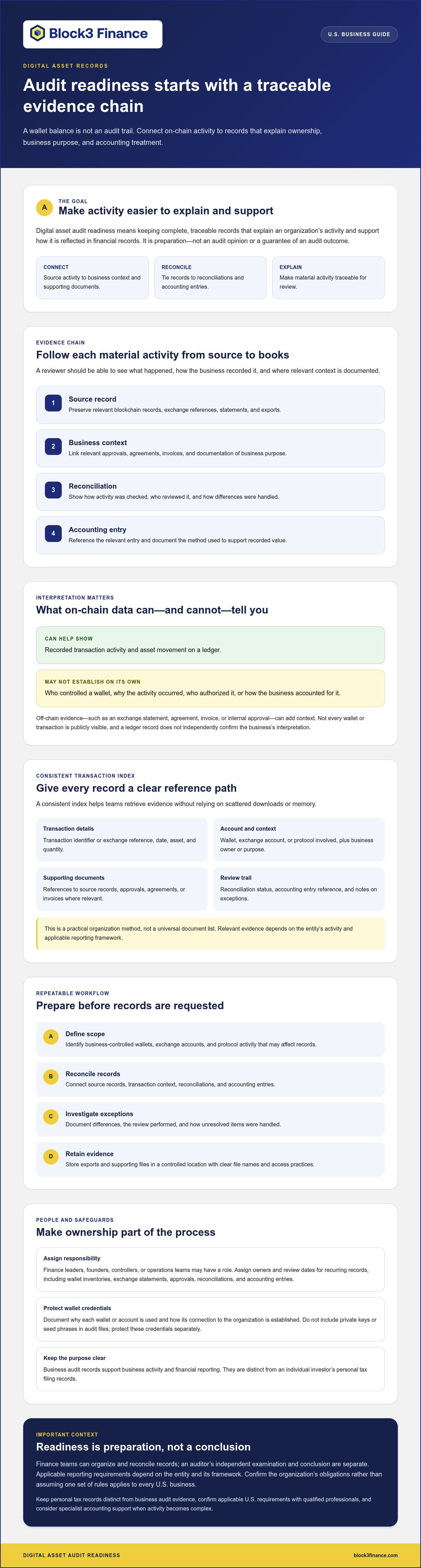
A blockchain may record a transaction, but that record alone may not establish who controlled the wallet, why the activity occurred, or how the business accounted for it. Audit readiness connects those details while recognizing what an on-chain record cannot prove by itself.
Why on-chain visibility is not the whole audit trail
Blockchain technology can support a traceable evidence chain by recording activity across a distributed ledger. But a transaction identifier and asset movement may not identify the responsible employee, business purpose, approval, or accounting entry. Not every wallet or transaction is publicly visible, and a ledger record does not independently confirm a business’s interpretation of the activity.
Off-chain evidence can provide essential context. An exchange statement, for example, may help explain activity routed through a custodial account. An agreement, invoice, or internal approval may document why a transfer took place. Together, these records help connect what happened with who authorized it and how the organization recorded it.
Who should prepare digital asset audit records?
Finance leaders, founders, controllers, and operations teams may all have a role in preserving evidence. The right owner depends on the entity, its activity, and the reporting framework it follows. Assigning responsibility for wallet inventories, exchange statements, approvals, reconciliations, and accounting entries helps prevent important context from sitting with one person or system.
Business audit records also differ from an individual investor’s tax filing records. An organization may need evidence that explains business activity and financial reporting, while an individual focuses on records relevant to personal tax reporting. Keep those purposes distinct, and confirm applicable U.S. requirements with qualified professionals.
Establish the process before records are requested. Block3 Finance’s audit and compliance information describes relevant capabilities. Confirm the scope of any support against your organization’s needs. Preparation can make activity easier to explain, but it cannot guarantee an auditor’s conclusion.
Build a Traceable Evidence Chain for U.S. Digital Asset Activity
A usable evidence chain connects an activity’s source record to its reconciliation and accounting entry. For each material transaction, a reviewer should be able to follow what happened, understand how the business recorded it, and find documents that provide relevant context.
Create a consistent index instead of relying on scattered downloads or team members’ memory. Depending on the activity, useful fields may include:
- Transaction identifier or exchange reference, date, asset, and quantity
- Wallet, exchange account, or protocol involved, plus the business owner or purpose
- Links to source records, approvals, agreements, or invoices where relevant
- Reconciliation status, accounting entry reference, and notes explaining exceptions
This is a practical way to organize records, not a universal list of documents required for every U.S. audit. The entity’s activity and applicable reporting framework influence which evidence is relevant.
Connect wallets, exchanges, and protocols to the ledger
Start by inventorying business-controlled wallets, exchange accounts, and protocol activity that may affect the organization’s records. Preserve relevant exports and supporting files in a controlled location. Use clear file names and access practices so the finance team can retrieve records and explain where they came from.
Document why each wallet or account is used and how the business establishes its connection to the organization. Do not include private keys or seed phrases in audit files. These credentials can control assets and should be protected separately.
Support valuation, ownership, and transaction purpose
For each material activity, retain source records and document the method used to support the value recorded in the books. Link relevant approvals, agreements, invoices, or other business records to the transaction index. Note who reviewed the reconciliation and how unresolved differences were handled.
A transaction hash can show that a transfer was recorded on-chain, but it cannot explain the business purpose, responsible party, or accounting decision behind it. Those details come from connecting the transaction record with the organization’s documentation and review process.
Accounting treatment can depend on the applicable framework and the nature of the activity. For example, the FASB maintains a project on accounting for transfers of crypto assets. Consult relevant materials and qualified professionals rather than assuming one approach applies to every entity or transaction.
This structure makes digital asset audit readiness more practical: teams can trace records, investigate missing context, and explain how activity flows into financial reporting. If your organization needs help organizing complex on-chain activity into accounting records, you can discuss your accounting needs with Block3 Finance.
Resolve the Biggest Digital Asset Audit Readiness Gaps
An immutable ledger preserves recorded activity, but it does not prove that a business captured every relevant transaction or recorded it correctly. Digital asset audit readiness depends on investigating how on-chain movements connect to the organization’s records, not treating blockchain visibility as a complete accounting system.
Gaps often emerge where records meet: an unlisted wallet, a transfer without clear context, or a book entry without supporting detail. These examples can help a U.S. organization review its records, but they are not universal audit requirements. None automatically means an audit finding or adverse opinion.
Distinguish a visible transaction from a supported entry
Suppose a blockchain record shows assets moving from one wallet to another. Locating the transaction confirms that a movement appears on the ledger. Reconciling it means matching it to the organization’s books and investigating whether the records agree. Separate documentation may be needed to explain whether it was an internal transfer, payment, protocol interaction, or another type of activity.
The appropriate accounting treatment and materiality, meaning the importance of an item to the organization’s financial statements, depend on the entity and its circumstances. A qualified accounting professional can assess those questions. Do not infer the treatment from a transaction label alone.
Identify and document exceptions
Use a review log to make unresolved differences visible and actionable. For each item, record what does not match, who will investigate it, the next step, and its current status.
- Missing wallet coverage: Compare known business wallets with transaction sources and document the scope of any review.
- Unexplained movements: Link activity to available approvals, agreements, invoices, or other relevant context, and note what remains unknown.
- Unresolved balances or missing records: Record the difference, the source checked, and the follow-up needed to explain or substantiate it.
- Duplicate or unsupported entries: Trace each entry to its source and preserve the basis for any proposed correction.
Do not erase the trail when correcting a record. Retain the original information, the reason for the adjustment, and the evidence and review supporting it, so the change can be followed later.
The AICPA digital asset auditing guidance offers U.S. practitioners resources on digital assets and blockchain. Use relevant professional guidance alongside an assessment of your organization’s reporting framework. A single checklist will not resolve every gap.
A well-maintained exception log helps finance teams prioritize follow-up and explain what they know, what they corrected, and what still needs review. It supports a clearer evidence trail without predicting an auditor’s conclusion.
Use a Repeatable U.S. Digital Asset Audit Readiness Workflow
A repeatable process turns digital asset audit readiness from a last-minute records exercise into ongoing financial discipline. Adapt the steps to the organization’s activity and applicable U.S. reporting framework, then document who performs and reviews each task.
Establish scope, source inventory, and ownership
Start by identifying the reporting entity and period under review. Then list relevant assets, business-controlled wallets, exchange accounts, and protocol activity. Record how the inventory was assembled and how the team will check that it covers the organization’s activity. Confirm the applicable U.S. reporting framework with qualified accounting professionals.
Assign a primary owner and reviewer for each recurring record or reconciliation. Set review dates that fit the organization’s close process. Document changes when accounts, responsibilities, or activity sources are added or retired.
Reconcile records and close the evidence gaps
Compare source activity with internal records, then follow differences through to a documented resolution or an open exception. Retain the reconciliation support, an explanation for each unresolved item, and evidence of review. This allows another team member to understand the work without reconstructing it from memory.
Use a consistent close sequence:
- Gather current source records for in-scope wallets, accounts, and activity.
- Compare activity with internal transaction records and accounting entries.
- Investigate missing, unmatched, or duplicated items and record the outcome.
- Retain supporting files, review notes, and the final reconciliation in a retrievable location.
Repeat the process on a defined schedule, not only when an audit is approaching. Ongoing monthly accounting support may help organizations maintain reconciliations and records as activity occurs. Block3 Finance’s audit and compliance services provide relevant service information for businesses assessing their support needs.
If your team needs help shaping a repeatable process around its activity and reporting framework, discuss your audit-readiness needs with Block3 Finance. A clear workflow strengthens the evidence trail, while entity-specific accounting judgments still require appropriate professional review.
Maintain Audit Readiness with the Right Digital Asset Support
Internal processes may be enough when the organization has a manageable set of accounts, a clear record owner, and a consistent way to reconcile activity and resolve exceptions. Specialist review may be useful when activity spans multiple entities, wallets, exchanges, or protocols, or when the finance team lacks experience connecting complex on-chain activity to accounting records.
Evaluate internal capacity and specialist support
Before bringing in support, define the work your team needs help with. Ask prospective providers how they handle source data, organize reconciliations, document unresolved items, and describe the scope and deliverables of their work. These questions help clarify whether the support fits your organization’s activity and applicable U.S. reporting framework.
Keep preparation distinct from independent examination. Your team or an accounting provider may organize records and prepare financial information, while an auditor’s independent examination and conclusion are separate. Confirm each party’s role and responsibilities directly. Do not assume that accounting or audit-related support guarantees compliance or acceptance by an auditor.
Block3 Finance provides digital asset accounting, audits and compliance, monthly accounting, and tax filing and reporting. Its digital asset audit services may be relevant to organizations assessing audit-related support. Confirm the specific scope based on the work required.
Keep the evidence trail current after the audit
Readiness is an ongoing practice, not a one-time collection of files. Carry documented procedures, account inventories, and exception logs into recurring close processes. Update them when wallets, exchanges, entities, or transaction workflows change.
Use separate specialists for distinct accounting and tax questions. Accounting records support an organization’s financial reporting, while tax reporting addresses tax obligations. One process should not be treated as a substitute for the other. Confirm which U.S. requirements apply to your entity and situation with qualified professionals.
Start with practical steps: organize available records, list remaining gaps, assign owners to resolve them, and clarify what support would address the work. Ongoing monthly accounting support may be relevant when your organization needs help maintaining records and reconciliations as activity occurs.
If you are ready to define the next steps for your organization, contact Block3 Finance to discuss audit readiness. A clear conversation about scope can help identify appropriate support without promising a particular audit outcome.
Turn Audit Preparation into an Ongoing Practice
Strong digital asset audit readiness is not a one-time file collection. It comes from keeping evidence connected to business activity, making gaps visible, and maintaining repeatable reviews as wallets, accounts, and workflows change.
Start by identifying records that need attention, assigning owners to open questions, and setting a process for keeping reconciliations current. These steps help your U.S. organization explain its activity more clearly, while leaving entity-specific accounting judgments and an auditor’s independent conclusions to the appropriate professionals.
Block3 Finance’s client materials cite more than 13 years of blockchain financial expertise and more than 980 clients globally. Its services include audits and compliance, monthly accounting, and tax reporting, which may be relevant as you assess the support your organization needs. No provider can guarantee an audit outcome.
Take the next step with a clear view of your records and priorities. Discuss your digital asset audit-readiness needs with Block3 Finance to identify a practical path toward stronger, more supportable financial records.
Frequently Asked Questions
What does digital asset audit readiness mean for a U.S. business?
Digital asset audit readiness means being able to explain the organization’s digital asset activity with organized, traceable records. A finance team should be able to connect relevant activity to its business purpose, supporting documents, reconciliation, and accounting entry. The records and procedures needed depend on the entity and its applicable reporting framework, so readiness is a preparation process, not a promise of a particular audit result.
Are blockchain transactions enough evidence for an audit?
No. A blockchain record may show that activity occurred, but it might not identify who controlled an address, why a transfer happened, or how the organization recorded it. For example, a transfer between two addresses may need internal records to establish whether it was the organization’s own movement or a payment. Agreements, approvals, exchange records, and accounting documentation can help provide context where relevant.
What records should a U.S. business organize before a digital asset audit?
Organize records that help explain the business’s activity, such as relevant wallet and exchange records, transaction identifiers, dates, asset quantities, reconciliations, and accounting entries. Depending on the activity, approvals, agreements, invoices, or records explaining ownership and account purpose may also help. These are examples, not a universal checklist: the entity’s activities and reporting framework determine which records are relevant. Protect private keys and seed phrases separately.
How do you reconcile digital asset transactions to accounting records?
Compare activity from each relevant source with the organization’s internal transaction records and accounting entries. Match items using available identifiers, dates, assets, and quantities, then investigate unmatched, duplicate, or differently recorded activity. Document the explanation or keep the item on an exception log with an owner and next step. Retain the reconciliation and evidence of review so another team member can follow how differences were addressed.
Does digital asset audit readiness include IRS tax compliance?
Not automatically. Audit readiness for a business’s financial records and compliance with U.S. federal tax reporting are related but distinct responsibilities. Tax records should support the organization’s tax reporting, while financial audit preparation focuses on evidence relevant to the applicable reporting framework and examination. A business may need both types of work. Confirm its specific U.S. tax obligations with a qualified tax professional and current IRS guidance.
When should a business seek specialist digital asset accounting support?
Consider specialist support if the organization has activity across multiple entities, wallets, exchanges, or protocols, or if internal staff are unsure how to connect source data with accounting records. Before engaging a provider, clarify the work’s scope, how source data will be handled, the reconciliation approach, and expected deliverables. Also distinguish who prepares records from who independently examines them, since preparation does not determine an auditor’s conclusion.
Can audit-ready digital asset records guarantee a clean audit?
No. Organized records can make activity easier to trace and explain, but they cannot guarantee a clean audit, a particular opinion, or acceptance by an auditor. An auditor reaches an independent conclusion based on the examination and relevant circumstances. Businesses can strengthen their preparation by keeping records current, documenting unresolved items, and preserving the rationale and support for corrections, without promising a particular outcome.

Article by
Mahad Mohamed
Mahad Mohamed is an accountant and the CEO of Block3 Finance, with over 26+ years of Canadian and international tax and accounting experience. A crypto accounting specialist since the early days of Bitcoin, he has consulted for over 38 crypto companies and collaborated with legal professionals on regulatory matters. His expertise spans corporate reorganization, cross-border tax structuring (Canada & US), tax disputes, and CRA audits.
Previously, Mahad worked for the Canada Revenue Agency (CRA), Big4 accounting firms, and served as a Rulings Officer for the Federal Tax Authority of the UAE before acquiring Tax Partners in 2014.
Block3 Finance and Tax Partners has 44 full-time accountants and over 9,800+ clients.
Disclaimer
This article provides general information only and is current as of its publication date. It has not been updated and may be out of date. It does not constitute legal advice and should not be relied upon as such. Every tax situation is unique and may differ from the examples discussed in this article. If you have specific questions, you should seek the advice of our accountants for your unique circumstances.
Frequently Asked Questions
Who should prepare digital asset audit records?
Finance leaders, founders, controllers, and operations teams may all have a role in preserving evidence. The right owner depends on the entity, its activity, and the reporting framework it follows. Assigning responsibility for wallet inventories, exchange statements, approvals, reconciliations, and accounting entries helps prevent important context from sitting with one person or system. Business audit records also differ from an individual investor’s tax filing records. An organization may need evidence that explains business activity and financial reporting, while an individual focuses on records relevant to personal tax reporting. Keep those purposes distinct, and confirm applicable U.S. requirements with qualified professionals. Establish the process before records are requested. Block3 Finance’s audit and compliance information describes relevant capabilities. Confirm the scope of any support against your organization’s needs. Preparation can make activity easier to explain, but it cannot guarantee an auditor’s conclusion. A usable evidence chain connects an activity’s source record to its reconciliation and accounting entry. For each material transaction, a reviewer should be able to follow what happened, understand how the business recorded it, and find documents that provide relevant context. Create a consistent index instead of relying on scattered downloads or team members’ memory. Depending on the activity, useful fields may include: This is a practical way to organize records, not a universal list of documents required for every U.S. audit. The entity’s activity and applicable reporting framework influence which evidence is relevant.
What does digital asset audit readiness mean for a U.S. business?
Digital asset audit readiness means being able to explain the organization’s digital asset activity with organized, traceable records. A finance team should be able to connect relevant activity to its business purpose, supporting documents, reconciliation, and accounting entry. The records and procedures needed depend on the entity and its applicable reporting framework, so readiness is a preparation process, not a promise of a particular audit result.
Are blockchain transactions enough evidence for an audit?
No. A blockchain record may show that activity occurred, but it might not identify who controlled an address, why a transfer happened, or how the organization recorded it. For example, a transfer between two addresses may need internal records to establish whether it was the organization’s own movement or a payment. Agreements, approvals, exchange records, and accounting documentation can help provide context where relevant.
What records should a U.S. business organize before a digital asset audit?
Organize records that help explain the business’s activity, such as relevant wallet and exchange records, transaction identifiers, dates, asset quantities, reconciliations, and accounting entries. Depending on the activity, approvals, agreements, invoices, or records explaining ownership and account purpose may also help. These are examples, not a universal checklist: the entity’s activities and reporting framework determine which records are relevant. Protect private keys and seed phrases separately.
How do you reconcile digital asset transactions to accounting records?
Compare activity from each relevant source with the organization’s internal transaction records and accounting entries. Match items using available identifiers, dates, assets, and quantities, then investigate unmatched, duplicate, or differently recorded activity. Document the explanation or keep the item on an exception log with an owner and next step. Retain the reconciliation and evidence of review so another team member can follow how differences were addressed.
Does digital asset audit readiness include IRS tax compliance?
Not automatically. Audit readiness for a business’s financial records and compliance with U.S. federal tax reporting are related but distinct responsibilities. Tax records should support the organization’s tax reporting, while financial audit preparation focuses on evidence relevant to the applicable reporting framework and examination. A business may need both types of work. Confirm its specific U.S. tax obligations with a qualified tax professional and current IRS guidance.
When should a business seek specialist digital asset accounting support?
Consider specialist support if the organization has activity across multiple entities, wallets, exchanges, or protocols, or if internal staff are unsure how to connect source data with accounting records. Before engaging a provider, clarify the work’s scope, how source data will be handled, the reconciliation approach, and expected deliverables. Also distinguish who prepares records from who independently examines them, since preparation does not determine an auditor’s conclusion.
Can audit-ready digital asset records guarantee a clean audit?
No. Organized records can make activity easier to trace and explain, but they cannot guarantee a clean audit, a particular opinion, or acceptance by an auditor. An auditor reaches an independent conclusion based on the examination and relevant circumstances. Businesses can strengthen their preparation by keeping records current, documenting unresolved items, and preserving the rationale and support for corrections, without promising a particular outcome.