
What if the best structure for a Canadian crypto business isn’t the one that looks simplest on paper? Crypto corporate structuring works best when it reflects what the business actually does, whether it trades, mines, processes payments, or manages digital assets.
Choosing an entity is only one part of the decision. The structure can affect how the business separates activities, controls assets, and organizes its books and tax reporting as it grows. If wallet activity can’t be matched to business records, even a sound structure can be difficult to manage.
This article explains what to assess before establishing or changing a Canadian business structure. You’ll compare practical operating considerations and learn how mapping activities, wallets, and transactions can support clearer bookkeeping, CRA reporting, and financial oversight.
Key Takeaways
- Map what your Canadian crypto business does before deciding how to organize its entities and responsibilities.
- Use crypto corporate structuring to connect business activities with clear ownership, financial controls, and reporting workflows.
- Compare potential structures by operational clarity, accounting needs, decision-making, and flexibility rather than assuming one setup fits every business.
- Assign responsibility for wallet records, transaction support, reconciliations, and recurring financial reviews.
- Connect corporate planning with bookkeeping, tax filing, audit readiness, and financial oversight to build more defensible business records.
What crypto corporate structuring means for a Canadian business
A founder’s first structural decision is not simply which entity to create. It’s how to align the business structure with the Canadian crypto operation, how it handles digital assets, and who is responsible for financial oversight.
Crypto corporate structuring is the organization of a Canadian crypto business’s entities, responsibilities, records, and financial oversight to support its activities and reporting needs. It’s a planning framework, not a single incorporation choice.
Incorporation creates a legal entity. Corporate structuring considers how that entity, or multiple entities, fits the operation. Tax filing reports relevant activity to the Canada Revenue Agency (CRA), while regulatory authorization concerns whether specific activities require permission under applicable rules. These considerations are connected, but none automatically replaces the others.
Which crypto business activities shape the structure?
Start by listing what the business does: operate a protocol, provide crypto-related services, manage a company treasury, distribute tokens, or carry out other digital-asset activities. Each function can involve different responsibilities, transaction flows, and records.
Keep ownership and purpose clear in the accounting records. Customer funds, company treasury assets, and founders’ personal holdings should not be blurred together. Clear distinctions help show which activity a transaction belongs to and who controls the asset.
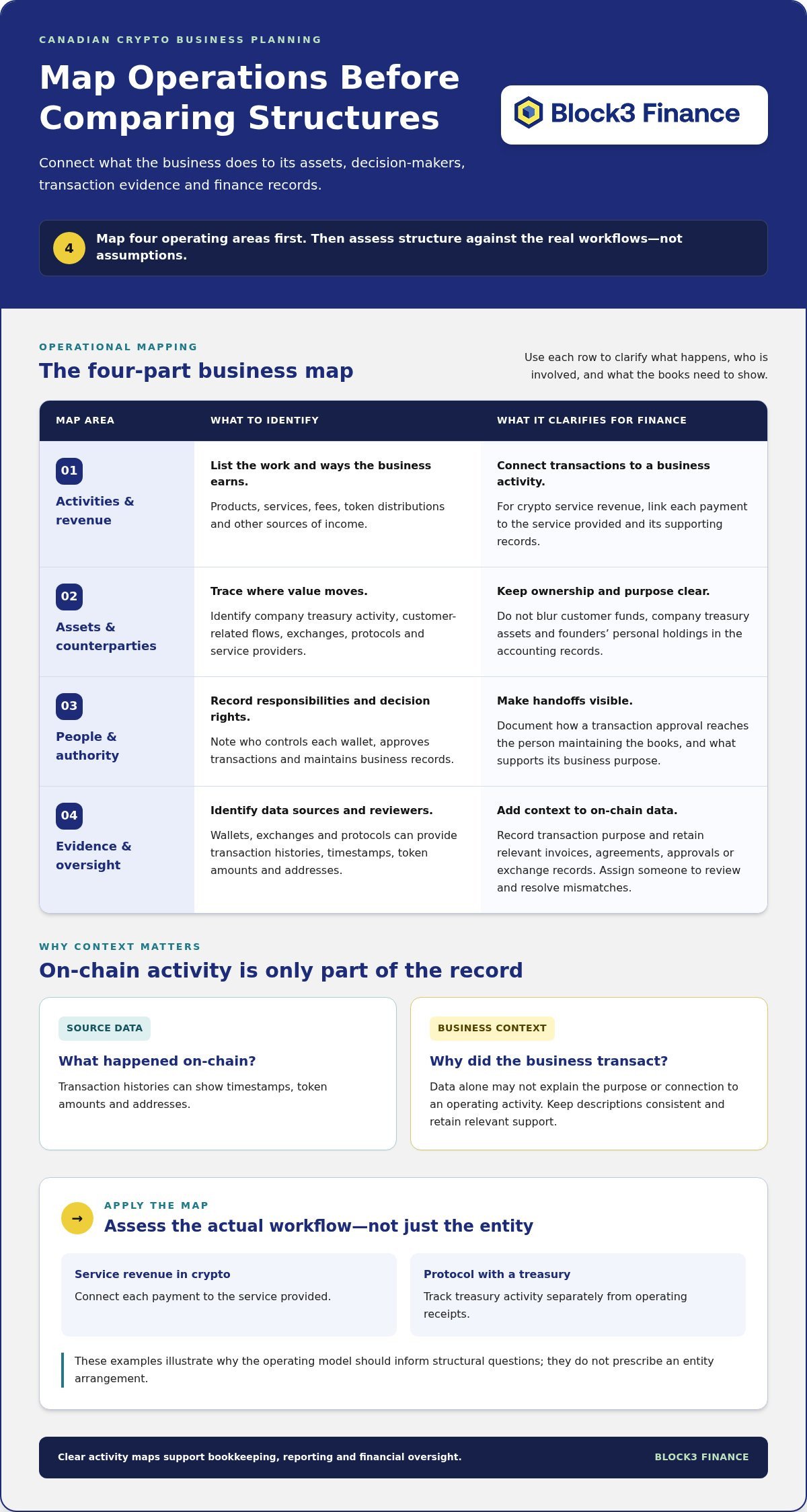
For example, a business that earns service revenue in crypto needs records connecting each payment to the service provided. A protocol that also manages a treasury needs to track treasury activity separately from operating receipts. These examples don’t prescribe an entity arrangement. They show why the operating model should inform the questions a founder assesses.
Why entity structure is only one part of the picture
An entity alone doesn’t resolve questions about tax treatment, governance, or regulatory authorization. Governance means the rules and decision-making processes used to direct an organization, including who can approve transactions and how financial responsibilities are assigned. These processes are part of corporate governance, adapted to the business’s activities and oversight needs.
For Canadian businesses, tax outcomes depend on the facts and the nature of the activity. The structure should therefore connect to accurate transaction records and reporting processes. For background on how the CRA approaches crypto tax treatment, read this Canadian crypto tax guide.
Corporate planning is more practical when it links entity decisions with bookkeeping and financial controls. Block3 Finance’s corporate structuring support connects those considerations with the records and oversight a digital-asset business needs to manage its operations.
Map Canadian crypto operations before comparing structures
Before comparing entity arrangements, map the Canadian operation. Identify how value enters, moves through, and leaves the business, then connect each activity to the people, wallets, and records involved.
Build an activity and stakeholder map
Start with a working inventory. Record what the business offers, how it earns revenue, who it transacts with, and which responsibilities support each activity.
- Activities and revenue: List products, services, fees, token distributions, and other sources of income.
- Assets and counterparties: Identify company treasury activity, customer-related flows, exchanges, protocols, and service providers.
- People and authority: Note who controls each wallet, approves transactions, and maintains business records.
- Evidence and oversight: Identify where transaction data comes from and who reviews it for bookkeeping and reporting.
This map can expose unclear handoffs. For example, if one person approves a treasury transfer and another records it, document how the approval reaches the person maintaining the books and what evidence supports the transaction’s business purpose.
For a DAO, or decentralized autonomous organization, map how governance decisions are made, how contributors carry out work, and how related transactions are recorded. A DAO label alone doesn’t establish a universal legal classification in Canada, so describe the actual arrangements rather than assuming the label settles structural questions.
Connect on-chain activity to finance records
Wallets, exchanges, and protocols generate source data for accounting, including transaction histories, timestamps, token amounts, and addresses. That data shows what happened on-chain, but may not explain why the business made a transaction or how it relates to an operating activity.
Use a consistent process to connect each material transaction to its business context. Keep descriptions consistent, record the purpose, and retain relevant supporting details such as invoices, agreements, approvals, or exchange records. This helps the finance team reconcile activity, investigate gaps, and prepare clearer reporting.
For instance, label a protocol payment with the service or business purpose it relates to instead of leaving it as an unexplained wallet movement. Identify who reviews the supporting records and resolves items that don’t match the expected activity.
This operational map gives crypto corporate structuring a stronger foundation: decisions can be assessed against actual workflows, not assumptions. Explore digital asset accounting services to connect on-chain activity with organized financial records, or discuss your business’s finance needs.
Compare structuring considerations without assuming one Canadian setup fits all
Once you’ve mapped the operating model, compare possible arrangements against the work they must support. Ask practical questions: who controls assets, who approves decisions, how records flow into the books, and whether the arrangement can adapt as the Canadian business changes.
Incorporation alone doesn’t establish that an operating model meets its tax or regulatory obligations. Those questions depend on the business’s activities and circumstances, so verify specific Canadian requirements with the relevant authorities before relying on them.
What should founders compare when assessing an arrangement?
Use decision factors rather than a universal ranking of legal forms. A straightforward setup may be easier to administer, while separating responsibilities can add recordkeeping and coordination work.
| Decision factor | What to assess | Possible trade-off |
|---|---|---|
| Operational clarity | Are activities, asset control, and responsibilities easy to distinguish? | More separation may clarify roles but require more coordination. |
| Ownership and decisions | Is it clear who owns or controls assets and who approves transactions? | Shared decision-making can support oversight but may slow approvals. |
| Accounting complexity | Can the finance team connect activity and records without confusion? | More moving parts may mean more reconciliations and documentation. |
| Reporting workflows | Can relevant records be gathered and reviewed consistently? | Separate activities may need distinct tracking and review processes. |
| Future flexibility | Can the arrangement accommodate new services, counterparties, or responsibilities? | Flexibility can support change, but may add administrative work. |
Apply each factor to the business’s current activities and plausible changes, such as adding a service or changing who manages treasury decisions. Crypto corporate structuring is more useful when it tests real workflows than when it starts with a presumed “best” entity type.
When does cross-border activity require closer review?
Customers, founders, operations, or related entities in other countries can affect Canadian planning. Treat these connections as prompts for closer review, not as automatic proof that a particular structure or tax result applies.
Keep the analysis focused on Canadian obligations. For a specific tax question, consult current Canada Revenue Agency guidance. For regulatory questions, identify the Canadian authority relevant to the activity and verify its current requirements. Don’t assume incorporation settles either question.
Turn a Canadian crypto structure into workable finance processes
A structure becomes useful when people can follow it in daily operations. For a Canadian crypto business, that means connecting each activity and wallet to clear responsibilities, reliable records, and recurring financial review.
Create an implementation sequence founders can maintain
Build the process in practical stages and document who owns each task. Keep the record current as the business and its activities evolve.
- 1. Document the operating model. Record business activities, entities, revenue streams, and the purpose of each wallet or exchange account.
- 2. Assign authority. Identify who controls wallets, who can approve transactions, and how approvals are recorded.
- 3. Set record-collection routines. Gather wallet histories, exchange statements, invoices, agreements, and transaction approvals consistently.
- 4. Reconcile and resolve gaps. Compare records with wallet and exchange activity, investigate unmatched items, and document how they were addressed.
- 5. Review when things change. Revisit responsibilities and processes when activities, counterparties, treasury practices, or the operating structure shift.
Make ownership explicit. For example, one person may collect transaction support, another may prepare reconciliations, and a designated reviewer may investigate exceptions before information flows into management reporting or tax preparation.
Build reporting and oversight into daily operations
Bookkeeping and reconciliations work best as recurring processes, not a year-end scramble. Consistent transaction records give leadership a clearer view of business activity and help organize information for Canadian tax reporting.
Canadian tax and regulatory requirements depend on the facts and can change. Verify current guidance with the relevant Canadian authority before applying a specific rule. Don’t assume a general workflow or entity choice settles a reporting question.
Financial oversight also helps turn records into decisions. CFO support can help leadership interpret financial information, monitor the operating picture, and plan how processes should adapt as the business grows. Learn more about crypto CFO services.
Strong crypto corporate structuring connects the plan to repeatable controls, from wallet-level evidence to reconciliations and reporting. Discuss your Canadian crypto structure with Block3 Finance.
How Block3 Finance supports crypto corporate structuring in Canada
A Canadian crypto business needs more than an entity plan. Its structure must connect with financial processes that capture digital-asset activity, support tax filing, prepare records for audit review, and give leadership a clear view of operations.
Block3 Finance provides corporate structuring, bookkeeping, tax filing, audit and compliance, and CFO services for digital-asset businesses. The firm reports more than 13 years of blockchain financial expertise and serves more than 980 clients globally.
Bring corporate planning and digital-asset accounting together
Documented business activities can guide how the finance team organizes records and reporting workflows. Connecting on-chain transactions to wallets, business purposes, and supporting documents helps create financial records that are easier to review and use.
Consistent records can support Canadian tax filing and audit preparation, though they don’t guarantee a particular tax treatment or audit outcome. The work can include organizing transaction support, maintaining bookkeeping processes, and aligning financial reports with the business’s documented operating model.
Explore Block3 Finance’s corporate structuring service to see how corporate planning connects with the financial processes behind a crypto business.
Plan for growth with coordinated financial oversight
As products, treasury activity, or operating scale change, finance processes may need to change too. CFO services can help leadership interpret financial information alongside operational priorities, supporting informed planning and ongoing review.
This coordination keeps structural decisions connected to how the business works in practice. A finance team that understands digital-asset activity can organize complex on-chain information into clear business records and support the bookkeeping, reporting, and oversight processes management relies on.
Crypto corporate structuring is an ongoing part of building a finance function that can adapt as a Canadian business evolves. Discuss your structuring needs with Block3 Finance.
Build a finance structure ready to evolve
Strong crypto corporate structuring starts with what your Canadian business actually does, then connects its activities to clear responsibilities, records, and financial oversight. There’s no universal arrangement that suits every operation.
Map activities and wallet responsibilities before comparing structures. Assess how each option affects decision-making, bookkeeping, reporting workflows, and the ability to adapt as the business changes. Incorporation alone doesn’t settle tax or regulatory questions, so keep financial processes aligned with current Canadian requirements.
Block3 Finance connects corporate structuring with bookkeeping, tax filing, audit preparation, and CFO services for digital-asset businesses. The firm reports more than 13 years of blockchain financial expertise and serves more than 980 clients globally.
Discuss your crypto corporate structuring needs with Block3 Finance and take a considered next step toward financial processes that support your Canadian business. Clear records and coordinated oversight can help you manage operations as they grow.
Frequently Asked Questions
What is crypto corporate structuring?
Crypto corporate structuring is how a business organizes its entities, responsibilities, financial records, and oversight around its digital-asset activities. For a Canadian crypto business, start by mapping what it does, how it handles assets, and who makes decisions. That operating picture can inform bookkeeping and reporting workflows. Structuring is broader than incorporation, which creates a legal entity, and it doesn’t by itself settle tax or regulatory questions.
Does a Canadian crypto business need a separate company for each activity?
No single answer applies to every Canadian crypto business. Whether activities belong in one entity or more than one depends on the operation’s activities, ownership, responsibilities, financial controls, and reporting needs. Map revenue streams, treasury activity, customer-related flows, and service relationships, then compare how possible arrangements affect records, decision-making, and administration. Don’t assume that adding entities automatically improves clarity or resolves tax or regulatory questions.
Can incorporation make a crypto business tax-compliant in Canada?
No. Incorporation creates a legal entity, but it doesn’t ensure that the business has reported its crypto activity correctly or met every applicable Canadian requirement. The business still needs records that explain transactions and support tax reporting. The relevant treatment can depend on the activity and circumstances. Keep the entity plan connected to the accounting process, and verify current tax guidance with the Canada Revenue Agency (CRA).
How should a crypto company organize its wallets and accounting records?
Maintain an inventory identifying each business wallet and exchange account, its purpose, who controls it, and who approves transactions. Keep wallet and exchange histories alongside records that explain business activity, such as invoices, agreements, and approvals. Use consistent transaction descriptions and document each business purpose so the finance team can reconcile on-chain activity with the books. Clearly distinguish company activity from customer-related flows and founders’ personal holdings.
When should a Canadian crypto startup review its corporate structure?
Review the structure when the business changes how it operates, not only at incorporation. New products or services, different revenue streams, changes in who controls wallets, new counterparties, or altered treasury practices can affect responsibilities and finance workflows. A review can assess whether the arrangement still supports clear decision-making, bookkeeping, and reporting. If a change raises a Canadian tax or regulatory question, verify the relevant current guidance before acting on assumptions.
What does a crypto CFO contribute to corporate structuring?
A crypto CFO helps connect financial information with operating priorities and leadership decisions. This can include reviewing reporting workflows, interpreting financial results, and identifying where controls or records need attention as the business evolves. CFO oversight complements corporate structuring by helping management assess whether day-to-day finance processes match the business’s activities. It doesn’t replace legal or tax determinations, but it can support informed planning and coordinated financial oversight.
How do Canadian tax rules affect crypto corporate structuring?
Canadian tax rules make it important to understand what the business does and how it uses or transfers digital assets. The CRA treats cryptocurrency as a commodity for income tax purposes, and the tax treatment may depend on whether activity is business income or an investment. These distinctions can affect accounting and reporting workflows, so preserve transaction details and supporting records. Confirm the current treatment for the business’s facts with CRA guidance or a qualified tax professional.

Article by
Mahad Mohamed
Mahad Mohamed is an accountant and the CEO of Block3 Finance, with over 26+ years of Canadian and international tax and accounting experience. A crypto accounting specialist since the early days of Bitcoin, he has consulted for over 38 crypto companies and collaborated with legal professionals on regulatory matters. His expertise spans corporate reorganization, cross-border tax structuring (Canada & US), tax disputes, and CRA audits.
Previously, Mahad worked for the Canada Revenue Agency (CRA), Big4 accounting firms, and served as a Rulings Officer for the Federal Tax Authority of the UAE before acquiring Tax Partners in 2014.
Block3 Finance and Tax Partners has 44 full-time accountants and over 9,800+ clients.
Disclaimer
This article provides general information only and is current as of its publication date. It has not been updated and may be out of date. It does not constitute legal advice and should not be relied upon as such. Every tax situation is unique and may differ from the examples discussed in this article. If you have specific questions, you should seek the advice of our accountants for your unique circumstances.
Frequently Asked Questions
Which crypto business activities shape the structure?
Start by listing what the business does: operate a protocol, provide crypto-related services, manage a company treasury, distribute tokens, or carry out other digital-asset activities. Each function can involve different responsibilities, transaction flows, and records. Keep ownership and purpose clear in the accounting records. Customer funds, company treasury assets, and founders’ personal holdings should not be blurred together. Clear distinctions help show which activity a transaction belongs to and who controls the asset. For example, a business that earns service revenue in crypto needs records connecting each payment to the service provided. A protocol that also manages a treasury needs to track treasury activity separately from operating receipts. These examples don’t prescribe an entity arrangement. They show why the operating model should inform the questions a founder assesses.
What should founders compare when assessing an arrangement?
Use decision factors rather than a universal ranking of legal forms. A straightforward setup may be easier to administer, while separating responsibilities can add recordkeeping and coordination work. Apply each factor to the business’s current activities and plausible changes, such as adding a service or changing who manages treasury decisions. Crypto corporate structuring is more useful when it tests real workflows than when it starts with a presumed “best” entity type.
When does cross-border activity require closer review?
Customers, founders, operations, or related entities in other countries can affect Canadian planning. Treat these connections as prompts for closer review, not as automatic proof that a particular structure or tax result applies. Keep the analysis focused on Canadian obligations. For a specific tax question, consult current Canada Revenue Agency guidance. For regulatory questions, identify the Canadian authority relevant to the activity and verify its current requirements. Don’t assume incorporation settles either question. A structure becomes useful when people can follow it in daily operations. For a Canadian crypto business, that means connecting each activity and wallet to clear responsibilities, reliable records, and recurring financial review.
What is crypto corporate structuring?
Crypto corporate structuring is how a business organizes its entities, responsibilities, financial records, and oversight around its digital-asset activities. For a Canadian crypto business, start by mapping what it does, how it handles assets, and who makes decisions. That operating picture can inform bookkeeping and reporting workflows. Structuring is broader than incorporation, which creates a legal entity, and it doesn’t by itself settle tax or regulatory questions.
Does a Canadian crypto business need a separate company for each activity?
No single answer applies to every Canadian crypto business. Whether activities belong in one entity or more than one depends on the operation’s activities, ownership, responsibilities, financial controls, and reporting needs. Map revenue streams, treasury activity, customer-related flows, and service relationships, then compare how possible arrangements affect records, decision-making, and administration. Don’t assume that adding entities automatically improves clarity or resolves tax or regulatory questions.
Can incorporation make a crypto business tax-compliant in Canada?
No. Incorporation creates a legal entity, but it doesn’t ensure that the business has reported its crypto activity correctly or met every applicable Canadian requirement. The business still needs records that explain transactions and support tax reporting. The relevant treatment can depend on the activity and circumstances. Keep the entity plan connected to the accounting process, and verify current tax guidance with the Canada Revenue Agency (CRA).
How should a crypto company organize its wallets and accounting records?
Maintain an inventory identifying each business wallet and exchange account, its purpose, who controls it, and who approves transactions. Keep wallet and exchange histories alongside records that explain business activity, such as invoices, agreements, and approvals. Use consistent transaction descriptions and document each business purpose so the finance team can reconcile on-chain activity with the books. Clearly distinguish company activity from customer-related flows and founders’ personal holdings.
When should a Canadian crypto startup review its corporate structure?
Review the structure when the business changes how it operates, not only at incorporation. New products or services, different revenue streams, changes in who controls wallets, new counterparties, or altered treasury practices can affect responsibilities and finance workflows. A review can assess whether the arrangement still supports clear decision-making, bookkeeping, and reporting. If a change raises a Canadian tax or regulatory question, verify the relevant current guidance before acting on assumptions.
What does a crypto CFO contribute to corporate structuring?
A crypto CFO helps connect financial information with operating priorities and leadership decisions. This can include reviewing reporting workflows, interpreting financial results, and identifying where controls or records need attention as the business evolves. CFO oversight complements corporate structuring by helping management assess whether day-to-day finance processes match the business’s activities. It doesn’t replace legal or tax determinations, but it can support informed planning and coordinated financial oversight.
How do Canadian tax rules affect crypto corporate structuring?
Canadian tax rules make it important to understand what the business does and how it uses or transfers digital assets. The CRA treats cryptocurrency as a commodity for income tax purposes, and the tax treatment may depend on whether activity is business income or an investment. These distinctions can affect accounting and reporting workflows, so preserve transaction details and supporting records. Confirm the current treatment for the business’s facts with CRA guidance or a qualified tax professional.