
A crypto business can have complete transaction records and still lack a clear financial picture. For Canadian firms asking “what does a fractional CFO do,” the answer goes beyond bookkeeping: this senior finance partner turns complex activity across wallets, currencies, and operations into insight leaders can use.
Accounting reports show what has already happened, but may not tell leaders whether the business can fund its plans, how cash flow could change, or which choices best support its priorities. A fractional CFO provides forward-looking financial leadership without requiring the organization to create a full-time CFO role.
This article covers the role’s practical work, from cash-flow planning and forecasting to management reporting and strategic support. It also explains when fragmented crypto records or upcoming growth decisions point to a need for stronger financial guidance, and how CFO services work alongside bookkeeping, audits, and tax reporting. The goal is clearer decisions grounded in reliable financial information and tailored to a Canadian digital-asset business.
Key Takeaways
- A fractional CFO provides tailored financial leadership, connecting business goals with practical planning without assuming a standard schedule or package.
- Reconciling on-chain activity with broader business records helps build a more complete view of crypto operations.
- A fractional CFO focuses on strategic planning and decision support, distinct from transaction recording, accounting, tax filing, and audit support.
- Consider CFO support when cash visibility is uncertain, reports feel disconnected, or recurring decisions need stronger financial analysis.
- Block3 Finance connects digital-asset financial records with CFO and corporate structuring support to help leaders plan and report with clarity.
What does a fractional CFO do for a Canadian crypto business?
A fractional CFO provides senior financial leadership on a part-time or otherwise tailored basis. Instead of filling a permanent executive role, they help a business interpret its finances, set priorities, and plan around its needs.
In practical terms, a fractional CFO connects financial information to management decisions. They may guide planning, improve visibility into available cash, review performance, and help leaders assess the financial implications of business choices. The Chief Financial Officer role broadly includes financial planning, reporting, and risk oversight. A fractional CFO provides that leadership at a scope suited to the organization.
This work is distinct from recording transactions, preparing tax returns, or giving investment advice. Bookkeeping and accounting maintain and interpret financial records, while tax and audit work address separate reporting and assurance needs. CFO leadership uses reliable financial information to help management decide what to do next, with the scope shaped by the business’s needs.
What financial leadership means in practice
A CFO turns financial information into a working view of the business. For a Canadian digital-asset company, that could mean reviewing operating costs alongside crypto activity, identifying gaps in cash visibility, and assessing whether planned spending fits business priorities.
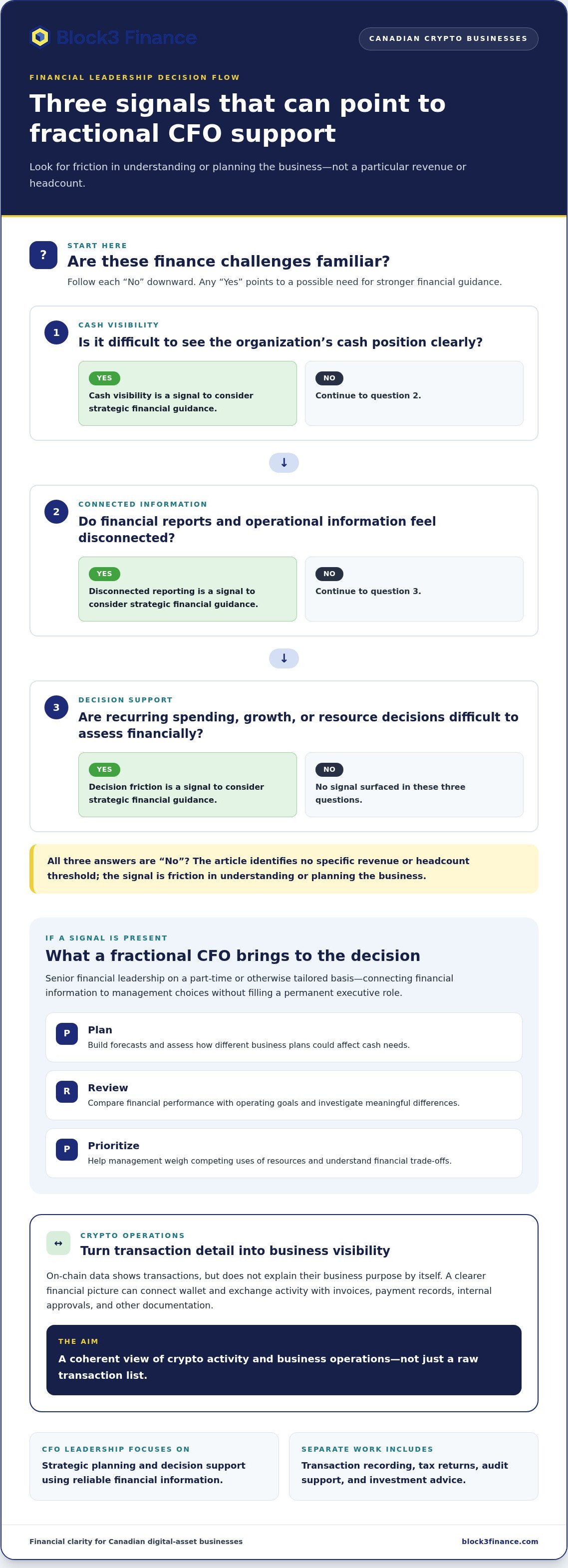
- Plan: Build forecasts and assess how different business plans could affect cash needs.
- Review: Compare financial performance with operating goals and investigate meaningful differences.
- Prioritize: Help management weigh competing uses of resources and understand the financial trade-offs.
The value is not just a report. It is a clearer basis for decisions about hiring, product development, and other operating plans.
Which Canadian crypto businesses may benefit?
Startups, established digital-asset businesses, and DAOs operating in Canada may benefit when their financial complexity outpaces their decision-making tools. The signal is not a specific revenue or headcount. It is friction in understanding or planning the business.
- Is it difficult to see the organization’s cash position clearly?
- Do financial reports and operational information feel disconnected?
- Are recurring decisions about spending, growth, or resources difficult to assess financially?
If these questions sound familiar, strategic guidance may help before a full-time CFO role makes sense. A fractional arrangement provides senior financial perspective tailored to current needs, while accounting and recordkeeping continue to support the underlying information.
How a fractional CFO applies financial strategy to crypto operations
Crypto financial strategy starts with records leaders can rely on. A CFO helps turn activity across wallets and exchanges into organized business information, then uses that view to analyze performance, plan for upcoming needs, and inform management decisions. In crypto operations, a fractional CFO connects transaction detail with business direction.
From blockchain activity to useful financial visibility
On-chain data shows transactions, but does not explain their business purpose by itself. Finance teams may need to connect wallet and exchange activity with invoices, payment records, internal approvals, and other documentation to understand how each movement relates to the organization’s operations.
This work can include identifying transfers between company-controlled wallets, tracing assets exchanged through platforms, and linking crypto-to-fiat payments to business activity. The aim is a coherent financial picture, not just a raw transaction list. Consistent digital-asset bookkeeping provides organized records that support CFO analysis.
Hypothetical example: A Canadian software company receives a customer payment in crypto and later converts some of it to fiat to pay an operating expense. The finance team would connect the payment, wallet movement, conversion record, and expense documentation so management can understand the cash flow. This example describes recordkeeping and planning, not a guaranteed result or a statement about tax treatment.
Planning cash flow, treasury, and business priorities
With a reconciled view of activity, a CFO can help leaders assess liquidity, meaning the resources available to meet upcoming obligations. They can compare expected receipts with operating costs, consider possible changes in business activity, and frame decisions about timing and priorities. Treasury means managing the organization’s financial resources, not recommending which tokens to buy or hold.
- Cash flow: Map anticipated inflows and expenses against payment timing.
- Scenarios: Compare how different operating assumptions could affect available funds.
- Priorities: Assess whether planned hiring, expansion, or product work fits the company’s financial capacity.
Hypothetical example: If a Canadian crypto business is considering adding a team member while planning a product expansion, a forecast could help management compare expected costs and timing under different plans. It supports a more informed discussion, but does not guarantee that either option will succeed.
Crypto-to-fiat payment workflows also need operational attention. Leaders can review how payments are received, documented, converted, and made available for business obligations without turning that review into investment advice. For financial guidance tailored to digital-asset operations, explore Block3 Finance’s CFO support.
Fractional CFO vs. accountant: who handles what?
These roles work together, but solve different problems. Bookkeeping maintains transaction records; accounting organizes and interprets financial information; tax filing reports relevant information to tax authorities; and audit support helps prepare and substantiate records. CFO leadership uses financial information to guide planning and management decisions.
A fractional CFO helps leaders decide what the numbers mean for the business, rather than replacing the people who record, report, or examine those numbers.
| Role | Primary purpose | Typical work | Decisions supported |
|---|---|---|---|
| Bookkeeping | Maintain transaction records | Record income, expenses, transfers, and supporting details | What activity has been recorded, and what needs follow-up? |
| Accounting | Organize and interpret financial information | Prepare financial reports and help maintain consistent records | What do the reports show about the business? |
| Tax filing | Meet applicable tax reporting responsibilities | Prepare and submit returns using relevant records | What information is needed for Canadian tax reporting? |
| Audit support | Help make financial records reviewable | Organize documents and support reported amounts | Can the business explain and substantiate its records? |
| CFO leadership | Connect financial information with business strategy | Guide forecasts, performance reviews, cash planning, and priorities | How should management plan and allocate resources? |
CFO strategy versus accounting and bookkeeping
For a Canadian crypto business, bookkeeping may capture wallet movements and exchange activity alongside ordinary business transactions. Accounting organizes that information into usable reports, while crypto accounting services support accurate, coherent financial records. A CFO then uses those records to assess performance, compare plans, and help management weigh financial trade-offs.
The roles can coordinate. A CFO may identify a reporting gap for the accounting team to address, but strategic oversight does not automatically include transaction recording or replace accounting work.
How CFO guidance complements tax and audit work
Tax professionals handle filing and reporting for the applicable jurisdiction. For a Canadian business, they use records to prepare Canadian tax reporting; CFO guidance helps management understand how financial plans and operating decisions relate to the company’s broader financial picture.
Audit support helps organize and substantiate financial records for review. These responsibilities can inform one another, but remain distinct: CFO leadership supports business decisions, tax specialists address filing, and audit work focuses on examining or substantiating records. CFO support does not replace accounting or tax specialists, and it is not investment advice.
When should a Canadian crypto business consider fractional CFO support?
There is no universal revenue or headcount threshold for strategic finance support. A better test is whether leadership can understand the business’s financial position, explain performance, and assess the financial effects of upcoming decisions.
The question of what a fractional CFO does becomes especially relevant when those tasks are difficult to manage with basic reporting alone. Use these readiness questions to pinpoint where added financial leadership could help:
- Can decision-makers see the business’s cash position and upcoming obligations clearly?
- Do financial reports connect smoothly with operational activity, or do leaders spend time reconciling separate records?
- Can the team explain what is driving financial performance and what has changed?
- Are hiring, expansion, or other plans being revised without a reliable way to compare scenarios?
- Do multiple wallets, exchanges, protocols, entities, or payment flows make it harder to form a complete business view?
A “no” or “not sure” is not proof of a crisis. It may signal that the organization’s financial needs have outgrown its current reporting process, even if it is not ready to hire a full-time CFO.
Signals that finance needs have outgrown basic reporting
Look for recurring friction, not a single imperfect report. If leaders cannot forecast cash needs, explain differences between expected and actual performance, or connect financial information to business activity, they may lack the analysis needed for confident planning.
Crypto records can add complexity when activity is spread across wallets, protocols, or entities and does not readily align with the organization’s other records. That fragmentation can make visibility harder, but does not automatically mean the business has a financial problem. It is a signal to understand how the records fit together.
What to prepare before engaging a fractional CFO
Preparation does not need to be perfect. Gather the information already available so an initial discussion can focus on decisions and gaps rather than reconstructing the business from memory.
- Financial records: Recent financial statements, bookkeeping records, and any existing forecasts.
- Operating context: A high-level summary of relevant wallets, exchanges, entities, and crypto-to-fiat payment flows.
- Business priorities: The plans leadership is considering and the financial questions those plans raise.
- Key decisions: A short list of choices the team expects to make in the coming period, such as hiring, expansion, or spending priorities.
Bring the questions that are hardest to answer. A focused conversation can clarify how CFO guidance can address your Canadian organization’s needs. Discuss your CFO support needs with Block3 Finance.
How Block3 Finance supports Canadian crypto businesses with CFO services
For Canadian digital-asset organizations, a fractional CFO turns complex financial information into guidance for operational priorities and planning. Block3 Finance provides CFO services to crypto startups, established businesses, DAOs, and Web3 projects, helping leadership connect financial records with business decisions.
On-chain activity can be difficult to interpret when it sits apart from other business records. Block3 Finance specializes in turning complex on-chain activity into clean, defensible financial records, providing a stronger foundation for management reporting and informed decisions. CFO guidance helps leaders assess financial priorities and plan with a clearer view of the business.
A finance approach built for digital assets
Block3 Finance provides fractional CFO services focused on strategic financial leadership for digital-asset operations. CFO support can be coordinated with the firm’s bookkeeping, audit, tax reporting, and corporate structuring work.
Each function contributes a different perspective. Bookkeeping maintains transaction records, tax reporting addresses filing needs, and audit support helps organize and substantiate financial information. CFO guidance uses that foundation to help management evaluate plans and business priorities. Together, these services support reporting that is useful for decisions and grounded in organized records.
Corporate structuring can also form part of the wider financial conversation for a digital-asset organization. The relevant considerations depend on the business and its operations. The goal is to connect financial leadership with the organization’s broader structure and plans, rather than treat each finance task in isolation.
Start with the decisions your business needs to make
A useful discussion starts with your organization’s current questions, not a preset package. Consider which reports are difficult to interpret, where financial visibility breaks down, what planning decisions are approaching, and how wallets, platforms, entities, or payment flows shape the finance function.
Sharing those priorities gives the conversation a practical starting point. Block3 Finance provides CFO guidance alongside existing financial work, with support tailored to the organization’s needs.
If your Canadian crypto business is ready for more clarity in financial planning, discuss your organization’s priorities with Block3 Finance.
Turn better financial visibility into confident decisions
For Canadian crypto businesses, a fractional CFO brings financial information into the decisions that shape the organization, from planning cash needs to assessing business priorities. This strategic guidance works alongside bookkeeping, accounting, tax reporting, and audit support rather than replacing those functions.
The starting point is having records that reflect both on-chain activity and the wider business. With that foundation, leaders can better understand their financial position, identify reporting gaps, and approach upcoming choices with a clearer view of the trade-offs.
Block3 Finance supports digital-asset organizations with CFO services, bookkeeping, audits, tax reporting, and corporate structuring. If your current reports are not answering the questions your team needs to make decisions, start a conversation about your priorities and where tailored financial guidance can help.
Discuss your crypto business’s finance needs with Block3 Finance to take the next step toward clearer financial planning.
Frequently Asked Questions
What does a fractional CFO do for a crypto business in Canada?
A fractional CFO provides tailored senior financial leadership to help a Canadian crypto business use financial information for planning and management decisions. They may guide forecasting, cash-flow visibility, performance reviews, and financial priorities, while helping leaders connect on-chain activity with broader business records. The role’s scope reflects the organization’s needs. It does not automatically replace bookkeeping, tax filing, or other specialist work.
How is a fractional CFO different from an accountant?
An accountant organizes financial information and supports accurate records and reporting; a fractional CFO uses financial information to guide business planning and decisions. For example, accounting may clarify recorded expenses, while CFO guidance can help management assess how planned spending fits its priorities. The roles can coordinate, but serve different purposes. A Canadian crypto company may need both reliable accounting and forward-looking financial leadership.
Can a fractional CFO help a Canadian crypto startup manage cash flow?
Yes. A fractional CFO can help a Canadian crypto startup understand expected cash inflows, operating costs, and upcoming obligations, then use forecasts to assess possible plans. For example, the team could compare the financial implications of hiring now with delaying a planned expense. Forecasts support better-informed decisions, but depend on available information and do not guarantee a particular outcome.
Does a fractional CFO handle crypto bookkeeping and tax filing?
Not automatically. CFO leadership focuses on financial strategy and decision support, while bookkeeping maintains transaction records and tax filing prepares and submits required reporting. These functions can coordinate, especially when crypto activity needs to be reflected in organized business records. Block3 Finance provides CFO services alongside monthly accounting, bookkeeping, and tax filing and reporting, bringing related financial work together for a clearer overall picture.
When should a Canadian crypto company hire a fractional CFO?
Consider fractional CFO support when leaders struggle to understand the company’s cash position, connect financial reports with operations, or assess recurring plans with useful forecasts. Multiple wallets, exchanges, entities, or payment flows can also make financial visibility more demanding. There is no single revenue or headcount threshold: a Canadian company may need strategic guidance before it is ready to create a full-time CFO role.
Can a fractional CFO work with a DAO or Web3 company?
Yes. A fractional CFO can support a Canadian DAO or Web3 company by helping leadership interpret financial information, plan around business priorities, and improve visibility into digital-asset operations. The scope should reflect the organization’s structure, records, and decisions rather than assume every DAO or Web3 project works the same way. Block3 Finance serves crypto startups, businesses, DAOs, and Web3 projects with digital-asset finance capabilities.
Does a fractional CFO provide investment or trading advice?
No. CFO support focuses on an organization’s financial planning, reporting, cash-flow visibility, and business decisions. It can help leaders understand financial resources and evaluate operating scenarios, but does not mean recommending tokens, trades, or investment strategies. For a Canadian crypto business, strategic finance guidance supports how the organization manages its business finances, not which assets it should buy or sell.

Article by
Mahad Mohamed
Mahad Mohamed is an accountant and the CEO of Block3 Finance, with over 26+ years of Canadian and international tax and accounting experience. A crypto accounting specialist since the early days of Bitcoin, he has consulted for over 38 crypto companies and collaborated with legal professionals on regulatory matters. His expertise spans corporate reorganization, cross-border tax structuring (Canada & US), tax disputes, and CRA audits.
Previously, Mahad worked for the Canada Revenue Agency (CRA), Big4 accounting firms, and served as a Rulings Officer for the Federal Tax Authority of the UAE before acquiring Tax Partners in 2014.
Block3 Finance and Tax Partners has 44 full-time accountants and over 9,800+ clients.
Disclaimer
This article provides general information only and is current as of its publication date. It has not been updated and may be out of date. It does not constitute legal advice and should not be relied upon as such. Every tax situation is unique and may differ from the examples discussed in this article. If you have specific questions, you should seek the advice of our accountants for your unique circumstances.
Frequently Asked Questions
Which Canadian crypto businesses may benefit?
Startups, established digital-asset businesses, and DAOs operating in Canada may benefit when their financial complexity outpaces their decision-making tools. The signal is not a specific revenue or headcount. It is friction in understanding or planning the business. If these questions sound familiar, strategic guidance may help before a full-time CFO role makes sense. A fractional arrangement provides senior financial perspective tailored to current needs, while accounting and recordkeeping continue to support the underlying information. Crypto financial strategy starts with records leaders can rely on. A CFO helps turn activity across wallets and exchanges into organized business information, then uses that view to analyze performance, plan for upcoming needs, and inform management decisions. In crypto operations, a fractional CFO connects transaction detail with business direction.
What does a fractional CFO do for a crypto business in Canada?
A fractional CFO provides tailored senior financial leadership to help a Canadian crypto business use financial information for planning and management decisions. They may guide forecasting, cash-flow visibility, performance reviews, and financial priorities, while helping leaders connect on-chain activity with broader business records. The role’s scope reflects the organization’s needs. It does not automatically replace bookkeeping, tax filing, or other specialist work.
How is a fractional CFO different from an accountant?
An accountant organizes financial information and supports accurate records and reporting; a fractional CFO uses financial information to guide business planning and decisions. For example, accounting may clarify recorded expenses, while CFO guidance can help management assess how planned spending fits its priorities. The roles can coordinate, but serve different purposes. A Canadian crypto company may need both reliable accounting and forward-looking financial leadership.
Can a fractional CFO help a Canadian crypto startup manage cash flow?
Yes. A fractional CFO can help a Canadian crypto startup understand expected cash inflows, operating costs, and upcoming obligations, then use forecasts to assess possible plans. For example, the team could compare the financial implications of hiring now with delaying a planned expense. Forecasts support better-informed decisions, but depend on available information and do not guarantee a particular outcome.
Does a fractional CFO handle crypto bookkeeping and tax filing?
Not automatically. CFO leadership focuses on financial strategy and decision support, while bookkeeping maintains transaction records and tax filing prepares and submits required reporting. These functions can coordinate, especially when crypto activity needs to be reflected in organized business records. Block3 Finance provides CFO services alongside monthly accounting, bookkeeping, and tax filing and reporting, bringing related financial work together for a clearer overall picture.
When should a Canadian crypto company hire a fractional CFO?
Consider fractional CFO support when leaders struggle to understand the company’s cash position, connect financial reports with operations, or assess recurring plans with useful forecasts. Multiple wallets, exchanges, entities, or payment flows can also make financial visibility more demanding. There is no single revenue or headcount threshold: a Canadian company may need strategic guidance before it is ready to create a full-time CFO role.
Can a fractional CFO work with a DAO or Web3 company?
Yes. A fractional CFO can support a Canadian DAO or Web3 company by helping leadership interpret financial information, plan around business priorities, and improve visibility into digital-asset operations. The scope should reflect the organization’s structure, records, and decisions rather than assume every DAO or Web3 project works the same way. Block3 Finance serves crypto startups, businesses, DAOs, and Web3 projects with digital-asset finance capabilities.
Does a fractional CFO provide investment or trading advice?
No. CFO support focuses on an organization’s financial planning, reporting, cash-flow visibility, and business decisions. It can help leaders understand financial resources and evaluate operating scenarios, but does not mean recommending tokens, trades, or investment strategies. For a Canadian crypto business, strategic finance guidance supports how the organization manages its business finances, not which assets it should buy or sell.