
Crypto payroll is payroll first and a digital-asset transaction second. If you’re assessing how to pay employees in crypto, the main challenge is not simply transferring tokens. It’s fitting that payment into U.S. payroll processes while keeping wage calculations, tax reporting, and accounting records aligned.
Under IRS rules, compensation paid in cryptocurrency is still wages. Employers use its fair market value in U.S. dollars when calculating and reporting payroll taxes, and state wage-payment requirements can also affect how a payment plan works.
This guide covers U.S.-specific issues to assess before launch, including employee payment choices, wage compliance, valuation, withholding, and recordkeeping. It also explains how to build a documented workflow that connects each crypto payment to payroll and accounting records.
Key Takeaways
- Learn how to pay employees in crypto by treating payroll policy, wage requirements, payment execution, and accounting as connected steps.
- Compare fiat, partial-crypto, and full-crypto compensation based on employee choice, volatility exposure, processing needs, and recordkeeping.
- Separate U.S. federal payroll questions from state wage-payment requirements, and verify both for the relevant locations and payment arrangement.
- Build a documented workflow that links payroll calculations and payment records to reconciliation and accounting close.
- Specialist tax and accounting support can help organize digital-asset records, reporting, and reliable books.
What Does Paying U.S. Employees in Crypto Actually Mean?
Crypto payroll means delivering some or all of an employee’s compensation in digital assets instead of paying the entire amount in U.S. dollars. This guide focuses on U.S. employers and the U.S. payroll considerations they need to assess; rules elsewhere are outside its scope.
The payment method changes, but payroll responsibilities remain. Under U.S. federal tax rules, cryptocurrency paid as employee compensation is treated as wages and must be handled through payroll processes. That means planning for wage calculations, tax withholding, reporting, and records alongside the transfer itself. Applicable state wage-payment rules are a separate consideration for each workforce location.
What counts as crypto compensation for a U.S. employee?
Wages denominated in dollars specify the employee’s compensation in U.S. currency, even if the employer later converts some of it to crypto for delivery. A digital asset is a digital representation of value that can be transferred electronically; cryptocurrency is one type. What is cryptocurrency? offers background on how it can function as a digital payment system. Different tokens can have different features, so don’t assume each has identical tax treatment.
Employers can assess two distinct arrangements:
- Partial crypto payment: A portion of compensation is delivered in a digital asset, while the remaining amount is paid in dollars.
- Full crypto payment: The employer delivers the full compensation amount in digital assets, subject to applicable payroll and wage rules.
In either arrangement, document both the compensation amount and the asset delivered. For example, a policy might set wages in dollars and specify that an agreed portion will be converted into a selected digital asset for payment. This differs from setting wages as a fixed number of tokens, where the dollar value may change between payroll periods.
Why employers consider crypto payroll, and what it changes
Some employees may value receiving digital assets, and employers with distributed or cross-border teams may consider crypto as another way to deliver funds. These are potential motivations, not guaranteed savings or faster payments. Results depend on the asset, payment route, employee needs, and operational setup.
That flexibility adds work. Employers need a clear method for determining the U.S.-dollar wage value, handling payroll calculations, recording the asset transfer, and explaining timing and value changes to employees. A token’s market price can move, so its value to the employee may change after payment.
Crypto payroll is a compensation arrangement; a crypto payroll platform is a tool that may help process or record payments. A platform doesn’t define the employer’s policy or remove payroll responsibilities. For U.S. employers assessing how to pay employees in crypto, keeping that distinction clear is the first step toward a controlled workflow.
Which U.S. Payroll and Tax Questions Must Employers Resolve?
Before designing a payment process, separate two questions: which wage-payment rules apply where employees work, and how the compensation must be handled for U.S. federal tax purposes. The answers can depend on current law and the arrangement, so a crypto transfer method alone doesn’t establish that the arrangement is permitted.
This section is educational, not legal or tax advice. Verify current federal and state requirements for your circumstances, and seek qualified legal or tax advice where needed.
How should employers assess wage-payment requirements?
Start with federal wage rules, then review the requirements of each relevant state. Minimum-wage and overtime calculations, as well as rules that may govern payment methods, need to be assessed under the current law that applies to the employee and compensation plan.
Make the review specific to each workforce location. A policy for employees in one state may not address the requirements for a team working across several states. Older commentary, including legal articles published in 2022, can help identify questions to investigate, but shouldn’t be treated as current law without authoritative verification.
What tax and payroll records need careful treatment?
Under U.S. federal tax guidance, cryptocurrency paid as employee compensation is treated as wages. Employers must account for applicable income-tax withholding and employment taxes, including Social Security, Medicare, and federal unemployment taxes, and report wages through payroll reporting such as Form W-2. Confirm current IRS requirements for the relevant tax year rather than relying on assumptions about what a payment platform handles.
Fair market value means an asset’s value in U.S. dollars at a specified time. The IRS’s current valuation guidance matters because the value used for payroll calculations and reporting needs support in the employer’s records. Document the payment date, asset and amount transferred, valuation method and source, dollar value, and connection to payroll records.
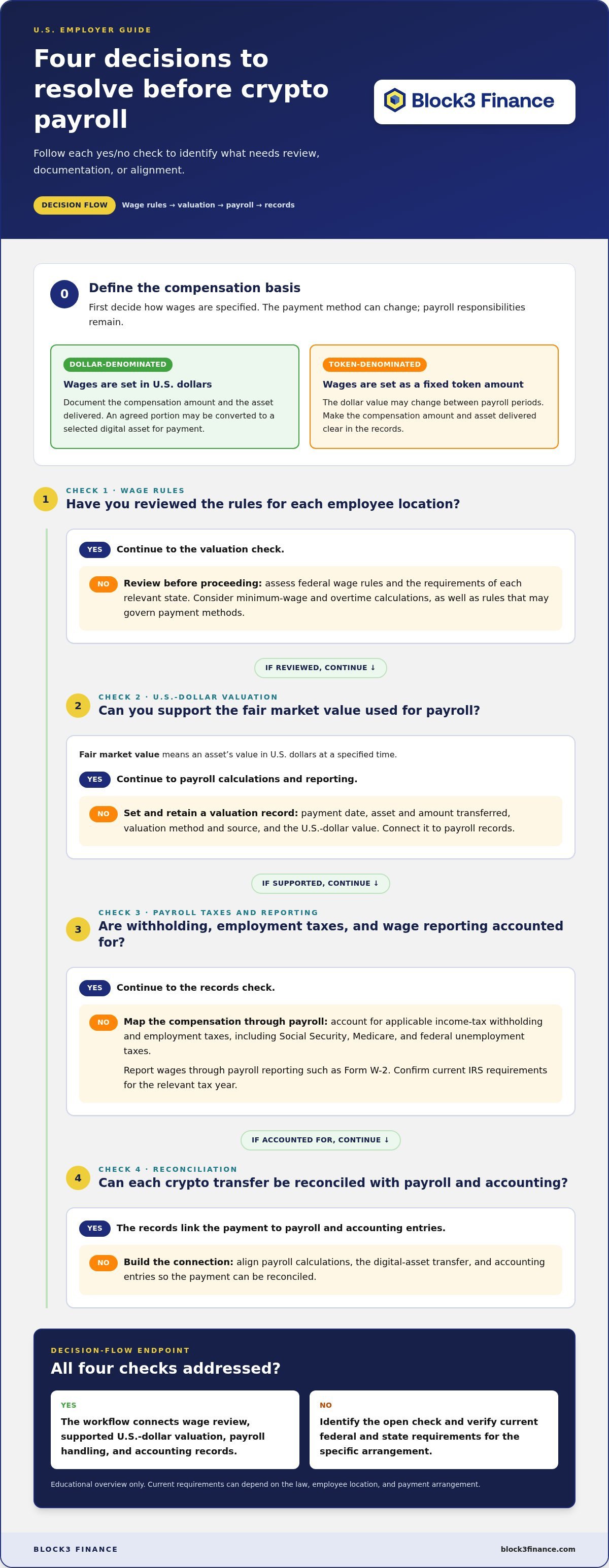
Build a repeatable review around these questions:
- Which federal and state wage rules apply to the employee and arrangement?
- How will the employer establish and retain the U.S.-dollar value of each wage payment?
- How will payroll withholding, employment-tax calculations, and wage reporting reflect the compensation?
- Can the company reconcile payroll records with the digital-asset transfer and its accounting entries?
Broader U.S. tax context can help finance teams understand how payroll records fit into a company’s overall digital-asset reporting. The U.S. cryptocurrency taxation guide provides background on that wider reporting landscape.
Reduce uncertainty by aligning wage-rule review, IRS tax analysis, and accounting records before implementation. Discuss crypto accounting and tax support when you need help organizing the reporting and records behind the process.
Crypto Payroll vs. Fiat Payroll: Which Approach Fits Your Team?
The right model depends on employee preferences and your company’s ability to run a clear, repeatable payment process. Fiat payroll keeps compensation in U.S. dollars. Crypto arrangements add a digital-asset transfer that requires separate valuation and transaction records.
Compare the three approaches against the same operational questions before deciding:
| Approach | Employee choice | Volatility exposure | Processing steps | Recordkeeping |
|---|---|---|---|---|
| Fiat payroll | Employees receive pay in dollars. | No crypto-price exposure from wage delivery. | Use the company’s established dollar-payment process. | Maintain payroll and payment records. |
| Partial crypto compensation | Employees may receive an agreed portion in a digital asset, if the plan allows. | Limited to the portion delivered in crypto, though its value can change. | Calculate payroll, then coordinate dollar and crypto payments. | Reconcile payroll with the asset transfer and its recorded value. |
| Full crypto compensation | Compensation is delivered in digital assets under the chosen arrangement. | Employees may face broader exposure to price movements. | Coordinate the full payment amount, asset delivery, and payroll process. | Track the complete compensation amount and each related transfer. |
Don’t assume a crypto payment is automatically faster or cheaper. Settlement time and fees depend on the payment rail and provider, while payroll calculations, withholding, reporting, and reconciliation remain part of the employer’s process.
When might partial crypto compensation be more manageable?
Partial payment can let an employer test employee interest without changing every payment at once. First assess whether employees want the option, then define who can participate, how the crypto portion is calculated, and how the company will record it. A limited pilot can keep the operational scope focused, but it doesn’t reduce applicable wage or tax responsibilities.
One possible workflow is to calculate wages in dollars and convert an agreed portion into crypto for delivery. Other arrangements may work differently, so document the method and communicate it clearly before payments begin.
What trade-offs come with paying entirely in crypto?
With full crypto compensation, price movements between calculation, transfer, and receipt can affect the asset’s value to the employee. Consider whether workers can access and understand the chosen asset, and whether receiving all compensation this way fits their preferences. Clear instructions about payment timing and valuation can help prevent misunderstandings.
Payment convenience and payroll compliance are separate questions. A transfer that feels simple for the employee may still require careful employer-side administration, complete records, and ongoing review of applicable U.S. requirements.
Compare the models based on employee choice, volatility tolerance, processing capacity, and recordkeeping needs. Choose an arrangement your team can explain, operate, and reconcile consistently.
How to Build a U.S. Crypto Payroll Workflow
A reliable process connects wage rules, employee choices, payroll calculations, digital-asset transfers, and accounting records. For U.S. employers, verify current federal and applicable state requirements before launch, then assign clear ownership for each step.
Use this sequence to make the policy repeatable from one payroll cycle to the next:
- Review jurisdictions. Identify where participating employees work. Check current U.S. federal wage and tax rules, then review applicable state wage-payment requirements for each location. Get legal and tax advice on questions specific to your arrangement.
- Set the policy. Define who may participate, which payment options are available, how employees make or change an election, and who approves the policy and individual payments. Record elections and acknowledgements through established HR processes.
- Prepare payroll in dollars. Calculate compensation and applicable payroll deductions using your established payroll process. Confirm current IRS guidance relevant to valuing, withholding, and reporting employee compensation paid in digital assets.
- Determine the crypto amount. Apply the documented valuation method to the portion designated for digital-asset payment. Retain the valuation basis and source so another team member can understand how the transfer amount was calculated.
- Execute and verify payment. Follow the company’s approval controls before initiating the transfer. Record the asset, quantity, destination wallet or provider details, date, transaction identifier, and payment status. Investigate any difference between the intended and completed payment.
- Reconcile and close. Match payroll records to wallet or provider activity and the general ledger, the company’s primary accounting record. Document adjustments, unresolved differences, and the period-end review so each payment can be traced from payroll calculation through accounting close.
Set policy, employee expectations, and approval controls
Make the policy operational. State the available payment options, employee eligibility, approval roles, and process for changing an election. Use existing HR procedures to retain each employee’s choice and acknowledgement.
Explain how the company determines the crypto amount and when a transfer is considered complete. Employees should understand that digital-asset values can change and that transfer timing may differ from the payroll calculation point. Clear communication can reduce surprises, but it doesn’t change the employer’s payroll responsibilities.
Execute, document, and reconcile each payroll cycle
Use a consistent record set for every cycle: payroll calculation, valuation basis, transfer details, supporting transaction identifier, and evidence of review. Reconcile those records to wallet or provider activity and the general ledger. Investigate mismatches rather than carrying them forward without explanation.
Recurring reconciliation supports reliable books and tax reporting. Employers building this control into ongoing digital asset accounting can align payroll activity with wider financial records instead of treating each transfer as an isolated event.
A documented workflow gives the team a shared path from jurisdiction review to accounting close. Discuss crypto payroll accounting support to strengthen the records and reconciliation process behind your plan.
How Block3 Finance Supports Crypto Payroll Readiness
Crypto payroll readiness depends on more than sending a digital asset to an employee. Employers need a finance process that connects each transfer to payroll calculations, tax reporting, and reliable books. Block3 Finance supports this accounting and tax work, helping employers organize financial records and reporting as they develop their payroll process.
Connect payroll activity to defensible financial records
Each crypto wage transfer creates activity finance teams need to trace and reconcile. Payroll records should connect the compensation calculation and its valuation basis with the asset, quantity, transaction identifier, and corresponding accounting entry. Organized evidence makes activity easier to review and reporting more consistent.
Block3 Finance’s monthly accounting and tax filing and reporting services help bring digital-asset activity into company books and tax records. Its crypto tax reporting services can support the preparation and organization of relevant tax information, alongside the company’s payroll processes.
- Transaction organization: Bring wallet or provider activity together with payroll records.
- Bookkeeping alignment: Record crypto transfers consistently in the company’s financial records.
- Tax reporting preparation: Keep supporting information organized for relevant reporting work.
Plan next steps with specialist finance support
For a readiness discussion, gather the materials that show how the proposed process will work: the draft payroll policy, employee payment elections, wallet or provider records, transaction histories, and existing accounting procedures. These materials can help identify how information should flow between payroll, finance, and tax reporting, and where a documented control or reconciliation step may be needed.
Block3 Finance brings more than 13 years of blockchain financial expertise and has served more than 980 clients globally. The firm helps organize digital-asset activity, while employers remain responsible for confirming current U.S. federal and applicable state requirements with appropriate legal and tax professionals.
Specialist accounting support can connect your crypto payroll workflow to clean books and usable tax records. Discuss your crypto payroll accounting needs with Block3 Finance.
Make Your Next Move a Controlled One
For leaders deciding how to pay employees in crypto, readiness is an ongoing operating capability, not a one-time launch task. As your workforce, payment preferences, and digital-asset activity evolve, build a review point into finance planning so the process remains practical and the records stay usable.
Before expanding or changing payment options, assign an owner to review employee feedback, transaction exceptions, and the effort required to close each payroll period. Use that documented experience to decide whether to maintain or refine the arrangement, rather than relying on assumptions. Involve legal and tax specialists when policies or workforce locations change, and verify applicable U.S. requirements at that time.
The goal isn’t crypto adoption for its own sake. It’s a compensation approach your business can explain, administer, and support with confidence. To plan the accounting side of your next step, map out your crypto payroll accounting needs with Block3 Finance.
Frequently Asked Questions
Is it legal to pay employees in crypto in the United States?
There isn’t a universal yes-or-no answer; the result can depend on the payment structure and applicable U.S. federal and state requirements. Don’t infer that an arrangement is lawful because a platform advertises it or because a different state permits a particular approach. Before adopting a policy, have qualified U.S. legal counsel review the arrangement and verify current requirements with relevant authorities.
Can U.S. employees choose to receive part of their pay in cryptocurrency?
An employer may consider employee choice when designing a payment policy, but an employee’s election doesn’t settle wage-payment or payroll-tax questions under U.S. rules. Before offering the option, explain how the crypto portion is determined, how price changes may affect its value, and when the transfer is expected to occur. Keep each election in writing and check applicable federal and state requirements for the arrangement.
How are crypto wages valued for U.S. payroll and tax reporting?
Fair market value means the value an asset has in U.S. dollars at a particular time. Employers should check current IRS guidance to determine the appropriate valuation timing and method for their circumstances, rather than assuming a quote from any one exchange automatically applies. Record the payment date, valuation basis, and supporting transaction information consistently so payroll calculations and reporting can be traced to source records.
Does paying wages in crypto remove an employer’s payroll tax responsibilities?
No. Using a digital asset to deliver compensation isn’t a reason to skip U.S. payroll-tax analysis or required reporting. The precise obligations depend on current U.S. rules and the compensation arrangement, so employers should confirm applicable IRS requirements and state rules with qualified tax and legal advisers before processing payments. Include payroll review in the payment process from the start.
What records should a U.S. business keep for crypto payroll?
Keep records that let finance staff trace each payment from the payroll calculation to the accounting entry. A useful file may include employee elections, approvals, calculation details, the valuation basis, transfer records, transaction identifiers, and reconciliation support. If a transfer doesn’t match the intended payment, these records help document the difference and its resolution. Verify current federal and state recordkeeping requirements for your circumstances; don’t assume one retention period applies to every business.
Are stablecoins different from other cryptocurrencies for employee payroll?
A stablecoin is designed to track a reference value, but that design doesn’t make it identical to U.S. dollars or automatically resolve payroll, tax, or legal questions. Before using one, assess the specific asset, how the transfer will be executed, how records will be retained, and which current U.S. requirements apply. A stablecoin can still carry price, operational, and compliance risks, so explain those considerations clearly to employees.

Article by
Mahad Mohamed
Mahad Mohamed is an accountant and the CEO of Block3 Finance, with over 26+ years of Canadian and international tax and accounting experience. A crypto accounting specialist since the early days of Bitcoin, he has consulted for over 38 crypto companies and collaborated with legal professionals on regulatory matters. His expertise spans corporate reorganization, cross-border tax structuring (Canada & US), tax disputes, and CRA audits.
Previously, Mahad worked for the Canada Revenue Agency (CRA), Big4 accounting firms, and served as a Rulings Officer for the Federal Tax Authority of the UAE before acquiring Tax Partners in 2014.
Block3 Finance and Tax Partners has 44 full-time accountants and over 9,800+ clients.
Disclaimer
This article provides general information only and is current as of its publication date. It has not been updated and may be out of date. It does not constitute legal advice and should not be relied upon as such. Every tax situation is unique and may differ from the examples discussed in this article. If you have specific questions, you should seek the advice of our accountants for your unique circumstances.
Frequently Asked Questions
What counts as crypto compensation for a U.S. employee?
Wages denominated in dollars specify the employee’s compensation in U.S. currency, even if the employer later converts some of it to crypto for delivery. A digital asset is a digital representation of value that can be transferred electronically; cryptocurrency is one type. What is cryptocurrency? offers background on how it can function as a digital payment system. Different tokens can have different features, so don’t assume each has identical tax treatment. Employers can assess two distinct arrangements: In either arrangement, document both the compensation amount and the asset delivered. For example, a policy might set wages in dollars and specify that an agreed portion will be converted into a selected digital asset for payment. This differs from setting wages as a fixed number of tokens, where the dollar value may change between payroll periods.
How should employers assess wage-payment requirements?
Start with federal wage rules, then review the requirements of each relevant state. Minimum-wage and overtime calculations, as well as rules that may govern payment methods, need to be assessed under the current law that applies to the employee and compensation plan. Make the review specific to each workforce location. A policy for employees in one state may not address the requirements for a team working across several states. Older commentary, including legal articles published in 2022, can help identify questions to investigate, but shouldn’t be treated as current law without authoritative verification.
What tax and payroll records need careful treatment?
Under U.S. federal tax guidance, cryptocurrency paid as employee compensation is treated as wages. Employers must account for applicable income-tax withholding and employment taxes, including Social Security, Medicare, and federal unemployment taxes, and report wages through payroll reporting such as Form W-2. Confirm current IRS requirements for the relevant tax year rather than relying on assumptions about what a payment platform handles. Fair market value means an asset’s value in U.S. dollars at a specified time. The IRS’s current valuation guidance matters because the value used for payroll calculations and reporting needs support in the employer’s records. Document the payment date, asset and amount transferred, valuation method and source, dollar value, and connection to payroll records. Build a repeatable review around these questions: Broader U.S. tax context can help finance teams understand how payroll records fit into a company’s overall digital-asset reporting. The U.S. cryptocurrency taxation guide provides background on that wider reporting landscape. Reduce uncertainty by aligning wage-rule review, IRS tax analysis, and accounting records before implementation. Discuss crypto accounting and tax support when you need help organizing the reporting and records behind the process. The right model depends on employee preferences and your company’s ability to run a clear, repeatable payment process. Fiat payroll keeps compensation in U.S. dollars. Crypto arrangements add a digital-asset transfer that requires separate valuation and transaction records. Compare the three approaches against the same operational questions before deciding: Don’t assume a crypto payment is automatically faster or cheaper. Settlement time and fees depend on the payment rail and provider, while payroll calculations, withholding, reporting, and reconciliation remain part of the employer’s process.
When might partial crypto compensation be more manageable?
Partial payment can let an employer test employee interest without changing every payment at once. First assess whether employees want the option, then define who can participate, how the crypto portion is calculated, and how the company will record it. A limited pilot can keep the operational scope focused, but it doesn’t reduce applicable wage or tax responsibilities. One possible workflow is to calculate wages in dollars and convert an agreed portion into crypto for delivery. Other arrangements may work differently, so document the method and communicate it clearly before payments begin.
What trade-offs come with paying entirely in crypto?
With full crypto compensation, price movements between calculation, transfer, and receipt can affect the asset’s value to the employee. Consider whether workers can access and understand the chosen asset, and whether receiving all compensation this way fits their preferences. Clear instructions about payment timing and valuation can help prevent misunderstandings. Payment convenience and payroll compliance are separate questions. A transfer that feels simple for the employee may still require careful employer-side administration, complete records, and ongoing review of applicable U.S. requirements. Compare the models based on employee choice, volatility tolerance, processing capacity, and recordkeeping needs. Choose an arrangement your team can explain, operate, and reconcile consistently. A reliable process connects wage rules, employee choices, payroll calculations, digital-asset transfers, and accounting records. For U.S. employers, verify current federal and applicable state requirements before launch, then assign clear ownership for each step. Use this sequence to make the policy repeatable from one payroll cycle to the next:
Is it legal to pay employees in crypto in the United States?
There isn’t a universal yes-or-no answer; the result can depend on the payment structure and applicable U.S. federal and state requirements. Don’t infer that an arrangement is lawful because a platform advertises it or because a different state permits a particular approach. Before adopting a policy, have qualified U.S. legal counsel review the arrangement and verify current requirements with relevant authorities.
Can U.S. employees choose to receive part of their pay in cryptocurrency?
An employer may consider employee choice when designing a payment policy, but an employee’s election doesn’t settle wage-payment or payroll-tax questions under U.S. rules. Before offering the option, explain how the crypto portion is determined, how price changes may affect its value, and when the transfer is expected to occur. Keep each election in writing and check applicable federal and state requirements for the arrangement.
How are crypto wages valued for U.S. payroll and tax reporting?
Fair market value means the value an asset has in U.S. dollars at a particular time. Employers should check current IRS guidance to determine the appropriate valuation timing and method for their circumstances, rather than assuming a quote from any one exchange automatically applies. Record the payment date, valuation basis, and supporting transaction information consistently so payroll calculations and reporting can be traced to source records.
Does paying wages in crypto remove an employer’s payroll tax responsibilities?
No. Using a digital asset to deliver compensation isn’t a reason to skip U.S. payroll-tax analysis or required reporting. The precise obligations depend on current U.S. rules and the compensation arrangement, so employers should confirm applicable IRS requirements and state rules with qualified tax and legal advisers before processing payments. Include payroll review in the payment process from the start.
What records should a U.S. business keep for crypto payroll?
Keep records that let finance staff trace each payment from the payroll calculation to the accounting entry. A useful file may include employee elections, approvals, calculation details, the valuation basis, transfer records, transaction identifiers, and reconciliation support. If a transfer doesn’t match the intended payment, these records help document the difference and its resolution. Verify current federal and state recordkeeping requirements for your circumstances; don’t assume one retention period applies to every business.
Are stablecoins different from other cryptocurrencies for employee payroll?
A stablecoin is designed to track a reference value, but that design doesn’t make it identical to U.S. dollars or automatically resolve payroll, tax, or legal questions. Before using one, assess the specific asset, how the transfer will be executed, how records will be retained, and which current U.S. requirements apply. A stablecoin can still carry price, operational, and compliance risks, so explain those considerations clearly to employees.