
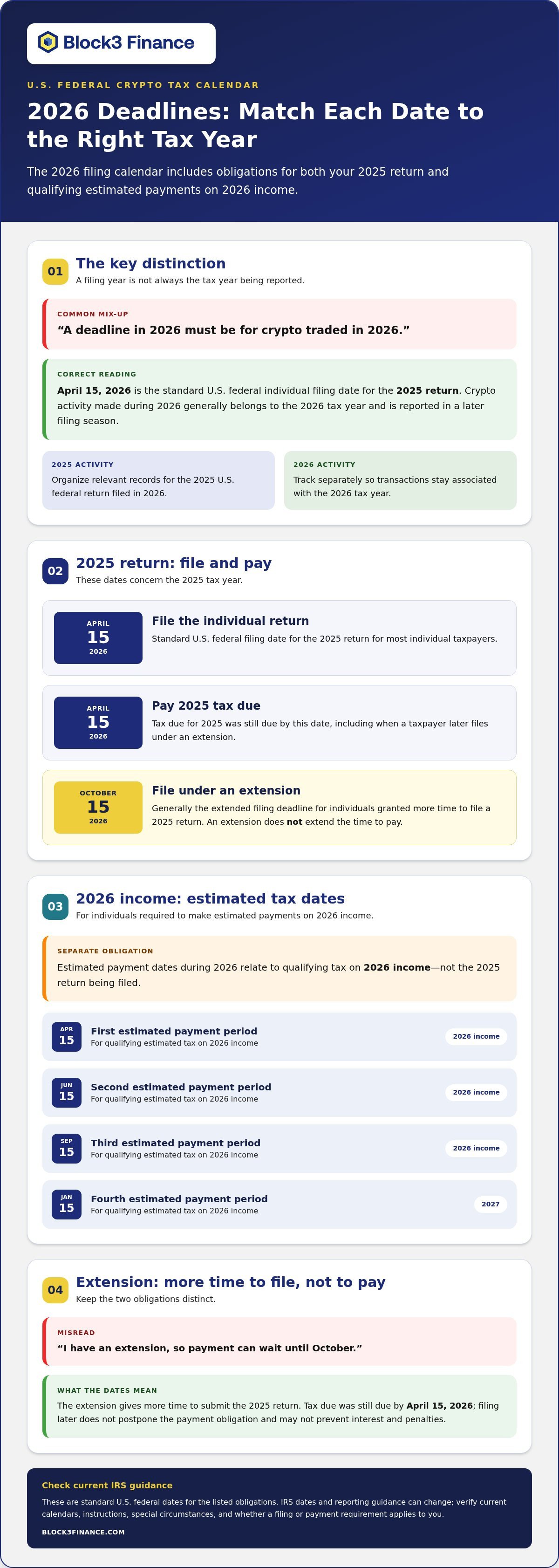
Does the crypto tax deadline 2026 apply to crypto you traded this year or to the return you’re filing now? The distinction matters: the regular U.S. federal deadline of April 15, 2026, applied to your 2025 tax return. October 15, 2026, is the extended filing deadline for taxpayers who requested more time.
An extension gives you more time to file, not more time to pay. Tax due for 2025 was still due by April 15, so filing later doesn’t postpone your payment obligation or necessarily prevent interest and penalties.
Estimated tax dates during 2026 relate to qualifying tax on 2026 income, not your 2025 return. That distinction can be easy to miss when your crypto activity spans exchanges, self-custody wallets, staking, NFTs, or DeFi.
This guide explains which U.S. federal filing, payment, extension, and estimated tax dates apply to each tax year, and what records to gather, including broker transaction details reported on Form 1099-DA. IRS dates and reporting guidance can change, so verify current details directly with the IRS. If your transaction history is fragmented, crypto-focused tax preparation and reporting can help organize your activity into a clearer filing picture.
Key Takeaways
- The crypto tax deadline 2026 concerns U.S. federal filing for 2025 income. Keep your 2026 crypto activity separate when planning estimated tax payments.
- Build a calendar that labels each IRS date by obligation and taxpayer category, including quarterly estimated tax dates.
- Before relying on an extension, verify current IRS instructions for eligibility and process. Keep filing and payment obligations distinct.
- Bring exchange statements, wallet histories, and relevant on-chain records together so your crypto activity can be reviewed as a complete record.
- Specialist tax filing and reporting can help individuals, businesses, DAOs, and Web3 projects organize complex crypto activity for U.S. compliance.
Which U.S. crypto tax year does the 2026 deadline cover?
The crypto tax deadline 2026 generally concerns filing a U.S. federal return for the 2025 tax year, not reporting all activity made during 2026. A tax year is the period whose income and transactions are reported on a tax return.
In short: A U.S. federal filing deadline in 2026 generally applies to 2025 activity. Crypto transactions made during 2026 generally belong on a return filed in a later filing season. Keeping the years separate helps you match each transaction, record, and payment to the right tax obligation.
The 2025 return filed during 2026
For most individual taxpayers, a U.S. federal return filed during 2026 reports relevant income and transactions from January through December 2025. The standard U.S. federal individual filing date for that return was April 15, 2026. Filing dates can change or vary in particular circumstances, so verify the date against the current IRS calendar and guidance.
The year you file is not necessarily the year the return reports. If you sold or exchanged digital assets in 2025, those transactions generally belong in your 2025 tax-year records, even if you gather documents or prepare the return in 2026.
Use this year map to organize your filing plan:
- 2025 activity: Organize relevant crypto records for the 2025 U.S. federal return filed in 2026.
- 2026 activity: Track transactions separately as they happen, so they remain associated with the 2026 tax year.
- Filing date: Treat April 15, 2026, as the standard U.S. federal individual filing date for the 2025 return, subject to current IRS guidance and any applicable circumstances.
A clear year boundary helps prevent two common recordkeeping problems: mixing activity from separate tax years and overlooking transactions that fall outside the period covered by the return. Block3 Finance provides organized U.S. crypto tax filing and reporting for individuals and organizations handling digital asset activity.
Crypto activity made during 2026
Transactions made during 2026 generally belong to the 2026 tax year. The annual U.S. federal return reporting that year’s activity is ordinarily filed in a later filing season, so don’t treat it as the same return as your 2025 filing.
For example, if you trade crypto in 2026 after preparing your 2025 return, record that activity under 2026 rather than adding it to the earlier year’s transaction history. Organize exchange statements, wallet records, and other relevant documentation by year. This makes later review clearer without requiring you to calculate tax as you collect each record.
No future filing date is stated here for the 2026 tax year. Confirm the applicable U.S. federal deadline with current IRS guidance when that filing calendar is available, and distinguish the deadline for submitting a return from any payment dates during the year.
What are the key U.S. crypto tax deadlines in 2026?
The relevant date depends on whether you’re filing a return, paying tax due, filing under an extension, or making estimated payments. These U.S. federal deadlines can relate to different tax years, so label each date by both obligation and year when planning.
A return deadline is the date to submit your tax return; a payment deadline is the date to pay tax owed. They may fall on the same day, but an extension to file doesn’t automatically extend the time to pay. The IRS’s guidance on virtual currencies provides federal context for digital asset tax obligations.
| U.S. federal obligation | Due date | Tax year and taxpayer category |
|---|---|---|
| File individual return | April 15, 2026 | 2025 return; generally individual taxpayers |
| Pay tax due with return | April 15, 2026 | 2025 tax; individuals with an amount due |
| File after an extension | October 15, 2026 | 2025 return; individuals granted an extension |
| Estimated tax payment, first period | April 15, 2026 | 2026 income; individuals required to make estimated payments |
| Estimated tax payment, second period | June 15, 2026 | 2026 income; individuals required to make estimated payments |
| Estimated tax payment, third period | September 15, 2026 | 2026 income; individuals required to make estimated payments |
| Estimated tax payment, fourth period | January 15, 2027 | 2026 income; individuals required to make estimated payments |
These are the standard U.S. federal dates for the obligations listed. Check current IRS calendars and instructions for official changes, special circumstances, and whether a particular payment or filing requirement applies to you.
Federal individual return and payment dates
For most individuals, April 15, 2026, was the U.S. federal deadline to file a 2025 return and pay any tax due. An eligible individual who obtained an extension generally had until October 15, 2026, to file, but the extension didn’t move the payment deadline.
Individual dates don’t necessarily apply to every taxpayer or situation. Confirm your filing category and applicable IRS instructions, especially if your return involves circumstances beyond a standard individual filing.
Estimated payments and other taxpayer schedules
Estimated tax payments are periodic payments toward tax on income earned during the current year. The dates in the table apply to individuals required to make estimated payments for 2026 income; they are not due dates for filing the 2025 annual return.
Business and entity schedules depend on the entity type and relevant IRS rules. Don’t assume an individual’s filing date applies to a business. If your crypto records include both personal and business activity, discussing your filing situation with Block3 Finance can help you plan an appropriate review.
Does a crypto tax extension give you more time to pay?
No. Under U.S. federal rules, a filing extension generally gives eligible taxpayers extra time to submit a return, not extra time to pay tax owed. Assuming an extension postpones both obligations could leave you past the payment deadline while you prepare to file later.
For a 2025 U.S. federal individual return, the standard filing and payment date was April 15, 2026. The extended filing date was October 15, 2026, for eligible individuals who requested an extension. Verify the dates, extension process, and your eligibility against current IRS guidance, since individual circumstances or official changes may affect them.
What a filing extension changes
An extension changes the time allowed to file the return, not the underlying payment due date. If you expect to owe, review your records and determine whether payment is due by the original U.S. federal payment deadline instead of waiting until the extended filing date to address the balance.
For the 2025 tax year, use this distinction as a planning guide:
- File: The standard U.S. federal individual deadline was April 15, 2026. An eligible taxpayer who obtained an extension generally had until October 15, 2026, to file. Verify the dates and process with the IRS.
- Pay: Any amount owed for 2025 was generally due by April 15, 2026, even if the taxpayer had more time to file. Confirm payment requirements with the IRS for your circumstances.
An extension doesn’t remove the obligation to report crypto activity accurately. It also doesn’t guarantee that no penalties or interest will apply if payment is late or incomplete. The result depends on the taxpayer’s situation and current IRS rules, so don’t treat an extension as a pause on every tax responsibility.
This explanation covers U.S. federal rules only. State filing and payment requirements are separate, and a federal extension shouldn’t be assumed to change a state deadline. Check the relevant state tax authority’s instructions as well.
When filing circumstances differ
Some circumstances can affect filing dates. For example, the IRS may announce disaster-related tax relief for eligible taxpayers in specified areas, with deadlines and eligibility described in official notices.
Don’t apply a special deadline based on a headline, a past relief announcement, or another taxpayer’s situation. Review current IRS notices to confirm whether relief applies to your location, tax obligation, and filing circumstances, and follow the stated instructions.
For a practical filing plan, enter the return deadline and payment deadline separately on your calendar. If your crypto records are still being organized, use any additional filing time to complete that work while checking payment obligations independently. Extra time to file is not a reason to leave payment questions unresolved.
How should you prepare crypto records before the 2026 filing deadline?
Start with records, not tax calculations. A clear file for the relevant U.S. tax year helps you spot missing activity, compare broker documents with your own history, and prepare for a more complete return review.
Collect and reconcile transaction records
Gather records for the tax year covered by the return, including exchange statements and exports, wallet histories, and relevant on-chain records. Then check for gaps and transfers between accounts before moving on to return preparation.
- Set the tax-year scope. Keep records for the year being reported separate from activity in other years, so transactions don’t end up in the wrong filing file.
- Collect exchange records. Download available statements and transaction histories from each exchange you used. Keep the source files together and note accounts with missing or inaccessible records.
- Gather wallet and on-chain histories. Collect wallet activity and relevant blockchain transaction records for the same year. If a transfer appears in one record but not another, note it for follow-up rather than automatically treating it as a new transaction.
- Reconcile the sources. Compare exchange, wallet, and on-chain records to identify gaps, duplicate entries, transfers, or mismatched details. Keep a brief note about any unresolved items.
- Review the completed return. Before filing, check that the return reflects the assembled records and that questions or discrepancies have been addressed or clearly flagged for review.
This order keeps the work manageable: collect first, reconcile second, and review the completed return before filing. The crypto tax filing guide explains how record preparation fits into the filing and reporting process.
Review information returns and prepare for filing
For the 2025 U.S. tax year, brokers may issue Form 1099-DA, a tax document reporting digital asset proceeds from broker transactions. Compare the form with your complete personal records. A reported proceeds figure alone doesn’t establish taxable gain or loss because it may not include the asset’s cost basis, generally the amount used to establish what you paid for it.
For 2025 tax-year forms issued in 2026, brokers report gross proceeds but aren’t required to report cost basis. Your transaction history is therefore important for identifying missing context. Verify current IRS instructions and how they apply to your filing situation.
For a plain-language overview of the IRS treatment of cryptocurrency, use this U.S.-focused resource alongside current IRS guidance. If fragmented exchange, wallet, or on-chain records make preparing your return difficult, get support organizing your crypto tax records with Block3 Finance’s filing and reporting team.
How can Block3 Finance help with U.S. crypto tax filing?
Knowing the crypto tax deadline 2026 is one part of a disciplined filing plan. Your return records may span exchanges, self-custody wallets, and on-chain activity, so specialist tax filing and reporting can help bring those sources into a structured review.
Block3 Finance provides U.S. crypto tax filing and reporting for individuals, businesses, DAOs, and Web3 projects. Its work covers complex digital asset activity such as staking, mining, NFTs, and DeFi, where transaction histories may need to be organized across multiple sources before a return is prepared.
Support for complex digital asset records
Crypto-focused bookkeeping helps create consistent records for tax reporting. Instead of treating each exchange export or wallet history in isolation, the process organizes activity into a clearer record set and identifies items that may need further review.
Block3 Finance’s crypto accounting services support ongoing record organization, while audit and compliance services can help when documentation needs additional review. This work establishes a clearer basis for filing decisions without promising a particular tax result or outcome.
This is particularly useful for activity such as DeFi interactions or staking, where records may be spread across platforms and blockchain transactions. A specialist review can help surface missing details or inconsistencies for follow-up before filing work is finalized.
If you’re ready to discuss how specialist support could fit your U.S. filing needs, discuss your crypto tax filing needs with Block3 Finance.
Plan a clear next step before filing
Start by assembling documents that explain your crypto activity and prior filing history. This gives the review a practical starting point and helps identify which records are available and where follow-up may be needed.
- Transaction exports and statements from each exchange used during the relevant tax year.
- Wallet histories and relevant on-chain records for activity not fully reflected in exchange documents.
- Prior tax returns and any IRS notices related to your filing history.
- A short list of missing records, unexplained transfers, or questions you want addressed.
Block3 Finance brings more than 13 years of blockchain financial expertise to crypto tax and accounting work. That experience informs a structured approach to complex digital asset records and connects the work of organizing activity with U.S. filing and reporting needs.
Prepare your records and note the issues that need attention before your review. Contact Block3 Finance about U.S. crypto tax filing.
Turn your filing plan into a stronger recordkeeping system
The crypto tax deadline 2026 is also a prompt to build a more dependable process for the next reporting cycle. Keep transaction records organized as activity happens, and separate personal, business, and project documentation so future reviews start with a clearer foundation.
For U.S. crypto tax work, specialist support can bring exchange, wallet, and on-chain activity into a structured filing and reporting process. Block3 Finance serves more than 980 clients globally, supporting individuals and organizations as they manage complex digital asset records.
Your next step can be practical: gather the records you have, note any gaps or questions, and decide what level of review fits your filing situation. A focused conversation can help you move from scattered transaction histories toward a more organized U.S. tax filing process.
Plan your next crypto tax filing step with Block3 Finance. With a clear process and the right records in view, you can approach upcoming filing obligations with greater confidence.
Frequently Asked Questions
Is the 2026 crypto tax deadline for 2025 transactions?
Yes. The crypto tax deadline 2026 generally applies to a U.S. federal return reporting relevant activity from the 2025 tax year. For example, a digital asset sale made during 2025 belongs in the records for that year’s return, even if you received a broker document or gathered supporting information in 2026. Keep documents organized by tax year to avoid mixing activity from separate periods.
Can I report crypto transactions from 2026 on my 2025 tax return?
Generally, no. A transaction made during 2026 belongs to the 2026 tax year, not the 2025 year reported on a return filed in 2026. For example, keep a 2026 exchange trade in your 2026 records even if you’re still finalizing the earlier year’s return. If a record has the wrong date or appears in an unexpected tax document, review the underlying transaction details and seek qualified tax guidance.
Will Form 1099-DA change the 2026 crypto tax deadline?
No. Form 1099-DA, a broker tax document for digital asset proceeds, affects transaction reporting, not the filing calendar. For 2025 tax-year forms issued in 2026, brokers report gross proceeds but aren’t required to report cost basis, the amount generally used to establish what you paid for an asset. Compare the form with your own records and check current IRS instructions for how to report differences.
Do crypto tax deadlines differ for U.S. businesses?
They can. A U.S. business’s filing schedule depends on its entity type and applicable IRS requirements, so don’t automatically apply an individual taxpayer’s date to a business return. For example, a company and its owner may have separate filing responsibilities. Identify the legal entity involved, review the current IRS calendar and instructions that apply, and keep business crypto activity distinct from an owner’s personal transactions.
Do I need to report crypto if I only bought and held it?
Under IRS guidance, buying cryptocurrency with U.S. dollars and holding it without selling, exchanging, or otherwise disposing of it generally isn’t a taxable event by itself. That doesn’t determine whether you must file a U.S. federal return for other income or circumstances. Keep purchase confirmations and account records to document when and how you acquired the asset if you later dispose of it.
Are U.S. state crypto tax deadlines the same as the federal deadline?
Not necessarily. A U.S. state may set its own return due dates, payment rules, and extension procedures, so don’t assume a federal deadline or extension automatically applies to your state filing. Check the current instructions from the tax authority for each state where you have a filing obligation. If you have questions about more than one state, review each state’s requirements separately.

Article by
Mahad Mohamed
Mahad Mohamed is an accountant and the CEO of Block3 Finance, with over 26+ years of Canadian and international tax and accounting experience. A crypto accounting specialist since the early days of Bitcoin, he has consulted for over 38 crypto companies and collaborated with legal professionals on regulatory matters. His expertise spans corporate reorganization, cross-border tax structuring (Canada & US), tax disputes, and CRA audits.
Previously, Mahad worked for the Canada Revenue Agency (CRA), Big4 accounting firms, and served as a Rulings Officer for the Federal Tax Authority of the UAE before acquiring Tax Partners in 2014.
Block3 Finance and Tax Partners has 44 full-time accountants and over 9,800+ clients.
Disclaimer
This article provides general information only and is current as of its publication date. It has not been updated and may be out of date. It does not constitute legal advice and should not be relied upon as such. Every tax situation is unique and may differ from the examples discussed in this article. If you have specific questions, you should seek the advice of our accountants for your unique circumstances.
Frequently Asked Questions
Is the 2026 crypto tax deadline for 2025 transactions?
Yes. The crypto tax deadline 2026 generally applies to a U.S. federal return reporting relevant activity from the 2025 tax year. For example, a digital asset sale made during 2025 belongs in the records for that year’s return, even if you received a broker document or gathered supporting information in 2026. Keep documents organized by tax year to avoid mixing activity from separate periods.
Can I report crypto transactions from 2026 on my 2025 tax return?
Generally, no. A transaction made during 2026 belongs to the 2026 tax year, not the 2025 year reported on a return filed in 2026. For example, keep a 2026 exchange trade in your 2026 records even if you’re still finalizing the earlier year’s return. If a record has the wrong date or appears in an unexpected tax document, review the underlying transaction details and seek qualified tax guidance.
Will Form 1099-DA change the 2026 crypto tax deadline?
No. Form 1099-DA, a broker tax document for digital asset proceeds, affects transaction reporting, not the filing calendar. For 2025 tax-year forms issued in 2026, brokers report gross proceeds but aren’t required to report cost basis, the amount generally used to establish what you paid for an asset. Compare the form with your own records and check current IRS instructions for how to report differences.
Do crypto tax deadlines differ for U.S. businesses?
They can. A U.S. business’s filing schedule depends on its entity type and applicable IRS requirements, so don’t automatically apply an individual taxpayer’s date to a business return. For example, a company and its owner may have separate filing responsibilities. Identify the legal entity involved, review the current IRS calendar and instructions that apply, and keep business crypto activity distinct from an owner’s personal transactions.
Do I need to report crypto if I only bought and held it?
Under IRS guidance, buying cryptocurrency with U.S. dollars and holding it without selling, exchanging, or otherwise disposing of it generally isn’t a taxable event by itself. That doesn’t determine whether you must file a U.S. federal return for other income or circumstances. Keep purchase confirmations and account records to document when and how you acquired the asset if you later dispose of it.
Are U.S. state crypto tax deadlines the same as the federal deadline?
Not necessarily. A U.S. state may set its own return due dates, payment rules, and extension procedures, so don’t assume a federal deadline or extension automatically applies to your state filing. Check the current instructions from the tax authority for each state where you have a filing obligation. If you have questions about more than one state, review each state’s requirements separately.