
What if incorporating abroad changes where your crypto business is formed but doesn’t resolve its U.S. tax responsibilities? For U.S. founders, an offshore crypto corporate structure may support governance or operational goals, but incorporation alone isn’t a complete tax or compliance strategy.
Claims about tax savings, privacy, asset protection, and lighter regulation can sound compelling. The implications depend on ownership, business activity, and U.S. connections, so founders need to assess their circumstances under current IRS guidance.
This article explains how to evaluate an offshore structure without treating it as a shortcut. You’ll learn what to assess before choosing an entity, how to distinguish practical benefits from promotional claims, and why financial oversight and accurate blockchain-based records matter. It also covers governance, tax planning, and recordkeeping considerations that can help align a company’s structure with its crypto operations.
Key Takeaways
- Separate entity formation from tax classification, ownership, and business activity when assessing U.S. implications.
- Compare companies, LLCs, and foundations by governance, ownership, treasury needs, counterparties, and reporting demands.
- Evaluate an offshore crypto corporate structure against a documented business purpose, not assumptions about tax savings or privacy.
- Map entities, owners, wallets, exchanges, and transaction responsibilities before forming, then maintain records as operations evolve.
- Align corporate structuring with U.S. tax planning, accounting, compliance, and financial oversight to support clearer decisions.
What an offshore crypto corporate structure means for U.S. founders
An offshore crypto corporate structure starts with a basic fact: the entity is formed in a country other than the founder’s home country. For a U.S.-connected business, that describes where the company is created, not how the IRS will treat it or whether it meets the business’s operating needs.
This section focuses on U.S. founders and U.S. tax considerations. An offshore company may have a role in running business activities, while a trust or personal asset-holding arrangement serves a different purpose. These structures aren’t interchangeable, and forming an entity abroad doesn’t by itself establish tax savings, privacy, or asset protection.
What does offshore mean for a U.S.-connected crypto business?
“Offshore” refers to the entity’s formation jurisdiction, the country whose process establishes the company. It isn’t a tax conclusion. A founder’s U.S. tax status, ownership, where business decisions are made, and the company’s activities are among the facts that may need analysis under current IRS guidance.
Keep an operating company’s assets and records distinct from a founder’s personal crypto holdings. For example, tokens held by a business treasury aren’t automatically the same as tokens held in the founder’s personal wallet. Clear ownership records and wallet responsibilities help show who owns each asset and how it relates to business operations.
For general background on the term, see What is an Offshore Company? For a U.S. founder, the useful question isn’t simply where an entity can be formed, but what business purpose it serves and how its activity will be managed and recorded.
Which crypto activities might a business structure support?
Different activities create different operating needs. A business trading digital assets may need clear trade records and treasury controls. A company managing a treasury may focus on approvals, custody responsibilities, and transaction tracking, while fundraising and protocol operations can involve different counterparties, decision-making arrangements, and flows of funds.
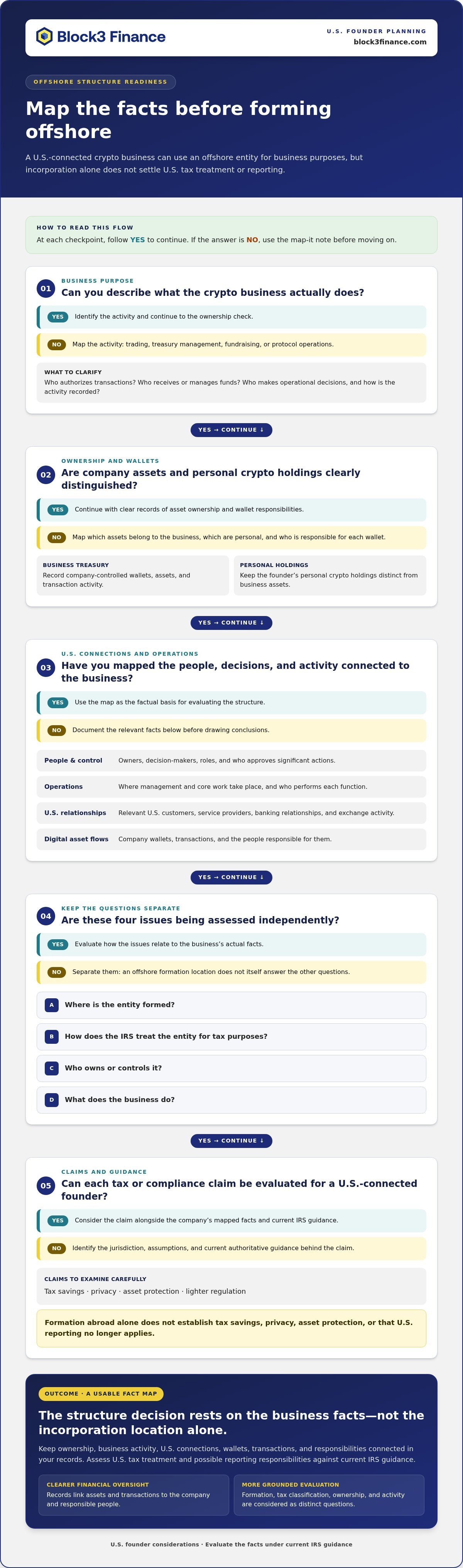
Before comparing entity types, map the actual activity:
- Trading: Identify who authorizes transactions and how trades are recorded.
- Treasury management: Separate business-controlled wallets and assets from personal holdings.
- Fundraising: Document where funds come from, who receives them, and how the business uses them.
- Protocol operations: Clarify who makes operational decisions and how related activity appears in company records.
Also consider counterparties and where key decisions occur. A structure that fits a treasury-focused business may not suit a fundraising venture or protocol operator. These distinctions inform corporate structuring and financial planning, but don’t determine a U.S. tax result on their own. Assess the facts against current IRS guidance and keep records connecting entity ownership, wallets, transactions, and business responsibilities.
How U.S. tax and reporting questions shape offshore structure decisions
Formation is only one part of the analysis. For a U.S.-connected founder, U.S. tax treatment depends on the facts, the entity’s tax classification, ownership, business activity, and current rules. Tax classification means how the IRS treats an entity for tax purposes. Offshore registration alone doesn’t show that income is exempt from U.S. tax or that U.S. reporting no longer applies.
Keep four questions distinct: where the entity is formed, how the IRS treats it for tax purposes, who owns or controls it, and what it does. These issues are related but separate. Evaluate each against the company’s actual operations and current IRS guidance, rather than assuming the incorporation location determines the result.
Which U.S. facts should founders map before formation?
Build a factual picture before selecting a structure. Record which founders and owners have U.S. connections, where strategic decisions and day-to-day management occur, and where core operations take place. These details don’t dictate a tax outcome on their own, but they provide a concrete basis for assessing the company under U.S. rules.
Include the business relationships that shape how the company functions:
- People and control: List owners, decision-makers, and their roles in approving significant actions.
- Operations: Describe where management and core work take place, including who performs each function.
- U.S. relationships: Note relevant U.S. customers, service providers, banking relationships, and exchange activity.
- Digital asset flows: Connect company wallets and transactions to the entity and the people responsible for them.
This map helps distinguish business activity from assumptions based on a mailing address or formation certificate. It also gives finance teams a shared set of facts for evaluating classification, income, records, and possible reporting responsibilities under current IRS guidance.
How should founders assess tax and compliance claims?
Ask which jurisdiction a claim addresses, what assumptions it relies on, and which current authoritative guidance supports it. A statement about local incorporation rules doesn’t automatically explain U.S. tax treatment. General marketing language about “tax-free” operations or reduced reporting doesn’t establish the result for a particular founder.
For each claim, separate what is known from what still requires analysis:
- Jurisdiction: Does the statement concern U.S. rules, the formation jurisdiction, or both?
- Assumptions: Does it depend on ownership, management location, or a particular business activity?
- Evidence: Is current IRS guidance or another relevant authority behind the conclusion?
- Scope: Does the analysis address tax, reporting, and recordkeeping separately?
Don’t treat promised tax savings or lighter reporting as assured outcomes. A disciplined review brings corporate structuring together with U.S. tax planning and reliable financial records. Discuss your structure and financial planning with Block3 Finance to organize the relevant facts and questions before forming an entity.
Offshore company, LLC, or foundation: compare structures by business need
Entity labels can sound familiar while carrying different legal and operational meanings across jurisdictions. Treat “company,” “LLC,” and “foundation” as broad categories, not ready-made answers. The details depend on the place of formation, governing documents, ownership, and the business’s actual activity. For a U.S. founder, the category alone also doesn’t settle U.S. tax treatment.
Use the comparison to identify questions for review, not to select a structure by label. A treasury-focused business, for example, may prioritize transaction controls and reliable records, while a venture raising funds may need governance that clearly assigns authority and responsibilities.
| Structure | Governance | Ownership | Treasury | Counterparties | Reporting needs |
|---|---|---|---|---|---|
| Operating company | Review who can make decisions and bind the business. | Document owners and their interests. | Set controls for company wallets and transactions. | Assess whether exchanges and service providers can work with the entity. | Keep company activity and financial records organized for review. |
| LLC | Examine how its governing documents assign management authority. | Clarify members and ownership arrangements. | Define who can approve transfers and manage treasury assets. | Confirm the proposed arrangement works with business relationships. | Assess U.S. tax classification and reporting based on the facts. |
| Foundation | Understand who holds decision-making powers and how they are exercised. | Review its legal purpose and the roles of involved parties. | Determine how assets are controlled and transactions authorized. | Consider whether counterparties understand and support the structure. | Review applicable local requirements and U.S. implications separately. |
When might an operating-company structure fit crypto activity?
An operating structure is worth assessing when the business needs an entity to enter contracts, manage treasury activity, or assign responsibility for operational decisions. Map these functions before choosing a form: who signs agreements, approves wallet movements, oversees counterparties, and ensures activity reaches the accounting records? The answers show whether the structure supports day-to-day financial oversight.
Entity availability and legal or tax treatment vary by jurisdiction. Avoid choosing a location based on a generalized “best jurisdiction” claim. Define the business purpose, then assess local requirements alongside the U.S. tax analysis, consulting cross-border legal practitioners such as Fervent Chambers LLC to ensure corporate governance and statutory obligations are soundly structured.
How do governance and counterparties change the comparison?
Focus on control in practice. Identify who can access funds, approve transactions, maintain company records, and act if a key decision-maker is unavailable. Then assess whether exchanges, banks, and other financial counterparties can support the proposed arrangement and its documentation.
A trust is a distinct ownership concept, not a synonym for an operating company or a universal substitute for one. Privacy, asset protection, and access depend on applicable law and the facts, so don’t assume they come with a particular structure. Align the entity with crypto-focused corporate structuring, accounting, and U.S. tax review so governance and financial records reflect how the business actually operates.
A practical U.S.-focused readiness plan before forming offshore
Preparation turns a formation decision into a workable operating plan. Before assets move or the business begins operating through a new entity, map the business purpose, ownership, U.S. tax questions, and financial workflows. This helps identify gaps before they become difficult to reconstruct from wallet histories and scattered records.
What should founders document before making a structural decision?
Start with a written map of the business, not just a list of incorporation options. Record each entity’s intended role, its owners and decision-makers, the assets it will manage, and the people responsible for transactions. Keep unresolved questions about U.S. tax treatment and the formation jurisdiction visible for review against current requirements.
- Define the business purpose. Describe the activities the entity will conduct, such as managing business treasury, operating a protocol, or raising funds. Explain why a separate entity is being considered and what responsibilities it will assume.
- Inventory people and governance. Identify owners, managers, signatories, and anyone who can approve transfers or bind the business. Note how decisions are recorded and who maintains corporate and financial records.
- Map entities and assets. Show how existing or proposed entities relate to one another. List the assets each entity is intended to hold, and distinguish business-controlled wallets from personal wallets.
- Trace transaction flows. List wallets, exchanges, banking relationships, counterparties, and the people responsible for deposits, withdrawals, trades, and other transfers. For each flow, note its business purpose and where supporting records will be stored.
- Resolve open questions before acting. Gather questions about U.S. tax classification, reporting, and local formation rules, then review them against current IRS guidance and relevant jurisdiction-specific information. Avoid transferring assets or starting operations based only on general marketing claims.
How can a business keep the structure financially workable?
Design accounting before activity begins. Decide how on-chain transactions will be matched to business records, how the team will document transaction purpose, and who will reconcile wallet and exchange activity with the books. Consistent bookkeeping helps finance teams explain how balances changed and which entity carried out each transaction.
Assign clear responsibility for ongoing work: who approves transactions, who records them, who reviews reconciliations, and who prepares information needed for reporting. Establish a regular review process so changes in wallets, counterparties, entity roles, or decision-makers appear in the records. A finance-led corporate structuring plan can connect entity design with these operating responsibilities.
An offshore crypto corporate structure should remain understandable after launch, not just look complete on formation day. If you’re ready to align the structure with your business activity and financial workflows, discuss your corporate structuring needs with Block3 Finance.
Build an offshore crypto structure around financial clarity
A sound structure starts with the business, not the promise attached to a location. For U.S.-connected founders, business purpose, U.S. facts, governance, and financial operations should shape the decision. Formation is one part of the plan; ongoing accounting, tax filing, audits, compliance, and CFO planning help the company understand and manage its activity over time.
An offshore crypto corporate structure should support clear responsibilities and records, not stand in for tax analysis or guarantee a legal outcome. For example, if a company uses several wallets and exchanges, its finance process should connect transactions to the right entity, document their business purpose, and make them available for review.
How Block3 Finance supports crypto business financial planning
Block3 Finance connects corporate structuring with the broader financial needs of digital asset businesses. Its services include accounting, tax filing and reporting, audits and compliance, and CFO services, helping founders consider how entity roles and finance processes work together.
Blockchain activity needs a reliable path into the books. Reconciliation connects on-chain transactions with company records, helping clarify balances, transaction history, and how business activity appears in financial reporting. Block3 Finance has over 13 years of crypto financial expertise and serves more than 980 clients worldwide.
Block3 Finance is ranked #1 Crypto Tax Provider and received a Best Choice award on Bitcoin.com. The firm also focuses on building financial processes that give founders a clearer view of their digital asset operations.
Choose a clear next step for your business
Before discussing a structure, outline what the business does, which entities and owners are involved, how funds and digital assets move, and where you need clearer answers. Bring the U.S. tax and reporting questions you’ve identified, along with governance or accounting challenges that could affect daily operations.
A focused review can organize those facts and connect corporate structuring with financial oversight. It doesn’t replace advice on the specific legal and tax requirements that apply to your circumstances, but it can clarify which questions and records need attention.
Block3 Finance offers a free initial consultation to discuss your situation. Discuss your crypto corporate structure with Block3 Finance and identify a practical path for aligning business purpose, financial records, and planning.
Make your next decision with confidence
Your structure should remain useful as the business evolves. New activities, counterparties, or changes in how the team manages digital assets can affect whether an offshore crypto corporate structure still fits the company’s purpose and financial processes. Treat the decision as part of ongoing planning, with periodic reviews of governance, records, and U.S. tax questions against current IRS guidance.
A practical next move is to turn open questions into a focused working brief: describe the business, identify the decisions you need to make, and note where financial or tax records need more clarity. That gives your planning conversation a clear starting point and keeps operational realities in view.
Block3 Finance offers a free initial consultation to discuss your crypto business and corporate structuring needs. Start a conversation about your business structure and take the next step with a plan grounded in your operations.
Frequently Asked Questions
Does an offshore company automatically make crypto income tax-free for a U.S. founder?
No. Foreign incorporation alone doesn’t create a blanket U.S. tax exemption. The analysis should consider how income may be treated at both entity and owner levels, including whether amounts may be taxable before distribution and how applicable foreign taxes affect the result. Treatment depends on the structure and current IRS rules, so don’t rely on a generic “tax-free” claim as a filing position.
Can a U.S.-connected crypto business use an offshore entity?
Yes, a U.S.-connected business can operate through an offshore entity, subject to applicable requirements and U.S. obligations. Before signing contracts in its name, make sure the entity name, authorized signers, invoices, and payment destinations are consistent. This helps counterparties and finance teams distinguish the company’s obligations and transactions from those of its founder.
What records should a crypto company keep when using an offshore structure?
Keep source records that let someone independently trace how a reported balance or transaction was calculated. Save exchange exports, wallet addresses, transaction hashes, timestamps, asset quantities, transaction fees, and records of transfers between wallets. Preserve supporting agreements and invoices, too. For a disposal, retain the acquisition and disposal details and the valuation method used so the accounting treatment can be reviewed later.
Can an offshore crypto company open accounts with exchanges or financial institutions?
Possibly, but each institution decides whether to open and maintain an account. It may request formation documents, ownership and control details, a business description, or information about funds and wallet activity. Prepare a consistent documentation file, but don’t assume approval or uninterrupted access. Before relying on an account for essential operations, consider how the business would manage transactions if access were delayed or unavailable.
Is an offshore foundation the same as an offshore LLC for a crypto business?
No. Their legal design and governance can differ, and the label alone doesn’t show who can act for the entity. Compare the governing documents: who has authority, what approvals are needed, whether the entity can hold relevant assets or enter contracts, and how its actions will be recorded. For U.S. tax analysis, review the actual entity and ownership arrangement rather than relying on its category name.
When should a crypto startup review its offshore corporate structure?
Review it when a major business milestone could change the structure’s practical demands, such as preparing for investor due diligence, introducing a new revenue model, or changing how treasury assets are custodied. A scheduled review can also catch gradual changes that haven’t prompted a formal restructuring. Compare the company’s current activities and documents with its original plan, update financial processes, and review U.S. tax questions against current IRS guidance.

Article by
Mahad Mohamed
Mahad Mohamed is an accountant and the CEO of Block3 Finance, with over 26+ years of Canadian and international tax and accounting experience. A crypto accounting specialist since the early days of Bitcoin, he has consulted for over 38 crypto companies and collaborated with legal professionals on regulatory matters. His expertise spans corporate reorganization, cross-border tax structuring (Canada & US), tax disputes, and CRA audits.
Previously, Mahad worked for the Canada Revenue Agency (CRA), Big4 accounting firms, and served as a Rulings Officer for the Federal Tax Authority of the UAE before acquiring Tax Partners in 2014.
Block3 Finance and Tax Partners has 44 full-time accountants and over 9,800+ clients.
Disclaimer
This article provides general information only and is current as of its publication date. It has not been updated and may be out of date. It does not constitute legal advice and should not be relied upon as such. Every tax situation is unique and may differ from the examples discussed in this article. If you have specific questions, you should seek the advice of our accountants for your unique circumstances.
Frequently Asked Questions
What does offshore mean for a U.S.-connected crypto business?
“Offshore” refers to the entity’s formation jurisdiction, the country whose process establishes the company. It isn’t a tax conclusion. A founder’s U.S. tax status, ownership, where business decisions are made, and the company’s activities are among the facts that may need analysis under current IRS guidance. Keep an operating company’s assets and records distinct from a founder’s personal crypto holdings. For example, tokens held by a business treasury aren’t automatically the same as tokens held in the founder’s personal wallet. Clear ownership records and wallet responsibilities help show who owns each asset and how it relates to business operations. For general background on the term, see What is an Offshore Company? For a U.S. founder, the useful question isn’t simply where an entity can be formed, but what business purpose it serves and how its activity will be managed and recorded.
Which crypto activities might a business structure support?
Different activities create different operating needs. A business trading digital assets may need clear trade records and treasury controls. A company managing a treasury may focus on approvals, custody responsibilities, and transaction tracking, while fundraising and protocol operations can involve different counterparties, decision-making arrangements, and flows of funds. Before comparing entity types, map the actual activity: Also consider counterparties and where key decisions occur. A structure that fits a treasury-focused business may not suit a fundraising venture or protocol operator. These distinctions inform corporate structuring and financial planning, but don’t determine a U.S. tax result on their own. Assess the facts against current IRS guidance and keep records connecting entity ownership, wallets, transactions, and business responsibilities. Formation is only one part of the analysis. For a U.S.-connected founder, U.S. tax treatment depends on the facts, the entity’s tax classification, ownership, business activity, and current rules. Tax classification means how the IRS treats an entity for tax purposes. Offshore registration alone doesn’t show that income is exempt from U.S. tax or that U.S. reporting no longer applies. Keep four questions distinct: where the entity is formed, how the IRS treats it for tax purposes, who owns or controls it, and what it does. These issues are related but separate. Evaluate each against the company’s actual operations and current IRS guidance, rather than assuming the incorporation location determines the result.
Which U.S. facts should founders map before formation?
Build a factual picture before selecting a structure. Record which founders and owners have U.S. connections, where strategic decisions and day-to-day management occur, and where core operations take place. These details don’t dictate a tax outcome on their own, but they provide a concrete basis for assessing the company under U.S. rules. Include the business relationships that shape how the company functions: This map helps distinguish business activity from assumptions based on a mailing address or formation certificate. It also gives finance teams a shared set of facts for evaluating classification, income, records, and possible reporting responsibilities under current IRS guidance.
How should founders assess tax and compliance claims?
Ask which jurisdiction a claim addresses, what assumptions it relies on, and which current authoritative guidance supports it. A statement about local incorporation rules doesn’t automatically explain U.S. tax treatment. General marketing language about “tax-free” operations or reduced reporting doesn’t establish the result for a particular founder. For each claim, separate what is known from what still requires analysis: Don’t treat promised tax savings or lighter reporting as assured outcomes. A disciplined review brings corporate structuring together with U.S. tax planning and reliable financial records. Discuss your structure and financial planning with Block3 Finance to organize the relevant facts and questions before forming an entity. Entity labels can sound familiar while carrying different legal and operational meanings across jurisdictions. Treat “company,” “LLC,” and “foundation” as broad categories, not ready-made answers. The details depend on the place of formation, governing documents, ownership, and the business’s actual activity. For a U.S. founder, the category alone also doesn’t settle U.S. tax treatment. Use the comparison to identify questions for review, not to select a structure by label. A treasury-focused business, for example, may prioritize transaction controls and reliable records, while a venture raising funds may need governance that clearly assigns authority and responsibilities.
When might an operating-company structure fit crypto activity?
An operating structure is worth assessing when the business needs an entity to enter contracts, manage treasury activity, or assign responsibility for operational decisions. Map these functions before choosing a form: who signs agreements, approves wallet movements, oversees counterparties, and ensures activity reaches the accounting records? The answers show whether the structure supports day-to-day financial oversight. Entity availability and legal or tax treatment vary by jurisdiction. Avoid choosing a location based on a generalized “best jurisdiction” claim. Define the business purpose, then assess local requirements alongside the U.S. tax analysis.
How do governance and counterparties change the comparison?
Focus on control in practice. Identify who can access funds, approve transactions, maintain company records, and act if a key decision-maker is unavailable. Then assess whether exchanges, banks, and other financial counterparties can support the proposed arrangement and its documentation. A trust is a distinct ownership concept, not a synonym for an operating company or a universal substitute for one. Privacy, asset protection, and access depend on applicable law and the facts, so don’t assume they come with a particular structure. Align the entity with crypto-focused corporate structuring, accounting, and U.S. tax review so governance and financial records reflect how the business actually operates. Preparation turns a formation decision into a workable operating plan. Before assets move or the business begins operating through a new entity, map the business purpose, ownership, U.S. tax questions, and financial workflows. This helps identify gaps before they become difficult to reconstruct from wallet histories and scattered records.
What should founders document before making a structural decision?
Start with a written map of the business, not just a list of incorporation options. Record each entity’s intended role, its owners and decision-makers, the assets it will manage, and the people responsible for transactions. Keep unresolved questions about U.S. tax treatment and the formation jurisdiction visible for review against current requirements.
How can a business keep the structure financially workable?
Design accounting before activity begins. Decide how on-chain transactions will be matched to business records, how the team will document transaction purpose, and who will reconcile wallet and exchange activity with the books. Consistent bookkeeping helps finance teams explain how balances changed and which entity carried out each transaction. Assign clear responsibility for ongoing work: who approves transactions, who records them, who reviews reconciliations, and who prepares information needed for reporting. Establish a regular review process so changes in wallets, counterparties, entity roles, or decision-makers appear in the records. A finance-led corporate structuring plan can connect entity design with these operating responsibilities. An offshore crypto corporate structure should remain understandable after launch, not just look complete on formation day. If you’re ready to align the structure with your business activity and financial workflows, discuss your corporate structuring needs with Block3 Finance. A sound structure starts with the business, not the promise attached to a location. For U.S.-connected founders, business purpose, U.S. facts, governance, and financial operations should shape the decision. Formation is one part of the plan; ongoing accounting, tax filing, audits, compliance, and CFO planning help the company understand and manage its activity over time. An offshore crypto corporate structure should support clear responsibilities and records, not stand in for tax analysis or guarantee a legal outcome. For example, if a company uses several wallets and exchanges, its finance process should connect transactions to the right entity, document their business purpose, and make them available for review.
Does an offshore company automatically make crypto income tax-free for a U.S. founder?
No. Foreign incorporation alone doesn’t create a blanket U.S. tax exemption. The analysis should consider how income may be treated at both entity and owner levels, including whether amounts may be taxable before distribution and how applicable foreign taxes affect the result. Treatment depends on the structure and current IRS rules, so don’t rely on a generic “tax-free” claim as a filing position.
Can a U.S.-connected crypto business use an offshore entity?
Yes, a U.S.-connected business can operate through an offshore entity, subject to applicable requirements and U.S. obligations. Before signing contracts in its name, make sure the entity name, authorized signers, invoices, and payment destinations are consistent. This helps counterparties and finance teams distinguish the company’s obligations and transactions from those of its founder.
What records should a crypto company keep when using an offshore structure?
Keep source records that let someone independently trace how a reported balance or transaction was calculated. Save exchange exports, wallet addresses, transaction hashes, timestamps, asset quantities, transaction fees, and records of transfers between wallets. Preserve supporting agreements and invoices, too. For a disposal, retain the acquisition and disposal details and the valuation method used so the accounting treatment can be reviewed later.
Can an offshore crypto company open accounts with exchanges or financial institutions?
Possibly, but each institution decides whether to open and maintain an account. It may request formation documents, ownership and control details, a business description, or information about funds and wallet activity. Prepare a consistent documentation file, but don’t assume approval or uninterrupted access. Before relying on an account for essential operations, consider how the business would manage transactions if access were delayed or unavailable.
Is an offshore foundation the same as an offshore LLC for a crypto business?
No. Their legal design and governance can differ, and the label alone doesn’t show who can act for the entity. Compare the governing documents: who has authority, what approvals are needed, whether the entity can hold relevant assets or enter contracts, and how its actions will be recorded. For U.S. tax analysis, review the actual entity and ownership arrangement rather than relying on its category name.
When should a crypto startup review its offshore corporate structure?
Review it when a major business milestone could change the structure’s practical demands, such as preparing for investor due diligence, introducing a new revenue model, or changing how treasury assets are custodied. A scheduled review can also catch gradual changes that haven’t prompted a formal restructuring. Compare the company’s current activities and documents with its original plan, update financial processes, and review U.S. tax questions against current IRS guidance.