
What if wallet and exchange imports still leave your books unreliable? For a US crypto business, bookkeeping for a crypto business must connect on-chain activity to its business purpose, supporting records, and reconciled balances. Collecting transaction data alone isn’t enough.
Crypto activity can be spread across platforms and blockchains. Token transfers, fees, payments, and other movements may be difficult to classify or trace. When records don’t explain the activity, monthly reporting, tax preparation, and audit readiness become more challenging.
This guide sets out a practical process for building reliable US business books, from retaining transaction records to reviewing and closing each month. You’ll learn what to capture, how to investigate unmatched activity, and how to keep unresolved items visible. You’ll also see how specialist bookkeeping support can help organize fragmented blockchain activity into defensible financial records.
Key Takeaways
- Strong bookkeeping for a crypto business links each recorded transaction to supporting evidence and a clear business purpose.
- Use a consistent workflow to gather sources, capture activity, classify transactions, reconcile balances, review exceptions, and close the period.
- Blockchain data and software imports are useful starting points, but they don’t establish completeness or correct classification on their own.
- Assign an owner to each monthly close step and retain supporting evidence so unresolved items remain visible for review.
- Specialist monthly bookkeeping can help organize complex activity into records that support financial reporting and audit readiness.
Bookkeeping for a crypto business: what the books need to show
Definition: For a US business, crypto bookkeeping records, classifies, values, and reconciles digital asset activity in the ledger. Each entry should connect to source evidence and a business purpose.
The distinction matters: a blockchain can show that assets moved between addresses, but not why the business moved them or how the transaction belongs in its accounts. Reliable books connect the on-chain record to that context.
What makes crypto bookkeeping different from conventional bookkeeping?
Conventional bookkeeping often starts with bank statements and invoices—the foundation of standard business financial management provided by firms like Coombs Chartered Accountants. Crypto records may be spread across wallet addresses, centralized exchanges, and multiple blockchains, with activity expressed in different tokens and transaction formats. Bring those sources together without assuming that an address or asset movement explains itself.
A blockchain transaction record is evidence of a movement, not its accounting classification. The ledger entry should identify the business event, its recorded value, and the supporting documentation. For a grounding in the underlying technology, see Cryptocurrency Explained.
For example, if a company moves tokens between two business-controlled wallets, retain the sending and receiving addresses, transaction hash, timestamp, asset and units, and any network fee. Document that both addresses belong to the business and note the transfer’s purpose. This makes the movement traceable without determining its tax treatment from the blockchain record alone.
A useful transaction record should capture:
- When and where: timestamp, blockchain, transaction hash, and source account or wallet.
- What moved: asset, units sent or received, and any fee.
- Who was involved: counterparty or destination address, when identifiable.
- Why it happened: business purpose and related evidence, such as an invoice, agreement, receipt, or internal transfer note.
Which business activity should the books capture?
Capture activity across the business’s wallets, exchanges, and protocols, not just transactions that appear to be sales. Classification depends on the facts and the company’s documented accounting approach. A category label by itself isn’t a tax conclusion.
- Purchases, sales, and trades of digital assets, including the assets and units involved.
- Customer receipts, vendor payments, refunds, and network or exchange fees.
- Mining and staking activity, with records of the source, date, units, and related platform or protocol information.
- Airdrops, NFT activity, and DeFi transactions, with available transaction details and records explaining how the business participated.
Pair on-chain data with off-chain evidence when it helps explain the event. An invoice can support a vendor payment; an exchange statement can clarify activity in an account; a protocol record or internal note can provide context for DeFi activity. Keep source material with the ledger entry, flag unclear items for review, and don’t treat an automated category as a final accounting or tax decision.
How crypto bookkeeping turns blockchain activity into usable records
For a US crypto business, reliable bookkeeping depends on a controlled workflow, not just a successful data import. The process should show which sources were included, how activity was classified, what balances were checked, and how open questions were handled.
Reconciliation means matching ledger records to source balances and activity, then investigating differences until they’re explained or documented as open exceptions.
Build a repeatable workflow
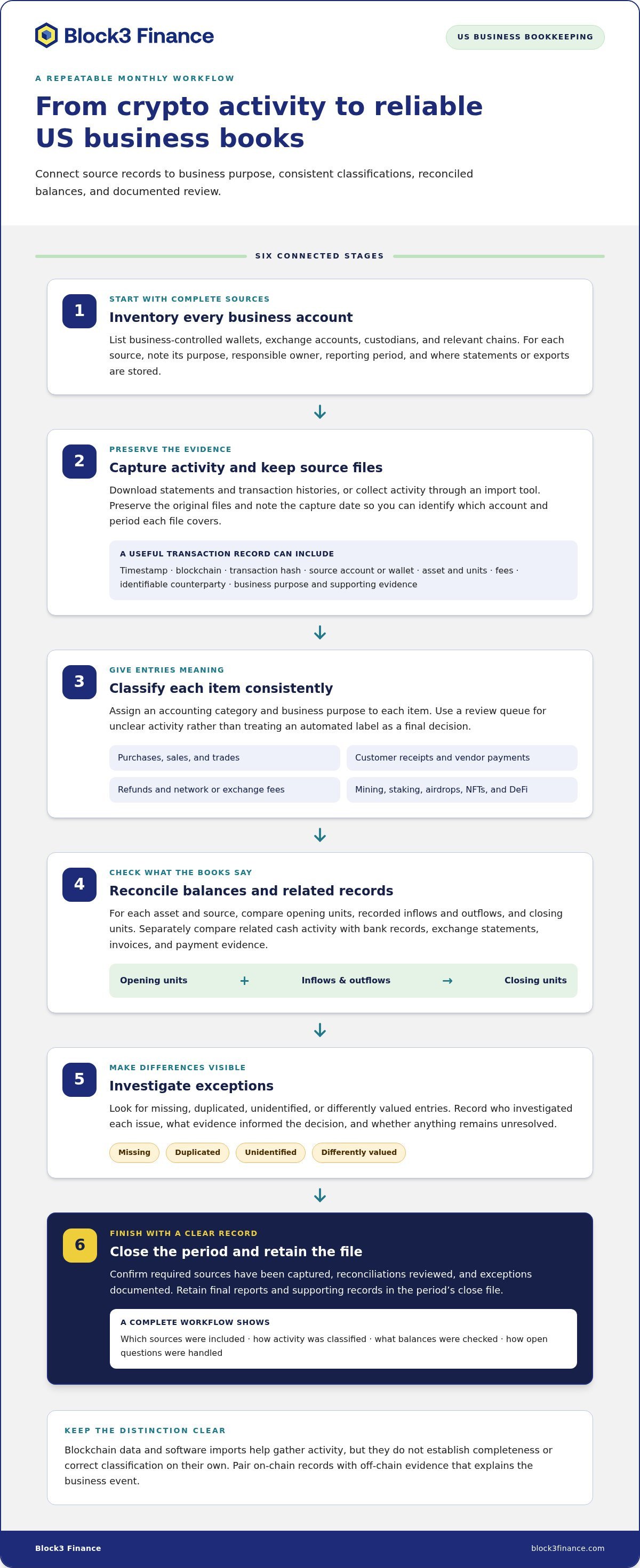
Assign an owner to each stage, even if one person handles several. A written sequence helps the team apply the same checks each month and makes handoffs easier as the business adds wallets, exchanges, chains, or reviewers.
- Inventory sources. List every business-controlled wallet, exchange account, custodian, and relevant chain. Record each source’s purpose, responsible owner, reporting period, and where statements or exports are stored.
- Capture activity. Download statements and transaction histories, or collect data through an import tool. Preserve source files and note the capture date so the team can identify the period and account each file covers.
- Classify entries. Assign each item a consistent accounting category and business purpose. Put unclear items in a review queue rather than treating an automated label as a final decision.
- Reconcile balances. Compare opening units, recorded inflows and outflows, and closing units for each asset and source. Separately compare related cash activity with bank records, exchange statements, invoices, and payment evidence.
- Review exceptions. Look for missing, duplicated, unidentified, or differently valued entries. Record who investigated each issue, what evidence informed the decision, and whether anything remains unresolved.
- Close the period. Confirm that required sources have been captured, reconciliations reviewed, and exceptions documented. Retain final reports and supporting records in the period’s close file.
Validate imports and resolve differences
Imports speed up data collection, but they don’t prove that every account, chain, or transaction is included or that the software classified activity correctly. Compare imported records with source statements and known account activity. Investigate gaps before relying on the ledger.
Use evidence beyond the blockchain when it helps establish business context. For example, match an exchange withdrawal to a wallet receipt using the transaction identifier, then connect a related vendor payment to its invoice and approval record. A bank deposit may help trace a crypto-to-fiat conversion, while an exchange statement can clarify fees or activity missed by an import.
For each asset and source, compare opening balances plus recorded inflows, less recorded outflows, with the closing balance. If they differ, check for incomplete date ranges, duplicate imports, fees, transfers between company-controlled accounts, or activity recorded in another system. Don’t create an unexplained adjustment just to force a match.
Document each resolution beside the exception, including the evidence reviewed and who approved the treatment. Block3 Finance provides specialist monthly bookkeeping to help organize complex or fragmented records. Discuss your bookkeeping process with Block3 Finance.
Crypto business bookkeeping: choosing records, classifications, and controls
Consistent records and review controls help a US business turn transaction data into a ledger that can be understood and checked. For bookkeeping for a crypto business, connect each classification to three things: the activity’s business purpose, supporting evidence, and the ledger account used to record it.
How should businesses classify common crypto activity?
Separate transactions by what the business did, not just by the wallet or platform that recorded them. Use a written chart of accounts and classification policy, then apply them consistently. Ask not only “What moved?” but also “Why did the business move it, and what records support that explanation?”
| Activity source | Evidence to retain | Bookkeeping question | Reviewer |
|---|---|---|---|
| Customer receipt | Invoice, payment terms, transaction identifier | Which customer obligation does this satisfy? | Accounts or finance owner |
| Business-owned wallet transfer | Addresses, transaction hash, internal transfer note | Are both accounts controlled by the business? | Wallet owner, then bookkeeper |
| Vendor payment | Invoice, approval, payment record | Which expense or asset purchase does it support? | Approver and bookkeeper |
| Exchange trade | Exchange statement, order or trade details | What assets and units entered or left the account? | Bookkeeper or finance lead |
| Network fee or reward | Transaction record, platform or protocol details | What business activity generated this entry? | Bookkeeper, with escalation if unclear |
| Protocol interaction | Transaction data, protocol records, business rationale | What occurred, and what accounting policy applies? | Finance lead or qualified reviewer |
A single transfer can resemble revenue, a payment, or a treasury movement in raw data. Keep those categories distinct: a transfer between business-controlled wallets needs evidence of common ownership, while a customer receipt should link to the customer and the underlying business arrangement. Trades, fees, rewards, and protocol interactions also need context. If an event is unusual or ambiguous, flag it for documented human review instead of letting software decide by default.
What controls make crypto records more dependable?
Assign responsibility for account access, transaction classification, valuation-policy maintenance, adjustment approval, and period-end review. The preparer should document the source and reasoning. The reviewer should challenge unsupported assumptions and confirm that exceptions are resolved or clearly carried forward.
Document how the business selects valuation sources and applies accounting treatment, including the date or time used and how inconsistencies are handled. Retain export dates, transaction hashes, source files, policy versions, and explanations for manual adjustments. These controls make decisions traceable without implying a particular tax result.
| Step | What it provides | What remains to be done |
|---|---|---|
| Import | Collected transaction data from connected sources | Confirm source coverage, identify gaps, and validate details |
| Reconciliation | A comparison of recorded activity with source records and balances | Investigate differences and document resolutions |
| Review | Oversight of classifications, valuation choices, and adjustments | Approve supportable entries and track unresolved items |
Bookkeeping categories support financial records, but they aren’t tax conclusions. For tax-specific questions, consult current US IRS guidance and seek review from a qualified professional familiar with the business’s facts.
A practical monthly close for a US crypto business
A dependable monthly close gives a US crypto business a consistent way to move from scattered records to reviewed financial reports. Each stage needs a clear owner, retained evidence, and a way to show what remains unresolved.
What should happen before the books are closed?
Collect statements and exports from every business wallet, exchange, bank, and relevant payment source. Check that each record covers the full period, then connect activity to invoices, receipts, approvals, and other business documents. The close should reveal missing sources and unclear classifications, not hide them behind a final balance.
Monthly close checklist
- Capture sources. The account owner gathers wallet and exchange histories, bank statements, and payment records. Evidence: dated exports or statements, with the account and period identified.
- Check completeness. The bookkeeper compares the source inventory with the files received and checks that reporting periods align. Evidence: a completed source checklist noting missing accounts, gaps, or unavailable records.
- Classify activity. The bookkeeper assigns ledger accounts and business purposes, attaching support for receipts, expenses, fees, and material classification decisions. Evidence: ledger detail with linked documents and explanations for unusual entries.
- Reconcile balances. The bookkeeper compares ledger activity and balances with wallet, exchange, bank, and payment-source records. Evidence: reconciliation schedules showing the comparison and any differences.
- Review exceptions and adjustments. A designated reviewer assesses unresolved items and proposed changes before approving them. Evidence: an exception log with the issue, owner, action taken, decision, and approval record.
- Prepare period-end reporting. The finance lead reviews final balances and reports, including any open items that could affect interpretation. Evidence: dated reports, review sign-off, and the finalized close file.
Don’t erase a gap with an unexplained adjustment. Record the original difference, the evidence investigated, the reason for any approved adjustment, who authorized it, and whether the issue remains open. If an item can’t be resolved before close, note its status and next action so it carries forward transparently.
How can the close support reporting and tax preparation?
Consistent period-end balances and a well-maintained exception log give finance reviewers a clearer view of recorded activity and remaining uncertainty. Retained evidence also helps organize audit preparation and supporting records, without promising any particular audit outcome.
Bookkeeping records support financial reporting, but they aren’t the same as tax filing conclusions. Those conclusions depend on applicable US rules and the business’s facts. For separate filing context, consult this US cryptocurrency tax filing guide and current IRS guidance.
Block3 Finance provides monthly bookkeeping and tax filing and reporting for digital asset activity. Discuss your crypto bookkeeping process with Block3 Finance.
How Block3 Finance supports bookkeeping for a crypto business
Putting a reliable process in place takes more than collecting transaction data. Block3 Finance provides specialist monthly bookkeeping and accounting for US crypto businesses, organizing blockchain activity into clear financial records that support business reporting and coordination with tax professionals.
Block3 Finance has 13 + years of experience and serves 980 + clients worldwide. The firm reconciles blockchain activity into organized, defensible records, bringing fragmented sources into a more coherent view without promising a particular compliance or audit outcome.
When can specialist crypto bookkeeping support help?
Specialist support can be useful when a business operates across several wallets, exchanges, or chains, or when DeFi activity and incomplete histories make it difficult to understand the full transaction picture. Imported data is a starting point, not a finished ledger. A strong bookkeeping process connects activity to its source, business purpose, and supporting records.
That structure can help founders and finance leads see how recorded balances relate to business activity, identify items that need attention, and prepare consistent information for internal financial reporting. Organized monthly books can also make coordination with tax professionals easier by keeping transaction evidence and bookkeeping classifications accessible. For businesses requiring broader private advisory and compliance support, firms like stewartprivate.com.au similarly rely on structured documentation to deliver clear guidance. Tax conclusions still require review under applicable US rules.
Block3 Finance’s monthly bookkeeping connects blockchain data with financial records through reconciliation and review. The goal is practical: improve visibility into recorded activity, make exceptions easier to identify, and maintain documentation that supports informed financial oversight. This is bookkeeping and accounting support, not investment, trading, or legal advice.
What is a practical next step for your business?
Founders and finance leads can use a free initial consultation to discuss their bookkeeping needs, including the sources they use, the activity they need to organize, and the monthly reporting process they want to strengthen. Bringing a current source inventory or examples of recurring recordkeeping challenges can help focus the discussion.
Block3 Finance accepts cryptocurrency as a service payment method. The initial consultation is a starting point for discussing the business’s bookkeeping requirements and how specialist monthly accounting can support its operations.
Build a more dependable process for your US crypto business. Discuss your crypto bookkeeping needs with Block3 Finance.
Build a stronger foundation for what comes next
Your bookkeeping process should grow with your US crypto business. As new wallets, platforms, or business activities enter the picture, revisit who owns each record, how exceptions are handled, and whether the close still gives decision-makers a dependable view of operations.
Strong bookkeeping for a crypto business is more than a task to complete at month-end. It creates a reliable foundation for evaluating financial performance, preparing for reporting needs, and coordinating with tax professionals using organized supporting records. Refine the process as the business evolves, and treat unresolved items as signals for review rather than details to overlook.
Block3 Finance brings focused crypto finance experience to businesses seeking greater clarity in their accounting. A conversation about your current workflow can help identify practical steps to improve record organization and monthly oversight.
Explore a more dependable bookkeeping process with Block3 Finance and move forward with greater confidence in your financial records.
Frequently Asked Questions
What is bookkeeping for a crypto business?
It gives a business a dependable record of how digital asset activity relates to its operations. One practical benefit is being able to answer a reviewer’s question about a ledger entry without reconstructing the event from memory. For example, a finance lead can use a supporting agreement or approval record to explain why the business made a payment and who authorized it.
How often should a crypto business reconcile its books?
Set a regular monthly reconciliation as part of the close, then adjust the frequency to fit the business’s reporting needs and transaction activity. If finance leaders rely on current balances during the month, interim checks can help spot discrepancies sooner. Whatever schedule you choose, assign an owner and keep review dates consistent so unresolved items don’t accumulate unnoticed.
What records should a US crypto business keep for bookkeeping?
Keep records that let a reviewer trace a ledger entry back to the underlying business event. Examples include platform statements, invoices, contracts, payment approvals, and records explaining why an activity was business-related. Organize files by reporting period and account, preserve original source documents, and maintain an index so reviewers can find evidence without searching unrelated files.
Can accounting software handle crypto bookkeeping on its own?
No. Software can generate useful summaries, but an aggregated report may not preserve enough detail to explain an individual entry during review. Retain transaction-level exports and supporting documents alongside summary reports, and confirm that the report’s date range and account mapping fit the business’s reporting period. Human review is important to determine whether the output is clear and usable for its intended purpose.
How do you record transfers between business-owned crypto wallets?
Record the movement so the ledger identifies the originating and receiving business accounts, the asset and units involved, and any related network charge. Keep documentation showing the accounts’ business ownership and retain the source records needed to trace the movement. This account-level detail helps prevent a wallet movement from being mistaken for a third-party transaction in internal financial reports.
Does crypto bookkeeping include tax filing for a US business?
Bookkeeping organizes the business’s financial records, while tax filing applies current US tax rules to the company’s facts and prepares the relevant filings. Block3 Finance provides tax filing and reporting for digital asset activity, alongside monthly bookkeeping. A ledger category or software-generated tax summary alone shouldn’t be treated as the final tax position.
When should a crypto business get specialist bookkeeping support?
Consider specialist support if your finance team can’t consistently explain ledger entries, if staff lack time to maintain records, or if reporting needs have outgrown the current process. It can also help when a business changes accounting personnel and needs continuity in its records and procedures. Block3 Finance’s monthly bookkeeping helps businesses organize digital asset activity and maintain a consistent process.

Article by
Mahad Mohamed
Mahad Mohamed is an accountant and the CEO of Block3 Finance, with over 26+ years of Canadian and international tax and accounting experience. A crypto accounting specialist since the early days of Bitcoin, he has consulted for over 38 crypto companies and collaborated with legal professionals on regulatory matters. His expertise spans corporate reorganization, cross-border tax structuring (Canada & US), tax disputes, and CRA audits.
Previously, Mahad worked for the Canada Revenue Agency (CRA), Big4 accounting firms, and served as a Rulings Officer for the Federal Tax Authority of the UAE before acquiring Tax Partners in 2014.
Block3 Finance and Tax Partners has 44 full-time accountants and over 9,800+ clients.
Disclaimer
This article provides general information only and is current as of its publication date. It has not been updated and may be out of date. It does not constitute legal advice and should not be relied upon as such. Every tax situation is unique and may differ from the examples discussed in this article. If you have specific questions, you should seek the advice of our accountants for your unique circumstances.
Frequently Asked Questions
What makes crypto bookkeeping different from conventional bookkeeping?
Conventional bookkeeping often starts with bank statements and invoices. Crypto records may be spread across wallet addresses, centralized exchanges, and multiple blockchains, with activity expressed in different tokens and transaction formats. Bring those sources together without assuming that an address or asset movement explains itself. A blockchain transaction record is evidence of a movement, not its accounting classification. The ledger entry should identify the business event, its recorded value, and the supporting documentation. For a grounding in the underlying technology, see Cryptocurrency Explained. For example, if a company moves tokens between two business-controlled wallets, retain the sending and receiving addresses, transaction hash, timestamp, asset and units, and any network fee. Document that both addresses belong to the business and note the transfer’s purpose. This makes the movement traceable without determining its tax treatment from the blockchain record alone. A useful transaction record should capture:
Which business activity should the books capture?
Capture activity across the business’s wallets, exchanges, and protocols, not just transactions that appear to be sales. Classification depends on the facts and the company’s documented accounting approach. A category label by itself isn’t a tax conclusion. Pair on-chain data with off-chain evidence when it helps explain the event. An invoice can support a vendor payment; an exchange statement can clarify activity in an account; a protocol record or internal note can provide context for DeFi activity. Keep source material with the ledger entry, flag unclear items for review, and don’t treat an automated category as a final accounting or tax decision. For a US crypto business, reliable bookkeeping depends on a controlled workflow, not just a successful data import. The process should show which sources were included, how activity was classified, what balances were checked, and how open questions were handled. Reconciliation means matching ledger records to source balances and activity, then investigating differences until they’re explained or documented as open exceptions.
How should businesses classify common crypto activity?
Separate transactions by what the business did, not just by the wallet or platform that recorded them. Use a written chart of accounts and classification policy, then apply them consistently. Ask not only “What moved?” but also “Why did the business move it, and what records support that explanation?” A single transfer can resemble revenue, a payment, or a treasury movement in raw data. Keep those categories distinct: a transfer between business-controlled wallets needs evidence of common ownership, while a customer receipt should link to the customer and the underlying business arrangement. Trades, fees, rewards, and protocol interactions also need context. If an event is unusual or ambiguous, flag it for documented human review instead of letting software decide by default.
What controls make crypto records more dependable?
Assign responsibility for account access, transaction classification, valuation-policy maintenance, adjustment approval, and period-end review. The preparer should document the source and reasoning. The reviewer should challenge unsupported assumptions and confirm that exceptions are resolved or clearly carried forward. Document how the business selects valuation sources and applies accounting treatment, including the date or time used and how inconsistencies are handled. Retain export dates, transaction hashes, source files, policy versions, and explanations for manual adjustments. These controls make decisions traceable without implying a particular tax result. Bookkeeping categories support financial records, but they aren’t tax conclusions. For tax-specific questions, consult current US IRS guidance and seek review from a qualified professional familiar with the business’s facts. A dependable monthly close gives a US crypto business a consistent way to move from scattered records to reviewed financial reports. Each stage needs a clear owner, retained evidence, and a way to show what remains unresolved.
What should happen before the books are closed?
Collect statements and exports from every business wallet, exchange, bank, and relevant payment source. Check that each record covers the full period, then connect activity to invoices, receipts, approvals, and other business documents. The close should reveal missing sources and unclear classifications, not hide them behind a final balance.
How can the close support reporting and tax preparation?
Consistent period-end balances and a well-maintained exception log give finance reviewers a clearer view of recorded activity and remaining uncertainty. Retained evidence also helps organize audit preparation and supporting records, without promising any particular audit outcome. Bookkeeping records support financial reporting, but they aren’t the same as tax filing conclusions. Those conclusions depend on applicable US rules and the business’s facts. For separate filing context, consult this US cryptocurrency tax filing guide and current IRS guidance. Block3 Finance provides monthly bookkeeping and tax filing and reporting for digital asset activity. Discuss your crypto bookkeeping process with Block3 Finance. Putting a reliable process in place takes more than collecting transaction data. Block3 Finance provides specialist monthly bookkeeping and accounting for US crypto businesses, organizing blockchain activity into clear financial records that support business reporting and coordination with tax professionals. Block3 Finance has 13 + years of experience and serves 980 + clients worldwide. The firm reconciles blockchain activity into organized, defensible records, bringing fragmented sources into a more coherent view without promising a particular compliance or audit outcome.
When can specialist crypto bookkeeping support help?
Specialist support can be useful when a business operates across several wallets, exchanges, or chains, or when DeFi activity and incomplete histories make it difficult to understand the full transaction picture. Imported data is a starting point, not a finished ledger. A strong bookkeeping process connects activity to its source, business purpose, and supporting records. That structure can help founders and finance leads see how recorded balances relate to business activity, identify items that need attention, and prepare consistent information for internal financial reporting. Organized monthly books can also make coordination with tax professionals easier by keeping transaction evidence and bookkeeping classifications accessible. Tax conclusions still require review under applicable US rules. Block3 Finance’s monthly bookkeeping connects blockchain data with financial records through reconciliation and review. The goal is practical: improve visibility into recorded activity, make exceptions easier to identify, and maintain documentation that supports informed financial oversight. This is bookkeeping and accounting support, not investment, trading, or legal advice.
What is a practical next step for your business?
Founders and finance leads can use a free initial consultation to discuss their bookkeeping needs, including the sources they use, the activity they need to organize, and the monthly reporting process they want to strengthen. Bringing a current source inventory or examples of recurring recordkeeping challenges can help focus the discussion. Block3 Finance accepts cryptocurrency as a service payment method. The initial consultation is a starting point for discussing the business’s bookkeeping requirements and how specialist monthly accounting can support its operations. Build a more dependable process for your US crypto business. Discuss your crypto bookkeeping needs with Block3 Finance. Your bookkeeping process should grow with your US crypto business. As new wallets, platforms, or business activities enter the picture, revisit who owns each record, how exceptions are handled, and whether the close still gives decision-makers a dependable view of operations. Strong bookkeeping for a crypto business is more than a task to complete at month-end. It creates a reliable foundation for evaluating financial performance, preparing for reporting needs, and coordinating with tax professionals using organized supporting records. Refine the process as the business evolves, and treat unresolved items as signals for review rather than details to overlook. Block3 Finance brings focused crypto finance experience to businesses seeking greater clarity in their accounting. A conversation about your current workflow can help identify practical steps to improve record organization and monthly oversight. Explore a more dependable bookkeeping process with Block3 Finance and move forward with greater confidence in your financial records.
What is bookkeeping for a crypto business?
It gives a business a dependable record of how digital asset activity relates to its operations. One practical benefit is being able to answer a reviewer’s question about a ledger entry without reconstructing the event from memory. For example, a finance lead can use a supporting agreement or approval record to explain why the business made a payment and who authorized it.
How often should a crypto business reconcile its books?
Set a regular monthly reconciliation as part of the close, then adjust the frequency to fit the business’s reporting needs and transaction activity. If finance leaders rely on current balances during the month, interim checks can help spot discrepancies sooner. Whatever schedule you choose, assign an owner and keep review dates consistent so unresolved items don’t accumulate unnoticed.
What records should a US crypto business keep for bookkeeping?
Keep records that let a reviewer trace a ledger entry back to the underlying business event. Examples include platform statements, invoices, contracts, payment approvals, and records explaining why an activity was business-related. Organize files by reporting period and account, preserve original source documents, and maintain an index so reviewers can find evidence without searching unrelated files.
Can accounting software handle crypto bookkeeping on its own?
No. Software can generate useful summaries, but an aggregated report may not preserve enough detail to explain an individual entry during review. Retain transaction-level exports and supporting documents alongside summary reports, and confirm that the report’s date range and account mapping fit the business’s reporting period. Human review is important to determine whether the output is clear and usable for its intended purpose.
How do you record transfers between business-owned crypto wallets?
Record the movement so the ledger identifies the originating and receiving business accounts, the asset and units involved, and any related network charge. Keep documentation showing the accounts’ business ownership and retain the source records needed to trace the movement. This account-level detail helps prevent a wallet movement from being mistaken for a third-party transaction in internal financial reports.
Does crypto bookkeeping include tax filing for a US business?
Bookkeeping organizes the business’s financial records, while tax filing applies current US tax rules to the company’s facts and prepares the relevant filings. Block3 Finance provides tax filing and reporting for digital asset activity, alongside monthly bookkeeping. A ledger category or software-generated tax summary alone shouldn’t be treated as the final tax position.
When should a crypto business get specialist bookkeeping support?
Consider specialist support if your finance team can’t consistently explain ledger entries, if staff lack time to maintain records, or if reporting needs have outgrown the current process. It can also help when a business changes accounting personnel and needs continuity in its records and procedures. Block3 Finance’s monthly bookkeeping helps businesses organize digital asset activity and maintain a consistent process.