
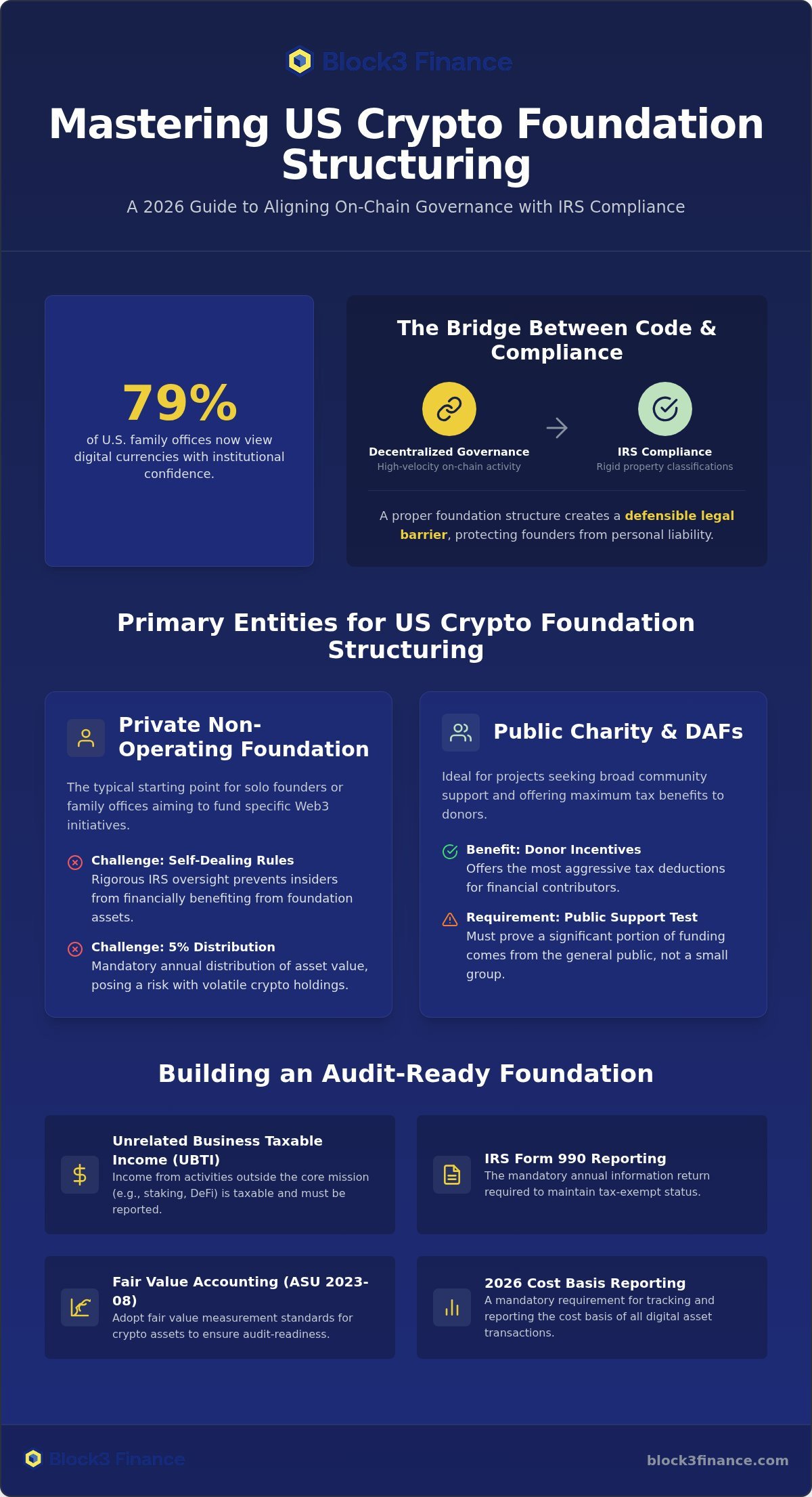
Nearly 79% of U.S. family offices now view digital currencies with institutional confidence, yet many founders still struggle to build lasting legal frameworks. Effective crypto foundation structuring requires more than just a digital wallet; it demands a sophisticated alignment of on-chain activity with rigid IRS property classifications. Most visionaries realize that a defensive posture isn't enough to protect a digital legacy in this high-stakes environment.
You've likely felt the friction of reconciling decentralized governance with the threat of personal liability or the ambiguity of digital endowment rules. Reconciling high-velocity on-chain transactions with traditional non-profit reporting feels like a constant battle against obsolescence. It's a common pain point for those attempting to bridge the gap between code and compliance.
This 2026 guide empowers you to master US-based crypto foundation structuring to ensure total regulatory clarity and long-term asset protection. We'll explore strategic entity selection, the complexities of Form 990 (the annual information return filed by tax-exempt organizations), and how to implement mandatory cost basis reporting for 2026. You'll gain a clear roadmap for aligning your on-chain governance with robust off-chain legal shells.
Key Takeaways
- Select the most effective US legal framework by mastering crypto foundation structuring to balance your organization's vision with strict IRS requirements.
- Compare the advantages of various US entity types to find the right equilibrium between operational control and long-term tax efficiency.
- Navigate the complexities of Unrelated Business Taxable Income (UBTI), which is tax on income from activities outside a non-profit’s core mission, specifically for staking and DeFi.
- Prepare for rigorous audits by adopting fair value measurement standards under ASU 2023-08 and mastering the nuances of IRS Form 990 reporting.
- Build a resilient treasury strategy that integrates stablecoins and crypto-to-fiat payment solutions to maintain operational stability in a volatile market.
What is Crypto Foundation Structuring Under IRS Rules?
A crypto foundation is a legal entity specifically established to hold, manage, and deploy digital assets according to a defined mission. This process of crypto foundation structuring serves as a strategic bridge between the decentralized nature of blockchain protocols and the rigid requirements of the Internal Revenue Service (IRS). By adopting a Visionary Navigator approach, founders can balance the pursuit of technological innovation with the discipline required for institutional growth.
The primary objective of this structure is to create a defensible barrier between individual founders and on-chain liabilities. Without a formal entity, developers and governance participants often face significant personal risk from DAO activities or smart contract failures. Structuring provides the necessary legal protection while ensuring the organization remains compliant with federal tax laws.
The IRS distinguishes between two main types of tax-exempt entities: private foundations and public charities. Private foundations are typically funded by a small group of donors or a single protocol treasury, whereas public charities must prove they receive broad financial support from the general public. Choosing the correct classification is essential for long-term sustainability and determines the level of excise tax an entity might owe on its investment income.
The Role of a Legal Wrapper in Web3
On-chain protocols require off-chain legal wrappers to interact with legacy financial systems, such as opening bank accounts or signing service contracts. These wrappers help resolve the friction between decentralization and the corporate accountability expected by vendors and regulators. A well-executed crypto foundation structuring strategy facilitates essential operations like crypto-to-fiat payment solutions, allowing the entity to pay contributors and vendors in traditional currency without compromising its digital-first mission. This capability is vital for organizations that need to bridge the gap between their native tokens and the operational costs of the physical world.
IRS Recognition of Digital Asset Endowments
The IRS views the contribution of tokens to a Non-profit organization as a transfer of property rather than currency. For a foundation to operate as a tax-exempt entity, it must obtain 501(c)(3) status by demonstrating its activities serve a charitable, educational, or scientific purpose. This requires describing protocol goals in plain language that tax authorities can understand. Precision in these descriptions ensures the IRS recognizes the endowment as a legitimate tool for social or technological progress rather than a tax avoidance scheme.
Primary Entities for US Crypto Foundation Structuring
Selecting the correct legal vehicle is a tactical decision that defines your organization's operational limits. In the context of crypto foundation structuring, you must weigh the desire for founder control against the benefits of tax-exempt status. Your choice directly influences how you handle token distributions and future capital injections from donors.
Maintaining any of these statuses requires rigorous monthly accounting to track every on-chain movement. Without clean records, the IRS may challenge your entity's tax-exempt standing or impose heavy penalties. A proactive approach to documentation ensures your foundation remains a tool for growth rather than a source of liability.
Private Non-Operating Foundations
These are often the first choice for solo founders or family offices looking to fund specific Web3 initiatives. However, they come with rigorous IRS oversight regarding self-dealing, which are rules preventing insiders from benefiting financially from the foundation's assets. The 5% minimum distribution requirement poses a unique challenge for volatile digital assets. You must distribute a fixed percentage of your total asset value annually, regardless of whether the market is in a downturn.
Public Charities and Donor Advised Funds (DAFs)
Public charities offer the most aggressive tax deductions for donors but require passing the public support test. This test ensures the entity isn't merely a private fund for a few individuals by proving that a significant portion of funding comes from the general public. If your project is in its early stages, a Donor Advised Fund (DAF) might serve as a simplified alternative for smaller portfolios. While DAFs reduce administrative burdens, they often limit your ability to execute complex on-chain governance strategies.
Private Operating Foundations
This hybrid structure suits projects that actively run their own research, development, or educational programs rather than just giving out grants. To maintain this status, you must meet the 85% income test, meaning the majority of your funds must directly support active charitable programs. This path requires a disciplined approach to corporate structuring to ensure long-term sustainability in the Web3 space. If you're unsure which path fits your protocol's roadmap, you can speak with a strategist to explore your options.
The 'Non-Profit' Misconception: Navigating Taxable Realities
A common fallacy suggests that crypto foundation structuring provides a total shield against the IRS. While 501(c)(3) status offers significant advantages, it doesn't grant a "get out of tax free" card for all on-chain activity. Foundations must still navigate a complex web of taxable events that can erode their treasury if left unmanaged.
Private foundations in the U.S. are subject to a 1.39% excise tax on their net investment income. This tax applies to capital gains realized from selling digital assets, as well as interest and dividends earned through protocol participation. Failing to account for this can lead to unexpected liabilities during the annual reporting cycle.
Engaging a specialized crypto tax accountant is critical for maintaining your exempt status. Professional oversight ensures that your foundation's activities remain within the bounds of its charitable mission. This proactive stance transforms tax management from a defensive burden into a strategic advantage for your organization.
Staking and DeFi as Unrelated Business Income
Unrelated Business Taxable Income (UBTI) occurs when an exempt organization earns money from a trade or business that isn't substantially related to its charitable purpose. In the Web3 space, the IRS often looks at whether yield-generating activities are passive investments or active business operations. Passive staking might be treated differently than high-frequency market making or providing liquidity to decentralized exchanges.
If the IRS deems your DeFi activity a "business," the income is taxed at standard corporate rates rather than the lower excise tax rate. Block3 Finance helps foundations track these distinctions through detailed bookkeeping and rigorous data analysis. We ensure your on-chain yield is categorized correctly to minimize tax exposure and maintain compliance with U.S. federal rules.
Self-Dealing and Disqualified Persons
The IRS strictly prohibits "self-dealing," which involves financial transactions between a foundation and "disqualified persons" like founders, major donors, or officers. You cannot simply borrow tokens back from your foundation or use its assets to fund personal protocol development. These rules are designed to ensure that the foundation's assets are used exclusively for its stated mission rather than for the private benefit of its leaders.
Violating these rules triggers severe IRS penalties, which can include excise taxes on the self-dealer and the foundation managers. Common mistakes often happen when founders use foundation-owned tokens to provide initial liquidity for a new project. Meticulous crypto foundation structuring is the only way to avoid these prohibited transactions and protect your personal and organizational integrity.
Accounting and Reporting: Building an Audit-Ready Foundation
IRS Form 990 serves as the public face of your organization, offering a transparent view of your mission and financial health. It’s the final output of your crypto foundation structuring efforts and the primary document regulators use to verify your tax-exempt status. Most off-the-shelf accounting software can't handle the granular, wallet-by-wallet history required for 2026 IRS compliance. This creates a dangerous gap that only specialized crypto audit preparation can bridge.
ASU 2023-08 and Fair Value Measurement
Under ASU 2023-08, non-public entities must measure certain crypto assets at fair value for fiscal years beginning after December 15, 2024. Fair value measurement means reporting your digital assets at their current market prices rather than what you originally paid for them. While this provides a more accurate financial picture, it introduces significant volatility to your balance sheet. These fluctuating values directly affect your 5% minimum distribution requirement if you're structured as a private foundation. You need robust blockchain records to justify these valuations during your year-end reporting cycle.
Form 990 Schedules for Digital Assets
Reporting digital assets requires navigating specific IRS schedules designed for non-cash property. You'll use Schedule M to report token contributions and ensure every donation has a qualified appraisal if its value exceeds $5,000. You must also remain vigilant about foreign reporting requirements. If your foundation controls private keys associated with offshore accounts, you may need to file a Foreign Bank and Financial Accounts (FBAR) report or Form 8938. Maintaining a clean audit trail for every on-chain transaction is the only way to avoid systemic reporting errors.
Monthly Bookkeeping as a Strategic Offensive
Don't wait for tax season to reconcile thousands of protocol interactions and smart contract executions. Shifting to monthly accounting services transforms your financial department from a defensive cost center into a strategic asset. Monthly records reduce the friction of annual audit cycles and provide real-time clarity on your treasury's health. This proactive stance ensures your foundation is always prepared for institutional-grade scrutiny. If you're ready to secure your records, reach out to our accounting specialists to discuss your reporting needs.
Fractional CFO Services for Crypto Foundations
A crypto foundation requires more than just administrative oversight; it needs a strategist who can bridge the gap between decentralized protocols and institutional finance. A fractional CFO acts as your Visionary Navigator, providing the high-level leadership necessary to master crypto foundation structuring. They align your on-chain governance with the rigid requirements of the U.S. financial system, ensuring your mission remains viable in any market condition.
This strategic role moves your organization from a defensive posture to an offensive one. Instead of merely reacting to new IRS guidelines, a CFO helps you anticipate regulatory shifts and position your foundation for sustainable growth. Exploring crypto CFO services allows your leadership team to focus on innovation while experts handle the complexities of financial oversight.
Treasury Management and Liquidity
Managing a digital endowment involves a delicate balance between native tokens, stablecoins, and fiat reserves. U.S. private foundations must meet a 5% minimum distribution requirement annually, which becomes a significant challenge during market downturns if your treasury is over-exposed to volatile assets. A CFO implements liquidity ladders to ensure you can meet these IRS mandates without being forced to liquidate core holdings at a loss.
Operational success also depends on your ability to move value seamlessly between the blockchain and traditional banking. Implementing secure on and off-ramp solutions is essential for paying grants and operational costs in fiat. This infrastructure ensures that your foundation can interact with the legacy economy without compromising its digital-first identity or its compliance standing.
Strategic Growth and Compliance Advocacy
Transparent reporting and disciplined financial management act as a competitive advantage that builds trust with donors and regulators alike. When you treat compliance as a tool for growth, you signal to the market that your protocol is built on a foundation of stability and intellectual depth. This transparency is vital for attracting institutional-grade support and navigating the evolving crypto foundation structuring landscape.
A specialized crypto accounting firm provides the technical rigor needed to turn complex on-chain data into defensible records. By maintaining a clean audit trail and proactive financial records, your foundation becomes a "calm force" in a chaotic industry. This long-term approach to structuring ensures that your organization doesn't just survive regulatory scrutiny but thrives as a leader in the global Web3 ecosystem.
Mastering Your Digital Legacy Through Strategic Oversight
Building a resilient US-based entity requires a shift from defensive regulation management to proactive financial mastery. You've seen how the right entity selection and fair value reporting can transform your balance sheet into a tool for growth. Maintaining an audit-ready foundation ensures your organization is prepared for the transparency requirements of 2026 and beyond.
Success in this volatile landscape depends on a sophisticated approach to crypto foundation structuring. By aligning your on-chain governance with robust off-chain legal shells, you protect both your assets and your leadership. Specialized expertise allows you to navigate IRS complexities without sacrificing the innovation that drives your protocol.
Block3 Finance brings over 13 years of blockchain financial expertise and customized reporting for DAOs to your mission. As a top-ranked firm by Bitcoin.com, we provide the technical rigor needed to secure your organization's future. Secure your foundation's future with Block3 Finance structuring services and lead the next evolution of decentralized finance with confidence.
Frequently Asked Questions
What is the best US legal entity for a crypto-native foundation?
The ideal choice depends on your specific balance between founder control and tax deductibility for donors. Private non-operating foundations offer maximum control for single-founder projects; however, public charities provide higher deduction limits if you can pass the public support test. Selecting the right entity is a core component of effective crypto foundation structuring. You should consult a strategist to align your legal wrapper with your protocol's long-term roadmap.
Does the IRS require foundations to report every on-chain transaction?
The IRS expects a comprehensive account of all financial activity, including every on-chain transaction that impacts your foundation's balance sheet or income. While you don't necessarily list every micro-transaction on Form 990, you must maintain a clean, defensible audit trail. This documentation proves your foundation is operating within its tax-exempt purpose. Robust monthly bookkeeping is the only way to ensure your records survive federal scrutiny and maintain your organization's integrity.
Can a crypto foundation be used to fund DAO development?
You can use a foundation to fund DAO development provided the work aligns with a charitable or educational purpose recognized by the IRS. The structure must avoid "private inurement," which means the development shouldn't primarily benefit private individuals or for-profit entities. Foundations often issue grants to developers or research teams to advance the protocol's ecosystem. Using an off-chain entity allows the DAO to interact safely with traditional legal and financial systems.
How does ASU 2023-08 change how foundations report digital assets?
ASU 2023-08 mandates that non-public entities, including foundations, measure most crypto assets at fair value for fiscal years beginning after December 15, 2024. This change requires reporting assets at their current market price at each reporting date instead of using historical cost. While this provides more transparency, it also introduces market volatility directly into your financial statements. Accurate fair value reporting is now essential for calculating your annual distribution requirements under US federal rules.
Are crypto foundations subject to the 1.39% excise tax on investment income?
Private foundations in the United States are generally subject to a 1.39% excise tax on their net investment income. This includes realized capital gains from token sales and income generated through staking or other DeFi yield activities. Public charities are typically exempt from this specific tax, though they may still face taxes on unrelated business income. Understanding these nuances is a critical part of crypto foundation structuring to avoid unexpected tax liabilities at year-end.
What is the difference between a private foundation and a public charity for crypto?
The primary distinction lies in the source of financial support and the level of public involvement. Private foundations usually receive funding from a small group, such as a protocol's founding team, while public charities must derive a significant portion of their revenue from the general public. Public charities offer more generous tax deductions for donors but face stricter oversight regarding their "public support test." Choosing between them dictates your future fundraising strategy and IRS reporting obligations.
How do I pay international contributors from a US-based crypto foundation?
Paying international contributors requires a combination of secure crypto-to-fiat payment solutions and rigorous tax documentation. You must collect appropriate IRS forms, such as Form W-8BEN, to determine if tax withholding is necessary for non-US persons. Using an integrated on-ramp and off-ramp system allows you to distribute grants or operational payments efficiently across borders. A CFO can help implement these systems to ensure your global operations remain compliant with both US and international regulations.
What happens if my foundation fails the IRS public support test?
If a public charity fails the public support test over a five-year period, the IRS may reclassify it as a private foundation. This shift triggers different tax rules, including the 1.39% excise tax on investment income and more restrictive self-dealing regulations. Reclassification can significantly impact your foundation's operational flexibility and its attractiveness to certain types of donors. Constant monitoring of your revenue streams is vital to maintaining your intended tax status under IRS rules.

Article by
Mahad Mohamed
Mahad Mohamed is an accountant and the CEO of Block3 Finance, with over 26+ years of Canadian and international tax and accounting experience. A crypto accounting specialist since the early days of Bitcoin, he has consulted for over 38 crypto companies and collaborated with legal professionals on regulatory matters. His expertise spans corporate reorganization, cross-border tax structuring (Canada & US), tax disputes, and CRA audits.
Previously, Mahad worked for the Canada Revenue Agency (CRA), Big4 accounting firms, and served as a Rulings Officer for the Federal Tax Authority of the UAE before acquiring Tax Partners in 2014.
Block3 Finance and Tax Partners has 44 full-time accountants and over 9,800+ clients.
Disclaimer
This article provides general information only and is current as of its publication date. It has not been updated and may be out of date. It does not constitute legal advice and should not be relied upon as such. Every tax situation is unique and may differ from the examples discussed in this article. If you have specific questions, you should seek the advice of our accountants for your unique circumstances.
Frequently Asked Questions
What is the best US legal entity for a crypto-native foundation?
The ideal choice depends on your specific balance between founder control and tax deductibility for donors. Private non-operating foundations offer maximum control for single-founder projects; however, public charities provide higher deduction limits if you can pass the public support test. Selecting the right entity is a core component of effective crypto foundation structuring. You should consult a strategist to align your legal wrapper with your protocol's long-term roadmap.
Does the IRS require foundations to report every on-chain transaction?
The IRS expects a comprehensive account of all financial activity, including every on-chain transaction that impacts your foundation's balance sheet or income. While you don't necessarily list every micro-transaction on Form 990, you must maintain a clean, defensible audit trail. This documentation proves your foundation is operating within its tax-exempt purpose. Robust monthly bookkeeping is the only way to ensure your records survive federal scrutiny and maintain your organization's integrity.
Can a crypto foundation be used to fund DAO development?
You can use a foundation to fund DAO development provided the work aligns with a charitable or educational purpose recognized by the IRS. The structure must avoid "private inurement," which means the development shouldn't primarily benefit private individuals or for-profit entities. Foundations often issue grants to developers or research teams to advance the protocol's ecosystem. Using an off-chain entity allows the DAO to interact safely with traditional legal and financial systems.
How does ASU 2023-08 change how foundations report digital assets?
ASU 2023-08 mandates that non-public entities, including foundations, measure most crypto assets at fair value for fiscal years beginning after December 15, 2024. This change requires reporting assets at their current market price at each reporting date instead of using historical cost. While this provides more transparency, it also introduces market volatility directly into your financial statements. Accurate fair value reporting is now essential for calculating your annual distribution requirements under US federal rules.
Are crypto foundations subject to the 1.39% excise tax on investment income?
Private foundations in the United States are generally subject to a 1.39% excise tax on their net investment income. This includes realized capital gains from token sales and income generated through staking or other DeFi yield activities. Public charities are typically exempt from this specific tax, though they may still face taxes on unrelated business income. Understanding these nuances is a critical part of crypto foundation structuring to avoid unexpected tax liabilities at year-end.
What is the difference between a private foundation and a public charity for crypto?
The primary distinction lies in the source of financial support and the level of public involvement. Private foundations usually receive funding from a small group, such as a protocol's founding team, while public charities must derive a significant portion of their revenue from the general public. Public charities offer more generous tax deductions for donors but face stricter oversight regarding their "public support test." Choosing between them dictates your future fundraising strategy and IRS reporting obligations.
How do I pay international contributors from a US-based crypto foundation?
Paying international contributors requires a combination of secure crypto-to-fiat payment solutions and rigorous tax documentation. You must collect appropriate IRS forms, such as Form W-8BEN, to determine if tax withholding is necessary for non-US persons. Using an integrated on-ramp and off-ramp system allows you to distribute grants or operational payments efficiently across borders. A CFO can help implement these systems to ensure your global operations remain compliant with both US and international regulations.
What happens if my foundation fails the IRS public support test?
If a public charity fails the public support test over a five-year period, the IRS may reclassify it as a private foundation. This shift triggers different tax rules, including the 1.39% excise tax on investment income and more restrictive self-dealing regulations. Reclassification can significantly impact your foundation's operational flexibility and its attractiveness to certain types of donors. Constant monitoring of your revenue streams is vital to maintaining your intended tax status under IRS rules.