
What if the decentralization that defines your DAO is exactly what triggers an IRS red flag in 2026? As the IRS shifts from reactive monitoring to proactive enforcement, the "ownerless" nature of your treasury no longer provides a shield against scrutiny. Reconciling thousands of on-chain transactions into defensible financial statements is a high-stakes challenge that requires more than just a block explorer.
You likely feel the pressure of aligning decentralized governance with the rigid demands of a crypto audit for DAOs. It is difficult to maintain community trust while facing the fear of IRS penalties for a structure that does not fit traditional tax boxes. We recognize that managing a volatile treasury requires a move from a defensive posture to one of total command over your financial data.
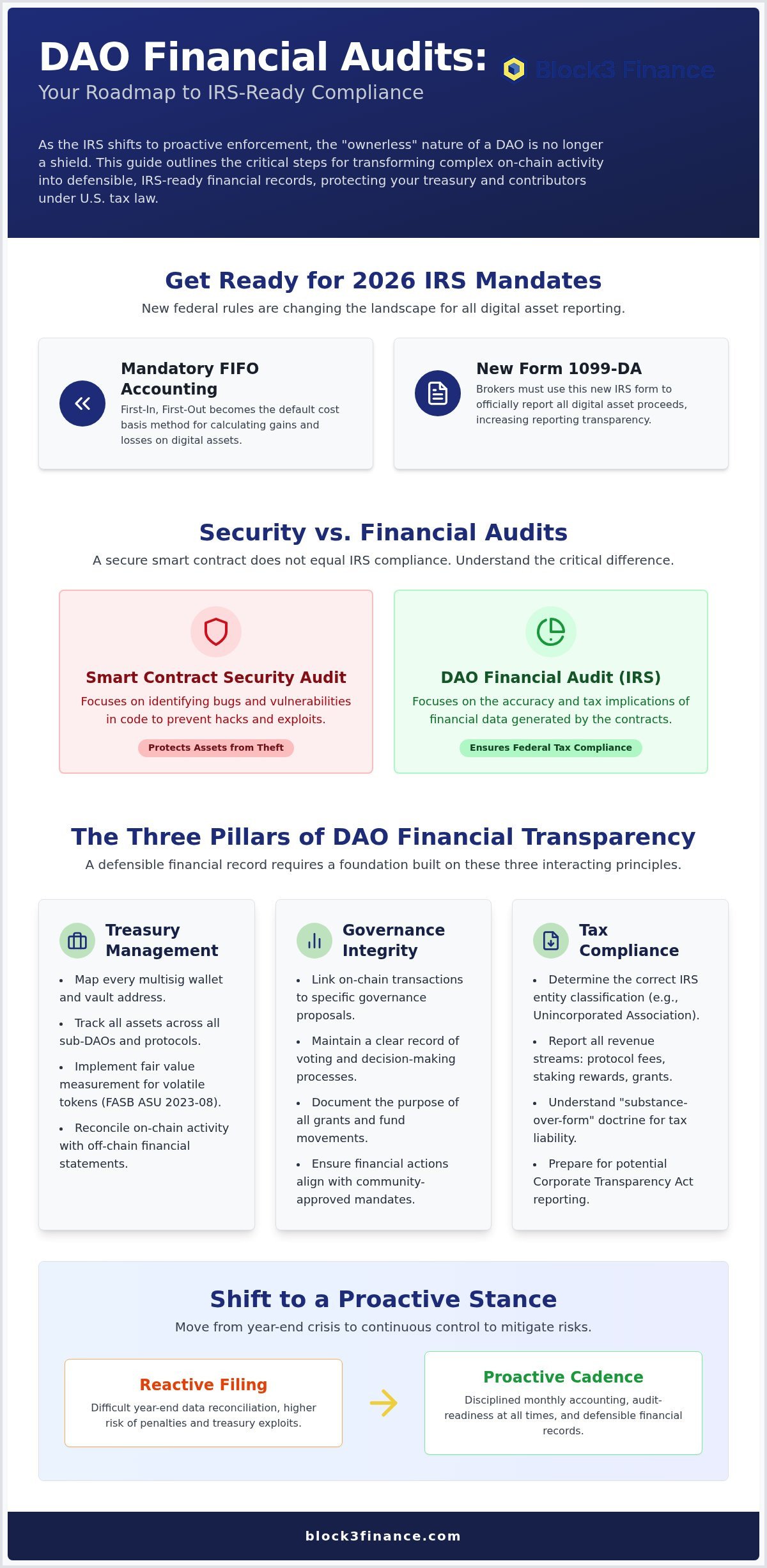
This guide provides a roadmap for mastering the transition to mandatory First-In, First-Out (FIFO) accounting, which is a method where the first assets you acquired are treated as the first ones sold. You will also learn to manage the new Form 1099-DA, the official IRS form brokers use to report digital asset proceeds. We show you how to transform complex on-chain activity into IRS-ready records that protect your treasury and your contributors.
Key Takeaways
- Distinguish between smart contract security and a crypto audit for DAOs to ensure your organization meets IRS standards for comprehensive financial reporting.
- Prepare for 2026 IRS mandates, including the mandatory First-In, First-Out (FIFO) cost basis method and the new Form 1099-DA for digital asset proceeds.
- Build a defensible financial record by aligning your treasury management with governance actions and federal tax obligations.
- Transition from reactive year-end filing to a proactive monthly accounting cadence to mitigate the risk of IRS penalties and treasury exploits.
- Navigate the complexities of the Corporate Transparency Act—a federal law requiring certain entities to report ownership information—and determine the correct IRS classification for your DAO.
What is a Crypto Audit for DAOs Under IRS Standards?
A crypto audit for DAOs is a rigorous validation process that goes far beyond simple code reviews. It's a formal examination of treasury records and governance actions to ensure every transaction aligns with federal reporting requirements. This guide focuses exclusively on US-based organizations or those with US-based participants operating under IRS rules.
Audit-readiness is a proactive state of financial health. It means your organization can produce defensible records of income, airdrops, and staking rewards at a moment's notice. Achieving this requires a shift from reactive bookkeeping to a disciplined monthly accounting cadence that captures the economic reality of your protocol.
The Distinction Between Security and Financial Audits
Many teams confuse a smart contract security audit with a financial one. Security audits focus on identifying bugs or vulnerabilities in code to prevent hacks or exploits. A crypto audit for DAOs focuses on the accuracy and tax implications of the financial data those contracts generate.
The blockchain serves as a shared ledger, but it's not a tax return. You must reconcile on-chain events, like token swaps or liquidity provision, with off-chain legal obligations. Verifying a protocol's code doesn't satisfy the IRS if the resulting dollar-denominated gains aren't reported correctly on your annual filings.
Financial audits involve verifying the cost basis of assets and the timing of income recognition. Cost basis is the original value of an asset for tax purposes, used to determine your capital gains or losses. Without this reconciliation, the "trustless" nature of the blockchain becomes a liability during an IRS examination.
Why the IRS Cares About Your DAO Treasury
The IRS views a Decentralized Autonomous Organization (DAO) as a nexus of contracts that often functions as a business entity. A nexus of contracts is a legal theory that views a firm as a collection of agreements rather than a single person. Without a formal legal structure, the IRS may classify your organization as an unincorporated association.
An unincorporated association is a group of people who act together for a common purpose without a formal corporate status. This status creates significant risk for US participants who may be held personally liable for the entity's tax obligations. The agency uses the substance-over-form doctrine to tax you based on your actual economic activity rather than your decentralized label.
The IRS is specifically looking for transparent reporting of all revenue streams. This includes protocol fees, staking rewards, and governance-approved grants. We help you transform these high-volume on-chain events into a transparent treasury report that satisfies both your community and federal regulators.
The Three Pillars of DAO Financial Transparency
A successful crypto audit for DAOs rests on three essential pillars: Treasury Management, Governance Integrity, and Tax Compliance. These pillars don't exist in isolation. Instead, they interact to create a defensible financial record that stands up to the scrutiny of federal regulators. You shouldn't wait for an official notice to start building these foundations.
Proactive preparation ensures that your organization transitions from a defensive posture to one of total command over its financial landscape. We recommend establishing these systems early to avoid the friction of retroactive reconciliation. For a deeper look at the operational side, see our DAO Accounting: A Strategic Guide.
Treasury Management and Asset Reconciliation
The first step in any audit is mapping every multisig wallet and vault address controlled by the DAO. A multisig (multi-signature) wallet is a digital wallet that requires two or more private keys to sign and send a transaction. We meticulously track these addresses to ensure every asset is accounted for across all sub-DAOs and protocol layers.
One of the most complex challenges is fair value measurement for volatile governance tokens. Under the Financial Accounting Standards Board (FASB) ASU 2023-08, companies must measure many crypto assets at fair value in each reporting period. This means you must record the market value of your tokens on specific dates rather than just their original cost.
This requirement aligns with the latest IRS digital asset reporting regulations, which demand granular data for every taxable event. Accurate reconciliation prevents the misreporting of income that often leads to costly penalties. Our team specializes in turning this high-volume data into clear, IRS-ready financial statements.
Governance Integrity and Spending Proposals
Transparency requires linking on-chain votes to actual fund movements. When a community uses platforms like Snapshot or Tally to approve a grant, auditors must verify that the multisig execution matched the proposal's intent. Discrepancies between what was voted on and what was actually spent can lead to governance exploits or treasury mismanagement.
We examine the "intent" of a proposal against its execution to prevent governance capture. Governance capture occurs when a small group of influential actors gains enough voting power to manipulate the DAO's treasury for their own benefit. By auditing these interactions, you protect the community from internal friction and external regulatory flags.
A transparent treasury report builds trust with your token holders and demonstrates a commitment to best practices. If your team needs a professional review of these complex layers, you can consult with our specialized audit team to ensure your records are IRS-ready. We bridge the gap between decentralized innovation and traditional financial oversight.
IRS vs. Traditional Audits: Why DAOs are Different
Traditional audits rely on paper trails and human oversight. A crypto audit for DAOs operates on a different plane. While a traditional firm is a nexus of contracts held together by legal filings, a DAO is a nexus of contracts orchestrated by immutable code. This shifts the auditor's role from trusting a board of directors to verifying a protocol's execution.
We don't wait for monthly bank statements in the decentralized world. Instead, we rely on block explorers to decode a 24/7 stream of activity. Traditional corporate reporting is quarterly and reactive. DAO activity is constant, requiring a real-time approach to financial oversight that matches the speed of the blockchain.
The transition from "trust" to "verification" is the hallmark of modern monthly accounting for digital assets. We use specialized tools to pull data directly from the ledger, ensuring that every transaction is accounted for. This method eliminates the risk of human error or document tampering that often plagues traditional financial reviews.
The integration of blockchain and financial auditing allows for a level of transparency previously impossible in legacy systems. We help you leverage this transparency to build a defensible record for the IRS. Our goal is to transform your raw on-chain data into a polished financial narrative.
The Challenge of Anonymity and KYC
The IRS expects clear records of who receives treasury distributions. This creates friction with the decentralized ideal of anonymity. Under IRS rules, organizations must often issue Form 1099 to contributors receiving significant payments. A Form 1099 is an IRS tax document used to report various types of income other than wages, salaries, and tips.
DAOs can manage this by implementing "KYC-lite" processes or using sub-entities to handle payroll legally. KYC stands for "Know Your Customer," a standard process used to verify the identity of participants to prevent fraud. We help you navigate these requirements without compromising the core values of your community.
Revenue Recognition in a Decentralized Ecosystem
Auditing income in a decentralized ecosystem is inherently complex. Income arrives through protocol fees, token sales, or yield farming. Yield farming is the practice of staking or lending crypto assets to generate high returns or rewards in the form of additional cryptocurrency. We also account for the nuances of liquidity pool (LP) positions, where assets are locked in a smart contract to facilitate trading.
Revenue recognition for DAOs occurs when the protocol's smart contracts successfully execute a fee-generating event, regardless of whether those assets are immediately converted to fiat. This requires precise timing and valuation to ensure your tax filings are accurate. We reconcile these events to prevent the overpayment or underpayment of taxes.
Preparing Your DAO for an IRS-Ready Audit
Audit preparation is not a year-end hurdle. It's a continuous rhythm of financial discipline. Transitioning from a defensive posture to one of total command requires shifting your focus from reactive filing to proactive mastery. We recommend integrating crypto accounting services into your monthly operations to ensure your records remain defensible under IRS scrutiny.
A successful crypto audit for DAOs relies on an immutable record of all governance decisions. You must prove to the IRS that every fund movement was authorized and served a legitimate business purpose. This level of transparency protects your treasury from internal exploits and external regulatory flags.
Step 1: Inventory All On-Chain and Off-Chain Assets
The first stage of preparation involves creating a comprehensive map of your organization's footprint. You must list every multisig wallet address, smart contract vault, and fiat bank account associated with the DAO. A smart contract vault is a secure digital container on the blockchain used to store and manage assets according to pre-set rules.
- Include all "staked" assets and "locked" tokens currently earning yield.
- Identify off-chain assets like intellectual property (IP) or legal entities.
- IP refers to intangible assets like trademarks or software copyrights owned by the DAO's legal wrapper.
Step 2: Reconcile Governance Proposals to Treasury Outflows
The IRS looks for the "intent" behind every transaction. We recommend maintaining a database that links every Proposal ID to its corresponding Transaction Hash. A transaction hash is a unique string of characters that acts as a digital receipt for a blockchain transaction.
You must document the specific business purpose of every treasury distribution. Flag any transactions that lack a corresponding governance vote for immediate review. This process ensures that your financial narrative is consistent with your on-chain activity.
Step 3: Implement Professional Crypto Bookkeeping
Manual spreadsheets fail at scale. As your DAO grows, the complexity of thousands of on-chain transactions makes manual tracking impossible. Relying on professional crypto audit preparation ensures that your data is structured in a way that an IRS agent can easily follow.
Professional bookkeeping creates a clear audit trail. It transforms raw blockchain data into polished financial statements that reflect the economic reality of your protocol. If you want to secure your organization's future, schedule a consultation with our DAO experts to begin your journey toward total financial transparency.
How Block3 Finance Navigates DAO Audit Complexity
Block3 Finance acts as a visionary navigator for organizations facing the intricate demands of a crypto audit for DAOs. With over 13 years of blockchain financial expertise, we've helped more than 980 global clients turn high-volume data into defensible records. Our firm is a Bitcoin.com top-ranked provider, offering the technical rigor needed to satisfy federal regulators while respecting decentralized principles.
We believe that the future of finance requires a new set of rules and a different kind of community engagement. Our team doesn't just provide a service; we offer a roadmap for thriving in a complex world. We position ourselves as a calm force in a chaotic industry, characterized by deep experience and a commitment to best practices.
Turning On-Chain Chaos into Clean Financial Records
We specialize in transforming on-chain chaos into polished financial narratives through a proprietary reconciliation process. This methodology handles thousands of transactions across multiple chains, ensuring every movement of funds has a documented business purpose. We build comprehensive audit trails that satisfy both the IRS and your community members, fostering trust through radical transparency.
For growing organizations, our fractional crypto CFO services provide strategic leadership without the overhead of a full-time executive. A fractional CFO is a part-time financial expert who offers high-level guidance on budgeting, tax strategy, and risk management. This proactive oversight ensures your treasury remains healthy and compliant as you scale.
Our goal is to resolve the friction between decentralized ideals and the practical realities of compliance. We use specialized tools to pull data directly from the ledger, eliminating the risk of human error. This disciplined approach allows you to maintain total command over your financial landscape while preparing for a crypto audit for DAOs.
Strategic Corporate Structuring for DAOs
Strategic corporate structuring is essential for mitigating the risks associated with decentralized governance. Wrapping a DAO in a legal entity, such as an LLC or a Foundation, provides a defined framework for interacting with traditional systems. This structure reduces the personal liability of participants, protecting them from being treated as an unincorporated association under IRS rules.
A legal wrapper also simplifies the process of opening fiat bank accounts and entering into contracts with off-chain vendors. We help you choose the right jurisdiction and entity type to align with your organization's long-term goals. This proactive approach to global tax compliance mitigates the risk of sudden regulatory shifts.
By choosing a partner with deep immersion in the blockchain ecosystem, you secure an elite strategist for your Web3 financial oversight. We invite you to consult with our team to ensure your organization is fully prepared for the 2026 tax season. Let us help you cultivate a treasury that is both innovative and IRS-ready.
Master Your DAO’s Financial Narrative
The 2026 tax season marks a definitive turning point for decentralized organizations. You've seen that a crypto audit for DAOs requires a fusion of smart contract transparency and rigorous IRS financial reporting. By implementing proactive monthly accounting and reconciling every governance vote to treasury outflows, you protect your community from personal liability and regulatory friction.
Block3 Finance brings 13+ years of blockchain financial expertise to your organization. We've served over 980 global clients and are ranked as the #1 Crypto Tax Provider by Bitcoin.com. Our team transforms complex on-chain activity into defensible financial records that satisfy federal regulators while respecting your decentralized mission.
Don't let the "ownerless" nature of your treasury become a liability. You can Secure Your DAO’s Financial Future with Block3 Finance Audit Services starting today. Take command of your financial landscape and build a legacy of institutional-grade transparency.
Frequently Asked Questions
Does a DAO really need a financial audit if all transactions are on the blockchain?
Yes, a financial audit is essential because the blockchain records data but not tax intent. A crypto audit for DAOs turns raw data into a defensible financial statement that satisfies federal regulators. The IRS doesn't accept a block explorer link as a valid tax return. You must reconcile every swap and transfer to establish a clear cost basis for capital gains reporting and treasury transparency.
What are the main IRS forms a DAO might need to consider for tax reporting?
Depending on your structure, you may need to file Form 1065 for partnerships or Form 1120 for corporations. Starting in 2026, the new Form 1099-DA is mandatory for reporting digital asset proceeds to the IRS. If your DAO has international participants or assets, you might also face requirements for Form 5471 or Form 8865. Always check with the IRS for current filing thresholds.
How does the IRS treat treasury diversification into stablecoins or US Treasuries?
Diversification events are generally treated as taxable disposals under IRS rules. Swapping volatile tokens for stablecoins triggers a capital gain or loss that you must report. If your treasury holds US Treasuries, you must also account for interest income. These transactions require precise fair value measurement under FASB ASU 2023-08 standards to ensure your books reflect the economic reality of the organization.
Can an anonymous contributor receive payments from a DAO treasury legally?
It's difficult to pay anonymous contributors legally if those payments exceed $600 in a tax year. The IRS requires organizations to issue a Form 1099 for such distributions. Most DAOs use a legal wrapper to handle these payments or require a Know Your Customer (KYC) process. This ensures the organization avoids penalties for failing to report income paid to individuals for their services or contributions.
What is the difference between a smart contract audit and a DAO financial audit?
A smart contract audit focuses on code security to prevent hacks and exploits by finding bugs. In contrast, a crypto audit for DAOs focuses on financial accuracy and IRS compliance for the organization's treasury. One ensures the protocol works as intended, while the other ensures the treasury's activity is reported correctly. Both are necessary to protect your decentralized organization from different types of systemic risk.
How long does a typical crypto audit for a DAO take to complete?
The duration of an audit depends on the transaction volume and the current state of your records. A standard review typically takes between four and eight weeks to complete. If your organization has thousands of unreconciled on-chain transactions across multiple protocols, the process can take longer. Maintaining monthly accounting records significantly reduces the time required for a formal year-end examination or an official IRS review.
What happens if our DAO cannot reconcile all historical on-chain transactions?
Unreconciled transactions often lead the IRS to assume a zero-dollar cost basis. This means you could be taxed on the full value of a sale rather than just the profit. It's critical to use professional bookkeeping to build a defensible record of all historical activity. Our team specializes in forensic reconciliation to help you reconstruct these missing financial narratives and mitigate the risk of overpayment.
How often should a DAO treasury undergo a formal financial review?
We recommend a formal financial review at least once per year, but monthly reviews are the gold standard for compliance. A monthly cadence allows you to catch errors early and maintain audit-ready status throughout the year. This proactive approach prevents a year-end panic and ensures you are ready for the 2026 filing season. It also builds trust with your community and governance participants.

Article by
Mahad Mohamed
Mahad Mohamed is an accountant and the CEO of Block3 Finance, with over 26+ years of Canadian and international tax and accounting experience. A crypto accounting specialist since the early days of Bitcoin, he has consulted for over 38 crypto companies and collaborated with legal professionals on regulatory matters. His expertise spans corporate reorganization, cross-border tax structuring (Canada & US), tax disputes, and CRA audits.
Previously, Mahad worked for the Canada Revenue Agency (CRA), Big4 accounting firms, and served as a Rulings Officer for the Federal Tax Authority of the UAE before acquiring Tax Partners in 2014.
Block3 Finance and Tax Partners has 44 full-time accountants and over 9,800+ clients.
Disclaimer
This article provides general information only and is current as of its publication date. It has not been updated and may be out of date. It does not constitute legal advice and should not be relied upon as such. Every tax situation is unique and may differ from the examples discussed in this article. If you have specific questions, you should seek the advice of our accountants for your unique circumstances.
Frequently Asked Questions
Does a DAO really need a financial audit if all transactions are on the blockchain?
Yes, a financial audit is essential because the blockchain records data but not tax intent. A crypto audit for DAOs turns raw data into a defensible financial statement that satisfies federal regulators. The IRS doesn't accept a block explorer link as a valid tax return. You must reconcile every swap and transfer to establish a clear cost basis for capital gains reporting and treasury transparency.
What are the main IRS forms a DAO might need to consider for tax reporting?
Depending on your structure, you may need to file Form 1065 for partnerships or Form 1120 for corporations. Starting in 2026, the new Form 1099-DA is mandatory for reporting digital asset proceeds to the IRS. If your DAO has international participants or assets, you might also face requirements for Form 5471 or Form 8865. Always check with the IRS for current filing thresholds.
How does the IRS treat treasury diversification into stablecoins or US Treasuries?
Diversification events are generally treated as taxable disposals under IRS rules. Swapping volatile tokens for stablecoins triggers a capital gain or loss that you must report. If your treasury holds US Treasuries, you must also account for interest income. These transactions require precise fair value measurement under FASB ASU 2023-08 standards to ensure your books reflect the economic reality of the organization.
Can an anonymous contributor receive payments from a DAO treasury legally?
It's difficult to pay anonymous contributors legally if those payments exceed $600 in a tax year. The IRS requires organizations to issue a Form 1099 for such distributions. Most DAOs use a legal wrapper to handle these payments or require a Know Your Customer (KYC) process. This ensures the organization avoids penalties for failing to report income paid to individuals for their services or contributions.
What is the difference between a smart contract audit and a DAO financial audit?
A smart contract audit focuses on code security to prevent hacks and exploits by finding bugs. In contrast, a crypto audit for DAOs focuses on financial accuracy and IRS compliance for the organization's treasury. One ensures the protocol works as intended, while the other ensures the treasury's activity is reported correctly. Both are necessary to protect your decentralized organization from different types of systemic risk.
How long does a typical crypto audit for a DAO take to complete?
The duration of an audit depends on the transaction volume and the current state of your records. A standard review typically takes between four and eight weeks to complete. If your organization has thousands of unreconciled on-chain transactions across multiple protocols, the process can take longer. Maintaining monthly accounting records significantly reduces the time required for a formal year-end examination or an official IRS review.
What happens if our DAO cannot reconcile all historical on-chain transactions?
Unreconciled transactions often lead the IRS to assume a zero-dollar cost basis. This means you could be taxed on the full value of a sale rather than just the profit. It's critical to use professional bookkeeping to build a defensible record of all historical activity. Our team specializes in forensic reconciliation to help you reconstruct these missing financial narratives and mitigate the risk of overpayment.
How often should a DAO treasury undergo a formal financial review?
We recommend a formal financial review at least once per year, but monthly reviews are the gold standard for compliance. A monthly cadence allows you to catch errors early and maintain audit-ready status throughout the year. This proactive approach prevents a year-end panic and ensures you are ready for the 2026 filing season. It also builds trust with your community and governance participants.