
Most DAOs view the IRS as an inevitable threat, yet the truly resilient organizations realize that rigorous financial oversight is actually their greatest competitive advantage. Precision is no longer optional. When your treasury holds millions in volatile assets, the lack of standardized DAO accounting isn't just a technical hurdle; it's a systemic risk to your mission.
You've likely felt the friction of trying to explain Gnosis Safe transactions to a traditional accountant who treats smart contracts like science fiction. Tracking global contributor payments while your native token fluctuates wildly makes even basic bookkeeping feel like a nightmare. We understand that you need to shift from a defensive posture to one of total command over your decentralized finances. This guide provides a comprehensive framework to master decentralized financial reporting and IRS compliance under current federal rules. We will detail how to build a defensible audit trail, implement transparent workflows for contributor payroll, and professionalize your treasury management to meet the evolving standards of the 2025 tax year.
Key Takeaways
- Learn why the IRS may default to treating your DAO as a General Partnership and how to mitigate this risk through strategic entity structuring and proactive classification.
- Master the complexities of DAO accounting by implementing specialized workflows for multi-sig wallet reconciliation and consistent native token valuation.
- Discover why legacy software like QuickBooks often fails decentralized organizations and how to select the right crypto-native sub-ledger to aggregate multi-chain data.
- Establish a defensible audit trail for the IRS by standardizing transaction labeling within Gnosis Safe and other decentralized treasury management tools.
- Unlock transparent financial reporting for your members while ensuring your organization remains compliant with the evolving 2025 IRS reporting requirements.
DAO Accounting Foundations Under IRS Frameworks
At its core, DAO accounting is the rigorous process of capturing, categorizing, and reporting the economic activities of a Decentralized Autonomous Organization (DAO). It transforms raw blockchain data into a structured financial narrative that satisfies both internal community transparency and external regulatory demands. For US-based organizations, this isn't merely a bookkeeping exercise; it's a vital survival mechanism. This guide focuses exclusively on the requirements for DAOs operating under IRS rules or those with core contributors residing within the United States.
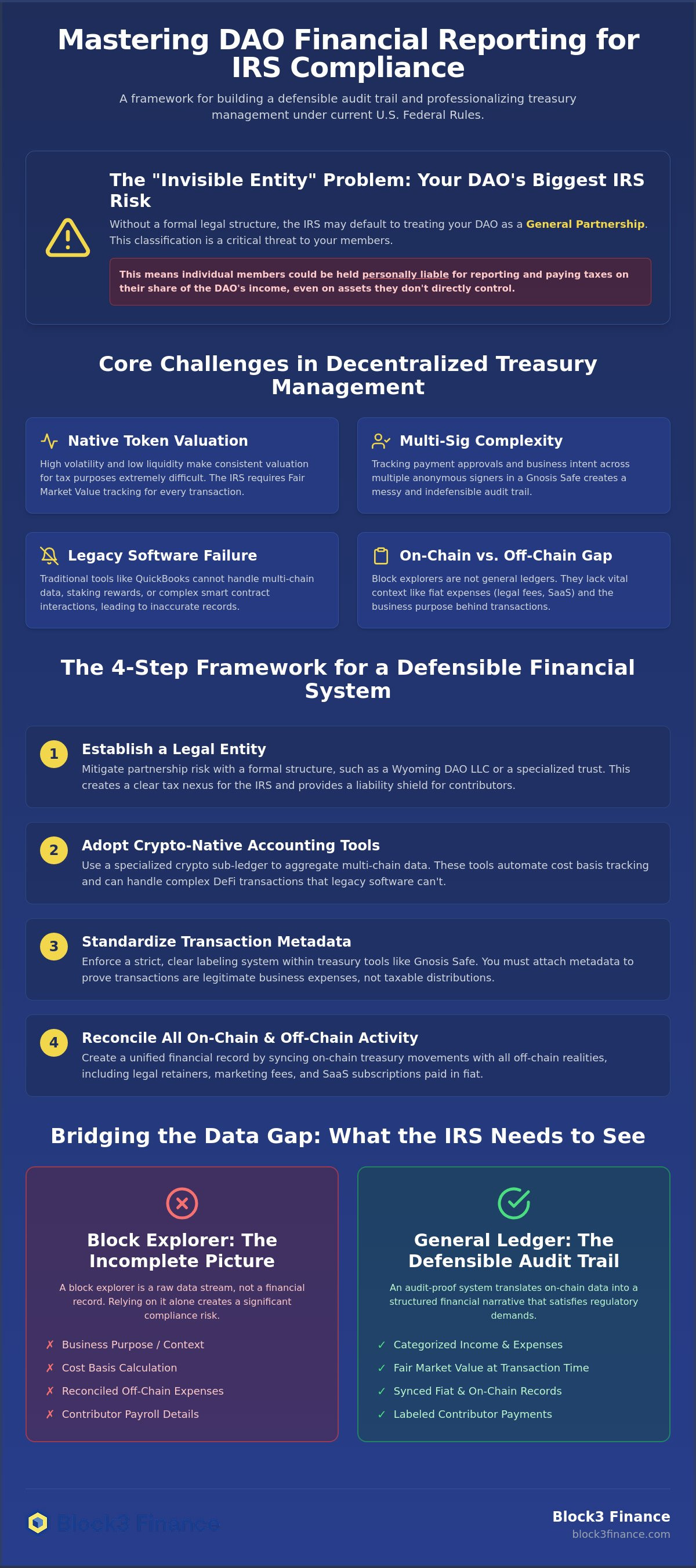
The primary hurdle many decentralized teams face is the "Invisible Entity" problem. Without a formal legal wrapper, the IRS doesn't see a revolutionary protocol; it sees an unincorporated group of individuals engaging in business for profit. As of 2026, the default treatment for a DAO with no legal wrapper is often considered a pass-through partnership. This classification is dangerous. It implies that individual members could be held responsible for reporting their share of the DAO's income, potentially leading to personal tax liabilities on assets they don't directly control. Shifting from this defensive posture requires a proactive approach to treasury management that treats a multi-sig wallet as a professional balance sheet rather than a communal slush fund.
Tax Classification for DAOs: IRS Perspectives
Choosing a formal structure is the first step toward gaining command over your financial landscape. While the ecosystem often debates the merits of various wrappers, the IRS typically looks for a clear tax nexus. Organizations that remain "disregarded entities" or default partnerships face immense friction when trying to open bank accounts or comply with the new Form 1099-DA reporting requirements. We often advocate for corporate structuring to provide a shield for contributors and a clear pathway for tax efficiency. Whether you opt for a Wyoming DAO LLC or a specialized trust, you must verify the specific entity type to ensure it aligns with your governance model.
The Distinction Between On-Chain and Off-Chain Records
A common misconception in the space is that Etherscan or other block explorers serve as a sufficient financial record. They don't. A block explorer is a data stream, not a general ledger. Effective DAO accounting requires a "defensible" audit trail that bridges the gap between on-chain transactions and off-chain realities. This includes:
- Syncing fiat expenses: Legal retainers, marketing agency fees, and SaaS subscriptions paid via traditional banking must be reconciled with treasury outflows.
- Cost basis tracking: Every time a treasury moves assets, the IRS requires a record of the fair market value at the time of the transaction. For the 2025 tax year, brokers are generally required to report gross proceeds, making accurate internal cost basis tracking essential for the 2026 mandatory reporting transition.
- Contributor context: Smart contracts don't explain the intent behind a payment. You must attach metadata to transactions to prove they were legitimate business expenses rather than taxable distributions to members.
By maintaining these dual records, you create a robust framework that can withstand the scrutiny of an IRS inquiry while providing your community with the transparency they deserve.
Core Challenges in Decentralized Treasury Management
Managing a decentralized treasury requires moving beyond simple wallet tracking toward a sophisticated translation of on-chain activity into compliant financial data. The inherent legal and tax uncertainties of DAOs often stem from the friction between automated smart contracts and rigid regulatory frameworks. For organizations managing millions in assets, the accounting hurdles are multi-layered, ranging from pricing illiquid native tokens to reconciling complex multi-sig approvals. Without a clear system for labeling transactions across different signers, your treasury becomes a black box that invites regulatory scrutiny.
Valuation of Native Tokens and Airdrops
One of the most persistent friction points in DAO accounting is the valuation of the organization's own native tokens. Unlike stablecoins, native tokens often suffer from low liquidity and high volatility, making fair value measurement a constant challenge. Under IRS rules, specifically IRS Revenue Ruling 2019-24, the receipt of assets through airdrops or hard forks is generally treated as ordinary income based on the fair market value at the time of receipt. Determining a "cost basis" for tokens minted directly by the protocol remains a gray area. We advocate for a disciplined approach that utilizes weighted average pricing from reputable oracles to establish a defensible valuation for your balance sheet.
Tracking Contributor Payments and Crypto Payroll
The decentralized nature of these organizations often results in a global workforce, yet US-based contributors must still comply with federal tax obligations. Distinguishing between a W-2 employee and a 1099-NEC independent contractor is critical for avoiding payroll tax penalties. This becomes even more complex when using "streaming" payment protocols like Sablier. While these tools automate the flow of capital, they create a reporting nightmare if the income isn't properly attributed to specific accounting periods. To mitigate these risks, we often recommend corporate structuring to centralize payroll liability and provide a clear legal framework for contributor agreements. If your team is struggling to reconcile these streams, reaching out for a professional consultation can help you establish the necessary guardrails.
Liquidity Pool and DeFi Accounting
Treasuries that actively participate in DeFi must also account for impermanent loss, which is the temporary reduction in value that occurs when the market price of assets in a liquidity pool changes compared to their price at the time of deposit. Tracking the fluctuating value of liquidity provider (LP) tokens is not as simple as checking a wallet balance. Each swap, deposit, and withdrawal is a taxable event under current IRS frameworks. You must maintain precise records of the cost basis for each asset within the pool to accurately report gains or losses. Ignoring these complexities can lead to significant discrepancies during an audit, undermining the transparency of your organization. Every transaction must be captured in real-time to ensure your DAO accounting remains robust against future inquiries.
Comparing Solutions: DAO Accounting Software vs. Specialized Firms
Scaling a decentralized treasury eventually exposes the fragile nature of DIY bookkeeping. While spreadsheets work for early-stage prototypes, they crumble under the weight of high-volume on-chain activity and multi-chain complexity. Professional DAO accounting requires a sophisticated tech stack that bridges the gap between decentralized protocols and centralized regulatory expectations. You must decide whether to rely solely on automated software or to partner with a specialized firm that provides the strategic oversight required for IRS defense; for organizations looking to professionalize their financial oversight, you can learn more about AccouConsult and their specialized bookkeeping solutions.
Traditional ERPs vs. Crypto Sub-Ledgers
Traditional ERPs like QuickBooks or NetSuite weren't built for the blockchain. They can't interpret smart contract interactions, track cost basis across thousands of transactions, or handle the specific nuances of digital asset impairment. Crypto-native sub-ledgers like Entendre or Bitwave act as the vital translator. These tools ingest raw chain data and convert it into a format your general ledger can digest. However, automation is not a panacea. The "garbage in, garbage out" principle applies heavily here. If you don't correctly label your transactions, your sub-ledger will simply automate your errors. The stakes for accurate reporting grew significantly following the SEC investigative report on DAO tokens, which established that decentralized assets can be classified as securities, fundamentally changing your tax obligations under IRS frameworks.
Why Specialized Crypto Accountants are Essential
Software alone cannot defend your treasury during an IRS inquiry. It lacks the nuanced judgment required to navigate a volatile landscape. Specialized crypto accountants provide the intellectual depth needed to manage high-stakes environments. They excel in audit preparation for Web3 organizations, ensuring every transaction has a defensible trail and proper documentation. These experts also navigate the specific complexities of fair value accounting under Accounting Standards Update (ASU) 2023-08. This ASU is a set of updated rules from the Financial Accounting Standards Board that mandates certain crypto assets be measured at fair value, which can significantly impact how your treasury's health is perceived by members and regulators alike.
Partnering with a specialized firm moves your organization from a defensive posture to an offensive one focused on mastery. Beyond basic bookkeeping, these professionals offer CFO services that help you navigate treasury diversification and risk mitigation. They provide the roadmap for thriving in a complex world, shifting the focus from merely managing regulations to active participation in the evolution of decentralized finance. By integrating technical reconciliation with high-level strategic planning, you gain total command over your organization's financial future.
Implementation: Building a Defensible DAO Financial System
Transitioning from a reactive bookkeeping posture to a proactive financial strategy requires a structured implementation of systems that bridge the gap between multi-sig wallets and traditional reporting frameworks. For US-based organizations, this isn't just about efficiency; it's about creating an audit trail that holds up under IRS rules. A defensible DAO accounting system ensures that every gas fee, contributor payment, and staking reward is captured with the same rigor as a traditional corporate ledger.
Success depends on a methodical five-step framework designed to eliminate the friction between decentralized activity and centralized compliance:
- Standardize treasury workflows: Every transaction in your Gnosis Safe or multi-sig must be labeled at the point of approval. Without immediate context, you lose the ability to distinguish between business expenses and taxable distributions.
- Select a crypto-native sub-ledger: You need a specialized tool to aggregate multi-chain data and track cost basis in real-time. This sub-ledger acts as the essential translator for your raw blockchain data.
- Establish a month-end close process: On-chain reconciliation must happen every thirty days. Waiting until tax season to resolve "missing" transactions is a recipe for regulatory failure.
- Integrate with a traditional general ledger: Sync your sub-ledger data with an ERP like QuickBooks or Xero. This creates a consolidated view of your organization’s total financial health.
- Perform regular internal audits: Periodically review your records to ensure they align with current IRS reporting requirements, such as the new gross proceeds reporting for the 2025 tax year.
Setting Up Your Chart of Accounts for Web3
A Chart of Accounts in a DAO context is a structured index of every financial category used to record on-chain and off-chain transactions, providing the necessary granularity for protocol-specific expenses like gas and staking rewards. You can't simply use a standard corporate template. Your COA must reflect the unique economic activities of a decentralized protocol. We recommend creating specific buckets for protocol revenue, validator rewards, and bridge-related slippage. This level of detail allows for more accurate tax reporting and gives your community a transparent view of where capital is actually flowing.
The Month-End Close: Reconciling the Treasury
The month-end close is the heartbeat of professional monthly accounting for decentralized teams. This process involves matching every wallet outflow to a specific invoice or a DAO proposal found on Snapshot or Tally. You must also account for the movement of assets across bridges, ensuring that "wrapped" versions of tokens are correctly reconciled against their underlying assets. Failure to track these movements often results in phantom gains or losses that skew your financial statements. If you're ready to professionalize your treasury operations and secure your organization's future, contact our team today to begin building your defensible financial framework.
The Block3 Finance Approach to DAO Financial Governance
Block3 Finance operates as the visionary navigator for organizations that refuse to let regulatory friction stall their evolution. We don't just manage your books; we cultivate a financial environment where decentralized innovation meets the uncompromising rigor of IRS expectations. Our approach to DAO accounting transforms a volatile treasury into a disciplined, audit-ready asset through a sophisticated blend of technical mastery and strategic advocacy. With over 13 years of immersion in the blockchain ecosystem, we provide the grounded expertise required to navigate high-stakes environments with total confidence.
Our specialized tax filing and reporting services are designed to handle the specific burdens of the 2025 tax year, including the mandatory gross proceeds reporting on Form 1099-DA. We bridge the gap between complex on-chain data and the clear, defensible records the IRS demands. From the initial stages of corporate structuring to the delivery of consolidated financial statements, we provide a full-cycle solution that protects your contributors and empowers your community.
Strategic CFO Leadership for DAO Treasuries
True financial governance requires moving beyond simple transaction labeling toward high-level strategic planning. Our CFO services offer the roadmap your organization needs to thrive in a complex world. We manage the delicate balance of on and off-ramp solutions, ensuring that your operational expenses are funded through compliant fiat channels without triggering unnecessary tax events. As the SEC moves forward with its 2026 regulatory agenda, which includes a proposal for "Regulation Crypto" expected as early as July 2026, having an elite strategist at your side ensures you're positioned for growth rather than merely reacting to new rules.
Ready to Secure Your DAO’s Financial Future?
The era of "move fast and break things" in decentralized finance is being replaced by an era of disciplined maturity. Proactive compliance is no longer a defensive posture; it's an offensive strategy that builds trust with members and stability for the treasury. We invite you to begin your journey toward total financial command with a professional DAO financial assessment. Block3 Finance stands ready to serve as your calm force in a chaotic industry, characterized by deep experience and a belief in the power of professional networks. Connect with our team today to establish the best practices that will define your organization's legacy.
Command Your Decentralized Financial Future
Mastering DAO accounting is no longer a luxury for early adopters; it's a foundational requirement for any organization seeking to thrive under IRS scrutiny. You've seen how the lack of a formal legal wrapper can lead to risky partnership classifications and how the shift toward mandatory 1099-DA reporting for the 2025 tax year demands technical precision. By standardizing your treasury workflows and implementing crypto-native sub-ledgers, you transform your organization from a regulatory target into a model of transparent governance.
Block3 Finance serves as your visionary navigator in this volatile landscape. With 13+ years of specialized blockchain financial expertise and a track record of being trusted by 980+ global clients, we bridge the gap between protocol innovation and institutional rigor. It's no coincidence that we've been ranked as a top crypto accounting firm by Bitcoin.com. We provide the strategic CFO leadership and audit-ready reporting you need to scale with total confidence. You don't have to navigate these high-stakes complexities alone. Secure your DAO’s financial future with Block3 Finance and reclaim your agency in the evolution of finance. Your mission deserves a financial foundation as bold as your vision.
Frequently Asked Questions
How does the IRS view a DAO for tax purposes?
The IRS typically classifies an unincorporated DAO as a general partnership by default. This means the organization is treated as a pass-through entity where the tax obligations flow directly to the individual members. Because federal guidance on decentralized structures remains limited, you should confirm current details directly with the IRS regarding your specific classification and filing requirements.
Does a DAO need to issue 1099s to its contributors?
A DAO is generally required to issue Form 1099-NEC to any US-based contributor who receives $600 or more in a calendar year for services rendered. This form is used to report non-employee compensation paid to independent contractors. Because reporting thresholds and deadlines can change, you must confirm current details directly with the IRS website or official instructions for Form 1099-NEC.
What is the best accounting software for a DAO treasury?
The most robust solution involves a "hub-and-spoke" architecture that connects crypto-native sub-ledgers to a traditional general ledger. Tools like Bitwave or Entendre excel at capturing high-volume on-chain data, which is then synced into a traditional system like QuickBooks for consolidated reporting. This dual-layered approach is essential for professional DAO accounting and ensures your data is ready for a formal audit.
How do you handle the cost basis of native tokens in a DAO?
You handle the cost basis by recording the fair market value of the tokens at the precise moment they are received or minted. Fair market value is the price an asset would sell for on the open market between a willing buyer and seller. Since the valuation of illiquid tokens can be complex, you should confirm current details directly with the IRS regarding acceptable appraisal methods for digital assets.
Can a DAO be sued if it doesn't have a legal entity?
A DAO can be sued regardless of its legal status, and the lack of a formal entity often exposes members to joint and several liability. This legal concept means that any individual member can be held responsible for the entire amount of the organization's debts or legal damages. Establishing a legal wrapper is a critical step in protecting contributors from these systemic risks.
What are the main differences between DAO accounting and traditional accounting?
The primary difference is the source of truth; traditional accounting relies on bank records, while decentralized accounting uses the blockchain. You must reconcile transactions across multi-sig wallets and smart contracts in real-time rather than waiting for a monthly bank statement. This shift requires specialized technical knowledge to translate raw on-chain data into a format that satisfies standard accounting principles.
How do gas fees affect DAO bookkeeping?
Gas fees are generally treated as deductible business expenses that reduce your overall taxable income. These fees are the costs paid to network validators to process transactions on the blockchain. Because the deductibility of specific fees can vary based on the nature of the transaction, you should confirm current details directly with the IRS or a qualified tax professional.
Is a DAO treasury subject to capital gains tax?
A DAO treasury is subject to capital gains tax whenever it sells or exchanges one digital asset for another, including swaps for stablecoins. These events trigger a tax liability based on the difference between the asset's cost basis and its value at the time of the trade. You should confirm current details directly with the IRS to determine the specific tax rates applicable to your organization's capital gains for the current tax year.

Article by
Mahad Mohamed
Mahad Mohamed is an accountant and the CEO of Block3 Finance, with over 26+ years of Canadian and international tax and accounting experience. A crypto accounting specialist since the early days of Bitcoin, he has consulted for over 38 crypto companies and collaborated with legal professionals on regulatory matters. His expertise spans corporate reorganization, cross-border tax structuring (Canada & US), tax disputes, and CRA audits.
Previously, Mahad worked for the Canada Revenue Agency (CRA), Big4 accounting firms, and served as a Rulings Officer for the Federal Tax Authority of the UAE before acquiring Tax Partners in 2014.
Block3 Finance and Tax Partners has 44 full-time accountants and over 9,800+ clients.
Disclaimer
This article provides general information only and is current as of its publication date. It has not been updated and may be out of date. It does not constitute legal advice and should not be relied upon as such. Every tax situation is unique and may differ from the examples discussed in this article. If you have specific questions, you should seek the advice of our accountants for your unique circumstances.
Frequently Asked Questions
Tax Classification for DAOs: IRS Perspectives
Choosing a formal structure is the first step toward gaining command over your financial landscape. While the ecosystem often debates the merits of various wrappers, the IRS typically looks for a clear tax nexus. Organizations that remain "disregarded entities" or default partnerships face immense friction when trying to open bank accounts or comply with the new Form 1099-DA reporting requirements. We often advocate for corporate structuring to provide a shield for contributors and a clear pathway for tax efficiency. Whether you opt for a Wyoming DAO LLC or a specialized trust, you must verify the specific entity type to ensure it aligns with your governance model.
The Distinction Between On-Chain and Off-Chain Records
A common misconception in the space is that Etherscan or other block explorers serve as a sufficient financial record. They don't. A block explorer is a data stream, not a general ledger. Effective DAO accounting requires a "defensible" audit trail that bridges the gap between on-chain transactions and off-chain realities. This includes: By maintaining these dual records, you create a robust framework that can withstand the scrutiny of an IRS inquiry while providing your community with the transparency they deserve. Managing a decentralized treasury requires moving beyond simple wallet tracking toward a sophisticated translation of on-chain activity into compliant financial data. The inherent legal and tax uncertainties of DAOs often stem from the friction between automated smart contracts and rigid regulatory frameworks. For organizations managing millions in assets, the accounting hurdles are multi-layered, ranging from pricing illiquid native tokens to reconciling complex multi-sig approvals. Without a clear system for labeling transactions across different signers, your treasury becomes a black box that invites regulatory scrutiny.
Valuation of Native Tokens and Airdrops
One of the most persistent friction points in DAO accounting is the valuation of the organization's own native tokens. Unlike stablecoins, native tokens often suffer from low liquidity and high volatility, making fair value measurement a constant challenge. Under IRS rules, specifically IRS Revenue Ruling 2019-24, the receipt of assets through airdrops or hard forks is generally treated as ordinary income based on the fair market value at the time of receipt. Determining a "cost basis" for tokens minted directly by the protocol remains a gray area. We advocate for a disciplined approach that utilizes weighted average pricing from reputable oracles to establish a defensible valuation for your balance sheet.
Tracking Contributor Payments and Crypto Payroll
The decentralized nature of these organizations often results in a global workforce, yet US-based contributors must still comply with federal tax obligations. Distinguishing between a W-2 employee and a 1099-NEC independent contractor is critical for avoiding payroll tax penalties. This becomes even more complex when using "streaming" payment protocols like Sablier. While these tools automate the flow of capital, they create a reporting nightmare if the income isn't properly attributed to specific accounting periods. To mitigate these risks, we often recommend corporate structuring to centralize payroll liability and provide a clear legal framework for contributor agreements. If your team is struggling to reconcile these streams, reaching out for a professional consultation can help you establish the necessary guardrails.
Liquidity Pool and DeFi Accounting
Treasuries that actively participate in DeFi must also account for impermanent loss, which is the temporary reduction in value that occurs when the market price of assets in a liquidity pool changes compared to their price at the time of deposit. Tracking the fluctuating value of liquidity provider (LP) tokens is not as simple as checking a wallet balance. Each swap, deposit, and withdrawal is a taxable event under current IRS frameworks. You must maintain precise records of the cost basis for each asset within the pool to accurately report gains or losses. Ignoring these complexities can lead to significant discrepancies during an audit, undermining the transparency of your organization. Every transaction must be captured in real-time to ensure your DAO accounting remains robust against future inquiries. Scaling a decentralized treasury eventually exposes the fragile nature of DIY bookkeeping. While spreadsheets work for early-stage prototypes, they crumble under the weight of high-volume on-chain activity and multi-chain complexity. Professional DAO accounting requires a sophisticated tech stack that bridges the gap between decentralized protocols and centralized regulatory expectations. You must decide whether to rely solely on automated software or to partner with a specialized firm that provides the strategic oversight required for IRS defense.
Traditional ERPs vs. Crypto Sub-Ledgers
Traditional ERPs like QuickBooks or NetSuite weren't built for the blockchain. They can't interpret smart contract interactions, track cost basis across thousands of transactions, or handle the specific nuances of digital asset impairment. Crypto-native sub-ledgers like Entendre or Bitwave act as the vital translator. These tools ingest raw chain data and convert it into a format your general ledger can digest. However, automation is not a panacea. The "garbage in, garbage out" principle applies heavily here. If you don't correctly label your transactions, your sub-ledger will simply automate your errors. The stakes for accurate reporting grew significantly following the SEC investigative report on DAO tokens, which established that decentralized assets can be classified as securities, fundamentally changing your tax obligations under IRS frameworks.
Why Specialized Crypto Accountants are Essential
Software alone cannot defend your treasury during an IRS inquiry. It lacks the nuanced judgment required to navigate a volatile landscape. Specialized crypto accountants provide the intellectual depth needed to manage high-stakes environments. They excel in audit preparation for Web3 organizations, ensuring every transaction has a defensible trail and proper documentation. These experts also navigate the specific complexities of fair value accounting under Accounting Standards Update (ASU) 2023-08. This ASU is a set of updated rules from the Financial Accounting Standards Board that mandates certain crypto assets be measured at fair value, which can significantly impact how your treasury's health is perceived by members and regulators alike. Partnering with a specialized firm moves your organization from a defensive posture to an offensive one focused on mastery. Beyond basic bookkeeping, these professionals offer CFO services that help you navigate treasury diversification and risk mitigation. They provide the roadmap for thriving in a complex world, shifting the focus from merely managing regulations to active participation in the evolution of decentralized finance. By integrating technical reconciliation with high-level strategic planning, you gain total command over your organization's financial future. Transitioning from a reactive bookkeeping posture to a proactive financial strategy requires a structured implementation of systems that bridge the gap between multi-sig wallets and traditional reporting frameworks. For US-based organizations, this isn't just about efficiency; it's about creating an audit trail that holds up under IRS rules. A defensible DAO accounting system ensures that every gas fee, contributor payment, and staking reward is captured with the same rigor as a traditional corporate ledger. Success depends on a methodical five-step framework designed to eliminate the friction between decentralized activity and centralized compliance:
Setting Up Your Chart of Accounts for Web3
A Chart of Accounts in a DAO context is a structured index of every financial category used to record on-chain and off-chain transactions, providing the necessary granularity for protocol-specific expenses like gas and staking rewards. You can't simply use a standard corporate template. Your COA must reflect the unique economic activities of a decentralized protocol. We recommend creating specific buckets for protocol revenue, validator rewards, and bridge-related slippage. This level of detail allows for more accurate tax reporting and gives your community a transparent view of where capital is actually flowing.
The Month-End Close: Reconciling the Treasury
The month-end close is the heartbeat of professional monthly accounting for decentralized teams. This process involves matching every wallet outflow to a specific invoice or a DAO proposal found on Snapshot or Tally. You must also account for the movement of assets across bridges, ensuring that "wrapped" versions of tokens are correctly reconciled against their underlying assets. Failure to track these movements often results in phantom gains or losses that skew your financial statements. If you're ready to professionalize your treasury operations and secure your organization's future, contact our team today to begin building your defensible financial framework. Block3 Finance operates as the visionary navigator for organizations that refuse to let regulatory friction stall their evolution. We don't just manage your books; we cultivate a financial environment where decentralized innovation meets the uncompromising rigor of IRS expectations. Our approach to DAO accounting transforms a volatile treasury into a disciplined, audit-ready asset through a sophisticated blend of technical mastery and strategic advocacy. With over 13 years of immersion in the blockchain ecosystem, we provide the grounded expertise required to navigate high-stakes environments with total confidence. Our specialized tax filing and reporting services are designed to handle the specific burdens of the 2025 tax year, including the mandatory gross proceeds reporting on Form 1099-DA. We bridge the gap between complex on-chain data and the clear, defensible records the IRS demands. From the initial stages of corporate structuring to the delivery of consolidated financial statements, we provide a full-cycle solution that protects your contributors and empowers your community.
Strategic CFO Leadership for DAO Treasuries
True financial governance requires moving beyond simple transaction labeling toward high-level strategic planning. Our CFO services offer the roadmap your organization needs to thrive in a complex world. We manage the delicate balance of on and off-ramp solutions, ensuring that your operational expenses are funded through compliant fiat channels without triggering unnecessary tax events. As the SEC moves forward with its 2026 regulatory agenda, which includes a proposal for "Regulation Crypto" expected as early as July 2026, having an elite strategist at your side ensures you're positioned for growth rather than merely reacting to new rules.
Ready to Secure Your DAO’s Financial Future?
The era of "move fast and break things" in decentralized finance is being replaced by an era of disciplined maturity. Proactive compliance is no longer a defensive posture; it's an offensive strategy that builds trust with members and stability for the treasury. We invite you to begin your journey toward total financial command with a professional DAO financial assessment. Block3 Finance stands ready to serve as your calm force in a chaotic industry, characterized by deep experience and a belief in the power of professional networks. Connect with our team today to establish the best practices that will define your organization's legacy. Mastering DAO accounting is no longer a luxury for early adopters; it's a foundational requirement for any organization seeking to thrive under IRS scrutiny. You've seen how the lack of a formal legal wrapper can lead to risky partnership classifications and how the shift toward mandatory 1099-DA reporting for the 2025 tax year demands technical precision. By standardizing your treasury workflows and implementing crypto-native sub-ledgers, you transform your organization from a regulatory target into a model of transparent governance. Block3 Finance serves as your visionary navigator in this volatile landscape. With 13+ years of specialized blockchain financial expertise and a track record of being trusted by 980+ global clients, we bridge the gap between protocol innovation and institutional rigor. It's no coincidence that we've been ranked as a top crypto accounting firm by Bitcoin.com. We provide the strategic CFO leadership and audit-ready reporting you need to scale with total confidence. You don't have to navigate these high-stakes complexities alone. Secure your DAO’s financial future with Block3 Finance and reclaim your agency in the evolution of finance. Your mission deserves a financial foundation as bold as your vision.
How does the IRS view a DAO for tax purposes?
The IRS typically classifies an unincorporated DAO as a general partnership by default. This means the organization is treated as a pass-through entity where the tax obligations flow directly to the individual members. Because federal guidance on decentralized structures remains limited, you should confirm current details directly with the IRS regarding your specific classification and filing requirements.
Does a DAO need to issue 1099s to its contributors?
A DAO is generally required to issue Form 1099-NEC to any US-based contributor who receives $600 or more in a calendar year for services rendered. This form is used to report non-employee compensation paid to independent contractors. Because reporting thresholds and deadlines can change, you must confirm current details directly with the IRS website or official instructions for Form 1099-NEC.
What is the best accounting software for a DAO treasury?
The most robust solution involves a "hub-and-spoke" architecture that connects crypto-native sub-ledgers to a traditional general ledger. Tools like Bitwave or Entendre excel at capturing high-volume on-chain data, which is then synced into a traditional system like QuickBooks for consolidated reporting. This dual-layered approach is essential for professional DAO accounting and ensures your data is ready for a formal audit.
How do you handle the cost basis of native tokens in a DAO?
You handle the cost basis by recording the fair market value of the tokens at the precise moment they are received or minted. Fair market value is the price an asset would sell for on the open market between a willing buyer and seller. Since the valuation of illiquid tokens can be complex, you should confirm current details directly with the IRS regarding acceptable appraisal methods for digital assets.
Can a DAO be sued if it doesn't have a legal entity?
A DAO can be sued regardless of its legal status, and the lack of a formal entity often exposes members to joint and several liability. This legal concept means that any individual member can be held responsible for the entire amount of the organization's debts or legal damages. Establishing a legal wrapper is a critical step in protecting contributors from these systemic risks.
What are the main differences between DAO accounting and traditional accounting?
The primary difference is the source of truth; traditional accounting relies on bank records, while decentralized accounting uses the blockchain. You must reconcile transactions across multi-sig wallets and smart contracts in real-time rather than waiting for a monthly bank statement. This shift requires specialized technical knowledge to translate raw on-chain data into a format that satisfies standard accounting principles.
How do gas fees affect DAO bookkeeping?
Gas fees are generally treated as deductible business expenses that reduce your overall taxable income. These fees are the costs paid to network validators to process transactions on the blockchain. Because the deductibility of specific fees can vary based on the nature of the transaction, you should confirm current details directly with the IRS or a qualified tax professional.
Is a DAO treasury subject to capital gains tax?
A DAO treasury is subject to capital gains tax whenever it sells or exchanges one digital asset for another, including swaps for stablecoins. These events trigger a tax liability based on the difference between the asset's cost basis and its value at the time of the trade. You should confirm current details directly with the IRS to determine the specific tax rates applicable to your organization's capital gains for the current tax year.