
The market for tokenized real-world assets surged to over $31 billion by mid-2026, yet a significant portion of this value remains stagnant because of the paralyzing complexity of tokenized asset accounting. You likely feel the friction of managing high-stakes digital investments while facing the ambiguity of how the IRS views the relationship between a token and its underlying physical asset. It is a high-stakes environment where a single classification error can trigger an audit. We understand that reconciling on-chain movements with traditional ledgers feels like a defensive battle; however, it is time to shift your posture toward total command.
This guide provides the roadmap you need to master your reporting under current IRS rules and FASB standards. You'll learn to implement the fair value measurements required by ASU 2023-08 and navigate the new Form 1099-DA reporting requirements for the 2026 filing season. We'll explore a clear framework for asset classification, audit-ready record keeping, and the per-wallet cost basis tracking methods now mandatory for U.S. taxpayers. Our goal is to provide the technical rigor and strategic clarity required to transform regulatory pressure into a position of strength.
Key Takeaways
- Learn how the IRS applies the "look-through" principle to treat digital tokens as transparent wrappers for their underlying physical or financial assets.
- Master the measurement requirements of FASB ASU 2023-08 to recognize fair value fluctuations directly within your net income for the 2026 fiscal year.
- Develop a precise framework for tokenized asset accounting that bridges the gap between on-chain transaction data and traditional legal contracts.
- Determine the correct tax classification for your Real-World Assets (RWAs) to ensure compliance with IRS property rules and SEC security standards.
- Discover how visionary CFO leadership can leverage tokenization to optimize corporate treasury liquidity and institutional scaling.
What is Tokenized Asset Accounting for IRS Filers?
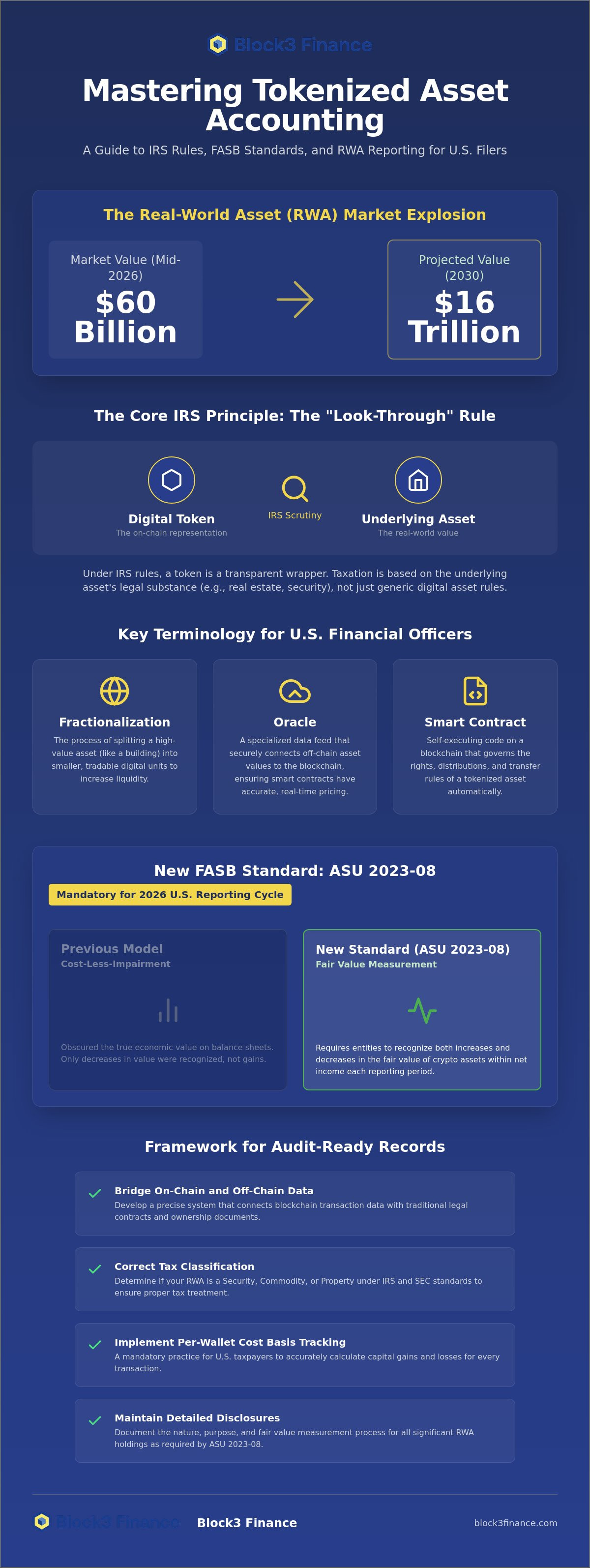
Tokenized asset accounting is the specialized process of recording Real-World Assets (RWAs) that have been digitally represented on a blockchain. For those reporting to the IRS, this isn't merely a sub-discipline of crypto bookkeeping; it is a fundamental shift in how we define ownership and value transfer. The core challenge lies in the IRS "look-through" principle. This principle suggests that the tax authorities often ignore the digital wrapper and instead focus on the underlying asset's legal substance. If you hold a token representing a share of a commercial building, the IRS expects you to follow real estate tax laws, not just general digital asset rules.
Distinguishing between native on-chain assets and off-chain assets brought onto the ledger is vital for compliance. Native assets, like Bitcoin, exist only on the blockchain. Off-chain assets, such as private credit or commodities, require a bridge between the physical world and the digital ledger. Traditional crypto accounting methods often fail here because they're designed for high-frequency liquid trading. Developing a robust framework for tokenized asset accounting requires moving beyond simple price tracking to account for the complex legal structures, depreciation schedules, or specialized yield distributions inherent in tokenized private equity.
The Rise of Real-World Assets (RWAs) in 2026
By mid-2026, the integration of traditional finance and blockchain has moved past the experimental phase. While the current market for tokenized RWAs is valued at approximately $60 billion, industry projections suggest this figure could reach $16 trillion by 2030. This growth is driven by the tokenization of treasury bills, private equity, and commodities. As institutional adoption accelerates, the need for rigorous accounting becomes a matter of survival. Financial officers must move beyond defensive compliance and adopt a proactive strategy that ensures every on-chain movement mirrors a legal reality.
Key Terminology for Financial Officers
Understanding the technical framework of Tokenization is the first step toward mastery. Here are three essential terms every IRS filer should know:
- Fractionalization: This is the process of splitting a high-value asset, such as a piece of fine art or a skyscraper, into smaller, tradable units to increase liquidity.
- Oracle: This is a specialized data feed that connects off-chain asset values to the blockchain, ensuring the smart contract has accurate, real-time pricing data.
- Smart Contract: This refers to the self-executing code that governs the rights, distributions, and transfer rules of the tokenized asset.
Mastering tokenized asset accounting means navigating these technical layers while maintaining the rigor of traditional financial oversight. It is about ensuring that your digital ledger is not just a record of tokens, but an audit-ready reflection of real-world value.
FASB Standards and ASU 2023-08: Measuring Fair Value
ASU 2023-08 represents a seismic shift in the financial oversight of digital holdings. This standard, mandatory for the 2026 reporting cycle, requires entities to measure in-scope crypto assets at fair value. It moves away from the restrictive cost-less-impairment model that previously obscured the true economic value of a balance sheet. This transition aligns digital reporting with the foundational logic of IRS Notice 2014-21, which treats virtual currency as property for federal tax purposes. Under the new standard, you must recognize both increases and decreases in fair value within your net income for each reporting period.
Implementing tokenized asset accounting under these rules demands a high degree of technical rigor. While Bitcoin or Ethereum may have clear market prices, niche tokenized assets like private credit or fractionalized real estate often lack a high-frequency trading environment. This creates a challenge in determining whether an "active market" exists. If your holdings are significant, you must also provide detailed disclosures regarding the nature, purpose, and fair value of those assets. Mastery of these requirements transforms your financial statements from static documents into dynamic tools for growth.
Determining the Principal Market
Identifying the principal market is the first step in accurate price discovery. You must evaluate which platform offers the greatest volume and level of activity for your specific token. While decentralized exchanges (DEXs) provide 24/7 liquidity, institutional platforms often serve as the primary venue for tokenized Real-World Assets (RWAs) due to their regulatory safeguards. According to FASB ASC 820, the principal market is the market with the greatest volume and level of activity for the asset or liability. Choosing the wrong market can lead to valuation discrepancies that invite IRS scrutiny.
Level 1, 2, and 3 Inputs for Tokenized Assets
The fair value hierarchy categorizes your inputs based on their observability. Level 1 includes liquid assets with quoted prices in active markets. Level 2 involves observable inputs other than quoted prices, such as tokens that trade infrequently but have comparable counterparts. Most tokenized RWAs fall into Level 3 because their value is derived from unobservable inputs and significant management judgment. Maintaining a rigorous schedule for monthly accounting allows firms to capture these value shifts with precision. If you require a strategist to map your fair value hierarchy and ensure compliance, you can consult with our team to secure your financial position.
IRS Tax Classification: Security, Commodity, or Property?
The IRS maintains a rigorous stance on digital assets. However, tokenized real-world assets (RWAs) introduce a layer of complexity that traditional cryptocurrency doesn't possess. While the SEC applies the Howey Test to determine if an asset is an investment contract, the IRS primarily relies on Notice 2014-21 to classify virtual currency as property. For tokenized asset accounting, this means your tax treatment often hinges on the "substance over form" doctrine. If a token represents a corporate bond, the IRS typically expects you to report interest income and capital gains based on bond regulations, regardless of the blockchain wrapper.
Wrapping a token, such as converting a stablecoin into a yield-bearing version, remains a technical grey area. Many professionals argue that if the underlying economic interest remains identical, it isn't a taxable event. However, the IRS hasn't issued definitive guidance on every "wrapped" RWA scenario. You must evaluate if the wrapping process creates a "materially different" asset. If it does, it could trigger a realization of gains or losses under IRS Section 1001. This distinction is critical for maintaining an offensive posture in your tax strategy.
Capital Gains vs. Ordinary Income
Your tax rate depends on the character of the underlying asset and your specific holding period. Tokenized real estate held for over a year typically qualifies for long-term capital gains rates of 0%, 15%, or 20% for the 2026 tax year, depending on your income. Conversely, if a tokenized instrument generates monthly yield, that income is generally taxed at ordinary rates. Learning how to reconcile crypto transactions is essential to separate these income streams before your year-end filing. Accuracy here prevents the accidental overpayment of taxes on yield-bearing instruments.
Reporting Tokenized Assets on Form 8949
When you dispose of a tokenized asset, you must list the transaction on Form 8949. This becomes difficult when an asset is fractionalized across multiple wallets. Under IRS rules effective January 1, 2025, taxpayers must use a per-wallet or per-account cost basis tracking method. You must track the original purchase price and the date of acquisition for every fraction sold. Maintaining a defensible tax trail ensures you can justify your cost basis during a potential audit. This level of detail is a hallmark of professional tokenized asset accounting and protects your firm from costly misclassifications.
Maintaining Audit-Ready Records for Tokenized Assets
Establishing a defensible audit trail is the cornerstone of institutional-grade tokenized asset accounting. It isn't enough to point to a transaction hash on a block explorer; you must bridge the gap between the on-chain event and the off-chain legal reality. For IRS filers in 2026, the introduction of Form 1099-DA means the IRS possesses more visibility into digital movements than ever before. You need a rigorous process that links every blockchain movement to a specific legal contract, such as a property deed, a private credit agreement, or a commodity warehouse receipt. Ownership isn't assumed in a professional environment; it's proven through digital signature proofs and verified custodian statements.
Performing regular "Proof of Reserve" checks is another vital component of your defensive posture. This process ensures that the digital token is consistently backed by the underlying asset it represents. If a discrepancy arises between the on-chain supply and the off-chain collateral, it can lead to significant reporting errors and potential IRS scrutiny. By implementing sub-ledger systems that can ingest blockchain data directly into your general ledger, you cultivate a transparent and reliable financial record that stands up to the most demanding audits.
The Challenge of Dual-Ledger Reconciliation
Traditional ERP systems like NetSuite or SAP aren't native to the blockchain ecosystem. They require specialized middleware to ingest high-frequency data and translate it into a format your general ledger understands. This dual-ledger approach resolves the friction between blockchain finality, which is nearly instantaneous, and traditional banking settlement, which often takes days to clear. Utilizing professional audit services allows you to validate these internal controls and ensure your reconciliation process is airtight before the filing season begins.
Internal Controls for Private Keys and Custody
Institutional custody requires a shift from individual ownership to collective accountability. You must develop a multi-signature policy that ensures no single person has total command over the firm's digital holdings. Segregation of duties is an internal control designed to prevent error and fraud by ensuring that at least two individuals are required to complete a single digital asset transaction. Relying on custodians who provide SOC 1 and SOC 2 reports adds a layer of professional weight to your compliance posture. If you're ready to secure your records and prepare for the 2026 filing season, reach out to our specialists today to fortify your financial infrastructure.
Strategic CFO Oversight: Scaling with Block3 Finance
The role of the modern CFO has evolved from a traditional gatekeeper of compliance to a visionary navigator of the digital economy. In a financial landscape where tokenized assets now exceed $31 billion, simply managing regulations is no longer enough to maintain a competitive edge. You must shift your narrative from a defensive posture to an offensive one focused on mastery and growth. By integrating tokenized asset accounting into your core corporate strategy, you transform your digital holdings from a reporting burden into a powerful engine for institutional scaling. This proactive approach allows you to command your financial data with the technical rigor required to thrive in high-stakes environments.
Mastery requires a move away from reactive tax filing toward a philosophy of continuous financial oversight. When your accounting systems are built to handle the complexities of on-chain data, you gain real-time visibility into your firm's true economic position. This level of clarity is essential for making informed decisions under the new FASB fair value measurement standards. A well-executed accounting framework ensures that your vision for the company is backed by audit-ready records that satisfy the most stringent IRS requirements for the 2026 filing season.
Treasury Management and Liquidity Solutions
Tokenization enables a level of treasury management that was previously impossible for traditional firms. You can now utilize tokenized assets as collateral for corporate financing, creating immediate liquidity without the need to dispose of the underlying asset and trigger a taxable event. Optimizing your on-and-off-ramp solutions ensures that your fiat-to-token operations remain frictionless and fully transparent for your internal ledgers. Additionally, some firms are exploring the use of tokenized stablecoins to manage global payroll, though you must carefully coordinate these efforts with current IRS reporting rules and state-level employment regulations to ensure full compliance.
The Block3 Advantage for IRS Compliance
Block3 Finance brings over 13 years of blockchain financial expertise to high-growth firms navigating the complexities of the Web3 economy. Our CFO services provide a comprehensive roadmap for digital asset mastery, ensuring that your long-term vision and daily execution are inseparable. We understand that tokenized asset accounting is about more than just numbers; it is about providing the intellectual leadership and stability your firm needs to scale. We act as a calm force in a chaotic industry, characterized by a commitment to best practices and a deep understanding of the evolving regulatory landscape. Secure your audit-ready future and gain total command over your financial destiny by booking a professional consultation with our team today.
Command Your Position in the Tokenized Economy
Mastering tokenized asset accounting requires more than just technical awareness; it demands a strategic alignment between on-chain data and IRS reporting requirements. You've learned how to apply the "look-through" principle to Real-World Assets and how to implement the fair value measurements mandated by FASB ASU 2023-08. Moving from reactive filing to a proactive, audit-ready stance ensures that your digital holdings remain a source of growth rather than a regulatory liability. This transition allows you to lead with confidence in a landscape that rewards precision and foresight.
Block3 Finance serves as your visionary navigator in this complex environment. Having served over 980 global clients and earned the rank of #1 Crypto Accounting Firm by Bitcoin.com, we bring 13+ years of specialized blockchain financial expertise to your organization. Our team provides the technical rigor and strategic clarity necessary to thrive under current IRS rules. Master your tokenized asset compliance with Block3 Finance and secure your organization's future today. Your journey toward total financial command is just beginning.
Frequently Asked Questions
Is tokenized real estate taxed differently than physical real estate under IRS rules?
Under IRS rules, tokenized real estate is generally taxed the same as physical real estate because the tax authorities apply a look-through principle to the underlying asset. You must still account for depreciation, rental income, and capital gains according to standard real estate tax laws. The blockchain wrapper does not change the character of the income or the applicable tax rates for U.S. federal filings.
Does the IRS consider the fractionalization of an asset a taxable event?
The act of fractionalizing an asset you already own is generally not a taxable event under IRS rules, provided there is no change in the beneficial ownership of the asset. However, if you sell those fractions to third parties, each sale is a realization event that triggers capital gains or losses. Accurate tokenized asset accounting is required to track the cost basis of each fractional unit as it is disposed of across different wallets.
How do I report income from tokenized treasury bills (T-bills)?
Income from tokenized treasury bills should be reported as interest income on your IRS tax return, mirroring the treatment of traditional T-bills. While the asset moves on-chain, the underlying economic substance remains a government debt obligation. You must report this interest in the year it is accrued or paid, and you may receive a Form 1099-INT from the platform or broker to facilitate this reporting.
Can I use standard accounting software like QuickBooks for tokenized assets?
Standard accounting software like QuickBooks cannot natively track blockchain transactions or handle the complexities of tokenized asset accounting without third-party middleware. You need a sub-ledger system to ingest on-chain data and translate it into journal entries that your general ledger can recognize. This ensures your records remain audit-ready and reconcile with your traditional bank statements and legal contracts.
What is the role of an oracle in tokenized asset accounting?
An oracle acts as a bridge that provides external, real-world valuation data to the blockchain to ensure the smart contract reflects the current market price of the underlying asset. In the context of accounting, oracles are essential for establishing the fair value of illiquid or off-chain assets. This data provides the observable inputs required to satisfy FASB fair value measurement standards during financial reporting cycles.
How does ASU 2023-08 change the way I report tokenized assets on my balance sheet?
ASU 2023-08 requires you to report in-scope crypto assets at fair value on each reporting date rather than using the historical cost-less-impairment model. This means any fluctuations in the market value of your tokenized holdings will be recognized directly in your net income for the period. It provides a more accurate reflection of your firm's current economic health but increases the need for frequent and precise valuations.
Are tokenized assets subject to FBAR or FATCA reporting requirements?
Tokenized assets may be subject to FBAR or FATCA reporting if they are held through a foreign financial institution or custodian. The IRS requires U.S. persons to report foreign financial accounts that exceed specific thresholds to prevent tax evasion. You should consult with a professional to determine if your specific custody arrangement or the location of the underlying asset triggers these additional disclosure requirements.
What happens if the underlying asset of my token is lost or stolen?
If the underlying physical asset is lost or stolen, the digital token representing it may become worthless, potentially allowing for a tax deduction under IRS rules for business losses. You must be able to prove the loss of the physical asset and the resulting lack of value in the token. This situation requires meticulous documentation of the event and an assessment of whether the loss is characterizable as a business expense or a capital loss.

Article by
Mahad Mohamed
Mahad Mohamed is an accountant and the CEO of Block3 Finance, with over 26+ years of Canadian and international tax and accounting experience. A crypto accounting specialist since the early days of Bitcoin, he has consulted for over 38 crypto companies and collaborated with legal professionals on regulatory matters. His expertise spans corporate reorganization, cross-border tax structuring (Canada & US), tax disputes, and CRA audits.
Previously, Mahad worked for the Canada Revenue Agency (CRA), Big4 accounting firms, and served as a Rulings Officer for the Federal Tax Authority of the UAE before acquiring Tax Partners in 2014.
Block3 Finance and Tax Partners has 44 full-time accountants and over 9,800+ clients.
Disclaimer
This article provides general information only and is current as of its publication date. It has not been updated and may be out of date. It does not constitute legal advice and should not be relied upon as such. Every tax situation is unique and may differ from the examples discussed in this article. If you have specific questions, you should seek the advice of our accountants for your unique circumstances.
Frequently Asked Questions
The Rise of Real-World Assets (RWAs) in 2026
By mid-2026, the integration of traditional finance and blockchain has moved past the experimental phase. While the current market for tokenized RWAs is valued at approximately $60 billion, industry projections suggest this figure could reach $16 trillion by 2030. This growth is driven by the tokenization of treasury bills, private equity, and commodities. As institutional adoption accelerates, the need for rigorous accounting becomes a matter of survival. Financial officers must move beyond defensive compliance and adopt a proactive strategy that ensures every on-chain movement mirrors a legal reality.
Key Terminology for Financial Officers
Understanding the technical framework of Tokenization is the first step toward mastery. Here are three essential terms every IRS filer should know: Mastering tokenized asset accounting means navigating these technical layers while maintaining the rigor of traditional financial oversight. It is about ensuring that your digital ledger is not just a record of tokens, but an audit-ready reflection of real-world value. ASU 2023-08 represents a seismic shift in the financial oversight of digital holdings. This standard, mandatory for the 2026 reporting cycle, requires entities to measure in-scope crypto assets at fair value. It moves away from the restrictive cost-less-impairment model that previously obscured the true economic value of a balance sheet. This transition aligns digital reporting with the foundational logic of IRS Notice 2014-21, which treats virtual currency as property for federal tax purposes. Under the new standard, you must recognize both increases and decreases in fair value within your net income for each reporting period. Implementing tokenized asset accounting under these rules demands a high degree of technical rigor. While Bitcoin or Ethereum may have clear market prices, niche tokenized assets like private credit or fractionalized real estate often lack a high-frequency trading environment. This creates a challenge in determining whether an "active market" exists. If your holdings are significant, you must also provide detailed disclosures regarding the nature, purpose, and fair value of those assets. Mastery of these requirements transforms your financial statements from static documents into dynamic tools for growth.
Determining the Principal Market
Identifying the principal market is the first step in accurate price discovery. You must evaluate which platform offers the greatest volume and level of activity for your specific token. While decentralized exchanges (DEXs) provide 24/7 liquidity, institutional platforms often serve as the primary venue for tokenized Real-World Assets (RWAs) due to their regulatory safeguards. According to FASB ASC 820, the principal market is the market with the greatest volume and level of activity for the asset or liability. Choosing the wrong market can lead to valuation discrepancies that invite IRS scrutiny.
Level 1, 2, and 3 Inputs for Tokenized Assets
The fair value hierarchy categorizes your inputs based on their observability. Level 1 includes liquid assets with quoted prices in active markets. Level 2 involves observable inputs other than quoted prices, such as tokens that trade infrequently but have comparable counterparts. Most tokenized RWAs fall into Level 3 because their value is derived from unobservable inputs and significant management judgment. Maintaining a rigorous schedule for monthly accounting allows firms to capture these value shifts with precision. If you require a strategist to map your fair value hierarchy and ensure compliance, you can consult with our team to secure your financial position. The IRS maintains a rigorous stance on digital assets. However, tokenized real-world assets (RWAs) introduce a layer of complexity that traditional cryptocurrency doesn't possess. While the SEC applies the Howey Test to determine if an asset is an investment contract, the IRS primarily relies on Notice 2014-21 to classify virtual currency as property. For tokenized asset accounting, this means your tax treatment often hinges on the "substance over form" doctrine. If a token represents a corporate bond, the IRS typically expects you to report interest income and capital gains based on bond regulations, regardless of the blockchain wrapper. Wrapping a token, such as converting a stablecoin into a yield-bearing version, remains a technical grey area. Many professionals argue that if the underlying economic interest remains identical, it isn't a taxable event. However, the IRS hasn't issued definitive guidance on every "wrapped" RWA scenario. You must evaluate if the wrapping process creates a "materially different" asset. If it does, it could trigger a realization of gains or losses under IRS Section 1001. This distinction is critical for maintaining an offensive posture in your tax strategy.
Capital Gains vs. Ordinary Income
Your tax rate depends on the character of the underlying asset and your specific holding period. Tokenized real estate held for over a year typically qualifies for long-term capital gains rates of 0%, 15%, or 20% for the 2026 tax year, depending on your income. Conversely, if a tokenized instrument generates monthly yield, that income is generally taxed at ordinary rates. Learning how to reconcile crypto transactions is essential to separate these income streams before your year-end filing. Accuracy here prevents the accidental overpayment of taxes on yield-bearing instruments.
Reporting Tokenized Assets on Form 8949
When you dispose of a tokenized asset, you must list the transaction on Form 8949. This becomes difficult when an asset is fractionalized across multiple wallets. Under IRS rules effective January 1, 2025, taxpayers must use a per-wallet or per-account cost basis tracking method. You must track the original purchase price and the date of acquisition for every fraction sold. Maintaining a defensible tax trail ensures you can justify your cost basis during a potential audit. This level of detail is a hallmark of professional tokenized asset accounting and protects your firm from costly misclassifications. Establishing a defensible audit trail is the cornerstone of institutional-grade tokenized asset accounting. It isn't enough to point to a transaction hash on a block explorer; you must bridge the gap between the on-chain event and the off-chain legal reality. For IRS filers in 2026, the introduction of Form 1099-DA means the IRS possesses more visibility into digital movements than ever before. You need a rigorous process that links every blockchain movement to a specific legal contract, such as a property deed, a private credit agreement, or a commodity warehouse receipt. Ownership isn't assumed in a professional environment; it's proven through digital signature proofs and verified custodian statements. Performing regular "Proof of Reserve" checks is another vital component of your defensive posture. This process ensures that the digital token is consistently backed by the underlying asset it represents. If a discrepancy arises between the on-chain supply and the off-chain collateral, it can lead to significant reporting errors and potential IRS scrutiny. By implementing sub-ledger systems that can ingest blockchain data directly into your general ledger, you cultivate a transparent and reliable financial record that stands up to the most demanding audits.
The Challenge of Dual-Ledger Reconciliation
Traditional ERP systems like NetSuite or SAP aren't native to the blockchain ecosystem. They require specialized middleware to ingest high-frequency data and translate it into a format your general ledger understands. This dual-ledger approach resolves the friction between blockchain finality, which is nearly instantaneous, and traditional banking settlement, which often takes days to clear. Utilizing professional audit services allows you to validate these internal controls and ensure your reconciliation process is airtight before the filing season begins.
Internal Controls for Private Keys and Custody
Institutional custody requires a shift from individual ownership to collective accountability. You must develop a multi-signature policy that ensures no single person has total command over the firm's digital holdings. Segregation of duties is an internal control designed to prevent error and fraud by ensuring that at least two individuals are required to complete a single digital asset transaction. Relying on custodians who provide SOC 1 and SOC 2 reports adds a layer of professional weight to your compliance posture. If you're ready to secure your records and prepare for the 2026 filing season, reach out to our specialists today to fortify your financial infrastructure. The role of the modern CFO has evolved from a traditional gatekeeper of compliance to a visionary navigator of the digital economy. In a financial landscape where tokenized assets now exceed $31 billion, simply managing regulations is no longer enough to maintain a competitive edge. You must shift your narrative from a defensive posture to an offensive one focused on mastery and growth. By integrating tokenized asset accounting into your core corporate strategy, you transform your digital holdings from a reporting burden into a powerful engine for institutional scaling. This proactive approach allows you to command your financial data with the technical rigor required to thrive in high-stakes environments. Mastery requires a move away from reactive tax filing toward a philosophy of continuous financial oversight. When your accounting systems are built to handle the complexities of on-chain data, you gain real-time visibility into your firm's true economic position. This level of clarity is essential for making informed decisions under the new FASB fair value measurement standards. A well-executed accounting framework ensures that your vision for the company is backed by audit-ready records that satisfy the most stringent IRS requirements for the 2026 filing season.
Treasury Management and Liquidity Solutions
Tokenization enables a level of treasury management that was previously impossible for traditional firms. You can now utilize tokenized assets as collateral for corporate financing, creating immediate liquidity without the need to dispose of the underlying asset and trigger a taxable event. Optimizing your on-and-off-ramp solutions ensures that your fiat-to-token operations remain frictionless and fully transparent for your internal ledgers. Additionally, some firms are exploring the use of tokenized stablecoins to manage global payroll, though you must carefully coordinate these efforts with current IRS reporting rules and state-level employment regulations to ensure full compliance.
The Block3 Advantage for IRS Compliance
Block3 Finance brings over 13 years of blockchain financial expertise to high-growth firms navigating the complexities of the Web3 economy. Our CFO services provide a comprehensive roadmap for digital asset mastery, ensuring that your long-term vision and daily execution are inseparable. We understand that tokenized asset accounting is about more than just numbers; it is about providing the intellectual leadership and stability your firm needs to scale. We act as a calm force in a chaotic industry, characterized by a commitment to best practices and a deep understanding of the evolving regulatory landscape. Secure your audit-ready future and gain total command over your financial destiny by booking a professional consultation with our team today. Mastering tokenized asset accounting requires more than just technical awareness; it demands a strategic alignment between on-chain data and IRS reporting requirements. You've learned how to apply the "look-through" principle to Real-World Assets and how to implement the fair value measurements mandated by FASB ASU 2023-08. Moving from reactive filing to a proactive, audit-ready stance ensures that your digital holdings remain a source of growth rather than a regulatory liability. This transition allows you to lead with confidence in a landscape that rewards precision and foresight. Block3 Finance serves as your visionary navigator in this complex environment. Having served over 980 global clients and earned the rank of #1 Crypto Accounting Firm by Bitcoin.com, we bring 13+ years of specialized blockchain financial expertise to your organization. Our team provides the technical rigor and strategic clarity necessary to thrive under current IRS rules. Master your tokenized asset compliance with Block3 Finance and secure your organization's future today. Your journey toward total financial command is just beginning.
Is tokenized real estate taxed differently than physical real estate under IRS rules?
Under IRS rules, tokenized real estate is generally taxed the same as physical real estate because the tax authorities apply a look-through principle to the underlying asset. You must still account for depreciation, rental income, and capital gains according to standard real estate tax laws. The blockchain wrapper does not change the character of the income or the applicable tax rates for U.S. federal filings.
Does the IRS consider the fractionalization of an asset a taxable event?
The act of fractionalizing an asset you already own is generally not a taxable event under IRS rules, provided there is no change in the beneficial ownership of the asset. However, if you sell those fractions to third parties, each sale is a realization event that triggers capital gains or losses. Accurate tokenized asset accounting is required to track the cost basis of each fractional unit as it is disposed of across different wallets.
How do I report income from tokenized treasury bills (T-bills)?
Income from tokenized treasury bills should be reported as interest income on your IRS tax return, mirroring the treatment of traditional T-bills. While the asset moves on-chain, the underlying economic substance remains a government debt obligation. You must report this interest in the year it is accrued or paid, and you may receive a Form 1099-INT from the platform or broker to facilitate this reporting.
Can I use standard accounting software like QuickBooks for tokenized assets?
Standard accounting software like QuickBooks cannot natively track blockchain transactions or handle the complexities of tokenized asset accounting without third-party middleware. You need a sub-ledger system to ingest on-chain data and translate it into journal entries that your general ledger can recognize. This ensures your records remain audit-ready and reconcile with your traditional bank statements and legal contracts.
What is the role of an oracle in tokenized asset accounting?
An oracle acts as a bridge that provides external, real-world valuation data to the blockchain to ensure the smart contract reflects the current market price of the underlying asset. In the context of accounting, oracles are essential for establishing the fair value of illiquid or off-chain assets. This data provides the observable inputs required to satisfy FASB fair value measurement standards during financial reporting cycles.
How does ASU 2023-08 change the way I report tokenized assets on my balance sheet?
ASU 2023-08 requires you to report in-scope crypto assets at fair value on each reporting date rather than using the historical cost-less-impairment model. This means any fluctuations in the market value of your tokenized holdings will be recognized directly in your net income for the period. It provides a more accurate reflection of your firm's current economic health but increases the need for frequent and precise valuations.
Are tokenized assets subject to FBAR or FATCA reporting requirements?
Tokenized assets may be subject to FBAR or FATCA reporting if they are held through a foreign financial institution or custodian. The IRS requires U.S. persons to report foreign financial accounts that exceed specific thresholds to prevent tax evasion. You should consult with a professional to determine if your specific custody arrangement or the location of the underlying asset triggers these additional disclosure requirements.
What happens if the underlying asset of my token is lost or stolen?
If the underlying physical asset is lost or stolen, the digital token representing it may become worthless, potentially allowing for a tax deduction under IRS rules for business losses. You must be able to prove the loss of the physical asset and the resulting lack of value in the token. This situation requires meticulous documentation of the event and an assessment of whether the loss is characterizable as a business expense or a capital loss.