
The most dangerous mistake a Canadian crypto founder can make isn't picking the wrong protocol; it's the assumption that an offshore incorporation shield offers any protection against the evolving reach of the Canada Revenue Agency. You likely feel the mounting pressure of a regulatory environment where a single jurisdictional misstep results in frozen accounts or a catastrophic audit. We understand that the drive for global expansion shouldn't be paralyzed by compliance friction. It's time to shift from a defensive posture to one of strategic mastery.
This guide provides the definitive framework for choosing a jurisdiction for crypto business while maintaining absolute command over your CRA reporting obligations. You'll master the nuances of T1135 filings and the updated 2026 FAPI rules that govern foreign investment income. We will navigate the strategic trade-offs between MiCA, VARA, and emerging Asian frameworks to help you cultivate a corporate structure that is both growth oriented and fully defensible under Canadian law. By aligning your global ambitions with domestic reporting requirements, you can build a resilient foundation for the next stage of your enterprise.
Key Takeaways
- Understand why a passive approach to choosing a jurisdiction for crypto business creates systemic risk and how to define your legal environment for maximum growth.
- Compare the regulatory frameworks of the EU, UAE, and Singapore to determine which jurisdiction offers the best balance of pragmatism and financial discipline.
- Learn how to manage the T1135 reporting burden and navigate the specific FAPI rules that apply to Canadian founders with controlled foreign corporations.
- Discover the critical documentation and VASP registration steps required to maintain reliable crypto-to-fiat on-ramps and institutional banking relationships.
- Establish a strategic corporate structure that protects your enterprise from frozen accounts and provides a clear roadmap for global expansion.
Defining the Strategic Importance of Jurisdiction for CRA Filers
A crypto jurisdiction isn't just a point on a map where you file incorporation papers. It represents the entire legal and regulatory environment that dictates how your digital asset entity interacts with the global financial system. For Canadian founders, choosing a jurisdiction for crypto business is a high-stakes decision that extends far beyond initial setup costs or simple tax rates. Adopting a "wait and see" approach to regulation is no longer a viable strategy; it has become a systemic risk. As global authorities tighten their grip, being caught in a regulatory vacuum can lead to the sudden loss of exchange access or immediate, aggressive scrutiny from the Canada Revenue Agency (CRA).
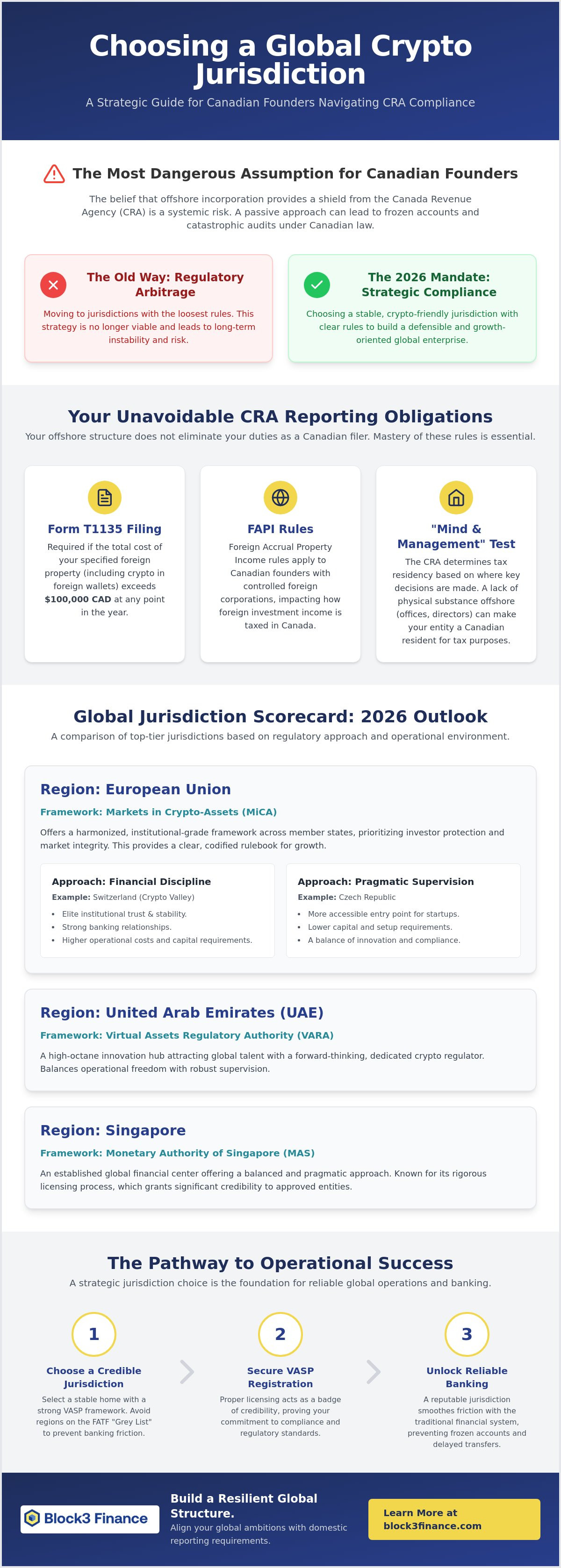
Founders must distinguish between jurisdictions that are merely "tax-neutral" and those that are truly "crypto-friendly." A tax-neutral zone might offer a 0% rate but lack the legal infrastructure to defend your business against international pressure. In contrast, a crypto-friendly jurisdiction provides a clear, codified rulebook that enables growth. While the industry once focused on "Regulatory Arbitrage," which involved moving to wherever rules were loosest, the 2026 mandate is "Strategic Compliance." This shift prioritizes long-term stability and a defensible posture over temporary tax loopholes. You can explore the diversity of these approaches by examining global crypto legal frameworks to see how different nations balance innovation with oversight.
The 2026 Landscape: Beyond Simple Tax Avoidance
The era of digital asset anonymity has effectively ended. With the implementation of the OECD's Crypto-Asset Reporting Framework (CARF) in 2026, transparency is now the default state for blockchain financial records. Under the Canadian Income Tax Act, the CRA views most cryptocurrencies as commodities rather than legal tender. This means every trade or disposal is a taxable event. For CRA filers, holding assets in a foreign entity doesn't erase reporting obligations. If the cost amount of your specified foreign property, including crypto held in foreign wallets, exceeds $100,000 CAD at any time during the year, you must file Form T1135. Mastery of these reporting requirements is the only way to ensure your offshore structure doesn't become a domestic liability.
Why Your Jurisdiction Choice Dictates Your Banking Success
Your ability to maintain stable fiat gateways depends entirely on the reputation of your chosen home. Banks are increasingly hesitant to service entities from regions on the Financial Action Task Force (FATF) "Grey List." As of June 2026, nations like Iraq and Bosnia and Herzegovina are under increased monitoring, which can lead to delayed wire transfers or the total freezing of business accounts. If you can't move capital, you can't pay global contractors or scale operations. Securing a jurisdiction with a robust Virtual Asset Service Provider (VASP) framework is essential for accessing reliable on-and-off-ramp solutions. A well-chosen jurisdiction acts as a badge of credibility, smoothing the friction between the blockchain and the traditional banking world.
Comparing Top Crypto Jurisdictions for 2026
Choosing a jurisdiction for crypto business isn't a one-size-fits-all exercise; it's a strategic alignment of your business model with a sovereign rulebook. For Canadian founders, the decision involves balancing operational freedom with the reality of CRA oversight. The global landscape has matured into distinct tiers, ranging from the high-octane innovation hubs of the Middle East to the structured, institutional environments of Europe. Success in 2026 depends on selecting a home that provides both a clear regulatory path and the physical substance required to satisfy domestic tax authorities.
The CRA maintains a sharp focus on where a company's "mind and management" resides. If you lack physical substance offshore—such as local offices, resident directors, and actual business activity—the CRA may determine that your entity is actually a Canadian resident for tax purposes. This makes the choice between "Pragmatic Supervision" and "Financial Discipline" critical. The Czech Republic, for example, offers an accessible entry point with lower capital requirements, while Switzerland provides elite financial discipline and institutional trust. While the costs in Switzerland's Crypto Valley are higher, the resulting stability is often worth the investment for high-volume enterprises.
The European Union: MiCA and the CASP License
The European Union has moved to the forefront of global regulation with the Markets in Crypto-Assets (MiCA) framework. For Canadian firms, the standout benefit is "passporting." This mechanism allows a firm licensed as a Crypto-Asset Service Provider (CASP) in one member state to offer services across all 27 EU nations without seeking additional approvals. Capital requirements vary based on your service category, with higher thresholds for exchanges and custody providers. Global regulators are increasingly aligning with FATF guidance on virtual assets to ensure these licenses carry international weight. If you're targeting the European market, Lithuania and France currently offer some of the most sophisticated AML supervision environments.
The Middle East and Asia: UAE and Singapore
Dubai has established itself as a premier destination through the Virtual Assets Regulatory Authority (VARA), the world's first regulator built specifically for the Web3 sector. VARA provides a modular licensing approach that suits everything from advisory services to full-scale exchange operations. In Asia, Singapore remains the anchor for stablecoin issuers and payment providers under the Payment Services Act managed by the Monetary Authority of Singapore (MAS). Both hubs require a genuine physical presence, and the operational costs of maintaining an office in these regions are significant. Strategic founders should consult with our specialized team to evaluate these trade-offs before committing capital to a specific region.
The 2026 outlook for "lightly regulated" zones is increasingly grim, especially for DAOs. Most decentralized organizations are now seeking legal wrappers in jurisdictions that offer clear liability protection and banking access. By choosing a jurisdiction for crypto business that emphasizes compliance and substance, you protect your venture from being marginalized by the traditional financial system.
Navigating FAPI and Foreign Reporting Requirements under CRA Rules
Choosing a jurisdiction for crypto business involves more than just analyzing local statutes; it requires a deep understanding of how the Canada Revenue Agency (CRA) integrates those structures into your domestic tax profile. Many founders mistakenly believe that incorporating in a tax-neutral region like the Cayman Islands or the UAE creates an immediate tax shield. In reality, the CRA utilizes the Foreign Accrual Property Income (FAPI) regime to ensure that passive income earned by a Controlled Foreign Corporation (CFC) is taxed in Canada in the year it is earned. If your offshore entity is primarily engaged in crypto trading, staking, or lending, that income is often classified as FAPI and must be reported on your Canadian return, regardless of whether you repatriate the funds.
The most common concern for Canadian founders is the threat of double taxation. While Canada provides foreign tax credits to mitigate this, recent amendments have reduced the "relevant tax factor" for FAPI inclusions. This means that unless the foreign jurisdiction imposes a significant tax rate, you will likely owe the difference to the CRA. To manage these complexities, you must first master the foundational principles of how the CRA treats digital assets. Understanding these rules is the only way to build a structure that remains compliant while you scale globally.
The T1135 Filing: Disclosing Foreign Digital Assets
For CRA filers, transparency is a legal mandate. You must file Form T1135, the Foreign Income Verification Statement, if the total cost amount of your specified foreign property exceeds $100,000 CAD at any time during the year. This includes cryptocurrency held in foreign exchanges or private wallets located outside Canada. It's critical to value these assets at their historical cost rather than their current market value for this specific threshold. Failing to file can result in penalties of $25 per day, up to a maximum of $2,500 per year, plus interest. The CRA has significantly increased its focus on these disclosures, making accurate record-keeping a non-negotiable part of your operations.
Avoiding the "Mind and Management" Trap
Your business might be registered in Dubai, but the CRA may still consider it a Canadian resident if its "central management and control" stays in Canada. If you make all high-level strategic decisions from your home in Toronto or Vancouver, the CRA can argue the company's real home is Canada. To maintain a defensible separation, you should follow this protocol:
- Appoint local, qualified directors in the chosen jurisdiction who possess genuine decision-making authority.
- Conduct and document board meetings within the foreign jurisdiction.
- Maintain the company’s primary books, records, and bank accounts in the local region.
- Ensure the entity has physical substance, such as a dedicated office and local employees, to prove it isn't a "shell" company.
Establishing this physical presence also provides an opportunity to build your entity's financial footprint; for instance, The CEO Creative helps businesses equip their offices while establishing credit through net-30 accounts.
Establishing these boundaries is essential for protecting your corporate structure from being reclassified and taxed as a domestic Canadian corporation.
Operational Readiness: Banking, Licensing, and On-Ramps
Operational readiness is the bridge between a theoretical corporate structure and a functional enterprise. Choosing a jurisdiction for crypto business is only half the battle; the other half is ensuring that your entity can actually move capital. In 2026, the implementation of the OECD's Crypto-Asset Reporting Framework (CARF) has transformed the documentation landscape. To secure a bank account, you must present a comprehensive package: your Virtual Asset Service Provider (VASP) registration, a robust AML/KYC policy, and clear details on your Ultimate Beneficial Owners (UBO). Without these, your offshore entity is effectively stranded.
The role of VASP registration has moved from a "nice-to-have" to a mandatory requirement for securing stable payment rails. Regulators now demand that entities demonstrate a high level of compliance before they can access the traditional financial system. This means your choice of home dictates which banking partners will even look at your application. Integrating crypto-to-fiat payment solutions is the final step in this process, allowing you to manage global payroll and vendor payments with the same efficiency as your on-chain operations. It's about building a system that works as hard as your code does.
Securing Fiat Gateways in a High-Compliance Environment
Electronic Money Institutions (EMIs) often offer more flexibility than traditional commercial banks, which remain cautious about digital assets. The Markets in Crypto-Assets Regulation (MiCAR) in the European Union has standardized stablecoin liquidity, making it easier for firms to maintain reserves. For Canadian founders, finding on-ramp providers that support CAD-to-crypto flows is essential to avoid excessive currency conversion friction. You don't want your growth capped by inefficient on-ramps that can't handle the volume your business generates.
Building a Defensible Audit Trail
A successful strategy for choosing a jurisdiction for crypto business ends with an "Audit-Ready" bookkeeping system. If you face a CRA crypto audit, the agency will demand a granular reconciliation of every cross-border transaction. You can't rely on simple exchange exports. You need sub-ledger reconciliation that maps blockchain data directly to your general ledger, ensuring every trade is accounted for. This is where Block3 Finance accounting services provide the intellectual depth needed to manage complex, multi-jurisdictional books. Speak with our strategists to ensure your operational rails are as robust as your corporate structure.
Strategic Entity Structuring with Block3 Finance
Establishing an offshore entity is a legal milestone, but it's only the first step toward building a sustainable global enterprise. Block3 Finance acts as the critical bridge between initial legal setup and total financial mastery. We understand that choosing a jurisdiction for crypto business is a decision that dictates your reporting burden for years to come. Our "Visionary Navigator" approach ensures that your corporate structure isn't just a shell; it's a high-performance vehicle designed for growth within the strict parameters set by the Canada Revenue Agency (CRA). By aligning your international footprint with your domestic obligations, we turn regulatory friction into a competitive advantage.
A specialized crypto tax accountant is no longer a luxury for Canadian founders; it's a defensive necessity for international operations. The CRA is increasingly sophisticated in its ability to track cross-border digital asset flows, meaning your accounting must be equally advanced. We provide the intellectual depth required to navigate FAPI inclusions and T1135 disclosures without sacrificing your operational momentum. Our goal is to empower you with a structure that is both tax efficient and fully defensible under Canadian law.
Fractional CFO Leadership for Web3 Firms
Innovation often moves faster than accounting standards. Our CFO services provide the strategic oversight needed to manage this inherent tension between rapid growth and regulatory compliance. We've developed a rigorous methodology for turning on-chain chaos into clean, defensible financial records that satisfy both internal stakeholders and external auditors. Instead of merely reacting to tax deadlines, we proactively engineer your financial systems to handle the complexities of cross-border liquidity and multi-token treasuries. We invite you to book a consultation to develop a custom entity structuring roadmap that reflects the unique needs of your protocol or platform.
Ensuring Long-Term Audit Readiness
The global tax landscape is in a state of constant evolution. This shift is driven by frameworks like the OECD's CARF and the CRA's tightening disclosure requirements for foreign-held assets. At Block3 Finance, we maintain a proactive stance on these global tax shifts, ensuring our clients are never blindsided by new reporting mandates. With over 13 years of blockchain financial expertise, we serve as a protective force for your enterprise. We anticipate regulatory shifts before they impact your bottom line, ensuring that your books remain audit-ready from the moment of incorporation. Don't leave your global expansion to chance. Contact Block3 Finance to structure your global crypto entity with authority and gain total command over your financial future.
Master Your Global Financial Footprint
Success in the digital asset space requires a transition from defensive management to strategic mastery. Choosing a jurisdiction for crypto business is the most consequential decision a Canadian founder will make; it defines your operational freedom and your standing with the CRA. You now understand that a resilient structure requires more than just a certificate of incorporation. It demands a rigorous commitment to physical substance, a clear navigation of FAPI reporting rules, and the securing of robust banking rails through VASP registration. By prioritizing transparency and audit readiness, you transform compliance from a burden into a scalable foundation.
Block3 Finance stands as your partner in this evolution. As a top-ranked crypto accounting firm by Bitcoin.com with over 13 years of blockchain financial expertise, we've helped more than 980 global clients gain total command over their fiscal landscape. We bridge the gap between complex on-chain activity and the strict requirements of Canadian tax law. Don't let regulatory uncertainty cap your potential. Secure your global crypto structure with Block3 Finance and build with the confidence that comes from elite strategic oversight. Your roadmap to global expansion starts with a single, decisive step toward financial clarity.
Frequently Asked Questions
Which jurisdiction is best for a DAO with Canadian contributors?
The Cayman Islands and Switzerland remain the premier choices for Decentralized Autonomous Organizations (DAOs) seeking a legal wrapper in 2026. The Cayman Foundation Company provides a flexible structure that limits member liability without requiring a traditional shareholding model. While these jurisdictions offer legal clarity, Canadian contributors must remember that their personal participation and income remain subject to CRA reporting and potential self-employment tax obligations.
Do I need to pay Canadian tax if my crypto business is registered in Dubai?
Yes, you'll likely still face Canadian tax obligations if you reside in Canada while choosing a jurisdiction for crypto business. The CRA uses Foreign Accrual Property Income (FAPI) rules to tax passive income earned by a Controlled Foreign Corporation (CFC) in the year it's generated. Unless your Dubai entity has significant active business operations and local staff, its profits are generally attributed back to you as the Canadian shareholder.
What is the most crypto-friendly bank for a newly registered VASP?
Institutional banks in Switzerland and Electronic Money Institutions (EMIs) in Lithuania currently offer the most reliable paths for new Virtual Asset Service Providers (VASPs). These entities prioritize firms that can demonstrate a robust compliance program and a clear audit trail. Success in banking depends less on the specific institution and more on your ability to present a professional, VASP-licensed profile that meets 2026 global AML standards.
How does the CRA track digital assets held in foreign jurisdictions?
The CRA utilizes the OECD's Crypto-Asset Reporting Framework (CARF) to receive automated transaction data from foreign exchanges and service providers starting in 2026. This global transparency initiative is supplemented by mandatory T1135 filings for assets exceeding the $100,000 CAD cost threshold. Additionally, the CRA monitors on-chain activity and compares it against T5008 forms issued by Canadian platforms to identify undisclosed offshore holdings.
What is the difference between a CASP license and a VASP registration?
A Crypto-Asset Service Provider (CASP) license is a specific regulatory requirement under the European Union’s MiCA framework, allowing firms to "passport" services across all EU member states. VASP is a broader term defined by the Financial Action Task Force (FATF) that applies globally to any entity facilitating virtual asset transfers. While a CASP license is a form of VASP registration, it carries significantly more weight for firms targeting the European market.
How much does it cost to maintain a crypto-friendly entity in 2026?
Maintenance costs vary significantly based on your "Physical Substance" requirements, which include local office rent, resident director fees, and mandatory compliance audits. When choosing a jurisdiction for crypto business, you must budget for these operational realities rather than just the initial registration fee. High-tier hubs like Singapore or the UAE demand a higher capital commitment than emerging regions, but they offer superior banking stability and long-term regulatory safety.
Can I use a Canadian bank account for my offshore crypto company?
Using a Canadian bank account for an offshore entity is a major tactical error that often triggers a "mind and management" audit. The CRA may use this domestic banking activity as evidence that the company is actually a Canadian resident for tax purposes. To maintain a defensible structure, you should keep all financial operations within the foreign jurisdiction or through specialized international EMIs that support your corporate home.
What happens if I fail to disclose my foreign crypto holdings to the CRA?
Failing to file Form T1135 results in an immediate penalty of $25 per day, reaching a maximum of $2,500 per year, plus interest. If the CRA determines that the non-disclosure was intentional or due to gross negligence, they can apply a penalty equal to 5% of the cost of the property. In extreme cases involving tax evasion, founders face criminal prosecution and significantly higher financial sanctions under the Income Tax Act.

Article by
Mahad Mohamed
Mahad Mohamed is an accountant and the CEO of Block3 Finance, with over 26+ years of Canadian and international tax and accounting experience. A crypto accounting specialist since the early days of Bitcoin, he has consulted for over 38 crypto companies and collaborated with legal professionals on regulatory matters. His expertise spans corporate reorganization, cross-border tax structuring (Canada & US), tax disputes, and CRA audits.
Previously, Mahad worked for the Canada Revenue Agency (CRA), Big4 accounting firms, and served as a Rulings Officer for the Federal Tax Authority of the UAE before acquiring Tax Partners in 2014.
Block3 Finance and Tax Partners has 44 full-time accountants and over 9,800+ clients.
Disclaimer
This article provides general information only and is current as of its publication date. It has not been updated and may be out of date. It does not constitute legal advice and should not be relied upon as such. Every tax situation is unique and may differ from the examples discussed in this article. If you have specific questions, you should seek the advice of our accountants for your unique circumstances.
Frequently Asked Questions
The 2026 Landscape: Beyond Simple Tax Avoidance
The era of digital asset anonymity has effectively ended. With the implementation of the OECD's Crypto-Asset Reporting Framework (CARF) in 2026, transparency is now the default state for blockchain financial records. Under the Canadian Income Tax Act, the CRA views most cryptocurrencies as commodities rather than legal tender. This means every trade or disposal is a taxable event. For CRA filers, holding assets in a foreign entity doesn't erase reporting obligations. If the cost amount of your specified foreign property, including crypto held in foreign wallets, exceeds $100,000 CAD at any time during the year, you must file Form T1135. Mastery of these reporting requirements is the only way to ensure your offshore structure doesn't become a domestic liability.
Why Your Jurisdiction Choice Dictates Your Banking Success
Your ability to maintain stable fiat gateways depends entirely on the reputation of your chosen home. Banks are increasingly hesitant to service entities from regions on the Financial Action Task Force (FATF) "Grey List." As of June 2026, nations like Iraq and Bosnia and Herzegovina are under increased monitoring, which can lead to delayed wire transfers or the total freezing of business accounts. If you can't move capital, you can't pay global contractors or scale operations. Securing a jurisdiction with a robust Virtual Asset Service Provider (VASP) framework is essential for accessing reliable on-and-off-ramp solutions. A well-chosen jurisdiction acts as a badge of credibility, smoothing the friction between the blockchain and the traditional banking world. Choosing a jurisdiction for crypto business isn't a one-size-fits-all exercise; it's a strategic alignment of your business model with a sovereign rulebook. For Canadian founders, the decision involves balancing operational freedom with the reality of CRA oversight. The global landscape has matured into distinct tiers, ranging from the high-octane innovation hubs of the Middle East to the structured, institutional environments of Europe. Success in 2026 depends on selecting a home that provides both a clear regulatory path and the physical substance required to satisfy domestic tax authorities. The CRA maintains a sharp focus on where a company's "mind and management" resides. If you lack physical substance offshore—such as local offices, resident directors, and actual business activity—the CRA may determine that your entity is actually a Canadian resident for tax purposes. This makes the choice between "Pragmatic Supervision" and "Financial Discipline" critical. The Czech Republic, for example, offers an accessible entry point with lower capital requirements, while Switzerland provides elite financial discipline and institutional trust. While the costs in Switzerland's Crypto Valley are higher, the resulting stability is often worth the investment for high-volume enterprises.
The European Union: MiCA and the CASP License
The European Union has moved to the forefront of global regulation with the Markets in Crypto-Assets (MiCA) framework. For Canadian firms, the standout benefit is "passporting." This mechanism allows a firm licensed as a Crypto-Asset Service Provider (CASP) in one member state to offer services across all 27 EU nations without seeking additional approvals. Capital requirements vary based on your service category, with higher thresholds for exchanges and custody providers. Global regulators are increasingly aligning with FATF guidance on virtual assets to ensure these licenses carry international weight. If you're targeting the European market, Lithuania and France currently offer some of the most sophisticated AML supervision environments.
The Middle East and Asia: UAE and Singapore
Dubai has established itself as a premier destination through the Virtual Assets Regulatory Authority (VARA), the world's first regulator built specifically for the Web3 sector. VARA provides a modular licensing approach that suits everything from advisory services to full-scale exchange operations. In Asia, Singapore remains the anchor for stablecoin issuers and payment providers under the Payment Services Act managed by the Monetary Authority of Singapore (MAS). Both hubs require a genuine physical presence, and the operational costs of maintaining an office in these regions are significant. Strategic founders should consult with our specialized team to evaluate these trade-offs before committing capital to a specific region. The 2026 outlook for "lightly regulated" zones is increasingly grim, especially for DAOs. Most decentralized organizations are now seeking legal wrappers in jurisdictions that offer clear liability protection and banking access. By choosing a jurisdiction for crypto business that emphasizes compliance and substance, you protect your venture from being marginalized by the traditional financial system. Choosing a jurisdiction for crypto business involves more than just analyzing local statutes; it requires a deep understanding of how the Canada Revenue Agency (CRA) integrates those structures into your domestic tax profile. Many founders mistakenly believe that incorporating in a tax-neutral region like the Cayman Islands or the UAE creates an immediate tax shield. In reality, the CRA utilizes the Foreign Accrual Property Income (FAPI) regime to ensure that passive income earned by a Controlled Foreign Corporation (CFC) is taxed in Canada in the year it is earned. If your offshore entity is primarily engaged in crypto trading, staking, or lending, that income is often classified as FAPI and must be reported on your Canadian return, regardless of whether you repatriate the funds. The most common concern for Canadian founders is the threat of double taxation. While Canada provides foreign tax credits to mitigate this, recent amendments have reduced the "relevant tax factor" for FAPI inclusions. This means that unless the foreign jurisdiction imposes a significant tax rate, you will likely owe the difference to the CRA. To manage these complexities, you must first master the foundational principles of how the CRA treats digital assets. Understanding these rules is the only way to build a structure that remains compliant while you scale globally.
The T1135 Filing: Disclosing Foreign Digital Assets
For CRA filers, transparency is a legal mandate. You must file Form T1135, the Foreign Income Verification Statement, if the total cost amount of your specified foreign property exceeds $100,000 CAD at any time during the year. This includes cryptocurrency held in foreign exchanges or private wallets located outside Canada. It's critical to value these assets at their historical cost rather than their current market value for this specific threshold. Failing to file can result in penalties of $25 per day, up to a maximum of $2,500 per year, plus interest. The CRA has significantly increased its focus on these disclosures, making accurate record-keeping a non-negotiable part of your operations.
Avoiding the "Mind and Management" Trap
Your business might be registered in Dubai, but the CRA may still consider it a Canadian resident if its "central management and control" stays in Canada. If you make all high-level strategic decisions from your home in Toronto or Vancouver, the CRA can argue the company's real home is Canada. To maintain a defensible separation, you should follow this protocol: Establishing these boundaries is essential for protecting your corporate structure from being reclassified and taxed as a domestic Canadian corporation. Operational readiness is the bridge between a theoretical corporate structure and a functional enterprise. Choosing a jurisdiction for crypto business is only half the battle; the other half is ensuring that your entity can actually move capital. In 2026, the implementation of the OECD's Crypto-Asset Reporting Framework (CARF) has transformed the documentation landscape. To secure a bank account, you must present a comprehensive package: your Virtual Asset Service Provider (VASP) registration, a robust AML/KYC policy, and clear details on your Ultimate Beneficial Owners (UBO). Without these, your offshore entity is effectively stranded. The role of VASP registration has moved from a "nice-to-have" to a mandatory requirement for securing stable payment rails. Regulators now demand that entities demonstrate a high level of compliance before they can access the traditional financial system. This means your choice of home dictates which banking partners will even look at your application. Integrating crypto-to-fiat payment solutions is the final step in this process, allowing you to manage global payroll and vendor payments with the same efficiency as your on-chain operations. It's about building a system that works as hard as your code does.
Securing Fiat Gateways in a High-Compliance Environment
Electronic Money Institutions (EMIs) often offer more flexibility than traditional commercial banks, which remain cautious about digital assets. The Markets in Crypto-Assets Regulation (MiCAR) in the European Union has standardized stablecoin liquidity, making it easier for firms to maintain reserves. For Canadian founders, finding on-ramp providers that support CAD-to-crypto flows is essential to avoid excessive currency conversion friction. You don't want your growth capped by inefficient on-ramps that can't handle the volume your business generates.
Building a Defensible Audit Trail
A successful strategy for choosing a jurisdiction for crypto business ends with an "Audit-Ready" bookkeeping system. If you face a CRA crypto audit, the agency will demand a granular reconciliation of every cross-border transaction. You can't rely on simple exchange exports. You need sub-ledger reconciliation that maps blockchain data directly to your general ledger, ensuring every trade is accounted for. This is where Block3 Finance accounting services provide the intellectual depth needed to manage complex, multi-jurisdictional books. Speak with our strategists to ensure your operational rails are as robust as your corporate structure. Establishing an offshore entity is a legal milestone, but it's only the first step toward building a sustainable global enterprise. Block3 Finance acts as the critical bridge between initial legal setup and total financial mastery. We understand that choosing a jurisdiction for crypto business is a decision that dictates your reporting burden for years to come. Our "Visionary Navigator" approach ensures that your corporate structure isn't just a shell; it's a high-performance vehicle designed for growth within the strict parameters set by the Canada Revenue Agency (CRA). By aligning your international footprint with your domestic obligations, we turn regulatory friction into a competitive advantage. A specialized crypto tax accountant is no longer a luxury for Canadian founders; it's a defensive necessity for international operations. The CRA is increasingly sophisticated in its ability to track cross-border digital asset flows, meaning your accounting must be equally advanced. We provide the intellectual depth required to navigate FAPI inclusions and T1135 disclosures without sacrificing your operational momentum. Our goal is to empower you with a structure that is both tax efficient and fully defensible under Canadian law.
Fractional CFO Leadership for Web3 Firms
Innovation often moves faster than accounting standards. Our CFO services provide the strategic oversight needed to manage this inherent tension between rapid growth and regulatory compliance. We've developed a rigorous methodology for turning on-chain chaos into clean, defensible financial records that satisfy both internal stakeholders and external auditors. Instead of merely reacting to tax deadlines, we proactively engineer your financial systems to handle the complexities of cross-border liquidity and multi-token treasuries. We invite you to book a consultation to develop a custom entity structuring roadmap that reflects the unique needs of your protocol or platform.
Ensuring Long-Term Audit Readiness
The global tax landscape is in a state of constant evolution. This shift is driven by frameworks like the OECD's CARF and the CRA's tightening disclosure requirements for foreign-held assets. At Block3 Finance, we maintain a proactive stance on these global tax shifts, ensuring our clients are never blindsided by new reporting mandates. With over 13 years of blockchain financial expertise, we serve as a protective force for your enterprise. We anticipate regulatory shifts before they impact your bottom line, ensuring that your books remain audit-ready from the moment of incorporation. Don't leave your global expansion to chance. Contact Block3 Finance to structure your global crypto entity with authority and gain total command over your financial future. Success in the digital asset space requires a transition from defensive management to strategic mastery. Choosing a jurisdiction for crypto business is the most consequential decision a Canadian founder will make; it defines your operational freedom and your standing with the CRA. You now understand that a resilient structure requires more than just a certificate of incorporation. It demands a rigorous commitment to physical substance, a clear navigation of FAPI reporting rules, and the securing of robust banking rails through VASP registration. By prioritizing transparency and audit readiness, you transform compliance from a burden into a scalable foundation. Block3 Finance stands as your partner in this evolution. As a top-ranked crypto accounting firm by Bitcoin.com with over 13 years of blockchain financial expertise, we've helped more than 980 global clients gain total command over their fiscal landscape. We bridge the gap between complex on-chain activity and the strict requirements of Canadian tax law. Don't let regulatory uncertainty cap your potential. Secure your global crypto structure with Block3 Finance and build with the confidence that comes from elite strategic oversight. Your roadmap to global expansion starts with a single, decisive step toward financial clarity.
Which jurisdiction is best for a DAO with Canadian contributors?
The Cayman Islands and Switzerland remain the premier choices for Decentralized Autonomous Organizations (DAOs) seeking a legal wrapper in 2026. The Cayman Foundation Company provides a flexible structure that limits member liability without requiring a traditional shareholding model. While these jurisdictions offer legal clarity, Canadian contributors must remember that their personal participation and income remain subject to CRA reporting and potential self-employment tax obligations.
Do I need to pay Canadian tax if my crypto business is registered in Dubai?
Yes, you'll likely still face Canadian tax obligations if you reside in Canada while choosing a jurisdiction for crypto business. The CRA uses Foreign Accrual Property Income (FAPI) rules to tax passive income earned by a Controlled Foreign Corporation (CFC) in the year it's generated. Unless your Dubai entity has significant active business operations and local staff, its profits are generally attributed back to you as the Canadian shareholder.
What is the most crypto-friendly bank for a newly registered VASP?
Institutional banks in Switzerland and Electronic Money Institutions (EMIs) in Lithuania currently offer the most reliable paths for new Virtual Asset Service Providers (VASPs). These entities prioritize firms that can demonstrate a robust compliance program and a clear audit trail. Success in banking depends less on the specific institution and more on your ability to present a professional, VASP-licensed profile that meets 2026 global AML standards.
How does the CRA track digital assets held in foreign jurisdictions?
The CRA utilizes the OECD's Crypto-Asset Reporting Framework (CARF) to receive automated transaction data from foreign exchanges and service providers starting in 2026. This global transparency initiative is supplemented by mandatory T1135 filings for assets exceeding the $100,000 CAD cost threshold. Additionally, the CRA monitors on-chain activity and compares it against T5008 forms issued by Canadian platforms to identify undisclosed offshore holdings.
What is the difference between a CASP license and a VASP registration?
A Crypto-Asset Service Provider (CASP) license is a specific regulatory requirement under the European Union’s MiCA framework, allowing firms to "passport" services across all EU member states. VASP is a broader term defined by the Financial Action Task Force (FATF) that applies globally to any entity facilitating virtual asset transfers. While a CASP license is a form of VASP registration, it carries significantly more weight for firms targeting the European market.
How much does it cost to maintain a crypto-friendly entity in 2026?
Maintenance costs vary significantly based on your "Physical Substance" requirements, which include local office rent, resident director fees, and mandatory compliance audits. When choosing a jurisdiction for crypto business, you must budget for these operational realities rather than just the initial registration fee. High-tier hubs like Singapore or the UAE demand a higher capital commitment than emerging regions, but they offer superior banking stability and long-term regulatory safety.
Can I use a Canadian bank account for my offshore crypto company?
Using a Canadian bank account for an offshore entity is a major tactical error that often triggers a "mind and management" audit. The CRA may use this domestic banking activity as evidence that the company is actually a Canadian resident for tax purposes. To maintain a defensible structure, you should keep all financial operations within the foreign jurisdiction or through specialized international EMIs that support your corporate home.
What happens if I fail to disclose my foreign crypto holdings to the CRA?
Failing to file Form T1135 results in an immediate penalty of $25 per day, reaching a maximum of $2,500 per year, plus interest. If the CRA determines that the non-disclosure was intentional or due to gross negligence, they can apply a penalty equal to 5% of the cost of the property. In extreme cases involving tax evasion, founders face criminal prosecution and significantly higher financial sanctions under the Income Tax Act.