
Your decentralized autonomy is not a tax shield. If your organization operates without a formal legal wrap, the Canada Revenue Agency (CRA) likely views your collective as a default partnership. This classification means every participant could face personal liability for the treasury's activity. Achieving DAO tax compliance in 2026 requires moving beyond the "wait and see" approach that has defined the industry for years.
You've likely felt the weight of uncertainty as you reconcile thousands of on-chain transactions for an audit that feels inevitable. It's frustrating to build on the cutting edge while being forced to fit into legacy tax boxes that don't recognize your governance model. We understand that you want to protect your community while maintaining the agility that makes your DAO successful.
This guide provides the roadmap you need to transform volatile on-chain data into defensible, audit-ready financial records. We'll show you how to master the CRA's current silence on digital assets through strategic entity structuring and proactive treasury management. You'll learn exactly how to secure legal protection for your members while meeting 2026 filing deadlines with total confidence.
Key Takeaways
- Understand why the CRA views "unwrapped" decentralized organizations as default partnerships and how this classification creates immediate personal liability for participants.
- Identify strategic entity wrapping options, such as Canadian corporations, to provide a protective legal shield for both your treasury and your community.
- Master the process of DAO tax compliance by establishing real-time tracking systems that turn volatile on-chain activity into defensible financial records.
- Navigate the complexities of 2026 CRA filing requirements with a clear framework for reporting income, rewards, and capital gains from DAO activities.
- Transition from defensive regulatory management to proactive growth by integrating specialized financial leadership into your decentralized governance model.
The Legal Mirage: How the CRA Defines a DAO in 2026
Decentralization is a technical achievement, not a legal exemption. While developers view a Decentralized Autonomous Organization (DAO) as a trustless protocol governed by code, the Canada Revenue Agency (CRA) views it through the lens of economic substance. The CRA does not recognize "decentralization" as a valid legal status that bypasses the Income Tax Act. Instead, they look for the human actors behind the smart contracts to determine where tax obligations lie. Under Canadian law, a DAO is considered an unincorporated association. This classification is the foundation of DAO tax compliance, as it strips away the illusion of borderless anonymity and forces the organization into existing regulatory frameworks.
Clarity on your status is the first step toward mastery. We view this legal reality as a calm force that allows your organization to build on solid ground rather than shifting sands. By acknowledging how the CRA defines your structure, you move from a defensive posture to an offensive one focused on sustainable growth. You gain total command over your financial future by accepting that code is not law in the eyes of Canadian tax authorities.
Unincorporated Associations and the Income Tax Act
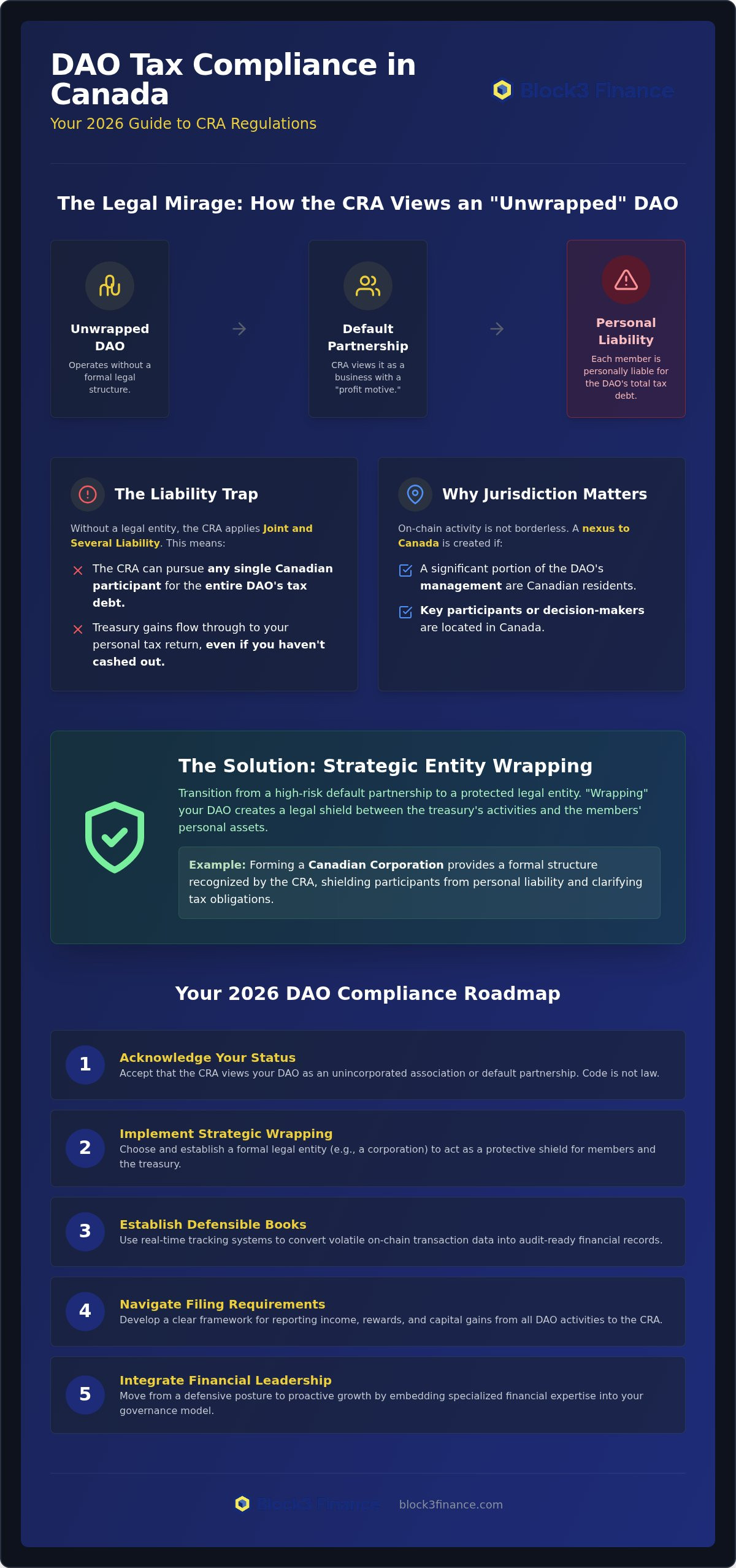
The CRA applies existing tax laws to decentralized structures by identifying a "common goal" and a "profit motive." If your DAO generates revenue or distributes rewards, it's likely operating as a business in the eyes of the government. This triggers specific reporting requirements for Canadian participants who hold beneficial ownership in the treasury. Beneficial ownership refers to the right to enjoy the economic benefits of an asset, even if the legal title is held by a smart contract. The CRA looks past the code to see who ultimately controls the funds or votes on their allocation. If the group acts together to generate profit, the organization may be treated as a partnership by default. This creates a high stakes environment where participants may face joint and several liability for the collective's tax debts.
Why Ignorance of Jurisdiction is a Compliance Trap
It's a dangerous misconception that on-chain activity is borderless and beyond the reach of national authorities. The CRA maintains that if a significant portion of a DAO's management or its key participants are Canadian residents, the organization has a nexus to Canada. This residency triggers CRA interest and subjects the treasury activity to Canadian oversight. You can't hide behind a global contributor base if your core decision makers are filing taxes in Ontario or British Columbia. For a deeper look at how these rules apply to your specific holdings, review our guide on CRA crypto tax basics. Ignoring these jurisdictional ties doesn't protect the DAO; it only ensures that participants are unprepared when an audit begins. Achieving DAO tax compliance starts with recognizing that your physical location matters more than your server's location.
Tax Liability and the Default Classification Trap for Canadian Participants
Most DAO participants believe their liability ends with their initial token contribution. This is a dangerous assumption. Without a formal legal structure, the CRA interprets your collective activity as a General Partnership. This means you aren't just a community member; you're a partner in a business enterprise. As highlighted in Harvard Law School's Primer on DAOs, these organizations often mirror traditional business structures despite their decentralized nature. In Canada, this default classification triggers joint and several liability. This legal concept means the CRA can pursue any single Canadian participant for the full tax debt owed by the entire organization.
Treasury gains don't stay locked in the smart contract for tax purposes. They flow through to your personal tax return. If the DAO treasury appreciates or generates yield, you may owe tax on your portion of those gains even if you haven't "cashed out" to fiat. Mastering DAO tax compliance requires a proactive stance. You must define your narrative before an auditor does. Waiting for a CRA inquiry is a reactive strategy that leaves you vulnerable to aggressive interpretations of your on-chain activity. We empower you to take an offensive posture by documenting your intent and participation early.
The T5013 Partnership Information Return Requirement
If a DAO has Canadian partners or carries on business in Canada, it may be required to file a T5013 Partnership Information Return. This form details the income, losses, and distributions of the partnership to the CRA. For the 2025 tax year, the filing deadline is typically March 31, 2026, for partnerships where all partners are individuals. Non-compliance carries heavy penalties that can erode treasury holdings quickly. These rules ensure that income flows through to Canadian residents, who must then report their share on their individual T1 returns. We help you navigate these filings to ensure every participant's record remains defensible against future scrutiny.
GST/HST Implications for DAO Operations
Canadian sales tax adds another layer of friction to decentralized operations. If your DAO provides services or sells digital assets, you must determine if those "supplies" are subject to GST/HST. The challenge lies in "place of supply" rules. These rules determine which province's tax rate applies based on the location of the recipient. For a borderless protocol, identifying the recipient's location is notoriously difficult without professional monthly bookkeeping. Clean books are the only way to prove you've met your obligations to the CRA. If you're concerned about your personal exposure, reach out to our strategists to discuss a protective framework for your participants.
Strategic Entity Wrapping: Protecting the Treasury and the Community
A "Wrapped DAO" isn't a surrender of decentralization. It's a strategic interface that allows a protocol to interact with the legacy financial system while maintaining its core ethos. Without this layer, your organization remains a "naked DAO," exposed to the default partnership risks we discussed earlier. By adopting a formal legal structure, you create a distinct entity that can hold assets, sign contracts, and protect its participants. We act as your strategic navigator for corporate structuring, ensuring your legal wrap mirrors your technical governance.
Strategic entity wrapping is the key to DAO tax compliance in 2026. It transforms a loose collection of wallets into a recognized taxpayer with predictable rules. This transition is essential for moving funds from on-chain treasuries to off-chain operations, such as paying developers in fiat or leasing physical office space. A wrapper provides the "legal personhood" required to open bank accounts and engage with traditional vendors without exposing individual members to personal risk.
Canadian Corporations and Non-Resident Trusts
Federal corporations in Canada offer a robust and familiar framework for DAO wrapping. They provide clear rules for governance and tax reporting, though they require careful management of the CRA's "Mind and Management" test. This test determines residency based on where the actual decisions are made. If your governance happens entirely on-chain through a global vote, proving the location of management becomes a complex task. Some organizations prefer non-resident trusts or foundation companies in jurisdictions like the Cayman Islands, but these must be structured carefully to avoid being caught in Canada's foreign affiliate rules. We ensure your wrapper supports your governance model rather than breaking it, and for specialized guidance in other complex Canadian regulatory sectors, you can visit JZ Law.
Liability Shielding for Individual Contributors
The primary benefit of a wrapper is the "corporate veil." This legal concept separates the entity's liabilities from the personal assets of its contributors. It stops the CRA or creditors from pursuing individual developers for the DAO's obligations. Contractual protections can be further strengthened for governance participants through specific indemnification clauses within the corporate bylaws. Managing these complex structures requires more than just a filing; it demands ongoing CFO leadership to oversee treasury movements and compliance. This high-level oversight ensures that your liability shield remains intact even as your organization scales and evolves.
The Compliance Roadmap: Converting On-Chain Activity into Defensible Books
On-chain activity is often a storm of data without a clear anchor. To achieve DAO tax compliance, you must transform this raw transaction history into a structured ledger that a CRA auditor can actually interpret. We help you move from on-chain chaos to clean, defensible books by implementing real-time tracking for every treasury movement. This isn't just about recording transfers; it's about establishing a methodology that withstands high-stakes scrutiny.
The presence of anonymous or pseudonymous participants doesn't excuse the organization from reporting requirements. You must develop internal systems to verify the tax residency of key contributors to ensure your filings remain accurate. Use our Block3 Finance audit-ready checklist to start organizing your records today. It's the first step in shifting from a defensive posture to total command over your financial narrative.
Treasury Reconciliation and Fair Value Measurement
Reconciliation is the process of proving that your on-chain balances match your accounting records. This requires a methodical approach to data aggregation and valuation that accounts for every gas fee and token swap. We recommend a three-step process to ensure your records are ready for the 2026 filing season:
- Step 1: Aggregate data from all DAO-controlled wallets and multi-sigs to create a single, unified source of truth.
- Step 2: Assign a CAD fair market value to each asset at the exact time of the transaction, as the CRA requires all values to be reported in Canadian dollars.
- Step 3: Categorize flows as Revenue, Expense, or Capital Contribution to ensure the correct tax treatment is applied to every movement.
Documenting Governance Decisions for Audit Trails
A transaction without context is a red flag for the CRA. Your financial records must include the "why" behind the "what," linking on-chain execution to the original intent of the community. Snapshot votes, forum discussions, and Discord archives serve as the narrative glue for your financial activity. When a treasury allocates funds for a grant or a protocol upgrade, these records prove the business purpose of the expense.
Bridging the gap between code and intent is essential for a successful CRA audit preparation. Auditors look for consistency between what the community voted for and what the smart contract executed. If you're ready to secure your organization's future and protect your participants, contact our specialized accountants to build your defensible roadmap.
Strategic Financial Leadership for Modern Decentralized Entities
Compliance is the threshold of legitimacy. By transforming your organization from a decentralized experiment into a structured entity, you gain the credibility required to scale in a global market. This transition allows you to attract elite contributors and secure institutional partnerships that were once impossible. We view DAO tax compliance not as a burden, but as the foundation for your organization’s long-term survival and success.
The path to legitimacy requires moving beyond the default partnership trap and the joint liability risks we identified in earlier sections. You need a framework that respects the ethos of decentralization while meeting the technical demands of the CRA. This balance is achieved through strategic leadership that treats financial oversight as a core governance function rather than an afterthought.
Mastering the Volatile Landscape
Navigating the intersection of blockchain protocols and Canadian tax law requires a "Visionary Navigator" who possesses both technical rigor and strategic foresight. We bring 13+ years of blockchain-specific financial expertise to your treasury management. This deep experience allows us to turn regulatory complexity into a distinct competitive advantage for your community.
We move your organization from a defensive tax posture to one of offensive growth mastery. Instead of reacting to CRA inquiries, you operate with the confidence that your books are audit-ready and your liability is shielded. By mastering the volatile landscape, you ensure that your DAO remains resilient regardless of how the regulatory environment shifts in 2026 and beyond. We help you cultivate a professional environment where innovation and accountability exist in total harmony.
Secure Your DAO's Future with Block3 Finance
Block3 Finance acts as a sophisticated bridge between the cutting-edge world of Web3 and the established protocols of legacy corporate finance. We are active participants in the industry’s evolution, helping to define the rules for a new era of decentralized accounting. Our team translates on-chain chaos into the structured financial records that Canadian regulators demand.
Don't let your community's treasury remain exposed to the risks of default classification or personal liability. We invite you to consult with our strategists on DAO tax filing and reporting to establish a defensible framework for your participants. We help you gain total command over your financial narrative, protecting your members while enabling your protocol to reach its full potential.
True liberation comes through financial command. By securing your organization’s future today, you provide the stability needed to innovate without the friction of legal or tax uncertainty. Partner with a calm force in a chaotic industry to ensure your DAO isn't just a protocol, but a lasting institution. We stand ready to help you navigate this high-stakes environment with precision and confidence.
Secure Your Protocol’s Legacy Through Financial Command
Achieving DAO tax compliance in 2026 is a strategic evolution that replaces personal liability with institutional stability. You've seen how the CRA views unwrapped organizations as default partnerships and why strategic entity wrapping is essential to protect your community's treasury. By converting on-chain activity into defensible, audit-ready records, you move from a defensive posture to total growth mastery. This transition ensures that your protocol isn't just a technical experiment but a lasting institution.
As the #1 ranked crypto accountant by Bitcoin.com, Block3 Finance provides the global expertise in CRA compliance needed to navigate this volatile landscape. We have delivered audit-ready financial records for over 980 clients, successfully bridging the gap between Web3 innovation and legacy finance. Secure your DAO's financial future; contact our expert compliance team today.
Take command of your financial narrative today. We're here to ensure your organization remains resilient, compliant, and ready to lead the next era of finance.
Frequently Asked Questions
Is a DAO considered a legal person in Canada?
No, the CRA does not currently recognize a DAO as a distinct legal person. Unless you implement a formal legal wrap, the agency typically views the organization as an unincorporated association or a general partnership. This means the DAO cannot sign contracts or hold assets in its own name under Canadian law.
Do Canadian DAO participants have to pay tax on treasury gains they haven't withdrawn?
Yes, Canadian participants may owe tax on their share of treasury gains even if they don't withdraw funds to a personal wallet. If the CRA classifies the DAO as a partnership, all income and capital gains flow through to the individual members. You must report your portion of the profit on your personal T1 return for the year it was earned.
How does the CRA track DAO transactions if the treasury is on-chain?
The CRA utilizes sophisticated blockchain analysis tools and data-matching programs to monitor on-chain activity. They also receive information from centralized exchanges and international tax authorities to identify Canadian residents linked to specific wallets. Maintaining proactive DAO tax compliance records is the only way to defend your position during an audit.
What happens if a DAO fails to file a Canadian tax return?
Failure to file can result in significant financial penalties and interest charges applied by the CRA. Because unwrapped DAOs are often treated as partnerships, every Canadian participant could be held jointly and severally liable for the total debt. This means the government can pursue a single member to pay the entire organization's tax bill.
Can a DAO issue T4 slips for contributors in Canada?
A DAO can only issue T4 slips if it has established a formal legal entity, such as a corporation, and registered for a payroll account with the CRA. Unwrapped organizations lack the legal standing to act as employers under the Income Tax Act. Most DAOs instead treat contributors as independent contractors who are responsible for their own tax filings.
How do GST/HST rules apply to DAO governance tokens?
GST/HST treatment depends on whether the governance tokens are classified as financial instruments or taxable supplies. If the DAO provides services to Canadians in exchange for tokens, it may have an obligation to collect and remit sales tax. Determining the "place of supply" for a decentralized protocol requires specialized accounting oversight to avoid unexpected assessments.
What is the best legal structure for a Canadian-based DAO?
A Canadian federal corporation is often the most effective structure for providing liability protection and tax clarity for participants. This "wrapper" allows the DAO to interact with the traditional financial system while shielding members from personal debt. Some organizations may also consider non-resident trusts, though these require careful navigation of foreign affiliate rules.
Can Block3 Finance help with cross-border DAO tax issues?
Yes, Block3 Finance specializes in resolving complex cross-border DAO tax compliance challenges for organizations with global footprints. We provide the strategic leadership needed to harmonize CRA requirements with international tax frameworks. For organizations managing international business and investment between the United States and Israel, the Israel Cross Border Law Firm offers specialized legal guidance that complements our tax compliance services. Our team ensures your records remain audit-ready and defensible across multiple jurisdictions.

Article by
Mahad Mohamed
Mahad Mohamed is an accountant and the CEO of Block3 Finance, with over 26+ years of Canadian and international tax and accounting experience. A crypto accounting specialist since the early days of Bitcoin, he has consulted for over 38 crypto companies and collaborated with legal professionals on regulatory matters. His expertise spans corporate reorganization, cross-border tax structuring (Canada & US), tax disputes, and CRA audits.
Previously, Mahad worked for the Canada Revenue Agency (CRA), Big4 accounting firms, and served as a Rulings Officer for the Federal Tax Authority of the UAE before acquiring Tax Partners in 2014.
Block3 Finance and Tax Partners has 44 full-time accountants and over 9,800+ clients.
Disclaimer
This article provides general information only and is current as of its publication date. It has not been updated and may be out of date. It does not constitute legal advice and should not be relied upon as such. Every tax situation is unique and may differ from the examples discussed in this article. If you have specific questions, you should seek the advice of our accountants for your unique circumstances.
Frequently Asked Questions
Is a DAO considered a legal person in Canada?
No, the CRA does not currently recognize a DAO as a distinct legal person. Unless you implement a formal legal wrap, the agency typically views the organization as an unincorporated association or a general partnership. This means the DAO cannot sign contracts or hold assets in its own name under Canadian law.
Do Canadian DAO participants have to pay tax on treasury gains they haven't withdrawn?
Yes, Canadian participants may owe tax on their share of treasury gains even if they don't withdraw funds to a personal wallet. If the CRA classifies the DAO as a partnership, all income and capital gains flow through to the individual members. You must report your portion of the profit on your personal T1 return for the year it was earned.
How does the CRA track DAO transactions if the treasury is on-chain?
The CRA utilizes sophisticated blockchain analysis tools and data-matching programs to monitor on-chain activity. They also receive information from centralized exchanges and international tax authorities to identify Canadian residents linked to specific wallets. Maintaining proactive DAO tax compliance records is the only way to defend your position during an audit.
What happens if a DAO fails to file a Canadian tax return?
Failure to file can result in significant financial penalties and interest charges applied by the CRA. Because unwrapped DAOs are often treated as partnerships, every Canadian participant could be held jointly and severally liable for the total debt. This means the government can pursue a single member to pay the entire organization's tax bill.
Can a DAO issue T4 slips for contributors in Canada?
A DAO can only issue T4 slips if it has established a formal legal entity, such as a corporation, and registered for a payroll account with the CRA. Unwrapped organizations lack the legal standing to act as employers under the Income Tax Act. Most DAOs instead treat contributors as independent contractors who are responsible for their own tax filings.
How do GST/HST rules apply to DAO governance tokens?
GST/HST treatment depends on whether the governance tokens are classified as financial instruments or taxable supplies. If the DAO provides services to Canadians in exchange for tokens, it may have an obligation to collect and remit sales tax. Determining the "place of supply" for a decentralized protocol requires specialized accounting oversight to avoid unexpected assessments.
What is the best legal structure for a Canadian-based DAO?
A Canadian federal corporation is often the most effective structure for providing liability protection and tax clarity for participants. This "wrapper" allows the DAO to interact with the traditional financial system while shielding members from personal debt. Some organizations may also consider non-resident trusts, though these require careful navigation of foreign affiliate rules.
Can Block3 Finance help with cross-border DAO tax issues?
Yes, Block3 Finance specializes in resolving complex cross-border DAO tax compliance challenges for organizations with global footprints. We provide the strategic leadership needed to harmonize CRA requirements with international tax frameworks. Our team ensures your records remain audit-ready and defensible across multiple jurisdictions.