
Relying on automated software to manage your digital asset portfolio is no longer a viable strategy for US-based entities facing the IRS's 2026 reporting requirements. A specialized blockchain accounting firm does more than just tally balances; it deciphers the logic of smart contracts, which are self-executing digital agreements, to ensure every transaction is defensible. This proactive approach shifts your stance from defensive compliance to offensive financial mastery.
You likely recognize that the friction between decentralized finance and legacy accounting standards creates a significant risk for your business. It's exhausting to bridge the gap between complex on-chain activity, which refers to transactions recorded directly on the blockchain, and the rigid expectations of traditional financial oversight. Traditional accountants often lack the technical depth to interpret gas fees, the transaction costs paid to process blockchain activity.
This article demonstrates how elite financial guidance transforms your raw data into audit-ready records and strategic tax optimization under US law. We will examine the methodologies for maintaining seamless crypto-to-fiat operations while securing your position as a leader in the Web3 ecosystem. You'll discover how to gain total command over your financial landscape through precise, white-glove reporting.
Key Takeaways
- Learn how a specialized blockchain accounting firm bridges the gap between decentralized protocols and IRS standards by interpreting smart contract interactions as taxable events.
- Understand the requirements for accurately categorizing income from mining, staking, and airdrops to ensure your US-based entity remains fully compliant.
- Explore how monthly bookkeeping and fractional CFO services provide the strategic oversight necessary to scale your digital asset operations with confidence.
- Identify the technical criteria for selecting an accounting partner that understands the nuances of DeFi, NFTs, and DAOs.
- Discover the methodology for transforming complex on-chain data into defensible financial records that support long-term growth under US law.
The Role of a Specialized Blockchain Accounting Firm
A specialized blockchain accounting firm serves as the essential bridge between decentralized protocols and the rigid requirements of traditional financial reporting. These firms don't just record numbers. They interpret smart contracts, which are self-executing digital agreements, to ensure every interaction aligns with US tax standards. This expertise is critical for any entity operating within the Web3 space.
The primary objective is to establish a central point of truth for all digital asset transactions. By integrating monthly accounting with high-level CFO services, these firms transform raw data into a strategic growth engine. This proactive oversight moves beyond simple filing and focuses on long-term financial health and defensibility.
Why Traditional Accountants Often Struggle with Web3
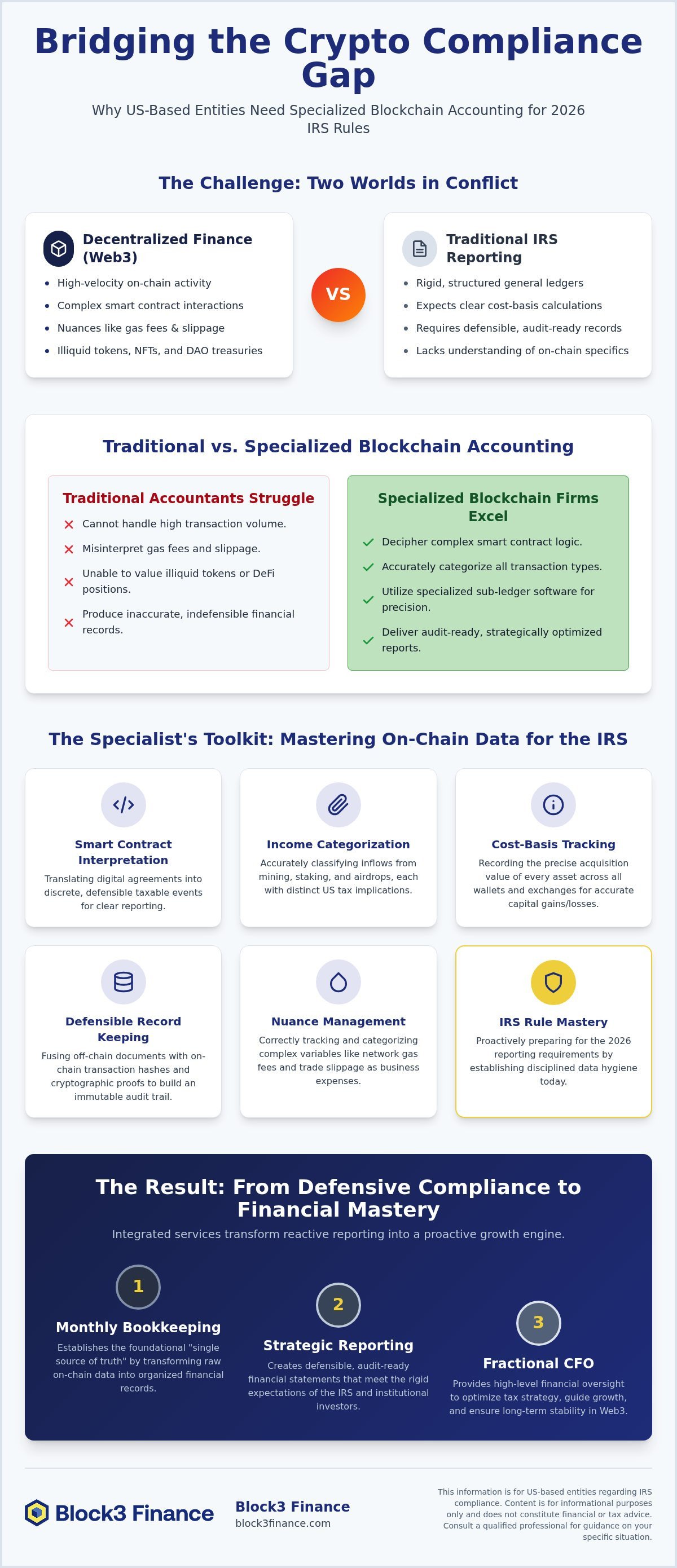
Legacy general ledgers aren't designed to handle the velocity or volume of on-chain activity. Traditional firms often buckle when faced with thousands of transactions across multiple protocols. They frequently struggle to value illiquid tokens or complex positions within decentralized finance, often called DeFi. This lack of technical depth creates significant risk for US taxpayers.
Understanding specific costs is non-negotiable for accurate reporting. For example, gas fees, which are the transaction costs paid to process activity on the network, must be correctly categorized as business expenses. Similarly, slippage, the difference between the expected and executed price of a trade, requires precise tracking to maintain accurate records under IRS rules. Traditional methods often overlook these nuances, leading to inaccurate financial statements.
Navigating the Complexity of On-Chain Financial Records
Building a defensible record requires a deep understanding of what is blockchain technology and how it stores immutable data. Financial records in this space are a fusion of off-chain documentation and on-chain transaction hashes. These hashes serve as unique identifiers for every entry on the ledger, providing a permanent trail for auditors to follow.
A professional blockchain accounting firm verifies the ownership and control of digital wallets through cryptographic proofs. This process ensures that every asset listed on the balance sheet is legitimately held by the entity. It also helps in identifying any unauthorized activity or discrepancies before they become major liabilities during an audit.
Managing this vast data set requires specialized sub-ledger software. These tools aggregate data from multiple chains and exchanges into a single, cohesive view that traditional software can't provide. This level of technical sophistication is necessary to ensure that your records are always audit-ready and investor-compliant. For developers and businesses building out their Web3 presence, Crypto Chief provides a unified infrastructure platform to support these technical requirements, allowing your business to move with confidence in a high-stakes environment.
Navigating US Tax Compliance: IRS Rules for 2026
US entities face a transformative shift in regulatory expectations as we approach the 2026 tax year. Adhering to IRS rules for 2026 requires a disciplined approach to data hygiene that most businesses are currently unprepared to execute. A specialized blockchain accounting firm ensures that your organization doesn't just react to these changes but masters them through precise documentation.
Accountants must accurately categorize every inflow of digital assets to avoid misreporting. Income generated from mining, which involves securing a network for rewards, staking, or locking assets to support a protocol, and airdrops, the receipt of free tokens, all carry distinct tax implications. Misclassifying these events can lead to significant underreporting and trigger unwanted scrutiny from federal authorities.
Managing cost-basis tracking across a fragmented ecosystem is a primary challenge for modern enterprises. This process involves recording the original value of an asset at the exact moment of acquisition across dozens of exchanges and private wallets. Without a unified ledger, calculating capital gains or losses becomes a speculative exercise rather than a defensible financial record. Proper reporting prevents costly penalties and drastically reduces the risk of a full IRS audit.
Understanding ASU 2023-08 and Fair Value Measurement
The Accounting Standards Update (ASU) 2023-08 fundamentally changes how corporate entities report digital assets on their balance sheets. It requires certain crypto assets to be measured at fair value, which is their current market price, rather than their historical cost. While this shift introduces higher earnings volatility, it provides a more accurate reflection of a company's true financial position. For a deeper analysis of these changes, see our guide on ASU 2023-08 and Crypto Revenue Recognition.
IRS Reporting Requirements: Form 1099-DA and Beyond
The introduction of Form 1099-DA marks a new era of transparency for brokers and digital asset platforms. This form requires third parties to report gross proceeds and cost-basis information directly to the government, making it easier for the IRS to track non-compliance. Relying solely on these forms is a high-risk strategy; you must maintain independent, internal records to verify their accuracy and resolve any discrepancies that may arise.
Beyond transaction-specific forms, the IRS continues to prioritize the "digital asset" question on standard US tax returns. Businesses must also monitor reporting thresholds for Form 8300 when receiving large payments in digital assets for trade or business purposes. You should verify current thresholds directly with the IRS to ensure your reporting remains current and accurate. To secure your 2026 filing strategy and move toward total financial command, consult with our specialists today.
Core Services: From Bookkeeping to Fractional CFO
A premier blockchain accounting firm provides the operational backbone necessary for sustainable growth in the digital asset sector. Monthly bookkeeping ensures your records remain audit-ready and investor-compliant at all times. This proactive management allows you to present a clear financial story to stakeholders without the stress of historical cleanup, while specialized resources like asapsolutions.tax help small businesses prepare for the broader accounting challenges of 2026.
Tax filing and reporting services focus on maximizing legitimate deductions under US law while maintaining absolute transparency with the IRS. Beyond simple filing, corporate structuring helps you select the most tax-efficient entity for your specific crypto activities. This strategic alignment is a key role of a specialized blockchain accounting firm in today's market.
Automated On-Chain Reconciliation and Sub-Ledgers
Sub-ledgers are specialized secondary record-keeping systems that aggregate data from multiple chains into a single, cohesive financial view. These tools are essential because they handle the high volume of transactions that traditional general ledgers cannot process efficiently. Our monthly accounting methodology focuses on matching these on-chain movements with off-chain business justifications.
This reconciliation process involves verifying that every digital transfer corresponds to a specific invoice, receipt, or contract. By creating this link, we transform anonymous transaction hashes into defensible business records. This level of detail is what separates a compliant enterprise from one at risk of failing an audit.
Strategic CFO Services for Web3 Growth
Fractional CFO services provide the high-level leadership required to scale complex digital asset operations. For high-growth firms, treasury management, which is the administration of your entity's financial assets, and runway planning are vital. Runway refers to the amount of time your business can continue to operate before needing additional capital or revenue.
For growth-oriented businesses requiring expert financial direction on a flexible basis, pcfo.co.uk provides part-time CFO services that help maintain stability and strategic focus.
For high-income entrepreneurs who need to balance corporate growth with personal financial security, Kotini & Kotini offers a boutique virtual family office that integrates tax, wealth, and lifestyle planning into a single strategic framework.
For startups and SMEs based in New Zealand, Proledger offers the specialized bookkeeping and business advisory services required to navigate growth with financial clarity.
For organizations looking to expand their leadership teams, Mark Loucas Ltd acts as a specialist recruitment consultancy, providing the executive search solutions required to find top talent in the global fintech and digital banking sectors.
For Australian professional services firms looking to scale their operations with offshore talent, you can visit Tarino to explore specialized recruitment services in the Philippines.
To ensure your business maintains a solid financial foundation while scaling, you may also want to check out JKB Services, a strategic accounting firm that provides comprehensive support for corporate financial management.
A CFO also plays a critical role in implementing secure on- and off-ramp solutions. These solutions allow your business to move efficiently between fiat currencies like the US dollar and digital assets. Utilizing CFO services ensures your treasury remains liquid and your strategic goals remain within reach during market volatility.
How to Choose the Right Blockchain Accounting Partner
Selecting a partner is a strategic decision that dictates the long-term defensibility of your financial position. You must verify a firm’s specific experience within your particular niche, whether you operate in decentralized finance (DeFi), non-fungible tokens (NFTs), or decentralized autonomous organizations (DAOs). Each of these sectors operates under unique cryptographic logic that a generalist accountant will likely misinterpret.
A high-caliber blockchain accounting firm provides proactive advice rather than mere data entry. This "white-glove" approach ensures that your technical stack integrates seamlessly with your existing custodial solutions. The firm must also demonstrate a mastery of US-specific tax codes and Financial Accounting Standards Board (FASB) requirements to maintain regulatory alignment. When assessing their technical capabilities, consider the following:
- Custodial integration: Does the firm support your specific wallet or exchange provider?
- Sub-ledger capability: Can their software handle the volume of your on-chain activity?
- Real-time reporting: Do they offer dashboard access for continuous monitoring?
Audit Readiness and Defensible Record Keeping
Compliance is not a static goal but a continuous state of readiness. Your chosen partner should provide records that are "defensible" during a professional audit, meaning every entry stands up to rigorous scrutiny. This level of precision requires an established audit trail for every transaction hash recorded on the ledger.
Transaction hashes act as unique digital fingerprints for every movement of value. By linking these hashes to specific business justifications, you create an immutable chain of evidence. For more detailed insights on the selection process, read our guide on how to choose a crypto tax accountant.
The Importance of Native Blockchain Expertise
There is a sharp distinction between "crypto-aware" firms and those that are truly "blockchain-native." A crypto-aware firm might understand basic exchange trades but will struggle with the nuances of liquidity pooling or cross-chain bridging. In contrast, native expertise allows for a deep understanding of the underlying protocol mechanics.
Longevity in this space is a rare and valuable asset. Block3 Finance brings 13+ years of blockchain financial expertise to every engagement, a critical factor in an industry where rules change monthly. You should prioritize firms with recognized industry rankings, such as being featured as a top provider by Bitcoin.com. This third-party validation confirms a firm's ability to navigate high-stakes environments with total command. To secure your organization's financial future, contact our elite strategy team for a comprehensive compliance review.
The Block3 Finance Advantage: Mastery Over Volatility
Block3 Finance transforms the burden of compliance into a strategic advantage for our clients. As a premier blockchain accounting firm, we move away from the dry, detached nature of traditional reporting to offer a proactive stance that feels both protective and enabling. We position US entities to navigate high-stakes environments with total command, shifting the narrative from merely managing regulations to achieving offensive growth. Our methodology ensures that you aren't just an observer of the industry but an active participant in its financial evolution.
Mastery requires more than technical rigor. It demands a partnership that provides a clear roadmap for thriving in a volatile landscape. We empower your team to gain total agency over on-chain data, turning complex transaction histories into a source of strategic insight. By choosing an elite strategist, you secure a future where vision and execution are inseparable. For regional support in Southeast Asia, you can check out K Cloud Accounting Pte Ltd to handle your local bookkeeping and compliance needs.
Global Reach with Local US Expertise
Our global footprint provides a unique perspective on the digital asset economy, yet our specialized knowledge of IRS regulations remains our core strength for American filers. We maintain a deep commitment to international crypto tax compliance, ensuring that multinational firms remain synchronized across diverse legal frameworks. This specialized oversight resolves the friction often found in cross-border digital operations.
In key international markets, firms like CTC Tax & Accounting serve as vital partners, offering the bookkeeping and tax compliance expertise needed to navigate these diverse legal frameworks. This level of professional support ensures that global entities can scale with confidence while remaining fully synchronized with their financial obligations.
In the Mediterranean region, לוי ושות' רואי חשבון (Levi and Co. CPA) provides essential auditing and double-entry bookkeeping services, helping businesses maintain high standards of financial reporting and transparency across their operations.
Intellectual leadership is the cornerstone of our practice. Our company background reflects a mission to lead the industry through technical rigor and mentorship. Having served over 980 clients globally, we understand the nuances of high-stakes Web3 environments. We act as a calm force in a chaotic industry, providing the stability your organization needs to move with confidence.
Scaling with Authority and Security
We provide a roadmap for thriving as your Web3 project grows from a seed-stage startup to a mature enterprise. Our focus on corporate structuring ensures your assets are protected while maximizing tax efficiency under current US law. As your operations expand, our services evolve to match your complexity, providing the technical depth required for institutional-grade reporting.
Security and authority go hand in hand. We invite you to explore our learning center for deeper insights into the future of digital finance and best practices for on-chain oversight. This commitment to transparency helps you build a defensible financial foundation that attracts investors and withstands audits. Ready to secure your financial future and gain total command over your digital assets? Contact our expert team today to begin your journey toward financial mastery.
Mastering the Future of Digital Finance
The transition toward the IRS’s 2026 reporting standards demands more than just a passing familiarity with digital assets. Success requires a partnership that translates complex on-chain logic into the disciplined language of corporate finance. By prioritizing audit-ready records and strategic tax optimization, your organization can move with absolute confidence in a high-stakes environment.
Block3 Finance stands as a calm force in this evolving landscape. As a premier blockchain accounting firm, we bring 13+ years of native expertise to every engagement. We are trusted by over 980 clients globally and were recently ranked as the top provider by Bitcoin.com. This proven track record ensures your treasury is secure and your growth is defensible. For US-based entities seeking broader financial oversight, Wright CPAs, LLC offers the full-service tax and consulting expertise required to maintain clarity across all business operations.
You don't have to navigate these complexities alone. Our team provides the elite strategy and technical rigor necessary to secure your position as a leader in the Web3 ecosystem. Secure your Web3 future with a professional consultation today and gain total command over your financial landscape.
Frequently Asked Questions
What is a blockchain accounting firm and how does it differ from a CPA?
A blockchain accounting firm possesses specialized technical knowledge of on-chain protocols that a generalist CPA often lacks. While both manage financial records, a blockchain specialist interprets smart contracts and cryptographic proofs to ensure every digital transaction aligns with IRS standards. They act as a visionary navigator through high-stakes Web3 environments to ensure your data is defensible.
Does the IRS require specialized accounting for crypto-to-crypto trades?
Yes, the IRS treats every crypto-to-crypto trade as a taxable event requiring precise cost-basis tracking under US law. You must report the fair market value of the assets at the time of the exchange to determine capital gains or losses. A professional blockchain accounting firm ensures these calculations are accurate and defensible against future audits by maintaining a unified ledger.
How does a blockchain accounting firm handle DeFi and liquidity pool transactions?
Firms handle DeFi transactions by utilizing sub-ledger software to aggregate complex activity like yield farming or liquidity provision. These interactions are categorized as income or capital events depending on the specific protocol logic. Specialists verify the ownership of liquidity provider tokens to maintain a clear trail of assets and liabilities on your corporate balance sheet.
Can a blockchain accounting firm help me if I have lost or stolen crypto?
An accounting firm helps document the loss for financial reporting purposes; however, US taxpayers should check current IRS rules regarding casualty loss deductions. While many personal casualty losses were limited by federal law, business-related losses may still be deductible under certain conditions. We provide the cryptographic evidence needed to record the event accurately for your financial statements.
What are the benefits of hiring a fractional CFO for a crypto startup?
A fractional CFO provides elite strategic leadership without the cost of a full-time executive. They manage treasury operations, oversee runway planning, and implement secure crypto-to-fiat payment solutions; to explore how modern fintech platforms facilitate global transactions, you can learn more about DUC App. This proactive oversight helps startups navigate market volatility while ensuring that all financial operations remain compliant with evolving US regulations and investor expectations for transparency.
How do blockchain accounting firms verify on-chain transaction data?
Verification occurs through the reconciliation of on-chain transaction hashes with off-chain business documentation like invoices or contracts. Firms use cryptographic proofs to confirm wallet ownership and ensure that the ledger accurately reflects the entity's financial position. This process creates a central point of truth that is essential for building investor confidence and maintaining audit readiness.
Is my DAO required to file taxes with the IRS in 2026?
Most DAOs, or decentralized autonomous organizations, are likely required to file US tax returns if they have US-based members or earn US-sourced income. The IRS often classifies these entities as partnerships or corporations depending on their specific structure and activity. You should consult a specialist to determine your specific filing obligations under the latest federal guidelines for 2026.
What happens if my business fails to report digital asset transactions to the IRS?
Failure to report can result in substantial penalties, interest charges, and an increased risk of a full IRS audit. In severe cases, intentional non-compliance may lead to criminal charges under federal law. A specialized blockchain accounting firm helps you avoid these pitfalls by maintaining proactive, transparent records of all digital asset activity across every wallet and exchange.

Article by
Mahad Mohamed
Mahad Mohamed is an accountant and the CEO of Block3 Finance, with over 26+ years of Canadian and international tax and accounting experience. A crypto accounting specialist since the early days of Bitcoin, he has consulted for over 38 crypto companies and collaborated with legal professionals on regulatory matters. His expertise spans corporate reorganization, cross-border tax structuring (Canada & US), tax disputes, and CRA audits.
Previously, Mahad worked for the Canada Revenue Agency (CRA), Big4 accounting firms, and served as a Rulings Officer for the Federal Tax Authority of the UAE before acquiring Tax Partners in 2014.
Block3 Finance and Tax Partners has 44 full-time accountants and over 9,800+ clients.
Disclaimer
This article provides general information only and is current as of its publication date. It has not been updated and may be out of date. It does not constitute legal advice and should not be relied upon as such. Every tax situation is unique and may differ from the examples discussed in this article. If you have specific questions, you should seek the advice of our accountants for your unique circumstances.
Frequently Asked Questions
What is a blockchain accounting firm and how does it differ from a CPA?
A blockchain accounting firm possesses specialized technical knowledge of on-chain protocols that a generalist CPA often lacks. While both manage financial records, a blockchain specialist interprets smart contracts and cryptographic proofs to ensure every digital transaction aligns with IRS standards. They act as a visionary navigator through high-stakes Web3 environments to ensure your data is defensible.
Does the IRS require specialized accounting for crypto-to-crypto trades?
Yes, the IRS treats every crypto-to-crypto trade as a taxable event requiring precise cost-basis tracking under US law. You must report the fair market value of the assets at the time of the exchange to determine capital gains or losses. A professional blockchain accounting firm ensures these calculations are accurate and defensible against future audits by maintaining a unified ledger.
How does a blockchain accounting firm handle DeFi and liquidity pool transactions?
Firms handle DeFi transactions by utilizing sub-ledger software to aggregate complex activity like yield farming or liquidity provision. These interactions are categorized as income or capital events depending on the specific protocol logic. Specialists verify the ownership of liquidity provider tokens to maintain a clear trail of assets and liabilities on your corporate balance sheet.
Can a blockchain accounting firm help me if I have lost or stolen crypto?
An accounting firm helps document the loss for financial reporting purposes; however, US taxpayers should check current IRS rules regarding casualty loss deductions. While many personal casualty losses were limited by federal law, business-related losses may still be deductible under certain conditions. We provide the cryptographic evidence needed to record the event accurately for your financial statements.
What are the benefits of hiring a fractional CFO for a crypto startup?
A fractional CFO provides elite strategic leadership without the cost of a full-time executive. They manage treasury operations, oversee runway planning, and implement secure crypto-to-fiat payment solutions. This proactive oversight helps startups navigate market volatility while ensuring that all financial operations remain compliant with evolving US regulations and investor expectations for transparency.
How do blockchain accounting firms verify on-chain transaction data?
Verification occurs through the reconciliation of on-chain transaction hashes with off-chain business documentation like invoices or contracts. Firms use cryptographic proofs to confirm wallet ownership and ensure that the ledger accurately reflects the entity's financial position. This process creates a central point of truth that is essential for building investor confidence and maintaining audit readiness.
Is my DAO required to file taxes with the IRS in 2026?
Most DAOs, or decentralized autonomous organizations, are likely required to file US tax returns if they have US-based members or earn US-sourced income. The IRS often classifies these entities as partnerships or corporations depending on their specific structure and activity. You should consult a specialist to determine your specific filing obligations under the latest federal guidelines for 2026.
What happens if my business fails to report digital asset transactions to the IRS?
Failure to report can result in substantial penalties, interest charges, and an increased risk of a full IRS audit. In severe cases, intentional non-compliance may lead to criminal charges under federal law. A specialized blockchain accounting firm helps you avoid these pitfalls by maintaining proactive, transparent records of all digital asset activity across every wallet and exchange.