
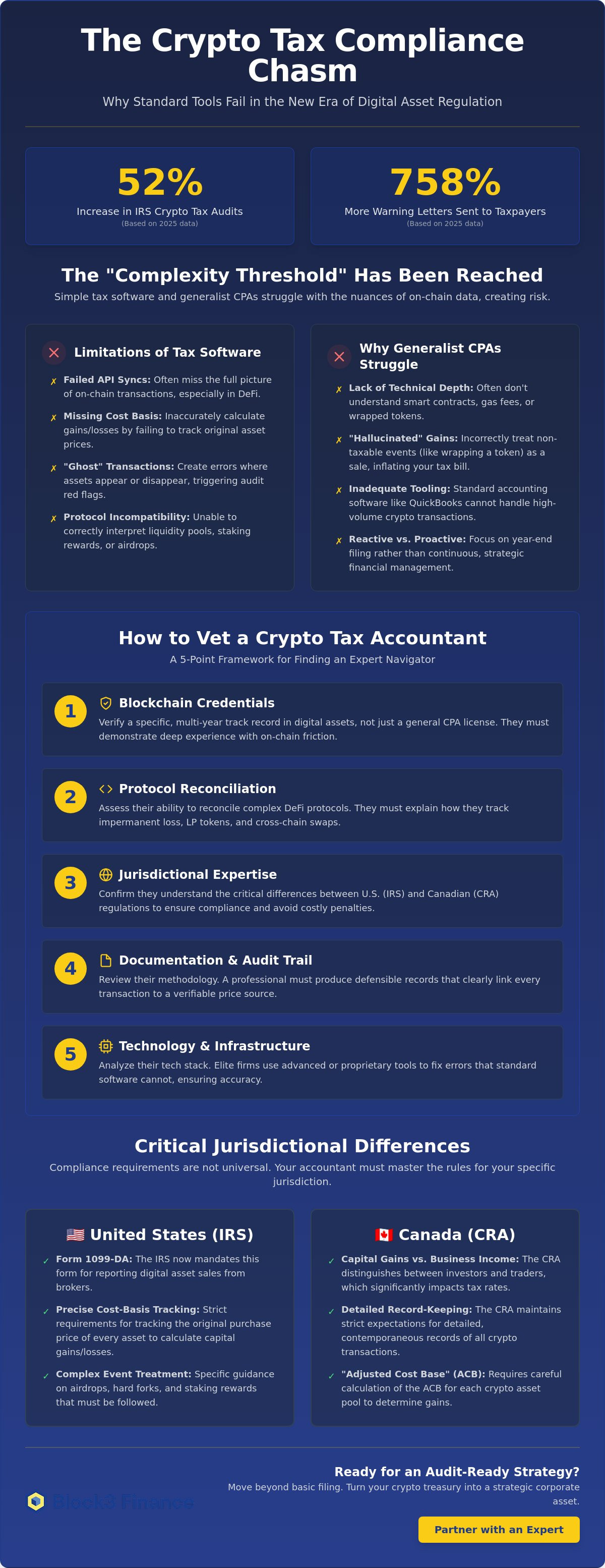
Did you know the IRS increased crypto tax audits by 52% in 2025 while sending out 758% more warning letters to taxpayers? It's a sobering reality for anyone managing digital assets in 2026. You've likely realized that standard crypto tax software often fails when faced with complex liquidity pool positions or cross-chain airdrops. Whether you're filing with the IRS in the U.S. or the CRA in Canada, the pressure to maintain defensible, audit-ready records has never been higher. Finding a qualified crypto tax accountant is no longer about simple data entry; it's about securing a strategic partner who can master the volatility of on-chain data.
We understand the anxiety of staring at a Form 1099-DA or a complex CRA reporting requirement without a clear roadmap. This guide provides the exact framework for vetting a professional who can translate your raw blockchain history into clean, strategic financial books. You'll learn how to identify a navigator who handles corporate structuring and tax-efficient off-ramping with the precision of a traditional auditor and the foresight of a digital native. We'll explore the critical differences between American and Canadian compliance and the specific questions that separate elite strategists from basic filing clerks.
Key Takeaways
- Learn why 2026 regulatory shifts require moving beyond basic software to a specialized crypto tax accountant who can reconcile complex on-chain protocols.
- Discover our 5-point framework for verifying blockchain credentials and ensuring your advisor can accurately translate DeFi and NFT data into defensible records.
- Explore how proactive monthly accounting and fractional CFO services can transform your crypto treasury from a compliance burden into a strategic corporate asset.
- Understand the critical jurisdictional differences between IRS and CRA reporting requirements to avoid costly penalties and ensure your financial records are audit-ready.
The Shift from Software to Specialized Crypto Accounting
The era of "click and sync" tax filing has ended. For years, investors relied on plug-and-play software to manage their obligations, but the 2026 regulatory environment has rendered these automated solutions insufficient for complex portfolios. A specialized crypto tax accountant acts as a vital bridge between the decentralized world of Web3 and the rigid structures of legacy finance. While software attempts to automate data, an expert interprets it. This distinction is critical because simple tax preparation is merely a reactive filing of forms; comprehensive digital asset accounting is a proactive, year-round methodology for tracking wealth and ensuring compliance.
Most users eventually reach a "Complexity Threshold" where a generalist CPA or a basic app cannot keep up. If you participate in liquidity pools, staking, or cross-chain airdrops, your data likely exceeds the capabilities of standard tools. In the U.S., the IRS now mandates the use of Form 1099-DA to report digital asset sales, requiring precise cost-basis tracking. In Canada, the CRA maintains strict expectations for detailed records to determine if activity qualifies as capital gains or business income. Without a navigator who understands the nuances of what is cryptocurrency and how it moves through smart contracts, you are likely leaving money on the table or inviting scrutiny.
The Limitations of Standard Tax Software
API connections often fail to capture the full picture of on-chain movement. These tools frequently miss the cost basis, which is the original purchase price used to calculate capital gains or losses. Software errors often create "ghost" transactions where assets seem to appear or disappear without a clear trail. This leads to missing price data in DeFi protocols, causing you to overpay taxes or, worse, trigger red flags during an audit. Relying solely on a scraper to reconcile thousands of micro-transactions is a high-stakes gamble that rarely pays off in the current enforcement climate.
Why Generalist CPAs Struggle with On-Chain Data
Traditional accountants often lack the technical depth to understand smart contract interactions or gas fees, which are the network fees paid to miners or validators to process transactions. A generalist might see a "wrapped" token and incorrectly treat it as a taxable sale rather than a non-taxable exchange, leading to "hallucinated" gains that inflate your tax bill. Standard accounting software like QuickBooks isn't built to handle the sheer volume of transactions found in modern portfolios. A crypto tax accountant provides the intellectual leadership necessary to resolve this friction, ensuring your books are clean and defensible.
How to Vet a Crypto Tax Accountant: A 5-Point Framework
Selecting the right crypto tax accountant requires more than a simple search for a local practitioner; it demands a rigorous vetting process to ensure they possess the technical capacity to handle sophisticated on-chain activity. You're hiring a strategist, not a data entry clerk. Our framework focuses on five pillars: credentials, protocol reconciliation, jurisdictional expertise, documentation standards, and technological infrastructure. These elements distinguish a visionary navigator from a generalist who may struggle to interpret the nuances of your digital asset history.
First, verify their blockchain-specific track record. It isn't enough to possess a CPA license; they must demonstrate years of navigating the specific friction of digital assets. Second, assess their ability to reconcile complex DeFi protocols. If they can't explain how they track impermanent loss or liquidity provider tokens, they won't be able to defend your returns during an audit. Third, evaluate their understanding of international rules. For U.S. taxpayers, this includes staying current with IRS reporting requirements for digital assets. For Canadians, it means understanding how the CRA distinguishes between an investor and a trader to determine if gains are capital or business income.
Fourth, review their methodology for creating an audit trail. A professional should produce records that clearly link every transaction to a verifiable price source. Finally, analyze their tech stack. While many firms use off-the-shelf software, elite firms often utilize proprietary tools or advanced reconciliation methods to fix the errors that standard apps miss. If you're looking for a partner who understands these nuances, the team at Block3 Finance provides the specialized oversight needed for high-stakes portfolios.
Technical Competency Interview Questions
Screening potential advisors requires asking the right questions to expose gaps in their knowledge. You should ask, "How do you handle cross-chain bridging and liquidity pool exits?" Their answer should involve tracking the original cost basis across different networks without losing the data trail. You should also ask, "What is your process for valuing illiquid NFTs or locked tokens?" A competent advisor will use fair market value principles based on the date of receipt. An "Audit-Ready" standard for on-chain records means every transaction is mapped to a wallet address and a verifiable price, ensuring no gaps exist in your cost-basis history.
Assessing Global Compliance Knowledge
Jurisdictional boundaries don't exist on the blockchain, but they are vital for tax compliance. If you're a U.S. taxpayer, your accountant must understand cross-border reporting requirements like FBAR and FATCA, which apply to foreign financial accounts. In Canada, taxpayers must report foreign property exceeding $100,000 CAD on Form T1135. Specific regional treatments of airdrops and forks also vary; the IRS generally treats these as ordinary income, while the CRA has specific rules regarding the cost basis of these assets. Ensuring your advisor can handle the nuances of crypto-to-fiat on-ramps is essential for maintaining total command over your financial landscape.
Beyond Filing: Strategic CFO and Corporate Services
True financial mastery requires a shift from defensive compliance to offensive growth. While an annual filing satisfies basic legal requirements, high-stakes digital asset portfolios demand proactive monthly bookkeeping to maintain total command over a volatile landscape. Waiting until the tax deadline to reconcile a year of decentralized activity often leads to irreversible errors and missed opportunities for tax optimization. A specialized crypto tax accountant functions as a strategic partner, transforming chaotic on-chain data into a disciplined financial record that supports long-term scaling.
In the United States, the IRS has significantly increased its oversight, utilizing new reporting standards to track digital asset movement. Taxpayers often consult the virtual currency transaction FAQs to understand fair market value and income recognition, but these general guidelines don't replace the need for professional oversight. In Canada, the CRA focuses on the "badges of trade" to determine if your activity constitutes a personal investment or a business operation. This distinction is vital because business income is taxed differently than capital gains, and misclassification can lead to substantial penalties and interest.
Corporate Structuring for Digital Asset Firms
Selecting the correct entity type is a foundational decision that impacts your liability and tax efficiency. For Web3 projects, this might involve choosing between a C-Corp or LLC in the U.S., or a Canadian-Controlled Private Corporation (CCPC) in Canada. Managing the financial records of a DAO with global contributors introduces unique friction, as you must reconcile payments across multiple jurisdictions and currencies. Implementing defensible on-ramp and off-ramp systems ensures that your crypto-to-fiat transitions remain transparent and audit-ready, satisfying both internal stakeholders and external regulators.
Fractional CFO Services for Scaling Startups
Growth requires more than just accounting; it requires visionary financial leadership. A Fractional CFO manages your crypto runway and treasury, ensuring your firm maintains liquidity during market downturns. They provide essential oversight for tokenomics and investor reporting, building the internal controls necessary to prevent mismanagement. By integrating crypto-to-fiat payment solutions, your firm can operate globally without the friction of traditional banking delays. This level of sophisticated oversight ensures that your vision and execution remain inseparable as you navigate the complexities of the blockchain ecosystem.
The ROI of Specialized Crypto Accounting
High-stakes digital asset management is often viewed as a line-item expense. This is a mistake. Engaging a specialized crypto tax accountant is a strategic investment that yields a measurable return on investment (ROI) through tax mitigation and risk reduction. In 2026, as the IRS and CRA increase their enforcement efforts, the cost of poor record-keeping has reached a breaking point. Inaccurate cost-basis tracking often leads to significant tax overpayment, as investors default to the least favorable accounting methods because they lack the data to prove otherwise. Clean, professional books don't just satisfy regulators; they increase the valuation of Web3 companies during fundraising by providing investors with total financial transparency.
The financial value of audit-proofing your portfolio cannot be overstated. Beyond the immediate tax savings, professional oversight helps you avoid the compounding interest and penalties that follow a failed audit. For corporate entities, having an established audit trail from genesis to the present is a prerequisite for institutional-grade operations. If you are ready to transform your accounting from a burden into a competitive advantage, the experts at Block3 Finance provide the technical rigor necessary to secure your treasury.
Tax Optimization and Loss Harvesting
Generalist CPAs frequently overlook advanced tax loss harvesting strategies that are unique to the blockchain ecosystem. In the United States, the IRS allows taxpayers to use specific identification of lots if they can provide contemporaneous records, enabling the disposal of high-cost-basis assets to minimize realized gains. Conversely, in Canada, the CRA typically requires the use of the Adjusted Cost Base (ACB) method, where the cost of identical properties is averaged. A specialist understands these jurisdictional nuances, such as the Canadian "superficial loss" rule which prevents claiming a loss if the asset is repurchased within 30 days. Properly accounting for worthless assets or stolen tokens also requires specific documentation to meet the high evidentiary bar set by both the IRS and CRA. Ultimately, specialized accounting pays for itself by ensuring you never pay a dollar more in tax than the law requires.
Defensibility and Audit Protection
Building a bulletproof audit trail requires more than just a list of trades; it requires a comprehensive map of every wallet, bridge, and smart contract interaction. Professional representation changes the dynamic of a tax audit by shifting the posture from defensive to offensive. When an auditor sees records prepared by a crypto tax accountant who understands the underlying technology, it signals that the taxpayer is in total command of their data. This level of preparation provides the peace of mind that comes from knowing your financial records are defensible and transparent. For those operating on a global scale, this defensibility is the foundation of long-term stability in an increasingly regulated market.
Partnering with Block3 Finance: Your Visionary Navigator
Mastery in the digital asset space is not a destination; it's a continuous state of readiness. With over 13 years of specialized blockchain financial expertise, Block3 Finance has established itself as an elite strategist for those who require more than just a standard filing service. We provide a "white-glove" experience that transforms chaotic on-chain data into clean, defensible financial truth. This proactive approach is why over 980 global clients trust us to manage their Web3 compliance. As your dedicated crypto tax accountant, we don't just record your past transactions; we architect a roadmap that ensures you maintain total command over your financial future.
The Block3 Methodology
Our philosophy moves away from the dry, reactive nature of traditional accounting. We adopt a proactive stance that feels both protective and enabling, shifting the narrative from merely managing regulations to achieving total mastery over your assets. We bridge the gap between cutting-edge innovation and rigorous compliance by weaving together technical methodology with specialized expertise. Whether you are an individual investor, a high-growth startup, or a DAO with complex governance, we provide customized solutions that resolve friction. We prioritize the active voice in our reporting, ensuring that you remain the primary actor in your financial evolution while we handle the technical reconciliation.
Get Started with a Global Leader
While our firm is based in Ontario, we serve a sophisticated worldwide client base that navigates various legal frameworks. We maintain a sharp distinction between jurisdictional requirements to ensure your records are flawless. For our American clients, we ensure every transaction aligns with IRS expectations, including the specific reporting required on Form 1040 and the emerging 1099-DA standards. For our Canadian clients, we apply rigorous CRA standards to provincial and federal filings, ensuring that foreign property reporting and capital gains are handled with precision. This intellectual leadership ensures that your vision and execution are never separated by a lack of compliance.
The onboarding process at Block3 Finance is designed for speed and depth. We begin with a comprehensive data reconciliation phase where we map your entire blockchain history across wallets and exchanges. Our team identifies gaps in cost-basis data and resolves them before they become liabilities. This methodical flow builds trust through the steady accumulation of professional weight, giving you the agency to grow your portfolio with confidence. If you're ready to secure your legacy with a team that understands the future of finance, it's time to schedule a consultation with a Block3 crypto tax specialist today.
Master Your Financial Evolution
The landscape of digital asset regulation is shifting from passive observation to active enforcement. You've seen how specialized oversight transforms chaotic on-chain data into a strategic financial asset. Whether you're navigating IRS requirements in the U.S. or CRA guidelines in Canada, the right crypto tax accountant ensures your records remain defensible and your tax bill optimized. Block3 Finance combines the technical rigor of traditional auditing with the visionary mindset of a blockchain pioneer. We've spent over 13 years cultivating expertise in this volatile space, serving more than 980 global clients and earning recognition as a top-ranked firm by Bitcoin.com. Your financial books should be a roadmap for growth, not a source of friction. It's time to shift from a defensive posture to total command over your digital wealth. It is a journey toward liberation and agency in a complex world. Secure your financial future with Block3 Finance’s specialized crypto tax services. We look forward to helping you navigate the future of finance with confidence.
Frequently Asked Questions
Do I really need a specialized crypto tax accountant if I use software?
Yes, because automated software frequently fails to interpret complex smart contract interactions or internal wallet transfers correctly. While software serves as a data aggregator, a professional provides the essential reconciliation and intellectual oversight needed to ensure your records are audit-ready. An expert navigator identifies the "ghost" transactions and missing cost-basis data that automated scrapers often overlook, protecting you from overpaying or triggering regulatory red flags.
How much does a crypto tax accountant typically cost in 2026?
Professional fees generally depend on your total transaction volume and the technical complexity of your on-chain activity. Most specialized firms utilize either an hourly rate or a flat-fee package based on the number of wallets and protocols requiring reconciliation. You should view these costs as a strategic investment in risk mitigation; the value of avoiding penalties and optimizing your tax position often far exceeds the service fee.
Can a crypto accountant help me if I haven’t filed taxes in several years?
Professional accountants specialize in historical reconstruction and can help you navigate the process of catching up on multiple years of unfiled returns. In the United States, this involves filing amended returns with the IRS to correct past omissions. In Canada, your advisor can utilize the Voluntary Disclosures Program (VDP) to report previous errors to the CRA, which may help you avoid or reduce certain penalties and interest charges.
What documents should I prepare before meeting with a crypto tax professional?
You should gather a comprehensive list of all public wallet addresses, exchange API keys, and CSV exports of your transaction history. It's also vital to provide records of any off-chain transactions, such as private sales or payments made in digital assets. Having clear documentation of the date, fair market value, and specific purpose of each transfer allows your advisor to establish an accurate and defensible cost-basis history from the start.
How do accountants handle DeFi transactions like liquidity mining and staking?
Accountants categorize these transactions as either ordinary income or capital gains based on the specific protocol mechanics and your local tax laws. In the U.S., the IRS generally treats staking rewards and liquidity mining incentives as taxable income at the moment you gain dominion and control over the assets. In Canada, the CRA evaluates the frequency and nature of your activity to determine if the rewards constitute personal investment income or business income.
What happens if my crypto tax software and my accountant disagree on the numbers?
Your accountant's manual reconciliation is the definitive record because software often misinterprets non-taxable movements as realized gains. An expert will examine the raw ledger data to correct "hallucinated" gains that occur when software loses track of a token's cost basis across different chains. This professional verification ensures that your final filing reflects the financial truth of your portfolio rather than an unverified automated estimate.
Is Block3 Finance able to help with international crypto tax compliance?
Block3 Finance provides sophisticated oversight for clients who operate across multiple jurisdictions and need to satisfy diverse reporting standards. We manage U.S. requirements such as FBAR and FATCA for foreign financial accounts alongside Canadian requirements like Form T1135 for foreign property. Our team ensures that your global operations remain compliant with both federal and provincial or state-level regulations, providing a seamless roadmap for international growth.
Can a crypto accountant help with corporate entity structuring for my Web3 startup?
A specialized crypto tax accountant provides the strategic framework necessary to choose the most tax-efficient entity for your project. We analyze whether a C-Corp in the U.S. or a Canadian-Controlled Private Corporation (CCPC) in Canada offers the best protection and growth potential for your treasury. This proactive structuring ensures that your tokenomics, employee compensation, and long-term capital gains are managed with the technical rigor required for institutional-grade scaling.

Article by
Mahad Mohamed
Mahad Mohamed is an accountant and the CEO of Block3 Finance, with over 26+ years of Canadian and international tax and accounting experience. A crypto accounting specialist since the early days of Bitcoin, he has consulted for over 38 crypto companies and collaborated with legal professionals on regulatory matters. His expertise spans corporate reorganization, cross-border tax structuring (Canada & US), tax disputes, and CRA audits.
Previously, Mahad worked for the Canada Revenue Agency (CRA), Big4 accounting firms, and served as a Rulings Officer for the Federal Tax Authority of the UAE before acquiring Tax Partners in 2014.
Block3 Finance and Tax Partners has 44 full-time accountants and over 9,800+ clients.
Disclaimer
This article provides general information only and is current as of its publication date. It has not been updated and may be out of date. It does not constitute legal advice and should not be relied upon as such. Every tax situation is unique and may differ from the examples discussed in this article. If you have specific questions, you should seek the advice of our accountants for your unique circumstances.
Frequently Asked Questions
The Limitations of Standard Tax Software
API connections often fail to capture the full picture of on-chain movement. These tools frequently miss the cost basis, which is the original purchase price used to calculate capital gains or losses. Software errors often create "ghost" transactions where assets seem to appear or disappear without a clear trail. This leads to missing price data in DeFi protocols, causing you to overpay taxes or, worse, trigger red flags during an audit. Relying solely on a scraper to reconcile thousands of micro-transactions is a high-stakes gamble that rarely pays off in the current enforcement climate.
Why Generalist CPAs Struggle with On-Chain Data
Traditional accountants often lack the technical depth to understand smart contract interactions or gas fees, which are the network fees paid to miners or validators to process transactions. A generalist might see a "wrapped" token and incorrectly treat it as a taxable sale rather than a non-taxable exchange, leading to "hallucinated" gains that inflate your tax bill. Standard accounting software like QuickBooks isn't built to handle the sheer volume of transactions found in modern portfolios. A crypto tax accountant provides the intellectual leadership necessary to resolve this friction, ensuring your books are clean and defensible. Selecting the right crypto tax accountant requires more than a simple search for a local practitioner; it demands a rigorous vetting process to ensure they possess the technical capacity to handle sophisticated on-chain activity. You're hiring a strategist, not a data entry clerk. Our framework focuses on five pillars: credentials, protocol reconciliation, jurisdictional expertise, documentation standards, and technological infrastructure. These elements distinguish a visionary navigator from a generalist who may struggle to interpret the nuances of your digital asset history. First, verify their blockchain-specific track record. It isn't enough to possess a CPA license; they must demonstrate years of navigating the specific friction of digital assets. Second, assess their ability to reconcile complex DeFi protocols. If they can't explain how they track impermanent loss or liquidity provider tokens, they won't be able to defend your returns during an audit. Third, evaluate their understanding of international rules. For U.S. taxpayers, this includes staying current with IRS reporting requirements for digital assets. For Canadians, it means understanding how the CRA distinguishes between an investor and a trader to determine if gains are capital or business income. Fourth, review their methodology for creating an audit trail. A professional should produce records that clearly link every transaction to a verifiable price source. Finally, analyze their tech stack. While many firms use off-the-shelf software, elite firms often utilize proprietary tools or advanced reconciliation methods to fix the errors that standard apps miss. If you're looking for a partner who understands these nuances, the team at Block3 Finance provides the specialized oversight needed for high-stakes portfolios.
Technical Competency Interview Questions
Screening potential advisors requires asking the right questions to expose gaps in their knowledge. You should ask, "How do you handle cross-chain bridging and liquidity pool exits?" Their answer should involve tracking the original cost basis across different networks without losing the data trail. You should also ask, "What is your process for valuing illiquid NFTs or locked tokens?" A competent advisor will use fair market value principles based on the date of receipt. An "Audit-Ready" standard for on-chain records means every transaction is mapped to a wallet address and a verifiable price, ensuring no gaps exist in your cost-basis history.
Assessing Global Compliance Knowledge
Jurisdictional boundaries don't exist on the blockchain, but they are vital for tax compliance. If you're a U.S. taxpayer, your accountant must understand cross-border reporting requirements like FBAR and FATCA, which apply to foreign financial accounts. In Canada, taxpayers must report foreign property exceeding $100,000 CAD on Form T1135. Specific regional treatments of airdrops and forks also vary; the IRS generally treats these as ordinary income, while the CRA has specific rules regarding the cost basis of these assets. Ensuring your advisor can handle the nuances of crypto-to-fiat on-ramps is essential for maintaining total command over your financial landscape. True financial mastery requires a shift from defensive compliance to offensive growth. While an annual filing satisfies basic legal requirements, high-stakes digital asset portfolios demand proactive monthly bookkeeping to maintain total command over a volatile landscape. Waiting until the tax deadline to reconcile a year of decentralized activity often leads to irreversible errors and missed opportunities for tax optimization. A specialized crypto tax accountant functions as a strategic partner, transforming chaotic on-chain data into a disciplined financial record that supports long-term scaling. In the United States, the IRS has significantly increased its oversight, utilizing new reporting standards to track digital asset movement. Taxpayers often consult the virtual currency transaction FAQs to understand fair market value and income recognition, but these general guidelines don't replace the need for professional oversight. In Canada, the CRA focuses on the "badges of trade" to determine if your activity constitutes a personal investment or a business operation. This distinction is vital because business income is taxed differently than capital gains, and misclassification can lead to substantial penalties and interest.
Corporate Structuring for Digital Asset Firms
Selecting the correct entity type is a foundational decision that impacts your liability and tax efficiency. For Web3 projects, this might involve choosing between a C-Corp or LLC in the U.S., or a Canadian-Controlled Private Corporation (CCPC) in Canada. Managing the financial records of a DAO with global contributors introduces unique friction, as you must reconcile payments across multiple jurisdictions and currencies. Implementing defensible on-ramp and off-ramp systems ensures that your crypto-to-fiat transitions remain transparent and audit-ready, satisfying both internal stakeholders and external regulators.
Fractional CFO Services for Scaling Startups
Growth requires more than just accounting; it requires visionary financial leadership. A Fractional CFO manages your crypto runway and treasury, ensuring your firm maintains liquidity during market downturns. They provide essential oversight for tokenomics and investor reporting, building the internal controls necessary to prevent mismanagement. By integrating crypto-to-fiat payment solutions, your firm can operate globally without the friction of traditional banking delays. This level of sophisticated oversight ensures that your vision and execution remain inseparable as you navigate the complexities of the blockchain ecosystem. High-stakes digital asset management is often viewed as a line-item expense. This is a mistake. Engaging a specialized crypto tax accountant is a strategic investment that yields a measurable return on investment (ROI) through tax mitigation and risk reduction. In 2026, as the IRS and CRA increase their enforcement efforts, the cost of poor record-keeping has reached a breaking point. Inaccurate cost-basis tracking often leads to significant tax overpayment, as investors default to the least favorable accounting methods because they lack the data to prove otherwise. Clean, professional books don't just satisfy regulators; they increase the valuation of Web3 companies during fundraising by providing investors with total financial transparency. The financial value of audit-proofing your portfolio cannot be overstated. Beyond the immediate tax savings, professional oversight helps you avoid the compounding interest and penalties that follow a failed audit. For corporate entities, having an established audit trail from genesis to the present is a prerequisite for institutional-grade operations. If you are ready to transform your accounting from a burden into a competitive advantage, the experts at Block3 Finance provide the technical rigor necessary to secure your treasury.
Tax Optimization and Loss Harvesting
Generalist CPAs frequently overlook advanced tax loss harvesting strategies that are unique to the blockchain ecosystem. In the United States, the IRS allows taxpayers to use specific identification of lots if they can provide contemporaneous records, enabling the disposal of high-cost-basis assets to minimize realized gains. Conversely, in Canada, the CRA typically requires the use of the Adjusted Cost Base (ACB) method, where the cost of identical properties is averaged. A specialist understands these jurisdictional nuances, such as the Canadian "superficial loss" rule which prevents claiming a loss if the asset is repurchased within 30 days. Properly accounting for worthless assets or stolen tokens also requires specific documentation to meet the high evidentiary bar set by both the IRS and CRA. Ultimately, specialized accounting pays for itself by ensuring you never pay a dollar more in tax than the law requires.
Defensibility and Audit Protection
Building a bulletproof audit trail requires more than just a list of trades; it requires a comprehensive map of every wallet, bridge, and smart contract interaction. Professional representation changes the dynamic of a tax audit by shifting the posture from defensive to offensive. When an auditor sees records prepared by a crypto tax accountant who understands the underlying technology, it signals that the taxpayer is in total command of their data. This level of preparation provides the peace of mind that comes from knowing your financial records are defensible and transparent. For those operating on a global scale, this defensibility is the foundation of long-term stability in an increasingly regulated market.