
Your DAO’s smart contract might be immutable, but its default status as an unincorporated association makes every voting member a potential target for joint and several liability. It's a sobering reality that many decentralized pioneers ignore until the IRS demands clarity on millions in treasury assets. You likely entered this space to build the future of finance, not to get lost in the friction of legacy tax codes or the fear of personal audits. We understand that this lack of clarity feels like a weight on your innovation.
This guide will help you master DAO tax compliance; we provide the roadmap to transform your organization from a high-risk liability into a defensible, strategic enterprise. You'll gain a clear understanding of IRS entity classifications and an actionable plan for filing Form 1065 under current federal rules. We'll explore how to protect your participants and ensure your treasury is prepared for the reporting requirements taking effect in 2026. By shifting from a defensive posture to one of mastery, you can secure your project's longevity in an increasingly regulated landscape.
Key Takeaways
- Identify the risks of the "default entity trap" where the IRS classifies unincorporated DAOs as general partnerships, exposing all members to joint liability.
- Evaluate entity classification strategies, such as utilizing Wyoming legal wrappers or "Check-the-Box" regulations, to transition from a liability to a defensible enterprise.
- Master the essential federal filing requirements for DAO tax compliance, including the strategic preparation of Form 1065 and Schedule K-1 to properly allocate profits and losses.
- Apply IRS Notice 2014-21 principles to on-chain treasury management to ensure token minting and rebalancing are recorded with professional precision.
- Implement strategic oversight through monthly bookkeeping and CFO services to maintain an audit-ready status that protects your organization’s financial integrity.
The IRS Perspective on DAOs: Navigating the Default Entity Trap
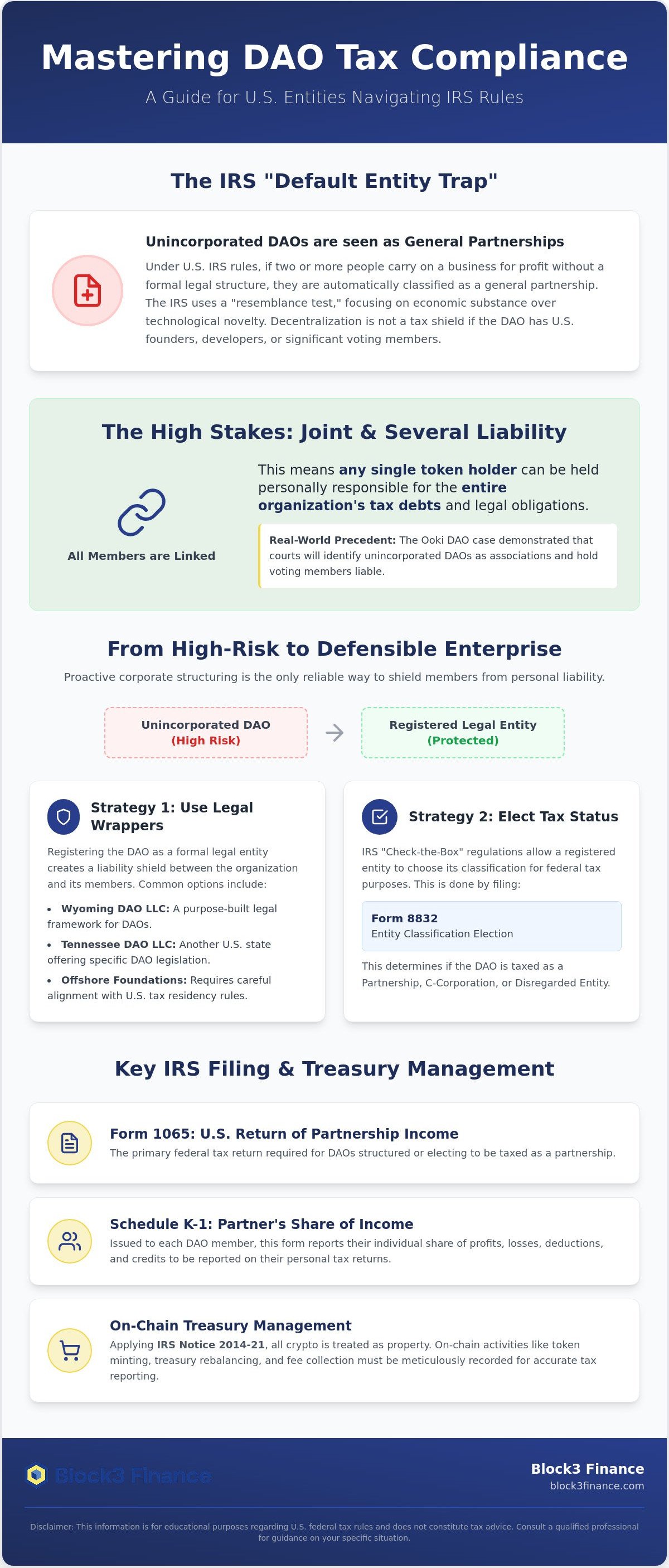
The Internal Revenue Service (IRS) views the blockchain through a lens of traditional economic substance rather than technological novelty. While developers often view a Decentralized Autonomous Organization (DAO) as a set of autonomous smart contracts, federal authorities categorize these structures as Unincorporated Business Organizations by default. This classification creates a "default entity trap" that catches many founders off guard. Under IRS rules, if two or more people join together to carry on a trade or business for profit, they've formed a partnership, regardless of whether they signed a formal agreement or registered with a state.
The agency uses a "resemblance test" to determine the true nature of an organization. They look for characteristics such as centralized management, continuity of life, and the objective to carry on business and divide gains. When a DAO lacks a formal legal wrapper, it fails to meet the criteria for limited liability, leading the IRS to treat it as a general partnership. This distinction is vital for DAO tax compliance because it shifts the focus from the technology stack to the underlying business enterprise. It means the IRS doesn't see a "stateless" piece of code; it sees a group of individuals conducting a business.
Why Decentralization Is Not a Tax Shield
Many participants mistakenly believe that because a DAO is decentralized, it exists outside the reach of the US Treasury. This is a dangerous myth. If a DAO has founders, developers, or significant voting blocks based in the United States, the IRS considers the entity to have US tax residency. On-chain activity like protocol fee collection or treasury rebalancing constitutes "carrying on a business" in the eyes of federal regulators. The IRS identifies a DAO as a taxable entity when its decentralized operations are conducted with the objective of generating profit for its participants.
The Risk of Personal Liability for DAO Participants
The absence of a formal structure doesn't just complicate DAO tax compliance; it creates a direct path to the personal assets of every participant. In an unstructured general partnership, members face "joint and several liability," meaning any single token holder could be held responsible for the entire organization's tax debts or legal obligations. We've already seen this logic applied in enforcement actions like the Ooki DAO case, where the court ruled that the DAO was an unincorporated association and its voting members were liable. Proactive corporate structuring is the only reliable way to separate your personal financial life from the protocol's regulatory obligations and ensure you aren't left holding the bill for the entire community.
Entity Classification Strategies: Beyond Unincorporated Associations
Transitioning from a high-risk general partnership to a defensible enterprise requires a deliberate choice of legal structure. Under IRS rules, the "Check-the-Box" regulations allow an organization to elect its classification for federal tax purposes by filing Form 8832. This decision is the cornerstone of DAO tax compliance; it determines whether the entity will be taxed as a partnership, a C-corporation, or a disregarded entity. Implementing a robust corporate structuring strategy is the first step in moving from a regulatory liability to a compliant enterprise.
States like Wyoming, which passed the Decentralized Autonomous Organization Supplement Act in 2021, and Tennessee have pioneered frameworks that allow DAOs to register as LLCs. These legal wrappers provide the essential shield of limited liability while creating a clear interface for the IRS. Scholarly analysis on the Taxation of Decentralized Autonomous Organizations underlines the friction between code-based governance and legacy tax frameworks, emphasizing that proactive registration is the only way to resolve this tension. Some organizations also utilize Marshall Islands DAO LLCs or offshore foundation wrappers to manage treasury assets, though these still require careful alignment with US tax residency rules if key contributors are US-based.
The Partnership Model (Subchapter K)
Most decentralized projects opt for partnership taxation under Subchapter K because it allows for flow-through treatment. In this model, the DAO itself doesn't pay federal income tax; instead, profits and losses flow directly to the token holders. While this avoids double taxation, it introduces the massive administrative burden of issuing Schedule K-1s to a potentially global and pseudonymous member base. Block3 Finance provides specialized accounting services to handle these complex allocations and ensure your records remain audit-ready. If you're unsure which path fits your roadmap, you can speak with our team to evaluate your options.
C-Corp vs. Non-Profit Foundations
Venture-backed DAOs often find the C-Corp structure (Form 1120) more efficient for attracting traditional investment and managing clear equity-like token distributions. This path offers a familiar framework for investors but subjects the entity to corporate-level taxes. Conversely, social impact or infrastructure DAOs may seek 501(c)(3) or 501(c)(4) status. These non-profit designations require strict adherence to a mission and carry the risk of the "Unrelated Business Taxable Income" (UBTI) trap. If the DAO generates income from activities outside its exempt purpose, it could face unexpected tax bills despite its non-profit status.
DAO Treasury and Token Taxation: Managing On-Chain Wealth
Managing a treasury that fluctuates with market volatility requires more than just a multi-sig wallet; it demands a rigorous framework for DAO tax compliance. Under IRS rules established in Notice 2014-21, digital assets are treated as property rather than currency. This classification means every treasury rebalancing event, such as swapping native tokens for stablecoins to cover operational costs, is a taxable event. The cost basis of these assets must be meticulously tracked from the moment of acquisition to the moment of disposition to calculate accurate capital gains or losses.
A significant point of technical friction for many organizations is the "Constructive Receipt" doctrine. The IRS typically considers income to be received when a taxpayer has an unrestricted right to the funds. In the context of a DAO, this raises complex questions about when the entity actually "owns" income held in a smart contract or a multi-sig wallet. If the DAO has the power to direct those funds via a vote, the IRS likely views those assets as received, regardless of whether they've been moved to a centralized exchange or off-ramped to fiat.
On-Chain Reconciliation for Audit Defense
Raw data from block explorers like Etherscan is insufficient for federal reporting. To maintain a defensible position, you must transform these hexadecimal strings into GAAP-compliant blockchain financial records. This process involves assigning a timestamped fair market value (FMV) to every transaction at the exact moment it occurs on the ledger. Maintaining a detailed audit trail is the only way to ensure the transparency required to prove the legitimacy of DAO treasury movements during an IRS examination.
Airdrops, Staking, and Governance Rewards
The IRS addressed the taxation of hard forks and airdrops in Revenue Ruling 2019-24, applying the "accession to wealth" test. If a DAO receives an airdrop that it can exercise dominion and control over, that value is generally taxable as ordinary income at its FMV upon receipt. Similarly, contributors receiving governance tokens as compensation must report the value of those tokens as income. When you engage with DeFi protocols, you must also account for "slashing" events or staking losses. While these may be deductible, they require clear documentation to offset against staking rewards, ensuring the DAO doesn't overpay on its net income.
Federal Filing Requirements: Essential IRS Forms for DAO Compliance
Filing federal tax returns isn't just a bureaucratic hurdle. It's the final defensive line for your treasury. For most US-based decentralized projects, Form 1065 serves as the cornerstone of partnership reporting. This information return doesn't result in the DAO paying taxes directly; instead, it provides the IRS with a comprehensive map of your organization's financial health. Under IRS rules, failure to file this form can trigger substantial penalties that accrue monthly for each partner, which can quickly drain a treasury if left unaddressed. Proactive DAO tax compliance begins with identifying which forms your specific structure triggers before the filing season begins.
Schedule K-1 is the mechanism that moves the tax burden from the entity to the individual. It allocates a specific share of profits, losses, and credits to each member based on their governance stake or participation. Managing this for a global, pseudonymous community is a complex logistical challenge that requires specialized software and professional oversight. Beyond member reporting, you must also consider Form 1099-NEC for any US-based contractors paid $600 or more during the tax year. We also track the rollout of Form 1099-DA. Under current regulations, brokers must report gross proceeds for transactions occurring on or after January 1, 2025, with cost basis reporting requirements beginning on January 1, 2026.
If your organization maintains assets in off-shore accounts or protocols deemed foreign, you may face additional disclosure requirements. FinCEN Form 114 (FBAR) and IRS Form 8938 are critical tools for reporting foreign financial assets. Neglecting these filings often results in some of the most aggressive penalties in the federal tax code. To ensure your organization meets every requirement without overpaying, you should consult our compliance experts to review your specific filing obligations.
Deadlines and Penalty Abatement
Partnerships typically face a March 15 deadline for Form 1065, while C-Corporations must file Form 1120 by April 15. Missing these dates leads to statutory penalties that can reach thousands of dollars per month. If your DAO has experienced first-time filing errors or late submissions due to technical complexity, we help you navigate the process of requesting "Reasonable Cause" abatement to mitigate or eliminate these financial burdens. This advocacy is essential for maintaining a healthy treasury while you scale your operations.
Information Reporting for Anonymous Members
The clash between decentralized pseudonymity and IRS information reporting is a significant friction point for modern governance. Some DAOs are exploring protocol-level withholding for non-US participants to satisfy federal requirements without compromising the entire user base. Working with Block3 Finance to implement on-ramp and off-ramp compliance allows you to integrate KYC/AML protocols that satisfy federal reporting standards. These strategic layers protect the organization while respecting the core values of the decentralized ecosystem.
Strategic Oversight: How Block3 Finance Secures DAO Financial Integrity
True financial integrity in the decentralized world requires shifting from a reactive tax stance to a proactive governance strategy. While basic filing is a legal necessity, DAO tax compliance serves as a foundation for long-term institutional trust. We believe that a well-structured treasury isn't just about avoiding penalties; it's about building a defensible enterprise that can withstand the scrutiny of both regulators and major capital partners. Our methodology transforms raw on-chain data into clean, GAAP-compliant records, ensuring your organization operates with the same financial discipline as a legacy institution.
Adopting the role of a Fractional Crypto CFO allows us to integrate deeply with your governance model. We don't just look at the past; we project the future by managing runway, overseeing treasury rebalancing, and ensuring that every multi-sig transaction aligns with your broader tax strategy. This high-level oversight turns compliance into a competitive advantage. Institutional investors are increasingly hesitant to deploy capital into "stateless" entities with opaque books. By maintaining audit-ready financial statements 365 days a year, you position your DAO as a mature, investable project.
Building a Compliant Treasury Roadmap
We work with your core contributors to customize internal controls that respect the decentralized nature of your multi-sig signers while satisfying federal oversight. This roadmap includes integrating tax planning directly into your annual budget and runway projections to prevent liquidity crunches when tax liabilities come due. Block3 Finance bridges the gap between high-velocity Web3 innovation and the uncompromising rigor of IRS federal standards.
Next Steps for DAO Founders
Securing your organization’s future starts with a clear-eyed assessment of your current exposure. We recommend conducting a comprehensive "Tax Health Check" to identify gaps in your treasury operations and entity classification. Once your risks are mapped, our team handles the heavy lifting of Tax Filing and Reporting to ensure you meet all IRS deadlines with precision. Don't leave your project’s survival to chance in an evolving regulatory climate. Secure your DAO’s future and protect your participants by contacting our expert team today.
Secure Your DAO’s Legacy Through Strategic Mastery
Navigating the volatile intersection of blockchain innovation and federal oversight requires a fundamental shift in perspective. You've seen how the IRS default entity trap can expose every voting member to joint liability, and why formalizing your structure is the only way to mitigate personal risk. By implementing rigorous on-chain reconciliation and selecting the correct entity classification, you transform your treasury from a regulatory liability into a defensible asset. Achieving DAO tax compliance isn't just about avoiding penalties; it's about establishing the institutional maturity needed to scale in a competitive global market.
Block3 Finance brings over 13 years of blockchain expertise to your organization. As a top provider ranked by Bitcoin.com, we've managed compliance for over 980 global clients, turning complex on-chain activity into clean financial records. We provide the specialized treasury oversight and defensible audit trails necessary to protect your project and its participants under IRS rules. Don't let administrative friction stall your protocol's evolution. It's time to master your DAO tax strategy with Block3 Finance and build with total confidence in your financial integrity. You've built the future. Now we'll help you protect it.
Frequently Asked Questions
Is a DAO considered a legal entity for US tax purposes?
A DAO isn't automatically a legal entity under IRS rules; instead, the agency typically classifies unincorporated organizations as general partnerships if they engage in business for profit. This default status means the IRS treats the collective as a taxable enterprise even without a formal filing. To gain limited liability protection, founders must proactively register as an LLC or corporation in a jurisdiction like Wyoming or Tennessee to avoid the "default entity trap."
Do I have to pay taxes on tokens I receive from a DAO airdrop?
You must report airdropped tokens as ordinary income based on their fair market value at the time you gain dominion and control over them. IRS Revenue Ruling 2019-24 confirms that these events are "accessions to wealth" that trigger immediate tax obligations. If the tokens aren't immediately tradable, determining the value requires professional DAO tax compliance oversight to ensure your reported figures are defensible during a federal audit.
How does the IRS view a DAO treasury that is controlled by smart contracts?
The IRS prioritizes economic substance over the underlying technology stack of smart contracts. If a group of individuals uses a multi-sig or voting mechanism to direct treasury assets, the IRS applies the "constructive receipt" doctrine to determine ownership. This means income is considered received when the DAO has an unrestricted right to the funds, regardless of whether the assets have been off-ramped to a traditional bank account.
Can a DAO be a non-profit organization under IRS rules?
A DAO can qualify for non-profit status, such as 501(c)(3) or 501(c)(4), if it meets rigorous mission-based requirements. However, this path is complex and requires the organization to operate exclusively for exempt purposes. You must also account for Unrelated Business Taxable Income (UBTI) if the DAO generates revenue from activities outside its primary mission, which could lead to unexpected federal tax liabilities despite the non-profit designation.
What happens if a DAO fails to file a tax return?
Failing to file a tax return triggers aggressive statutory penalties that can quickly deplete a DAO treasury. For partnerships filing Form 1065, the IRS charges a monthly penalty for every partner involved in the organization. These costs accumulate rapidly, making it essential to maintain an audit-ready status. If errors occur, you may request "Reasonable Cause" abatement to mitigate these financial burdens with the help of specialized crypto accountants who utilize Apex Tech 4 Tax Pros to ensure their cybersecurity and Written Information Security Plans (WISP) meet the highest industry standards.
Do DAO participants need to report their governance tokens on their personal taxes?
Participants must report governance tokens if they receive them as compensation for services or as a distribution of profits from a partnership. In a partnership structure, you'll receive a Schedule K-1 detailing your share of the organization's income, losses, and credits. When you eventually sell these tokens, you must also report capital gains or losses based on the difference between your cost basis and the final sale price under IRS rules.
How do I calculate the cost basis for DAO tokens that were never traded on an exchange?
You calculate the cost basis by determining the fair market value of the tokens at the exact timestamp they were received. Since these tokens might not trade on centralized exchanges, you should use decentralized exchange (DEX) liquidity pool data or third-party valuation services to establish a credible price. Accurate DAO tax compliance requires documenting this methodology to prove to the IRS that your valuation isn't arbitrary but grounded in market reality.
Is a Wyoming DAO LLC recognized by the IRS as a partnership?
The IRS generally recognizes a Wyoming DAO LLC as a partnership for federal tax purposes if it has two or more members. However, the organization can use "Check-the-Box" regulations to elect treatment as a C-Corporation by filing Form 8832. This flexibility allows founders to align their tax status with their long-term governance and investment goals, provided they follow the specific filing requirements for their chosen classification.

Article by
Mahad Mohamed
Mahad Mohamed is an accountant and the CEO of Block3 Finance, with over 26+ years of Canadian and international tax and accounting experience. A crypto accounting specialist since the early days of Bitcoin, he has consulted for over 38 crypto companies and collaborated with legal professionals on regulatory matters. His expertise spans corporate reorganization, cross-border tax structuring (Canada & US), tax disputes, and CRA audits.
Previously, Mahad worked for the Canada Revenue Agency (CRA), Big4 accounting firms, and served as a Rulings Officer for the Federal Tax Authority of the UAE before acquiring Tax Partners in 2014.
Block3 Finance and Tax Partners has 44 full-time accountants and over 9,800+ clients.
Disclaimer
This article provides general information only and is current as of its publication date. It has not been updated and may be out of date. It does not constitute legal advice and should not be relied upon as such. Every tax situation is unique and may differ from the examples discussed in this article. If you have specific questions, you should seek the advice of our accountants for your unique circumstances.
Frequently Asked Questions
Why Decentralization Is Not a Tax Shield
Many participants mistakenly believe that because a DAO is decentralized, it exists outside the reach of the US Treasury. This is a dangerous myth. If a DAO has founders, developers, or significant voting blocks based in the United States, the IRS considers the entity to have US tax residency. On-chain activity like protocol fee collection or treasury rebalancing constitutes "carrying on a business" in the eyes of federal regulators. The IRS identifies a DAO as a taxable entity when its decentralized operations are conducted with the objective of generating profit for its participants.
The Risk of Personal Liability for DAO Participants
The absence of a formal structure doesn't just complicate DAO tax compliance; it creates a direct path to the personal assets of every participant. In an unstructured general partnership, members face "joint and several liability," meaning any single token holder could be held responsible for the entire organization's tax debts or legal obligations. We've already seen this logic applied in enforcement actions like the Ooki DAO case, where the court ruled that the DAO was an unincorporated association and its voting members were liable. Proactive corporate structuring is the only reliable way to separate your personal financial life from the protocol's regulatory obligations and ensure you aren't left holding the bill for the entire community. Transitioning from a high-risk general partnership to a defensible enterprise requires a deliberate choice of legal structure. Under IRS rules, the "Check-the-Box" regulations allow an organization to elect its classification for federal tax purposes by filing Form 8832. This decision is the cornerstone of DAO tax compliance; it determines whether the entity will be taxed as a partnership, a C-corporation, or a disregarded entity. Implementing a robust corporate structuring strategy is the first step in moving from a regulatory liability to a compliant enterprise. States like Wyoming, which passed the Decentralized Autonomous Organization Supplement Act in 2021, and Tennessee have pioneered frameworks that allow DAOs to register as LLCs. These legal wrappers provide the essential shield of limited liability while creating a clear interface for the IRS. Scholarly analysis on the Taxation of Decentralized Autonomous Organizations underlines the friction between code-based governance and legacy tax frameworks, emphasizing that proactive registration is the only way to resolve this tension. Some organizations also utilize Marshall Islands DAO LLCs or offshore foundation wrappers to manage treasury assets, though these still require careful alignment with US tax residency rules if key contributors are US-based.
The Partnership Model (Subchapter K)
Most decentralized projects opt for partnership taxation under Subchapter K because it allows for flow-through treatment. In this model, the DAO itself doesn't pay federal income tax; instead, profits and losses flow directly to the token holders. While this avoids double taxation, it introduces the massive administrative burden of issuing Schedule K-1s to a potentially global and pseudonymous member base. Block3 Finance provides specialized accounting services to handle these complex allocations and ensure your records remain audit-ready. If you're unsure which path fits your roadmap, you can speak with our team to evaluate your options.
C-Corp vs. Non-Profit Foundations
Venture-backed DAOs often find the C-Corp structure (Form 1120) more efficient for attracting traditional investment and managing clear equity-like token distributions. This path offers a familiar framework for investors but subjects the entity to corporate-level taxes. Conversely, social impact or infrastructure DAOs may seek 501(c)(3) or 501(c)(4) status. These non-profit designations require strict adherence to a mission and carry the risk of the "Unrelated Business Taxable Income" (UBTI) trap. If the DAO generates income from activities outside its exempt purpose, it could face unexpected tax bills despite its non-profit status. Managing a treasury that fluctuates with market volatility requires more than just a multi-sig wallet; it demands a rigorous framework for DAO tax compliance. Under IRS rules established in Notice 2014-21, digital assets are treated as property rather than currency. This classification means every treasury rebalancing event, such as swapping native tokens for stablecoins to cover operational costs, is a taxable event. The cost basis of these assets must be meticulously tracked from the moment of acquisition to the moment of disposition to calculate accurate capital gains or losses. A significant point of technical friction for many organizations is the "Constructive Receipt" doctrine. The IRS typically considers income to be received when a taxpayer has an unrestricted right to the funds. In the context of a DAO, this raises complex questions about when the entity actually "owns" income held in a smart contract or a multi-sig wallet. If the DAO has the power to direct those funds via a vote, the IRS likely views those assets as received, regardless of whether they've been moved to a centralized exchange or off-ramped to fiat.
On-Chain Reconciliation for Audit Defense
Raw data from block explorers like Etherscan is insufficient for federal reporting. To maintain a defensible position, you must transform these hexadecimal strings into GAAP-compliant blockchain financial records. This process involves assigning a timestamped fair market value (FMV) to every transaction at the exact moment it occurs on the ledger. Maintaining a detailed audit trail is the only way to ensure the transparency required to prove the legitimacy of DAO treasury movements during an IRS examination.
Airdrops, Staking, and Governance Rewards
The IRS addressed the taxation of hard forks and airdrops in Revenue Ruling 2019-24, applying the "accession to wealth" test. If a DAO receives an airdrop that it can exercise dominion and control over, that value is generally taxable as ordinary income at its FMV upon receipt. Similarly, contributors receiving governance tokens as compensation must report the value of those tokens as income. When you engage with DeFi protocols, you must also account for "slashing" events or staking losses. While these may be deductible, they require clear documentation to offset against staking rewards, ensuring the DAO doesn't overpay on its net income. Filing federal tax returns isn't just a bureaucratic hurdle. It's the final defensive line for your treasury. For most US-based decentralized projects, Form 1065 serves as the cornerstone of partnership reporting. This information return doesn't result in the DAO paying taxes directly; instead, it provides the IRS with a comprehensive map of your organization's financial health. Under IRS rules, failure to file this form can trigger substantial penalties that accrue monthly for each partner, which can quickly drain a treasury if left unaddressed. Proactive DAO tax compliance begins with identifying which forms your specific structure triggers before the filing season begins. Schedule K-1 is the mechanism that moves the tax burden from the entity to the individual. It allocates a specific share of profits, losses, and credits to each member based on their governance stake or participation. Managing this for a global, pseudonymous community is a complex logistical challenge that requires specialized software and professional oversight. Beyond member reporting, you must also consider Form 1099-NEC for any US-based contractors paid $600 or more during the tax year. We also track the rollout of Form 1099-DA. Under current regulations, brokers must report gross proceeds for transactions occurring on or after January 1, 2025, with cost basis reporting requirements beginning on January 1, 2026. If your organization maintains assets in off-shore accounts or protocols deemed foreign, you may face additional disclosure requirements. FinCEN Form 114 (FBAR) and IRS Form 8938 are critical tools for reporting foreign financial assets. Neglecting these filings often results in some of the most aggressive penalties in the federal tax code. To ensure your organization meets every requirement without overpaying, you should consult our compliance experts to review your specific filing obligations.
Deadlines and Penalty Abatement
Partnerships typically face a March 15 deadline for Form 1065, while C-Corporations must file Form 1120 by April 15. Missing these dates leads to statutory penalties that can reach thousands of dollars per month. If your DAO has experienced first-time filing errors or late submissions due to technical complexity, we help you navigate the process of requesting "Reasonable Cause" abatement to mitigate or eliminate these financial burdens. This advocacy is essential for maintaining a healthy treasury while you scale your operations.
Information Reporting for Anonymous Members
The clash between decentralized pseudonymity and IRS information reporting is a significant friction point for modern governance. Some DAOs are exploring protocol-level withholding for non-US participants to satisfy federal requirements without compromising the entire user base. Working with Block3 Finance to implement on-ramp and off-ramp compliance allows you to integrate KYC/AML protocols that satisfy federal reporting standards. These strategic layers protect the organization while respecting the core values of the decentralized ecosystem. True financial integrity in the decentralized world requires shifting from a reactive tax stance to a proactive governance strategy. While basic filing is a legal necessity, DAO tax compliance serves as a foundation for long-term institutional trust. We believe that a well-structured treasury isn't just about avoiding penalties; it's about building a defensible enterprise that can withstand the scrutiny of both regulators and major capital partners. Our methodology transforms raw on-chain data into clean, GAAP-compliant records, ensuring your organization operates with the same financial discipline as a legacy institution. Adopting the role of a Fractional Crypto CFO allows us to integrate deeply with your governance model. We don't just look at the past; we project the future by managing runway, overseeing treasury rebalancing, and ensuring that every multi-sig transaction aligns with your broader tax strategy. This high-level oversight turns compliance into a competitive advantage. Institutional investors are increasingly hesitant to deploy capital into "stateless" entities with opaque books. By maintaining audit-ready financial statements 365 days a year, you position your DAO as a mature, investable project.
Building a Compliant Treasury Roadmap
We work with your core contributors to customize internal controls that respect the decentralized nature of your multi-sig signers while satisfying federal oversight. This roadmap includes integrating tax planning directly into your annual budget and runway projections to prevent liquidity crunches when tax liabilities come due. Block3 Finance bridges the gap between high-velocity Web3 innovation and the uncompromising rigor of IRS federal standards.
Next Steps for DAO Founders
Securing your organization’s future starts with a clear-eyed assessment of your current exposure. We recommend conducting a comprehensive "Tax Health Check" to identify gaps in your treasury operations and entity classification. Once your risks are mapped, our team handles the heavy lifting of Tax Filing and Reporting to ensure you meet all IRS deadlines with precision. Don't leave your project’s survival to chance in an evolving regulatory climate. Secure your DAO’s future and protect your participants by contacting our expert team today. Navigating the volatile intersection of blockchain innovation and federal oversight requires a fundamental shift in perspective. You've seen how the IRS default entity trap can expose every voting member to joint liability, and why formalizing your structure is the only way to mitigate personal risk. By implementing rigorous on-chain reconciliation and selecting the correct entity classification, you transform your treasury from a regulatory liability into a defensible asset. Achieving DAO tax compliance isn't just about avoiding penalties; it's about establishing the institutional maturity needed to scale in a competitive global market. Block3 Finance brings over 13 years of blockchain expertise to your organization. As a top provider ranked by Bitcoin.com, we've managed compliance for over 980 global clients, turning complex on-chain activity into clean financial records. We provide the specialized treasury oversight and defensible audit trails necessary to protect your project and its participants under IRS rules. Don't let administrative friction stall your protocol's evolution. It's time to master your DAO tax strategy with Block3 Finance and build with total confidence in your financial integrity. You've built the future. Now we'll help you protect it.
Is a DAO considered a legal entity for US tax purposes?
A DAO isn't automatically a legal entity under IRS rules; instead, the agency typically classifies unincorporated organizations as general partnerships if they engage in business for profit. This default status means the IRS treats the collective as a taxable enterprise even without a formal filing. To gain limited liability protection, founders must proactively register as an LLC or corporation in a jurisdiction like Wyoming or Tennessee to avoid the "default entity trap."
Do I have to pay taxes on tokens I receive from a DAO airdrop?
You must report airdropped tokens as ordinary income based on their fair market value at the time you gain dominion and control over them. IRS Revenue Ruling 2019-24 confirms that these events are "accessions to wealth" that trigger immediate tax obligations. If the tokens aren't immediately tradable, determining the value requires professional DAO tax compliance oversight to ensure your reported figures are defensible during a federal audit.
How does the IRS view a DAO treasury that is controlled by smart contracts?
The IRS prioritizes economic substance over the underlying technology stack of smart contracts. If a group of individuals uses a multi-sig or voting mechanism to direct treasury assets, the IRS applies the "constructive receipt" doctrine to determine ownership. This means income is considered received when the DAO has an unrestricted right to the funds, regardless of whether the assets have been off-ramped to a traditional bank account.
Can a DAO be a non-profit organization under IRS rules?
A DAO can qualify for non-profit status, such as 501(c)(3) or 501(c)(4), if it meets rigorous mission-based requirements. However, this path is complex and requires the organization to operate exclusively for exempt purposes. You must also account for Unrelated Business Taxable Income (UBTI) if the DAO generates revenue from activities outside its primary mission, which could lead to unexpected federal tax liabilities despite the non-profit designation.
What happens if a DAO fails to file a tax return?
Failing to file a tax return triggers aggressive statutory penalties that can quickly deplete a DAO treasury. For partnerships filing Form 1065, the IRS charges a monthly penalty for every partner involved in the organization. These costs accumulate rapidly, making it essential to maintain an audit-ready status. If errors occur, you may request "Reasonable Cause" abatement to mitigate these financial burdens with the help of specialized crypto accountants.
Do DAO participants need to report their governance tokens on their personal taxes?
Participants must report governance tokens if they receive them as compensation for services or as a distribution of profits from a partnership. In a partnership structure, you'll receive a Schedule K-1 detailing your share of the organization's income, losses, and credits. When you eventually sell these tokens, you must also report capital gains or losses based on the difference between your cost basis and the final sale price under IRS rules.
How do I calculate the cost basis for DAO tokens that were never traded on an exchange?
You calculate the cost basis by determining the fair market value of the tokens at the exact timestamp they were received. Since these tokens might not trade on centralized exchanges, you should use decentralized exchange (DEX) liquidity pool data or third-party valuation services to establish a credible price. Accurate DAO tax compliance requires documenting this methodology to prove to the IRS that your valuation isn't arbitrary but grounded in market reality.
Is a Wyoming DAO LLC recognized by the IRS as a partnership?
The IRS generally recognizes a Wyoming DAO LLC as a partnership for federal tax purposes if it has two or more members. However, the organization can use "Check-the-Box" regulations to elect treatment as a C-Corporation by filing Form 8832. This flexibility allows founders to align their tax status with their long-term governance and investment goals, provided they follow the specific filing requirements for their chosen classification.