
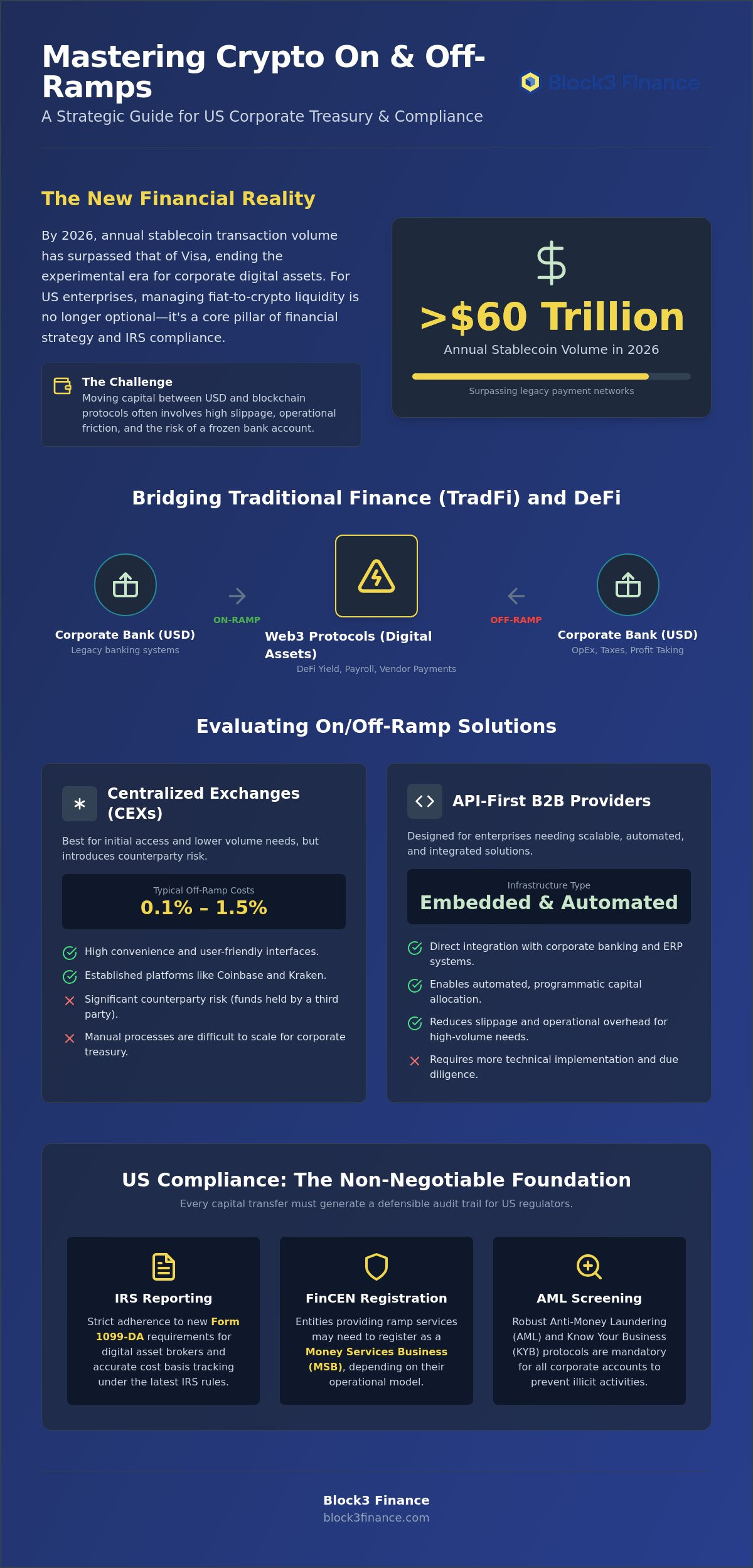
Annual transaction volume for stablecoins like USDC has officially surpassed that of Visa in 2026. This shift marks the end of the experimental era for corporate digital assets. You've likely realized that moving capital between USD and blockchain protocols should be a frictionless treasury function, yet the practical reality often involves high slippage and the constant anxiety of a potential bank freeze. Implementing robust crypto on-ramp off-ramp solutions is no longer just a technical requirement for US enterprises. It's a critical pillar of financial compliance and strategic liquidity management.
We understand that your priority is maintaining a defensible audit trail under the latest IRS cost basis reporting rules. This guide will help you master the complexities of the new Form 1099-DA requirements and the joint SEC and CFTC interpretations issued earlier this year. We'll examine how to optimize your treasury workflows to ensure seamless liquidity while providing the transparency your auditors demand. By the end of this article, you'll have a clear strategy to transform your digital asset transfers from a source of friction into a competitive advantage for your business.
Key Takeaways
- Define the strategic necessity of fiat-to-crypto liquidity as the backbone of modern Web3 business operations for US-based enterprises.
- Identify the critical compliance hurdles, from FinCEN Money Services Business registrations to the robust AML screening protocols required for corporate accounts.
- Learn to manage crypto on-ramp off-ramp solutions with precision, ensuring every capital transfer generates a defensible audit trail for IRS reporting.
- Evaluate the trade-offs between centralized exchange liquidity and API-first payment processors to optimize your corporate treasury workflow and reduce slippage.
- Leverage specialized CFO guidance to design secure ramp infrastructure that mitigates counterparty risk and aligns with 2026 federal tax requirements.
The Strategic Role of Fiat On-Ramp and Off-Ramp Solutions in Modern Enterprise
Strategic treasury management has evolved beyond simple asset accumulation. For US businesses, the ability to move capital fluidly between fiat and digital assets is the foundation of operational agility. While Cryptocurrency exchanges originally served individual traders, modern enterprises require sophisticated crypto on-ramp off-ramp solutions that integrate directly with corporate banking and ERP systems. This infrastructure allows firms to deploy capital into high-yield DeFi protocols or settle global vendor invoices within seconds, bypassing the multi-day settlement delays of legacy wire transfers. By 2026, the velocity of capital has become a primary competitive advantage, making seamless liquidity the backbone of any serious Web3 operation.
The transition from manual, simple exchange buys to integrated API-led ramp solutions represents a shift from experimentation to professionalization. Enterprises no longer treat crypto as a siloed asset class but as a programmable extension of their existing financial stack. This evolution enables automated capital allocation, where treasury software can trigger on-ramping events based on specific liquidity thresholds or investment opportunities. For firms operating under IRS rules, these systems must do more than just move money; they must provide the high-fidelity data required for accurate tax reporting and cost basis tracking from the moment of acquisition.
Bridging the Gap Between TradFi and DeFi
Legacy banking systems often create significant friction for crypto-native entities, frequently leading to delayed transfers or flagged accounts. To navigate this, many firms use stablecoins like USDC as an intermediate gear, providing a stable unit of account that can be moved across chains without the volatility of Bitcoin. An enterprise ramp serves as the mission-critical gateway that synchronizes traditional bank accounts with distributed ledger liquidity. By utilizing crypto on-ramp off-ramp solutions, businesses move from manual exchange orders to automated workflows that handle payroll and vendor payments with programmatic precision. This connectivity ensures that your digital operations aren't isolated from your primary USD banking relationships.
Why Exit Liquidity (Off-Ramping) is a Corporate Priority
Off-ramping is often the most overlooked component of a treasury strategy, yet it's the most vital for long-term stability. Businesses must settle operational expenses like rent, taxes, and insurance in USD. Without "off-ramp assurance," institutional stakeholders and investors may view digital asset holdings as illiquid or high-risk. Reliable off-ramping allows a firm to capture gains during market volatility, ensuring that capital is available in fiat exactly when it's needed for OpEx. This capability provides a safety valve, protecting the balance sheet from being locked into digital assets during sudden liquidity crunches. Effective exit strategies are built on documented, repeatable processes that satisfy both internal risk committees and external auditors.
Evaluating Types of Crypto On-Ramp and Off-Ramp Solutions for Web3 Firms
Selecting the appropriate architecture for capital movement requires balancing immediate liquidity against institutional security. For many US businesses, centralized exchanges (CEXs) represent the first point of contact. As of June 2026, typical all-in costs for off-ramping via major exchanges range from 0.1% to 1.5%. Coinbase Advanced provides free ACH withdrawals, while Kraken Pro offers verified US accounts a maximum taker fee of 0.4%. While these platforms offer high convenience, they introduce counterparty risk that requires rigorous internal oversight and a clear understanding of IRS guidelines on virtual currency to ensure every trade is documented for the new Form 1099-DA requirements.
Enterprises with higher volume requirements often bypass retail interfaces in favor of API-first B2B providers like Zero Hash. These crypto on-ramp off-ramp solutions function as embedded infrastructure, abstracting away the regulatory complexity of money transmitter licensing. Similarly, infrastructure layers like Gemba allow businesses to launch their own branded financial services, creating a more cohesive ecosystem. This approach is particularly effective for dApps and platforms that need to offer fiat-to-crypto capabilities directly within their own user interface. By integrating these services, firms can provide a seamless experience that feels like a standard e-commerce transaction while maintaining strict adherence to federal AML and KYC standards.
Institutional OTC Desks vs. Retail Exchanges
When corporate transfers exceed $1 million, the slippage on retail exchanges can become a significant drain on the treasury. Institutional Over-The-Counter (OTC) desks provide a "white-glove" alternative, offering personalized execution that minimizes market impact. Beyond price optimization, OTC desks provide enhanced privacy and security, ensuring that large-scale capital movements don't alert the broader market. If your firm is managing substantial capital allocations, you should transition to a dedicated liquidity partner to secure better execution speeds and more favorable pricing than a standard order book can provide. Our team can help you evaluate your current liquidity providers to ensure your execution strategy remains optimal.
Integrated Ramp APIs for Web3 Platforms
The rise of embedded finance has made it possible to integrate on-and-off-ramp solutions directly into your platform's core workflow. This eliminates the need for users to exit your ecosystem to fund their wallets, significantly increasing conversion rates. Evaluating these solutions requires a deep dive into fee structures; you must determine whether the platform or the end-user will absorb gas fees and processing costs. In 2026, high-throughput chains like Solana have become the preferred choice for these payment flows due to their low-cost settlement. Implementing these APIs correctly ensures that your platform remains compliant with the FATF Travel Rule for all transactions above $3,000.
Compliance and Regulatory Frameworks for US-Based Fiat Ramps
Compliance within the US digital asset ecosystem is a rigorous, multi-layered discipline. For an enterprise, integrating crypto on-ramp off-ramp solutions means entering the jurisdiction of the Financial Crimes Enforcement Network (FinCEN). Most reputable providers operate as Money Services Businesses (MSBs), which requires them to maintain a comprehensive anti-money laundering (AML) program. This isn't just a box-ticking exercise; it's a federal requirement under the Bank Secrecy Act (BSA) that ensures every dollar moving from a corporate bank account into a digital wallet is accounted for. For your treasury team, this means providing detailed Know Your Customer (KYC) data for all beneficial owners of the corporate entity before the first transfer occurs.
Detailed FinCEN guidance on virtual currencies clarifies that businesses acting as exchangers must comply with the same standards as traditional financial institutions. This includes the "Travel Rule," which requires the transmission of specific originator and beneficiary information for transactions exceeding $3,000. For US businesses, failing to verify that a ramp provider adheres to these standards can lead to severe operational disruptions. Banks are increasingly sensitive to digital asset flows, and using a non-compliant provider is the fastest way to trigger a permanent closure of your primary operating accounts.
Navigating the US Regulatory Landscape
Fear of "risk" labels often prevents companies from fully embracing blockchain efficiency. Rigorous documentation is the primary cure for this institutional anxiety. By maintaining a crystal-clear audit trail of every fiat-to-crypto exchange, you transform a perceived liability into a transparent, defensible financial record. Under IRS rules, this documentation is essential for the 2026 reporting cycle, where the new Form 1099-DA will require granular detail on acquisition and cost basis. Proactive compliance ensures your bank views your crypto activity as a legitimate treasury function rather than a suspicious red flag. It's about moving from a defensive posture to one of total financial command.
Due Diligence Checklist for Ramp Providers
Selecting a partner requires more than comparing fee schedules. You must verify that your provider holds money transmitter licenses in every state where your business has a physical or economic presence. Institutional-grade security audits, such as SOC2 Type II, are non-negotiable. These certifications prove that the provider has established rigorous controls for data privacy and fund safety, protecting you from internal fraud or technical failures. Our team provides specialized Block3 Finance audit services to help you vet potential liquidity partners. This due diligence protects your firm from the regulatory failings of substandard providers, ensuring your capital remains accessible and your reputation remains untarnished.
Accounting and Tax Reporting for Fiat Ramps under IRS Guidelines
Every entry and exit from the fiat system creates a data point that federal authorities will scrutinize with increasing rigor. While the act of on-ramping, or exchanging USD for digital assets, is generally not a taxable event under IRS rules, it establishes the critical cost basis for your entire holding. By 2026, the IRS has mandated that brokers report cost basis for transactions, effectively eliminating the "universal method" and requiring taxpayers to maintain records on a per-wallet or per-account basis. Your crypto on-ramp off-ramp solutions must therefore do more than facilitate liquidity; they must act as the primary source of truth for your financial sub-ledger.
Precise cost basis tracking requires recording the fair market value of the asset in USD at the exact moment of acquisition. This includes the treatment of exchange fees and gas costs. In most corporate treasury scenarios, these fees are not immediate deductions but are instead capitalized into the cost basis of the asset, reducing your eventual capital gains liability. Failing to reconcile these micro-costs across thousands of transactions creates a reconciliation debt that can become insurmountable during a year-end audit. Success requires a proactive approach to sub-ledger management that links every fiat bank transfer to its corresponding on-chain transaction hash.
IRS Reporting Requirements for US Entities
Reporting obligations intensify the moment you initiate an off-ramp. Under federal guidelines, the IRS treats every off-ramp as a potential realization event. This means converting digital assets back to USD, or even using them to pay a vendor, constitutes a disposal of property that must be reported on Form 8949 and Schedule D. For the 2026 filing season, the new Form 1099-DA will be the standard for reporting these disposals, making it impossible to hide discrepancies between your bank statements and your blockchain activity. You must ensure your internal systems can calculate gains or losses in real-time to avoid massive tax surprises at quarter-end.
Bookkeeping Best Practices for Web3 Treasury
High-growth firms must move beyond manual spreadsheets to survive the current regulatory environment. Modern bookkeeping requires syncing your ramp transactions directly with ERP systems like NetSuite or QuickBooks to maintain a continuous audit trail. This integration ensures that your fiat outflows are instantly matched with digital asset inflows, preventing the "uncategorized transaction" backlog that plagues many Web3 startups. If your team is struggling to bridge the gap between your bank and the blockchain, our Block3 Finance accounting services provide the specialized oversight needed to maintain a clean set of books. To ensure your treasury remains compliant and audit-ready, schedule a consultation for sub-ledger reconciliation today.
Optimizing Treasury Management with Block3 Finance CFO Services
Mastery over your capital flows requires more than just selecting a provider; it demands a comprehensive architectural design. High-growth firms often stumble because they treat their crypto on-ramp off-ramp solutions as isolated tools rather than integrated components of their financial engine. Our fractional CFOs step in to bridge this gap, designing custom workflows that align your digital asset activity with traditional corporate governance. By embedding these solutions into a broader Web3 treasury management strategy, we help you transition from reactive fire-fighting to proactive capital deployment. This level of oversight reduces operational overhead by automating much of the accounting and reporting burden, allowing your team to focus on core growth.
A well-structured treasury does more than just move money. It positions your firm for the scrutiny of institutional fundraising and rigorous third-party audits. We ensure that every on-chain movement is mirrored by a corresponding ledger entry, creating a seamless narrative of financial health. This preparation is vital for US businesses operating under the watchful eye of the IRS and SEC, where transparency is the only path to long-term survival. We resolve the friction between your digital ambitions and your regulatory obligations, turning compliance into a strategic asset.
Strategic Liquidity Planning
Effective treasury management hinges on the ability to forecast fiat requirements with surgical precision. Without a clear view of upcoming payroll obligations or quarterly tax deadlines, firms often find themselves "panic selling" assets during market downturns to cover basic OpEx. Our Block3 Finance CFO services provide the strategic oversight necessary to prevent these liquidity crunches. We help you establish tax-efficient corporate structures that protect your bottom line while ensuring you always have the necessary USD liquidity to meet your obligations under IRS rules. By planning your exits months in advance, you maintain total command over your market exposure and capital efficiency.
The Block3 Advantage: 13+ Years of Blockchain Expertise
Navigating the volatile digital asset landscape requires a partner with deep institutional memory. Bitcoin.com recognizes Block3 Finance as a premier provider because we possess the technical rigor to turn complex on-chain activity into clean, defensible financial records. We have spent over a decade cultivating the professional networks and best practices needed to bridge the gap between legacy finance and the blockchain. Our mission is to empower you with the tools and intelligence to thrive in a complex world. Don't leave your compliance to chance. Contact Block3 Finance for a consultation to secure your firm's financial future today.
Mastering the Future of Corporate Liquidity
Success in the digital asset landscape requires moving beyond reactive compliance. By implementing sophisticated crypto on-ramp off-ramp solutions, you transform a technical hurdle into a powerful engine for treasury growth. The resolution of friction between legacy fiat systems and on-chain capital depends on rigorous cost basis tracking and a deep alignment with the latest IRS guidelines. This disciplined approach ensures your firm remains audit-ready while maintaining the agility needed to deploy capital into high-yield protocols or settle global invoices instantly.
Block3 Finance brings 13+ years of blockchain financial expertise to your corner, having served over 980 global clients with a focus on stability and intellectual depth. Our team, ranked as a top-tier provider by Bitcoin.com, specializes in bridging the gap between legacy corporate finance and the future of programmable money. We empower you to take total command of your financial landscape. Schedule a consultation with Block3 Finance to optimize your crypto ramp strategy and secure a defensible, high-performance treasury today. It's time to lead the evolution of your industry with confidence.
Frequently Asked Questions
Is on-ramping crypto considered a taxable event for US businesses?
Under IRS rules, on-ramping is not a taxable event. It is treated as the purchase of property. You must record the fair market value in USD at the moment of the trade to establish your cost basis. This data is critical for future reporting on Form 1099-DA, which requires granular acquisition details for the 2026 tax year.
What are the most compliant crypto off-ramp solutions for US enterprises in 2026?
The most compliant crypto on-ramp off-ramp solutions for US businesses are providers registered as Money Services Businesses (MSBs) with FinCEN. Look for partners with SOC2 Type II certifications and robust AML screening protocols. These providers ensure that your transfers meet the FATF Travel Rule requirements for transactions exceeding $3,000, protecting your firm from federal regulatory scrutiny.
How do I avoid having my business bank account flagged when off-ramping crypto?
You avoid account flags by maintaining a transparent audit trail and using fully licensed ramp partners. Banks typically flag accounts when transfers lack clear documentation or originate from high-risk sources. Proactively sharing your compliance framework and your chosen ramp's licensing with your banking relationship manager can prevent unexpected freezes and build long-term institutional trust.
What documentation does the IRS require for fiat-to-crypto transfers?
The IRS requires granular records of the date, asset type, quantity, and USD value at the time of the transfer. For the 2026 tax year, you must also track cost basis on a per-wallet basis rather than using a universal method. Keeping a sub-ledger that links bank statements to on-chain transaction hashes is the gold standard for surviving a federal audit.
Can a US-based DAO legally use an off-ramp to pay contractors in fiat?
Yes, a US-based DAO can legally off-ramp to pay contractors, provided it complies with federal tax and employment laws. The entity must issue appropriate 1099 forms to contractors and report the off-ramp as a property disposal. This process requires a clear corporate or legal wrapper, such as an LLC, to satisfy the mandatory KYC requirements of the ramp provider.
What is the difference between a retail on-ramp and an institutional OTC desk?
Retail on-ramps are automated interfaces designed for smaller, frequent transactions with fixed fee schedules. Institutional Over-The-Counter (OTC) desks provide personalized execution for high-volume transfers, typically exceeding $100,000. OTC desks minimize slippage and market impact. They are the preferred choice for significant corporate treasury rebalancing where price execution and privacy are primary concerns for the business.
How do I reconcile ramp fees in my corporate bookkeeping?
You should generally capitalize fees from your crypto on-ramp off-ramp solutions into the cost basis of the acquired asset. This reduces your future capital gain when the asset is eventually sold. If the fee is for a platform subscription rather than a specific trade, it may be treated as a deductible business expense. You should verify these figures with the IRS or your tax professional.
Do US businesses need a specific license to use an on-ramp provider?
Most US businesses don't need a specific license to use a ramp, but the provider must be a licensed Money Services Business. If your business facilitates transfers for third parties or customers, you may be classified as a virtual currency exchanger yourself. This role would require you to register with FinCEN and comply with state-level money transmitter laws to remain operational.

Article by
Mahad Mohamed
Mahad Mohamed is an accountant and the CEO of Block3 Finance, with over 26+ years of Canadian and international tax and accounting experience. A crypto accounting specialist since the early days of Bitcoin, he has consulted for over 38 crypto companies and collaborated with legal professionals on regulatory matters. His expertise spans corporate reorganization, cross-border tax structuring (Canada & US), tax disputes, and CRA audits.
Previously, Mahad worked for the Canada Revenue Agency (CRA), Big4 accounting firms, and served as a Rulings Officer for the Federal Tax Authority of the UAE before acquiring Tax Partners in 2014.
Block3 Finance and Tax Partners has 44 full-time accountants and over 9,800+ clients.
Disclaimer
This article provides general information only and is current as of its publication date. It has not been updated and may be out of date. It does not constitute legal advice and should not be relied upon as such. Every tax situation is unique and may differ from the examples discussed in this article. If you have specific questions, you should seek the advice of our accountants for your unique circumstances.
Frequently Asked Questions
Bridging the Gap Between TradFi and DeFi
Legacy banking systems often create significant friction for crypto-native entities, frequently leading to delayed transfers or flagged accounts. To navigate this, many firms use stablecoins like USDC as an intermediate gear, providing a stable unit of account that can be moved across chains without the volatility of Bitcoin. An enterprise ramp serves as the mission-critical gateway that synchronizes traditional bank accounts with distributed ledger liquidity. By utilizing crypto on-ramp off-ramp solutions, businesses move from manual exchange orders to automated workflows that handle payroll and vendor payments with programmatic precision. This connectivity ensures that your digital operations aren't isolated from your primary USD banking relationships.
Why Exit Liquidity (Off-Ramping) is a Corporate Priority
Off-ramping is often the most overlooked component of a treasury strategy, yet it's the most vital for long-term stability. Businesses must settle operational expenses like rent, taxes, and insurance in USD. Without "off-ramp assurance," institutional stakeholders and investors may view digital asset holdings as illiquid or high-risk. Reliable off-ramping allows a firm to capture gains during market volatility, ensuring that capital is available in fiat exactly when it's needed for OpEx. This capability provides a safety valve, protecting the balance sheet from being locked into digital assets during sudden liquidity crunches. Effective exit strategies are built on documented, repeatable processes that satisfy both internal risk committees and external auditors. Selecting the appropriate architecture for capital movement requires balancing immediate liquidity against institutional security. For many US businesses, centralized exchanges (CEXs) represent the first point of contact. As of June 2026, typical all-in costs for off-ramping via major exchanges range from 0.1% to 1.5%. Coinbase Advanced provides free ACH withdrawals, while Kraken Pro offers verified US accounts a maximum taker fee of 0.4%. While these platforms offer high convenience, they introduce counterparty risk that requires rigorous internal oversight and a clear understanding of IRS guidelines on virtual currency to ensure every trade is documented for the new Form 1099-DA requirements. Enterprises with higher volume requirements often bypass retail interfaces in favor of API-first B2B providers like Zero Hash. These crypto on-ramp off-ramp solutions function as embedded infrastructure, abstracting away the regulatory complexity of money transmitter licensing. This approach is particularly effective for dApps and platforms that need to offer fiat-to-crypto capabilities directly within their own user interface. By integrating these services, firms can provide a seamless experience that feels like a standard e-commerce transaction while maintaining strict adherence to federal AML and KYC standards.
Institutional OTC Desks vs. Retail Exchanges
When corporate transfers exceed $1 million, the slippage on retail exchanges can become a significant drain on the treasury. Institutional Over-The-Counter (OTC) desks provide a "white-glove" alternative, offering personalized execution that minimizes market impact. Beyond price optimization, OTC desks provide enhanced privacy and security, ensuring that large-scale capital movements don't alert the broader market. If your firm is managing substantial capital allocations, you should transition to a dedicated liquidity partner to secure better execution speeds and more favorable pricing than a standard order book can provide. Our team can help you evaluate your current liquidity providers to ensure your execution strategy remains optimal.
Integrated Ramp APIs for Web3 Platforms
The rise of embedded finance has made it possible to integrate on-and-off-ramp solutions directly into your platform's core workflow. This eliminates the need for users to exit your ecosystem to fund their wallets, significantly increasing conversion rates. Evaluating these solutions requires a deep dive into fee structures; you must determine whether the platform or the end-user will absorb gas fees and processing costs. In 2026, high-throughput chains like Solana have become the preferred choice for these payment flows due to their low-cost settlement. Implementing these APIs correctly ensures that your platform remains compliant with the FATF Travel Rule for all transactions above $3,000. Compliance within the US digital asset ecosystem is a rigorous, multi-layered discipline. For an enterprise, integrating crypto on-ramp off-ramp solutions means entering the jurisdiction of the Financial Crimes Enforcement Network (FinCEN). Most reputable providers operate as Money Services Businesses (MSBs), which requires them to maintain a comprehensive anti-money laundering (AML) program. This isn't just a box-ticking exercise; it's a federal requirement under the Bank Secrecy Act (BSA) that ensures every dollar moving from a corporate bank account into a digital wallet is accounted for. For your treasury team, this means providing detailed Know Your Customer (KYC) data for all beneficial owners of the corporate entity before the first transfer occurs. Detailed FinCEN guidance on virtual currencies clarifies that businesses acting as exchangers must comply with the same standards as traditional financial institutions. This includes the "Travel Rule," which requires the transmission of specific originator and beneficiary information for transactions exceeding $3,000. For US businesses, failing to verify that a ramp provider adheres to these standards can lead to severe operational disruptions. Banks are increasingly sensitive to digital asset flows, and using a non-compliant provider is the fastest way to trigger a permanent closure of your primary operating accounts.
Navigating the US Regulatory Landscape
Fear of "risk" labels often prevents companies from fully embracing blockchain efficiency. Rigorous documentation is the primary cure for this institutional anxiety. By maintaining a crystal-clear audit trail of every fiat-to-crypto exchange, you transform a perceived liability into a transparent, defensible financial record. Under IRS rules, this documentation is essential for the 2026 reporting cycle, where the new Form 1099-DA will require granular detail on acquisition and cost basis. Proactive compliance ensures your bank views your crypto activity as a legitimate treasury function rather than a suspicious red flag. It's about moving from a defensive posture to one of total financial command.
Due Diligence Checklist for Ramp Providers
Selecting a partner requires more than comparing fee schedules. You must verify that your provider holds money transmitter licenses in every state where your business has a physical or economic presence. Institutional-grade security audits, such as SOC2 Type II, are non-negotiable. These certifications prove that the provider has established rigorous controls for data privacy and fund safety, protecting you from internal fraud or technical failures. Our team provides specialized Block3 Finance audit services to help you vet potential liquidity partners. This due diligence protects your firm from the regulatory failings of substandard providers, ensuring your capital remains accessible and your reputation remains untarnished. Every entry and exit from the fiat system creates a data point that federal authorities will scrutinize with increasing rigor. While the act of on-ramping, or exchanging USD for digital assets, is generally not a taxable event under IRS rules, it establishes the critical cost basis for your entire holding. By 2026, the IRS has mandated that brokers report cost basis for transactions, effectively eliminating the "universal method" and requiring taxpayers to maintain records on a per-wallet or per-account basis. Your crypto on-ramp off-ramp solutions must therefore do more than facilitate liquidity; they must act as the primary source of truth for your financial sub-ledger. Precise cost basis tracking requires recording the fair market value of the asset in USD at the exact moment of acquisition. This includes the treatment of exchange fees and gas costs. In most corporate treasury scenarios, these fees are not immediate deductions but are instead capitalized into the cost basis of the asset, reducing your eventual capital gains liability. Failing to reconcile these micro-costs across thousands of transactions creates a reconciliation debt that can become insurmountable during a year-end audit. Success requires a proactive approach to sub-ledger management that links every fiat bank transfer to its corresponding on-chain transaction hash.
IRS Reporting Requirements for US Entities
Reporting obligations intensify the moment you initiate an off-ramp. Under federal guidelines, the IRS treats every off-ramp as a potential realization event. This means converting digital assets back to USD, or even using them to pay a vendor, constitutes a disposal of property that must be reported on Form 8949 and Schedule D. For the 2026 filing season, the new Form 1099-DA will be the standard for reporting these disposals, making it impossible to hide discrepancies between your bank statements and your blockchain activity. You must ensure your internal systems can calculate gains or losses in real-time to avoid massive tax surprises at quarter-end.
Bookkeeping Best Practices for Web3 Treasury
High-growth firms must move beyond manual spreadsheets to survive the current regulatory environment. Modern bookkeeping requires syncing your ramp transactions directly with ERP systems like NetSuite or QuickBooks to maintain a continuous audit trail. This integration ensures that your fiat outflows are instantly matched with digital asset inflows, preventing the "uncategorized transaction" backlog that plagues many Web3 startups. If your team is struggling to bridge the gap between your bank and the blockchain, our Block3 Finance accounting services provide the specialized oversight needed to maintain a clean set of books. To ensure your treasury remains compliant and audit-ready, schedule a consultation for sub-ledger reconciliation today. Mastery over your capital flows requires more than just selecting a provider; it demands a comprehensive architectural design. High-growth firms often stumble because they treat their crypto on-ramp off-ramp solutions as isolated tools rather than integrated components of their financial engine. Our fractional CFOs step in to bridge this gap, designing custom workflows that align your digital asset activity with traditional corporate governance. By embedding these solutions into a broader Web3 treasury management strategy, we help you transition from reactive fire-fighting to proactive capital deployment. This level of oversight reduces operational overhead by automating much of the accounting and reporting burden, allowing your team to focus on core growth. A well-structured treasury does more than just move money. It positions your firm for the scrutiny of institutional fundraising and rigorous third-party audits. We ensure that every on-chain movement is mirrored by a corresponding ledger entry, creating a seamless narrative of financial health. This preparation is vital for US businesses operating under the watchful eye of the IRS and SEC, where transparency is the only path to long-term survival. We resolve the friction between your digital ambitions and your regulatory obligations, turning compliance into a strategic asset.
Strategic Liquidity Planning
Effective treasury management hinges on the ability to forecast fiat requirements with surgical precision. Without a clear view of upcoming payroll obligations or quarterly tax deadlines, firms often find themselves "panic selling" assets during market downturns to cover basic OpEx. Our Block3 Finance CFO services provide the strategic oversight necessary to prevent these liquidity crunches. We help you establish tax-efficient corporate structures that protect your bottom line while ensuring you always have the necessary USD liquidity to meet your obligations under IRS rules. By planning your exits months in advance, you maintain total command over your market exposure and capital efficiency.
The Block3 Advantage: 13+ Years of Blockchain Expertise
Navigating the volatile digital asset landscape requires a partner with deep institutional memory. Bitcoin.com recognizes Block3 Finance as a premier provider because we possess the technical rigor to turn complex on-chain activity into clean, defensible financial records. We have spent over a decade cultivating the professional networks and best practices needed to bridge the gap between legacy finance and the blockchain. Our mission is to empower you with the tools and intelligence to thrive in a complex world. Don't leave your compliance to chance. Contact Block3 Finance for a consultation to secure your firm's financial future today. Success in the digital asset landscape requires moving beyond reactive compliance. By implementing sophisticated crypto on-ramp off-ramp solutions, you transform a technical hurdle into a powerful engine for treasury growth. The resolution of friction between legacy fiat systems and on-chain capital depends on rigorous cost basis tracking and a deep alignment with the latest IRS guidelines. This disciplined approach ensures your firm remains audit-ready while maintaining the agility needed to deploy capital into high-yield protocols or settle global invoices instantly. Block3 Finance brings 13+ years of blockchain financial expertise to your corner, having served over 980 global clients with a focus on stability and intellectual depth. Our team, ranked as a top-tier provider by Bitcoin.com, specializes in bridging the gap between legacy corporate finance and the future of programmable money. We empower you to take total command of your financial landscape. Schedule a consultation with Block3 Finance to optimize your crypto ramp strategy and secure a defensible, high-performance treasury today. It's time to lead the evolution of your industry with confidence.
Is on-ramping crypto considered a taxable event for US businesses?
Under IRS rules, on-ramping is not a taxable event. It is treated as the purchase of property. You must record the fair market value in USD at the moment of the trade to establish your cost basis. This data is critical for future reporting on Form 1099-DA, which requires granular acquisition details for the 2026 tax year.
What are the most compliant crypto off-ramp solutions for US enterprises in 2026?
The most compliant crypto on-ramp off-ramp solutions for US businesses are providers registered as Money Services Businesses (MSBs) with FinCEN. Look for partners with SOC2 Type II certifications and robust AML screening protocols. These providers ensure that your transfers meet the FATF Travel Rule requirements for transactions exceeding $3,000, protecting your firm from federal regulatory scrutiny.
How do I avoid having my business bank account flagged when off-ramping crypto?
You avoid account flags by maintaining a transparent audit trail and using fully licensed ramp partners. Banks typically flag accounts when transfers lack clear documentation or originate from high-risk sources. Proactively sharing your compliance framework and your chosen ramp's licensing with your banking relationship manager can prevent unexpected freezes and build long-term institutional trust.
What documentation does the IRS require for fiat-to-crypto transfers?
The IRS requires granular records of the date, asset type, quantity, and USD value at the time of the transfer. For the 2026 tax year, you must also track cost basis on a per-wallet basis rather than using a universal method. Keeping a sub-ledger that links bank statements to on-chain transaction hashes is the gold standard for surviving a federal audit.
Can a US-based DAO legally use an off-ramp to pay contractors in fiat?
Yes, a US-based DAO can legally off-ramp to pay contractors, provided it complies with federal tax and employment laws. The entity must issue appropriate 1099 forms to contractors and report the off-ramp as a property disposal. This process requires a clear corporate or legal wrapper, such as an LLC, to satisfy the mandatory KYC requirements of the ramp provider.
What is the difference between a retail on-ramp and an institutional OTC desk?
Retail on-ramps are automated interfaces designed for smaller, frequent transactions with fixed fee schedules. Institutional Over-The-Counter (OTC) desks provide personalized execution for high-volume transfers, typically exceeding $100,000. OTC desks minimize slippage and market impact. They are the preferred choice for significant corporate treasury rebalancing where price execution and privacy are primary concerns for the business.
How do I reconcile ramp fees in my corporate bookkeeping?
You should generally capitalize fees from your crypto on-ramp off-ramp solutions into the cost basis of the acquired asset. This reduces your future capital gain when the asset is eventually sold. If the fee is for a platform subscription rather than a specific trade, it may be treated as a deductible business expense. You should verify these figures with the IRS or your tax professional.
Do US businesses need a specific license to use an on-ramp provider?
Most US businesses don't need a specific license to use a ramp, but the provider must be a licensed Money Services Business. If your business facilitates transfers for third parties or customers, you may be classified as a virtual currency exchanger yourself. This role would require you to register with FinCEN and comply with state-level money transmitter laws to remain operational.