
If your digital asset strategy is built on a defensive posture, you've already lost the competitive edge in the 2026 market. Managing a corporate balance sheet across multiple chains while facing strict IRS oversight often feels like trying to build a plane while it's in flight. You're likely dealing with fragmented data across cold wallets and exchanges, all while the fear of a misclassified transaction triggering an audit looms over your operations. Effective web3 treasury management isn't just about avoiding penalties; it's about establishing a command center that turns volatility into a strategic advantage for your US business.
We understand that the gap between on-chain activity and legacy financial reporting creates significant operational friction. This guide provides the professional framework you need to master digital asset oversight, from implementing defensible audit trails to optimizing yield without compromising security. We'll examine how to maintain compliance under IRS rules, specifically addressing the 2026 requirements for basis reporting, which tracks the original cost of your assets, and the mandatory use of Form 1099-DA for reporting digital asset proceeds. By the end of this article, you'll have a roadmap for seamless crypto-to-fiat workflows that satisfy both your payroll requirements and federal regulators.
Key Takeaways
- Shift your financial strategy from reactive cash management to proactive, programmable on-chain operations that ensure 24/7 liquidity and solvency.
- Establish a robust web3 treasury management framework by integrating MPC security and granular policy engines to safeguard your digital asset holdings.
- Maintain a defensible audit trail under IRS rules by implementing precise cost-basis tracking for every taxable event on the blockchain.
- Mitigate operational risk by rigorously evaluating protocol audits and stablecoin peg-stability before committing corporate capital to decentralized finance environments.
- Leverage fractional CFO services to bridge the gap between automated software and the high-level strategic oversight required for complex corporate structuring.
Defining Web3 Treasury Management in the Digital Asset Economy
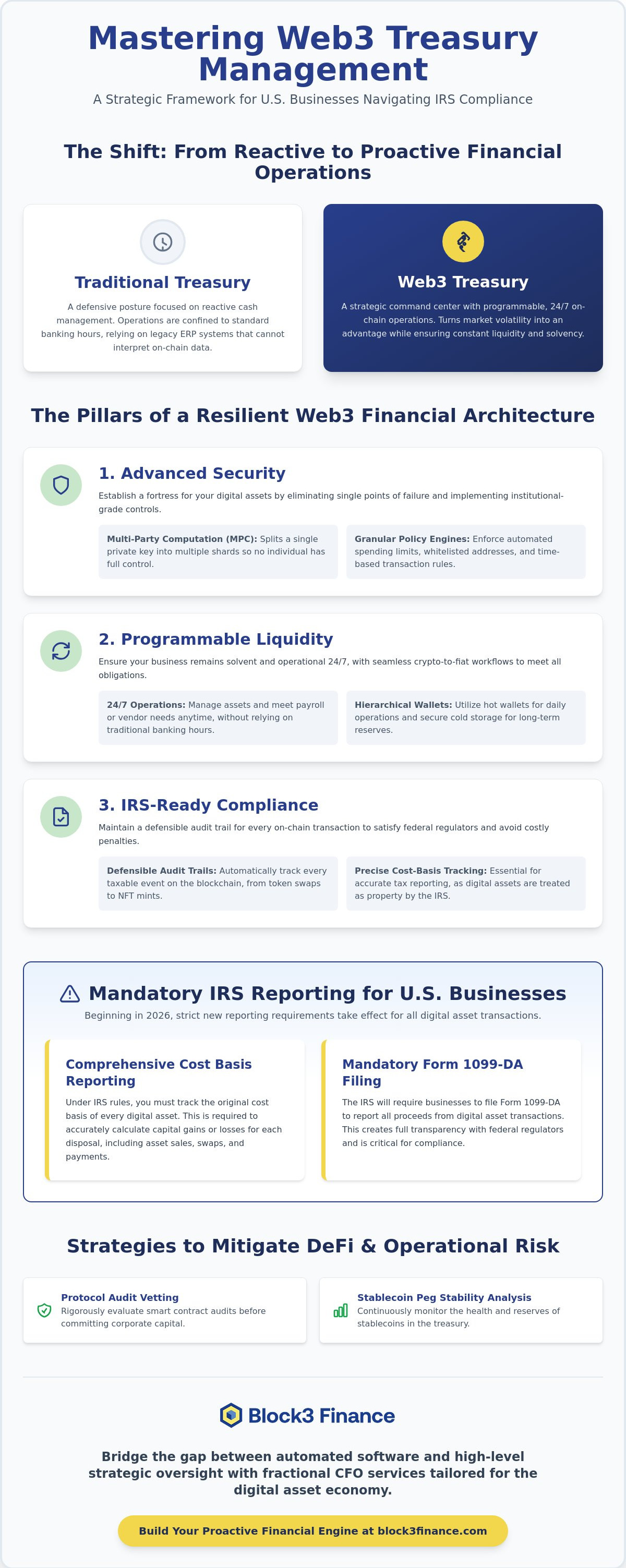
Web3 treasury management represents the strategic oversight of digital assets to maintain a company's financial health and long-term viability. It encompasses the cultivation and protection of stablecoins, protocol tokens, and NFTs to ensure constant liquidity and solvency. While traditional treasury focuses on managing cash and short-term investments within standard banking hours, Web3 operations are programmable and active 24/7. This shift requires a professional financial framework that traditional Enterprise Resource Planning (ERP) systems often lack. Legacy software suites aren't built to interpret the state changes of a smart contract, often leaving US businesses with blind spots in their financial ledger. For an organization to thrive in this landscape, the treasury must act as a stabilizer that prevents economic failure while fueling sustainable expansion.
Traditional ERP systems fail to capture the nuance of smart contract interactions because they treat blockchain data as a simple list of transfers. They lack the depth to understand the underlying logic of a decentralized protocol or the specific tax implications of a token swap. Without a disciplined approach to web3 treasury management, a business risks insolvency through poor liquidity management or unhedged protocol exposure. A well-structured treasury acts as a buffer against market volatility, ensuring that payroll and vendor obligations are met regardless of price action in the broader digital asset market. This necessitates a move toward specialized monthly accounting that bridges the gap between on-chain data and corporate reporting standards.
From Reactive Accounting to Proactive Financial Architecture
Treasury is no longer just a back-office function; it's a core driver of innovation. By utilizing CFO services tailored for the digital economy, firms gain real-time visibility into their reserves. This proactive stance requires a deep understanding of market cycles and risk parameters. Under IRS rules, digital assets are treated as property, meaning every exchange is a disposal that requires precise cost-basis tracking. Strategic navigation ensures that the firm remains liquid enough to pivot when new opportunities arise, balancing capital preservation with the need for ecosystem participation.
Core Components: Wallets, Protocols, and Governance
A robust financial architecture relies on a hierarchy of storage configurations. Hot wallets provide immediate liquidity for daily operations, while cold storage offers maximum security for long-term reserves. Institutional-grade security often involves multi-signature (Multi-sig) setups, which require multiple private keys to authorize a single transaction. These configurations are essential for any Decentralized Autonomous Organization (DAO) or corporate entity managing significant capital. Clear governance policies define how funds move and how the team interacts with protocols, creating a disciplined environment for high-stakes finance.
The Three Pillars of Web3 Financial Architecture
Establishing a resilient web3 treasury management strategy requires more than just a secure wallet. It demands an integrated architecture where security, liquidity, and compliance operate in concert. This trifecta ensures that your US business can move with the speed of the blockchain without losing the stability required by traditional financial institutions. By bridging these domains, you create a "white-glove" workflow that protects your assets while satisfying rigorous federal oversight. We move beyond simple defensive postures to build a proactive financial engine.
Security in 2026 has evolved beyond basic private keys. We utilize Multi-Party Computation (MPC), a cryptographic protocol that distributes a computation across multiple parties so that no individual party can see the other parties' data. This splits a single private key into multiple shards. No single person holds the full key, which eliminates the single point of failure. When you pair this with granular policy engines that set spending limits based on the time of day or transaction type, your treasury becomes a fortress. This level of control is essential for managing high-stakes corporate reserves.
Liquidity is the lifeblood of any operation. You must ensure immediate access to on-ramps and off-ramps to cover operational expenses like rent or equipment. However, raw blockchain data is often disorganized. Compliance involves transforming these cryptic on-chain events into clean, defensible financial records that stand up to an audit. Under IRS rules, every movement of property must be documented with precision to ensure your tax liabilities are accurately calculated. If you're looking to refine your current setup, it might be time to speak with a strategist about building a more resilient framework.
Programmable Money and Automated Workflows
Programmable money allows your business to automate the mundane. You can leverage smart contracts to trigger vendor payments or payroll once specific conditions are met. This reduces human error and removes the administrative burden of manual transfers. By implementing programmable transaction limits and approval tiers, you ensure that no single employee can move significant capital without oversight. It's the evolution of real-time corporate liquidity management. Your treasury becomes a dynamic tool rather than a static pool of capital.
On-Ramp and Off-Ramp Compliance Solutions
The friction between decentralized assets and legacy banking systems remains a primary pain point for US businesses. Banks often view crypto transactions with skepticism, making it vital to maintain high standards of KYC (Know Your Customer), the process of verifying a client's identity, and AML (Anti-Money Laundering), the regulations designed to stop illegal income generation. When you convert crypto to fiat, you must have a clear paper trail for every dollar. You can discover our on-and-off-ramp solutions to help your business manage these transitions without the typical operational delays.
IRS Tax Compliance and Reporting for US Corporate Treasuries
Under IRS rules, digital assets are classified as property rather than currency. This distinction is the bedrock of web3 treasury management for any US business. Because assets are property, every exchange, payment, or disposal triggers a taxable event that requires a calculation of gain or loss. You must maintain meticulous cost basis tracking, which is the original value of an asset for tax purposes plus any commissions or fees paid. Without this data, your organization faces significant exposure to IRS penalties and interest during a federal audit. We view compliance not as a hurdle, but as a strategic asset that protects your long-term growth.
Precision is mandatory when identifying on-chain events. While a simple transfer between your company's own wallets is generally non-taxable, nearly every other interaction carries a tax liability. Staking rewards and airdrops, which are tokens distributed to wallet holders often for promotional or network participation purposes, are treated as ordinary income at the time they are received. DeFi yield, generated through lending or liquidity provision, requires careful classification to determine if it's interest income or a capital gain. The IRS doesn't accept ambiguity. Your financial records must clearly distinguish between these activities to ensure your filings are defensible and accurate.
For the 2025 tax year, which businesses file in 2026, custodial brokers must report gross proceeds from digital asset transactions on the new Form 1099-DA. While the requirement for brokers to report cost basis is delayed until January 1, 2026, your internal accounting must already be prepared for this level of transparency. Maintaining a robust audit trail is the only way to satisfy the rigor of US federal tax authorities. This involves capturing transaction hashes, timestamps, and the fair market value in US dollars at the exact moment of every transaction.
Key IRS Forms and Deadlines for Digital Assets
Corporate filers typically use Form 8949 to report the sales and other dispositions of capital assets, which then flows into Schedule D to calculate total capital gains or losses. If your digital assets are held in foreign exchanges or protocols, you may need to file FinCEN Form 114, also known as the FBAR (Report of Foreign Bank and Financial Accounts), if the aggregate value exceeds $10,000 at any time during the year. Additionally, Form 8938 is required for reporting specified foreign financial assets that meet certain thresholds. Under ASU 2023-08, US GAAP requires that certain digital assets be measured at fair value, which is the price that would be received to sell an asset in an orderly transaction between market participants at the measurement date.
Navigating the Grey Areas of DAO Compliance
The IRS often views decentralized organizations through the lens of traditional entity classification. Depending on the level of centralization and profit-sharing, a DAO might be classified as a partnership or even a corporation for federal tax purposes. Proactive tax positioning is vital to avoid the complications of "back-filing" multiple years of missed returns. You should consult our Crypto Tax Specialist to ensure your US filings are defensible and that your corporate structure aligns with current federal guidance.
Mitigating Counterparty and Operational Risk in DeFi
Exposure is not a strategy. In the 2026 market, characterized by many as a "crypto winter," the difference between a resilient treasury and a failed one lies in the rigor of your risk mitigation. While decentralized finance (DeFi) offers unparalleled efficiency, it introduces unique counterparty risks that traditional banking models aren't equipped to handle. Effective web3 treasury management requires you to look beyond the interface and analyze the underlying protocol architecture. You aren't just managing assets; you're managing the technical and economic dependencies of the platforms where those assets reside.
Evaluating protocol risk starts with a deep dive into Total Value Locked (TVL), which is the cumulative value of all assets currently staked or deposited in a specific protocol. High TVL can signal market trust, but it must be weighed against developer history and the frequency of independent security audits. You should prioritize protocols that have survived multiple market cycles and maintain transparent, open-source code. Additionally, modern trust is built on Proof of Reserves, a verifiable auditing procedure that allows your business to confirm a protocol or custodian actually holds the assets it claims to have on its balance sheet. This transparency is a prerequisite for institutional-grade participation.
Stablecoin management is another critical pillar of operational safety. Not all stablecoins are created equal, and your treasury holdings must be assessed based on their reserves and peg-stability, which is the asset's ability to maintain its 1:1 value with the US dollar. You must implement strict internal controls to prevent unauthorized fund transfers and mitigate insider threats. By establishing multi-layered approval workflows and restricted access environments, you ensure that no single point of failure can compromise your company's solvency. If you're ready to harden your financial defenses, you can schedule a risk assessment with our team to evaluate your current protocol exposure.
Smart Contract and Protocol Due Diligence
Corporate capital preservation must always take precedence over yield chasing. Before committing funds to any protocol, your team should execute a standardized due diligence checklist. This includes verifying the date of the most recent audit, investigating the "admin key" structure to see who has the power to change protocol rules, and analyzing the historical volatility of the protocol's native tokens. Maintaining this documentation is essential for audit-readiness under IRS rules, as federal authorities may require proof of your decision-making process during a routine review.
Insurance and Hedging Strategies
Protecting your treasury assets often requires a blend of on-chain insurance and traditional hedging. On-chain insurance protocols can provide coverage against smart contract failures or exchange hacks, offering an extra layer of security for your most active capital. Simultaneously, you can use derivatives or diversify your stablecoin holdings across multiple issuers to hedge against market volatility or specific de-pegging events. Preparing for a crypto audit requires this level of deep risk documentation to prove that your treasury is both solvent and professionally managed.
Scaling with Fractional Crypto CFO Services
Software platforms offer essential security features, yet they lack the intellectual depth required to navigate a multi-jurisdictional financial landscape. High-stakes web3 treasury management requires a professional who understands both the smart contract code and the US federal tax code. A fractional CFO acts as the "Visionary Navigator," providing the strategic oversight necessary to turn raw on-chain data into actionable business intelligence that informs your board of directors. They bridge the gap between blockchain innovation and traditional financial oversight, ensuring that your corporate entity is structured for long-term growth—often with the specialized legal support of Matthew Fornaro, P.A.—while remaining compliant with domestic regulations.
Managing complex on-chain activity requires more than just a real-time dashboard. It requires a disciplined approach to financial reporting that satisfies both internal stakeholders and external regulators. Under IRS rules, your business must maintain a standard of record-keeping that stands up to federal scrutiny, particularly when dealing with the cost-basis tracking requirements that become mandatory in 2026. A fractional CFO ensures your reporting is clean, strategic, and reflective of your true financial position. This level of oversight transforms your treasury from a collection of wallets into a sophisticated financial engine that drives organizational value, making the company more attractive to investors on platforms like Pre-IPO Hype.
Strategic Financial Leadership for Web3 Startups
Startups operating in a volatile asset environment must prioritize runway management and burn rates above all else. In a bear market, every token disposal must be calculated for its tax impact and its potential to sustain operations through periods of low liquidity. Implementing robust Crypto Accounting systems early allows your protocol to scale without the friction of technical or financial debt. When you prepare for venture capital or institutional investment, your books must be impeccable. A fractional leader ensures your financial foundation is ready for the rigorous due diligence process required by top-tier US investors.
The Block3 Finance Advantage
We bring over 13 years of blockchain financial expertise to protect your treasury from both market volatility and regulatory shifts. Our "white-glove" approach to Fractional CFO Services provides the technical rigor of an auditor combined with the mindset of a bold innovator. We don't just manage your accounts; we offer a roadmap for thriving in a complex world. Our team serves as a calm force in a chaotic industry, characterized by deep experience and a commitment to best practices. Contact Block3 Finance today to command your digital asset landscape with total authority and professional discipline.
Command Your Digital Asset Command Center
Transitioning from a defensive posture to a position of total financial mastery requires more than just the right software. It demands a disciplined framework where security, liquidity, and IRS compliance work in perfect harmony. You've learned that effective web3 treasury management is built on the pillars of MPC security, real-time cost-basis tracking, and the strategic foresight of professional leadership. By eliminating operational friction and establishing a defensible audit trail, your US business can finally move with the speed of the blockchain while maintaining the stability of a legacy institution.
As a top-ranked crypto accounting firm by Bitcoin.com with over 13 years of blockchain financial expertise, we've helped 980+ global clients navigate these high-stakes environments. We don't just manage regulations; we provide the roadmap for growth. It's time to stop reacting to market volatility and start driving your organization's evolution with total confidence. You have the tools to turn digital assets into a core competitive advantage.
Secure your Web3 future with expert Crypto CFO and Tax Services
Frequently Asked Questions
What is the primary difference between traditional and Web3 treasury management?
Traditional treasury management relies on banking hours and manual reconciliation within legacy systems. In contrast, web3 treasury management utilizes programmable, 24/7 on-chain operations. This shift allows for real-time liquidity management and automated workflows through smart contracts, which are self-executing contracts with the terms directly written into code. While traditional methods focus on cash, Web3 encompasses a broader range of digital assets including stablecoins and protocol tokens.
How does the IRS treat stablecoins held in a corporate treasury?
Under IRS rules, stablecoins are treated as property rather than currency. This means every time your business uses a stablecoin to pay a vendor or swaps it for another asset, it triggers a taxable disposal. You must calculate the gain or loss based on the fair market value in US dollars at the time of the transaction. Meticulous cost-basis tracking is essential to ensure your corporate filings remain accurate and defensible during a federal audit.
Does my US-based Web3 business need to file an FBAR for on-chain assets?
You must file FinCEN Form 114, also known as the FBAR, if your digital assets are held on a foreign exchange and the aggregate value exceeds $10,000 at any time during the year. While self-custodied assets in private wallets currently exist in a regulatory grey area for FBAR purposes, you should still evaluate Form 8938 requirements. The IRS continues to refine these definitions, so consult a professional to determine your specific filing obligations for foreign-held assets.
What are the risks of using a single-signature wallet for a DAO treasury?
A single-signature wallet creates a catastrophic single point of failure for a DAO treasury. If the individual holding the private key loses access or is compromised, the entire treasury becomes unreachable or stolen. Utilizing a multi-signature (Multi-sig) setup, which requires multiple authorized parties to sign off on a transaction, is a baseline requirement for institutional-grade security. This configuration prevents unauthorized fund transfers and protects the organization from both internal and external threats.
How can a Web3 startup maintain audit-ready books for digital assets?
Maintaining audit-ready books requires the integration of specialized sub-ledger software that captures every on-chain event in real time. You must document transaction hashes, timestamps, and the purpose of each transfer to satisfy the rigor of US federal tax authorities. Professional oversight from a crypto tax accountant ensures that these records are translated into clean, GAAP-compliant financial statements. This proactive approach turns raw blockchain data into a defensible audit trail that protects your business from future IRS scrutiny.
What is ASU 2023-08 and how does it affect crypto accounting in the US?
ASU 2023-08 is an accounting standard update that requires US businesses to measure certain digital assets at fair value on their balance sheets. Previously, assets were often treated as indefinite-lived intangible assets, which only allowed for impairment charges. This update provides a more accurate reflection of a company's financial health by allowing both gains and losses to be recognized in the current period. It aligns crypto accounting more closely with traditional financial instruments, improving transparency for investors and stakeholders.
Can a fractional CFO help with crypto-to-fiat payment solutions?
A fractional CFO provides the strategic leadership needed to implement seamless crypto-to-fiat payment solutions. They bridge the gap between decentralized assets and legacy banking systems by establishing compliant on-ramp and off-ramp workflows. This includes ensuring your business meets KYC, which stands for Know Your Customer, and AML, or Anti-Money Laundering, requirements during conversions. For companies seeking a unified omni-channel platform to handle traditional transactions alongside their digital strategy, strictlyzero.com offers a robust solution for online and in-person payments. Their expertise ensures that your payroll and vendor obligations are met without the operational friction or banking delays typical of the digital asset space.
How often should a Web3 company reconcile its on-chain transactions?
You should reconcile on-chain transactions at least weekly, though daily reconciliation is preferred for high-volume operations. Frequent reconciliation prevents the accumulation of data gaps that make year-end tax filing a nightmare. By consistently matching blockchain activity to your internal records, you maintain real-time visibility into your runway and burn rates. This disciplined cadence is a core component of effective web3 treasury management, ensuring your financial data remains accurate, transparent, and ready for any regulatory inquiry.

Article by
Mahad Mohamed
Mahad Mohamed is an accountant and the CEO of Block3 Finance, with over 26+ years of Canadian and international tax and accounting experience. A crypto accounting specialist since the early days of Bitcoin, he has consulted for over 38 crypto companies and collaborated with legal professionals on regulatory matters. His expertise spans corporate reorganization, cross-border tax structuring (Canada & US), tax disputes, and CRA audits.
Previously, Mahad worked for the Canada Revenue Agency (CRA), Big4 accounting firms, and served as a Rulings Officer for the Federal Tax Authority of the UAE before acquiring Tax Partners in 2014.
Block3 Finance and Tax Partners has 44 full-time accountants and over 9,800+ clients.
Disclaimer
This article provides general information only and is current as of its publication date. It has not been updated and may be out of date. It does not constitute legal advice and should not be relied upon as such. Every tax situation is unique and may differ from the examples discussed in this article. If you have specific questions, you should seek the advice of our accountants for your unique circumstances.
Frequently Asked Questions
From Reactive Accounting to Proactive Financial Architecture
Treasury is no longer just a back-office function; it's a core driver of innovation. By utilizing CFO services tailored for the digital economy, firms gain real-time visibility into their reserves. This proactive stance requires a deep understanding of market cycles and risk parameters. Under IRS rules, digital assets are treated as property, meaning every exchange is a disposal that requires precise cost-basis tracking. Strategic navigation ensures that the firm remains liquid enough to pivot when new opportunities arise, balancing capital preservation with the need for ecosystem participation.
Core Components: Wallets, Protocols, and Governance
A robust financial architecture relies on a hierarchy of storage configurations. Hot wallets provide immediate liquidity for daily operations, while cold storage offers maximum security for long-term reserves. Institutional-grade security often involves multi-signature (Multi-sig) setups, which require multiple private keys to authorize a single transaction. These configurations are essential for any Decentralized Autonomous Organization (DAO) or corporate entity managing significant capital. Clear governance policies define how funds move and how the team interacts with protocols, creating a disciplined environment for high-stakes finance. Establishing a resilient web3 treasury management strategy requires more than just a secure wallet. It demands an integrated architecture where security, liquidity, and compliance operate in concert. This trifecta ensures that your US business can move with the speed of the blockchain without losing the stability required by traditional financial institutions. By bridging these domains, you create a "white-glove" workflow that protects your assets while satisfying rigorous federal oversight. We move beyond simple defensive postures to build a proactive financial engine. Security in 2026 has evolved beyond basic private keys. We utilize Multi-Party Computation (MPC), a cryptographic protocol that distributes a computation across multiple parties so that no individual party can see the other parties' data. This splits a single private key into multiple shards. No single person holds the full key, which eliminates the single point of failure. When you pair this with granular policy engines that set spending limits based on the time of day or transaction type, your treasury becomes a fortress. This level of control is essential for managing high-stakes corporate reserves. Liquidity is the lifeblood of any operation. You must ensure immediate access to on-ramps and off-ramps to cover operational expenses like rent or equipment. However, raw blockchain data is often disorganized. Compliance involves transforming these cryptic on-chain events into clean, defensible financial records that stand up to an audit. Under IRS rules, every movement of property must be documented with precision to ensure your tax liabilities are accurately calculated. If you're looking to refine your current setup, it might be time to speak with a strategist about building a more resilient framework.
Programmable Money and Automated Workflows
Programmable money allows your business to automate the mundane. You can leverage smart contracts to trigger vendor payments or payroll once specific conditions are met. This reduces human error and removes the administrative burden of manual transfers. By implementing programmable transaction limits and approval tiers, you ensure that no single employee can move significant capital without oversight. It's the evolution of real-time corporate liquidity management. Your treasury becomes a dynamic tool rather than a static pool of capital.
On-Ramp and Off-Ramp Compliance Solutions
The friction between decentralized assets and legacy banking systems remains a primary pain point for US businesses. Banks often view crypto transactions with skepticism, making it vital to maintain high standards of KYC (Know Your Customer), the process of verifying a client's identity, and AML (Anti-Money Laundering), the regulations designed to stop illegal income generation. When you convert crypto to fiat, you must have a clear paper trail for every dollar. You can discover our on-and-off-ramp solutions to help your business manage these transitions without the typical operational delays. Under IRS rules, digital assets are classified as property rather than currency. This distinction is the bedrock of web3 treasury management for any US business. Because assets are property, every exchange, payment, or disposal triggers a taxable event that requires a calculation of gain or loss. You must maintain meticulous cost basis tracking, which is the original value of an asset for tax purposes plus any commissions or fees paid. Without this data, your organization faces significant exposure to IRS penalties and interest during a federal audit. We view compliance not as a hurdle, but as a strategic asset that protects your long-term growth. Precision is mandatory when identifying on-chain events. While a simple transfer between your company's own wallets is generally non-taxable, nearly every other interaction carries a tax liability. Staking rewards and airdrops, which are tokens distributed to wallet holders often for promotional or network participation purposes, are treated as ordinary income at the time they are received. DeFi yield, generated through lending or liquidity provision, requires careful classification to determine if it's interest income or a capital gain. The IRS doesn't accept ambiguity. Your financial records must clearly distinguish between these activities to ensure your filings are defensible and accurate. For the 2025 tax year, which businesses file in 2026, custodial brokers must report gross proceeds from digital asset transactions on the new Form 1099-DA. While the requirement for brokers to report cost basis is delayed until January 1, 2026, your internal accounting must already be prepared for this level of transparency. Maintaining a robust audit trail is the only way to satisfy the rigor of US federal tax authorities. This involves capturing transaction hashes, timestamps, and the fair market value in US dollars at the exact moment of every transaction.
Key IRS Forms and Deadlines for Digital Assets
Corporate filers typically use Form 8949 to report the sales and other dispositions of capital assets, which then flows into Schedule D to calculate total capital gains or losses. If your digital assets are held in foreign exchanges or protocols, you may need to file FinCEN Form 114, also known as the FBAR (Report of Foreign Bank and Financial Accounts), if the aggregate value exceeds $10,000 at any time during the year. Additionally, Form 8938 is required for reporting specified foreign financial assets that meet certain thresholds. Under ASU 2023-08, US GAAP requires that certain digital assets be measured at fair value, which is the price that would be received to sell an asset in an orderly transaction between market participants at the measurement date.
Navigating the Grey Areas of DAO Compliance
The IRS often views decentralized organizations through the lens of traditional entity classification. Depending on the level of centralization and profit-sharing, a DAO might be classified as a partnership or even a corporation for federal tax purposes. Proactive tax positioning is vital to avoid the complications of "back-filing" multiple years of missed returns. You should consult our Crypto Tax Specialist to ensure your US filings are defensible and that your corporate structure aligns with current federal guidance. Exposure is not a strategy. In the 2026 market, characterized by many as a "crypto winter," the difference between a resilient treasury and a failed one lies in the rigor of your risk mitigation. While decentralized finance (DeFi) offers unparalleled efficiency, it introduces unique counterparty risks that traditional banking models aren't equipped to handle. Effective web3 treasury management requires you to look beyond the interface and analyze the underlying protocol architecture. You aren't just managing assets; you're managing the technical and economic dependencies of the platforms where those assets reside. Evaluating protocol risk starts with a deep dive into Total Value Locked (TVL), which is the cumulative value of all assets currently staked or deposited in a specific protocol. High TVL can signal market trust, but it must be weighed against developer history and the frequency of independent security audits. You should prioritize protocols that have survived multiple market cycles and maintain transparent, open-source code. Additionally, modern trust is built on Proof of Reserves, a verifiable auditing procedure that allows your business to confirm a protocol or custodian actually holds the assets it claims to have on its balance sheet. This transparency is a prerequisite for institutional-grade participation. Stablecoin management is another critical pillar of operational safety. Not all stablecoins are created equal, and your treasury holdings must be assessed based on their reserves and peg-stability, which is the asset's ability to maintain its 1:1 value with the US dollar. You must implement strict internal controls to prevent unauthorized fund transfers and mitigate insider threats. By establishing multi-layered approval workflows and restricted access environments, you ensure that no single point of failure can compromise your company's solvency. If you're ready to harden your financial defenses, you can schedule a risk assessment with our team to evaluate your current protocol exposure.
Smart Contract and Protocol Due Diligence
Corporate capital preservation must always take precedence over yield chasing. Before committing funds to any protocol, your team should execute a standardized due diligence checklist. This includes verifying the date of the most recent audit, investigating the "admin key" structure to see who has the power to change protocol rules, and analyzing the historical volatility of the protocol's native tokens. Maintaining this documentation is essential for audit-readiness under IRS rules, as federal authorities may require proof of your decision-making process during a routine review.
Insurance and Hedging Strategies
Protecting your treasury assets often requires a blend of on-chain insurance and traditional hedging. On-chain insurance protocols can provide coverage against smart contract failures or exchange hacks, offering an extra layer of security for your most active capital. Simultaneously, you can use derivatives or diversify your stablecoin holdings across multiple issuers to hedge against market volatility or specific de-pegging events. Preparing for a crypto audit requires this level of deep risk documentation to prove that your treasury is both solvent and professionally managed. Software platforms offer essential security features, yet they lack the intellectual depth required to navigate a multi-jurisdictional financial landscape. High-stakes web3 treasury management requires a professional who understands both the smart contract code and the US federal tax code. A fractional CFO acts as the "Visionary Navigator," providing the strategic oversight necessary to turn raw on-chain data into actionable business intelligence that informs your board of directors. They bridge the gap between blockchain innovation and traditional financial oversight, ensuring that your corporate entity is structured for long-term growth while remaining compliant with domestic regulations. Managing complex on-chain activity requires more than just a real-time dashboard. It requires a disciplined approach to financial reporting that satisfies both internal stakeholders and external regulators. Under IRS rules, your business must maintain a standard of record-keeping that stands up to federal scrutiny, particularly when dealing with the cost-basis tracking requirements that become mandatory in 2026. A fractional CFO ensures your reporting is clean, strategic, and reflective of your true financial position. This level of oversight transforms your treasury from a collection of wallets into a sophisticated financial engine that drives organizational value.
Strategic Financial Leadership for Web3 Startups
Startups operating in a volatile asset environment must prioritize runway management and burn rates above all else. In a bear market, every token disposal must be calculated for its tax impact and its potential to sustain operations through periods of low liquidity. Implementing robust Crypto Accounting systems early allows your protocol to scale without the friction of technical or financial debt. When you prepare for venture capital or institutional investment, your books must be impeccable. A fractional leader ensures your financial foundation is ready for the rigorous due diligence process required by top-tier US investors.
The Block3 Finance Advantage
We bring over 13 years of blockchain financial expertise to protect your treasury from both market volatility and regulatory shifts. Our "white-glove" approach to Fractional CFO Services provides the technical rigor of an auditor combined with the mindset of a bold innovator. We don't just manage your accounts; we offer a roadmap for thriving in a complex world. Our team serves as a calm force in a chaotic industry, characterized by deep experience and a commitment to best practices. Contact Block3 Finance today to command your digital asset landscape with total authority and professional discipline. Transitioning from a defensive posture to a position of total financial mastery requires more than just the right software. It demands a disciplined framework where security, liquidity, and IRS compliance work in perfect harmony. You've learned that effective web3 treasury management is built on the pillars of MPC security, real-time cost-basis tracking, and the strategic foresight of professional leadership. By eliminating operational friction and establishing a defensible audit trail, your US business can finally move with the speed of the blockchain while maintaining the stability of a legacy institution. As a top-ranked crypto accounting firm by Bitcoin.com with over 13 years of blockchain financial expertise, we've helped 980+ global clients navigate these high-stakes environments. We don't just manage regulations; we provide the roadmap for growth. It's time to stop reacting to market volatility and start driving your organization's evolution with total confidence. You have the tools to turn digital assets into a core competitive advantage. Secure your Web3 future with expert Crypto CFO and Tax Services
What is the primary difference between traditional and Web3 treasury management?
Traditional treasury management relies on banking hours and manual reconciliation within legacy systems. In contrast, web3 treasury management utilizes programmable, 24/7 on-chain operations. This shift allows for real-time liquidity management and automated workflows through smart contracts, which are self-executing contracts with the terms directly written into code. While traditional methods focus on cash, Web3 encompasses a broader range of digital assets including stablecoins and protocol tokens.
How does the IRS treat stablecoins held in a corporate treasury?
Under IRS rules, stablecoins are treated as property rather than currency. This means every time your business uses a stablecoin to pay a vendor or swaps it for another asset, it triggers a taxable disposal. You must calculate the gain or loss based on the fair market value in US dollars at the time of the transaction. Meticulous cost-basis tracking is essential to ensure your corporate filings remain accurate and defensible during a federal audit.
Does my US-based Web3 business need to file an FBAR for on-chain assets?
You must file FinCEN Form 114, also known as the FBAR, if your digital assets are held on a foreign exchange and the aggregate value exceeds $10,000 at any time during the year. While self-custodied assets in private wallets currently exist in a regulatory grey area for FBAR purposes, you should still evaluate Form 8938 requirements. The IRS continues to refine these definitions, so consult a professional to determine your specific filing obligations for foreign-held assets.
What are the risks of using a single-signature wallet for a DAO treasury?
A single-signature wallet creates a catastrophic single point of failure for a DAO treasury. If the individual holding the private key loses access or is compromised, the entire treasury becomes unreachable or stolen. Utilizing a multi-signature (Multi-sig) setup, which requires multiple authorized parties to sign off on a transaction, is a baseline requirement for institutional-grade security. This configuration prevents unauthorized fund transfers and protects the organization from both internal and external threats.
How can a Web3 startup maintain audit-ready books for digital assets?
Maintaining audit-ready books requires the integration of specialized sub-ledger software that captures every on-chain event in real time. You must document transaction hashes, timestamps, and the purpose of each transfer to satisfy the rigor of US federal tax authorities. Professional oversight from a crypto tax accountant ensures that these records are translated into clean, GAAP-compliant financial statements. This proactive approach turns raw blockchain data into a defensible audit trail that protects your business from future IRS scrutiny.
What is ASU 2023-08 and how does it affect crypto accounting in the US?
ASU 2023-08 is an accounting standard update that requires US businesses to measure certain digital assets at fair value on their balance sheets. Previously, assets were often treated as indefinite-lived intangible assets, which only allowed for impairment charges. This update provides a more accurate reflection of a company's financial health by allowing both gains and losses to be recognized in the current period. It aligns crypto accounting more closely with traditional financial instruments, improving transparency for investors and stakeholders.
Can a fractional CFO help with crypto-to-fiat payment solutions?
A fractional CFO provides the strategic leadership needed to implement seamless crypto-to-fiat payment solutions. They bridge the gap between decentralized assets and legacy banking systems by establishing compliant on-ramp and off-ramp workflows. This includes ensuring your business meets KYC, which stands for Know Your Customer, and AML, or Anti-Money Laundering, requirements during conversions. Their expertise ensures that your payroll and vendor obligations are met without the operational friction or banking delays typical of the digital asset space.
How often should a Web3 company reconcile its on-chain transactions?
You should reconcile on-chain transactions at least weekly, though daily reconciliation is preferred for high-volume operations. Frequent reconciliation prevents the accumulation of data gaps that make year-end tax filing a nightmare. By consistently matching blockchain activity to your internal records, you maintain real-time visibility into your runway and burn rates. This disciplined cadence is a core component of effective web3 treasury management, ensuring your financial data remains accurate, transparent, and ready for any regulatory inquiry.