
Can your current financial records survive a deep-dive CRA audit, or are they just a collection of disconnected wallet addresses? Most Web3 founders treat bookkeeping as a defensive chore rather than a strategic asset. Learning how to prepare financial statements for a crypto company is about more than just checking boxes for the Canada Revenue Agency (CRA). It's about building a defensible narrative of your on-chain activity that transforms chaotic data into a clear map of growth.
You likely feel the weight of thousands of DeFi transactions and the uncertainty of whether to classify tokens as intangible assets or inventory. It's a common struggle in the Canadian digital landscape where rules seem to shift as fast as the markets. We understand the pressure of maintaining precision while navigating high-stakes regulatory environments.
This definitive guide empowers you to master these complexities and secure full compliance with 2026 CRA standards. We'll provide a clear roadmap for classifying every digital asset and preparing audit-ready statements that protect your business. By the end, you'll have the tools to turn messy records into a professional financial foundation.
Key Takeaways
- Understand the critical distinction between inventory and intangible assets under CRA rules to ensure your balance sheet survives professional scrutiny.
- Master how to prepare financial statements for a crypto company by implementing a five-step workflow that aggregates complex on-chain data into audit-ready records.
- Learn to calculate the Fair Market Value of staking, mining, and DeFi yields at the exact moment of receipt for precise revenue recognition.
- Transition from a defensive compliance posture to a strategic one by using your financial statements to manage runway and fuel Web3 business growth.
- Gain clarity on the specific 2026 CRA filing requirements and reporting standards tailored for Canadian blockchain corporations.
Understanding Digital Asset Reporting Under CRA Standards
Crypto financial statements are a structured summary of digital asset transactions and balances. For Canadian corporations, these documents serve as the primary bridge between on-chain activity and the Canada Revenue Agency (CRA). Understanding how to prepare financial statements for a crypto company begins with recognizing that the CRA views digital assets as a commodity rather than a fiat currency.
This classification means that every trade, swap, or payment triggers a potential tax event. Traditional accounting frameworks often struggle with the sheer volume and technical nature of blockchain data. You must adapt these legacy systems to capture the nuances of gas fees, smart contract interactions, and wallet-to-wallet transfers.
Reporting requirements for incorporated businesses in Canada are significantly more complex than those for individual investors. Corporations must maintain a detailed ledger that accounts for every fractional movement of value. This level of oversight ensures that your business remains compliant while positioning you for long-term financial growth.
The Role of IFRS in Canadian Crypto Accounting
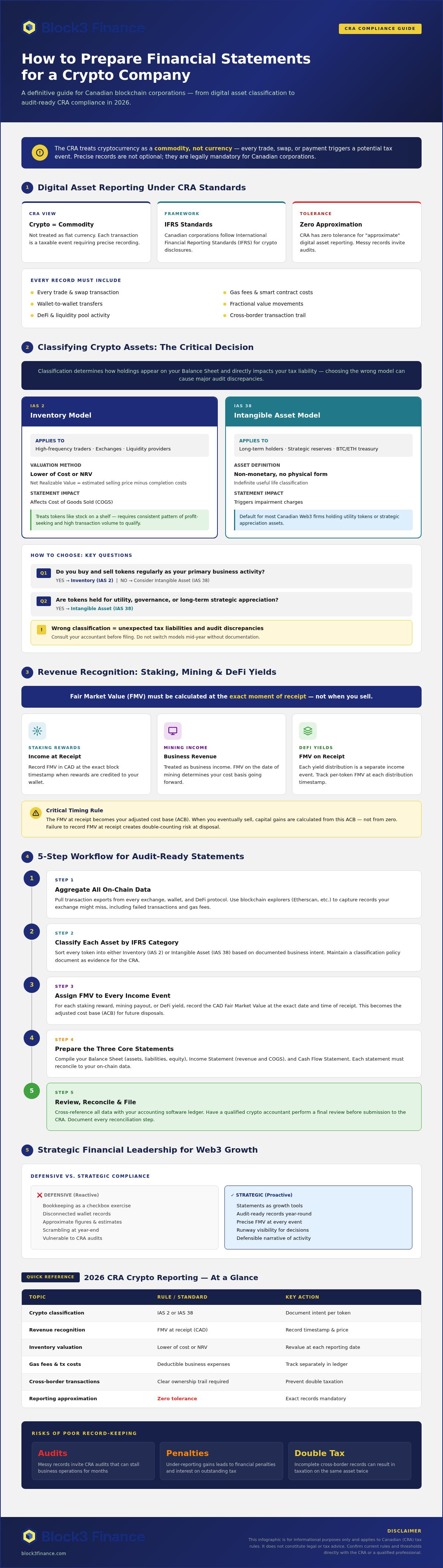
Most Canadian corporations utilize International Financial Reporting Standards (IFRS) to guide their financial disclosures. Under this framework, you must categorize your holdings based on their intended use. The two primary paths are IAS 2 (Inventory) and IAS 38 (Intangible Assets).
IAS 2 applies if your business holds digital assets for sale in the ordinary course of business, similar to a retail shop. IAS 38 covers intangible assets, which are non-monetary assets without physical substance. Most Canadian Web3 firms default to the intangible asset model because their tokens are held for utility or strategic appreciation.
Why Precision is Mandatory for CRA Compliance
The CRA maintains a zero-tolerance policy for "approximate" reporting regarding digital assets. Messy records are an invitation for an audit, which can stall your business operations for months. Precise data entry ensures you don't overpay taxes or face penalties for under-reporting your gains.
High-quality records also prevent double taxation on cross-border transactions by providing a clear trail of ownership. This transparency is essential for firms operating in global markets or utilizing offshore liquidity pools. Engaging expert accounting services provides the technical rigor needed to turn complex on-chain data into defensible financial statements.
Classifying Crypto Assets: Inventory vs. Intangible Assets
Classification isn't a mere administrative choice. It's a fundamental strategic decision that dictates how your digital holdings appear on your Balance Sheet and how they impact your bottom line. When determining how to prepare financial statements for a crypto company under Canadian rules, you must evaluate the intent behind every token held in your treasury.
The Canada Revenue Agency (CRA) generally treats cryptocurrency as a commodity. This means your tax and accounting treatment depends on whether you're conducting a business or holding for capital appreciation. Choosing the wrong model can lead to significant discrepancies during a year-end audit and unexpected tax liabilities.
How you categorize these assets determines which financial statements are affected. Inventory treatment impacts the cost of goods sold, while intangible assets primarily trigger impairment charges. Both paths require a disciplined approach to data collection and valuation.
The Inventory Model for Active Traders
If your company operates as a high-frequency trader, an exchange, or a liquidity provider, your digital assets likely qualify as inventory. To meet CRA criteria for business income, your activity must show a consistent pattern of profit-seeking behavior and high transaction volume. You're essentially treating tokens like stock on a shelf.
Under the inventory model, you typically report assets at the lower of cost or net realizable value (NRV). NRV represents the estimated selling price minus any costs required to complete the sale. This approach ensures your financial statements don't overstate the value of your holdings during a market downturn, which directly influences your taxable income for the year.
Intangible Asset Treatment for Long-Term Holders
Many Web3 firms hold Bitcoin or Ethereum as a strategic reserve asset. In these cases, the assets are classified as intangible assets with indefinite useful lives. This is the default treatment under IFRS for companies that don't fit the active trader profile.
Classification as an intangible asset requires regular impairment testing. If the market value of your tokens drops below their carrying amount, you must record an impairment charge on your Income Statement. These charges reduce your net income but don't provide an immediate cash flow benefit. Crucially, Canadian standards generally prevent you from writing up the value of these assets if the market recovers, unless you sell the asset.
Navigating these classification hurdles requires a proactive strategy to ensure your records remain defensible. If you're unsure which model applies to your specific protocol or treasury, consult with our specialized team to align your reporting with current CRA expectations.
Revenue Recognition for Staking, Mining, and DeFi Yields
Revenue recognition in the blockchain space presents unique challenges that traditional accounting software often fails to address. For Canadian corporations, the Canada Revenue Agency (CRA) requires that you recognize income at its Fair Market Value (FMV) at the exact moment of receipt. This is a vital component of how to prepare financial statements for a crypto company that remains defensible under audit.
The CRA distinguishes between mining as a business activity and mining as a hobby. If you're operating as a corporation, the CRA almost certainly views your activity as a business. This means all rewards are taxable as income, but you can also deduct legitimate expenses like electricity and gas fees.
Gas fees and transaction costs shouldn't be ignored as they directly impact your net profit. You must track these costs meticulously to ensure they're correctly offset against your revenue on the Income Statement. This level of detail is what separates a professional ledger from a simple spreadsheet.
Staking and Mining Revenue Triggers
The point of 'receipt' occurs when you gain possession and control over the rewards. For many protocols, this is the moment the tokens hit your wallet, regardless of whether you've moved them to an exchange. Valuing these tokens becomes difficult if they have low liquidity at launch, requiring a consistent and documented valuation methodology.
- Valuation: Use a reputable price aggregator to find the CAD value at the time of the block reward.
- Depreciation: You can claim Capital Cost Allowance (CCA) on mining hardware to offset your mining income.
- Timing: Record the income when the reward is earned, not when it's converted to fiat.
DeFi and Airdrop Accounting Challenges
DeFi interactions like yield farming and liquidity provision add layers of complexity. When you deposit assets into a liquidity pool, you typically receive liquidity provider (LP) tokens in return. The CRA often views this as a disposition of the original assets, which could trigger a capital gain or loss depending on your specific circumstances.
Airdrops are treated as income based on their FMV at the time you receive them. Even if you didn't seek out the airdrop, you're responsible for reporting its value once it's under your control. Understanding international crypto tax compliance is essential for firms managing these multifaceted on-chain revenue streams across different protocols.
A 5-Step Workflow for Preparing Audit-Ready Statements
Establishing a rigorous workflow is the only way to move from chaotic on-chain data to a defensible financial position. When you're determining how to prepare financial statements for a crypto company, you must treat the blockchain as a raw data source that requires significant refinement. This process ensures your reports meet the high standards of Canadian corporate compliance while providing a clear view of your business health.
The first step involves a comprehensive inventory of every wallet address, exchange account, and third-party custody solution your firm utilizes. Once identified, you must aggregate this data into a unified sub-ledger. Relying on fragmented records leads to visibility gaps that the CRA will likely flag during a corporate tax review.
Reconciling internal transfers is critical to eliminate duplicate gains that often occur when moving assets between cold storage and hot wallets. After cleaning the data, apply valuation rules based on your chosen accounting policy, whether you use the inventory or intangible asset model. Finally, perform a year-end review for impairment to ensure your Balance Sheet reflects current market realities according to IFRS standards.
Data Aggregation and Normalization
Moving beyond manual CSV exports is essential for operational accuracy. API-driven data collection is more reliable because it captures real-time transaction metadata that spreadsheets often miss. This approach helps resolve the common issue of "missing" cost basis for transferred assets by tracking the original acquisition point across different platforms.
By creating a "Golden Record," you establish an immutable audit trail that stands up to professional scrutiny. This single source of truth allows you to defend your numbers with confidence if the CRA requests additional documentation. It transforms your bookkeeping from a defensive chore into a strategic advantage for your Web3 business.
Final Review and Disclosure Notes
Audit-ready statements require detailed "Notes to Financial Statements" specifically tailored for digital assets. These notes must disclose your valuation methodologies, significant holdings, and any concentration risks your company faces. Providing this level of transparency demonstrates operational maturity and builds trust with stakeholders and regulators alike.
You must also document any significant events, such as protocol forks or major network upgrades, that occurred during the fiscal year. For a comprehensive guide to these requirements, review Block3 Finance's audit preparation checklist to ensure no detail is overlooked. If you're ready to transition from reactive bookkeeping to proactive financial strategy, contact our experts today to streamline your reporting workflow.
Strategic Financial Leadership for High-Growth Web3 Firms
Financial statements shouldn't be viewed as a defensive burden. They're a tool for mastery. Understanding how to prepare financial statements for a crypto company allows you to shift from a reactive compliance stance to an offensive growth strategy. When your records are precise, you gain the agency to navigate a volatile landscape with total confidence.
Volatility is the only constant in the digital asset market. Managing your treasury requires real-time visibility into your runway and burn rate, which is the speed at which your company spends its capital reserves. Without audit-ready data, you're essentially navigating a storm without a compass, risking your firm's stability during market downturns.
A fractional CFO provides the high-level oversight needed to interpret these complex data sets. They help you translate your on-chain activity into strategic insights that inform hiring, scaling, and protocol development. This specialized leadership ensures that your financial foundation is as innovative as the technology you're building.
Professional bookkeeping is also your primary lever for securing venture capital or navigating M&A (mergers and acquisitions) activity. Investors and acquirers demand a "white-glove" level of financial transparency before committing capital. Clean, defensible records prove that you have total command over your operations and are ready for the next stage of evolution.
Corporate Structuring for Tax Efficiency
Choosing the right entity is a foundational decision for any Canadian Web3 founder. You must decide between domestic and international entities based on your specific digital operations and where your team is located. This decision impacts everything from your tax liability to your ability to attract global talent.
Global teams often present unique on-ramp and off-ramp logistics that require sophisticated planning. Proper corporate structuring for crypto businesses ensures you can move capital efficiently across borders while staying fully compliant with CRA regulations. It resolves the friction of moving between fiat and digital assets in a high-growth environment.
The Navigator Advantage: Why Specialized Oversight Matters
Generalist accountants often lack the technical immersion required to handle the nuances of blockchain data. They might struggle to reconcile thousands of DeFi transactions or fail to correctly classify your treasury assets under IFRS. A specialist understands the underlying technology and the regulatory framework with equal depth.
Block3 Finance acts as a "Visionary Navigator" for firms that demand more than just traditional accounting. We turn complex, fragmented on-chain activity into defensible records that survive the most rigorous CRA audits. This proactive support empowers you to focus on innovation while we handle the complexities of your financial oversight.
Securing your company's future requires a partner who understands the rules of the new financial frontier. Our team provides the technical rigor and strategic roadmap you need to thrive in a complex world. Contact our team to secure your financial future and gain total command over your digital landscape.
Secure Your Financial Future in the Web3 Economy
Mastery of digital asset reporting is no longer a luxury for Canadian Web3 founders; it's a necessity for long-term survival. You now possess a comprehensive roadmap for asset classification and revenue recognition under 2026 CRA standards. Learning how to prepare financial statements for a crypto company is the first step toward building a defensible, high-growth business that survives professional scrutiny.
Don't let the technical friction of thousands of on-chain transactions stall your momentum. Block3 Finance brings over 13 years of specialized blockchain accounting expertise to your corner. We've helped over 980 global clients transform fragmented data into professional, audit-ready records that protect their treasury and reputation.
As the firm ranked as the top provider by Bitcoin.com, we offer the technical rigor and strategic oversight your business deserves. Secure Your Audit-Ready Financial Records with Block3 Finance to gain total command over your financial landscape. You have the vision to build the future of finance; let us provide the stability and precision to keep it thriving.
Frequently Asked Questions
How does the CRA define a crypto company for tax purposes?
The CRA determines if you're a crypto business based on the frequency and nature of your transactions. If your operations show a high degree of organization and profit-seeking intent, you're taxed on business income rather than capital gains. This distinction is vital when figuring out how to prepare financial statements for a crypto company that reflect your actual tax obligations.
Can I use fair value accounting for my crypto assets in Canada?
Canadian corporate standards generally favor the cost model for intangible assets or the lower of cost and net realizable value for inventory. While some public entities use fair value under specific IFRS rules, most private Web3 firms in Canada must record assets at their historical cost. You should record impairment charges if the market value drops significantly below your carrying amount.
What are the specific CRA reporting deadlines for crypto corporations in 2026?
In 2026, Canadian crypto corporations must file their T2 return within six months of their fiscal year-end. However, any tax balance owing is typically due within two or three months of that same year-end. Missing these deadlines can lead to significant penalties; you should consult the CRA website directly to confirm the specific dates for your corporate tax cycle.
How do I account for NFT sales on my company's financial statements?
NFT sales are recognized as revenue based on the CAD value of the consideration received at the moment of the transaction. If your company creates the NFT, you must also account for minting costs and gas fees as business expenses. These transactions impact your Income Statement and should be supported by clear on-chain evidence for every digital collectible sold during the fiscal year.
Is it necessary to have my crypto books audited by a specialist?
While not legally mandated for every firm, having a specialist review your records is essential for audit-readiness. Specialist oversight ensures your sub-ledger accurately reflects complex on-chain events that generalist software often misses. This proactive step provides the intellectual depth needed to defend your position if the CRA questions how to prepare financial statements for a crypto company with high transaction volumes.
How should I report crypto-to-crypto trades on my income statement?
Crypto-to-crypto trades are treated as barter transactions under Canadian tax law. You must report the disposition of the original asset and the acquisition of the new one at their respective Fair Market Values in CAD. Any difference between your cost basis and the FMV at the time of the trade results in a taxable gain or loss on your Income Statement.
What happens if my company loses its private keys or is hacked?
If your firm experiences a hack or loses private keys, you may be eligible to claim a business loss. You must provide the CRA with exhaustive documentation, including police reports or forensic blockchain analysis, to prove the assets are truly irrecoverable. These losses are recorded on your financial statements to reflect the involuntary reduction in your company's total asset value.
Can I pay my Canadian employees in crypto legally?
You can legally pay Canadian employees in digital assets, but the CRA treats this as a payment in kind. You must calculate the CAD value of the crypto on the day it's paid to determine the correct statutory withholdings for income tax, CPP, and EI. These amounts must be remitted in CAD and reported accurately on the employee's year-end T4 slip.

Article by
Mahad Mohamed
Mahad Mohamed is an accountant and the CEO of Block3 Finance, with over 26+ years of Canadian and international tax and accounting experience. A crypto accounting specialist since the early days of Bitcoin, he has consulted for over 38 crypto companies and collaborated with legal professionals on regulatory matters. His expertise spans corporate reorganization, cross-border tax structuring (Canada & US), tax disputes, and CRA audits.
Previously, Mahad worked for the Canada Revenue Agency (CRA), Big4 accounting firms, and served as a Rulings Officer for the Federal Tax Authority of the UAE before acquiring Tax Partners in 2014.
Block3 Finance and Tax Partners has 44 full-time accountants and over 9,800+ clients.
Disclaimer
This article provides general information only and is current as of its publication date. It has not been updated and may be out of date. It does not constitute legal advice and should not be relied upon as such. Every tax situation is unique and may differ from the examples discussed in this article. If you have specific questions, you should seek the advice of our accountants for your unique circumstances.
Frequently Asked Questions
How does the CRA define a crypto company for tax purposes?
The CRA determines if you're a crypto business based on the frequency and nature of your transactions. If your operations show a high degree of organization and profit-seeking intent, you're taxed on business income rather than capital gains. This distinction is vital when figuring out how to prepare financial statements for a crypto company that reflect your actual tax obligations.
Can I use fair value accounting for my crypto assets in Canada?
Canadian corporate standards generally favor the cost model for intangible assets or the lower of cost and net realizable value for inventory. While some public entities use fair value under specific IFRS rules, most private Web3 firms in Canada must record assets at their historical cost. You should record impairment charges if the market value drops significantly below your carrying amount.
What are the specific CRA reporting deadlines for crypto corporations in 2026?
In 2026, Canadian crypto corporations must file their T2 return within six months of their fiscal year-end. However, any tax balance owing is typically due within two or three months of that same year-end. Missing these deadlines can lead to significant penalties; you should consult the CRA website directly to confirm the specific dates for your corporate tax cycle.
How do I account for NFT sales on my company's financial statements?
NFT sales are recognized as revenue based on the CAD value of the consideration received at the moment of the transaction. If your company creates the NFT, you must also account for minting costs and gas fees as business expenses. These transactions impact your Income Statement and should be supported by clear on-chain evidence for every digital collectible sold during the fiscal year.
Is it necessary to have my crypto books audited by a specialist?
While not legally mandated for every firm, having a specialist review your records is essential for audit-readiness. Specialist oversight ensures your sub-ledger accurately reflects complex on-chain events that generalist software often misses. This proactive step provides the intellectual depth needed to defend your position if the CRA questions how to prepare financial statements for a crypto company with high transaction volumes.
How should I report crypto-to-crypto trades on my income statement?
Crypto-to-crypto trades are treated as barter transactions under Canadian tax law. You must report the disposition of the original asset and the acquisition of the new one at their respective Fair Market Values in CAD. Any difference between your cost basis and the FMV at the time of the trade results in a taxable gain or loss on your Income Statement.
What happens if my company loses its private keys or is hacked?
If your firm experiences a hack or loses private keys, you may be eligible to claim a business loss. You must provide the CRA with exhaustive documentation, including police reports or forensic blockchain analysis, to prove the assets are truly irrecoverable. These losses are recorded on your financial statements to reflect the involuntary reduction in your company's total asset value.
Can I pay my Canadian employees in crypto legally?
You can legally pay Canadian employees in digital assets, but the CRA treats this as a payment in kind. You must calculate the CAD value of the crypto on the day it's paid to determine the correct statutory withholdings for income tax, CPP, and EI. These amounts must be remitted in CAD and reported accurately on the employee's year-end T4 slip.