
The IRS has shifted its posture from passive observation to aggressive enforcement of digital asset income. As staking yields for assets like Ethereum and Solana become central to modern portfolios, the margin for reporting error has vanished. You likely feel the weight of tracking every reward distribution across a volatile, 24/7 market.
Precision in accounting for crypto staking rewards is the only way to move from a defensive stance to one of total financial command. This guide empowers you to establish a rigorous methodology that satisfies Revenue Ruling 2023-14 and secures your digital wealth against IRS scrutiny. We provide the technical clarity required to transform chaotic on-chain data into an elite, audit-ready record.
We will explore the critical mechanics of "dominion and control" and the specific reporting requirements for the 2026 filing season, including the new Form 1099-DA. You will learn how to accurately value rewards as ordinary income while building a defensible trail that integrates seamlessly into your broader financial statements.
Key Takeaways
- Identify the specific criteria the IRS uses to determine when staking rewards become taxable gross income under current 2026 regulations.
- Implement a robust methodology for accounting for crypto staking rewards by utilizing Fair Market Value standards and principal market data.
- Build a defensible audit trail by reconciling complex on-chain wallet movements with your corporate financial records.
- Differentiate between the accounting treatments for rebase tokens and reward-bearing liquid staking assets to avoid costly classification errors.
- Leverage professional oversight to transform high-volume staking data into a strategic growth lever while maintaining strict regulatory compliance.
Defining the Taxable Event: How the IRS Views Staking Rewards
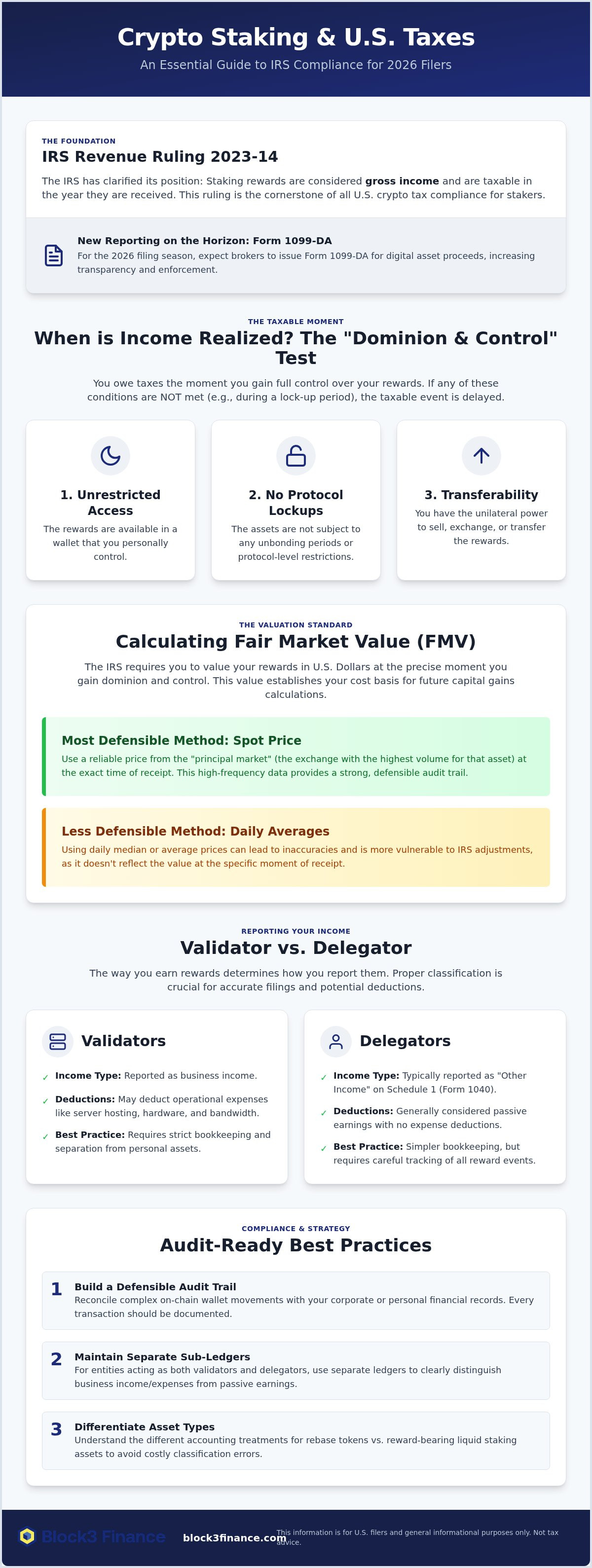
The IRS has formalized its stance on digital asset yields for US filers. Under Revenue Ruling 2023-14, taxpayers must recognize staking rewards as gross income in the tax year they are received. This rule transforms every protocol distribution into a realized revenue event. Staking income is defined as a taxable event at the point of receipt.
Mastering the accounting for crypto staking rewards requires a deep understanding of this mandate. It ensures that your records reflect the market value of every token at the exact second you gain the legal right to move it. Precision here prevents the accumulation of tax liabilities that could destabilize a portfolio during market downturns.
Validator vs. Delegator Rewards under IRS Rules
Professional validators operate as the technical backbone of the Proof-of-Stake consensus mechanism by running dedicated hardware. For these entities, rewards are often treated as business income rather than passive earnings. This classification may allow for the deduction of operational expenses like server hosting and high-speed bandwidth.
Individual delegators typically report rewards as "Other Income" on Schedule 1 of Form 1040. While the tax rate remains consistent with ordinary income brackets, the bookkeeping requirements differ significantly. Corporate ledgers must maintain a strict separation between these activities to prevent friction during a formal audit.
Maintaining separate sub-ledgers for validator operations and simple delegation is a best practice for 2026 compliance. This clarity allows you to defend expense claims while ensuring that gross income is reported accurately. It's the difference between a clean financial statement and a disorganized pile of wallet addresses.
The Concept of Dominion and Control
Timing is the most volatile element of staking compliance. The IRS uses the "dominion and control" standard to determine exactly when income is realized. You owe taxes the moment you have the unilateral power to sell, transfer, or exchange the reward.
Locked periods or unbonding durations delay the taxable event. If a protocol requires a 21-day cooldown before you can touch your tokens, you don't recognize income until that period ends. This nuance is critical for high-volume portfolios where price swings can occur during the unbonding phase.
- Unrestricted access: The tokens are available in a wallet you control.
- Ability to exit: The staking position is no longer subject to protocol-level lockups.
- Transferability: The assets can be moved to an external exchange or third-party wallet.
Establishing a precise timeline for these events is the foundation of audit-readiness. Without it, you risk overpaying on rewards that were technically inaccessible during market peaks. Accurate record-keeping protects your capital from being eroded by premature tax assessments.
Revenue Recognition and Valuation: The Core of Crypto Staking Accounting
Valuing digital assets requires a disciplined approach to market data. The IRS mandates that you record the Fair Market Value (FMV) of staking rewards in U.S. dollars at the precise moment of receipt. This valuation isn't a suggestion; it's the anchor for your cost basis and future capital gains calculations. Without a rigorous valuation strategy, your records remain vulnerable to IRS adjustments and penalties.
Effective accounting for crypto staking rewards hinges on identifying the "principal market." In 2026, standards require you to value assets based on the market with the highest volume and level of activity for that specific token. For active stakers, this necessitates high-frequency price data to capture the volatility inherent in decentralized protocols. Relying on stale or inaccurate data can lead to significant discrepancies in your financial reporting.
Determining Fair Market Value at the Moment of Receipt
Choosing a reliable price aggregator is paramount for consistency. While some filers attempt to use daily averages, the IRS Revenue Ruling 2023-14 emphasizes the value at the time the taxpayer gains dominion and control. Using a "spot price" methodology provides a more defensible audit trail than broad daily medians. You must maintain this specific valuation method throughout the entire fiscal year to prevent "cherry-picking" data that artificially lowers tax liability.
Applying ASC 606 to Staking Operations
Corporate entities must align their crypto activities with Generally Accepted Accounting Principles (GAAP). Specifically, ASC 606 provides a five-step model for revenue recognition that clarifies when a staker has fulfilled their obligations. This framework ensures that staking income is integrated into corporate financial statements with the same level of integrity as traditional revenue streams.
- Identify the contract: In decentralized staking, the "contract" is the protocol's programmatic rules.
- Performance obligations: Your obligation is the commitment of capital to secure the network.
- Determine transaction price: This is the FMV of the tokens earned at the point of receipt.
- Allocate the price: Revenue is recognized as those rewards are programmatically distributed.
- Recognize revenue: Income is recorded when the performance obligation is satisfied and control of the reward is transferred.
This structured approach transforms staking from a speculative activity into a mature business line. If you find the intersection of GAAP and blockchain data overwhelming, our team can help you implement a compliant valuation framework tailored to your specific portfolio needs.
Practical Bookkeeping: Converting On-Chain Data to Defensible Records
Bridging the gap between a block explorer and a general ledger is where most filers fail. Successful accounting for crypto staking rewards requires a systematic reconciliation of every on-chain event with your primary financial records. Our accounting services specialize in this translation process to ensure your digital assets are fully integrated into a defensible corporate framework.
Manual block explorer verification is often necessary for high-value audits to confirm the accuracy of automated data. This step ensures that every token received is accounted for at the protocol level. It eliminates the risk of discrepancies that frequently occur between third-party software and the actual blockchain state.
Building an Audit-Ready Ledger
A compliant ledger must capture more than just a balance. You need a granular record for every reward distribution to satisfy the rigorous requirements of IRS Revenue Ruling 2023-14. Each entry should include the exact timestamp, the Fair Market Value in USD, the unique transaction ID (TxID), and the specific protocol used.
Use 'memo' fields to describe the nature of each reward, such as distinguishing between base staking and liquid staking distributions. This context is invaluable during an audit when protocol-specific activities might be questioned. Supplement these on-chain records with off-chain documentation like validator performance logs to support your income timing claims.
Storing these records in a centralized, secure environment prevents data loss over long fiscal periods. Digital asset markets move quickly, but your historical data must remain static and accessible. This discipline builds a foundation of trust with regulators and internal stakeholders alike.
Automation vs. Manual Oversight
Many popular crypto tax platforms struggle with the nuances of multi-chain staking and complex reward cycles. These tools often miss rewards tucked away in sub-wallets or claimable smart contract balances that haven't been "swept" to a main address. Relying solely on automated software creates a "black box" that may not survive a rigorous IRS examination.
A professional crypto tax specialist must review automated reports to identify these hidden gaps. Human oversight provides the strategic analysis needed to classify rewards correctly and minimize your total tax exposure. Professionals can spot anomalies in the data that software might simply ignore or miscategorize as a simple transfer.
The risk of missing rewards in complex smart contracts is a significant liability for high-volume stakers. Establishing a workflow that combines automated data ingestion with expert manual verification is the only way to ensure 100% accuracy. This dual-layered approach protects your capital and your reputation.
Advanced Accounting Challenges: Liquid Staking and Slashing Penalties
Liquid staking complicates the already dense process of accounting for crypto staking rewards by introducing secondary layers of asset representation. You're no longer just holding a native asset; you're holding a derivative that may or may not be accumulating value in real-time. Managing these complexities requires robust corporate structuring to ring-fence operational risks and optimize tax outcomes for high-volume portfolios.
Accounting for Liquid Staking Tokens (LSTs)
The "exchange versus receipt" debate remains a central friction point for US filers. When you swap native tokens for LSTs, the IRS typically views this as a taxable disposal of one property for another. This triggers an immediate capital gains or loss event based on the Fair Market Value (FMV) of the native token at the moment of the swap. You must track the cost basis of the LST independently from your original native asset to ensure accurate reporting upon future redemption.
Accounting treatments differ significantly between rebase tokens and reward-bearing tokens. Rebase tokens increase in quantity directly in your wallet, requiring you to record each distribution as ordinary income upon receipt. Reward-bearing tokens instead increase in value relative to the underlying asset. For these assets, rewards are technically "accrued" within the token's price, often deferring the tax event until you sell or exchange the LST. This distinction is critical for 2026 compliance as protocol designs continue to evolve.
The Tax Treatment of Slashing Penalties
Slashing represents the programmatic seizure of staked assets due to validator downtime or malicious behavior. For professional validators, these losses are generally deductible as ordinary business expenses under current IRS guidelines. This classification allows you to offset the income generated by the validator node with the losses incurred from technical failures. Individual delegators face a more difficult path because the Tax Cuts and Jobs Act (TCJA) significantly restricted deductions for personal digital asset losses.
Documenting a slashing event for audit purposes is non-negotiable. You must record the exact block height, the amount of capital seized, and the technical reason for the penalty as provided by the protocol's consensus logs. This evidence turns a chaotic loss into a defensible line item on your financial statements. Without this granular data, the IRS may view the missing tokens as a simple transfer rather than a deductible loss.
The volatility of protocol-level risks requires a proactive approach to financial oversight. Contact our team to audit your liquid staking positions and ensure your 2026 filings are bulletproof against regulatory scrutiny.
Strategic Compliance: Why Professional Oversight is Essential for Staking
Self-filing for high-volume staking activity is a significant operational risk. The 2026 tax year introduces the new Form 1099-DA, which increases the data visibility the IRS has into your digital asset activity. Errors in accounting for crypto staking rewards can trigger exhaustive audits that drain your resources and focus.
Our CFO services provide the high-level oversight needed to navigate these complexities. We transform your raw on-chain data into a strategic growth lever. This transition allows you to focus on capital deployment while we handle the meticulous requirements of US tax compliance.
Navigating the 2026 Regulatory Landscape
IRS enforcement has reached a new level of sophistication. Regulators now utilize advanced blockchain analysis tools to cross-reference reported income with on-chain movements. Professional firms stay ahead of the "Grey Area" by interpreting protocol-specific data through the lens of established legal frameworks. This proactive approach ensures you're never caught off guard by sudden shifts in IRS policy.
Jurisdictional focus is paramount for US filers. Rules regarding "dominion and control" are specific to the IRS and differ significantly from international standards. We ensure your methodology is strictly aligned with US requirements to prevent costly misclassifications. Our team monitors every regulatory update to protect your portfolio from emerging compliance threats.
- Threshold Monitoring: We track the $600 reporting threshold for Form 1099-MISC to ensure exchange data matches your records.
- Income Timing: Our experts verify the exact moment of income recognition for every reward distribution.
- Risk Mitigation: We identify potential audit triggers before they appear on a tax return.
The Block3 Finance Advantage
Block3 Finance is a "Visionary Navigator" in the digital asset space. We are ranked as a top provider by Bitcoin.com and have served over 980 global clients. Our team brings 13+ years of blockchain financial expertise to every engagement, ensuring your records are handled with intellectual depth and technical rigor.
Having an audit-ready set of books from day one is a prerequisite for institutional growth. It allows you to move from a defensive posture to an offensive financial strategy that prioritizes expansion over mere survival. We resolve the friction between legacy accounting and the blockchain ecosystem, providing you with total command over your financial future.
Effective accounting for crypto staking rewards is the foundation of a sustainable digital asset business. Don't leave your compliance to chance in an increasingly scrutinized environment.
Secure your compliance with a professional crypto consultation today to ensure your 2026 records are bulletproof.
Mastering Your Staking Compliance for 2026
The 2026 filing season demands more than just basic record-keeping. Timing is everything when identifying "dominion and control" under IRS Revenue Ruling 2023-14. Accurate accounting for crypto staking rewards requires a high-frequency valuation strategy and a disciplined approach to reconciling on-chain data with your general ledger. This process ensures your digital wealth is protected from the friction of regulatory scrutiny.
Block3 Finance stands as your partner in this volatile environment. We bring 13+ years of blockchain financial expertise and a track record of serving over 980 global clients. As a top-ranked provider by Bitcoin.com, we turn your complex staking portfolios into defensible, audit-ready records from day one. Our team bridges the gap between decentralized protocols and traditional corporate finance with intellectual depth.
Don't let regulatory shifts stall your momentum. Connect with a Block3 Finance Expert to Master Your Staking Compliance and gain total command over your digital asset records. You have the tools and the roadmap to thrive in the new era of decentralized finance.
Frequently Asked Questions
When is a staking reward considered 'received' for US tax purposes?
A staking reward is considered received for US tax purposes the moment you gain "dominion and control" over the asset. This means you have the unilateral power to sell, transfer, or exchange the tokens. If the protocol has a lock-up or unbonding period, the taxable event is delayed until those protocol-level restrictions expire.
Do I pay tax when I initially stake my crypto or only when I get rewards?
You generally don't pay tax when you initially stake your crypto because it isn't viewed as a sale or exchange. The IRS treats the staking of native assets as a transfer of property rather than a disposal. Tax liabilities only arise when you receive new tokens as rewards or if you swap your assets for a liquid staking derivative.
How do I calculate the Fair Market Value of rewards if the price changes hourly?
You calculate the Fair Market Value by identifying the spot price at the exact time of receipt. Successful accounting for crypto staking rewards relies on consistent data from a high-volume principal market or a reliable price aggregator. Using a daily average is risky; the IRS prefers the price at the moment you gain control of the tokens.
Are slashing penalties tax-deductible as a business expense under IRS rules?
Slashing penalties are typically tax-deductible as a business expense for professional validators under current IRS rules. If you operate as a business, these losses offset your gross income from staking. Individual delegators face stricter limits, as the Tax Cuts and Jobs Act removed most miscellaneous itemized deductions for personal investment losses through 2025.
What is the difference between validator and delegator rewards for accounting?
Validators report rewards as business income, while delegators usually report them as "Other Income" on Schedule 1 of Form 1040. This distinction is vital for accounting for crypto staking rewards because validators can often deduct operational costs like hardware and hosting. Delegators have fewer opportunities for deductions and must track rewards as passive earnings.
How does liquid staking change my tax treatment?
Liquid staking changes your tax treatment by potentially triggering a taxable exchange when you swap native tokens for Liquid Staking Tokens (LSTs). You're trading one property for another, which creates a capital gain or loss event. You must also track whether your LST uses a rebase mechanism or a reward-bearing model to determine when income is recognized.
Do I need to report staking rewards if I haven't sold them for USD yet?
Yes, you must report staking rewards even if you haven't sold them for USD yet. The IRS requires you to include the Fair Market Value of the rewards in your gross income for the year you received them. This receipt establishes your cost basis. If you later sell the tokens for USD, you'll calculate a capital gain or loss.
What forms do US businesses use to report staking income in 2026?
US businesses report staking income in 2026 using several key forms depending on their structure. Most will use Schedule 1 of Form 1040 or Form 1120 for corporations. You must also answer the digital asset question on Form 1040 and prepare for the new Form 1099-DA, which brokers use to report digital asset proceeds starting in 2026.

Article by
Mahad Mohamed
Mahad Mohamed is an accountant and the CEO of Block3 Finance, with over 26+ years of Canadian and international tax and accounting experience. A crypto accounting specialist since the early days of Bitcoin, he has consulted for over 38 crypto companies and collaborated with legal professionals on regulatory matters. His expertise spans corporate reorganization, cross-border tax structuring (Canada & US), tax disputes, and CRA audits.
Previously, Mahad worked for the Canada Revenue Agency (CRA), Big4 accounting firms, and served as a Rulings Officer for the Federal Tax Authority of the UAE before acquiring Tax Partners in 2014.
Block3 Finance and Tax Partners has 44 full-time accountants and over 9,800+ clients.
Disclaimer
This article provides general information only and is current as of its publication date. It has not been updated and may be out of date. It does not constitute legal advice and should not be relied upon as such. Every tax situation is unique and may differ from the examples discussed in this article. If you have specific questions, you should seek the advice of our accountants for your unique circumstances.
Frequently Asked Questions
When is a staking reward considered 'received' for US tax purposes?
A staking reward is considered received for US tax purposes the moment you gain "dominion and control" over the asset. This means you have the unilateral power to sell, transfer, or exchange the tokens. If the protocol has a lock-up or unbonding period, the taxable event is delayed until those protocol-level restrictions expire.
Do I pay tax when I initially stake my crypto or only when I get rewards?
You generally don't pay tax when you initially stake your crypto because it isn't viewed as a sale or exchange. The IRS treats the staking of native assets as a transfer of property rather than a disposal. Tax liabilities only arise when you receive new tokens as rewards or if you swap your assets for a liquid staking derivative.
How do I calculate the Fair Market Value of rewards if the price changes hourly?
You calculate the Fair Market Value by identifying the spot price at the exact time of receipt. Successful accounting for crypto staking rewards relies on consistent data from a high-volume principal market or a reliable price aggregator. Using a daily average is risky; the IRS prefers the price at the moment you gain control of the tokens.
Are slashing penalties tax-deductible as a business expense under IRS rules?
Slashing penalties are typically tax-deductible as a business expense for professional validators under current IRS rules. If you operate as a business, these losses offset your gross income from staking. Individual delegators face stricter limits, as the Tax Cuts and Jobs Act removed most miscellaneous itemized deductions for personal investment losses through 2025.
What is the difference between validator and delegator rewards for accounting?
Validators report rewards as business income, while delegators usually report them as "Other Income" on Schedule 1 of Form 1040. This distinction is vital for accounting for crypto staking rewards because validators can often deduct operational costs like hardware and hosting. Delegators have fewer opportunities for deductions and must track rewards as passive earnings.
How does liquid staking change my tax treatment?
Liquid staking changes your tax treatment by potentially triggering a taxable exchange when you swap native tokens for Liquid Staking Tokens (LSTs). You're trading one property for another, which creates a capital gain or loss event. You must also track whether your LST uses a rebase mechanism or a reward-bearing model to determine when income is recognized.
Do I need to report staking rewards if I haven't sold them for USD yet?
Yes, you must report staking rewards even if you haven't sold them for USD yet. The IRS requires you to include the Fair Market Value of the rewards in your gross income for the year you received them. This receipt establishes your cost basis. If you later sell the tokens for USD, you'll calculate a capital gain or loss.
What forms do US businesses use to report staking income in 2026?
US businesses report staking income in 2026 using several key forms depending on their structure. Most will use Schedule 1 of Form 1040 or Form 1120 for corporations. You must also answer the digital asset question on Form 1040 and prepare for the new Form 1099-DA, which brokers use to report digital asset proceeds starting in 2026.