
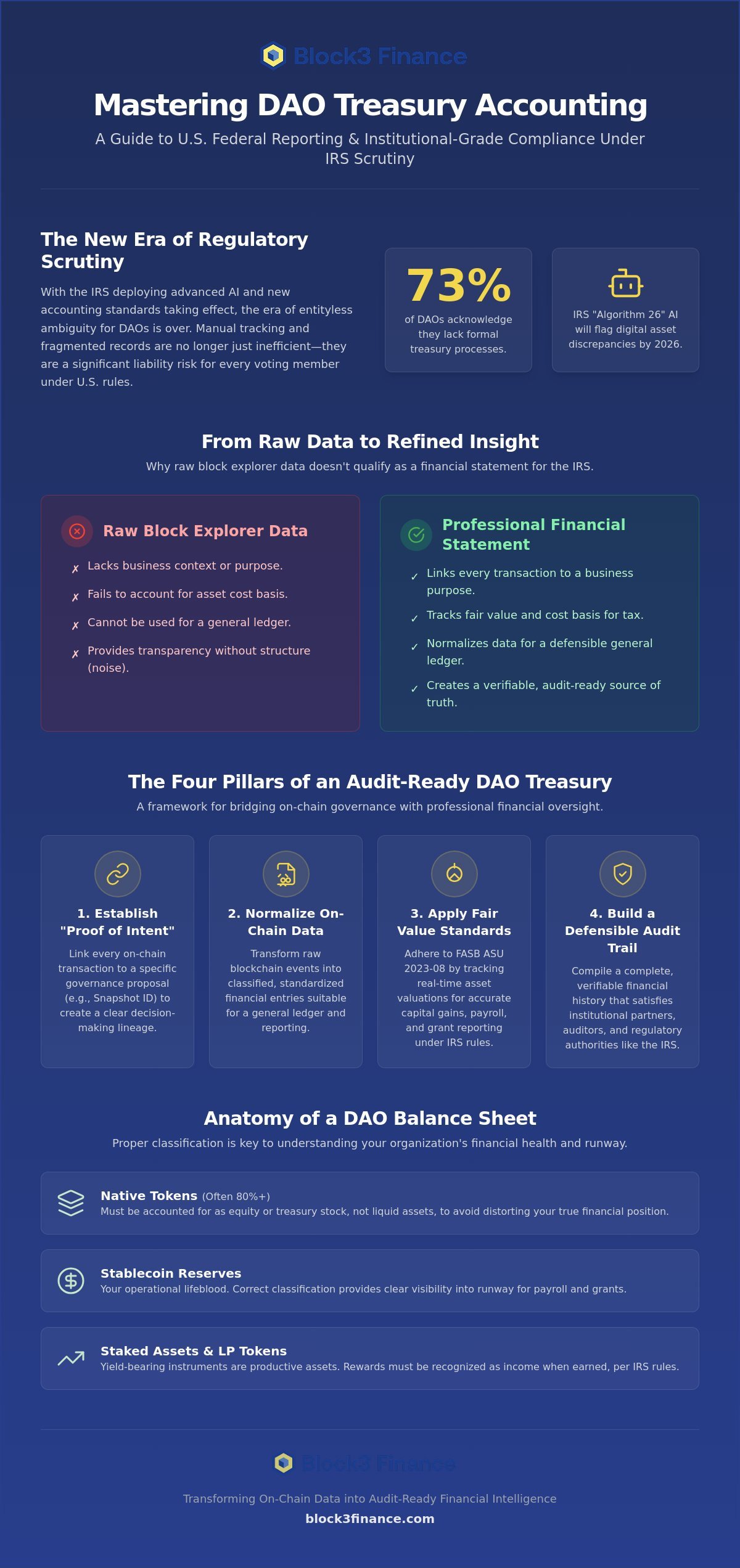
73% of DAOs acknowledge they lack formal treasury processes, yet for the 2026 tax year, the IRS has fully integrated "Algorithm 26," an AI-powered compliance engine designed to flag digital asset discrepancies with surgical precision. If you are managing a decentralized organization, the days of entityless ambiguity are over. You've likely struggled with the friction of mapping Snapshot votes to multisig outflows or reconciling assets across Ethereum and Base. We understand that this manual labor isn't just exhausting; it's a significant liability risk for every voting member under IRS rules.
This guide empowers you to master DAO treasury accounting for U.S. federal reporting, bridging the gap between on-chain governance and professional financial oversight. You'll gain total command over your organization's wealth while ensuring your books remain transparent and audit-ready. We'll explore how to establish a defensible audit trail, maintain clear visibility into your runway, and navigate the complexities of the proposed Form 1099-DA. By the end, you'll have the roadmap needed to transform your treasury into a compliant, institutional-grade asset that thrives under regulatory scrutiny.
Key Takeaways
- Bridge the gap between governance votes and financial reporting by establishing a "Proof of Intent" for every on-chain transaction.
- Learn why raw block explorer data doesn't count as a financial statement and how to normalize activity for professional oversight.
- Master DAO treasury accounting to build a defensible audit trail that satisfies institutional partners and regulatory authorities.
- Manage contributor payroll and grants with precision by reconciling real-time token valuations and adhering to fair value measurement standards under IRS rules.
- Leverage structured financial reporting to gain total visibility into your organization's runway and asset diversification strategies.
The Fundamentals of DAO Treasury Accounting and Financial Oversight
DAO treasury accounting is the rigorous process of reconciling smart contract interactions with traditional financial reporting frameworks. While the blockchain provides an immutable record, raw data is not the same as refined insight. We define this discipline as the transformation of on-chain events into normalized, classified, and defensible financial statements. For a Decentralized Autonomous Organization (DAO), transparency is a core value, but transparency without structure is merely noise. Block explorers show you that a transaction happened; accounting tells you why it happened and what it means for your organization's longevity.
Block explorers are not financial statements. They lack the context of a general ledger and fail to account for the cost basis or the specific business purpose of a transfer. We move our clients beyond the "Source of Truth" being a list of hashes on Etherscan. Instead, we establish a professional "Source of Truth" that satisfies both the community and the tax man. With over $20 billion held in DAO treasuries globally, the stakes for professional oversight have never been higher. You cannot rely on manual spreadsheets when the IRS is deploying Algorithm 26 to scan for inconsistencies in digital asset reporting, making the perspective of Trinity Networx, LLC on ethical technology use more relevant than ever.
Transitioning from manual tracking to an automated, audit-ready accounting stack is a prerequisite for growth. Under FASB Accounting Standard ASU 2023-08, many organizations must now adopt fair value measurement for fungible crypto assets. This shift requires moving from an impairment-only model to quarterly mark-to-market adjustments. We help you navigate this transition by implementing monthly accounting systems that capture every event in real time, ensuring your books are always ready for a professional audit.
The Challenges of Decentralised Financial Records
Fragmentation creates immediate friction. Many DAOs manage assets across Ethereum, Arbitrum, and Base, requiring a unified view that standard tools cannot provide. Anonymity also presents a hurdle; identifying the purpose of a multisig outflow without a traditional invoice requires forensic precision. Furthermore, the volatility of governance tokens complicates fair value measurements. Under IRS rules, you must track the exact valuation at the time of each transaction to ensure accurate capital gains reporting and tax compliance.
Core Components of a DAO Balance Sheet
Your balance sheet is a map of your organization's health, not just a list of tokens. We focus on three critical pillars:
- Native Tokens: These often represent 80% or more of a treasury. They must be accounted for as equity or treasury stock rather than simple liquid assets to avoid distorting your financial position.
- Stablecoin Reserves: This is your operational lifeblood. We ensure these are classified correctly to provide clear visibility into your runway for contributor payroll and grants.
- Staked Assets and LP Tokens: Yield-bearing instruments are productive assets. They require specific classification under both IRS and CRA frameworks to ensure that rewards are recognized as income at the moment they are earned.
Mapping Governance to Financial Reporting: The DAO Framework
Mapping governance to the general ledger is where social consensus meets fiscal reality. In a decentralized environment, every outflow must have a corresponding "Proof of Intent" that links on-chain execution to a specific community mandate. This governance-to-finance pipeline ensures that your DAO treasury accounting is not just a list of numbers but a verifiable record of organizational will. By linking Snapshot or Tally proposal IDs directly to transaction hashes, we create a transparent lineage that satisfies both token holders and regulatory bodies.
The importance of this lineage cannot be overstated. The SEC's Report on The DAO highlighted that governance activity and the expectation of profit are central to how decentralized organizations are viewed under existing legal frameworks. For those operating under IRS rules, documenting the quorum, vote results, and the specific proposal text as part of the financial record is essential for defensibility. We categorize DAO spending into distinct buckets, including ecosystem grants, core contributor rewards, and protocol incentives. This granular classification allows for better visibility into how capital allocation aligns with the DAO's long-term strategic goals—for instance, if your budget includes media production to boost transparency, you can check out Remote Podcast Recording and Production to support your communication strategy.
Operationalising Multisig Reconciliation
Effective DAO treasury accounting begins at the point of signing. We advocate for best practices in Safe transaction labeling, where signers include metadata or proposal links within the transaction itself. This proactive approach eliminates the guesswork during the monthly close, ensuring compliance with federal reporting standards. Reconciling "internal transfers" between treasury sub-wallets and working groups is equally critical. We create exception reports for any unauthorized or unmapped wallet activity, ensuring that every movement of capital is accounted for and authorized by the appropriate governance body.
Grant Tracking and Milestone Accounting
Accounting for grants requires a shift from simple cash-basis tracking to a more sophisticated accrual model. When a DAO commits to a milestone-based payment, it creates a liability on the balance sheet that must be recognized even before the tokens leave the multisig. Tracking "clawback" provisions and unspent grant funds is vital for maintaining an accurate view of available liquidity. If your organization struggles to map these complex governance flows to a standard general ledger, you may want to reach out to our team for a consultation. Our accounting services are specifically designed to handle the nuances of professional grant reconciliation for decentralized entities.
DAO Tax Compliance: IRS Frameworks for U.S. Organizations
Entity choice is the pivot point for all federal reporting. In 2026, while the IRS continues to draft specific rules for on-chain organization classification, most groups utilize legal wrappers like the Wyoming DAO LLC or the Unincorporated Non-profit Association (UNA). A UNA is a legal structure that allows a group to function as a separate entity without formal incorporation, providing a protective layer that clarifies member liability. These strategic choices dictate whether your DAO treasury accounting follows partnership rules or corporate standards under IRS rules.
The "Engaged in Trade or Business" (ETB) threshold is a critical concept for decentralized organizations. If your DAO's activities are frequent, continuous, and intended for profit, you're likely classified as ETB, which triggers extensive filing requirements. Accuracy in this determination is vital to avoid costly penalties. We recommend that you confirm your specific status and current thresholds directly with the IRS. For a deeper look at these structures, explore our DAO accounting guide for U.S. based entities.
Federal Reporting and Form 8300 Obligations
Under IRS rules, any DAO engaged in a trade or business must monitor Form 8300 requirements for the 2026 tax year. This form is mandatory when receiving more than $10,000 in digital assets in a single transaction or a series of related transactions. Furthermore, Revenue Ruling 2019-24 establishes that income from airdrops or hard forks is recognized the moment the treasury gains "dominion and control," which is the legal ability to sell or transfer the assets. Maintaining a professional audit trail ensures you're prepared for these transparency standards while protecting the organization from aggressive enforcement.
Entity Classification and the 1099-DA Horizon
Proposed rules for Form 1099-DA also impact how decentralized organizations must track member payouts. This form would require digital asset middlemen to report specific distributions, a category that may include certain DAOs with centralized management functions. By implementing a rigorous reporting framework now, you move from a defensive posture to one of total command over your fiscal future. We help you navigate these evolving legal architectures to ensure your organization remains a "calm force" in a complex regulatory landscape.
Operationalising the Treasury: Contributor Payroll and Grants
Operationalising a treasury requires a precise application of the worker classification tests defined under IRS rules. You must determine whether your contributors function as independent contractors or employees, as misclassification remains a primary target for federal enforcement agencies. In the context of DAO treasury accounting, every stablecoin disbursement must be pegged to its fair market value at the exact moment of the transfer. This ensures that the organization’s records reflect the true cost of labor and provides contributors with the data they need for their own personal filings, ensuring transparency across the entire community. When these contributors organize regional meetups or brand activations, you can explore Greito surinkimo palapinės to provide them with the professional equipment needed for success.
Native token compensation adds a layer of complexity regarding vesting and lock-ups that traditional payroll systems aren't equipped to handle. Under federal guidelines, income is typically recognized when the tokens are no longer subject to a "substantial risk of forfeiture," which often occurs at the moment of vesting. We implement on and off-ramp solutions to help DAOs manage these obligations while covering fiat-denominated costs like legal retainers or insurance premiums. This integration allows the organization to maintain liquidity in traditional markets without compromising its on-chain ethos or decentralized mission.
U.S. Contributor Compliance and Reporting
For every U.S.-based contributor receiving $600 or more during the tax year, the DAO must issue Form 1099-NEC to report the non-employee compensation. We utilize crypto-to-fiat payment solutions to streamline these payouts, ensuring that the necessary tax data is captured at the point of origin. This proactive approach resolves the friction of year-end reporting and protects the organization from the penalties associated with incomplete information returns. It also provides a clear audit trail that links on-chain distributions to the required federal disclosures.
Treasury Yield and Diversification Strategy
Yield-bearing activities, such as staking or liquidity provision, are generally classified as ordinary business income under current IRS rules at the time the rewards are earned. We also emphasize the importance of calculating "Real Runway," which accounts for the slippage and market impact incurred when liquidating native governance tokens for stable assets. Paper wealth in a treasury can be deceptive if the liquidity depth isn't there to support operational needs. You can reach out to our team to discuss how our CFO services can help you architect a treasury strategy that balances aggressive growth with the realities of market depth and federal compliance.
Achieving Audit-Readiness for Decentralised Organisations
Institutional trust is the primary currency of the decentralized economy. "Clean books" are no longer a luxury; they are the prerequisite for institutional partnerships and exchange listings. If your organization seeks to move beyond the experimental phase, your DAO treasury accounting must meet the rigorous standards of traditional finance. For organizations looking to leverage their financial health for expansion, Pinnacle Global Advisory offers specialized insights into capital efficiency and strategic growth. We transform chaotic on-chain data into defensible financial statements that stand up to the most intense scrutiny. This transition allows you to move from a defensive posture to one focused on mastery and growth, ensuring your organization is prepared for the next stage of its evolution.
Maintaining a permanent audit trail requires disciplined monthly bookkeeping. We don't just record transactions; we document the social and technical consensus behind them to provide a complete picture of organizational activity. By integrating tax filing and reporting into your core operations, you de-risk the organization from regulatory action. This proactive stance ensures that you remain compliant under IRS rules or for CRA filers, depending on your specific jurisdiction, without sacrificing the agility that makes decentralized governance powerful. We help you gain total command over a volatile landscape by establishing a foundation of professional accountability.
The Audit Trail: From Hash to Balance Sheet
A robust audit trail begins with a clearly defined "Control Environment." This includes documenting your private key management, multisig policies, and signing thresholds. When preparing for a crypto audit, third-party verification becomes essential. We provide on-chain proofs that link treasury balances to specific block height snapshots, ensuring a precise close to every reporting period. This methodical approach resolves the friction between decentralized transparency and professional defensibility, allowing you to provide stakeholders with absolute certainty regarding the DAO's financial health and the integrity of its assets.
Strategic Structuring for DAO Longevity
Longevity requires more than just good accounting; it requires strategic corporate structuring. Choosing the right legal wrapper is a critical decision that influences your tax-efficient treasury management and mitigates the risk of personal liability for voting members. At Block3 Finance, we serve as the visionary navigator for the world’s leading DAOs, providing the roadmap you need to thrive in a complex world. We bring the technical rigor of traditional auditing to the bold innovation of the blockchain space, helping you cultivate a financial ecosystem that is both resilient and transparent. Contact our DAO specialists to secure your treasury’s future and take total command over your financial landscape.
Mastering the Future of Decentralized Finance
The era of entityless, unaccountable treasuries has officially ended. Transitioning to professional DAO treasury accounting is the only way to protect your organization from regulatory friction and potential member liability. By establishing a clear pipeline from governance votes to on-chain outflows, you create an immutable record that satisfies both token holders and global tax authorities. Whether you're navigating IRS fair value measurement or CRA foreign property reporting, the focus must remain on precision and absolute defensibility.
As a top-ranked provider by Bitcoin.com with over 13 years of blockchain financial expertise, we've delivered audit-ready records for 980+ global clients. We bridge the gap between chaotic on-chain data and the technical rigor required for institutional-grade reporting. Don't leave your organization's longevity to chance in an increasingly scrutinized environment. Secure your DAO’s financial future with Block3 Finance and transform your treasury into a strategic engine for growth. The path to total financial command starts with a single, professional step.
Frequently Asked Questions
What is the best accounting software for a DAO treasury in 2026?
The most effective financial stack in 2026 involves a combination of blockchain-native subledgers and traditional ERP systems. Rather than searching for a single tool, elite organizations implement a pipeline that normalizes multi-chain activity into a format compatible with professional general ledger software. This approach allows for automated transaction classification and ensures that your financial records are consistently audit-ready without relying on a single point of software failure. For those requiring specialized anti-money laundering oversight, AML Partners offers the software and advisory services needed to maintain compliance in complex jurisdictions like Australia.
Does a DAO need to pay taxes on its native token treasury?
A DAO generally doesn't pay taxes on native tokens that remain unissued in its treasury. However, taxable events are triggered the moment those tokens are transferred for grants, contributor payroll, or liquidated for stablecoins. Under IRS rules, these tokens often have a zero-dollar cost basis, meaning the full fair market value at the time of transfer is recognized as a taxable gain or an expense, depending on the transaction's purpose.
How do we account for gas fees paid by the DAO treasury?
Gas fees must be categorized as operational expenses and recorded at their fiat value at the exact time of the transaction. For accurate DAO treasury accounting, you need to track the cost of the native gas token at the moment of confirmation. These costs are deductible business expenses for IRS or CRA filers, provided the underlying transaction served a legitimate organizational purpose like protocol maintenance or governance execution.
What is the difference between an on-chain subledger and a general ledger for a DAO?
An on-chain subledger serves as the granular record of every blockchain event, while the general ledger provides the high-level summary of the organization's financial position. The subledger handles the complex work of price oracles and transaction normalization across multiple chains. Once this data is refined, it's pushed to the general ledger to produce standard financial statements, such as the Balance Sheet, which are required for institutional partnerships and audits.
How does the IRS treat DAO contributor payments in stablecoins?
The IRS treats stablecoin payments as ordinary income, identical to USD-based compensation. Since stablecoins are pegged to the dollar, the valuation is usually simple, but the DAO must still track the transfer date to ensure accurate reporting. If a US-based contractor receives more than $600 in a calendar year, the DAO is required to issue Form 1099-NEC to remain compliant with federal tax reporting obligations.
What are the CRA reporting requirements for a Canadian-managed DAO?
For CRA filers, the most critical requirement is the T1135 Foreign Income Verification Statement if the cost of the DAO's on-chain assets exceeds $100,000 CAD. Additionally, if the DAO provides digital products or services to Canadian residents, it must monitor the $30,000 CAD revenue threshold for GST/HST registration. The CRA typically classifies decentralized activity as business income, requiring a full disclosure of global blockchain holdings.
Can a DAO be audited if it doesn’t have a traditional bank account?
Yes, a DAO can be audited through the use of on-chain proofs and cryptographic verification of multisig wallets. Auditors verify the existence and rights of assets by matching on-chain balances to the reported financial statements at specific block heights. While the lack of a bank account changes the nature of the off-ramp verification, the inherent transparency of the blockchain often provides a more reliable data set than traditional paper-based financial records.
How do we reconcile cross-chain bridge transactions in our books?
Reconciling cross-chain transactions requires a clearing account methodology to ensure assets are tracked accurately as they move between networks. You must record the outflow from the source chain and the corresponding inflow on the destination chain, accounting for bridge fees as a separate expense. This approach ensures your DAO treasury accounting reflects consolidated assets across different networks without double-counting tokens that are currently in transit through a bridge protocol.

Article by
Mahad Mohamed
Mahad Mohamed is an accountant and the CEO of Block3 Finance, with over 26+ years of Canadian and international tax and accounting experience. A crypto accounting specialist since the early days of Bitcoin, he has consulted for over 38 crypto companies and collaborated with legal professionals on regulatory matters. His expertise spans corporate reorganization, cross-border tax structuring (Canada & US), tax disputes, and CRA audits.
Previously, Mahad worked for the Canada Revenue Agency (CRA), Big4 accounting firms, and served as a Rulings Officer for the Federal Tax Authority of the UAE before acquiring Tax Partners in 2014.
Block3 Finance and Tax Partners has 44 full-time accountants and over 9,800+ clients.
Disclaimer
This article provides general information only and is current as of its publication date. It has not been updated and may be out of date. It does not constitute legal advice and should not be relied upon as such. Every tax situation is unique and may differ from the examples discussed in this article. If you have specific questions, you should seek the advice of our accountants for your unique circumstances.
Frequently Asked Questions
The Challenges of Decentralised Financial Records
Fragmentation creates immediate friction. Many DAOs manage assets across Ethereum, Arbitrum, and Base, requiring a unified view that standard tools cannot provide. Anonymity also presents a hurdle; identifying the purpose of a multisig outflow without a traditional invoice requires forensic precision. Furthermore, the volatility of governance tokens complicates fair value measurements. Under IRS rules, you must track the exact valuation at the time of each transaction to ensure accurate capital gains reporting and tax compliance.
Core Components of a DAO Balance Sheet
Your balance sheet is a map of your organization's health, not just a list of tokens. We focus on three critical pillars: Mapping governance to the general ledger is where social consensus meets fiscal reality. In a decentralized environment, every outflow must have a corresponding "Proof of Intent" that links on-chain execution to a specific community mandate. This governance-to-finance pipeline ensures that your DAO treasury accounting is not just a list of numbers but a verifiable record of organizational will. By linking Snapshot or Tally proposal IDs directly to transaction hashes, we create a transparent lineage that satisfies both token holders and regulatory bodies. The importance of this lineage cannot be overstated. The SEC's Report on The DAO highlighted that governance activity and the expectation of profit are central to how decentralized organizations are viewed under existing legal frameworks. For those operating under IRS rules, documenting the quorum, vote results, and the specific proposal text as part of the financial record is essential for defensibility. We categorize DAO spending into distinct buckets, including ecosystem grants, core contributor rewards, and protocol incentives. This granular classification allows for better visibility into how capital allocation aligns with the DAO's long-term strategic goals.
Operationalising Multisig Reconciliation
Effective DAO treasury accounting begins at the point of signing. We advocate for best practices in Safe transaction labeling, where signers include metadata or proposal links within the transaction itself. This proactive approach eliminates the guesswork during the monthly close, ensuring compliance with federal reporting standards. Reconciling "internal transfers" between treasury sub-wallets and working groups is equally critical. We create exception reports for any unauthorized or unmapped wallet activity, ensuring that every movement of capital is accounted for and authorized by the appropriate governance body.
Grant Tracking and Milestone Accounting
Accounting for grants requires a shift from simple cash-basis tracking to a more sophisticated accrual model. When a DAO commits to a milestone-based payment, it creates a liability on the balance sheet that must be recognized even before the tokens leave the multisig. Tracking "clawback" provisions and unspent grant funds is vital for maintaining an accurate view of available liquidity. If your organization struggles to map these complex governance flows to a standard general ledger, you may want to reach out to our team for a consultation. Our accounting services are specifically designed to handle the nuances of professional grant reconciliation for decentralized entities. Entity choice is the pivot point for all federal reporting. In 2026, while the IRS continues to draft specific rules for on-chain organization classification, most groups utilize legal wrappers like the Wyoming DAO LLC or the Unincorporated Non-profit Association (UNA). A UNA is a legal structure that allows a group to function as a separate entity without formal incorporation, providing a protective layer that clarifies member liability. These strategic choices dictate whether your DAO treasury accounting follows partnership rules or corporate standards under IRS rules. The "Engaged in Trade or Business" (ETB) threshold is a critical concept for decentralized organizations. If your DAO's activities are frequent, continuous, and intended for profit, you're likely classified as ETB, which triggers extensive filing requirements. Accuracy in this determination is vital to avoid costly penalties. We recommend that you confirm your specific status and current thresholds directly with the IRS. For a deeper look at these structures, explore our DAO accounting guide for U.S. based entities.
Federal Reporting and Form 8300 Obligations
Under IRS rules, any DAO engaged in a trade or business must monitor Form 8300 requirements for the 2026 tax year. This form is mandatory when receiving more than $10,000 in digital assets in a single transaction or a series of related transactions. Furthermore, Revenue Ruling 2019-24 establishes that income from airdrops or hard forks is recognized the moment the treasury gains "dominion and control," which is the legal ability to sell or transfer the assets. Maintaining a professional audit trail ensures you're prepared for these transparency standards while protecting the organization from aggressive enforcement.
Entity Classification and the 1099-DA Horizon
Proposed rules for Form 1099-DA also impact how decentralized organizations must track member payouts. This form would require digital asset middlemen to report specific distributions, a category that may include certain DAOs with centralized management functions. By implementing a rigorous reporting framework now, you move from a defensive posture to one of total command over your fiscal future. We help you navigate these evolving legal architectures to ensure your organization remains a "calm force" in a complex regulatory landscape. Operationalising a treasury requires a precise application of the worker classification tests defined under IRS rules. You must determine whether your contributors function as independent contractors or employees, as misclassification remains a primary target for federal enforcement agencies. In the context of DAO treasury accounting, every stablecoin disbursement must be pegged to its fair market value at the exact moment of the transfer. This ensures that the organization’s records reflect the true cost of labor and provides contributors with the data they need for their own personal filings, ensuring transparency across the entire community. Native token compensation adds a layer of complexity regarding vesting and lock-ups that traditional payroll systems aren't equipped to handle. Under federal guidelines, income is typically recognized when the tokens are no longer subject to a "substantial risk of forfeiture," which often occurs at the moment of vesting. We implement on and off-ramp solutions to help DAOs manage these obligations while covering fiat-denominated costs like legal retainers or insurance premiums. This integration allows the organization to maintain liquidity in traditional markets without compromising its on-chain ethos or decentralized mission.
U.S. Contributor Compliance and Reporting
For every U.S.-based contributor receiving $600 or more during the tax year, the DAO must issue Form 1099-NEC to report the non-employee compensation. We utilize crypto-to-fiat payment solutions to streamline these payouts, ensuring that the necessary tax data is captured at the point of origin. This proactive approach resolves the friction of year-end reporting and protects the organization from the penalties associated with incomplete information returns. It also provides a clear audit trail that links on-chain distributions to the required federal disclosures.
Treasury Yield and Diversification Strategy
Yield-bearing activities, such as staking or liquidity provision, are generally classified as ordinary business income under current IRS rules at the time the rewards are earned. We also emphasize the importance of calculating "Real Runway," which accounts for the slippage and market impact incurred when liquidating native governance tokens for stable assets. Paper wealth in a treasury can be deceptive if the liquidity depth isn't there to support operational needs. You can reach out to our team to discuss how our CFO services can help you architect a treasury strategy that balances aggressive growth with the realities of market depth and federal compliance. Institutional trust is the primary currency of the decentralized economy. "Clean books" are no longer a luxury; they are the prerequisite for institutional partnerships and exchange listings. If your organization seeks to move beyond the experimental phase, your DAO treasury accounting must meet the rigorous standards of traditional finance. We transform chaotic on-chain data into defensible financial statements that stand up to the most intense scrutiny. This transition allows you to move from a defensive posture to one focused on mastery and growth, ensuring your organization is prepared for the next stage of its evolution. Maintaining a permanent audit trail requires disciplined monthly bookkeeping. We don't just record transactions; we document the social and technical consensus behind them to provide a complete picture of organizational activity. By integrating tax filing and reporting into your core operations, you de-risk the organization from regulatory action. This proactive stance ensures that you remain compliant under IRS rules or for CRA filers, depending on your specific jurisdiction, without sacrificing the agility that makes decentralized governance powerful. We help you gain total command over a volatile landscape by establishing a foundation of professional accountability.
The Audit Trail: From Hash to Balance Sheet
A robust audit trail begins with a clearly defined "Control Environment." This includes documenting your private key management, multisig policies, and signing thresholds. When preparing for a crypto audit, third-party verification becomes essential. We provide on-chain proofs that link treasury balances to specific block height snapshots, ensuring a precise close to every reporting period. This methodical approach resolves the friction between decentralized transparency and professional defensibility, allowing you to provide stakeholders with absolute certainty regarding the DAO's financial health and the integrity of its assets.
Strategic Structuring for DAO Longevity
Longevity requires more than just good accounting; it requires strategic corporate structuring. Choosing the right legal wrapper is a critical decision that influences your tax-efficient treasury management and mitigates the risk of personal liability for voting members. At Block3 Finance, we serve as the visionary navigator for the world’s leading DAOs, providing the roadmap you need to thrive in a complex world. We bring the technical rigor of traditional auditing to the bold innovation of the blockchain space, helping you cultivate a financial ecosystem that is both resilient and transparent. Contact our DAO specialists to secure your treasury’s future and take total command over your financial landscape. The era of entityless, unaccountable treasuries has officially ended. Transitioning to professional DAO treasury accounting is the only way to protect your organization from regulatory friction and potential member liability. By establishing a clear pipeline from governance votes to on-chain outflows, you create an immutable record that satisfies both token holders and global tax authorities. Whether you're navigating IRS fair value measurement or CRA foreign property reporting, the focus must remain on precision and absolute defensibility. As a top-ranked provider by Bitcoin.com with over 13 years of blockchain financial expertise, we've delivered audit-ready records for 980+ global clients. We bridge the gap between chaotic on-chain data and the technical rigor required for institutional-grade reporting. Don't leave your organization's longevity to chance in an increasingly scrutinized environment. Secure your DAO’s financial future with Block3 Finance and transform your treasury into a strategic engine for growth. The path to total financial command starts with a single, professional step.
What is the best accounting software for a DAO treasury in 2026?
The most effective financial stack in 2026 involves a combination of blockchain-native subledgers and traditional ERP systems. Rather than searching for a single tool, elite organizations implement a pipeline that normalizes multi-chain activity into a format compatible with professional general ledger software. This approach allows for automated transaction classification and ensures that your financial records are consistently audit-ready without relying on a single point of software failure.
Does a DAO need to pay taxes on its native token treasury?
A DAO generally doesn't pay taxes on native tokens that remain unissued in its treasury. However, taxable events are triggered the moment those tokens are transferred for grants, contributor payroll, or liquidated for stablecoins. Under IRS rules, these tokens often have a zero-dollar cost basis, meaning the full fair market value at the time of transfer is recognized as a taxable gain or an expense, depending on the transaction's purpose.
How do we account for gas fees paid by the DAO treasury?
Gas fees must be categorized as operational expenses and recorded at their fiat value at the exact time of the transaction. For accurate DAO treasury accounting, you need to track the cost of the native gas token at the moment of confirmation. These costs are deductible business expenses for IRS or CRA filers, provided the underlying transaction served a legitimate organizational purpose like protocol maintenance or governance execution.
What is the difference between an on-chain subledger and a general ledger for a DAO?
An on-chain subledger serves as the granular record of every blockchain event, while the general ledger provides the high-level summary of the organization's financial position. The subledger handles the complex work of price oracles and transaction normalization across multiple chains. Once this data is refined, it's pushed to the general ledger to produce standard financial statements, such as the Balance Sheet, which are required for institutional partnerships and audits.
How does the IRS treat DAO contributor payments in stablecoins?
The IRS treats stablecoin payments as ordinary income, identical to USD-based compensation. Since stablecoins are pegged to the dollar, the valuation is usually simple, but the DAO must still track the transfer date to ensure accurate reporting. If a US-based contractor receives more than $600 in a calendar year, the DAO is required to issue Form 1099-NEC to remain compliant with federal tax reporting obligations.
What are the CRA reporting requirements for a Canadian-managed DAO?
For CRA filers, the most critical requirement is the T1135 Foreign Income Verification Statement if the cost of the DAO's on-chain assets exceeds $100,000 CAD. Additionally, if the DAO provides digital products or services to Canadian residents, it must monitor the $30,000 CAD revenue threshold for GST/HST registration. The CRA typically classifies decentralized activity as business income, requiring a full disclosure of global blockchain holdings.
Can a DAO be audited if it doesn’t have a traditional bank account?
Yes, a DAO can be audited through the use of on-chain proofs and cryptographic verification of multisig wallets. Auditors verify the existence and rights of assets by matching on-chain balances to the reported financial statements at specific block heights. While the lack of a bank account changes the nature of the off-ramp verification, the inherent transparency of the blockchain often provides a more reliable data set than traditional paper-based financial records.
How do we reconcile cross-chain bridge transactions in our books?
Reconciling cross-chain transactions requires a clearing account methodology to ensure assets are tracked accurately as they move between networks. You must record the outflow from the source chain and the corresponding inflow on the destination chain, accounting for bridge fees as a separate expense. This approach ensures your DAO treasury accounting reflects consolidated assets across different networks without double-counting tokens that are currently in transit through a bridge protocol.