
Your governance tokens aren't just community voting rights. To the Canada Revenue Agency (CRA), they're taxable commodities; these are tradable assets like gold or oil that require precise accounting for governance tokens to ensure compliance. Every on-chain vote or treasury transfer creates a trail that the CRA expects you to track with professional discipline.
Most Canadian firms feel the friction of trying to categorize these assets while staring down the threat of a potential audit. It's difficult to maintain confidence when the line between business income and capital gains, which is the profit made from selling an asset, feels like a moving target. We understand the pressure of managing a DAO, or Decentralized Autonomous Organization, where every treasury transaction is a permanent, public record.
Mastering these complexities allows you to transform regulatory friction into a strategic advantage. You'll gain total command over your digital asset portfolio by implementing clean, defensible bookkeeping practices that satisfy current CRA expectations. This guide provides a roadmap for navigating valuation hurdles, understanding your tax obligations, and ensuring your 2026 filings are bulletproof.
Key Takeaways
- Understand how the Canada Revenue Agency (CRA) classifies governance tokens as intangible property to ensure your corporate records align with federal standards.
- Learn to establish Fair Market Value (FMV), which is the price an asset would sell for on the open market, even when dealing with illiquid or thinly traded assets.
- Discover how to properly manage the accounting for governance tokens received through airdrops, staking, or liquidity mining to prevent unexpected tax liabilities.
- Navigate the unique complexities of DAO (Decentralized Autonomous Organization) treasury management by correctly distinguishing between issued and unissued native tokens.
- Eliminate audit risks by transitioning from manual spreadsheets to professional, audit-ready financial reporting built for the Canadian regulatory environment.
Accounting for Governance Tokens under CRA Rules
Governance tokens are cryptographic assets that grant holders the power to vote on specific proposals within a protocol's ecosystem. This decentralized control is the hallmark of a Decentralized Autonomous Organization (DAO), where stakeholders influence the project's strategic direction. For Canadian firms, the Canada Revenue Agency (CRA) doesn't recognize these tokens as legal tender. Instead, they're treated as commodities, which complicates the accounting for governance tokens compared to traditional cash holdings.
Your firm's primary challenge lies in the classification of these assets on your balance sheet. The CRA's 2013 standard remains the baseline, treating crypto assets as a form of property. This means every time you use a token to pay for a service or trade it for another asset, you trigger a taxable event. You're responsible for tracking the value of every transaction in Canadian dollars to remain compliant.
Categorising Tokens as Intangible Property
The CRA generally views governance tokens as intangible property. This term describes assets that lack physical substance but provide identifiable value, such as a patent or a trademark. While these tokens might feel like corporate shares because they provide voting rights, they don't typically represent legal ownership of a business entity. This distinction is vital when determining how to report them on your financial statements.
When your firm acquires these assets, you must treat them as part of a barter transaction if they're exchanged for goods. You're required to record the fair market value in Canadian dollars at the time of the transaction. Accurate monthly accounting ensures these values are captured before price volatility obscures the original cost. Without this real-time tracking, you risk misreporting your total asset value.
Business Income vs. Capital Gains in Canada
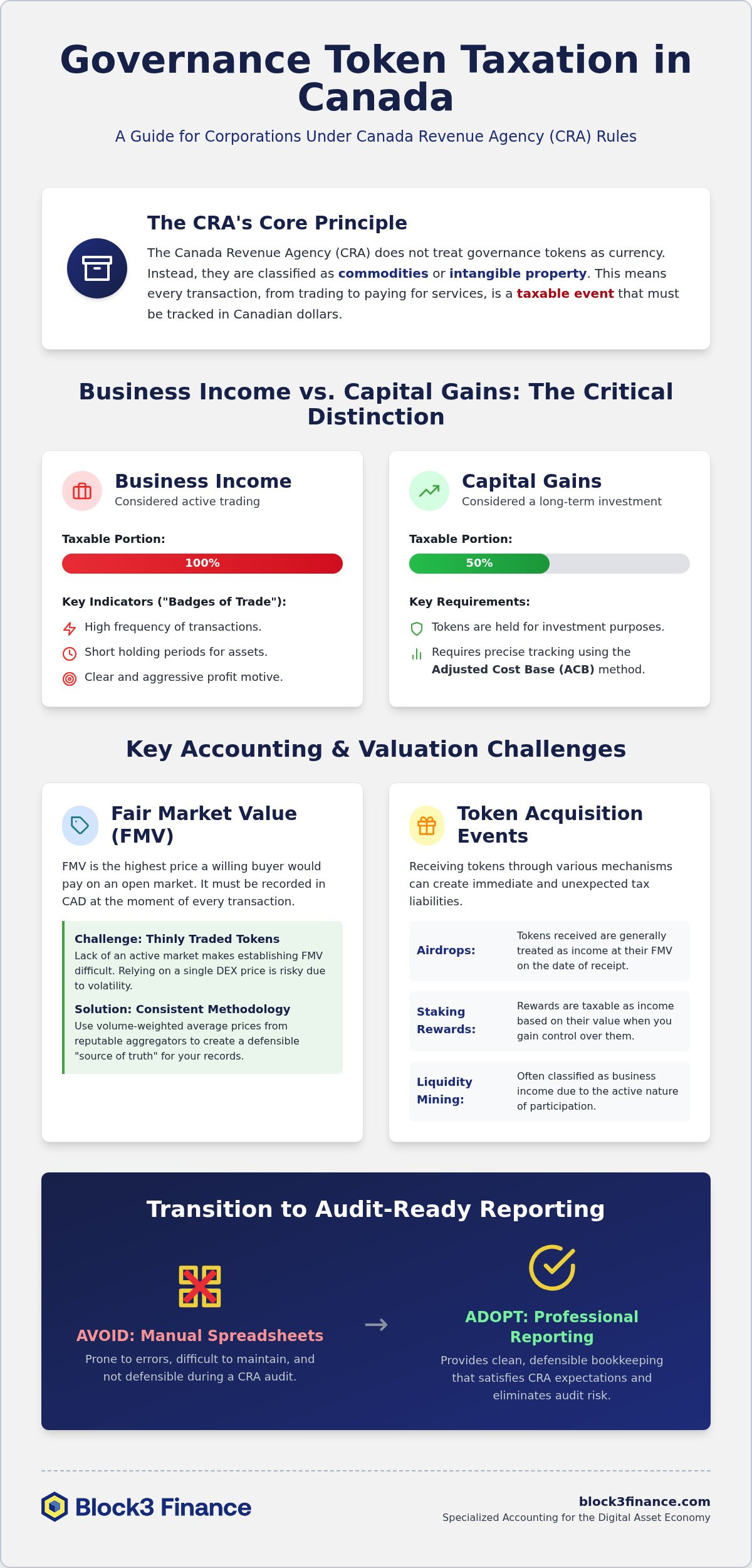
The tax treatment of your tokens depends on whether the CRA classifies your activity as business income or a capital gain. A capital gain occurs when you sell an asset for more than its original cost; in Canada, only 50% of this gain is taxable. If the CRA determines you're running a business through your token activity, 100% of the income becomes taxable. Your intent at the time of purchase is the deciding factor.
To make this distinction, the CRA looks at "badges of trade." These include the frequency of your transactions, the length of your holding period, and your overall profit motive. If your firm engages in high-frequency trading or aggressive liquidity mining, you're likely generating business income. This classification requires a more complex reporting structure to satisfy federal auditors.
For assets held as capital property, you must use the Adjusted Cost Base (ACB) method. This is a weighted average of the cost of all identical tokens in your portfolio. Using professional tax filing and reporting services helps you track these averages across multiple wallets and exchanges. This level of precision is the only way to maintain a defensible position during a CRA audit.
Measurement and Fair Value Challenges for Digital Assets
Establishing Fair Market Value (FMV) is mandatory under Canadian tax law. The CRA's Guide for Cryptocurrency Users defines FMV as the highest price a willing buyer would pay in an open market. For accounting for governance tokens, you must record this value in Canadian dollars at the exact moment of receipt.
Reputable aggregators provide a volume-weighted average that smooths out price anomalies across various platforms. Relying solely on a single decentralized exchange (DEX) spot price can be dangerous due to "thinly traded" markets where one large trade swings the price. This volatility requires you to establish a "source of truth" for your records that remains consistent across all reporting periods.
Thinly traded tokens present a unique bookkeeping hurdle for many firms. If an asset has no active market or visible price discovery, you might need to use the value of the goods or services exchanged to determine its worth. Maintaining a consistent valuation methodology is the only way to remain audit-ready and defensible against future CRA inquiries.
Valuing Restricted or Vested Tokens
Many Canadian startups issue tokens subject to a vesting schedule or a lock-up period. You can't simply use the current market price for an asset you aren't legally allowed to sell. In these cases, firms often apply a Discount for Lack of Marketability (DLOM) to reflect the restricted nature of the asset.
Documentation is your best defense against CRA scrutiny regarding these discounts. You must record the date, time, and specific source of your valuation for every vested tranche as it becomes available. If you're unsure how to apply these specific discounts to your protocol, consulting with a specialist can help clarify your reporting obligations.
IFRS and ASPE Considerations for Canadian Firms
Your accounting framework depends on your corporate structure and reporting requirements. Publicly accountable enterprises in Canada must follow International Financial Reporting Standards (IFRS), which provides a global benchmark for transparency. Under IFRS, governance tokens are often categorized as intangible assets, requiring you to choose between the cost model or the revaluation model for measurement.
Private Canadian companies typically use Accounting Standards for Private Enterprises (ASPE) to simplify their reporting. ASPE 3064 for intangible assets or ASPE 3031 for inventory are the common touchpoints for digital assets. Determining whether your crypto startup qualifies as a private enterprise allows you to streamline your compliance efforts while maintaining total command over your financial data.
Tax Treatment of Governance Token Acquisitions
Acquiring digital assets is the first step in building a protocol's influence. Whether you receive tokens through airdrops, earn them via staking, or purchase them on an exchange, the CRA requires precise record-keeping. The method of acquisition dictates how you handle the accounting for governance tokens on your year-end filings.
Purchasing tokens through an exchange or an Over-the-Counter (OTC) desk, which is a private trading platform for large-scale transactions, is straightforward. You record the purchase price plus any transaction fees in Canadian dollars. This total becomes the starting point for your cost tracking.
Airdrops and Staking Rewards
Airdrops are unsolicited distributions of tokens sent directly to your wallet. While some users view these as free money, the CRA typically treats them as taxable income if they're received in the course of business. You must determine the fair market value (FMV) of the tokens at the exact time of receipt and report this amount as income.
Staking rewards and liquidity mining, which involves earning tokens by providing capital to a protocol, follow similar rules. These rewards are considered income, not capital gains. To understand the broader framework, you can review our guide on Crypto Tax in Canada. Consistently recording the FMV of every reward ensures your income reporting is accurate and defensible.
Adjusted Cost Base (ACB) Calculations
The Adjusted Cost Base (ACB) is the average cost of all identical tokens you hold in your portfolio. For example, if you buy one token at $10 and another at $20, your ACB is $15 per token. This metric is vital because it determines your capital gain or loss when you eventually sell or trade the asset.
Canada uses the "identical properties rule" for digital assets. This means you can't pick and choose which specific token you sold to minimize taxes. You must pool all identical tokens together and calculate a weighted average cost. This rule prevents firms from using methods like First-In, First-Out (FIFO) which are common in other jurisdictions but disallowed by the CRA.
Tracking every purchase, airdrop, and reward is the only way to maintain an accurate ACB. If your records are incomplete, you risk overpaying on capital gains or triggering a red flag during an audit. Specialized tax filing and reporting helps maintain these complex ledgers automatically, keeping your firm's financial health in clear view.
Treasury Management and DAO Bookkeeping Standards
Treasury management for a Decentralized Autonomous Organization (DAO) introduces hurdles that traditional corporate finance rarely encounters. The most significant issue is how a treasury accounts for its own native governance tokens. While these tokens represent potential protocol influence, they aren't considered assets until they're "issued" into circulation.
Unissued tokens held in a treasury's smart contract generally have a zero-cost basis and shouldn't appear as assets on your financial statements. Once these tokens are distributed to investors or contributors, they enter the circulating supply and must be tracked as property. Accurate accounting for governance tokens requires a clear distinction between these two states to avoid inflating your balance sheet.
Revenue recognition adds another layer of complexity for Canadian-managed protocols. A DAO "earns" income when protocol fees are collected or when services are performed, not necessarily when tokens are minted. You must reconcile these on-chain events with off-chain financial records to ensure your Canadian tax filings reflect your true economic position.
DAO Treasury Transparency and Reporting
Community stakeholders and the CRA increasingly demand real-time visibility into DAO finances. Implementing a "Proof of Reserve" or a public accounting dashboard provides the transparency needed to build trust and satisfy regulatory inquiries. This level of openness helps prove that the treasury actually holds the assets it claims to control.
Cross-border operations often create additional friction for Canadian firms. If your organization has significant ties to the United States, you should review our guide on DAO Accounting for US-Based Organizations to navigate these jurisdictional overlaps. Managing these dual requirements is essential for global protocol growth.
Paying Contributors in Governance Tokens
When a DAO pays a contractor in native tokens, the CRA views this as a barter transaction. This means the DAO is effectively selling property to pay for a service. You must record the fair market value of the tokens at the time of the swap and recognize any resulting capital gain or loss.
Canadian-based contributors have their own reporting requirements. They must report the value of the tokens received as income in Canadian dollars. Failure to document these service-for-token swaps can lead to significant penalties for both the organization and the individual.
If your DAO needs to formalize its contributor payment systems and ensure audit-readiness, reach out to our team to implement a compliant treasury workflow.
Strategic Financial Oversight with Block3 Finance
Relying on manual spreadsheets is the most common reason Canadian firms fail a regulatory review. These static documents aren't designed to handle the velocity of decentralized finance or the complexity of sub-ledger reconciliation. Block3 Finance replaces these fragmented systems with a disciplined, proactive approach to accounting for governance tokens. We transform your financial data from a liability into a strategic asset.
Our firm acts as a visionary navigator for the Canadian Web3 ecosystem. We don't just record history; we help you shape it by providing the technical rigor of a traditional auditor paired with the mindset of a blockchain innovator. With experience serving over 980 global clients, including sophisticated DAOs, we understand how to translate on-chain reality into a language that Canadian tax authorities respect.
Audit-Ready Books for Canadian Web3 Firms
Securing your position against a CRA Crypto Audit is about more than just matching numbers. It requires a comprehensive methodology that accounts for every gas fee, airdrop, and governance vote. We build defensible audit trails that stand up to scrutiny by providing clear evidence of your asset's fair market value and your firm's intent.
Professional reconciliation is the only way to prevent the compounding errors that lead to massive tax penalties. Our 13+ years of blockchain financial expertise allows us to identify friction points before they become systemic failures. We ensure that your monthly bookkeeping is not just a compliance task but a foundation for long-term corporate growth.
Customized CFO and Tax Solutions
Scaling a digital asset portfolio requires a level of oversight that goes beyond basic accounting. Our Block3 Finance CFO Services provide high-level strategic planning for firms navigating high-stakes environments. We help you tailor corporate structures that protect your treasury while optimizing for the unique tax landscape in Canada.
This proactive stance moves your organization from a defensive posture to one of total mastery. We provide a roadmap for thriving in a complex world where the rules of finance are being rewritten in real time. If you want to achieve total command over your digital asset portfolio, contact our Canadian team in Ontario to begin your transition to professional financial oversight.
Master Your On-Chain Future
Establishing a resilient framework for accounting for governance tokens is no longer optional for Canadian firms aiming for sustainable protocol growth. You've learned that the CRA classifies these assets as commodities, which necessitates rigorous tracking of fair market values and precise cost base calculations to prevent systemic reporting failures. Maintaining these records ensures your treasury remains transparent and defensible during any future regulatory inquiry.
Transitioning from fragmented spreadsheets to audit-ready financial records allows your organization to shift from a defensive regulatory posture to one of total strategic command. Block3 Finance, ranked as a top provider by Bitcoin.com, provides the specialized CRA compliance expertise required to navigate high-stakes DAO environments with confidence. Our team bridges the gap between legacy corporate finance and the evolving digital asset landscape.
We've successfully served over 980 global clients by distilling complex blockchain activity into clean, actionable records. It's time to trade administrative friction for the stability of elite financial oversight and intellectual leadership.
Secure your digital assets with professional Canadian crypto accounting and lead your organization toward a compliant, prosperous future.
Frequently Asked Questions
Are governance tokens taxed as income or capital gains in Canada?
Governance tokens are taxed as either business income or capital gains depending on the holder's intent and activity frequency. If you're an active trader or received tokens as payment, the CRA treats 100% of the value as business income. Tokens held as long-term investments generally qualify for capital gains treatment, where only 50% of the gain is taxable. We help you evaluate the "badges of trade" to ensure your classification is defensible.
How do I value a governance token that isn't listed on major exchanges?
Valuing illiquid tokens requires establishing a Fair Market Value (FMV) using the best available evidence at the time of receipt. You can often use decentralized exchange (DEX) spot prices or volume-weighted averages from reputable on-chain aggregators. If no active market exists, you must value the token based on the fair value of the services or assets exchanged for it. Documenting this specific methodology is vital for maintaining audit-ready financial records.
Does the CRA consider a token airdrop to be a taxable event?
Yes, the CRA typically views airdrops as taxable income when they're received by a business or as a reward for previous activity. You must calculate the fair market value of the tokens in Canadian dollars at the exact moment they're credited to your wallet. This initial value becomes your income for the year and establishes the starting cost basis for any future capital gains calculations. Proactive reporting prevents unexpected liabilities during tax season.
What is the 'Adjusted Cost Base' and why does it matter for governance tokens?
The Adjusted Cost Base (ACB) is a weighted average of the cost of all identical tokens held in your corporate portfolio. It is a fundamental component of accounting for governance tokens because it dictates the profit or loss you report when selling or trading assets. The CRA mandates the identical properties rule. You can't use specific identification to pick which tokens you sold to minimize your tax burden.
Can I deduct the loss if my governance token's value drops to zero?
You can generally claim a loss if a governance token's value drops to zero, provided you can prove a disposition has occurred. If the asset was held as capital property, this results in a capital loss that can offset other capital gains. If it was business inventory, you might be able to claim a full business loss. You must maintain clear records showing the asset is truly worthless and no longer has an active market.
Do I need a specialized accountant for my DAO's treasury management?
Specialized accounting for governance tokens is critical for DAOs because standard bookkeeping often misses the nuances of smart contract distributions. A specialized accountant understands how to reconcile on-chain data with traditional financial statements while navigating CRA complexities. This oversight ensures your treasury management remains transparent and compliant. It moves your organization from a defensive posture to one of total financial command and strategic growth.
How does the CRA track governance token transactions on-chain?
The CRA employs advanced blockchain forensic tools to monitor public ledgers and identify transactions associated with Canadian entities. They also share information with international tax authorities and receive data from centralized exchanges operating in Canada. With the implementation of global reporting frameworks like CARF, the CRA's ability to cross-reference your filings with on-chain reality is stronger than ever. Clean, professional records are your only defense against automated flags and manual audits.
What forms do Canadian corporations use to report digital asset holdings?
Canadian corporations report their digital asset activity on the T2 Corporation Income Tax Return, specifically through Schedule 6 for capital gains or as business income. Additionally, if your corporation holds specified foreign property, including crypto on foreign exchanges, with a total cost over $100,000 CAD, you must file Form T1135. Missing these specific filing requirements can lead to significant penalties. We ensure your corporate reporting aligns with every CRA mandate.

Article by
Mahad Mohamed
Mahad Mohamed is an accountant and the CEO of Block3 Finance, with over 26+ years of Canadian and international tax and accounting experience. A crypto accounting specialist since the early days of Bitcoin, he has consulted for over 38 crypto companies and collaborated with legal professionals on regulatory matters. His expertise spans corporate reorganization, cross-border tax structuring (Canada & US), tax disputes, and CRA audits.
Previously, Mahad worked for the Canada Revenue Agency (CRA), Big4 accounting firms, and served as a Rulings Officer for the Federal Tax Authority of the UAE before acquiring Tax Partners in 2014.
Block3 Finance and Tax Partners has 44 full-time accountants and over 9,800+ clients.
Disclaimer
This article provides general information only and is current as of its publication date. It has not been updated and may be out of date. It does not constitute legal advice and should not be relied upon as such. Every tax situation is unique and may differ from the examples discussed in this article. If you have specific questions, you should seek the advice of our accountants for your unique circumstances.
Frequently Asked Questions
Are governance tokens taxed as income or capital gains in Canada?
Governance tokens are taxed as either business income or capital gains depending on the holder's intent and activity frequency. If you're an active trader or received tokens as payment, the CRA treats 100% of the value as business income. Tokens held as long-term investments generally qualify for capital gains treatment, where only 50% of the gain is taxable. We help you evaluate the "badges of trade" to ensure your classification is defensible.
How do I value a governance token that isn't listed on major exchanges?
Valuing illiquid tokens requires establishing a Fair Market Value (FMV) using the best available evidence at the time of receipt. You can often use decentralized exchange (DEX) spot prices or volume-weighted averages from reputable on-chain aggregators. If no active market exists, you must value the token based on the fair value of the services or assets exchanged for it. Documenting this specific methodology is vital for maintaining audit-ready financial records.
Does the CRA consider a token airdrop to be a taxable event?
Yes, the CRA typically views airdrops as taxable income when they're received by a business or as a reward for previous activity. You must calculate the fair market value of the tokens in Canadian dollars at the exact moment they're credited to your wallet. This initial value becomes your income for the year and establishes the starting cost basis for any future capital gains calculations. Proactive reporting prevents unexpected liabilities during tax season.
What is the 'Adjusted Cost Base' and why does it matter for governance tokens?
The Adjusted Cost Base (ACB) is a weighted average of the cost of all identical tokens held in your corporate portfolio. It is a fundamental component of accounting for governance tokens because it dictates the profit or loss you report when selling or trading assets. The CRA mandates the identical properties rule. You can't use specific identification to pick which tokens you sold to minimize your tax burden.
Can I deduct the loss if my governance token's value drops to zero?
You can generally claim a loss if a governance token's value drops to zero, provided you can prove a disposition has occurred. If the asset was held as capital property, this results in a capital loss that can offset other capital gains. If it was business inventory, you might be able to claim a full business loss. You must maintain clear records showing the asset is truly worthless and no longer has an active market.
Do I need a specialized accountant for my DAO's treasury management?
Specialized accounting for governance tokens is critical for DAOs because standard bookkeeping often misses the nuances of smart contract distributions. A specialized accountant understands how to reconcile on-chain data with traditional financial statements while navigating CRA complexities. This oversight ensures your treasury management remains transparent and compliant. It moves your organization from a defensive posture to one of total financial command and strategic growth.
How does the CRA track governance token transactions on-chain?
The CRA employs advanced blockchain forensic tools to monitor public ledgers and identify transactions associated with Canadian entities. They also share information with international tax authorities and receive data from centralized exchanges operating in Canada. With the implementation of global reporting frameworks like CARF, the CRA's ability to cross-reference your filings with on-chain reality is stronger than ever. Clean, professional records are your only defense against automated flags and manual audits.
What forms do Canadian corporations use to report digital asset holdings?
Canadian corporations report their digital asset activity on the T2 Corporation Income Tax Return, specifically through Schedule 6 for capital gains or as business income. Additionally, if your corporation holds specified foreign property, including crypto on foreign exchanges, with a total cost over $100,000 CAD, you must file Form T1135. Missing these specific filing requirements can lead to significant penalties. We ensure your corporate reporting aligns with every CRA mandate.