
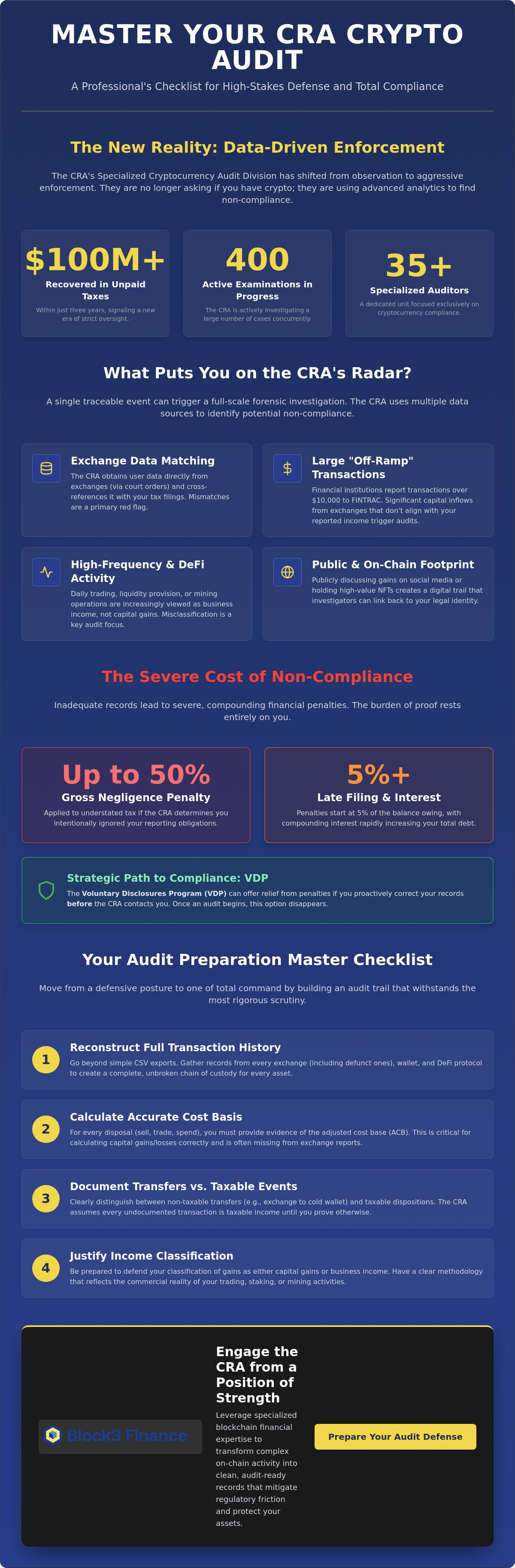
The CRA's specialized Cryptocurrency Audit Division has recovered over $100 million in unpaid taxes within just three years, signaling a definitive end to the era of regulatory ambiguity. With 400 active examinations currently in progress, the agency is leveraging advanced data analytics to cross-reference exchange records and identify non-compliance with surgical precision. You likely recognize the friction of this new reality; perhaps you're struggling to reconstruct transaction histories from defunct platforms or reconcile the intricate cost basis of your DeFi staking protocols. It's a volatile landscape where the fear of an inquiry often stems from the absence of a cohesive narrative.
This article provides the roadmap you need to master a CRA crypto audit through a professional preparation checklist built for high-stakes defense. We'll show you how to move from a defensive posture to one of total command by validating your existing records and building an audit trail that withstands the most rigorous scrutiny. By the end, you'll have a clear strategy to resolve record-keeping gaps and the confidence to engage with the CRA from a position of intellectual authority and strength.
Key Takeaways
- Identify the specific "off-ramp" triggers and data-sharing protocols that the CRA utilizes to initiate specialized cryptocurrency examinations.
- Discover why standard CSV exports from tax software are often insufficient for a CRA crypto audit and learn to reconstruct the critical documentation gaps between exchanges and cold storage.
- Implement a professional-grade preparation checklist to inventory your digital assets and preserve the forensic evidence required for a defensible financial narrative.
- Leverage specialized blockchain financial expertise to transform complex on-chain activity into clean, audit-ready records that mitigate regulatory friction.
The CRA’s 2026 Stance on Digital Assets: Why Preparation is Mandatory
The Canada Revenue Agency (CRA) has transitioned from a period of observation to one of aggressive, data-driven enforcement. By June 2026, the Cryptocurrency Specialized Audit Unit has matured into a formidable force of 35 specialized auditors who have already recovered over $100 million in unpaid taxes. This isn't a temporary initiative; it's a structural shift in the nation's fiscal oversight. The agency has moved away from the inefficiency of random checks in favor of surgical, targeted data-matching. They're no longer asking if you have crypto; they're cross-referencing exactly how much you've moved.
This evolution relies heavily on third-party data harvested from major exchanges like Coinsquare and Kraken. When these platforms comply with federal information requirements, the CRA gains a direct window into your transaction volume and off-ramp history. If your reported income fails to align with these external data points, you'll likely face a CRA crypto audit. In this environment, the burden of proof rests entirely on the taxpayer. The agency assumes every undocumented transaction is taxable income until you provide the forensic evidence to prove otherwise. Building defensible records isn't just a best practice; it's your primary line of defense against an agency that now possesses the technological tools to track your every move on-chain.
Understanding the CRA's Modern Audit Methodology
The "Unnamed Persons Requirement" remains the CRA's most potent weapon for mass data collection. By compelling exchanges to surrender user data through court orders, the agency identifies high-frequency traders who may be misclassifying business income as capital gains. If you're executing daily trades, providing liquidity to DeFi protocols, or running a mining operation, the CRA increasingly views your activity as a commercial enterprise. Passive capital gains treatment is no longer the default for active participants in the digital asset space. You must be prepared to justify your classification with a granular methodology that reflects the commercial reality of your holdings.
The High Cost of Non-Compliance
The financial consequences of inadequate record-keeping are severe and compounding. For the 2025 tax year, late filing penalties start at 5% of the balance owing, but the real threat is the gross negligence penalty. This can reach 50% of the understated tax if the CRA determines you've intentionally or recklessly ignored your reporting obligations. With interest rates on back-taxes remaining a significant compounding risk, a single year of unfiled crypto activity can quickly balloon into a debt that threatens your entire portfolio. If your books are currently in disarray, the Voluntary Disclosures Program (VDP) offers a strategic path to compliance before an audit begins. Once the CRA initiates contact, your ability to mitigate these penalties vanishes, leaving you to face the full weight of their specialized audit unit.
Identifying CRA Crypto Audit Triggers: What Put You on the Radar?
The transition from digital anonymity to fiscal transparency is often triggered by a single, traceable event. The agency's ability to cross-reference lifestyle expenditures with reported earnings has become remarkably sophisticated. If your bank deposits reflect significant capital inflows from exchanges while your tax returns show minimal activity, you've essentially invited a CRA crypto audit. Financial institutions and money services businesses now report transactions exceeding $10,000 directly to FINTRAC, providing the agency with a steady stream of data to flag potential non-compliance with surgical precision.
Beyond traditional banking, your on-chain footprint and social media presence provide secondary layers of visibility. Publicly discussing significant gains or maintaining a high-value NFT portfolio creates a digital trail that the agency's specialized units can link to your legal identity. Investors have long been targeted by the Canada Revenue Agency (CRA) with audits following court-ordered data releases from major exchanges. Establishing a proactive tax filing and reporting framework is the only way to ensure these digital breadcrumbs don't lead to a forensic investigation of your entire financial history.
DeFi and NFT-Specific Audit Triggers
Participation in decentralized finance (DeFi) introduces layers of complexity that the agency views with heightened scrutiny. High-frequency trading and liquidity pool participation often signal a commercial intent, potentially reclassifying your capital gains as fully taxable business income. Similarly, entering NFT acquisitions as 'zero-value' assets due to missing cost basis data is a significant error. The agency interprets these gaps as intentional omissions. Staking rewards and airdrops must be reported as income at the time of receipt; failing to do so breaks the continuity of your financial narrative and invites a deeper look into your wallet history.
The 'Red Flag' Checklist for 2026
A 'Red Flag' is any transaction that breaks the continuity of the audit trail. Unexplained wallet-to-wallet transfers are a primary target for investigation. The CRA assumes these are taxable dispositions unless you can prove they are internal movements between your own accounts. Additionally, the failure to file Form T1135 for foreign-held digital assets exceeding a $100,000 cost basis remains a critical oversight. In 2026, the agency is leveraging international data-sharing frameworks to identify these unreported offshore holdings. Total transparency is the only viable path for the modern digital asset holder who wishes to maintain command over their portfolio.
Reconciling Complex On-Chain Data for Audit Defense
Raw data is not a defense. Many taxpayers mistakenly assume that a collection of CSV exports from various exchanges constitutes a complete and compliant record. It doesn't. A CRA crypto audit requires far more than a disjointed list of trades; it demands a reconciled general ledger that accounts for every movement of value across the blockchain. The "Missing Link" problem frequently arises when assets migrate from a centralized exchange to cold storage or a complex DeFi protocol. Without meticulous manual intervention, these transfers often appear as taxable dispositions rather than internal movements, leading to inflated tax liabilities and unnecessary regulatory friction.
Standardizing this data involves converting thousands of disparate transactions into a unified, defensible format. You must apply consistent "Fair Value" measurements based on the CAD value at the exact moment of each trade, a requirement emphasized in the CRA's official crypto tax guide. This process transforms chaotic on-chain activity into a sophisticated financial narrative that demonstrates total command over your portfolio. By bridging the gaps between fragmented data points, you move from a position of vulnerability to one of professional-grade readiness.
The Limitation of Automated Tax Software
Automated tools are helpful for high-level tracking, but they frequently stumble when encountering complex smart contracts or liquidity provisions. Common errors include "ghost transactions" where one side of a trade is missing, or misclassified transfers that treat a simple wallet move as a sale. Relying solely on software-generated reports is a high-risk strategy during a CRA crypto audit. A professional accountant must validate these reports, ensuring that gas fees, airdrops, and staking rewards are categorized with precision. This manual reconciliation is the only way to resolve the technical discrepancies that automated algorithms often ignore.
Establishing an Immutable Audit Trail
Building a robust defense means documenting the "why" behind every significant trade. Contemporaneous notes provide the essential context an auditor needs to understand your strategic intent. You should preserve read-only API keys and public wallet addresses to allow for real-time verification of your holdings without compromising security. Maintaining this level of detail across multiple tax years is vital. It prevents "look-back" audits, where a single discrepancy in one year triggers a forensic review of your entire financial history. Consistency is your most powerful ally in maintaining long-term stability and intellectual authority over your digital assets.
The Master Crypto Audit Preparation Checklist
Transitioning from a fragmented data set to a defensible financial position requires a methodical, step-by-step approach. A CRA crypto audit is won or lost in the preparation phase, long before the first meeting with an examiner. You must move beyond the passive hope that your records are sufficient and instead adopt a proactive strategy of forensic verification. This checklist serves as your roadmap to total command over your digital asset narrative.
- Step 1: Inventory of All Platforms: Map every exchange, hardware wallet, and DeFi protocol you've interacted with since your first acquisition. Do not omit defunct platforms; the agency's data-matching tools often capture these historical footprints.
- Step 2: Data Extraction & Preservation: Secure read-only API keys, download all available CSV files, and take screenshots of account dashboards. Data on exchanges is often purged after several years, making immediate preservation critical.
- Step 3: Transaction Classification: Categorize every movement as income, capital gains, internal transfers, or deductible fees. In 2026, the distinction between business income and capital gains is a primary focus for the agency's specialized unit.
- Step 4: Cost Basis Validation: Calculate your Adjusted Cost Base (ACB) using the weighted average method required by Canadian tax law. Ensure every "buy" has a corresponding "fair market value" in CAD at the time of the trade.
- Step 5: Professional Review: Engage an expert to stress-test your ledger. Identifying a discrepancy yourself allows for a voluntary correction; having the CRA find it leads to penalties.
Documentary Evidence You Must Have Ready
The agency requires more than just a final number; they demand the trail that leads to it. You must maintain detailed transaction logs that include precise timestamps, asset types, and the CAD value of the trade. Additionally, keep bank statements that clearly highlight every fiat on-ramp and off-ramp movement to Canadian financial institutions. If you've lost tokens to hacks, lost keys, or exchange collapses, you must preserve proof of loss, such as police reports or on-chain evidence of the wallet's inaccessibility, to justify those deductions during a CRA crypto audit.
The 'Pre-Audit' Internal Review
To identify ACB errors before they trigger an inquiry, look for negative token balances in your records, as these almost always indicate a missing purchase history or a misclassified transfer. You must also verify your T1135 compliance if the cost basis of your foreign-held digital assets exceeded $100,000 CAD at any point during the year. In 2026, reconciling your mining rewards and staking income with specific business expense claims is essential. If your lifestyle expenditures don't align with your reported income, the agency will use its data-matching tools to bridge that gap on your behalf.
Finalizing Your Defense Dossier
Organize your documentation into a secure digital vault that is ready to be shared at a moment's notice. This dossier should include a summary of the "Taxpayer Position" for any complex DeFi transactions or NFT swaps that may be subject to interpretation. By presenting a polished, professional-grade record, you signal to the auditor that you possess the intellectual depth and technical rigor to defend your filings. Don't face the CRA alone; ensure your strategy is backed by specialized Audits and Compliance expertise. Download our full audit-ready guide to begin building your defensible record today.
Strategic Compliance: Leveraging Block3 Finance for Audit Defense
Block3 Finance operates at the intersection of legacy fiscal discipline and the decentralized future. We don't just manage records; we cultivate a narrative of total compliance that empowers our clients. Our team leverages over 13 years of blockchain financial expertise to distill thousands of chaotic on-chain events into clean, defensible books. This transformation is essential for navigating a CRA crypto audit with confidence. Whether you are a high-volume trader or a Web3 enterprise, our process ensures that your financial records reflect professional-grade rigor rather than automated guesswork.
We provide more than basic bookkeeping. Our CFO Services offer high-growth Web3 firms and DAOs the strategic oversight required to scale in a volatile regulatory environment. We move beyond reactive data extraction to build a proactive financial infrastructure. This includes reconciling complex liquidity pool participations, cross-chain swaps, and bridge transactions that typically baffle traditional accounting firms. By turning messy data into audit-ready financial statements, we resolve the friction between innovation and regulation.
Why Specialized Crypto Accountants Outperform Traditional Firms
Traditional accounting often fails to grasp the technical nuances of the blockchain ecosystem. A standard firm might misinterpret a bridge transaction as a taxable sale; we recognize it as a movement of capital. Our Crypto Tax Accountant specialists understand the underlying mechanics of DeFi protocols and smart contracts. This technical depth allows us to manage direct communication with CRA auditors from a position of intellectual authority. We don't just present data. We explain the methodology. This reduces the friction of the audit process while we implement strategic corporate structuring to minimize your future risk profile.
Securing Your Financial Future in the Web3 Era
Clean financial reporting is the foundation of long-term growth. By establishing an immutable audit trail today, you position your business to attract institutional interest and navigate future regulatory shifts without fear. The peace of mind that comes from professional, white-glove tax compliance is invaluable in an industry characterized by uncertainty. You deserve a partner who acts as a calm force during a CRA crypto audit, ensuring your legacy remains protected. Secure your command over the digital landscape. Book a consultation with Block3 Finance today and transition from regulatory vulnerability to strategic mastery.
Command Your Regulatory Narrative
The transition toward absolute transparency in the digital asset space is no longer a future projection; it's a present reality. By implementing a forensic preparation checklist and reconciling fragmented on-chain data into a unified general ledger, you move from a position of vulnerability to one of total command. Success in a CRA crypto audit depends on your ability to present a cohesive and defensible financial narrative that bridges the gap between exchange data and cold storage movements. It's about shifting from a defensive posture to an offensive strategy of mastery and growth.
You don't have to navigate these high-stakes complexities alone. Block3 Finance brings 13+ years of blockchain financial experience and the expertise gained from serving 980+ global clients to your defense strategy. As the firm ranked #1 Crypto Accountant by Bitcoin.com, we provide the elite, white-glove oversight necessary to protect your portfolio and secure your growth in the Web3 era. It's time to transform your compliance burden into a strategic advantage and reclaim agency over your financial future.
Get Audit-Ready with Block3 Finance's Specialized Crypto Accounting
Frequently Asked Questions
How long does a CRA crypto audit typically take in 2026?
A typical audit can span several months to over a year, depending on the volume of transactions and the complexity of your DeFi activity. The agency's specialized unit conducts a forensic review of every on-chain event to ensure total compliance. Providing structured, audit-ready books from the outset can significantly accelerate this timeline. Delays usually occur when taxpayers provide fragmented data that requires extensive clarification or manual reconstruction.
What are the most common triggers for a crypto tax audit in Canada?
The most frequent triggers include discrepancies between your bank deposits and reported income, as well as large "off-ramp" transactions over $10,000 reported to FINTRAC. The agency also uses data obtained through court orders from exchanges like Coinsquare to flag non-compliant users. If your lifestyle expenditures appear to exceed your declared earnings, the agency's AI tools will likely prioritize your file for a CRA crypto audit.
Can the CRA track my decentralized wallet if I don't provide the address?
Yes, the agency uses advanced blockchain analytics and AI to link anonymous wallet addresses to legal identities. Even if you don't provide a specific address, cluster analysis can associate your known exchange activity with your private decentralized wallets. With the implementation of the Crypto-Asset Reporting Framework (CARF) in 2026, international data sharing makes it nearly impossible to maintain an invisible on-chain footprint.
What penalties can the CRA impose for unreported crypto gains?
Penalties are severe and scale with the level of non-compliance. Late filing incurs a 5% fee on the balance owing plus 1% for each month it remains outstanding. If the agency determines gross negligence, you'll face a penalty of 50% of the understated tax. In cases of intentional tax evasion, penalties can reach 200% of the taxes owed; this is often accompanied by the compounding risk of criminal prosecution.
Do I need to report crypto-to-crypto trades even if I didn't cash out to CAD?
Yes, every crypto-to-crypto trade is a taxable event in Canada because the agency treats digital assets as commodities rather than currency. You must calculate the fair market value in CAD at the time of the trade to determine your capital gain or loss. Failing to report these swaps is a common error that breaks the continuity of your audit trail and invites immediate regulatory scrutiny.
How many years back can the CRA look into my cryptocurrency history?
The agency typically reviews records from the past three to four years, but this window is not absolute. If an auditor suspects fraud or a significant misrepresentation of income, they have the authority to look back indefinitely. Maintaining a clean, immutable record of your entire transaction history is the only way to ensure long-term protection against historical inquiries that could threaten your current portfolio.
What should I do if I receive an 'educational' letter from the CRA about crypto?
An educational letter is a formal signal that your digital asset activity has been flagged for review. You should treat this as a critical window to reconcile your records and ensure your past filings are accurate. Responding with professional-grade documentation often prevents the situation from escalating into a full CRA crypto audit. It's an opportunity to correct discrepancies before heavy penalties are assessed.
Is crypto tax software enough to win a CRA audit?
Standard tax software is rarely sufficient for a complex audit defense because it often misclassifies transfers or fails to bridge data gaps between platforms. Automated tools lack the intellectual depth to interpret intricate DeFi protocols or smart contract interactions correctly. A successful defense requires a reconciled general ledger and a clear taxpayer position that software alone cannot generate. Professional oversight is essential to validate software-generated reports.

Article by
Mahad Mohamed
Mahad Mohamed is an accountant and the CEO of Block3 Finance, with over 26+ years of Canadian and international tax and accounting experience. A crypto accounting specialist since the early days of Bitcoin, he has consulted for over 38 crypto companies and collaborated with legal professionals on regulatory matters. His expertise spans corporate reorganization, cross-border tax structuring (Canada & US), tax disputes, and CRA audits.
Previously, Mahad worked for the Canada Revenue Agency (CRA), Big4 accounting firms, and served as a Rulings Officer for the Federal Tax Authority of the UAE before acquiring Tax Partners in 2014.
Block3 Finance and Tax Partners has 44 full-time accountants and over 9,800+ clients.
Disclaimer
This article provides general information only and is current as of its publication date. It has not been updated and may be out of date. It does not constitute legal advice and should not be relied upon as such. Every tax situation is unique and may differ from the examples discussed in this article. If you have specific questions, you should seek the advice of our accountants for your unique circumstances.
Frequently Asked Questions
Understanding the CRA's Modern Audit Methodology
The "Unnamed Persons Requirement" remains the CRA's most potent weapon for mass data collection. By compelling exchanges to surrender user data through court orders, the agency identifies high-frequency traders who may be misclassifying business income as capital gains. If you're executing daily trades, providing liquidity to DeFi protocols, or running a mining operation, the CRA increasingly views your activity as a commercial enterprise. Passive capital gains treatment is no longer the default for active participants in the digital asset space. You must be prepared to justify your classification with a granular methodology that reflects the commercial reality of your holdings.
The High Cost of Non-Compliance
The financial consequences of inadequate record-keeping are severe and compounding. For the 2025 tax year, late filing penalties start at 5% of the balance owing, but the real threat is the gross negligence penalty. This can reach 50% of the understated tax if the CRA determines you've intentionally or recklessly ignored your reporting obligations. With interest rates on back-taxes remaining a significant compounding risk, a single year of unfiled crypto activity can quickly balloon into a debt that threatens your entire portfolio. If your books are currently in disarray, the Voluntary Disclosures Program (VDP) offers a strategic path to compliance before an audit begins. Once the CRA initiates contact, your ability to mitigate these penalties vanishes, leaving you to face the full weight of their specialized audit unit. The transition from digital anonymity to fiscal transparency is often triggered by a single, traceable event. The agency's ability to cross-reference lifestyle expenditures with reported earnings has become remarkably sophisticated. If your bank deposits reflect significant capital inflows from exchanges while your tax returns show minimal activity, you've essentially invited a CRA crypto audit. Financial institutions and money services businesses now report transactions exceeding $10,000 directly to FINTRAC, providing the agency with a steady stream of data to flag potential non-compliance with surgical precision. Beyond traditional banking, your on-chain footprint and social media presence provide secondary layers of visibility. Publicly discussing significant gains or maintaining a high-value NFT portfolio creates a digital trail that the agency's specialized units can link to your legal identity. Investors have long been targeted by the Canada Revenue Agency (CRA) with audits following court-ordered data releases from major exchanges. Establishing a proactive tax filing and reporting framework is the only way to ensure these digital breadcrumbs don't lead to a forensic investigation of your entire financial history.
DeFi and NFT-Specific Audit Triggers
Participation in decentralized finance (DeFi) introduces layers of complexity that the agency views with heightened scrutiny. High-frequency trading and liquidity pool participation often signal a commercial intent, potentially reclassifying your capital gains as fully taxable business income. Similarly, entering NFT acquisitions as 'zero-value' assets due to missing cost basis data is a significant error. The agency interprets these gaps as intentional omissions. Staking rewards and airdrops must be reported as income at the time of receipt; failing to do so breaks the continuity of your financial narrative and invites a deeper look into your wallet history.
The 'Red Flag' Checklist for 2026
A 'Red Flag' is any transaction that breaks the continuity of the audit trail. Unexplained wallet-to-wallet transfers are a primary target for investigation. The CRA assumes these are taxable dispositions unless you can prove they are internal movements between your own accounts. Additionally, the failure to file Form T1135 for foreign-held digital assets exceeding a $100,000 cost basis remains a critical oversight. In 2026, the agency is leveraging international data-sharing frameworks to identify these unreported offshore holdings. Total transparency is the only viable path for the modern digital asset holder who wishes to maintain command over their portfolio. Raw data is not a defense. Many taxpayers mistakenly assume that a collection of CSV exports from various exchanges constitutes a complete and compliant record. It doesn't. A CRA crypto audit requires far more than a disjointed list of trades; it demands a reconciled general ledger that accounts for every movement of value across the blockchain. The "Missing Link" problem frequently arises when assets migrate from a centralized exchange to cold storage or a complex DeFi protocol. Without meticulous manual intervention, these transfers often appear as taxable dispositions rather than internal movements, leading to inflated tax liabilities and unnecessary regulatory friction. Standardizing this data involves converting thousands of disparate transactions into a unified, defensible format. You must apply consistent "Fair Value" measurements based on the CAD value at the exact moment of each trade, a requirement emphasized in the CRA's official crypto tax guide. This process transforms chaotic on-chain activity into a sophisticated financial narrative that demonstrates total command over your portfolio. By bridging the gaps between fragmented data points, you move from a position of vulnerability to one of professional-grade readiness.
The Limitation of Automated Tax Software
Automated tools are helpful for high-level tracking, but they frequently stumble when encountering complex smart contracts or liquidity provisions. Common errors include "ghost transactions" where one side of a trade is missing, or misclassified transfers that treat a simple wallet move as a sale. Relying solely on software-generated reports is a high-risk strategy during a CRA crypto audit. A professional accountant must validate these reports, ensuring that gas fees, airdrops, and staking rewards are categorized with precision. This manual reconciliation is the only way to resolve the technical discrepancies that automated algorithms often ignore.
Establishing an Immutable Audit Trail
Building a robust defense means documenting the "why" behind every significant trade. Contemporaneous notes provide the essential context an auditor needs to understand your strategic intent. You should preserve read-only API keys and public wallet addresses to allow for real-time verification of your holdings without compromising security. Maintaining this level of detail across multiple tax years is vital. It prevents "look-back" audits, where a single discrepancy in one year triggers a forensic review of your entire financial history. Consistency is your most powerful ally in maintaining long-term stability and intellectual authority over your digital assets. Transitioning from a fragmented data set to a defensible financial position requires a methodical, step-by-step approach. A CRA crypto audit is won or lost in the preparation phase, long before the first meeting with an examiner. You must move beyond the passive hope that your records are sufficient and instead adopt a proactive strategy of forensic verification. This checklist serves as your roadmap to total command over your digital asset narrative.
Documentary Evidence You Must Have Ready
The agency requires more than just a final number; they demand the trail that leads to it. You must maintain detailed transaction logs that include precise timestamps, asset types, and the CAD value of the trade. Additionally, keep bank statements that clearly highlight every fiat on-ramp and off-ramp movement to Canadian financial institutions. If you've lost tokens to hacks, lost keys, or exchange collapses, you must preserve proof of loss, such as police reports or on-chain evidence of the wallet's inaccessibility, to justify those deductions during a CRA crypto audit.
The 'Pre-Audit' Internal Review
To identify ACB errors before they trigger an inquiry, look for negative token balances in your records, as these almost always indicate a missing purchase history or a misclassified transfer. You must also verify your T1135 compliance if the cost basis of your foreign-held digital assets exceeded $100,000 CAD at any point during the year. In 2026, reconciling your mining rewards and staking income with specific business expense claims is essential. If your lifestyle expenditures don't align with your reported income, the agency will use its data-matching tools to bridge that gap on your behalf.
Finalizing Your Defense Dossier
Organize your documentation into a secure digital vault that is ready to be shared at a moment's notice. This dossier should include a summary of the "Taxpayer Position" for any complex DeFi transactions or NFT swaps that may be subject to interpretation. By presenting a polished, professional-grade record, you signal to the auditor that you possess the intellectual depth and technical rigor to defend your filings. Don't face the CRA alone; ensure your strategy is backed by specialized Audits and Compliance expertise. Download our full audit-ready guide to begin building your defensible record today. Block3 Finance operates at the intersection of legacy fiscal discipline and the decentralized future. We don't just manage records; we cultivate a narrative of total compliance that empowers our clients. Our team leverages over 13 years of blockchain financial expertise to distill thousands of chaotic on-chain events into clean, defensible books. This transformation is essential for navigating a CRA crypto audit with confidence. Whether you are a high-volume trader or a Web3 enterprise, our process ensures that your financial records reflect professional-grade rigor rather than automated guesswork. We provide more than basic bookkeeping. Our CFO Services offer high-growth Web3 firms and DAOs the strategic oversight required to scale in a volatile regulatory environment. We move beyond reactive data extraction to build a proactive financial infrastructure. This includes reconciling complex liquidity pool participations, cross-chain swaps, and bridge transactions that typically baffle traditional accounting firms. By turning messy data into audit-ready financial statements, we resolve the friction between innovation and regulation.
Why Specialized Crypto Accountants Outperform Traditional Firms
Traditional accounting often fails to grasp the technical nuances of the blockchain ecosystem. A standard firm might misinterpret a bridge transaction as a taxable sale; we recognize it as a movement of capital. Our Crypto Tax Accountant specialists understand the underlying mechanics of DeFi protocols and smart contracts. This technical depth allows us to manage direct communication with CRA auditors from a position of intellectual authority. We don't just present data. We explain the methodology. This reduces the friction of the audit process while we implement strategic corporate structuring to minimize your future risk profile.
Securing Your Financial Future in the Web3 Era
Clean financial reporting is the foundation of long-term growth. By establishing an immutable audit trail today, you position your business to attract institutional interest and navigate future regulatory shifts without fear. The peace of mind that comes from professional, white-glove tax compliance is invaluable in an industry characterized by uncertainty. You deserve a partner who acts as a calm force during a CRA crypto audit, ensuring your legacy remains protected. Secure your command over the digital landscape. Book a consultation with Block3 Finance today and transition from regulatory vulnerability to strategic mastery. The transition toward absolute transparency in the digital asset space is no longer a future projection; it's a present reality. By implementing a forensic preparation checklist and reconciling fragmented on-chain data into a unified general ledger, you move from a position of vulnerability to one of total command. Success in a CRA crypto audit depends on your ability to present a cohesive and defensible financial narrative that bridges the gap between exchange data and cold storage movements. It's about shifting from a defensive posture to an offensive strategy of mastery and growth. You don't have to navigate these high-stakes complexities alone. Block3 Finance brings 13+ years of blockchain financial experience and the expertise gained from serving 980+ global clients to your defense strategy. As the firm ranked #1 Crypto Accountant by Bitcoin.com, we provide the elite, white-glove oversight necessary to protect your portfolio and secure your growth in the Web3 era. It's time to transform your compliance burden into a strategic advantage and reclaim agency over your financial future. Get Audit-Ready with Block3 Finance's Specialized Crypto Accounting
How long does a CRA crypto audit typically take in 2026?
A typical audit can span several months to over a year, depending on the volume of transactions and the complexity of your DeFi activity. The agency's specialized unit conducts a forensic review of every on-chain event to ensure total compliance. Providing structured, audit-ready books from the outset can significantly accelerate this timeline. Delays usually occur when taxpayers provide fragmented data that requires extensive clarification or manual reconstruction.
What are the most common triggers for a crypto tax audit in Canada?
The most frequent triggers include discrepancies between your bank deposits and reported income, as well as large "off-ramp" transactions over $10,000 reported to FINTRAC. The agency also uses data obtained through court orders from exchanges like Coinsquare to flag non-compliant users. If your lifestyle expenditures appear to exceed your declared earnings, the agency's AI tools will likely prioritize your file for a CRA crypto audit.
Can the CRA track my decentralized wallet if I don't provide the address?
Yes, the agency uses advanced blockchain analytics and AI to link anonymous wallet addresses to legal identities. Even if you don't provide a specific address, cluster analysis can associate your known exchange activity with your private decentralized wallets. With the implementation of the Crypto-Asset Reporting Framework (CARF) in 2026, international data sharing makes it nearly impossible to maintain an invisible on-chain footprint.
What penalties can the CRA impose for unreported crypto gains?
Penalties are severe and scale with the level of non-compliance. Late filing incurs a 5% fee on the balance owing plus 1% for each month it remains outstanding. If the agency determines gross negligence, you'll face a penalty of 50% of the understated tax. In cases of intentional tax evasion, penalties can reach 200% of the taxes owed; this is often accompanied by the compounding risk of criminal prosecution.
Do I need to report crypto-to-crypto trades even if I didn't cash out to CAD?
Yes, every crypto-to-crypto trade is a taxable event in Canada because the agency treats digital assets as commodities rather than currency. You must calculate the fair market value in CAD at the time of the trade to determine your capital gain or loss. Failing to report these swaps is a common error that breaks the continuity of your audit trail and invites immediate regulatory scrutiny.
How many years back can the CRA look into my cryptocurrency history?
The agency typically reviews records from the past three to four years, but this window is not absolute. If an auditor suspects fraud or a significant misrepresentation of income, they have the authority to look back indefinitely. Maintaining a clean, immutable record of your entire transaction history is the only way to ensure long-term protection against historical inquiries that could threaten your current portfolio.
What should I do if I receive an 'educational' letter from the CRA about crypto?
An educational letter is a formal signal that your digital asset activity has been flagged for review. You should treat this as a critical window to reconcile your records and ensure your past filings are accurate. Responding with professional-grade documentation often prevents the situation from escalating into a full CRA crypto audit. It's an opportunity to correct discrepancies before heavy penalties are assessed.
Is crypto tax software enough to win a CRA audit?
Standard tax software is rarely sufficient for a complex audit defense because it often misclassifies transfers or fails to bridge data gaps between platforms. Automated tools lack the intellectual depth to interpret intricate DeFi protocols or smart contract interactions correctly. A successful defense requires a reconciled general ledger and a clear taxpayer position that software alone cannot generate. Professional oversight is essential to validate software-generated reports.