
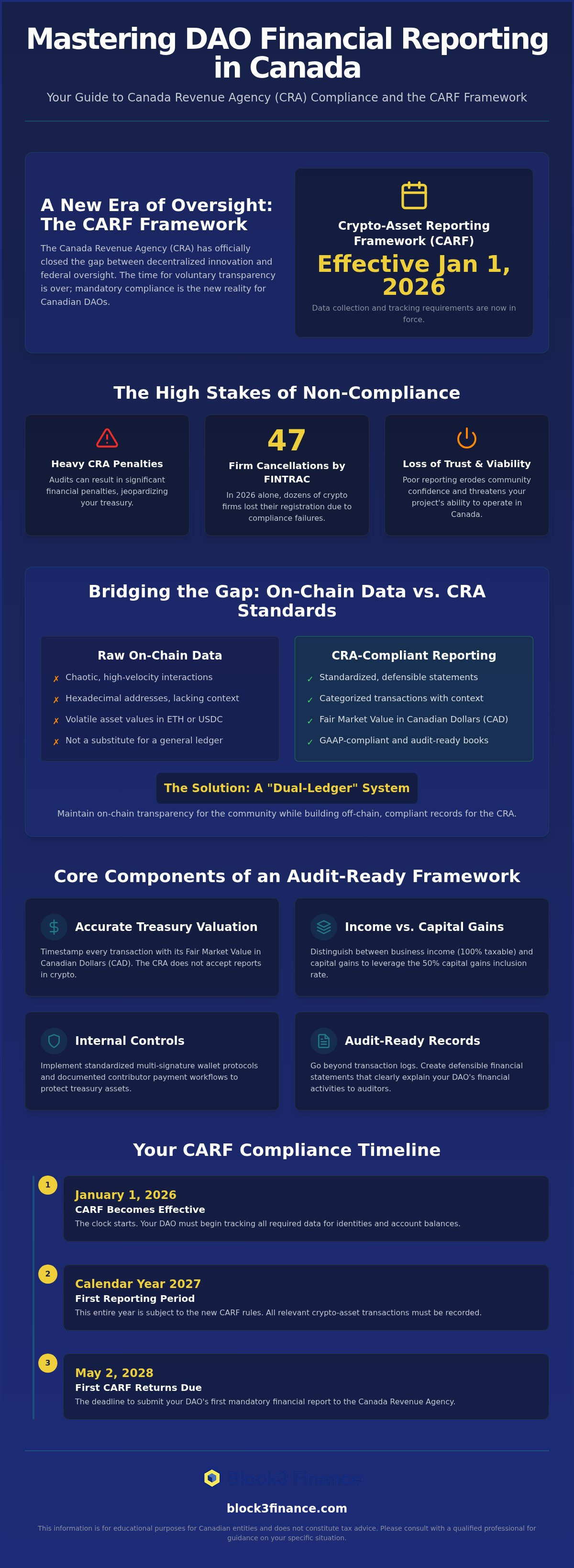
Your DAO's smart contracts might be immutable, but your liability with the Canada Revenue Agency is anything but fixed. With the Crypto-Asset Reporting Framework (CARF) now active as of January 1, 2026, the CRA has officially closed the gap between decentralized innovation and federal oversight. Effective DAO financial reporting is now the only way to protect your treasury from the scrutiny that has already led to dozens of firm cancellations by FINTRAC this year.
It's exhausting to reconcile thousands of on-chain interactions and volatile gas fees while the threat of an audit looms. You likely feel the friction between your commitment to decentralization and the rigid demands of legacy tax systems.
We'll show you how to resolve this tension and gain total command over your project's fiscal health. This guide provides the roadmap to master complex reporting, ensuring you maintain the 50% capital gains inclusion rate while keeping your books audit-ready.
We'll examine the specific CARF reporting deadlines for 2027 and the necessary steps to achieve true treasury transparency. You'll learn to implement a framework that satisfies both your token holders and the tax authorities.
Key Takeaways
- Understand why the CRA treats decentralized structures as taxable entities and how to convert raw on-chain data into defensible financial statements.
- Master the "Dual-Ledger" system to reconcile high-velocity smart contract interactions with traditional Canadian accounting standards.
- Accurately value your treasury and protocol fees to ensure your DAO financial reporting remains transparent for both token holders and auditors.
- Build audit-ready records by implementing standardized multi-signature wallet protocols and documented contributor payment workflows.
- Identify the optimal timing to transition to professional CFO services to manage complex cross-border compliance and ensure treasury sustainability.
The Critical Role of Financial Reporting for Canadian DAOs
Effective DAO financial reporting is the process of translating chaotic, high-velocity on-chain data into standardized, defensible financial statements. It goes beyond simple transaction logging. It requires the cultivation of a structured framework that bridges the gap between decentralized ledgers and the Canada Revenue Agency (CRA) expectations.
The CRA views a Decentralized Autonomous Organization (DAO) as a taxable entity regardless of its lack of a traditional corporate office. If your project has a sufficient nexus in Canada, such as key contributors or a permanent establishment, the authorities expect full disclosure. This shift from voluntary transparency to mandatory compliance became a reality on January 1, 2026, with the implementation of the Crypto-Asset Reporting Framework (CARF).
Rigorous reporting is not just a defensive measure against regulation. It is an offensive strategy to empower your community. Professional financial oversight builds profound trust with token holders by proving that the treasury is being managed with the same discipline as a top-tier financial institution.
CRA Jurisdiction and the DAO Landscape
Determining your tax obligations starts with identifying if your project has a "permanent establishment" in Canada. This often depends on where the mind and management of the DAO reside. You must distinguish between business income, which is 100% taxable, and capital gains, which benefit from a 50% inclusion rate in 2026.
Canadian DAOs must prepare for the first CARF reporting period, which covers the 2027 calendar year. While the first returns aren't due until May 2, 2028, the data collection requirements are already in force. Partnering with a specialized crypto tax accountant in Canada ensures you are tracking identities and account balances accurately from day one.
Consequences of Inadequate Financial Oversight
The risks of ignoring these standards are no longer theoretical. In 2026 alone, FINTRAC has cancelled 47 registrations of crypto firms for compliance failures. An audit by the CRA can result in heavy penalties and the loss of your project's ability to operate within the Canadian financial ecosystem.
Raw Etherscan data is not a substitute for a general ledger. It lacks the context, valuation, and categorization needed for GAAP-compliant books. Relying on unverified on-chain logs often leads to:
- Treasury mismanagement due to inaccurate asset valuations.
- A total loss of community trust when contributors cannot verify spending.
- Significant tax liabilities stemming from poorly documented gas fees and smart contract interactions.
Mastering your DAO financial reporting allows you to navigate these high-stakes environments with confidence. It turns a potential regulatory friction into a foundation for long-term growth and legitimacy.
Bridging the Gap: Real-Time On-Chain Data vs. CRA Standards
The chain never sleeps. While the immutability of the blockchain provides a foundation for trust, the sheer volume of high-velocity smart contract interactions creates a significant friction point for traditional accounting workflows. Raw data from explorers is often an unorganized stream of hexadecimal addresses and complex calls that lack the context required for DAO financial reporting.
We advocate for a "Dual-Ledger" system to resolve this friction. This framework maintains real-time on-chain transparency for your community while simultaneously building off-chain, GAAP-compliant records for the Canada Revenue Agency. Every gas fee, swap, and protocol interaction must be captured and translated into a language the CRA understands.
A critical step in this evolution is the time-stamping of every event with its fair market value in Canadian Dollars (CAD). The CRA does not accept reports in ETH or USDC; they require the value at the exact moment the transaction occurred. This is especially vital when reconciling decentralized exchanges (DEXs) and liquidity pool (LP) positions, where value shifts constantly due to market volatility and rewards accrual.
Data Aggregation and Normalization
Managing a DAO often involves monitoring multiple chains and hundreds of wallets. You need specialized tools to pull this data into a centralized accounting environment where it can be normalized. Under CRA rules, events like airdrops, forks, and staking rewards must be categorized correctly from the moment they land in your treasury.
Cost-basis reconciliation for Canadian digital assets is the process of determining the acquisition value of a token in CAD to establish a benchmark for future tax obligations. Without this benchmark, your DAO risks overpaying on capital gains or triggering an audit due to inconsistent reporting. If you are struggling to map your protocol's complex interaction history, you can discuss your reporting framework with our team.
Reconciling Smart Contract Interactions
Clarity requires a disciplined approach to wallet categorization. You must distinguish between "internal" transfers, such as moving funds between treasury sub-wallets, and "external" transfers that represent taxable events like vendor payments or revenue. This distinction is the bedrock of a defensible audit trail.
- Internal Transfers: Non-taxable movements between wallets controlled by the same DAO entity.
- External Transfers: Taxable dispositions, such as swapping assets for stablecoins or paying contributors.
- Governance Events: Precise tracking of token minting and burn events to maintain an accurate balance sheet.
By transforming raw data into structured blockchain financial records, you move from a defensive posture to one of total command. This methodical approach ensures that your DAO remains audit-ready while providing the transparency your token holders demand.
Core Components of a Comprehensive DAO Financial Report
Mastery over your treasury requires more than a simple list of transactions. Comprehensive DAO financial reporting demands a structured suite of financial statements that mirror traditional corporate standards while respecting the unique nature of decentralized assets. This multi-layered approach ensures your project remains audit-ready for the CRA while providing token holders with a clear view of operational health.
A single perspective is insufficient for a complex Web3 ecosystem. You must move beyond the basic income statement to include a balance sheet, a statement of cash flows, and detailed governance disclosures. This comprehensive framework transforms raw data into a narrative of stability and growth.
The Income Statement for Decentralized Protocols
A robust income statement must distinguish between protocol-earned revenue and passive treasury appreciation. For Canadian tax purposes, you must report revenue from protocol fees as business income, which is 100% taxable. Conversely, the appreciation of held assets is typically treated as capital gains, benefiting from the 50% inclusion rate in 2026.
You should also categorize contributor rewards and grant distributions as operational expenses. In Canada, gas fees incurred during protocol operations are fully deductible expenses. You must document these fees with precision to ensure they are not mischaracterized as capital losses during a CRA review.
Treasury Valuation and Fair Value Measurement
Valuing a treasury filled with volatile assets requires a commitment to fair value principles. While the ASU 2023-08 update specifically addresses U.S. standards, its emphasis on fair value measurement provides a vital framework for Canadian entities seeking the most accurate books. Implementing these crypto accounting services allows you to report assets at their current market price rather than historical cost.
This methodology is particularly important for managing unallocated governance tokens. These tokens should be clearly disclosed on the balance sheet to avoid inflating the perceived value of your liquid treasury. By separating liquid assets from unvested or unallocated tokens, you provide a realistic view of the DAO's actual purchasing power.
Statement of Cash Flows and Governance Disclosure
Your financial reporting must also include a Statement of Cash Flows to monitor liquidity and operational runway. It's not enough to have a large treasury; you must prove you have the liquid CAD or stablecoin reserves to meet upcoming obligations. This prevents the friction of being "asset rich but cash poor" during market downturns.
Finally, comprehensive reports include governance disclosures that detail token allocations and vesting schedules. This level of transparency protects the DAO from internal mismanagement. It also satisfies the CRA’s interest in the distribution of economic benefits within the decentralized ecosystem.
Establishing Internal Controls and Audit-Ready Records
Internal controls represent the structural integrity of your organization. While smart contracts automate the execution of treasury movements, the Canada Revenue Agency requires a clear record of the intent behind those actions. Achieving DAO financial reporting excellence means moving beyond the technical security of a private key to the institutional security of a documented workflow.
A defensible audit trail requires more than just a list of hashes. You must build a bridge between on-chain execution and off-chain documentation. This process ensures that every transaction is not only immutable on the ledger but also justifiable to a federal auditor.
Governance and Multi-Sig Oversight
Implementing multi-signature wallet protocols is a fundamental first step for any decentralized project. However, a multi-sig alone is not a sufficient internal control. You must document the specific signers and the business purpose for every movement of funds. This level of accountability is best managed by a dedicated treasury committee that reviews every transaction against established governance rules.
These committees serve as the "calm force" during periods of high transaction volume. They ensure that every on-chain event is supported by a clear governance decision. If you are unsure if your current setup meets federal standards, you should prioritize CRA crypto audit preparation to identify potential gaps in your record-keeping before they become liabilities.
Documentation for Contributors and Grants
Standardizing workflows for contributor payments and grant distributions is vital for maintaining a clean general ledger. You must track the fair market value of tokens in CAD at the exact moment of payment. This ensures that your tax liabilities are calculated on accurate data rather than end-of-year estimates. It also provides contributors with the necessary data for their own tax filings.
For significant grant recipients, the CRA may expect your DAO to perform KYC (Know Your Customer) or KYB (Know Your Business) procedures. This satisfies federal reporting requirements and protects the treasury from potential fraud. Every expenditure should link back to a specific governance proposal. This creates a seamless line of sight from community intent to financial execution.
Regular monthly closing procedures ensure that your data integrity remains high throughout the fiscal year. Waiting until tax season to reconcile a year of complex on-chain activity is a recipe for errors. If you want to build a truly audit-ready treasury, book a consultation with our strategists to implement these internal controls today.
Scaling Your DAO with Professional Financial Oversight
Community-led bookkeeping often hits a ceiling as transaction volume and treasury complexity scale. Transitioning to professional oversight is a strategic pivot that shifts your project from a defensive posture to one of proactive growth. Expert DAO financial reporting ensures your treasury remains a tool for expansion rather than a source of regulatory friction.
The transition typically happens when on-chain interactions move beyond simple transfers into complex liquidity provisioning and cross-chain governance. At this stage, the risk of misreporting to the CRA carries significant weight. Professional oversight provides the intellectual leadership needed to navigate these high-stakes environments with total command.
Block3 Finance specializes in turning chaotic, multi-chain data into defensible Canadian books. We resolve the friction of decentralized finance by providing a roadmap for thriving in a volatile landscape. Our team acts as a calm force, ensuring your project meets every federal standard while maintaining its innovative edge.
Fractional CFO Services for Decentralized Teams
A fractional CFO provides the technical rigor of a traditional auditor combined with the mindset of a bold innovator. They offer strategic runway management and sophisticated treasury diversification advice to protect your project against market volatility. This high-level oversight is essential for maintaining a healthy balance sheet that satisfies both token holders and federal regulators.
Managing operational fiat needs requires the implementation of robust on and off-ramp solutions. These systems allow your team to handle payroll and vendor payments without disrupting on-chain liquidity or triggering unnecessary tax events. The Block3 Finance executive team brings over 13 years of experience to these challenges, having served over 980 clients globally with white-glove financial services.
The Path to Long-Term Compliance
Preparing for the future requires establishing a scalable reporting cadence for monthly and annual filings. While the first CARF information returns aren't due until May 2, 2028, the data you collect throughout the 2027 calendar year will be the basis for those filings. You must begin cultivating these records now to ensure a smooth transition into the new reporting era.
Global compliance is a primary concern for DAOs with international contributors. You must account for international data sharing agreements that the CRA utilizes to combat tax evasion. For projects with a presence south of the border, our sibling guide on DAO Accounting for US Entities provides the necessary cross-border context to avoid jurisdictional overlap.
By partnering with a visionary navigator, you gain the agency to lead the evolution of your industry. We help you resolve the friction between innovation and compliance, ensuring your DAO remains a stable and transparent entity for years to come.
Master Your Treasury’s Future
The era of voluntary transparency has officially ended. As the CRA intensifies its oversight of decentralized entities, the ability to maintain rigorous DAO financial reporting is your project's greatest asset. You've learned that reconciling high-velocity on-chain data with Canadian standards requires a Dual-Ledger framework and disciplined internal controls.
By bridging the gap between smart contract interactions and GAAP-compliant records, you protect your community from audits and mismanagement. We specialize in transforming these complexities into defensible financial books that ensure long-term sustainability. Our specialized DAO accounting frameworks are designed to handle the unique friction of the Web3 space with precision.
With 13 plus years of blockchain financial expertise and our status as the top-ranked firm by Bitcoin.com, we're ready to serve as your visionary navigator. Schedule a consultation with our Canadian crypto accountants to secure your treasury today.
Your path to total command over your financial landscape starts with a single proactive step.
Frequently Asked Questions
Is a DAO required to file a tax return in Canada?
A DAO is generally required to file a return if it carries on business in Canada or is considered a resident for tax purposes. The CRA treats these entities as unincorporated associations or corporations depending on their specific structure. You should consult with a professional to determine your filing status under current Canadian tax law.
How do we value our DAO's governance tokens for financial reporting?
You must value governance tokens using their fair market value in Canadian Dollars (CAD) at the moment of each transaction. If the token is traded on an exchange, use the average trading price. For tokens without a liquid market, you may need a specialized valuation based on the underlying treasury assets.
Can the CRA audit a decentralized organization?
The CRA has the authority and the technical capability to audit decentralized organizations. They utilize on-chain analytics and data shared through the Crypto-Asset Reporting Framework (CARF) to identify non-compliance. Maintaining DAO financial reporting that is audit-ready is the only way to protect your project from penalties.
What is the best accounting method for DAO treasury management?
Accrual accounting is the most effective method for managing a DAO treasury because it matches revenue with expenses in the period they occur. This provides a clearer picture of your operational runway and liquidity. It also aligns with the standards required for professional financial statements in Canada.
How should we report gas fees on our financial statements?
Gas fees should be reported as deductible operational expenses when they're incurred for business activities. If the fees are related to the acquisition of an asset, they're typically added to the cost basis of that asset. Proper categorization ensures you don't overpay on your net income.
What happens if our DAO has no legal entity but operates in Canada?
If a DAO has no legal entity but has a "mind and management" presence in Canada, the CRA may treat it as a general partnership. This means the individual participants could be held liable for the entity's tax obligations. Establishing a clear corporate structure is a vital step in navigating this risk.
Do we need to report tokens held in a multi-sig wallet as assets?
You must report all tokens held in a multi-sig wallet as assets if the DAO maintains control over those funds. These assets appear on your balance sheet at their fair market value. This transparency is necessary for both CRA compliance and maintaining trust with your token holders.
How often should a DAO produce financial reports?
A DAO should produce financial reports monthly to ensure data integrity and catch reconciliation errors early. While the CRA only requires annual filings, monthly reporting allows your treasury committee to make informed decisions. It also simplifies the transition to year-end DAO financial reporting.

Article by
Mahad Mohamed
Mahad Mohamed is an accountant and the CEO of Block3 Finance, with over 26+ years of Canadian and international tax and accounting experience. A crypto accounting specialist since the early days of Bitcoin, he has consulted for over 38 crypto companies and collaborated with legal professionals on regulatory matters. His expertise spans corporate reorganization, cross-border tax structuring (Canada & US), tax disputes, and CRA audits.
Previously, Mahad worked for the Canada Revenue Agency (CRA), Big4 accounting firms, and served as a Rulings Officer for the Federal Tax Authority of the UAE before acquiring Tax Partners in 2014.
Block3 Finance and Tax Partners has 44 full-time accountants and over 9,800+ clients.
Disclaimer
This article provides general information only and is current as of its publication date. It has not been updated and may be out of date. It does not constitute legal advice and should not be relied upon as such. Every tax situation is unique and may differ from the examples discussed in this article. If you have specific questions, you should seek the advice of our accountants for your unique circumstances.
Frequently Asked Questions
Is a DAO required to file a tax return in Canada?
A DAO is generally required to file a return if it carries on business in Canada or is considered a resident for tax purposes. The CRA treats these entities as unincorporated associations or corporations depending on their specific structure. You should consult with a professional to determine your filing status under current Canadian tax law.
How do we value our DAO's governance tokens for financial reporting?
You must value governance tokens using their fair market value in Canadian Dollars (CAD) at the moment of each transaction. If the token is traded on an exchange, use the average trading price. For tokens without a liquid market, you may need a specialized valuation based on the underlying treasury assets.
Can the CRA audit a decentralized organization?
The CRA has the authority and the technical capability to audit decentralized organizations. They utilize on-chain analytics and data shared through the Crypto-Asset Reporting Framework (CARF) to identify non-compliance. Maintaining DAO financial reporting that is audit-ready is the only way to protect your project from penalties.
What is the best accounting method for DAO treasury management?
Accrual accounting is the most effective method for managing a DAO treasury because it matches revenue with expenses in the period they occur. This provides a clearer picture of your operational runway and liquidity. It also aligns with the standards required for professional financial statements in Canada.
How should we report gas fees on our financial statements?
Gas fees should be reported as deductible operational expenses when they're incurred for business activities. If the fees are related to the acquisition of an asset, they're typically added to the cost basis of that asset. Proper categorization ensures you don't overpay on your net income.
What happens if our DAO has no legal entity but operates in Canada?
If a DAO has no legal entity but has a "mind and management" presence in Canada, the CRA may treat it as a general partnership. This means the individual participants could be held liable for the entity's tax obligations. Establishing a clear corporate structure is a vital step in navigating this risk.
Do we need to report tokens held in a multi-sig wallet as assets?
You must report all tokens held in a multi-sig wallet as assets if the DAO maintains control over those funds. These assets appear on your balance sheet at their fair market value. This transparency is necessary for both CRA compliance and maintaining trust with your token holders.
How often should a DAO produce financial reports?
A DAO should produce financial reports monthly to ensure data integrity and catch reconciliation errors early. While the CRA only requires annual filings, monthly reporting allows your treasury committee to make informed decisions. It also simplifies the transition to year-end DAO financial reporting.