
Your blockchain ledger isn't just a list of transactions. It's a high-stakes financial narrative that US regulators are reading with unprecedented scrutiny. Managing this complexity demands a sophisticated digital asset CFO advisory partner who can transform chaotic on-chain data into a source of strategic advantage.
You've likely felt the frustration of trying to reconcile fragmented wallet data while worrying about an IRS audit. Navigating Decentralized Finance (DeFi), which refers to financial services built on blockchain technology without traditional intermediaries, often feels like a defensive struggle. It's difficult to maintain strategic foresight when you're buried in the technical debt of past transactions.
This article provides the blueprint to move from a defensive posture to total command over your financial landscape. You'll learn how to master the nuances of on-chain finance and maintain rigorous regulatory compliance under IRS rules. We'll examine the methodology for establishing audit-ready records and optimizing your corporate structure for tax efficiency.
By the end of this guide, you'll have a clear roadmap for scaling your digital asset operations through 2026. We'll show you how to bridge the gap between chaotic on-chain activity and defensible, growth-oriented corporate finance. This is your path to becoming a visionary navigator in a volatile market.
Key Takeaways
- Understand how to integrate traditional corporate finance with blockchain-native economic structures to drive institutional growth.
- Learn to maintain rigorous compliance under IRS rules by implementing granular tracking for every on-chain transaction your enterprise executes.
- Discover how expert digital asset CFO advisory optimizes your corporate structuring for tax efficiency and seamless liquidity management.
- Establish an audit-ready financial infrastructure by building the specialized protocols required to meet the gold standard for institutional firms.
- Transition from a defensive regulatory posture to an offensive strategy that leverages clean, defensible records for better capital allocation.
Defining Digital Asset CFO Advisory for Modern Enterprises
Digital asset CFO advisory represents a fundamental evolution in how blockchain-native enterprises manage their balance sheets. It isn't just about recording transactions; it's about integrating legacy corporate finance with the unique economic structures of the on-chain world. This specialized leadership ensures that digital assets, which include cryptocurrencies and tokenized securities, are treated as strategic tools rather than just technical line items.
Block3 Finance positions itself as a "Visionary Navigator" for firms moving toward financial maturity. This role shifts the focus from defensive compliance to offensive growth and proactive capital allocation. By partnering with an elite strategist, firms move beyond the friction of fragmented data to achieve total command over their fiscal future.
The Shift from Crypto Accounting to Strategic Advisory
Traditional crypto accounting focuses on historical records, ensuring you know what happened yesterday. In contrast, digital asset CFO advisory prioritizes forecasting and future growth. It bridges the gap between technical developers, who focus on protocol architecture, and financial stakeholders, who require clear performance metrics.
Software solutions often struggle with the nuance of complex DeFi interactions. DeFi, or Decentralized Finance, refers to financial services built on blockchain technology that bypass traditional banks. Executive-level oversight provides the intellectual depth necessary to interpret data and make high-stakes decisions that software alone cannot execute.
Core Pillars of Digital Asset Financial Leadership
Leadership in this space rests on three foundational pillars designed to stabilize and grow the enterprise:
- Strategic treasury management: Balancing on-chain liquidity with off-chain operational needs to maintain "dry powder," which is a term for available cash or liquid assets ready for deployment.
- Risk mitigation: Managing exposure to protocol failures, smart contract bugs, and market volatility through disciplined hedging and diversification.
- Mission alignment: Ensuring every blockchain interaction directly supports the company's long-term objectives and institutional vision.
Strategic treasury management requires a deep understanding of how to protect core capital while remaining agile. Under IRS rules, every move between assets triggers a reportable event, making strategic planning essential for tax efficiency. This level of oversight ensures that your financial architecture is built for scale, not just survival.
Navigating US Regulatory Frameworks and IRS Compliance
Compliance under IRS rules requires more than just high-level summaries. It demands granular tracking of every digital transaction to ensure absolute accuracy for your enterprise. Professional digital asset CFO advisory ensures that all on-chain activity is captured, categorized, and reconciled for tax reporting purposes.
The objective is to construct clean, defensible financial records that stand up to the highest level of scrutiny. Strategic advisory prevents the common, expensive errors that often surface during the annual tax filing season. You can review the latest IRS digital asset tax guidance to see how these requirements have evolved for US taxpayers.
Our executive team moves your firm from a defensive posture to one of total command. We don't just react to regulations; we build the infrastructure that makes compliance a seamless part of your operations. This proactive approach is essential for maintaining institutional trust in an environment where the rules are constantly shifting.
Understanding ASU 2023-08 and Fair Value Measurement
The Financial Accounting Standards Board (FASB) recently updated the rules governing how entities report their crypto holdings. ASU 2023-08 requires certain digital assets to be measured at fair value. Fair value represents the price that would be received to sell an asset in an orderly transaction between market participants at the measurement date.
This transition significantly changes how crypto-heavy balance sheets appear to institutional investors and lenders. By reflecting the current market value rather than historical cost, firms can present a more accurate picture of their financial health. For a deeper dive into these standards, see our guide on ASU 2023-08 and Crypto Revenue Recognition.
Critical IRS Reporting Requirements for 2026
Reporting for mining and staking remains a complex area under current US tax law. Mining refers to the process of validating transactions on a blockchain to earn rewards, while staking involves locking up assets to support network security in exchange for yield. Both activities are typically treated as ordinary income at the time the rewards are received.
Documenting these events requires the meticulous preparation of Form 8949. This form is used to report the sale or exchange of capital assets, including the specific cost basis and holding period for every transaction. CFO advisors manage the complexity of high-volume on-chain transactions to ensure every line item on this form is verifiable.
Managing thousands of transactions across multiple protocols is a significant burden for internal teams. We implement systems to automate data collection while maintaining the human oversight necessary for complex edge cases. If you're concerned about your current reporting accuracy, it's time to speak with our strategists to secure your financial records.
Strategic Corporate Structuring and On-Chain Liquidity
Corporate structuring serves as the architectural foundation for your firm's financial health. It dictates how your entity interacts with the blockchain and directly determines your tax efficiency under US law. Expert digital asset CFO advisory ensures your legal framework aligns with your operational goals while adhering to IRS digital asset tax guidance. Our team analyzes your specific business model to identify structural risks before they become costly liabilities.
Choosing the right setup is about more than just legal protection. It involves creating a system that minimizes friction when moving capital between traditional and decentralized environments. You can explore our specific methodologies for corporate structuring for crypto businesses to understand how we protect your bottom line. We move your organization from a defensive posture to an offensive one focused on mastery and growth.
Entity Selection for Digital Asset Operations
Selecting the appropriate corporate entity is critical for Web3 projects and Decentralized Autonomous Organizations (DAOs). A DAO is an organization governed by smart contracts where decisions are made by community members rather than a central authority. The choice between a C-Corp, LLC, or specific trust structures affects everything from your tax liability to your ability to attract institutional investors.
Structuring also impacts how you manage crypto-to-fiat payment systems for global teams. If your entity isn't optimized for cross-border trade, you may face unnecessary hurdles with banking partners or regulatory bodies. We provide the jurisdictional expertise needed to navigate these high-stakes environments with confidence, ensuring your treasury remains agile and secure.
Managing On-Chain and Off-Ramp Payment Solutions
Seamless movement between fiat and crypto is essential for operational stability. An on-ramp is a service that allows you to exchange traditional currency for digital assets, while an off-ramp does the opposite. We implement secure on and off-ramp solutions that allow you to pay payroll and vendors without disrupting your workflow.
Compliance remains a non-negotiable priority in these transactions. We ensure every transfer meets rigorous Anti-Money Laundering (AML) and Know Your Customer (KYC) standards. AML refers to the regulations designed to stop the movement of illicit funds, while KYC is the mandatory process of identifying and verifying a client's identity. This disciplined approach protects your firm from the reputational and legal risks associated with unregulated capital flows.
Strategic management of exchange relationships and liquidity pools ensures your firm always has access to capital. We act as your visionary navigator, reducing the friction of moving assets while maintaining a defensible audit trail. This level of oversight protects your treasury from the volatility and liquidity traps common in the digital asset space. By diversifying your off-ramp strategies, we ensure that your operations remain resilient even if specific banking channels experience increased scrutiny.
Building an Audit-Ready Financial Infrastructure
Audit readiness is the gold standard for institutional digital asset firms. It transforms your financial records from a potential liability into a defensible growth asset. Expert digital asset CFO advisory establishes the rigorous protocols needed to maintain a seamless audit trail under IRS scrutiny.
Modern enterprises must reconcile complex on-chain activity with legacy ledger systems to ensure transparency. A proactive approach prevents the chaotic, high-stakes cleanup often required at the end of the fiscal year. This methodology ensures your records remain transparent for stakeholders and regulators at all times.
Establishing the Blockchain Audit Trail
Capturing granular metadata for every transaction is essential to prove both ownership and intent. This data includes timestamps, wallet addresses, and transaction hashes that verify the underlying nature of every asset movement. It moves your firm away from defensive guesswork toward a position of absolute certainty.
Integrating specialized crypto accounting software with ERP systems ensures that financial data flows smoothly across your entire organization. ERP, or Enterprise Resource Planning, is software that manages core business processes like accounting, sales, and payroll in a single centralized system. Periodic internal reviews are also necessary to maintain the long-term integrity of these records.
Steps to Prepare for a 2026 Financial Audit
Preparation for a 2026 financial audit requires a methodical and disciplined approach to data management. Follow these four steps to ensure your firm is positioned for institutional success:
- Step 1: Reconcile all digital wallets and exchange accounts monthly to identify and resolve discrepancies early.
- Step 2: Document the specific pricing methodologies used for fair value measurement to satisfy IRS reporting requirements.
- Step 3: Review all smart contract interactions for proper tax classification to prevent the misreporting of income or gains.
- Step 4: Engage a specialized advisor to review your final audit package and verify its technical accuracy.
Achieving this level of precision requires deep blockchain financial expertise and a commitment to best practices. Don't leave your institutional reputation to chance during the next audit cycle. You can contact our executive team to build your audit-ready infrastructure today.
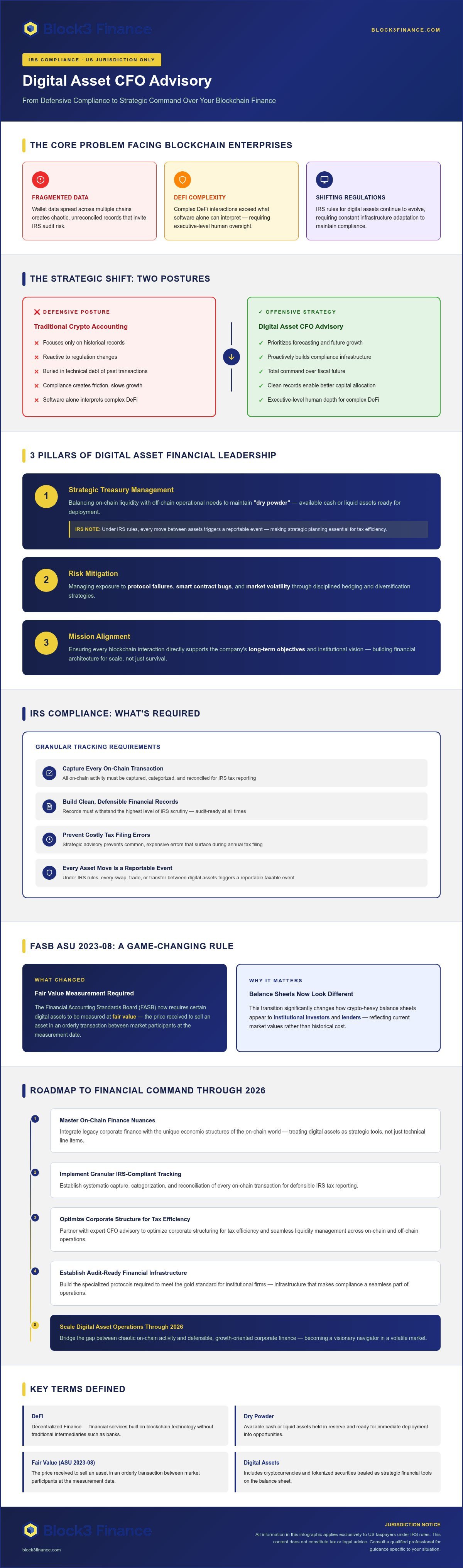
Block3 Finance: Your Visionary Navigator for Digital Strategy
Block3 Finance delivers elite digital asset CFO advisory services backed by over 13 years of specialized blockchain experience. We excel at transforming fragmented on-chain data into clean, defensible corporate records that satisfy the most rigorous US regulatory standards. We understand that the future of finance requires a new set of rules and a different kind of professional engagement.
Our team bridges the gap between legacy corporate finance and decentralized innovation. We empower you to move beyond defensive record-keeping and gain total command over your financial destiny. By positioning ourselves as your strategic partner, we ensure you have the roadmap necessary for thriving in a high-stakes environment.
We act as a "calm force" in a chaotic industry. Our executive team provides the intellectual depth and technical rigor required to ensure your firm remains an active participant in the industry's evolution. This disciplined approach shifts the narrative from merely managing regulations to achieving total mastery over your assets.
Why Institutional Firms Choose Block3 Advisory
Institutional firms require a partner with a proven pedigree and a deep immersion in the blockchain ecosystem. Block3 Finance is ranked as a top provider by Bitcoin.com for blockchain financial expertise. This recognition reflects our commitment to excellence and our ability to resolve friction in complex financial landscapes.
We've successfully served over 980 global clients, including high-growth startups and complex Decentralized Autonomous Organizations (DAOs). This extensive track record provides the intellectual depth necessary to navigate high-stakes environments with confidence. Every client engagement benefits from this cumulative experience and our commitment to institutional best practices.
You gain immediate access to our "white-glove" network of legal and tax professionals. This elite circle ensures that your financial oversight is supported by a well-connected professional community committed to regulatory excellence. We don't just provide a service; we offer a comprehensive ecosystem for financial stability.
Secure Your Strategic Financial Future
Don't let the fear of IRS audits or volatile markets hinder your institutional progress. Our fractional CFO services are designed to scale alongside your business as you expand. This flexibility ensures you always have access to executive-level expertise without the overhead of a full-time hire.
We help you move beyond basic compliance to start driving meaningful strategic growth today. This transition from a defensive posture to an offensive one is the key to mastering a volatile landscape. We ensure that your capital allocation and treasury management are always aligned with your broader business mission.
Your future in the digital asset space requires a roadmap built on experience and vision. It's time to Speak with a Block3 Digital Asset Advisor to secure your position in the 2026 financial landscape. Let us help you cultivate a financial infrastructure that is both resilient and built for scale.
Secure Your Strategic Command of Digital Finance
Success in the 2026 financial landscape requires more than just reactive bookkeeping. It demands a sophisticated digital asset CFO advisory partner who can bridge the gap between legacy corporate finance and decentralized innovation. By establishing audit-ready records and optimizing your corporate structure under IRS rules, you move from a defensive posture to one of total mastery.
Block3 Finance brings over 13 years of blockchain expertise and a proven track record of serving 980+ global clients. As a top-ranked provider by Bitcoin.com, we provide the technical rigor and intellectual depth necessary to navigate high-stakes environments with confidence. We turn complex on-chain data into defensible assets that fuel your institutional growth and long-term stability.
Don't leave your financial future to chance in a volatile market. It's time to gain total command over your fiscal destiny and build a resilient infrastructure for the years ahead. Schedule a Strategic CFO Consultation today to start your journey toward financial mastery and institutional excellence.
Frequently Asked Questions
What is the primary difference between a crypto accountant and a digital asset CFO?
A crypto accountant focuses on historical data and basic bookkeeping to record what already happened. In contrast, digital asset CFO advisory provides strategic financial leadership and forward-looking growth roadmaps. This executive role moves beyond simple ledger entries to focus on capital allocation, risk mitigation, and treasury management. It's the difference between merely documenting your past and actively engineering your firm's future in a volatile market.
How does ASU 2023-08 affect my corporate crypto tax reporting in the US?
ASU 2023-08 requires US entities to measure certain digital assets at fair value on their financial statements. Fair value is the price you'd receive to sell an asset in an orderly market transaction. This shift from historical cost reporting provides investors with a more transparent view of your crypto-heavy balance sheet. It also means your reporting must be more granular to capture value fluctuations at the exact time of each reportable event.
Can Block3 Finance help with corporate entity structuring for a new DAO?
We specialize in corporate structuring for Decentralized Autonomous Organizations (DAOs) and other Web3 projects. A DAO is a community-led entity governed by blockchain-based smart contracts. Selecting the right legal structure is vital for managing tax liability and attracting institutional capital. Our team provides the jurisdictional expertise needed to ensure your entity remains compliant while maintaining the flexibility required for decentralized operations.
What are the risks of using standard accounting software for digital assets?
Standard accounting software is often incapable of reconciling complex on-chain metadata or interacting with decentralized protocols. This leads to fragmented data silos that make financial reporting a nightmare for your team. Without specialized blockchain integration, you risk missing critical transaction details required by the IRS. This technical debt creates significant friction during year-end audits and can lead to costly penalties if your records are found to be indefensible.
How does a fractional CFO help a Web3 startup manage its runway?
A fractional CFO provides high-level strategic oversight to manage your runway, which is the time your startup can operate before running out of funds. Through our digital asset CFO advisory, we help you balance on-chain liquidity with off-chain operational expenses. This service allows you to access elite financial expertise without the overhead of a full-time executive. It's a scalable solution that helps Web3 startups navigate market volatility with professional discipline.
Does Block3 Finance provide international tax compliance for firms outside the US?
Block3 Finance serves over 980 global clients and provides international tax compliance for firms operating in multiple jurisdictions. While this guide focuses on IRS rules in the US, our methodology is designed for the global nature of blockchain commerce. We help international firms establish defensible records that meet the standards of global tax authorities. Our white-glove service ensures that your operations remain compliant regardless of where your core team or treasury is located.
What documentation does the IRS require for corporate digital asset transactions?
The IRS requires specific documentation for every corporate digital asset transaction, including the date, cost basis, and fair market value. Cost basis is the original value of an asset for tax purposes, usually the purchase price. You must also maintain records of wallet addresses and transaction hashes to prove ownership. Form 8949 is the primary document used to report capital gains and losses for these assets under US tax law.
How long does it take to get my crypto books audit-ready with an advisor?
The time required to reach audit-readiness depends on the volume of your transactions and the current state of your books. An advisor can typically begin the reconciliation process immediately to resolve historical data gaps. By implementing monthly protocols, we ensure that your records are always current and transparent for stakeholders. This proactive approach eliminates the chaos of year-end cleanup and provides you with a clear roadmap for your upcoming financial audit.

Article by
Mahad Mohamed
Mahad Mohamed is an accountant and the CEO of Block3 Finance, with over 26+ years of Canadian and international tax and accounting experience. A crypto accounting specialist since the early days of Bitcoin, he has consulted for over 38 crypto companies and collaborated with legal professionals on regulatory matters. His expertise spans corporate reorganization, cross-border tax structuring (Canada & US), tax disputes, and CRA audits.
Previously, Mahad worked for the Canada Revenue Agency (CRA), Big4 accounting firms, and served as a Rulings Officer for the Federal Tax Authority of the UAE before acquiring Tax Partners in 2014.
Block3 Finance and Tax Partners has 44 full-time accountants and over 9,800+ clients.
Disclaimer
This article provides general information only and is current as of its publication date. It has not been updated and may be out of date. It does not constitute legal advice and should not be relied upon as such. Every tax situation is unique and may differ from the examples discussed in this article. If you have specific questions, you should seek the advice of our accountants for your unique circumstances.
Frequently Asked Questions
What is the primary difference between a crypto accountant and a digital asset CFO?
A crypto accountant focuses on historical data and basic bookkeeping to record what already happened. In contrast, digital asset CFO advisory provides strategic financial leadership and forward-looking growth roadmaps. This executive role moves beyond simple ledger entries to focus on capital allocation, risk mitigation, and treasury management. It's the difference between merely documenting your past and actively engineering your firm's future in a volatile market.
How does ASU 2023-08 affect my corporate crypto tax reporting in the US?
ASU 2023-08 requires US entities to measure certain digital assets at fair value on their financial statements. Fair value is the price you'd receive to sell an asset in an orderly market transaction. This shift from historical cost reporting provides investors with a more transparent view of your crypto-heavy balance sheet. It also means your reporting must be more granular to capture value fluctuations at the exact time of each reportable event.
Can Block3 Finance help with corporate entity structuring for a new DAO?
We specialize in corporate structuring for Decentralized Autonomous Organizations (DAOs) and other Web3 projects. A DAO is a community-led entity governed by blockchain-based smart contracts. Selecting the right legal structure is vital for managing tax liability and attracting institutional capital. Our team provides the jurisdictional expertise needed to ensure your entity remains compliant while maintaining the flexibility required for decentralized operations.
What are the risks of using standard accounting software for digital assets?
Standard accounting software is often incapable of reconciling complex on-chain metadata or interacting with decentralized protocols. This leads to fragmented data silos that make financial reporting a nightmare for your team. Without specialized blockchain integration, you risk missing critical transaction details required by the IRS. This technical debt creates significant friction during year-end audits and can lead to costly penalties if your records are found to be indefensible.
How does a fractional CFO help a Web3 startup manage its runway?
A fractional CFO provides high-level strategic oversight to manage your runway, which is the time your startup can operate before running out of funds. Through our digital asset CFO advisory, we help you balance on-chain liquidity with off-chain operational expenses. This service allows you to access elite financial expertise without the overhead of a full-time executive. It's a scalable solution that helps Web3 startups navigate market volatility with professional discipline.
Does Block3 Finance provide international tax compliance for firms outside the US?
Block3 Finance serves over 980 global clients and provides international tax compliance for firms operating in multiple jurisdictions. While this guide focuses on IRS rules in the US, our methodology is designed for the global nature of blockchain commerce. We help international firms establish defensible records that meet the standards of global tax authorities. Our white-glove service ensures that your operations remain compliant regardless of where your core team or treasury is located.
What documentation does the IRS require for corporate digital asset transactions?
The IRS requires specific documentation for every corporate digital asset transaction, including the date, cost basis, and fair market value. Cost basis is the original value of an asset for tax purposes, usually the purchase price. You must also maintain records of wallet addresses and transaction hashes to prove ownership. Form 8949 is the primary document used to report capital gains and losses for these assets under US tax law.
How long does it take to get my crypto books audit-ready with an advisor?
The time required to reach audit-readiness depends on the volume of your transactions and the current state of your books. An advisor can typically begin the reconciliation process immediately to resolve historical data gaps. By implementing monthly protocols, we ensure that your records are always current and transparent for stakeholders. This proactive approach eliminates the chaos of year-end cleanup and provides you with a clear roadmap for your upcoming financial audit.