
Your crypto wallet is no longer a black box to the IRS; it's a transparent ledger they've already learned how to read. With the full implementation of Form 1099-DA in 2026 and the deployment of advanced blockchain analytics, the era of "wait and see" compliance has officially ended.
You likely feel the weight of fragmented data across multiple wallets and the headache of reconciling complex DeFi or NFT transactions. It's frustrating to manage shifting regulations while trying to protect your capital from aggressive enforcement actions like "Operation Hidden Treasure."
This guide provides the exact framework you need to build audit-proof crypto financial records that withstand the highest levels of regulatory scrutiny. We move beyond basic reporting to help you master the architectural process of reconciling on-chain truth with federal requirements.
You'll gain a clear checklist of required documents and learn how to maintain cost basis, which is the original purchase price used to calculate gains, on a per-wallet level. We'll show you how to transform your data from a potential liability into a defensible shield that reduces your total tax exposure.
Key Takeaways
- Learn how the IRS uses automated matching systems to identify discrepancies between your reported income and on-chain activity.
- Understand the specific documentation required to build audit-proof crypto financial records that place the burden of proof on the data rather than the taxpayer.
- Discover how to link every transaction to a unique TXID, which is a specific blockchain transaction ID, to create an immutable trail for auditors.
- Master the process of normalizing complex data from DeFi protocols and hardware wallets into a single functional currency for accurate IRS reporting.
- Gain confidence in your financial integrity by implementing institutional-grade bookkeeping methods that withstand high-level regulatory scrutiny.
The Rising Stakes of IRS Crypto Audits in 2026
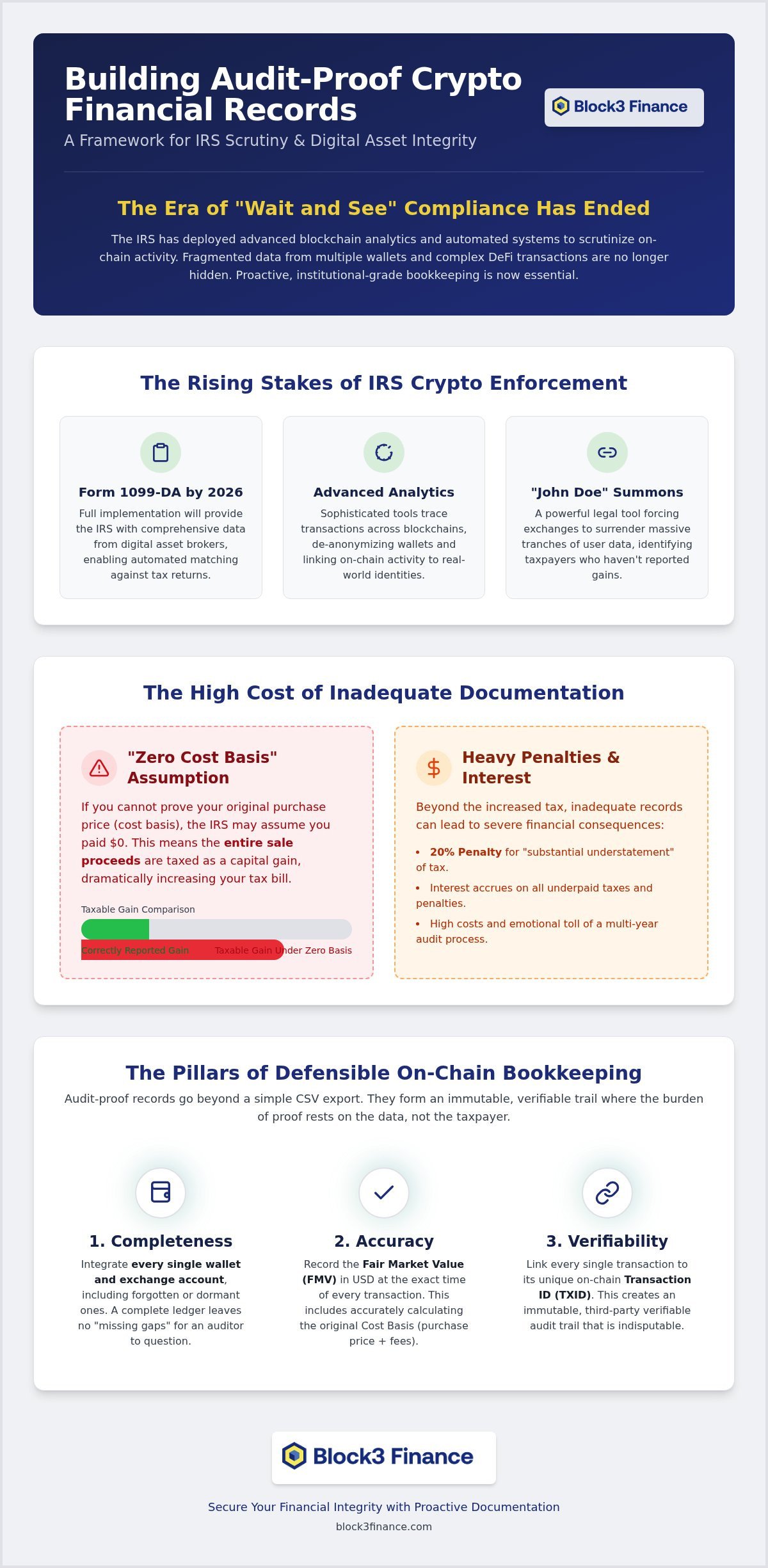
The IRS has fundamentally transformed its approach to digital asset oversight. They've moved beyond manual reviews to sophisticated, automated matching systems that instantly flag discrepancies between your reported income and on-chain activity. These systems compare data from major exchanges against individual returns with surgical precision. Relying on a standard tax return is no longer enough if the underlying data lacks a verifiable trail. Maintaining audit-proof crypto financial records is the only way to secure your financial integrity in this high-stakes environment.
Understanding IRS Enforcement Trends
The focus of federal regulators has shifted from targeting simple non-filers to investigating complex DeFi and NFT valuation errors. To bridge the data gap, the IRS utilizes the "John Doe Summons." This is a powerful legal tool that forces exchanges to surrender massive tranches of user data, even without knowing the specific names of the account holders. This allows the agency to identify US taxpayers involved in virtual currency transactions who haven't fully reported their gains. The 2026 IRS budget specifically allocates significant resources toward forensic accounting and blockchain analytics. This investment ensures that even "anonymous" wallet activity can be traced back to real-world identities.
The Cost of Inadequate Documentation
Missing or fragmented records create a dangerous opening for aggressive auditors. When a taxpayer cannot substantiate their purchase price, the IRS frequently applies a "zero cost basis" assumption. This methodology assumes you paid nothing for the asset; it effectively taxes the entire proceeds of a sale as a capital gain. Beyond the increased tax bill, the penalties for a "substantial understatement" can reach 20% of the underpaid tax. These financial burdens are often compounded by the emotional toll of a multi-year audit process. Securing professional audit services helps build a defensible trail that protects your assets from these preventable losses.
Waiting for an audit notice to organize your data is a losing strategy. The complexity of modern on-chain activity requires a continuous architectural approach to bookkeeping. By establishing audit-proof crypto financial records today, you transition from a defensive posture to one of total command over your financial landscape. Proactive documentation is the only reliable way to avoid heavy penalties and interest during a federal examination.
Defining Audit-Proof Crypto Financial Records Under IRS Standards
True audit-proof crypto financial records represent more than a simple collection of transaction IDs. They provide an immutable, third-party verifiable trail that substantiates every movement of capital across your digital ecosystem. Under IRS rules, the burden of proof rests entirely on your shoulders. You must be able to prove the accuracy of every figure you report, or you risk having your deductions disallowed during an examination.
A critical component of this trail is your Cost Basis. This is the original value of an asset for tax purposes, which typically includes the purchase price plus any associated transaction fees. Many taxpayers mistakenly believe that a basic CSV export from a centralized exchange qualifies as a defensible record. In reality, these files are often incomplete snapshots that fail to account for the "travel history" of an asset as it moves into self-custody or through decentralized protocols.
According to the IRS guidance on virtual currency, taxpayers must maintain records that are sufficient to establish the amount of gross income and deductions. Without a continuous chain of custody, an auditor may claim you have "unaccounted for" income. This fragmentation is precisely what robust record-keeping is designed to solve by bridging the gaps between disparate data sources.
Completeness vs. Accuracy in Digital Assets
Completeness requires that every single wallet, including those "forgotten" accounts from years ago, is integrated into your ledger. Accuracy demands that you record the Fair Market Value at the exact moment of the trade. Fair Market Value is the price an asset would sell for on the open market in an arm's length transaction. The IRS often rejects records that contain "missing gaps" in the transfer history. These gaps prevent a clear calculation of the holding period and basis, which can lead to your gains being taxed at higher short-term rates.
The Limitation of Standard Crypto Tax Software
Standard tax software frequently struggles with complex on-chain events like hard forks or wrapping tokens. A Hard Fork occurs when a blockchain protocol undergoes a permanent split, creating two separate paths and often resulting in a new taxable asset for the holder. Automated tools might misclassify these events or fail to assign the correct valuation. This is why professional crypto accounting is essential to verify and normalize software outputs. Our team ensures that your data reflects the actual economic reality of your trades rather than just the software's best guess.
If you're unsure if your current data meets these rigorous federal standards, you can reach out to our specialists for a comprehensive review of your reporting architecture.
The Three Pillars of Defensible On-Chain Bookkeeping
Building audit-proof crypto financial records requires a shift from reactive data collection to proactive financial architecture. You cannot simply trust that exchange APIs will remain active or that your memory will serve you during an IRS examination. Instead, you must anchor your reporting in three non-negotiable pillars that provide an airtight defense for every on-chain event. These pillars ensure that your data is not just present, but verifiable by a third-party auditor.
- Pillar 1: Source Documentation. Every transaction in your ledger must link back to a specific blockchain TXID. A TXID is a unique alphanumeric string that serves as a digital fingerprint for a transaction on the blockchain. Without this link, your records are merely claims rather than proven facts.
- Pillar 2: Valuation Consistency. You must use a unified pricing source for all digital assets across the entire fiscal year. Mixing data from different exchanges or price aggregators creates "noise" and valuation discrepancies that trigger IRS red flags.
- Pillar 3: Reconciliation. Your records must pass a basic mathematical test. The ending balance must equal the starting balance plus additions minus subtractions. If the math doesn't align, the IRS will likely conclude your reporting is fundamentally flawed.
Establishing an Immutable Source of Truth
The IRS requires US taxpayers to maintain records that are permanent and accurate. You must archive original JSON or CSV data from exchanges immediately because APIs often change or expire. This leaves you with gaps in your history that are nearly impossible to fill years later. For private sales or trades on a DEX, which is a decentralized exchange, you should capture timestamped screenshots of the trade details. We also recommend maintaining a detailed "Wallet Map." This document identifies the legal ownership and specific purpose of every digital address you control, preventing the IRS from misclassifying internal transfers as taxable sales.
Applying Consistent Valuation Methodologies
IRS regulations demand that you use a consistent "Reasonable Method" for determining Fair Market Value. This is especially important when dealing with "Illiquid Assets," which are tokens with very low trading volume that lack a stable price feed. If you change your valuation method mid-year to lower your tax bill, you invite significant regulatory scrutiny. For corporate entities, aligning these methods with ASU 2023-08 and Crypto Revenue Recognition is essential for maintaining institutional-grade compliance. This standard provides the necessary framework for how US companies must report digital asset holdings on their balance sheets to ensure transparency and accuracy.
Step-by-Step: Constructing Your Digital Asset Audit Trail
Transforming raw on-chain data into audit-proof crypto financial records requires a disciplined, sequential workflow. You must move beyond simple data exports to create a narrative that an IRS auditor can follow without confusion. This five-step framework ensures your reporting architecture is robust enough to withstand high-level regulatory scrutiny in 2026.
- Step 1: Aggregate. Collect data from every centralized exchange, hardware wallet, and DeFi protocol you've touched. This includes tracking wrapped tokens and bridge transactions to ensure no movement of capital is left unrecorded.
- Step 2: Normalize. Convert every transaction into USD. You must use the Fair Market Value at the exact time of the event to ensure accuracy under IRS rules.
- Step 3: Categorize. Label every movement as income, capital gain, gift, or a non-taxable transfer. Mislabeling a self-transfer as a sale is a common error that artificially inflates your tax liability and triggers unnecessary flags.
- Step 4: Reconcile. Perform a month-end check to identify and fix "missing cost basis" errors. Addressing these gaps monthly prevents the data from becoming cold and unrecoverable before the filing deadline.
- Step 5: Report. Generate a final Form 8949 and Schedule D. These documents should match your internal ledger exactly to prevent automated discrepancy notices from the IRS.
Handling Complex DeFi and NFT Events
Liquidity Providing involves depositing assets into a pool to earn fees from other traders. Under certain conditions, the IRS may view this as a taxable swap of your original tokens for liquidity provider (LP) tokens. You must also track Gas Fees, which are the transaction fees paid to miners or validators to process your trades on the blockchain. These fees are generally added to your cost basis or subtracted from your sales proceeds to reduce your total taxable gain. For NFTs, you need clear documentation for mints, burns, and secondary market royalties to prove the economic reality of each transaction to an examiner.
Monthly vs. Annual Reconciliation
Waiting until April to reconcile a full year of high-volume DeFi activity is a recipe for audit failure. Memories fade and blockchain explorers may not provide the granular data you need months after the transaction occurred. Adopting monthly bookkeeping allows you to maintain real-time audit readiness and catch errors while the data is still fresh. You can also refer to our CRA Crypto Audit guide to see how other jurisdictions require similar levels of meticulous documentation. If you're ready to secure your financial future with a defensible trail, contact our audit specialists today for expert guidance.
Strategic Resilience: How Block3 Finance Secures Your Financial Integrity
Block3 Finance operates as a partner in your financial evolution. We provide institutional-grade audit services designed specifically for the volatility and complexity of the digital asset ecosystem.
Our team specializes in transforming raw, fragmented on-chain data into clean, audit-proof crypto financial records that satisfy the most rigorous IRS standards. We bridge the gap between the decentralized world of blockchain and the structured requirements of federal reporting.
By leveraging over 13 years of blockchain financial expertise, we've helped more than 980 global clients maintain total command over their tax obligations. Our goal is to move you beyond defensive compliance into a state of offensive financial mastery where your records serve as a strategic asset.
The Block3 Forensic Approach
We don't simply rely on automated software to generate reports. Our specialists perform manual forensic reviews of high-value and complex transactions to ensure every detail is accurate.
This process includes experts in corporate structuring who work to optimize your tax position while maintaining full regulatory alignment. As your "Visionary Navigator," we help you stay ahead of the curve as IRS regulations evolve.
We anticipate shifts in federal oversight, such as the 2026 reporting mandates, to ensure your architecture remains resilient. This proactive stance eliminates the friction of reactive accounting and provides a clear roadmap for long-term growth.
We treat every transaction as a piece of a larger financial narrative that must be defensible under any level of scrutiny. This meticulous attention to detail protects both your capital and your reputation.
Your Roadmap to a Stress-Free Tax Season
Our engagement begins with a comprehensive "Health Check" of your existing documentation. We identify gaps in your cost basis tracking or transfer history before they become liabilities during an audit.
This diagnostic phase is essential for taxpayers who have moved assets across multiple protocols or centralized exchanges over several years. Once your historical data is secured, we implement automated, audit-proof systems that scale with your portfolio.
These systems provide real-time visibility into your tax exposure, allowing for more informed decision-making throughout the fiscal year. Whether you're a high-volume trader or a Web3 startup, we build the records that protect your legacy. If you are looking to leverage your digital wealth for a home purchase, you can visit LoansByJB (The Nuhome Team) to explore specialized mortgage solutions for complex income scenarios.
Don't leave your financial integrity to chance in an era of increased federal enforcement. You can contact our team today to ensure your digital asset records are built on solid ground.
The landscape of digital asset taxation has shifted from a grey area to a zone of high-intensity enforcement. By anchoring your reporting in the three pillars of defensible bookkeeping, you protect your capital from the arbitrary assumptions of federal examiners. This proactive stance moves you from a defensive posture to one of total financial command.
Building audit-proof crypto financial records is a continuous process of reconciling on-chain truth with IRS requirements. This methodology ensures that every transaction is backed by an immutable blockchain fingerprint, transforming your data into a powerful shield. You deserve the agency that comes with a perfectly organized ledger.
Block3 Finance brings 13+ years of specialized blockchain accounting experience to your side. As the provider ranked #1 by Bitcoin.com, we possess the technical rigor and IRS compliance expertise needed to navigate this complex environment. We've managed over 980 global clients, serving as a calm force in a chaotic industry.
Secure your digital assets with an audit-proof framework; Contact Block3 Finance today. We are ready to help you build a defensible trail that stands up to any level of regulatory scrutiny. Take the first step toward a stress-free tax season and lasting financial integrity.
Frequently Asked Questions
What documents does the IRS require for a crypto audit?
The IRS requires a comprehensive transaction history that includes the date, time, and Fair Market Value at the moment of each event. Fair Market Value is the price an asset would sell for on the open market. You must also provide the Cost Basis, which is the original purchase price plus fees. Auditors will expect a list of all public wallet addresses to verify your claims against the immutable blockchain ledger.
Can I use exchange statements as my only financial records?
Relying solely on exchange statements is a significant risk. These documents often fail to track the "travel history" of assets as they move between different platforms or self-custody wallets. To build audit-proof crypto financial records, you must supplement these statements with blockchain TXIDs. These unique transaction identifiers allow you to prove that a transfer was not a taxable sale, preventing the IRS from over-calculating your gains.
How long should I keep my cryptocurrency tax records?
You must maintain your records for at least three years from the date you file your return. The IRS can extend its look-back period to six years if they suspect a substantial understatement of income. It's safest to keep records for seven years to ensure you're protected. Since digital assets are treated as property, you need to keep the records for the entire time you own the asset plus the limitation period after you sell.
What happens if I cannot find the cost basis for an old transaction?
If you cannot prove your cost basis, the IRS will likely assign a value of zero to the transaction. This results in you paying tax on the full proceeds of the sale. You should attempt to reconstruct the data using blockchain explorers or historical price feeds. If you still can't find the data, our team can perform a forensic review to establish a defensible valuation based on reasonable market data.
Is DeFi income taxed differently than capital gains from trading?
DeFi income is generally taxed as ordinary income rather than capital gains. This includes staking rewards, airdrops, and interest earned from lending protocols. Ordinary income is taxed at your standard federal rate, which currently reaches up to 37%. In contrast, capital gains only occur when you sell or swap an asset. These gains may qualify for lower long-term rates if you held the digital asset for more than 12 months.
Does the IRS track my private 'unhosted' wallets?
The IRS uses blockchain analytics tools to trace activity on unhosted wallets, which are self-custody wallets where you control the private keys. By linking these addresses to centralized exchanges where you've provided identity documentation, they can map your entire financial history. They don't need to "hack" your wallet to see your transactions. The public nature of the blockchain makes your activity visible to federal agents once an address is linked to your identity.
How do I report crypto if I lost my private keys or the exchange collapsed?
Reporting losses from lost keys or exchange collapses is complex under current IRS rules. You must document the loss with specific evidence like police reports or bankruptcy filings. Personal casualty losses are currently not deductible for federal taxes through 2025 unless they occur in a federally declared disaster area. You should still record these events in your ledger to explain why the assets are no longer in your possession and to prevent future income flags.
What is the difference between FIFO and Specific Identification for crypto?
FIFO, or "First-In, First-Out," assumes you sell your oldest coins first. Specific Identification allows you to choose which units you are selling to optimize your tax outcome. To use this method, you must have audit-proof crypto financial records that track the exact timestamp and cost of every unit. This approach is often more beneficial because it allows you to sell units with a high cost basis first, which reduces your total taxable gain.

Article by
Mahad Mohamed
Mahad Mohamed is an accountant and the CEO of Block3 Finance, with over 26+ years of Canadian and international tax and accounting experience. A crypto accounting specialist since the early days of Bitcoin, he has consulted for over 38 crypto companies and collaborated with legal professionals on regulatory matters. His expertise spans corporate reorganization, cross-border tax structuring (Canada & US), tax disputes, and CRA audits.
Previously, Mahad worked for the Canada Revenue Agency (CRA), Big4 accounting firms, and served as a Rulings Officer for the Federal Tax Authority of the UAE before acquiring Tax Partners in 2014.
Block3 Finance and Tax Partners has 44 full-time accountants and over 9,800+ clients.
Disclaimer
This article provides general information only and is current as of its publication date. It has not been updated and may be out of date. It does not constitute legal advice and should not be relied upon as such. Every tax situation is unique and may differ from the examples discussed in this article. If you have specific questions, you should seek the advice of our accountants for your unique circumstances.
Frequently Asked Questions
What documents does the IRS require for a crypto audit?
The IRS requires a comprehensive transaction history that includes the date, time, and Fair Market Value at the moment of each event. Fair Market Value is the price an asset would sell for on the open market. You must also provide the Cost Basis, which is the original purchase price plus fees. Auditors will expect a list of all public wallet addresses to verify your claims against the immutable blockchain ledger.
Can I use exchange statements as my only financial records?
Relying solely on exchange statements is a significant risk. These documents often fail to track the "travel history" of assets as they move between different platforms or self-custody wallets. To build audit-proof crypto financial records, you must supplement these statements with blockchain TXIDs. These unique transaction identifiers allow you to prove that a transfer was not a taxable sale, preventing the IRS from over-calculating your gains.
How long should I keep my cryptocurrency tax records?
You must maintain your records for at least three years from the date you file your return. The IRS can extend its look-back period to six years if they suspect a substantial understatement of income. It's safest to keep records for seven years to ensure you're protected. Since digital assets are treated as property, you need to keep the records for the entire time you own the asset plus the limitation period after you sell.
What happens if I cannot find the cost basis for an old transaction?
If you cannot prove your cost basis, the IRS will likely assign a value of zero to the transaction. This results in you paying tax on the full proceeds of the sale. You should attempt to reconstruct the data using blockchain explorers or historical price feeds. If you still can't find the data, our team can perform a forensic review to establish a defensible valuation based on reasonable market data.
Is DeFi income taxed differently than capital gains from trading?
DeFi income is generally taxed as ordinary income rather than capital gains. This includes staking rewards, airdrops, and interest earned from lending protocols. Ordinary income is taxed at your standard federal rate, which currently reaches up to 37%. In contrast, capital gains only occur when you sell or swap an asset. These gains may qualify for lower long-term rates if you held the digital asset for more than 12 months.
Does the IRS track my private 'unhosted' wallets?
The IRS uses blockchain analytics tools to trace activity on unhosted wallets, which are self-custody wallets where you control the private keys. By linking these addresses to centralized exchanges where you've provided identity documentation, they can map your entire financial history. They don't need to "hack" your wallet to see your transactions. The public nature of the blockchain makes your activity visible to federal agents once an address is linked to your identity.
How do I report crypto if I lost my private keys or the exchange collapsed?
Reporting losses from lost keys or exchange collapses is complex under current IRS rules. You must document the loss with specific evidence like police reports or bankruptcy filings. Personal casualty losses are currently not deductible for federal taxes through 2025 unless they occur in a federally declared disaster area. You should still record these events in your ledger to explain why the assets are no longer in your possession and to prevent future income flags.
What is the difference between FIFO and Specific Identification for crypto?
FIFO, or "First-In, First-Out," assumes you sell your oldest coins first. Specific Identification allows you to choose which units you are selling to optimize your tax outcome. To use this method, you must have audit-proof crypto financial records that track the exact timestamp and cost of every unit. This approach is often more beneficial because it allows you to sell units with a high cost basis first, which reduces your total taxable gain.