
33% of Australians now own digital assets, yet the gap between holding a wallet and maintaining an audit-ready ledger has never been wider. With over $71 billion in on-chain volume flowing through domestic entities, the Australian Taxation Office (ATO) has moved from observation to aggressive oversight.
You're right to feel concerned about the complexity of reconciling DeFi transactions or determining your status as an investor versus a trader. It's exhausting to track every wrapped token or staking reward while fearing a potential audit or unexpected penalty.
This handbook provides the definitive ATO crypto tax guidance you need to master these complexities and secure your financial agency. We'll show you how to maintain full compliance while using legal optimization to protect your growth.
We'll examine the 2026 rulings on airdrops, the tax impact of wrapping assets, and how to calculate your cost base, which is the total price you paid to acquire an asset. You'll gain a clear roadmap for turning fragmented blockchain data into a professional, defensible record.
Key Takeaways
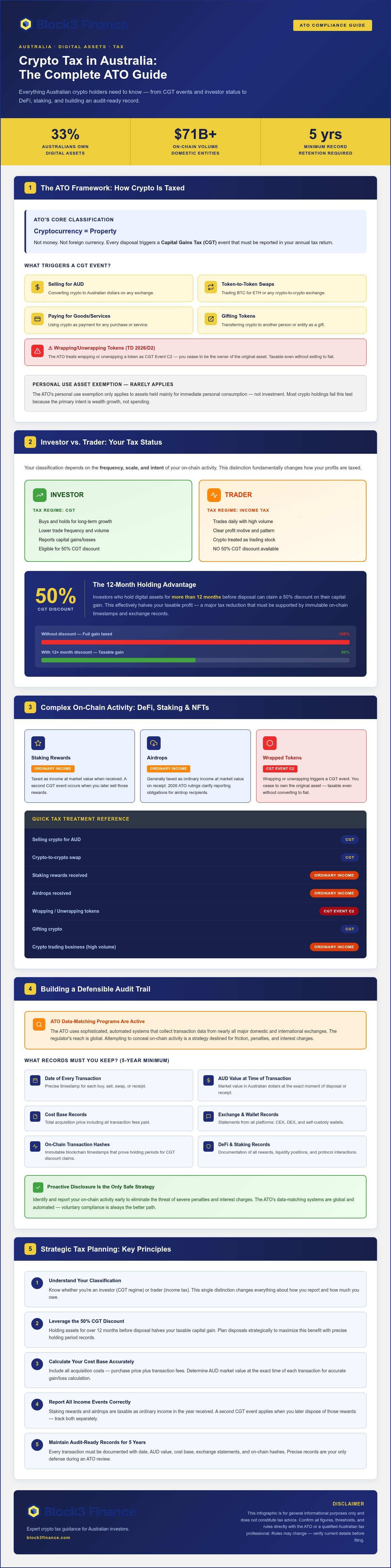
- Understand how the ATO treats cryptocurrency as property, meaning every disposal, such as selling, trading, or gifting, triggers a Capital Gains Tax (CGT) event, which is the tax on your investment profit.
- Distinguish between investor and trader status to leverage specific incentives, such as the 50% CGT discount available for assets held for more than 12 months.
- Apply expert ATO crypto tax guidance to report staking rewards and airdrops, as these are generally taxed as ordinary income, which is income taxed at your standard tax rate.
- Maintain a defensible audit trail by keeping precise records of all transactions for five years to ensure you are prepared for potential regulatory reviews.
- Implement a proactive tax strategy that moves beyond simple filing to optimize your portfolio and minimize your overall tax liability through professional oversight.
The ATO Framework: How Digital Assets are Taxed in Australia
The Australian Taxation Office (ATO) does not recognize digital assets as money or foreign currency. Instead, they classify cryptocurrency as property, which falls under the Capital Gains Tax (CGT) regime. CGT is the tax you pay on the profit made from disposing of an asset.
This classification serves as the foundation for all ATO crypto tax guidance, dictating how every transaction is recorded and reported. A CGT event occurs at the precise moment you sell, trade, or gift your cryptocurrency. Each action represents a disposal that requires you to calculate your capital gain or loss.
Some users hope to claim the personal use asset exemption, which applies to assets held mainly to purchase items for personal use. However, the ATO maintains a strict threshold for this category. It rarely applies if the asset is held for a significant period or used primarily as an investment.
Most digital holdings fail the personal use test because the primary intent is often wealth cultivation rather than immediate consumption. You must report these events in your annual tax return to remain compliant with federal law.
Defining CGT Events in the Digital Ecosystem
The history of Cryptocurrency in Australia shows a rapid evolution from a niche hobby to a mainstream financial pillar. This growth has led the ATO to clarify that swapping one token for another, such as trading Bitcoin for Ethereum, is a taxable disposal.
You must determine the market value in Australian dollars at the time of the swap to establish your cost base. The cost base is the total price you paid to acquire the asset, including transaction fees.
Common CGT events include:
- Selling crypto for Australian dollars (AUD).
- Exchanging one digital asset for another.
- Using crypto to pay for goods or services.
- Gifting tokens to another person or entity.
Draft Taxation Determination TD 2026/D2 further complicates this by addressing wrapped tokens. The ATO views wrapping or unwrapping an asset as a CGT event C2 because you cease to be the owner of the original asset. This technical shift triggers a tax obligation even if you haven't exited the market into fiat currency.
The 2026 ATO Compliance Landscape
The ATO now utilizes sophisticated data-matching programs that bridge the gap between domestic and international exchanges. These systems collect transaction data from nearly all major platforms to ensure every Australian taxpayer remains accountable. Attempting to hide on-chain activity is a strategy destined for friction.
The regulator's reach is now global and automated, leaving little room for error. Proactive disclosure is the only path to building a defensible portfolio that supports long-term growth. By identifying and reporting your activity early, you eliminate the threat of severe penalties and interest charges.
If you require expert oversight to navigate these regulations, Block3 Finance Tax Services offers the technical rigor needed to secure your financial future. We help you turn raw transaction data into clean, compliant records.
Investor vs. Trader: Navigating Your Tax Status
The ATO applies different rules depending on whether you are an investor or a trader. Understanding this distinction is vital for accurate reporting. Most Australians who buy and hold assets for long-term growth fall under the CGT regime, which is the system for taxing capital gains.
Your specific status depends entirely on the frequency, scale, and intent of your on-chain activity. If you trade daily with significant volume and a profit motive, the ATO may classify you as a trader rather than a hobbyist. This shift changes how you report every transaction and how your profits are calculated. For those who manage their digital assets as part of a broader business portfolio, including traditional sectors like construction, consulting with AllCover Insurance Brokers can help ensure your physical operations are as well-protected as your digital ones.
The 50% Capital Gains Tax Discount
For investors, the 50% CGT discount remains a powerful tool within the ATO crypto tax guidance framework. To qualify, you must hold your digital assets for more than 12 months before a disposal occurs. This incentive effectively halves your taxable gain, which significantly reduces your final tax liability.
You must confirm these holding periods through immutable on-chain timestamps and exchange records. The ATO expects precise data to support any discount claims during a review. Maintaining audit-ready records is the only way to protect this benefit during a regulatory inquiry.
Operating as a Crypto Trading Business
Professional traders operate under income tax rules rather than the CGT regime. In this scenario, cryptocurrency is treated as "trading stock," which refers to assets held for the purpose of being sold in the ordinary course of business. This classification mirrors how a traditional retail business treats its inventory.
Traders can often deduct business-related expenses and offset trading losses against other forms of income. This status requires meticulous, business-like record-keeping and a clear commercial strategy. If your volume has reached this level, exploring Corporate Structuring for Crypto can provide the necessary framework for your operations.
Identifying the most advantageous tax position requires a deep understanding of both your activity and current legislation. If you aren't sure where you stand, you can speak with our team to clarify your status before the next filing deadline.
Complex On-Chain Activity: DeFi, Staking, and NFTs
Decentralized Finance (DeFi) presents a unique challenge because it often involves multiple layers of taxable events within a single protocol. While automated software might struggle to interpret these interactions, the ATO expects a clear accounting of all yield and liquidity provision. Every interaction with a smart contract must be categorized to ensure your ATO crypto tax guidance remains accurate and defensible.
Non-Fungible Tokens (NFTs) are unique digital assets that follow the same CGT rules as fungible tokens. This means you can still access the 12-month discount if you hold the NFT for more than a year before disposing of it. Airdrops, which are free distributions of tokens to your wallet, are generally treated as ordinary income. The cost basis of an airdrop is usually its market value when received, which then serves as the starting point for future capital gains calculations.
Liquidity Pools and Yield Farming
When you provide assets to a liquidity pool, you typically receive "LP tokens" as a receipt for your contribution. The ATO often views the exchange of your original assets for these LP tokens as a CGT event. You must determine the market value of the assets at the time of deposit to calculate any immediate gain or loss.
Impermanent loss occurs when the price of your deposited assets changes compared to when you deposited them. You shouldn't confuse this with a realized capital loss; you only realize a loss for tax purposes when you withdraw your assets and exit the pool. Governance tokens earned through protocol incentives are also assessable income. You must record their Australian dollar value at the moment they become accessible to your wallet.
Staking Rewards and Liquid Staking
Native staking involves locking your tokens to support a network, while liquid staking derivatives (LSDs) provide you with a tradable token representing your stake. The ATO's draft ruling TR 2026/D1 clarifies that reward tokens are generally assessable as ordinary income upon receipt. This requires you to track the price of the reward token at the exact time it hits your wallet.
Liquid staking introduces extra complexity because swapping a native token for an LSD is often a taxable disposal. You must track the cost base of these derivatives separately from your original holdings to avoid reporting errors. Strategic timing for claiming rewards can help you manage your income tax brackets. By choosing when to trigger the receipt of rewards, you gain agency over your final tax obligation for the financial year.
Building a Defensible Audit Trail for the ATO
The ATO mandates that you retain exhaustive records of every transaction for at least five years. This requirement ensures that you can justify your reported figures if the regulator initiates a review of your past filings. You must document four essential data points for every trade: the date of the transaction, the market value in Australian dollars, the purpose of the trade, and the counterparty's wallet address.
Simply downloading CSV files from centralized exchanges isn't enough to satisfy ATO crypto tax guidance. Blockchain transparency means the ATO can verify your public wallet activity against your reported data. If discrepancies exist, the burden of proof rests entirely on you to explain the movement of your assets.
Reconciling On-Chain and Off-Chain Data
The most significant friction in crypto accounting occurs when matching bank transfers to exchange purchases and subsequent wallet migrations. You need a unified view that connects your fiat on-ramps to every downstream on-chain event. Without this connection, your records remain fragmented and vulnerable to scrutiny during a compliance check.
If you've used defunct exchanges where data is now inaccessible, you must reconstruct your history using the best available evidence. This might include bank statements or partial wallet logs to estimate a missing cost base. For those managing high-stakes portfolios, Blockchain Financial Records and Audit Prep provides the structural integrity needed to withstand a government inquiry.
Professional Oversight vs. Automated Software
Automated tax software serves as a useful tool for data ingestion, but it lacks the strategic nuance required for complex compliance. Software often misinterprets protocol-specific events, such as governance votes or liquidity migration, leading to over-reporting or missed deductions. The role of a Crypto Tax Accountant is to provide the interpretive lens necessary to align your activity with current Australian law.
Block3 Finance specializes in transforming raw, chaotic on-chain data into clean and defensible financial books. We don't just aggregate numbers; we build a strategic narrative that justifies your tax positions and protects your wealth. If you want to ensure your records are truly audit-ready, you can book a consultation with our team to secure your compliance.
Strategic Tax Planning with Block3 Finance
Effective tax planning is a continuous strategic discipline, not a frantic response to the end of the financial year. Block3 Finance combines the technical rigor of traditional auditing with a deep, native understanding of Web3 innovation. We act as your "Visionary Navigator," ensuring that your high-growth portfolio remains both compliant and optimized within the latest ATO crypto tax guidance.
We move beyond the passive management of regulations toward a proactive stance that prioritizes your agency and financial liberation. Our methodology resolves the friction between legacy financial systems and the decentralized future. We empower you to take command of your digital wealth through disciplined oversight and elite strategy. For business owners looking to extend this level of strategic oversight to their broader operations, Venta Belgarum offers expert advisory to help increase personal freedom and profitability.
The digital asset market operates without borders, but your tax obligations remain firmly rooted in Australian law. Our extensive experience with international tax authorities informs our local strategies, allowing us to anticipate regulatory shifts before they impact your domestic filings. You can explore our Block3 Global Reach to see how we support clients across multiple jurisdictions.
We specialize in managing complex cross-border compliance for Australian residents with global Web3 business interests. Whether you're participating in international DAOs or managing nodes across different continents, we ensure your global activity aligns with ATO reporting standards. Our global perspective provides the stability needed to navigate a volatile regulatory landscape.
Securing Your Financial Future in Web3
Transitioning from simple compliance to strategic corporate structuring is the hallmark of a mature digital asset strategy. We provide the CFO services and leadership necessary to transform your on-chain activity into a sustainable business engine. Our goal is to position you as a leader in the space, backed by clean, defensible books that withstand any level of scrutiny.
Maintaining an audit-ready posture is essential before the ATO initiates contact. By establishing a professional framework early, you protect your assets from unnecessary penalties and interest charges. You can contact Block3 Finance for a consultation to begin building your strategic roadmap today.
Mastering Your Blockchain Narrative
High-growth digital asset portfolios require more than reactive filing; they demand a strategic, defensible architecture. By mastering the distinction between investor and trader status and maintaining meticulous on-chain records, you transform tax compliance from a defensive burden into a proactive competitive advantage. This ATO crypto tax guidance serves as your essential foundation for navigating the regulatory complexities of 2026 and beyond.
Block3 Finance brings over 13 years of specialized blockchain financial expertise to every engagement. We ensure your reporting remains audit-ready through every market cycle. As a firm top-ranked by Bitcoin.com, we provide the technical rigor and global perspective necessary to protect your wealth in an increasingly transparent landscape.
Secure your blockchain financial future with Block3 Finance tax services. You now possess the strategic roadmap to master this environment, and with a dedicated partner, your financial agency is absolute.
Frequently Asked Questions
How does the ATO know if I have cryptocurrency?
The ATO utilizes an advanced data-matching program to identify cryptocurrency holdings by collecting transaction data from both Australian and international digital currency exchanges. This system automatically links your trading activity to your tax file number to ensure full transparency across the ecosystem. You should assume the regulator is already aware of your exchange-based transactions and focus on providing accurate, proactive disclosure in your annual return.
Is swapping one crypto for another a taxable event in Australia?
Swapping one digital asset for another is considered a disposal and triggers a Capital Gains Tax (CGT) event under current Australian law. You must calculate the market value of both assets in Australian dollars at the exact time of the trade to determine your gain or loss. This obligation applies even if you never withdraw funds to a traditional bank account or touch fiat currency during the transaction.
Can I claim the 50% CGT discount on my crypto gains?
You can claim the 50% CGT discount if you are classified as an investor and have held the specific asset for longer than 12 months. This discount effectively halves your taxable capital gain, which is the profit you made on the investment. However, this benefit is generally unavailable to those classified as traders who operate a business-like activity or hold "trading stock," which refers to assets held for sale in a business.
How are crypto airdrops and staking rewards taxed by the ATO?
The ATO generally treats staking rewards and airdrops as ordinary income, which is income taxed at your standard rate, at the time they become accessible in your wallet. You must report the fair market value of these tokens in Australian dollars as part of your total assessable income. This value then becomes the cost base for any future capital gains calculations when you eventually dispose of the tokens.
What happens if I lost my crypto or my wallet was hacked?
If your cryptocurrency is lost or stolen, you may be eligible to claim a capital loss to offset other capital gains. You must provide significant evidence to the ATO, such as the date the private keys were lost or the specific transaction record of a hack. Without definitive proof of ownership and the subsequent loss, the regulator may disallow the claim during an audit or compliance review.
Do I need to pay tax if I use crypto to buy a coffee or laptop?
Using cryptocurrency to purchase goods or services is a disposal that typically triggers a CGT event. While a "personal use asset" exemption exists for purchases under $10,000, it rarely applies if you held the crypto as an investment for a significant period. Most daily transactions, like buying a laptop, require you to calculate the gain or loss based on the asset's value change since you acquired it.
How should I report DeFi liquidity pool rewards to the ATO?
DeFi liquidity pool rewards are typically assessable as ordinary income when they are credited to your account or become available for withdrawal. The initial act of providing liquidity in exchange for "LP tokens," which are receipts representing your share of the pool, may also be viewed as a taxable swap. Navigating these layers requires specialized ATO crypto tax guidance to ensure you don't miscalculate your realized gains.
What records does the ATO require for crypto tax reporting?
The ATO requires you to maintain detailed records for at least five years after you dispose of a digital asset. These records must include the date of each transaction, the value in Australian dollars at the time, the purpose of the trade, and the other party's wallet address. Keeping audit-ready books is the only way to build a defensible trail that protects you from penalties during a regulatory review.

Article by
Mahad Mohamed
Mahad Mohamed is an accountant and the CEO of Block3 Finance, with over 26+ years of Canadian and international tax and accounting experience. A crypto accounting specialist since the early days of Bitcoin, he has consulted for over 38 crypto companies and collaborated with legal professionals on regulatory matters. His expertise spans corporate reorganization, cross-border tax structuring (Canada & US), tax disputes, and CRA audits.
Previously, Mahad worked for the Canada Revenue Agency (CRA), Big4 accounting firms, and served as a Rulings Officer for the Federal Tax Authority of the UAE before acquiring Tax Partners in 2014.
Block3 Finance and Tax Partners has 44 full-time accountants and over 9,800+ clients.
Disclaimer
This article provides general information only and is current as of its publication date. It has not been updated and may be out of date. It does not constitute legal advice and should not be relied upon as such. Every tax situation is unique and may differ from the examples discussed in this article. If you have specific questions, you should seek the advice of our accountants for your unique circumstances.
Frequently Asked Questions
How does the ATO know if I have cryptocurrency?
The ATO utilizes an advanced data-matching program to identify cryptocurrency holdings by collecting transaction data from both Australian and international digital currency exchanges. This system automatically links your trading activity to your tax file number to ensure full transparency across the ecosystem. You should assume the regulator is already aware of your exchange-based transactions and focus on providing accurate, proactive disclosure in your annual return.
Is swapping one crypto for another a taxable event in Australia?
Swapping one digital asset for another is considered a disposal and triggers a Capital Gains Tax (CGT) event under current Australian law. You must calculate the market value of both assets in Australian dollars at the exact time of the trade to determine your gain or loss. This obligation applies even if you never withdraw funds to a traditional bank account or touch fiat currency during the transaction.
Can I claim the 50% CGT discount on my crypto gains?
You can claim the 50% CGT discount if you are classified as an investor and have held the specific asset for longer than 12 months. This discount effectively halves your taxable capital gain, which is the profit you made on the investment. However, this benefit is generally unavailable to those classified as traders who operate a business-like activity or hold "trading stock," which refers to assets held for sale in a business.
How are crypto airdrops and staking rewards taxed by the ATO?
The ATO generally treats staking rewards and airdrops as ordinary income, which is income taxed at your standard rate, at the time they become accessible in your wallet. You must report the fair market value of these tokens in Australian dollars as part of your total assessable income. This value then becomes the cost base for any future capital gains calculations when you eventually dispose of the tokens.
What happens if I lost my crypto or my wallet was hacked?
If your cryptocurrency is lost or stolen, you may be eligible to claim a capital loss to offset other capital gains. You must provide significant evidence to the ATO, such as the date the private keys were lost or the specific transaction record of a hack. Without definitive proof of ownership and the subsequent loss, the regulator may disallow the claim during an audit or compliance review.
Do I need to pay tax if I use crypto to buy a coffee or laptop?
Using cryptocurrency to purchase goods or services is a disposal that typically triggers a CGT event. While a "personal use asset" exemption exists for purchases under $10,000, it rarely applies if you held the crypto as an investment for a significant period. Most daily transactions, like buying a laptop, require you to calculate the gain or loss based on the asset's value change since you acquired it.
How should I report DeFi liquidity pool rewards to the ATO?
DeFi liquidity pool rewards are typically assessable as ordinary income when they are credited to your account or become available for withdrawal. The initial act of providing liquidity in exchange for "LP tokens," which are receipts representing your share of the pool, may also be viewed as a taxable swap. Navigating these layers requires specialized ATO crypto tax guidance to ensure you don't miscalculate your realized gains.
What records does the ATO require for crypto tax reporting?
The ATO requires you to maintain detailed records for at least five years after you dispose of a digital asset. These records must include the date of each transaction, the value in Australian dollars at the time, the purpose of the trade, and the other party's wallet address. Keeping audit-ready books is the only way to build a defensible trail that protects you from penalties during a regulatory review.